





CELLULOSE ETHERS – Versatile
pharmaceutical excipients
Contents
• Introduction
• Classification
• Preparation
• Commercially important cellulose
ethers
• Sodium CMC
• Hypromellose
• Methylcellulose
• Nomenclature of hypromellose and
methylcellulose
• Croscarmellose sodium
• Ethylcellulose
• Hyprolose
• L-HPC
09-10-2014 2
Introduction
09-10-2014 3
Introduction
• From solids to liquids and tablets to ophthalmics, cellulose ethers
have become one of the most widely used excipient class
• Due to easy availability of cellulose and safety of these, as evidenced
by their use since many years, have been most contributing to their
widespread use
09-10-2014 4
Classification
09-10-2014 5
Classification
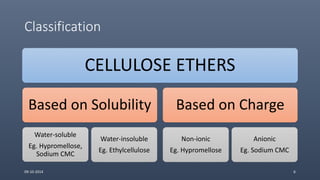
CELLULOSE ETHERS
Based on Solubility
Water-soluble
Eg. Hypromellose,
Sodium CMC
Water-insoluble
Eg. Ethylcellulose
Based on Charge
Non-ionic
Eg. Hypromellose
Anionic
Eg. Sodium CMC
09-10-2014 6
Preparation
09-10-2014 7
Preparation
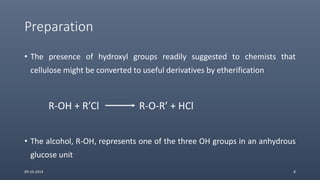
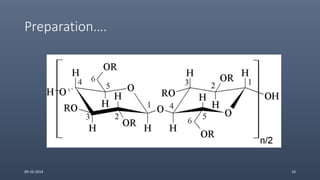
• The presence of hydroxyl groups readily suggested to chemists that
cellulose might be converted to useful derivatives by etherification
R-OH + R’Cl R-O-R’ + HCl
• The alcohol, R-OH, represents one of the three OH groups in an anhydrous
glucose unit
09-10-2014 8
Preparation
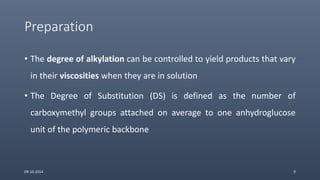
• The degree of alkylation can be controlled to yield products that vary
in their viscosities when they are in solution
• The Degree of Substitution (DS) is defined as the number of
carboxymethyl groups attached on average to one anhydroglucose
unit of the polymeric backbone
09-10-2014 9
Preparation….
09-10-2014 10
Commercially important cellulose
ethers
09-10-2014 11
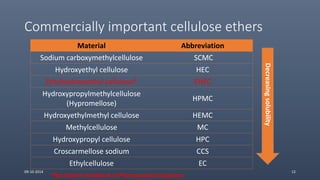
Commercially important cellulose ethers
Material Abbreviation
Sodium carboxymethylcellulose SCMC
Hydroxyethyl cellulose HEC
Ethylhydroxyethyl cellulose* EHEC
Hydroxypropylmethylcellulose
(Hypromellose)
HPMC
Hydroxyethylmethyl cellulose HEMC
Methylcellulose MC
Hydroxypropyl cellulose HPC
Croscarmellose sodium CCS
Ethylcellulose EC
Decreasingsolubility
*Not listed in Handbook of Pharmaceutical Excipients
09-10-2014 12
Sodium carboxymethylcellulose
09-10-2014 13
Introduction
• As a well-known and established excipient, SCMC is widely used in
oral and topical formulations.
• It is a Generally Recognized As Safe (GRAS) listed substance and an
authorized food additive.
• The FDA Inactive Ingredients Guide lists this excipient for oral
capsules, tablets, liquid and semi-solid products.
09-10-2014 14
Other names
• Nonproprietary Names
• BP: Carmellose Sodium
• JP: Carmellose Sodium
• PhEur: Carmellose Sodium
• USP: Carboxymethylcellulose Sodium
• Synonyms
• E466; Aqualon CMC; Walocel; carmellosum natricum; cellulose gum; CMC sodium;
SCMC; sodium cellulose glycolate
09-10-2014 15
Types
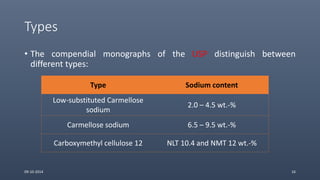
• The compendial monographs of the USP distinguish between
different types:
Type Sodium content
Low-substituted Carmellose
sodium
2.0 – 4.5 wt.-%
Carmellose sodium 6.5 – 9.5 wt.-%
Carboxymethyl cellulose 12 NLT 10.4 and NMT 12 wt.-%
09-10-2014 16
Types…
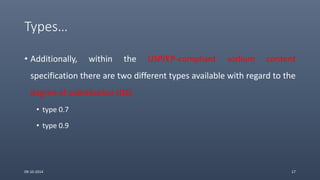
• Additionally, within the USP/EP-compliant sodium content
specification there are two different types available with regard to the
degree of substitution (DS)
• type 0.7
• type 0.9
09-10-2014 17
Functional Category
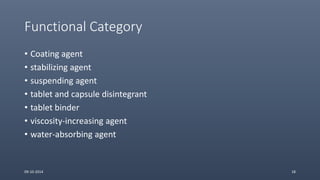
• Coating agent
• stabilizing agent
• suspending agent
• tablet and capsule disintegrant
• tablet binder
• viscosity-increasing agent
• water-absorbing agent
09-10-2014 18
Applications
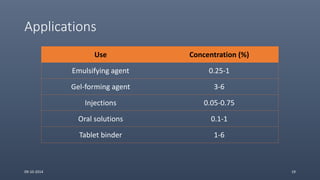
Use Concentration (%)
Emulsifying agent 0.25-1
Gel-forming agent 3-6
Injections 0.05-0.75
Oral solutions 0.1-1
Tablet binder 1-6
09-10-2014 19
Applications…
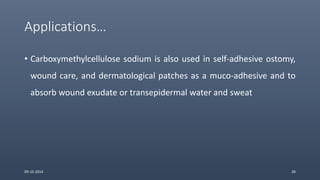
• Carboxymethylcellulose sodium is also used in self-adhesive ostomy,
wound care, and dermatological patches as a muco-adhesive and to
absorb wound exudate or transepidermal water and sweat
09-10-2014 20
Incompatibilities
• SCMC is incompatible with strongly acidic solutions and with the
soluble salts of iron and some other metals, such as aluminum,
mercury, and zinc. It is also incompatible with xanthan gum.
Precipitation may occur at pH<2
• Capable of precipitating certain positively charged proteins
09-10-2014 21
Hypromellose
09-10-2014 22
Introduction
• Methyl cellulose and their extension hypromellose are versatile,
water-soluble cellulose ethers used since many years
• GRAS listed
• Included in the FDA Inactive Ingredients Database (ophthalmic and
nasal preparations; oral capsules, suspensions, syrups, and tablets;
topical and vaginal preparations)
09-10-2014 23
Other names
• Nonproprietary Names
• BP: Hypromellose
• JP: Hypromellose
• PhEur: Hypromellose
• USP: Hypromellose
• Synonyms
• Benecel MHPC; E464; hydroxypropyl methylcellulose; HPMC; Methocel;
methylcellulose propylene glycol ether; methyl hydroxypropylcellulose; MHPC
09-10-2014 24
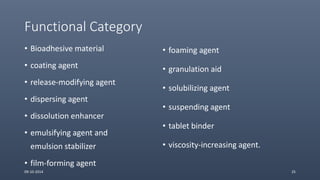
Functional Category
• Bioadhesive material
• coating agent
• release-modifying agent
• dispersing agent
• dissolution enhancer
• emulsifying agent and
emulsion stabilizer
• film-forming agent
• foaming agent
• granulation aid
• solubilizing agent
• suspending agent
• tablet binder
• viscosity-increasing agent.
09-10-2014 25
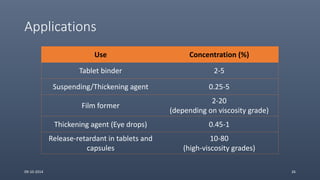
Applications
Use Concentration (%)
Tablet binder 2-5
Suspending/Thickening agent 0.25-5
Film former
2-20
(depending on viscosity grade)
Thickening agent (Eye drops) 0.45-1
Release-retardant in tablets and
capsules
10-80
(high-viscosity grades)
09-10-2014 26
Methylcellulose
09-10-2014 27
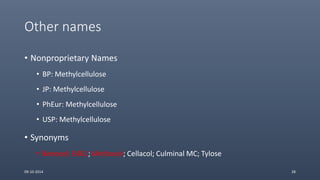
Other names
• Nonproprietary Names
• BP: Methylcellulose
• JP: Methylcellulose
• PhEur: Methylcellulose
• USP: Methylcellulose
• Synonyms
• Benecel; E461; Methocel; Cellacol; Culminal MC; Tylose
09-10-2014 28
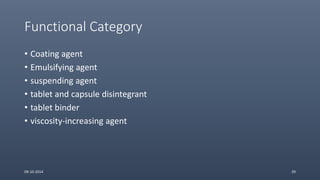
Functional Category
• Coating agent
• Emulsifying agent
• suspending agent
• tablet and capsule disintegrant
• tablet binder
• viscosity-increasing agent
09-10-2014 29
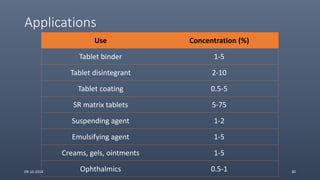
Applications
Use Concentration (%)
Tablet binder 1-5
Tablet disintegrant 2-10
Tablet coating 0.5-5
SR matrix tablets 5-75
Suspending agent 1-2
Emulsifying agent 1-5
Creams, gels, ointments 1-5
Ophthalmics 0.5-109-10-2014 30
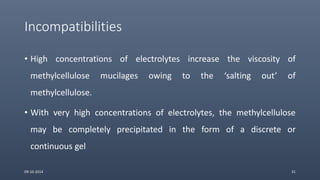
Incompatibilities
• High concentrations of electrolytes increase the viscosity of
methylcellulose mucilages owing to the ‘salting out’ of
methylcellulose.
• With very high concentrations of electrolytes, the methylcellulose
may be completely precipitated in the form of a discrete or
continuous gel
09-10-2014 31
Nomenclature for HPMC and
Methylcellulose (Methocel and
Benecel)
09-10-2014 32
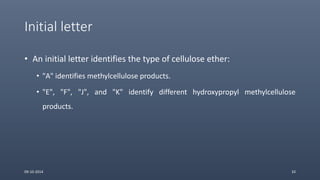
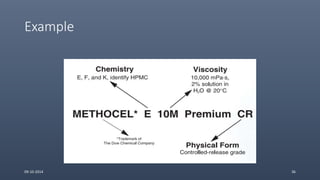
Initial letter
• An initial letter identifies the type of cellulose ether:
• "A" identifies methylcellulose products.
• "E", "F", "J", and "K" identify different hydroxypropyl methylcellulose
products.
09-10-2014 33
Number indicating viscosity
• The number that follows identifies the viscosity of that product in
millipascal-seconds (mPa.s), measured at 2% concentration in water
at 20°C.
• In designating viscosity, the letter "C" is frequently used to represent
a multiplier of 100, and the letter "M" is used to represent a
multiplier of 1,000.
09-10-2014 34
Other suffixes
• Several different suffixes are also used to identify special products.
• "P" is sometimes used to identify Premium grade products
• "LV" refers to special Low Viscosity products
• "CR" denotes a Premium, Controlled Release grade
• “LH” refers to a product with low hydroxypropyl content.
• “EP” denotes a product that meets European Pharmacopeia requirements
• “JP” grade products meet Japanese Pharmacopeia requirements.
• "G" identifies Granular products
09-10-2014 35
Example
09-10-2014 36
Croscarmellose sodium
09-10-2014 37
Introduction
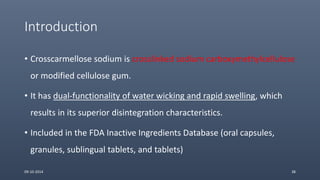
• Crosscarmellose sodium is crosslinked sodium carboxymethylcellulose
or modified cellulose gum.
• It has dual-functionality of water wicking and rapid swelling, which
results in its superior disintegration characteristics.
• Included in the FDA Inactive Ingredients Database (oral capsules,
granules, sublingual tablets, and tablets)
09-10-2014 38
Other names
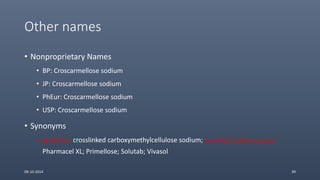
• Nonproprietary Names
• BP: Croscarmellose sodium
• JP: Croscarmellose sodium
• PhEur: Croscarmellose sodium
• USP: Croscarmellose sodium
• Synonyms
• Ac-Di-Sol; crosslinked carboxymethylcellulose sodium; modified cellulose gum;
Pharmacel XL; Primellose; Solutab; Vivasol
09-10-2014 39
Functional category
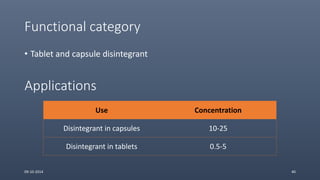
• Tablet and capsule disintegrant
Applications
Use Concentration
Disintegrant in capsules 10-25
Disintegrant in tablets 0.5-5
09-10-2014 40
Ethylcellulose
09-10-2014 41
Other names
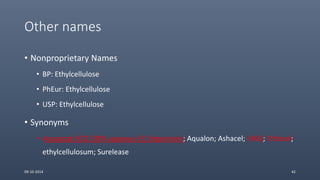
• Nonproprietary Names
• BP: Ethylcellulose
• PhEur: Ethylcellulose
• USP: Ethylcellulose
• Synonyms
• Aquacoat ECD (30% aqueous EC dispersion); Aqualon; Ashacel; E462; Ethocel;
ethylcellulosum; Surelease
09-10-2014 42
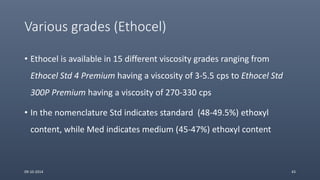
Various grades (Ethocel)
• Ethocel is available in 15 different viscosity grades ranging from
Ethocel Std 4 Premium having a viscosity of 3-5.5 cps to Ethocel Std
300P Premium having a viscosity of 270-330 cps
• In the nomenclature Std indicates standard (48-49.5%) ethoxyl
content, while Med indicates medium (45-47%) ethoxyl content
09-10-2014 43
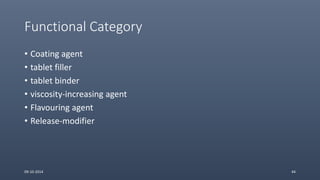
Functional Category
• Coating agent
• tablet filler
• tablet binder
• viscosity-increasing agent
• Flavouring agent
• Release-modifier
09-10-2014 44
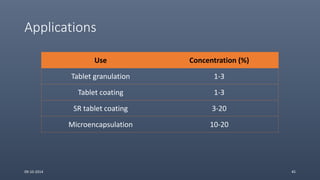
Applications
Use Concentration (%)
Tablet granulation 1-3
Tablet coating 1-3
SR tablet coating 3-20
Microencapsulation 10-20
09-10-2014 45
Hyprolose
09-10-2014 46
Other names
• Nonproprietary Names
• BP: Hydroxypropylcellulose
• JP: Hydroxypropylcellulose
• PhEur: Hydroxypropylcellulose
• USP: Hydroxypropyl cellulose
• Synonyms
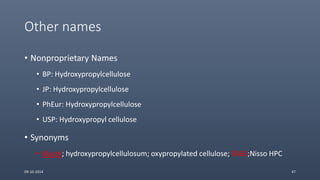
• Klucel; hydroxypropylcellulosum; oxypropylated cellulose; E463;Nisso HPC
09-10-2014 47
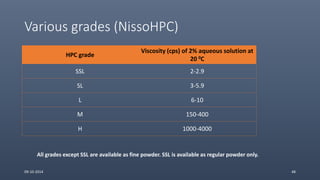
Various grades (NissoHPC)
HPC grade
Viscosity (cps) of 2% aqueous solution at
20 0C
SSL 2-2.9
SL 3-5.9
L 6-10
M 150-400
H 1000-4000
09-10-2014 48
All grades except SSL are available as fine powder. SSL is available as regular powder only.
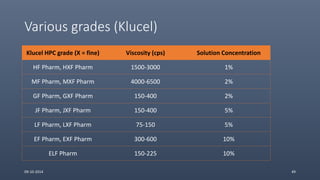
Various grades (Klucel)
Klucel HPC grade (X = fine) Viscosity (cps) Solution Concentration
HF Pharm, HXF Pharm 1500-3000 1%
MF Pharm, MXF Pharm 4000-6500 2%
GF Pharm, GXF Pharm 150-400 2%
JF Pharm, JXF Pharm 150-400 5%
LF Pharm, LXF Pharm 75-150 5%
EF Pharm, EXF Pharm 300-600 10%
ELF Pharm 150-225 10%
09-10-2014 49
Various grades (Klucel)…
09-10-2014 50
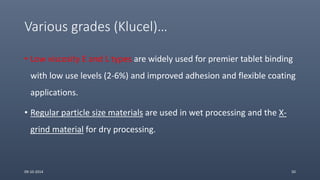
• Low viscosity E and L types are widely used for premier tablet binding
with low use levels (2-6%) and improved adhesion and flexible coating
applications.
• Regular particle size materials are used in wet processing and the X-
grind material for dry processing.
Functional Category
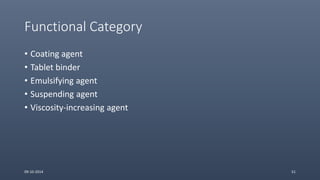
• Coating agent
• Tablet binder
• Emulsifying agent
• Suspending agent
• Viscosity-increasing agent
09-10-2014 51
Applications
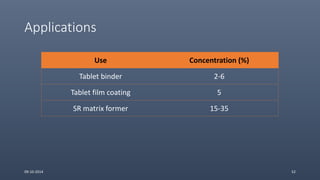
Use Concentration (%)
Tablet binder 2-6
Tablet film coating 5
SR matrix former 15-35
09-10-2014 52
L-HPC
09-10-2014 53
Introduction
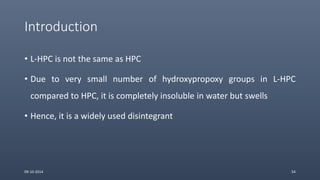
• L-HPC is not the same as HPC
• Due to very small number of hydroxypropoxy groups in L-HPC
compared to HPC, it is completely insoluble in water but swells
• Hence, it is a widely used disintegrant
09-10-2014 54
Other names
• Nonproprietary Names
• JP: Low Substituted Hydroxypropylcellulose
• USP: Low Substituted Hydroxypropyl cellulose
• Synonyms
• Hyprolose, low substituted
09-10-2014 55
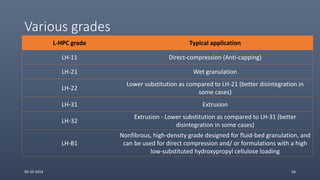
Various grades
L-HPC grade Typical application
LH-11 Direct-compression (Anti-capping)
LH-21 Wet granulation
LH-22
Lower substitution as compared to LH-21 (better disintegration in
some cases)
LH-31 Extrusion
LH-32
Extrusion - Lower substitution as compared to LH-31 (better
disintegration in some cases)
LH-B1
Nonfibrous, high-density grade designed for fluid-bed granulation, and
can be used for direct compression and/ or formulations with a high
low-substituted hydroxypropyl cellulose loading
09-10-2014 56
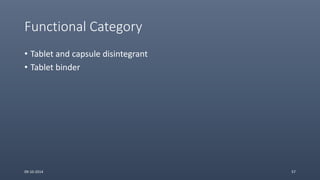
Functional Category
• Tablet and capsule disintegrant
• Tablet binder
09-10-2014 57
References:
• Richard J. LaPorte. Hydrophilic Polymer Coatings for Medical Devices,
Published by CRC Press. Pg. 69-71
• Rowe R C, Sheskey P J and Quinn M E. Handbook of Pharmaceutical
Excipients, 6th edition, Published by the Pharmaceutical Press and the
American Pharmacists Asociation
• Dow chemicals – cellulosics – www.dow.com
• Aqualon product literature – www.brenntagspecialities.com
• FMC BioPolymer – www.fmcbiopolymer.com
09-10-2014 58

Cellulose ethers - versatile pharmaceutical excipients

  • 1.
    CELLULOSE ETHERS –Versatile pharmaceutical excipients
  • 2.
    Contents • Introduction • Classification •Preparation • Commercially important cellulose ethers • Sodium CMC • Hypromellose • Methylcellulose • Nomenclature of hypromellose and methylcellulose • Croscarmellose sodium • Ethylcellulose • Hyprolose • L-HPC 09-10-2014 2
  • 3.
  • 4.
    Introduction • From solidsto liquids and tablets to ophthalmics, cellulose ethers have become one of the most widely used excipient class • Due to easy availability of cellulose and safety of these, as evidenced by their use since many years, have been most contributing to their widespread use 09-10-2014 4
  • 5.
  • 6.
    Classification CELLULOSE ETHERS Based onSolubility Water-soluble Eg. Hypromellose, Sodium CMC Water-insoluble Eg. Ethylcellulose Based on Charge Non-ionic Eg. Hypromellose Anionic Eg. Sodium CMC 09-10-2014 6
  • 7.
  • 8.
    Preparation • The presenceof hydroxyl groups readily suggested to chemists that cellulose might be converted to useful derivatives by etherification R-OH + R’Cl R-O-R’ + HCl • The alcohol, R-OH, represents one of the three OH groups in an anhydrous glucose unit 09-10-2014 8
  • 9.
    Preparation • The degreeof alkylation can be controlled to yield products that vary in their viscosities when they are in solution • The Degree of Substitution (DS) is defined as the number of carboxymethyl groups attached on average to one anhydroglucose unit of the polymeric backbone 09-10-2014 9
  • 10.
  • 11.
  • 12.
    Commercially important celluloseethers Material Abbreviation Sodium carboxymethylcellulose SCMC Hydroxyethyl cellulose HEC Ethylhydroxyethyl cellulose* EHEC Hydroxypropylmethylcellulose (Hypromellose) HPMC Hydroxyethylmethyl cellulose HEMC Methylcellulose MC Hydroxypropyl cellulose HPC Croscarmellose sodium CCS Ethylcellulose EC Decreasingsolubility *Not listed in Handbook of Pharmaceutical Excipients 09-10-2014 12
  • 13.
  • 14.
    Introduction • As awell-known and established excipient, SCMC is widely used in oral and topical formulations. • It is a Generally Recognized As Safe (GRAS) listed substance and an authorized food additive. • The FDA Inactive Ingredients Guide lists this excipient for oral capsules, tablets, liquid and semi-solid products. 09-10-2014 14
  • 15.
    Other names • NonproprietaryNames • BP: Carmellose Sodium • JP: Carmellose Sodium • PhEur: Carmellose Sodium • USP: Carboxymethylcellulose Sodium • Synonyms • E466; Aqualon CMC; Walocel; carmellosum natricum; cellulose gum; CMC sodium; SCMC; sodium cellulose glycolate 09-10-2014 15
  • 16.
    Types • The compendialmonographs of the USP distinguish between different types: Type Sodium content Low-substituted Carmellose sodium 2.0 – 4.5 wt.-% Carmellose sodium 6.5 – 9.5 wt.-% Carboxymethyl cellulose 12 NLT 10.4 and NMT 12 wt.-% 09-10-2014 16
  • 17.
    Types… • Additionally, withinthe USP/EP-compliant sodium content specification there are two different types available with regard to the degree of substitution (DS) • type 0.7 • type 0.9 09-10-2014 17
  • 18.
    Functional Category • Coatingagent • stabilizing agent • suspending agent • tablet and capsule disintegrant • tablet binder • viscosity-increasing agent • water-absorbing agent 09-10-2014 18
  • 19.
    Applications Use Concentration (%) Emulsifyingagent 0.25-1 Gel-forming agent 3-6 Injections 0.05-0.75 Oral solutions 0.1-1 Tablet binder 1-6 09-10-2014 19
  • 20.
    Applications… • Carboxymethylcellulose sodiumis also used in self-adhesive ostomy, wound care, and dermatological patches as a muco-adhesive and to absorb wound exudate or transepidermal water and sweat 09-10-2014 20
  • 21.
    Incompatibilities • SCMC isincompatible with strongly acidic solutions and with the soluble salts of iron and some other metals, such as aluminum, mercury, and zinc. It is also incompatible with xanthan gum. Precipitation may occur at pH<2 • Capable of precipitating certain positively charged proteins 09-10-2014 21
  • 22.
  • 23.
    Introduction • Methyl celluloseand their extension hypromellose are versatile, water-soluble cellulose ethers used since many years • GRAS listed • Included in the FDA Inactive Ingredients Database (ophthalmic and nasal preparations; oral capsules, suspensions, syrups, and tablets; topical and vaginal preparations) 09-10-2014 23
  • 24.
    Other names • NonproprietaryNames • BP: Hypromellose • JP: Hypromellose • PhEur: Hypromellose • USP: Hypromellose • Synonyms • Benecel MHPC; E464; hydroxypropyl methylcellulose; HPMC; Methocel; methylcellulose propylene glycol ether; methyl hydroxypropylcellulose; MHPC 09-10-2014 24
  • 25.
    Functional Category • Bioadhesivematerial • coating agent • release-modifying agent • dispersing agent • dissolution enhancer • emulsifying agent and emulsion stabilizer • film-forming agent • foaming agent • granulation aid • solubilizing agent • suspending agent • tablet binder • viscosity-increasing agent. 09-10-2014 25
  • 26.
    Applications Use Concentration (%) Tabletbinder 2-5 Suspending/Thickening agent 0.25-5 Film former 2-20 (depending on viscosity grade) Thickening agent (Eye drops) 0.45-1 Release-retardant in tablets and capsules 10-80 (high-viscosity grades) 09-10-2014 26
  • 27.
  • 28.
    Other names • NonproprietaryNames • BP: Methylcellulose • JP: Methylcellulose • PhEur: Methylcellulose • USP: Methylcellulose • Synonyms • Benecel; E461; Methocel; Cellacol; Culminal MC; Tylose 09-10-2014 28
  • 29.
    Functional Category • Coatingagent • Emulsifying agent • suspending agent • tablet and capsule disintegrant • tablet binder • viscosity-increasing agent 09-10-2014 29
  • 30.
    Applications Use Concentration (%) Tabletbinder 1-5 Tablet disintegrant 2-10 Tablet coating 0.5-5 SR matrix tablets 5-75 Suspending agent 1-2 Emulsifying agent 1-5 Creams, gels, ointments 1-5 Ophthalmics 0.5-109-10-2014 30
  • 31.
    Incompatibilities • High concentrationsof electrolytes increase the viscosity of methylcellulose mucilages owing to the ‘salting out’ of methylcellulose. • With very high concentrations of electrolytes, the methylcellulose may be completely precipitated in the form of a discrete or continuous gel 09-10-2014 31
  • 32.
    Nomenclature for HPMCand Methylcellulose (Methocel and Benecel) 09-10-2014 32
  • 33.
    Initial letter • Aninitial letter identifies the type of cellulose ether: • "A" identifies methylcellulose products. • "E", "F", "J", and "K" identify different hydroxypropyl methylcellulose products. 09-10-2014 33
  • 34.
    Number indicating viscosity •The number that follows identifies the viscosity of that product in millipascal-seconds (mPa.s), measured at 2% concentration in water at 20°C. • In designating viscosity, the letter "C" is frequently used to represent a multiplier of 100, and the letter "M" is used to represent a multiplier of 1,000. 09-10-2014 34
  • 35.
    Other suffixes • Severaldifferent suffixes are also used to identify special products. • "P" is sometimes used to identify Premium grade products • "LV" refers to special Low Viscosity products • "CR" denotes a Premium, Controlled Release grade • “LH” refers to a product with low hydroxypropyl content. • “EP” denotes a product that meets European Pharmacopeia requirements • “JP” grade products meet Japanese Pharmacopeia requirements. • "G" identifies Granular products 09-10-2014 35
  • 36.
  • 37.
  • 38.
    Introduction • Crosscarmellose sodiumis crosslinked sodium carboxymethylcellulose or modified cellulose gum. • It has dual-functionality of water wicking and rapid swelling, which results in its superior disintegration characteristics. • Included in the FDA Inactive Ingredients Database (oral capsules, granules, sublingual tablets, and tablets) 09-10-2014 38
  • 39.
    Other names • NonproprietaryNames • BP: Croscarmellose sodium • JP: Croscarmellose sodium • PhEur: Croscarmellose sodium • USP: Croscarmellose sodium • Synonyms • Ac-Di-Sol; crosslinked carboxymethylcellulose sodium; modified cellulose gum; Pharmacel XL; Primellose; Solutab; Vivasol 09-10-2014 39
  • 40.
    Functional category • Tabletand capsule disintegrant Applications Use Concentration Disintegrant in capsules 10-25 Disintegrant in tablets 0.5-5 09-10-2014 40
  • 41.
  • 42.
    Other names • NonproprietaryNames • BP: Ethylcellulose • PhEur: Ethylcellulose • USP: Ethylcellulose • Synonyms • Aquacoat ECD (30% aqueous EC dispersion); Aqualon; Ashacel; E462; Ethocel; ethylcellulosum; Surelease 09-10-2014 42
  • 43.
    Various grades (Ethocel) •Ethocel is available in 15 different viscosity grades ranging from Ethocel Std 4 Premium having a viscosity of 3-5.5 cps to Ethocel Std 300P Premium having a viscosity of 270-330 cps • In the nomenclature Std indicates standard (48-49.5%) ethoxyl content, while Med indicates medium (45-47%) ethoxyl content 09-10-2014 43
  • 44.
    Functional Category • Coatingagent • tablet filler • tablet binder • viscosity-increasing agent • Flavouring agent • Release-modifier 09-10-2014 44
  • 45.
    Applications Use Concentration (%) Tabletgranulation 1-3 Tablet coating 1-3 SR tablet coating 3-20 Microencapsulation 10-20 09-10-2014 45
  • 46.
  • 47.
    Other names • NonproprietaryNames • BP: Hydroxypropylcellulose • JP: Hydroxypropylcellulose • PhEur: Hydroxypropylcellulose • USP: Hydroxypropyl cellulose • Synonyms • Klucel; hydroxypropylcellulosum; oxypropylated cellulose; E463;Nisso HPC 09-10-2014 47
  • 48.
    Various grades (NissoHPC) HPCgrade Viscosity (cps) of 2% aqueous solution at 20 0C SSL 2-2.9 SL 3-5.9 L 6-10 M 150-400 H 1000-4000 09-10-2014 48 All grades except SSL are available as fine powder. SSL is available as regular powder only.
  • 49.
    Various grades (Klucel) KlucelHPC grade (X = fine) Viscosity (cps) Solution Concentration HF Pharm, HXF Pharm 1500-3000 1% MF Pharm, MXF Pharm 4000-6500 2% GF Pharm, GXF Pharm 150-400 2% JF Pharm, JXF Pharm 150-400 5% LF Pharm, LXF Pharm 75-150 5% EF Pharm, EXF Pharm 300-600 10% ELF Pharm 150-225 10% 09-10-2014 49
  • 50.
    Various grades (Klucel)… 09-10-201450 • Low viscosity E and L types are widely used for premier tablet binding with low use levels (2-6%) and improved adhesion and flexible coating applications. • Regular particle size materials are used in wet processing and the X- grind material for dry processing.
  • 51.
    Functional Category • Coatingagent • Tablet binder • Emulsifying agent • Suspending agent • Viscosity-increasing agent 09-10-2014 51
  • 52.
    Applications Use Concentration (%) Tabletbinder 2-6 Tablet film coating 5 SR matrix former 15-35 09-10-2014 52
  • 53.
  • 54.
    Introduction • L-HPC isnot the same as HPC • Due to very small number of hydroxypropoxy groups in L-HPC compared to HPC, it is completely insoluble in water but swells • Hence, it is a widely used disintegrant 09-10-2014 54
  • 55.
    Other names • NonproprietaryNames • JP: Low Substituted Hydroxypropylcellulose • USP: Low Substituted Hydroxypropyl cellulose • Synonyms • Hyprolose, low substituted 09-10-2014 55
  • 56.
    Various grades L-HPC gradeTypical application LH-11 Direct-compression (Anti-capping) LH-21 Wet granulation LH-22 Lower substitution as compared to LH-21 (better disintegration in some cases) LH-31 Extrusion LH-32 Extrusion - Lower substitution as compared to LH-31 (better disintegration in some cases) LH-B1 Nonfibrous, high-density grade designed for fluid-bed granulation, and can be used for direct compression and/ or formulations with a high low-substituted hydroxypropyl cellulose loading 09-10-2014 56
  • 57.
    Functional Category • Tabletand capsule disintegrant • Tablet binder 09-10-2014 57
  • 58.
    References: • Richard J.LaPorte. Hydrophilic Polymer Coatings for Medical Devices, Published by CRC Press. Pg. 69-71 • Rowe R C, Sheskey P J and Quinn M E. Handbook of Pharmaceutical Excipients, 6th edition, Published by the Pharmaceutical Press and the American Pharmacists Asociation • Dow chemicals – cellulosics – www.dow.com • Aqualon product literature – www.brenntagspecialities.com • FMC BioPolymer – www.fmcbiopolymer.com 09-10-2014 58