Respiratory tract infection
INTRODUCTION
 Respiratory tract infection refers to any of a
number of infectious diseases involving
the respiratory tract
 It is classified in to 2 types they are:
 UPPER RESPIRATORY TRACT INFECTION
 LOWER RESPIRATORY TRACT INFECTION
A respiratory tract infection (RTI) is any of a number
of infectious diseases involving the respiratory tractinfection
of this type is normally further classified as an upper
respiratory tract infection (URI or URTI) or a lower
respiratory tract infection (LRI or LRTI). Lower respiratory
infections, such as pneumonia, tend to be far more serious
conditions than upper respiratory infections, such as
the common cold.
PATHOGENESIS
Host Factors
Nasal hairs
Convoluted passage
Mucus lining
Secretary IgA
Nonspecific antibacterial substances
Cilia
Reflexes such as coughing, sneezing & swallowing.
Microorganism Factors
Adherence
Colonization
Fimbriae
Toxins
11
Possible pathogens
 Bacteria
 G+ve
 Streptococcus pneumonia
 Staphylococcus aureus
 Streptococcus pyogens
 G-ve
 Haemophilus influenza
 Klebsiella pneumonia
 Pseudomonas aeruginosa
 Proteus spp
 Yersina pestis
Mycobacterium tuberculosis
mycoplasma pneumonia
fungi and Actinomycetes
pneumosysis carini
Blastomyces dermatidis
Histoplasma capsulatum
Aspergillus spp
Candida albicans
Norcardia spp
parasites
paragonimus spp
Streptococcus pneumonia
Staphylococcus aureus Streptococcus pyogens
Haemophilus influenza
Klebsiella pneumonia
Pseudomonas aeruginosa
Viral infections : e.g
Influenza A
Respiratory syncytial virus (RSV)
Human metapneumovirus (hMPV)
Varicella-zoster virus (VZV)
Chickenpox
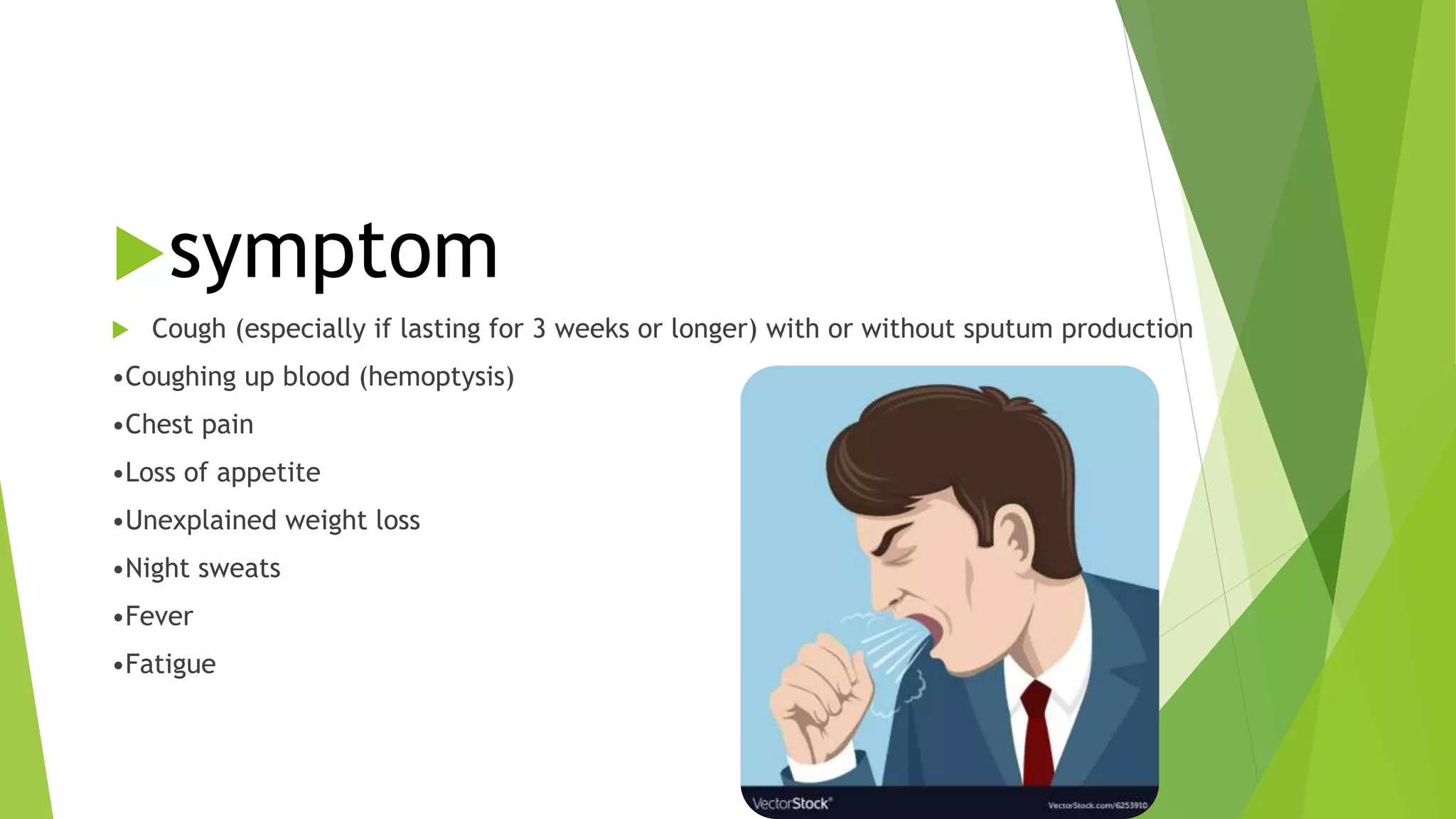
symptom
 Cough (especially if lasting for 3 weeks or longer) with or without sputum production
•Coughing up blood (hemoptysis)
•Chest pain
•Loss of appetite
•Unexplained weight loss
•Night sweats
•Fever
•Fatigue
Medical history, physical examination
Test for TB infection (TB skin test or TB blood
test)
Chest radiograph (X- ray), and
Appropriate laboratory tests
Diagnosis of TB disease
LABORATORY DIAGNOSIS
Specimen collection and Transport
A. Sputum
1. Expectorated
Food should not have been ingested for 1-2 hours before
expectoration.
Mouth should be rinsed with saline or water just before
expectoration.
The patient should be standing, if possible or sitting upright in bed.
He or she should take deep breath to full the lungs, and empty then in
one
breath, coughing as hard and as deeply as possible.
Sputum brought up should be spit into screw capped container.
Visually inspect the specimen.
Tighten the cap of the container and send immediately to lab
Collection of sample of sputum (Day1)
 1-before collecting sputum the mouth should be prerinsed and this removes
contaminants from oral cavity.
 2- give the patients a clean dry wide necked leak-proof container and request
him or her to cough deeply to produce a sputum specimen.
 3-for the best result early morning freshly expectorated sputum specimen
should be collected.
Examination
Volume:
A 24 hr volume of sputum is measured in patient with chronic bronchitis , lung
abscess or bronchial asthma. A rising volume indicates worsening & decreasing
volume indicates improvement
Appearance:-
 Purulent: Green looking, mostly pus
 Mucopurulent: green looking with pus & mucus.
 Mucoid: mostly mucus
 Mucoslivary: mucus with small amount of saliva.
Lab diagnosis for AFB patients
CBC (Complete Blood Count ) is normal
Usually moderate normochromic or
slightly hypochromic anemia
Thrombocytosis may be seen
Anemia may be there due to the
chronic debiliting nature of the disease
ESR & CRP are raised
 Used when few Bacilli are present
 Reduces time needed for testing
 Beter conclusion with one or two specimens unlike Ziehl Neelsen method needing 3 or more
specimen
Florescent microscopy
Result
 AFB Red, straight or slightly curved rods, occurring singly or in a
small groups, may appear beaded.
 Cells Green
 Background material Green
Molecular methods in diagnosis of Tuberculosis
PCR (polymerase chain reaction)
Culture of the specimen
 To obtain as pure a culture as possible of respiratory pathogens it is necessary
to reduce the number of commensals inoculated. Ways of reducing
commensal number include washing the sputum free from saliva or liquefying
and diluting it. The technique using saline- washed sputum described. The
dilution technique requires a liquid agent such as dithiothreitol (sputolysin
sputasol) wich is expensive and unstable.
Culturing Mycobacterium
Culturing on1- Lowenstein Jenson remain the affordable , economical method in developing world
 Mycobacterium spp are slow growing needed for 6-8 weeks for growing, so the sample can be
contaminated while growing.
 As even few bacilli can be grown in spite of smear negativity
2-liquid medium
3- agar medium
Each specimen received for culture
should be plated on agar
 Different agar:-
 1- blood agar
 2- chocolate agar
 3-macConkey agar
 4- Thioglycolate broth
blood agar and chocolate agar
 1 – wash a purulent part of sputum in about 5ml of sterile physiological saline
 2- inoculate the washed sputum on plate of :
 Blood agar
 Chocolate agar
 3- add on optochin disc to the blood plate within the area of 2 nd spread.
This will help to identify Sterptococcus pneumonia
 4- incubate the blood agar plate aerobically and the chocolate agar plate in a
carbon dioxide enriched atmosphere.
Day2 and onward
 Examine and report the culture
 Blood agar and chocolate agar cultures
 Look specially for a significant growth of :
 Stre. Pneumonia
 Haemo. Influenzae
 Staph. aureus

Respiratory tract infection

  • 1.
  • 2.
    INTRODUCTION  Respiratory tractinfection refers to any of a number of infectious diseases involving the respiratory tract  It is classified in to 2 types they are:  UPPER RESPIRATORY TRACT INFECTION  LOWER RESPIRATORY TRACT INFECTION A respiratory tract infection (RTI) is any of a number of infectious diseases involving the respiratory tractinfection of this type is normally further classified as an upper respiratory tract infection (URI or URTI) or a lower respiratory tract infection (LRI or LRTI). Lower respiratory infections, such as pneumonia, tend to be far more serious conditions than upper respiratory infections, such as the common cold.
  • 4.
    PATHOGENESIS Host Factors Nasal hairs Convolutedpassage Mucus lining Secretary IgA Nonspecific antibacterial substances Cilia Reflexes such as coughing, sneezing & swallowing. Microorganism Factors Adherence Colonization Fimbriae Toxins 11
  • 5.
    Possible pathogens  Bacteria G+ve  Streptococcus pneumonia  Staphylococcus aureus  Streptococcus pyogens  G-ve  Haemophilus influenza  Klebsiella pneumonia  Pseudomonas aeruginosa  Proteus spp  Yersina pestis
  • 6.
    Mycobacterium tuberculosis mycoplasma pneumonia fungiand Actinomycetes pneumosysis carini Blastomyces dermatidis Histoplasma capsulatum Aspergillus spp Candida albicans Norcardia spp parasites paragonimus spp
  • 7.
  • 8.
  • 9.
    Viral infections :e.g Influenza A Respiratory syncytial virus (RSV) Human metapneumovirus (hMPV) Varicella-zoster virus (VZV) Chickenpox
  • 10.
    symptom  Cough (especiallyif lasting for 3 weeks or longer) with or without sputum production •Coughing up blood (hemoptysis) •Chest pain •Loss of appetite •Unexplained weight loss •Night sweats •Fever •Fatigue
  • 12.
    Medical history, physicalexamination Test for TB infection (TB skin test or TB blood test) Chest radiograph (X- ray), and Appropriate laboratory tests Diagnosis of TB disease
  • 13.
    LABORATORY DIAGNOSIS Specimen collectionand Transport A. Sputum 1. Expectorated Food should not have been ingested for 1-2 hours before expectoration. Mouth should be rinsed with saline or water just before expectoration. The patient should be standing, if possible or sitting upright in bed. He or she should take deep breath to full the lungs, and empty then in one breath, coughing as hard and as deeply as possible. Sputum brought up should be spit into screw capped container. Visually inspect the specimen. Tighten the cap of the container and send immediately to lab
  • 14.
    Collection of sampleof sputum (Day1)  1-before collecting sputum the mouth should be prerinsed and this removes contaminants from oral cavity.  2- give the patients a clean dry wide necked leak-proof container and request him or her to cough deeply to produce a sputum specimen.  3-for the best result early morning freshly expectorated sputum specimen should be collected.
  • 15.
    Examination Volume: A 24 hrvolume of sputum is measured in patient with chronic bronchitis , lung abscess or bronchial asthma. A rising volume indicates worsening & decreasing volume indicates improvement
  • 16.
    Appearance:-  Purulent: Greenlooking, mostly pus  Mucopurulent: green looking with pus & mucus.  Mucoid: mostly mucus  Mucoslivary: mucus with small amount of saliva.
  • 17.
    Lab diagnosis forAFB patients CBC (Complete Blood Count ) is normal Usually moderate normochromic or slightly hypochromic anemia Thrombocytosis may be seen Anemia may be there due to the chronic debiliting nature of the disease ESR & CRP are raised
  • 19.
     Used whenfew Bacilli are present  Reduces time needed for testing  Beter conclusion with one or two specimens unlike Ziehl Neelsen method needing 3 or more specimen Florescent microscopy
  • 24.
    Result  AFB Red,straight or slightly curved rods, occurring singly or in a small groups, may appear beaded.  Cells Green  Background material Green
  • 25.
    Molecular methods indiagnosis of Tuberculosis PCR (polymerase chain reaction)
  • 27.
    Culture of thespecimen  To obtain as pure a culture as possible of respiratory pathogens it is necessary to reduce the number of commensals inoculated. Ways of reducing commensal number include washing the sputum free from saliva or liquefying and diluting it. The technique using saline- washed sputum described. The dilution technique requires a liquid agent such as dithiothreitol (sputolysin sputasol) wich is expensive and unstable.
  • 28.
    Culturing Mycobacterium Culturing on1-Lowenstein Jenson remain the affordable , economical method in developing world  Mycobacterium spp are slow growing needed for 6-8 weeks for growing, so the sample can be contaminated while growing.  As even few bacilli can be grown in spite of smear negativity 2-liquid medium 3- agar medium
  • 29.
    Each specimen receivedfor culture should be plated on agar  Different agar:-  1- blood agar  2- chocolate agar  3-macConkey agar  4- Thioglycolate broth
  • 30.
    blood agar andchocolate agar  1 – wash a purulent part of sputum in about 5ml of sterile physiological saline  2- inoculate the washed sputum on plate of :  Blood agar  Chocolate agar  3- add on optochin disc to the blood plate within the area of 2 nd spread. This will help to identify Sterptococcus pneumonia  4- incubate the blood agar plate aerobically and the chocolate agar plate in a carbon dioxide enriched atmosphere.
  • 31.
    Day2 and onward Examine and report the culture  Blood agar and chocolate agar cultures  Look specially for a significant growth of :  Stre. Pneumonia  Haemo. Influenzae  Staph. aureus