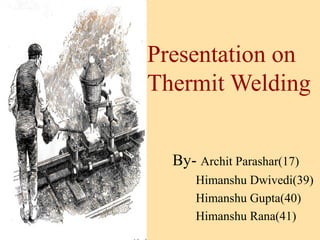
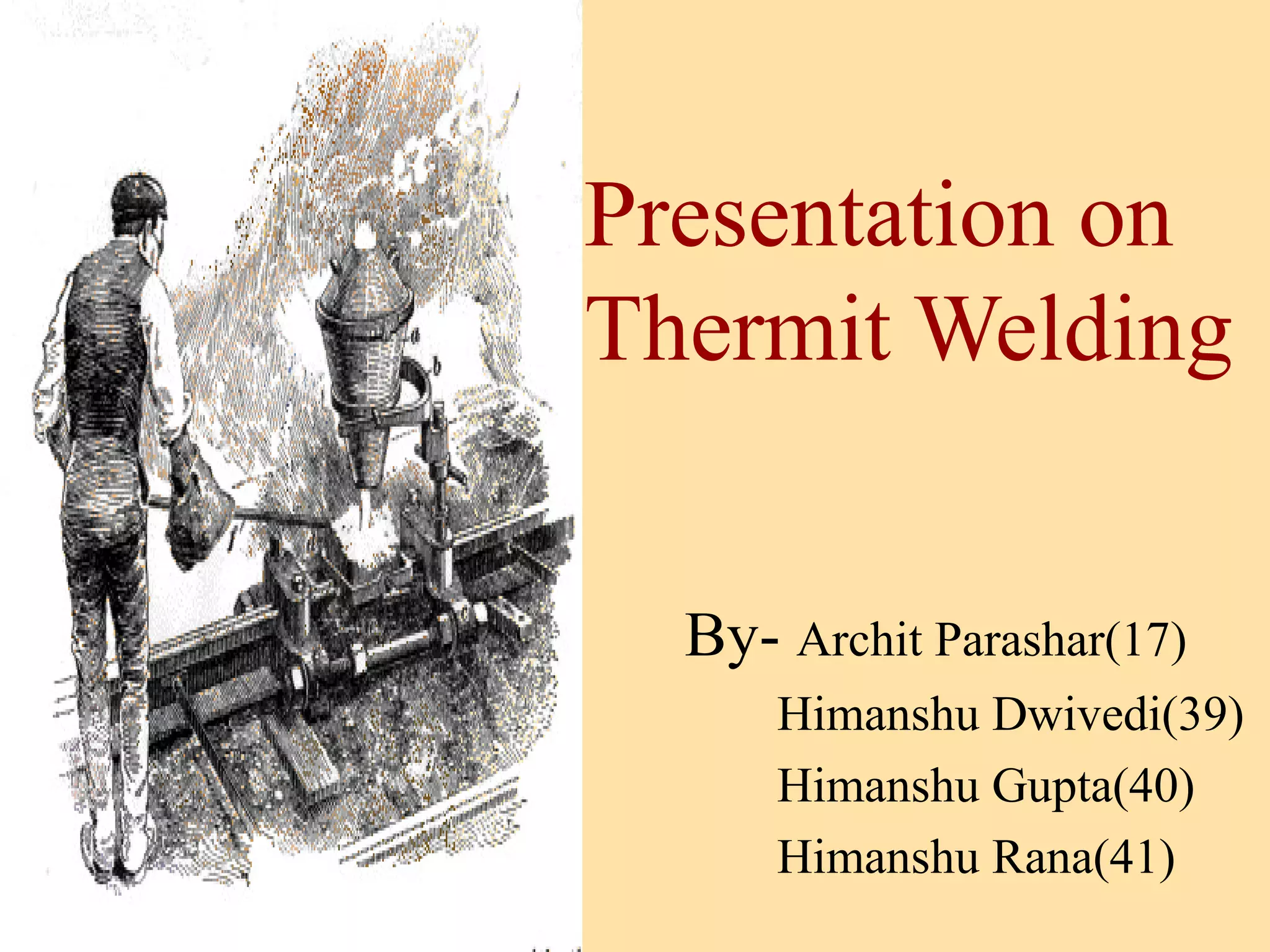

Presentation on
Thermit Welding


  By- Archit Parashar(17)
      Himanshu Dwivedi(39)
      Himanshu Gupta(40)
      Himanshu Rana(41)
HISTORY
• In 1893 Hans Goldschmidt of Germany began to
  experiment with aluminothermic reactions.
• Aluminothermic reactions are highly exothermic
  processes involving reactions of metallic oxides
  with aluminum powders.
• This work led to a patent application for the
  Thermit process in 1895.
• Due to the large amount of heat released by
  exothermic chemical reactions and the versatility
  of the thermit process, other applications were
  quickly found and Goldschmidt started a
  corporation in 1897.
• By the end of the 19th Century, the thermit
process had been successfully used to make
repairs to large cast and forged steel parts.
• In 1904 the Goldschmidt Thermit Company was
founded in New York and extensive use of thermit
welding on street railways in the United States
started.
INTRODUCTION
• It is a process in which heat for coalescence is
  produced by superheated molten metal from the
  chemical reaction of thermite.
• Thermite is mixture of Al and Fe3O4 fine powders
  that produce an exothermic reaction when ignited.
• Also used for incendiary bombs.
• Filler metal obtained from liquid metal.
• Process used for joining, but has more in common
  with casting than welding .
PRINCIPLE OF
OPERATION
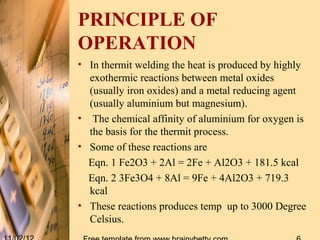
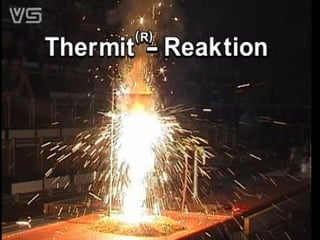
• In thermit welding the heat is produced by highly
  exothermic reactions between metal oxides
  (usually iron oxides) and a metal reducing agent
  (usually aluminium but magnesium).
• The chemical affinity of aluminium for oxygen is
  the basis for the thermit process.
• Some of these reactions are
  Eqn. 1 Fe2O3 + 2Al = 2Fe + Al2O3 + 181.5 kcal
  Eqn. 2 3Fe3O4 + 8Al = 9Fe + 4Al2O3 + 719.3
  kcal
• These reactions produces temp up to 3000 Degree
  Celsius.
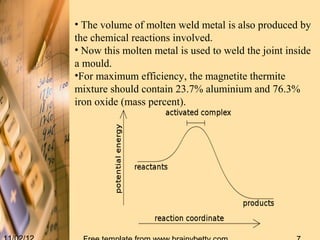
• The volume of molten weld metal is also produced by
the chemical reactions involved.
• Now this molten metal is used to weld the joint inside
a mould.
•For maximum efficiency, the magnetite thermite
mixture should contain 23.7% aluminium and 76.3%
iron oxide (mass percent).
THERMIT WELDING
MIXTURES
Thermit mixtures most commonly used for the
  welding of ferrous materials are-
• Plain Thermit: mixture of iron oxide and finely
  divided aluminium. It produces highest
  temperature for thermit welding.
• Mild steel Thermit: plain thermit with the addition
  of mild steel punchings to increase the metal
  products. Carbon and manganese are also added to
  balance reactions.
• Thermit for welding rails: plain thermit with
  addition of carbon and manganese to increase
  hardness of rail joints.
METHODS OF THERMIT
WELDING
The heat of thermit welding may be utilized in two
    ways-
 Fusion welding: It may heat and fuse the metal
    parts, thermit mixture acts as the filler metal
    also.
 Pressure welding: It may heat the metal parts
    and raise them to forging temperature, and
    forging force is applied to join them.
PROCEDURE OF
THERMIT WELDING
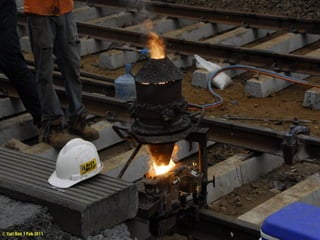
Various steps involved in fusion thermit welding of
    metal parts are-
•   Cleaning the joint: Joints to be welded should
    be cleaned and free from dust, grease, loose
    oxides, etc before welding.
•   Allow for contraction: A space of 1.5 to 6 mm
    is given between ends as contraction allowance.
•   Construction of mould: A mould is the part in
    which the metal parts to be joint lies and molten
    metal is poured in it. It is 100 mm thick between
    wax pattern and molding box and should provide
    necessary pouring gates, heating gates and riser.
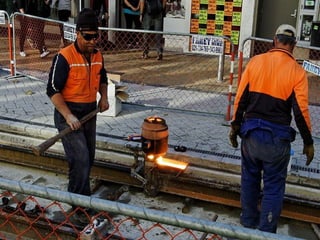
• Preheating the mould: Mould is preheated to
  remove wax pattern, dry the mould thoroughly and
  to bring the parts to be welded at desired
  temperature, i.e. 816oC-982oC.
• Crucible and it’s charging: crucible is a conical
  shaped vessel, it is filled with required amount of
  thermite mixture to joint the metal parts.
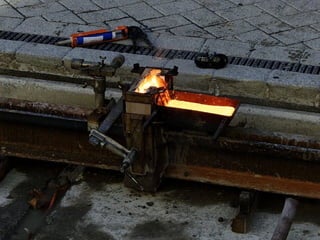
• Igniting the thermite mixture: ignition of thermite
  mixture lasts up to 60 seconds. After the ignition is
  completed crucible is tapped to release molten
  metal mould where fusion takes place.
• Opening the mold: mold is opened after 2-4
  hours. The longer the mould is left unopened, the
  better it is.
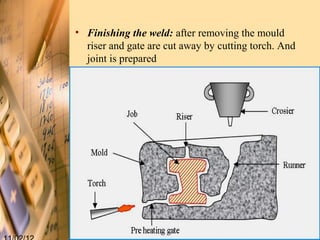
• Finishing the weld: after removing the mould
  riser and gate are cut away by cutting torch. And
  joint is prepared
Problems with Thermite
Welds
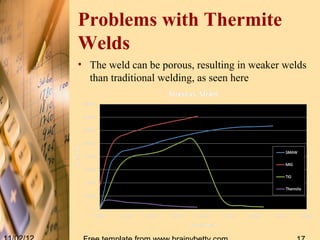
• The weld can be porous, resulting in weaker welds
  than traditional welding, as seen here
Advantages
• It is very portable process.
• No external power supply required.
• It is very cheap process for repairing broken parts
  of large metal structures such as rail lines, large
  parts of ships.
• On site welding can be done for railways.
LIMITATIONS
• Can only be used for ferrous metals.
• It is uneconomical when used for welding cheap
  metals or light parts.
• Thermite mixtures can not be stored due to safety
  hazards and should be used as soon as prepared.
Thermit Applications
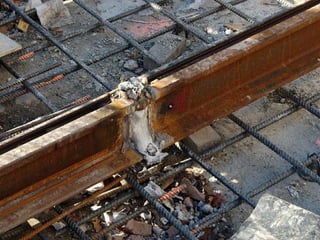
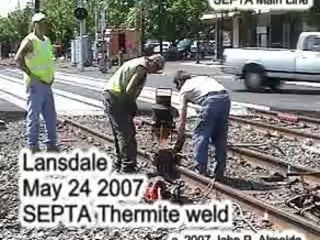
 • Repairing fractured rails
 • For butt welding pipes end to end
 • For welding large fractured crankshafts
 • For welding broken frames of machines
 • Welding of sections of casting where size
   prevents there being caste in one piece
 • Replacing broken pieces or large gears
 • End welding of reinforcing bars used in huge
   concrete constructions
Military Applications

 • Thermate -TH3 is a mixture of thermite and
   pyrotechnic additives for incendiary purposes.
   Its composition by weight is generally thermite
   68.7%, Ba(NO3)2 29.0%, S 2.0% and binder
   0.3%.
 • Ba(NO3)2 increases its thermal effect, creates
   flame in burning and significantly reduces the
   ignition temperature.
 • Ames Process – an adaptation of the thermite
   reaction for obtaining pure Uranium (as part of
   the Manhattan Project at Ames Laboratory).
Hazards
• Thermite usage is hazardous due to extremely high
  temperatures produced and the extreme difficulty
  in smothering a reaction once initiated.
• The thermite reactions releases dangerous ultra
  violet (UV) light.
• Mixing water with thermite or pouring water onto
  burning thermite can cause a steam explosion,
  spraying hot fragments in all directions.
THANK YOU

thermit welding

  • 1.
    Presentation on Thermit Welding By- Archit Parashar(17) Himanshu Dwivedi(39) Himanshu Gupta(40) Himanshu Rana(41)
  • 2.
    HISTORY • In 1893Hans Goldschmidt of Germany began to experiment with aluminothermic reactions. • Aluminothermic reactions are highly exothermic processes involving reactions of metallic oxides with aluminum powders. • This work led to a patent application for the Thermit process in 1895. • Due to the large amount of heat released by exothermic chemical reactions and the versatility of the thermit process, other applications were quickly found and Goldschmidt started a corporation in 1897.
  • 3.
    • By theend of the 19th Century, the thermit process had been successfully used to make repairs to large cast and forged steel parts. • In 1904 the Goldschmidt Thermit Company was founded in New York and extensive use of thermit welding on street railways in the United States started.
  • 5.
    INTRODUCTION • It isa process in which heat for coalescence is produced by superheated molten metal from the chemical reaction of thermite. • Thermite is mixture of Al and Fe3O4 fine powders that produce an exothermic reaction when ignited. • Also used for incendiary bombs. • Filler metal obtained from liquid metal. • Process used for joining, but has more in common with casting than welding .
  • 6.
    PRINCIPLE OF OPERATION • Inthermit welding the heat is produced by highly exothermic reactions between metal oxides (usually iron oxides) and a metal reducing agent (usually aluminium but magnesium). • The chemical affinity of aluminium for oxygen is the basis for the thermit process. • Some of these reactions are Eqn. 1 Fe2O3 + 2Al = 2Fe + Al2O3 + 181.5 kcal Eqn. 2 3Fe3O4 + 8Al = 9Fe + 4Al2O3 + 719.3 kcal • These reactions produces temp up to 3000 Degree Celsius.
  • 7.
    • The volumeof molten weld metal is also produced by the chemical reactions involved. • Now this molten metal is used to weld the joint inside a mould. •For maximum efficiency, the magnetite thermite mixture should contain 23.7% aluminium and 76.3% iron oxide (mass percent).
  • 8.
    THERMIT WELDING MIXTURES Thermit mixturesmost commonly used for the welding of ferrous materials are- • Plain Thermit: mixture of iron oxide and finely divided aluminium. It produces highest temperature for thermit welding. • Mild steel Thermit: plain thermit with the addition of mild steel punchings to increase the metal products. Carbon and manganese are also added to balance reactions. • Thermit for welding rails: plain thermit with addition of carbon and manganese to increase hardness of rail joints.
  • 9.
    METHODS OF THERMIT WELDING Theheat of thermit welding may be utilized in two ways-  Fusion welding: It may heat and fuse the metal parts, thermit mixture acts as the filler metal also.  Pressure welding: It may heat the metal parts and raise them to forging temperature, and forging force is applied to join them.
  • 11.
    PROCEDURE OF THERMIT WELDING Varioussteps involved in fusion thermit welding of metal parts are- • Cleaning the joint: Joints to be welded should be cleaned and free from dust, grease, loose oxides, etc before welding. • Allow for contraction: A space of 1.5 to 6 mm is given between ends as contraction allowance. • Construction of mould: A mould is the part in which the metal parts to be joint lies and molten metal is poured in it. It is 100 mm thick between wax pattern and molding box and should provide necessary pouring gates, heating gates and riser.
  • 12.
    • Preheating themould: Mould is preheated to remove wax pattern, dry the mould thoroughly and to bring the parts to be welded at desired temperature, i.e. 816oC-982oC. • Crucible and it’s charging: crucible is a conical shaped vessel, it is filled with required amount of thermite mixture to joint the metal parts. • Igniting the thermite mixture: ignition of thermite mixture lasts up to 60 seconds. After the ignition is completed crucible is tapped to release molten metal mould where fusion takes place. • Opening the mold: mold is opened after 2-4 hours. The longer the mould is left unopened, the better it is.
  • 13.
    • Finishing theweld: after removing the mould riser and gate are cut away by cutting torch. And joint is prepared
  • 17.
    Problems with Thermite Welds •The weld can be porous, resulting in weaker welds than traditional welding, as seen here
  • 18.
    Advantages • It isvery portable process. • No external power supply required. • It is very cheap process for repairing broken parts of large metal structures such as rail lines, large parts of ships. • On site welding can be done for railways.
  • 19.
    LIMITATIONS • Can onlybe used for ferrous metals. • It is uneconomical when used for welding cheap metals or light parts. • Thermite mixtures can not be stored due to safety hazards and should be used as soon as prepared.
  • 20.
    Thermit Applications •Repairing fractured rails • For butt welding pipes end to end • For welding large fractured crankshafts • For welding broken frames of machines • Welding of sections of casting where size prevents there being caste in one piece • Replacing broken pieces or large gears • End welding of reinforcing bars used in huge concrete constructions
  • 21.
    Military Applications •Thermate -TH3 is a mixture of thermite and pyrotechnic additives for incendiary purposes. Its composition by weight is generally thermite 68.7%, Ba(NO3)2 29.0%, S 2.0% and binder 0.3%. • Ba(NO3)2 increases its thermal effect, creates flame in burning and significantly reduces the ignition temperature. • Ames Process – an adaptation of the thermite reaction for obtaining pure Uranium (as part of the Manhattan Project at Ames Laboratory).
  • 22.
    Hazards • Thermite usageis hazardous due to extremely high temperatures produced and the extreme difficulty in smothering a reaction once initiated. • The thermite reactions releases dangerous ultra violet (UV) light. • Mixing water with thermite or pouring water onto burning thermite can cause a steam explosion, spraying hot fragments in all directions.
  • 24.