Evolution A change in the genetic makeup (gene frequency) of a population
Equilibrium is achieved by meeting ALL of these qualifications:   Not having ANY mutations. All mating is RANDOM.  Selecting a mate causes… selection. The population can have no immigration or emigration.  This causes a change in gene frequency. There are no environmental factors which cause selection to occur.  This includes short and long-term factors. The population is large.
Evolution vs. Equilibrium If a species is changing,  it is  evolving .  If it is  not  changing,  we say it is in  equilibrium .
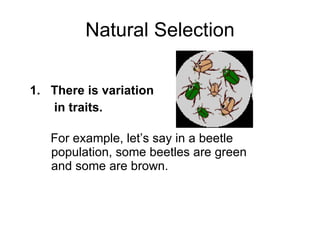
Natural Selection 1.  There is variation  in traits. For example, let’s say in a beetle population, some beetles are green and some are brown.
2.  There is often a struggle for survival.  Since the environment can't support unlimited population growth, not all individuals get to reproduce to their full potential.  In this example, green beetles tend to get eaten by birds and survive to reproduce less often than brown beetles do.
Survivors pass on their traits to their offspring. The surviving brown beetles have brown baby beetles because this trait has a genetic basis.
4. The traits that are better-suited for an environment will become more common.  These traits are called  adaptations . In our example, brown coloration allows the beetle to have more offspring, so it becomes more common in the population. If this process continues, eventually, all individuals in the population could be brown.
If the brown beetles outnumber the green beetles, are they the “best fit” for the environment? For ALL environments? What happens if the environment changes? Do organisms create mutations because they HAVE to change in order to survive?
What is Genetic Drift?? Random change in allele frequency, based on the laws of probability.  Example    Founder Effect Founder Effect: change in allele frequencies as a result of the migration of a small subgroup of population.  Gene Flow  is cut off from the original population.
Another example of genetic drift is called the  Bottleneck Effect Northern elephant seals have reduced genetic variation probably because of a population bottleneck humans inflicted on them in the 1890s. Hunting reduced their population size to as few as 20 individuals at the end of the 19th century. Their population has since rebounded to over 30,000—but their genes still carry the marks of this bottleneck: they have much less genetic variation than a population of southern elephant seals that was not so intensely hunted.
The role of Isolation in Evolution Geographic isolation  – groups of the same species are physically separated, so gene pools don’t mix.  Ecological Isolation  – groups of the same species are in the same area, but end up occupying separate habitats.
Temporal Isolation  – reproduction occurs at different times of the day or year. Behavioral Isolation  – they aren’t understanding each other, so mating doesn’t occur. Mechanical/Reproductive Isolation  – reproduction doesn’t occur either because the parts aren’t working together, or matings aren’t producing fertile offspring.
Grasses around the mine have all experienced selection – they can tolerate the heavy metal content of the soil. The plants are in close proximity, so in theory they could cross-pollinate. However, it has been noted that the plants that tolerate the mine waste also flower at a different time. What type(s) of isolation are represented?
“ Darwin’s Finches” What type of isolation is represented?
The mating rituals between male individuals may vary, and the females may vary in what they find attractive.  This may lead to two different groups of birds, even though they live in the same general location. What type of isolation would this represent?
+  =  Horses and donkeys are able to reproduce, but the offspring – a mule - will be sterile.  In the wild, these matings rarely occur because the female will often reject the male of the other species. What type(s) of isolation are represented?
Microevolution is a change that occurs within a species. A “species” refers to a group of organisms that can mate and produce fertile offspring. Macroevolution refers to changes among species, for example when one species goes extinct and another takes over its role. “ Speciation” is when evolution leads to the formation of new species.
Five Evidences used for studying evolution The fossil record provides a ‘picture’ of the transitional stages of many species.  It also supports the idea that simple organisms came before more complex organisms.
2. Anatomical similarities Homologous structures  are those that share a similar basic framework (even if they are used for a different purpose)
Vestigial structures  – are reduced in size or function from a previous ancestor.  (note: they are not “useless”) Ex:  human tailbone :  In most people it is not even noticeable, and serves no known function.
human appendix :  Does  serve some function as a part of your lymphatic system, but is much reduced from the digestive purposes served by it’s counterpart (the cecum) in herbivores.
by the way… Analagous structures are NOT evidence for evolution These serve a similar function, but have different underlying structures.
3. Genetics and molecular similarities All organisms have DNA and share a great similarity in proteins, carbohydrates and lipids that make them up.  Metabolic processes are also very similar in many ways.
 
4. Geographic distribution of related    species The more similar two organisms are, the more likely they are to be found near each other.  Australia had nearly all marsupial species, yet no land mammals such as dogs, bears, or horses.  Isolated islands generally have unique organisms found nowhere else, and lack common organisms found elsewhere.  For example, there are no snakes in Hawaii.
5. Experience with artificial selection …
…  and observed natural selection
What are the five categories of evidence for evolution? 1. Fossil Record 2. Anatomical features Homologous structures Vestigial structures 3. DNA and molecular sequences 4. Geography 5. Artificial selection and observed natural  selection.
Cladogram
How to read a Cladogram This diagram shows a relationship between 4 species.  These relatives share a  common ancestor  at the root of the tree. Cladograms are also a rough timeline.  The organism at the bottom of the tree has been around the longest. The four descendents at the top of the tree are DIFFERENT species.  This is called  SPECIATION . Image courtesy of http://evolution.berkeley.edu/evolibrary/article/0_0_0/evo_05
Branches on the tree represent SPECIATION, the formation of a new species. The event that causes the speciation is shown as the fork of the “V”. Image courtesy of http://evolution.berkeley.edu/evolibrary/article/0_0_0/evo_05
Species B and C each have characteristics that are unique only to them. But they also share some part of their history with species A.  This shared history is the common ancestor. Image courtesy of http://evolution.berkeley.edu/evolibrary/article/0_0_0/evo_05
Write a few sentences that summarize the relationship between organisms A, B, and C.  Does “B” have to be extinct in order for “C” to exist?  Does the common ancestor have to be extinct?  Image courtesy of http://evolution.berkeley.edu/evolibrary/article/0_0_0/evo_05
Look at the cladogram at the right.  What conclusions can be drawn about the relationship between humans and chimps? Image courtesy of http://evolution.berkeley.edu/evolibrary/article/0_0_0/evo_05
If we made a cladogram of ALL living things, the oldest organism would be the common ancestor of all living things. What would this organism be like?  What characteristics would it have?  What characteristics would it NOT have? What living organism would it most closely resemble?  Explain…
 
3 Types of Selection
Directional selection Low mortality, high fitness H igh mortality, low fitness Key Food becomes scarce. Directional Selection Form of natural selection by which the entire curve moves. Occurs when individuals at one end of the distribution curve have higher fitness than individuals in the middle or at the other end of the curve.
Stabilizing Selection Form of natural selection by which the center of the curve remains in its current position. Occurs when individuals near the center of distribution curve have higher fitness than individuals at either end. Selection against both extremes keep curve narrow and in same place. High mortality, low fitness Low mortality, high fitness Key Percentage of Population Birth Weight Stabilizing Selection
Disruptive Selection Form of natural selection in which a single curve splits into two. Occurs when individuals at the upper and lower ends of a distribution curve have higher fitness than individuals near the middle. Population splits into two subgroups specializing in different seeds. Disruptive Selection High mortality, low fitness Low mortality, high fitness Key Number of Birds in Population Beak Size Largest and smallest seeds become more common. Number of Birds in Population Beak Size
When speciation results in a “split” it is called  divergent evolution . If there are a lot of “splits” (like the finches) it is often called adaptive radiation.  Convergent evolution  is when two different species become more similar.  Why would convergent evolution occur? Would two different species ever become one species?
Does evolution happen gradually, or in short bursts? GRADUALISM   is the hypothesis that changes in species occur slowly and only small changes at a time. PUNCTUATED EQUILIBRIUM  This hypothesis was published in 1972 by Niles Eldredge and Stephen J. Gould. They suggested that major changes can occur relatively suddenly, and that they "punctuate" long periods of relatively little change.
Which hypothesis do you think is better at explaining changes in species?  Could both hypotheses coexist?
Endosymbiotic  Theory In 1968, Lynn Margulis  proposed the  endosymbiotic theory.  Based on similarities between prokaryotes & mitochondria and chloroplasts, she proposed that these organelles used to be prokaryotes.
A very brief comparison: Prokaryotes Eukaryotes Mitochondria Chloroplasts DNA 1 single, circular chromosome Many linear chromosomes 1 single, circular chromosome 1 single, circular chromosome Replication Binary Fission Mitosis Binary Fission Binary Fission Electron Transport Chain In the plasma membrane of the cell Found only in mitochondria and chloroplasts In the plasma membrane around the mitochondria In the plasma membrane around the chloroplast Size 1-10 µm 50-100 µm 1-10 µm 1-10 µm Ribosomes 70 S 80 S 70 S 80 S

Evolution

  • 1.
    Evolution A changein the genetic makeup (gene frequency) of a population
  • 2.
    Equilibrium is achievedby meeting ALL of these qualifications: Not having ANY mutations. All mating is RANDOM. Selecting a mate causes… selection. The population can have no immigration or emigration. This causes a change in gene frequency. There are no environmental factors which cause selection to occur. This includes short and long-term factors. The population is large.
  • 3.
    Evolution vs. EquilibriumIf a species is changing, it is evolving . If it is not changing, we say it is in equilibrium .
  • 4.
    Natural Selection 1. There is variation in traits. For example, let’s say in a beetle population, some beetles are green and some are brown.
  • 5.
    2. Thereis often a struggle for survival. Since the environment can't support unlimited population growth, not all individuals get to reproduce to their full potential. In this example, green beetles tend to get eaten by birds and survive to reproduce less often than brown beetles do.
  • 6.
    Survivors pass ontheir traits to their offspring. The surviving brown beetles have brown baby beetles because this trait has a genetic basis.
  • 7.
    4. The traitsthat are better-suited for an environment will become more common. These traits are called adaptations . In our example, brown coloration allows the beetle to have more offspring, so it becomes more common in the population. If this process continues, eventually, all individuals in the population could be brown.
  • 8.
    If the brownbeetles outnumber the green beetles, are they the “best fit” for the environment? For ALL environments? What happens if the environment changes? Do organisms create mutations because they HAVE to change in order to survive?
  • 9.
    What is GeneticDrift?? Random change in allele frequency, based on the laws of probability. Example  Founder Effect Founder Effect: change in allele frequencies as a result of the migration of a small subgroup of population. Gene Flow is cut off from the original population.
  • 10.
    Another example ofgenetic drift is called the Bottleneck Effect Northern elephant seals have reduced genetic variation probably because of a population bottleneck humans inflicted on them in the 1890s. Hunting reduced their population size to as few as 20 individuals at the end of the 19th century. Their population has since rebounded to over 30,000—but their genes still carry the marks of this bottleneck: they have much less genetic variation than a population of southern elephant seals that was not so intensely hunted.
  • 11.
    The role ofIsolation in Evolution Geographic isolation – groups of the same species are physically separated, so gene pools don’t mix. Ecological Isolation – groups of the same species are in the same area, but end up occupying separate habitats.
  • 12.
    Temporal Isolation – reproduction occurs at different times of the day or year. Behavioral Isolation – they aren’t understanding each other, so mating doesn’t occur. Mechanical/Reproductive Isolation – reproduction doesn’t occur either because the parts aren’t working together, or matings aren’t producing fertile offspring.
  • 13.
    Grasses around themine have all experienced selection – they can tolerate the heavy metal content of the soil. The plants are in close proximity, so in theory they could cross-pollinate. However, it has been noted that the plants that tolerate the mine waste also flower at a different time. What type(s) of isolation are represented?
  • 14.
    “ Darwin’s Finches”What type of isolation is represented?
  • 15.
    The mating ritualsbetween male individuals may vary, and the females may vary in what they find attractive. This may lead to two different groups of birds, even though they live in the same general location. What type of isolation would this represent?
  • 16.
    + = Horses and donkeys are able to reproduce, but the offspring – a mule - will be sterile. In the wild, these matings rarely occur because the female will often reject the male of the other species. What type(s) of isolation are represented?
  • 17.
    Microevolution is achange that occurs within a species. A “species” refers to a group of organisms that can mate and produce fertile offspring. Macroevolution refers to changes among species, for example when one species goes extinct and another takes over its role. “ Speciation” is when evolution leads to the formation of new species.
  • 18.
    Five Evidences usedfor studying evolution The fossil record provides a ‘picture’ of the transitional stages of many species. It also supports the idea that simple organisms came before more complex organisms.
  • 19.
    2. Anatomical similaritiesHomologous structures are those that share a similar basic framework (even if they are used for a different purpose)
  • 20.
    Vestigial structures – are reduced in size or function from a previous ancestor. (note: they are not “useless”) Ex: human tailbone : In most people it is not even noticeable, and serves no known function.
  • 21.
    human appendix : Does serve some function as a part of your lymphatic system, but is much reduced from the digestive purposes served by it’s counterpart (the cecum) in herbivores.
  • 22.
    by the way…Analagous structures are NOT evidence for evolution These serve a similar function, but have different underlying structures.
  • 23.
    3. Genetics andmolecular similarities All organisms have DNA and share a great similarity in proteins, carbohydrates and lipids that make them up. Metabolic processes are also very similar in many ways.
  • 24.
  • 25.
    4. Geographic distributionof related species The more similar two organisms are, the more likely they are to be found near each other. Australia had nearly all marsupial species, yet no land mammals such as dogs, bears, or horses. Isolated islands generally have unique organisms found nowhere else, and lack common organisms found elsewhere. For example, there are no snakes in Hawaii.
  • 26.
    5. Experience withartificial selection …
  • 27.
    … andobserved natural selection
  • 28.
    What are thefive categories of evidence for evolution? 1. Fossil Record 2. Anatomical features Homologous structures Vestigial structures 3. DNA and molecular sequences 4. Geography 5. Artificial selection and observed natural selection.
  • 29.
  • 30.
    How to reada Cladogram This diagram shows a relationship between 4 species. These relatives share a common ancestor at the root of the tree. Cladograms are also a rough timeline. The organism at the bottom of the tree has been around the longest. The four descendents at the top of the tree are DIFFERENT species. This is called SPECIATION . Image courtesy of http://evolution.berkeley.edu/evolibrary/article/0_0_0/evo_05
  • 31.
    Branches on thetree represent SPECIATION, the formation of a new species. The event that causes the speciation is shown as the fork of the “V”. Image courtesy of http://evolution.berkeley.edu/evolibrary/article/0_0_0/evo_05
  • 32.
    Species B andC each have characteristics that are unique only to them. But they also share some part of their history with species A. This shared history is the common ancestor. Image courtesy of http://evolution.berkeley.edu/evolibrary/article/0_0_0/evo_05
  • 33.
    Write a fewsentences that summarize the relationship between organisms A, B, and C. Does “B” have to be extinct in order for “C” to exist? Does the common ancestor have to be extinct? Image courtesy of http://evolution.berkeley.edu/evolibrary/article/0_0_0/evo_05
  • 34.
    Look at thecladogram at the right. What conclusions can be drawn about the relationship between humans and chimps? Image courtesy of http://evolution.berkeley.edu/evolibrary/article/0_0_0/evo_05
  • 35.
    If we madea cladogram of ALL living things, the oldest organism would be the common ancestor of all living things. What would this organism be like? What characteristics would it have? What characteristics would it NOT have? What living organism would it most closely resemble? Explain…
  • 36.
  • 37.
    3 Types ofSelection
  • 38.
    Directional selection Lowmortality, high fitness H igh mortality, low fitness Key Food becomes scarce. Directional Selection Form of natural selection by which the entire curve moves. Occurs when individuals at one end of the distribution curve have higher fitness than individuals in the middle or at the other end of the curve.
  • 39.
    Stabilizing Selection Formof natural selection by which the center of the curve remains in its current position. Occurs when individuals near the center of distribution curve have higher fitness than individuals at either end. Selection against both extremes keep curve narrow and in same place. High mortality, low fitness Low mortality, high fitness Key Percentage of Population Birth Weight Stabilizing Selection
  • 40.
    Disruptive Selection Formof natural selection in which a single curve splits into two. Occurs when individuals at the upper and lower ends of a distribution curve have higher fitness than individuals near the middle. Population splits into two subgroups specializing in different seeds. Disruptive Selection High mortality, low fitness Low mortality, high fitness Key Number of Birds in Population Beak Size Largest and smallest seeds become more common. Number of Birds in Population Beak Size
  • 41.
    When speciation resultsin a “split” it is called divergent evolution . If there are a lot of “splits” (like the finches) it is often called adaptive radiation. Convergent evolution is when two different species become more similar. Why would convergent evolution occur? Would two different species ever become one species?
  • 42.
    Does evolution happengradually, or in short bursts? GRADUALISM is the hypothesis that changes in species occur slowly and only small changes at a time. PUNCTUATED EQUILIBRIUM This hypothesis was published in 1972 by Niles Eldredge and Stephen J. Gould. They suggested that major changes can occur relatively suddenly, and that they "punctuate" long periods of relatively little change.
  • 43.
    Which hypothesis doyou think is better at explaining changes in species? Could both hypotheses coexist?
  • 44.
    Endosymbiotic TheoryIn 1968, Lynn Margulis proposed the endosymbiotic theory. Based on similarities between prokaryotes & mitochondria and chloroplasts, she proposed that these organelles used to be prokaryotes.
  • 45.
    A very briefcomparison: Prokaryotes Eukaryotes Mitochondria Chloroplasts DNA 1 single, circular chromosome Many linear chromosomes 1 single, circular chromosome 1 single, circular chromosome Replication Binary Fission Mitosis Binary Fission Binary Fission Electron Transport Chain In the plasma membrane of the cell Found only in mitochondria and chloroplasts In the plasma membrane around the mitochondria In the plasma membrane around the chloroplast Size 1-10 µm 50-100 µm 1-10 µm 1-10 µm Ribosomes 70 S 80 S 70 S 80 S

Editor's Notes

  • #10 Example: the Afrikaner population of Dutch settlers in South Africa is descended mainly from a few colonists. Today, the Afrikaner population has an unusually high frequency of the gene that causes Huntington’s disease, because those original Dutch colonists just happened to carry that gene with unusually high frequency. This effect is easy to recognize in genetic diseases, but of course, the frequencies of all sorts of genes are affected by founder events.
  • #11 Humans have probably had two major bottlenecks. One during the migration out of africa (africans are more diverse than all other races) and another at the Bering land bridge (native americans least diverse). There are many examples of founder effect in small populations
  • #14 Anthoxanthum odoratum – Ecological Isolation ; Temporal Isolation
  • #16 Behavioral. Not reproductive because that is when parts don’t fit and/or matings don’t make fertile offspring.
  • #17 Reproductive and Behavioral…….. donkeys have 62 chromosomes, horses 64. unable to match up, hybrid is sterile. Donkey usually the male, the missing chromosomes not as imp. “Hinnies” are female donkey, male horse. More rare.
  • #29 REVIEW
  • #31 Stress that cladograms not only serve as a pictorial representation of lineage, but also as a snapshot in time. Be sure to introduce the term SPECIATION. The four descendents are DIFFERENT species.
  • #34 Students should look at this illustration and begin to understand the concept of common ancestry. Be sure to have students justify their answer to the question.
  • #35 Students should be given a few minutes to consider the answer to this question. It is useful to have each student write a one or two sentence explanation of what they are thinking AND why. The metacognitive aspect of this exercise will set the tone for the rest of the presentation.
  • #36 Think-pair-share
  • #42 Dolphins and sharks …
  • #45 Lynn Margulis 1938- U of Chicago, U of Wisconsin, UC Berkely. Faculty at Boston University when proposed the Endosymbiotic theory, rejected by all journals While E.S. theory is widely accepted or at least plausible, she holds other various unconventional ideas (ex. About AIDS, evolution, etc)
  • #46 70 S are smaller, have less amino acids/proteins, 2:1 RNA:protein ratio…. 80 S are larger, have more… 1:1 RNA:protein ratio The “S” refers to the sedimentation rate