Event Fundraising Best
Practices
Our Speakers
               Richard Dietz
               Founder of Nonprofit R+D - Technology Training for
               Nonprofit Professionals

               Richard has over 20 years' experience working in
               and with a wide variety of nonprofit, political, and
               government organizations.

               You can find Rich on his website
               http://www.nonprofitrd.com
               or tweeting @nonprofit_rd


                          2
Our Speakers
               Jamy Squillace
               Sr. Product Manager Sage Nonprofit Solutions

               Responsible for Sage Fundraising 50, Sage
               Fundraising Online, Sage Nonprofit Online and
               Sage e-Marketing.

               Jamy has 16 years experience in product planning
               and management. Her goal is to create and evolve
               solutions that fulfill customer desires and exceed
               expectations.

               You can find her blogging at SageWords.net or on
               Twitter @jrsquillace.


                       3
Agenda
• Event Fundraising
   – What and Why
   – Examples

• Event Fundraising Best Practices
   –   Planning / Timeline
   –   Setup
   –   Publicity
   –   Running the Event
   –   Follow up
   –   Evaluate

• Q&A

                             4
Introduction
• Make sure to download the E-Book –
  “Event Fundraising Best Practices”
   – http://go.sagenonprofit.com/LP=204


• The E-Book goes more in-depth than we are discussing
  here and includes templates and worksheets.

• Our goal today
   – Get you to think about events in a different way
   – Get you to spend more time planning your events
   – Get you to take action and test some new ideas

                                5
Text Heavy Slides… Oh My.
• I promise I do not just read the slides
   – Boring!

• Why text heavy slides
   – You don’t have to take notes – the info is there for you later
   – You can focus on the “ah-ha” moments
   – They will still make sense 6 months from now

• Let me know what you think


                                 6
What is
Event Fundraising


        7
What is Event Fundraising
• The planning, managing, and execution of an event
  designed to raise money for a nonprofit organization.

   – Fundraising is the key


   – The purpose of the event is more important than
     the type of event being held.


                              8
Why
Event Fundraising


        9
Why is Event Fundraising Important
  • Nonprofits are doing them all the time

  • Many are not doing them very well or efficiently

  • Many people are willing to “spend” more for events or
    items when a portion of that money will go to a charity

  • People are different
     – Your organization needs different kinds of appeals to encourage
       as many people to support it as possible.
     – Event fundraising is just another channel or tool to help you raise
       funds


                                   10
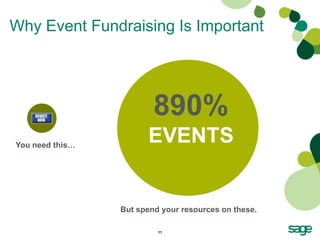
Why Event Fundraising Is Important


                         890%
You need this…
                       EVENTS


                 But spend your resources on these.

                          11
Examples of
Event Fundraising


        12
Examples of Event Fundraising
                      Run/Walk/Rides
                     Luncheons/Galas
                          Concerts
                      No shave month
               Birthday/Anniversary Giving
                    Memorials/Tributes
                          Pledging
                  Dancing with the Stars
                       Sponsorships
                        Ticket sales
    Use forms to collect votes for an event - votes equal
                     donation amounts
                     Golf tournaments
       Classes/symposiums/ educational meetings
                    Camp registrations
                Rapid response campaigns
                              13
Event Fundraising Best Practices


      1.   Planning / Timeline
      2.   Setup
      3.   Publicity
      4.   Running the event
      5.   Follow up
      6.   Evaluate


                          14
Planning / Timeline
• Sample Timeline included in the E-Book

• Covers all the major phases of an event cycle

• Focused on best practices

• Adapt to your needs and timeframe


                           15
Sample Timeline

     Printable version
     included in the
     Appendix


16
1. Planning / Timeline
 • “Fail to Plan, Plan to Fail”
    – It’s a cliché for a reason
    – The plan / timeline helps keep everyone on track and “on the
      same page”


 • Select Event Type
    – Don’t just do what you have always done
            – Test some new ideas (start small)
            – Ask your supporters
    – The Type will impact many other areas
    – Try this on a smaller event
    – Signature Events – How can you make it unique?


                                  17
Rebuilding Together
    “Even though some might consider our first year a
failure, we had to start somewhere. Now our donors are
 comfortable using the system but it’s raised our profile
 among our peers. We can now say that it’s as easy to
       donate with us as it is American Red Cross.”
    -- Lee Berkeley Shaw, Director of Development at
         Rebuilding Together Montgomery County


                          97% improvement
                          from 2011 to 2012

                             18
1. Planning / Timeline
 • Review Previous Events
    – What went well, what did not?
    – What can be improved?
    – What can be scrapped?
       • The event itself?


 • Set Goals
    –   Will be key when we get to evaluation
    –   Quantitative – money raised, number attended, etc.
    –   Qualitative – awareness, education
    –   May be hard, but need to make educated guess


                                  19
1. Planning / Timeline
 • Set the Date
    – Get on calendars early – save-the-date cards, etc.
    – Avoid other major events
    – Submit event notices everywhere


 • Mid-Campaign Check-In
    –   Schedule this as part of the timeline
    –   Identify tasks that are behind schedule
    –   Identify goals that are behind schedule
    –   Still have time to address them


                                   20
2. Setup
• Online Registration Process
   – Make it easy to complete
   – Make it easy to find                           47% of donors give up
                                                  before they have made a
   – Capture data                                   donation because the
      • Add to email list, important for follow       online journey is not
        up / cultivation                            intuitive and engaging
                                                  (http://www.nomensa.com/about
                                                  /news-items/charities-fail-make-
• Create Fundraising Systems                               online-impact)

   – How will you solicit funds before, during
     and after the event?
   – What will you need based on your event
     type?
       • Gala, auction, raffle, etc.


                                     21
2. Setup
 • Optimize Registration Forms
    –   Form must be specific to that event
    –   Make registration page easy to see
    –   Strong call to action
    –   Shorter is better
    –   Form should be embedded on your website
    –   Ability to set-up peer-to-peer


 • Sage Fundraising Online
    –   Unlimited forms
    –   Can handle registration, fundraising, and more
    –   Peer-to-Peer Fundraising
    –   Communicating progress
    –   Leverage social media
                                   22
Prominent Call To Action


        www.coloncancerpreventionproject.org/

                          23
2. Setup
 • Select and Confirm Vendors
    – Based on event type
    – Walk through event and create list of needs
       • Will location dictate food and entertainment?
       • Will the keynote speaker influence the auction items?
    – Ask your vendors to become sponsors!


 • Get Sponsors
    – Sponsors can make or break an event
    – Not just about money – in-kind, publicity, discounts, etc.
    – Think Win-Win – How can you help the sponsor?


                                  24
3. Publicity
 • If you build it…… they may not come after all
    – Marketing principle – 7 Touches


 • Create Marketing Plan and Calendar
    – Plan within the Plan
    – Week by week plan of what, who, how and when
    – Like an editorial calendar


 • Create Marketing Materials
    – Multiple channels – email, postcard, advertisements, etc.
    – Goal is to drive traffic to the event website


                                 25
3. Publicity
 • Promote to Past Participant and Supporters
    – Most likely to attend and more inexpensive to market to
    – Special invitations – VIPs
    – Tell A Friend
        • 71.7% of millennial donors willing to reach out to friends and family
          about ways to get involved with an organization they support


 • Promote to New Prospects
    – Bulk of marketing budget (and time) is spent here
    – Much harder to do
    – Remember, multiple touches and multiple channels


                                     26
3. Publicity: More Marketing
   Ideas
• Pre-event Communication
   – Give supporters an update on progress
   – Ask them to tell-a-friend


• Promote your Cause, Then the Activity
   – What makes your event different?


• Use Storytelling to Make Personal Connections
   – People give to people – Individual stories are best
   – Childhood hunger vs. 4-year-old Marie
   – Emotional connection


                                27
4. Running the Event
 • Now for the easy part ;-)

 • Set up Location and Registration Area
    – Think through the “flow”
    – Online registration can really help here
       • Speeds up the registration
       • Have separate line for “online registrants”
       • Encourages them to go online next time

 • Conduct a Full Run-Through
    – Have volunteers or staff pretend to be guests
    – Like a wedding rehearsal


 • Run the Event
                                  28
4. Running the Event
Ask for Donations at the Event

• Its not just an event... It’s a Fundraising Event
   – Don’t be afraid of the “ask”

• Plan the Ask
   – Concrete definition of organizations mission and need addressed
   – Clear description of how funds will address the need
   – Clearly stated request for donations

• Idea: Have someone else do the ask
   – Celebrity, past client, major donor
   – Individual story about why they support you
   – Clearly stated request for donations

                                    29
5. Follow Up
 • Right after the event is the best time to follow up
    – Still excited about the event/cause
    – More likely to respond to further requests, so ask!

 • Create a Follow-up Plan
    – May be more important than the overall plan
    – Long term, ongoing dialogue with your supporters
       • Don’t forget sponsors too!

 • Follow Up Calendar
    –   Post-event thank you
    –   Attendee / sponsor survey
    –   Thank them again throughout the year
    –   Update them on progress
    –   Add them to your fundraising campaigns – Donor Funnel

                                  30
6. Evaluate
 • Evaluation is really Step 1
    – Remember back to the planning phase
    – Wrap up flows right into planning for next event


 • What Worked / Did Not Work
    – Survey staff, attendees, sponsors, volunteers
    – Example surveys in E-Book
    – Was it all worth it?


 • Begin Planning Again
    – Think of events as cycles, not one-time events
    – If you wait you may not remember the details
            – Time heals all wounds

                                      31
6. Evaluate
 Return on Investment (ROI)


                Funds Raised – Total Expenses
        ROI = ----------------------------------------------------
                            Total Expenses


    – Not just money.. Time is an expense too
    – Evaluate the true ROI for the event
    – Was it all really worth it?
       • Do this again or something else?


                                           32
Q&A       Download the Event Fundraising E-Book
             http://go.sagenonprofit.com/LP=204

            Learn about Sage Fundraising Online
              www.sagefundraisingonline.com


   Contact Richard Dietz:                Contact Sage:
    www.nonprofitrd.com             www.sagenonprofit.com
 richard@nonprofitrd.com          www.twitter.com/sagenonprofit
                                         800-811-0961
      Jamy Squillace
 jamy.squillace@sage.com


                             33

Event Fundraising Best Practices

  • 1.
  • 2.
    Our Speakers Richard Dietz Founder of Nonprofit R+D - Technology Training for Nonprofit Professionals Richard has over 20 years' experience working in and with a wide variety of nonprofit, political, and government organizations. You can find Rich on his website http://www.nonprofitrd.com or tweeting @nonprofit_rd 2
  • 3.
    Our Speakers Jamy Squillace Sr. Product Manager Sage Nonprofit Solutions Responsible for Sage Fundraising 50, Sage Fundraising Online, Sage Nonprofit Online and Sage e-Marketing. Jamy has 16 years experience in product planning and management. Her goal is to create and evolve solutions that fulfill customer desires and exceed expectations. You can find her blogging at SageWords.net or on Twitter @jrsquillace. 3
  • 4.
    Agenda • Event Fundraising – What and Why – Examples • Event Fundraising Best Practices – Planning / Timeline – Setup – Publicity – Running the Event – Follow up – Evaluate • Q&A 4
  • 5.
    Introduction • Make sureto download the E-Book – “Event Fundraising Best Practices” – http://go.sagenonprofit.com/LP=204 • The E-Book goes more in-depth than we are discussing here and includes templates and worksheets. • Our goal today – Get you to think about events in a different way – Get you to spend more time planning your events – Get you to take action and test some new ideas 5
  • 6.
    Text Heavy Slides…Oh My. • I promise I do not just read the slides – Boring! • Why text heavy slides – You don’t have to take notes – the info is there for you later – You can focus on the “ah-ha” moments – They will still make sense 6 months from now • Let me know what you think 6
  • 7.
  • 8.
    What is EventFundraising • The planning, managing, and execution of an event designed to raise money for a nonprofit organization. – Fundraising is the key – The purpose of the event is more important than the type of event being held. 8
  • 9.
  • 10.
    Why is EventFundraising Important • Nonprofits are doing them all the time • Many are not doing them very well or efficiently • Many people are willing to “spend” more for events or items when a portion of that money will go to a charity • People are different – Your organization needs different kinds of appeals to encourage as many people to support it as possible. – Event fundraising is just another channel or tool to help you raise funds 10
  • 11.
    Why Event FundraisingIs Important 890% You need this… EVENTS But spend your resources on these. 11
  • 12.
  • 13.
    Examples of EventFundraising Run/Walk/Rides Luncheons/Galas Concerts No shave month Birthday/Anniversary Giving Memorials/Tributes Pledging Dancing with the Stars Sponsorships Ticket sales Use forms to collect votes for an event - votes equal donation amounts Golf tournaments Classes/symposiums/ educational meetings Camp registrations Rapid response campaigns 13
  • 14.
    Event Fundraising BestPractices 1. Planning / Timeline 2. Setup 3. Publicity 4. Running the event 5. Follow up 6. Evaluate 14
  • 15.
    Planning / Timeline •Sample Timeline included in the E-Book • Covers all the major phases of an event cycle • Focused on best practices • Adapt to your needs and timeframe 15
  • 16.
    Sample Timeline Printable version included in the Appendix 16
  • 17.
    1. Planning /Timeline • “Fail to Plan, Plan to Fail” – It’s a cliché for a reason – The plan / timeline helps keep everyone on track and “on the same page” • Select Event Type – Don’t just do what you have always done – Test some new ideas (start small) – Ask your supporters – The Type will impact many other areas – Try this on a smaller event – Signature Events – How can you make it unique? 17
  • 18.
    Rebuilding Together “Even though some might consider our first year a failure, we had to start somewhere. Now our donors are comfortable using the system but it’s raised our profile among our peers. We can now say that it’s as easy to donate with us as it is American Red Cross.” -- Lee Berkeley Shaw, Director of Development at Rebuilding Together Montgomery County 97% improvement from 2011 to 2012 18
  • 19.
    1. Planning /Timeline • Review Previous Events – What went well, what did not? – What can be improved? – What can be scrapped? • The event itself? • Set Goals – Will be key when we get to evaluation – Quantitative – money raised, number attended, etc. – Qualitative – awareness, education – May be hard, but need to make educated guess 19
  • 20.
    1. Planning /Timeline • Set the Date – Get on calendars early – save-the-date cards, etc. – Avoid other major events – Submit event notices everywhere • Mid-Campaign Check-In – Schedule this as part of the timeline – Identify tasks that are behind schedule – Identify goals that are behind schedule – Still have time to address them 20
  • 21.
    2. Setup • OnlineRegistration Process – Make it easy to complete – Make it easy to find 47% of donors give up before they have made a – Capture data donation because the • Add to email list, important for follow online journey is not up / cultivation intuitive and engaging (http://www.nomensa.com/about /news-items/charities-fail-make- • Create Fundraising Systems online-impact) – How will you solicit funds before, during and after the event? – What will you need based on your event type? • Gala, auction, raffle, etc. 21
  • 22.
    2. Setup •Optimize Registration Forms – Form must be specific to that event – Make registration page easy to see – Strong call to action – Shorter is better – Form should be embedded on your website – Ability to set-up peer-to-peer • Sage Fundraising Online – Unlimited forms – Can handle registration, fundraising, and more – Peer-to-Peer Fundraising – Communicating progress – Leverage social media 22
  • 23.
    Prominent Call ToAction www.coloncancerpreventionproject.org/ 23
  • 24.
    2. Setup •Select and Confirm Vendors – Based on event type – Walk through event and create list of needs • Will location dictate food and entertainment? • Will the keynote speaker influence the auction items? – Ask your vendors to become sponsors! • Get Sponsors – Sponsors can make or break an event – Not just about money – in-kind, publicity, discounts, etc. – Think Win-Win – How can you help the sponsor? 24
  • 25.
    3. Publicity •If you build it…… they may not come after all – Marketing principle – 7 Touches • Create Marketing Plan and Calendar – Plan within the Plan – Week by week plan of what, who, how and when – Like an editorial calendar • Create Marketing Materials – Multiple channels – email, postcard, advertisements, etc. – Goal is to drive traffic to the event website 25
  • 26.
    3. Publicity •Promote to Past Participant and Supporters – Most likely to attend and more inexpensive to market to – Special invitations – VIPs – Tell A Friend • 71.7% of millennial donors willing to reach out to friends and family about ways to get involved with an organization they support • Promote to New Prospects – Bulk of marketing budget (and time) is spent here – Much harder to do – Remember, multiple touches and multiple channels 26
  • 27.
    3. Publicity: MoreMarketing Ideas • Pre-event Communication – Give supporters an update on progress – Ask them to tell-a-friend • Promote your Cause, Then the Activity – What makes your event different? • Use Storytelling to Make Personal Connections – People give to people – Individual stories are best – Childhood hunger vs. 4-year-old Marie – Emotional connection 27
  • 28.
    4. Running theEvent • Now for the easy part ;-) • Set up Location and Registration Area – Think through the “flow” – Online registration can really help here • Speeds up the registration • Have separate line for “online registrants” • Encourages them to go online next time • Conduct a Full Run-Through – Have volunteers or staff pretend to be guests – Like a wedding rehearsal • Run the Event 28
  • 29.
    4. Running theEvent Ask for Donations at the Event • Its not just an event... It’s a Fundraising Event – Don’t be afraid of the “ask” • Plan the Ask – Concrete definition of organizations mission and need addressed – Clear description of how funds will address the need – Clearly stated request for donations • Idea: Have someone else do the ask – Celebrity, past client, major donor – Individual story about why they support you – Clearly stated request for donations 29
  • 30.
    5. Follow Up • Right after the event is the best time to follow up – Still excited about the event/cause – More likely to respond to further requests, so ask! • Create a Follow-up Plan – May be more important than the overall plan – Long term, ongoing dialogue with your supporters • Don’t forget sponsors too! • Follow Up Calendar – Post-event thank you – Attendee / sponsor survey – Thank them again throughout the year – Update them on progress – Add them to your fundraising campaigns – Donor Funnel 30
  • 31.
    6. Evaluate •Evaluation is really Step 1 – Remember back to the planning phase – Wrap up flows right into planning for next event • What Worked / Did Not Work – Survey staff, attendees, sponsors, volunteers – Example surveys in E-Book – Was it all worth it? • Begin Planning Again – Think of events as cycles, not one-time events – If you wait you may not remember the details – Time heals all wounds 31
  • 32.
    6. Evaluate Returnon Investment (ROI) Funds Raised – Total Expenses ROI = ---------------------------------------------------- Total Expenses – Not just money.. Time is an expense too – Evaluate the true ROI for the event – Was it all really worth it? • Do this again or something else? 32
  • 33.
    Q&A Download the Event Fundraising E-Book http://go.sagenonprofit.com/LP=204 Learn about Sage Fundraising Online www.sagefundraisingonline.com Contact Richard Dietz: Contact Sage: www.nonprofitrd.com www.sagenonprofit.com richard@nonprofitrd.com www.twitter.com/sagenonprofit 800-811-0961 Jamy Squillace jamy.squillace@sage.com 33

Editor's Notes

  • #19 By 2014, online donations could reach $60-70B and account for 46% of the total individual giftsRebuilding Together ExamplesBuild your housefile