Welcome!
Diversify Your Funding:
An Introduction to Fundraising Planning
Our Speaker

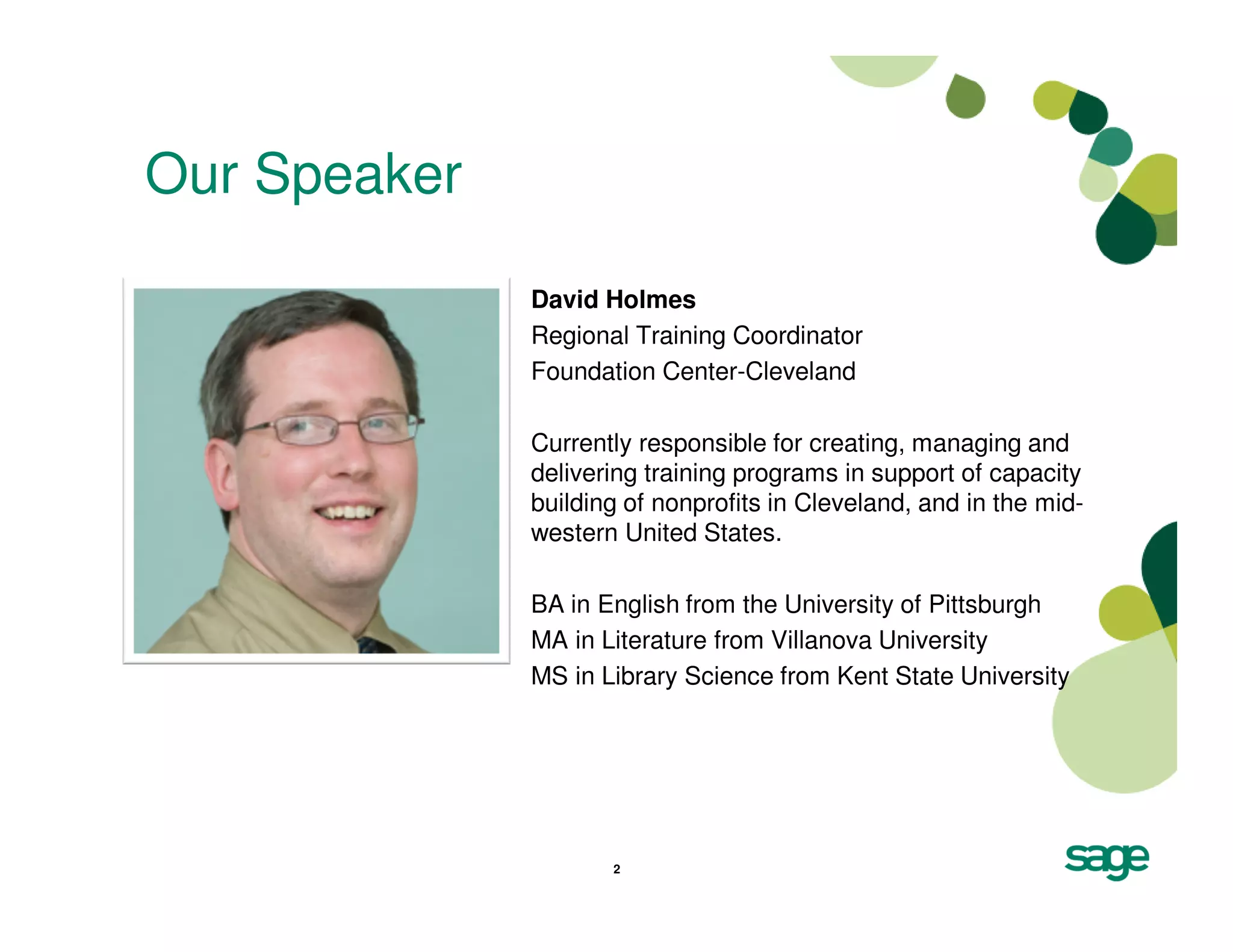
              David Holmes
              Regional Training Coordinator
              Foundation Center-Cleveland

              Currently responsible for creating, managing and
              delivering training programs in support of capacity
              building of nonprofits in Cleveland, and in the mid-
              western United States.

              BA in English from the University of Pittsburgh
              MA in Literature from Villanova University
              MS in Library Science from Kent State University


                     2
What You Will Learn Today

An overview of how to develop
a diverse fundraising plan, including:
• Conducting an assets inventory
• Developing a case statement
• Setting realistic fundraising goals
• Diversifying funding partners
• Preparing a timetable
The Importance of
Fundraising Planning
• Helps you set priorities
• Increases board involvement
• Assists in diversifying your fundraising
  vehicles
• Limits crisis fundraising
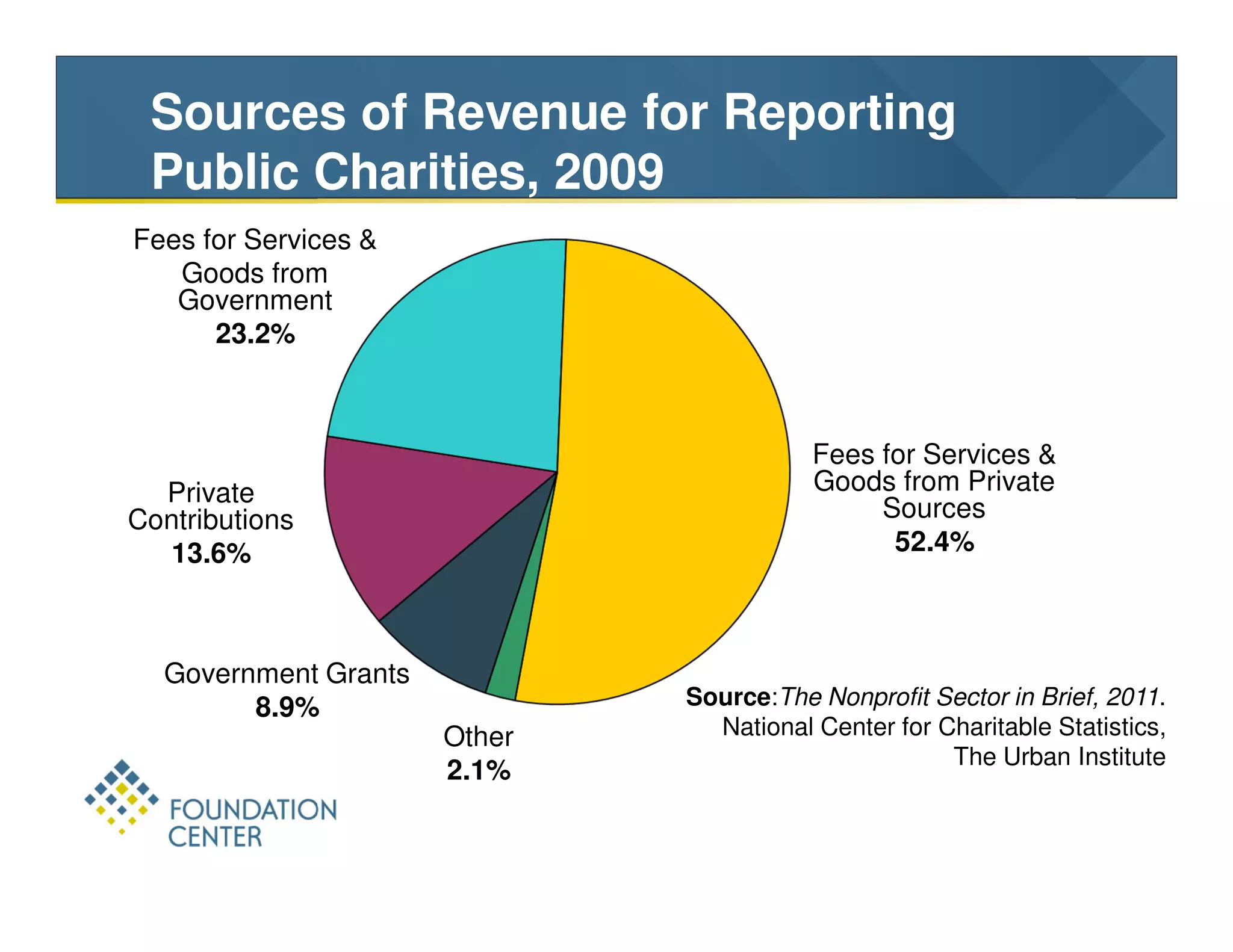
Sources of Revenue for Reporting
 Public Charities, 2009
Fees for Services &
   Goods from
   Government
      23.2%


                                         Fees for Services &
  Private                                Goods from Private
Contributions                                 Sources
   13.6%                                       52.4%


  Government Grants
        8.9%                  Source:The Nonprofit Sector in Brief, 2011.
                      Other     National Center for Charitable Statistics,
                                                     The Urban Institute
                      2.1%
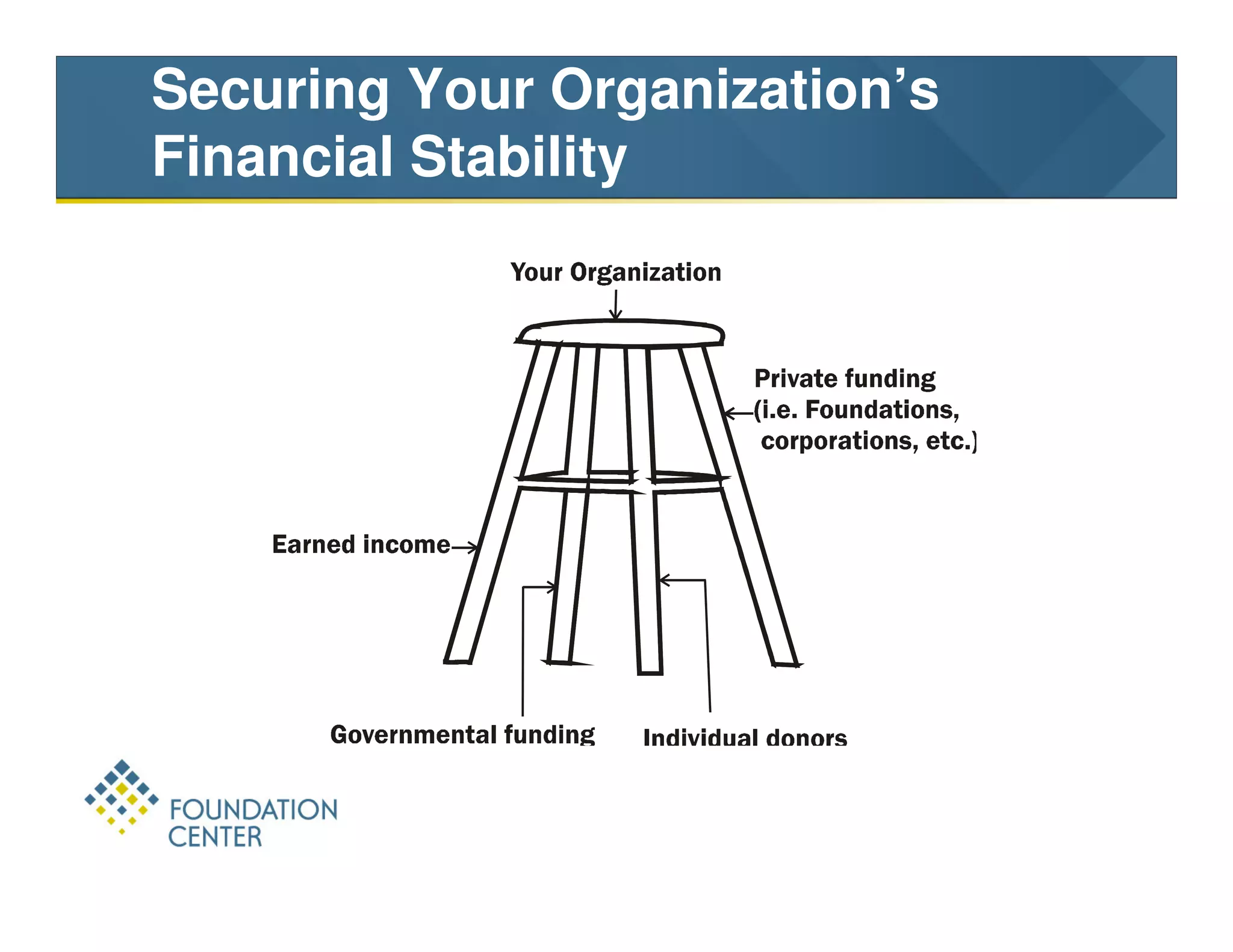
Securing Your Organization’s
Financial Stability
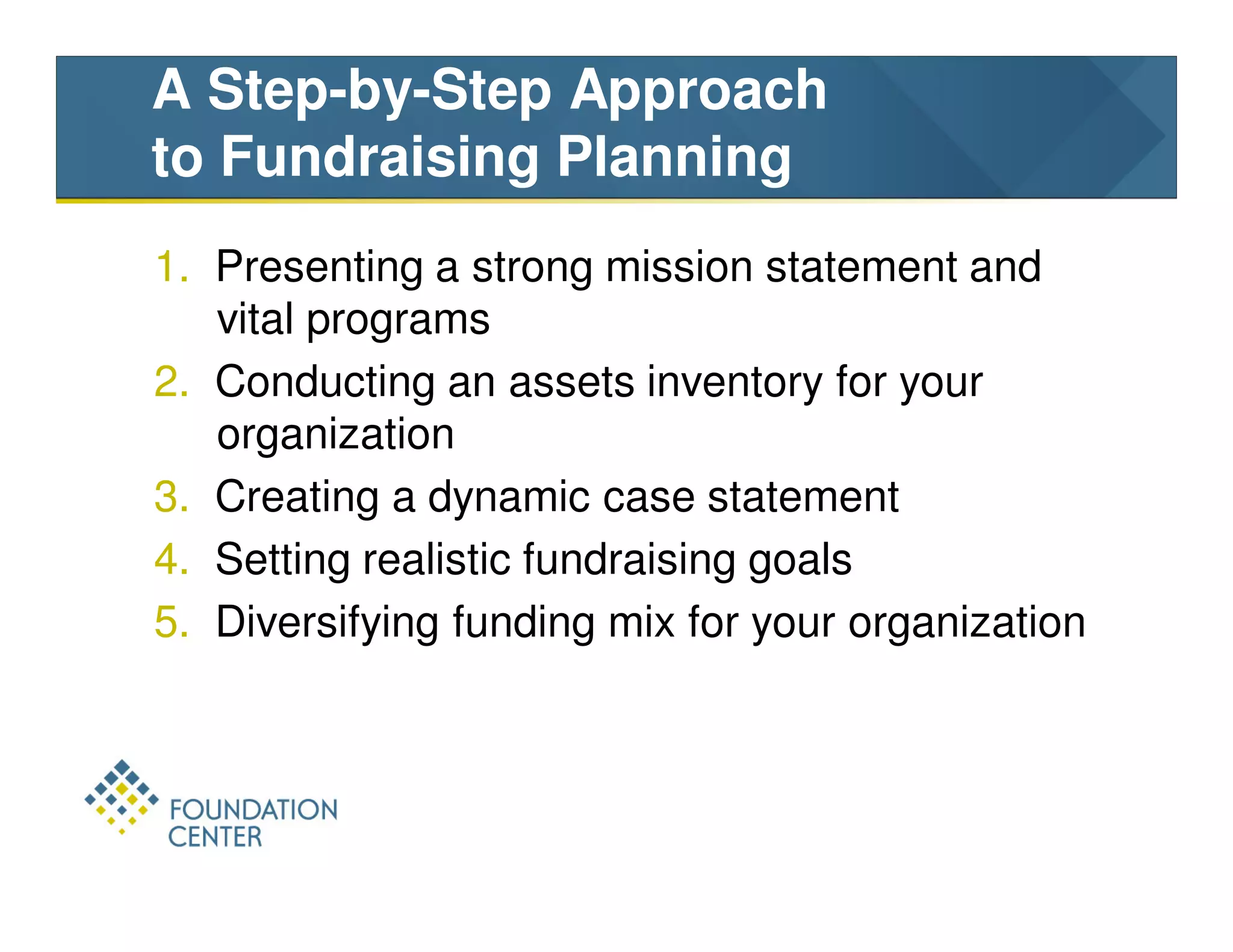
A Step-by-Step Approach
to Fundraising Planning
1. Presenting a strong mission statement and
   vital programs
2. Conducting an assets inventory for your
   organization
3. Creating a dynamic case statement
4. Setting realistic fundraising goals
5. Diversifying funding mix for your organization
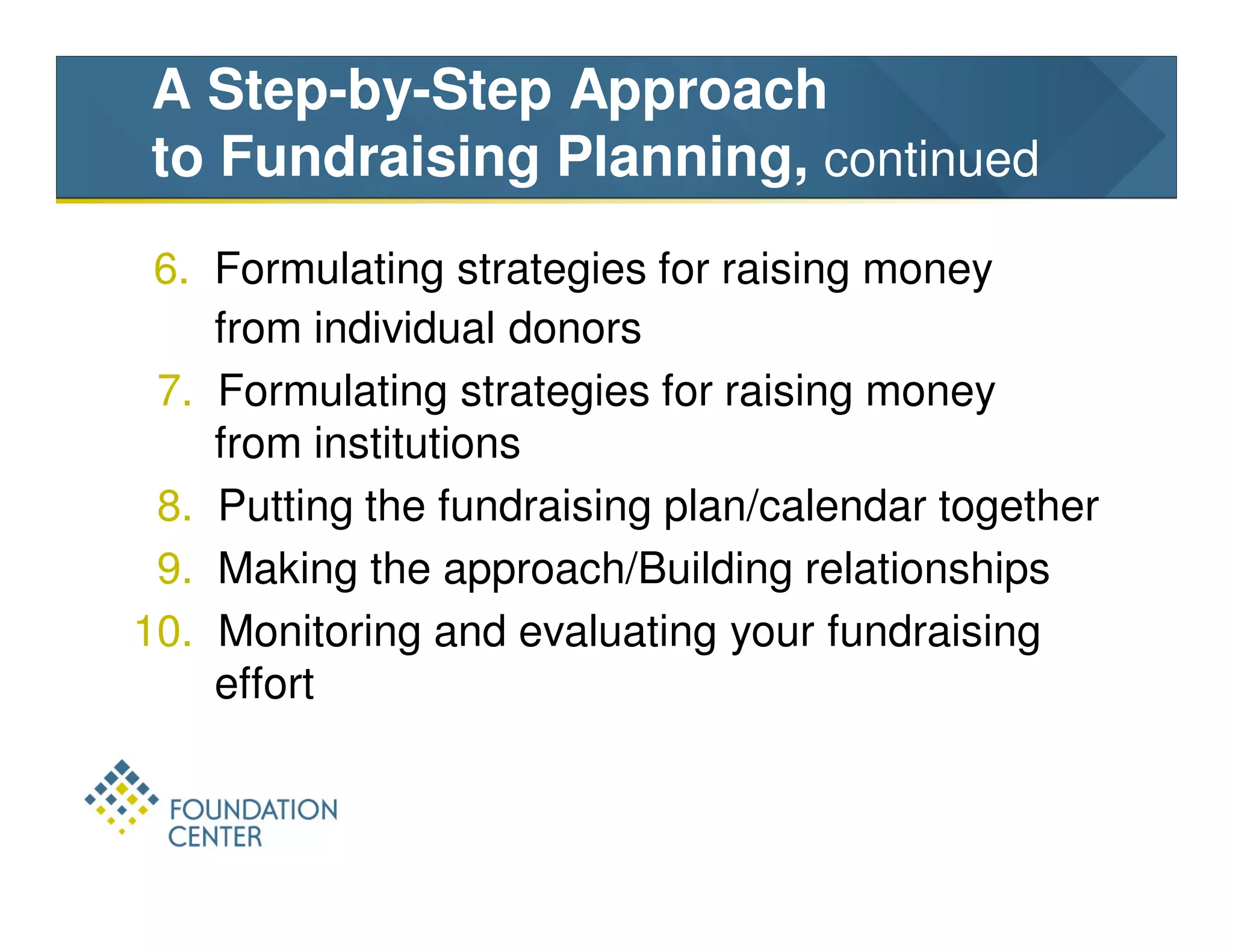
A Step-by-Step Approach
to Fundraising Planning, continued
 6. Formulating strategies for raising money
    from individual donors
 7. Formulating strategies for raising money
    from institutions
 8. Putting the fundraising plan/calendar together
 9. Making the approach/Building relationships
10. Monitoring and evaluating your fundraising
    effort
Presenting a Strong Mission
Statement
Sample mission statement
  “The mission of the Biloxi AIDS Service
  Organization is to help people both infected
  and affected by HIV/AIDS to secure adequate
  nutritional and health support to enhance
  their lives.”

Sample vision statement
  “Our ultimate goal is a world without
  HIV/AIDS.”
Conducting an Assets
   Inventory for
 Your Organization
Assess Strengths in the
Following Areas:
•   Program
•   Board and staff
•   Organizational
•   Funding
Case Study:
Youth for Community Action
The Youth for Community Action (YFCA) program was launched two years ago by a
large children/youth services agency to teach high school students leadership and
community organizing skills. Annual activities include monthly meetings, skill-
building retreats, a free one week summer camp (run with other youth service
agencies), and educational events.

In the past year, 25 youth participated from two high schools. The majority of
participants from the first year stayed in the program. They currently have a waiting
list and they would like to expand the program to other high schools for a total of 50
students. To do so, they need to almost double the program budget to $68,000.

YFCA was made possible by $20,000 in seed grants from three foundations; to
date, one has committed to continuing support. In addition, the youth have agreed to
help with fundraising as part of their skills training, and some parents expressed
interest in contributing or helping to raise funds.
YFCA fulfills an important need. It is the only project in the region that works with
teenagers to promote activism in partnership with community organizations,
government and educational institutions. The program is successful, with the need
to expand its services. The challenge is to find new funding sources and think of
additional income streams.
Establishing Your Case for
Support
• The reasons why your organization both
  needs and merits philanthropic support
• Include:
  – Mission
  – Programs and services
  – Accomplishments
  – Plans for the future
  – Budget needs
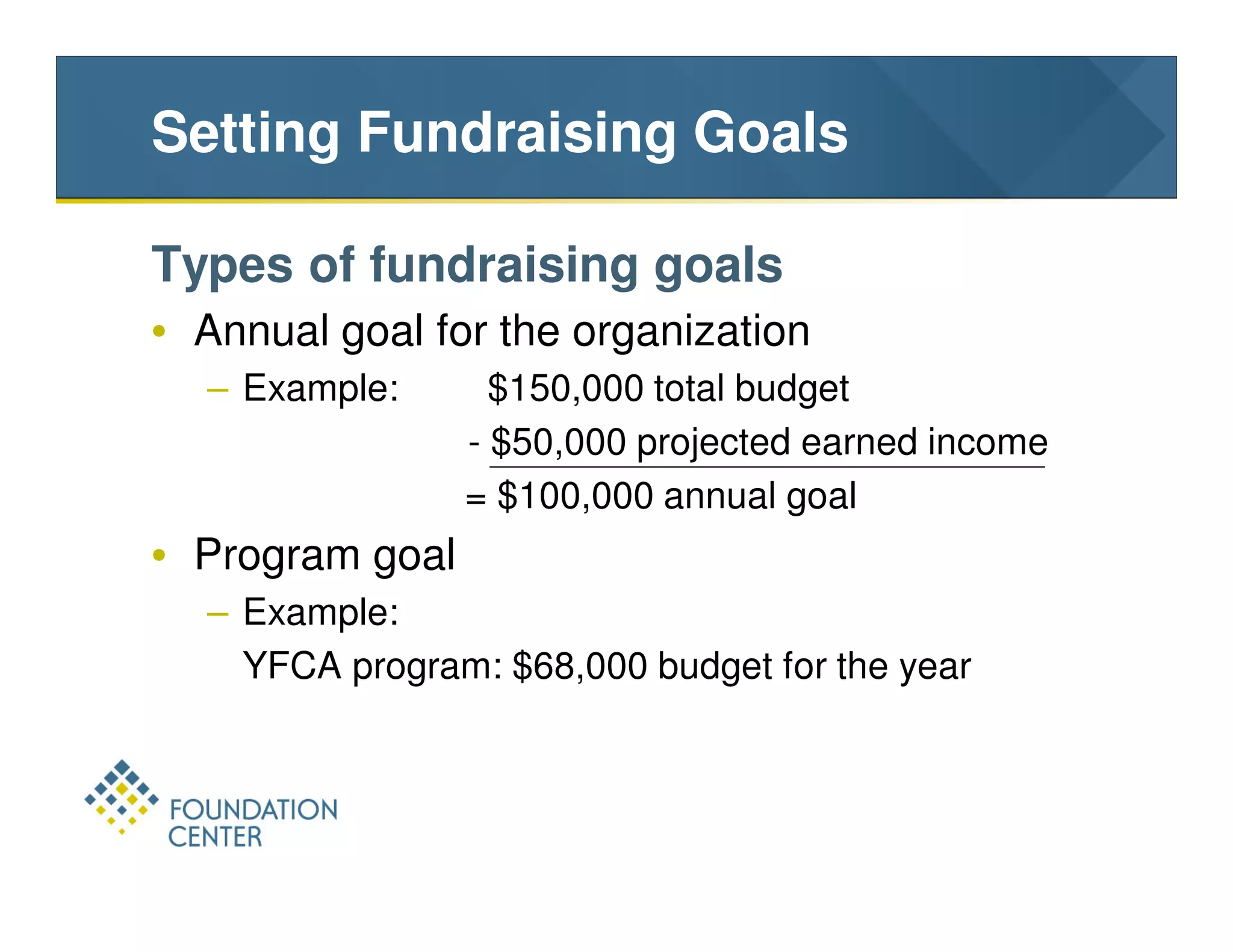
Setting Fundraising Goals

Types of fundraising goals
• Annual goal for the organization
  – Example:       $150,000 total budget
                 - $50,000 projected earned income
                 = $100,000 annual goal
• Program goal
  – Example:
    YFCA program: $68,000 budget for the year
Diversifying the Funding Mix for
Your Organization
• Which funding partners do you currently
  have?
• Which funding partners are viable for your
  funding mix? Which partners will provide
  long-term security?
• What level of support can you expect from
  each partner?
• How much time and money will it take to
  secure additional partners?
Putting the Fundraising Plan/
Calendar Together
1. Set a goal for each revenue strategy
2. Think through the details: who, when,
   what, where, and how.
3. Create a chart or narrative description
   outlining the details
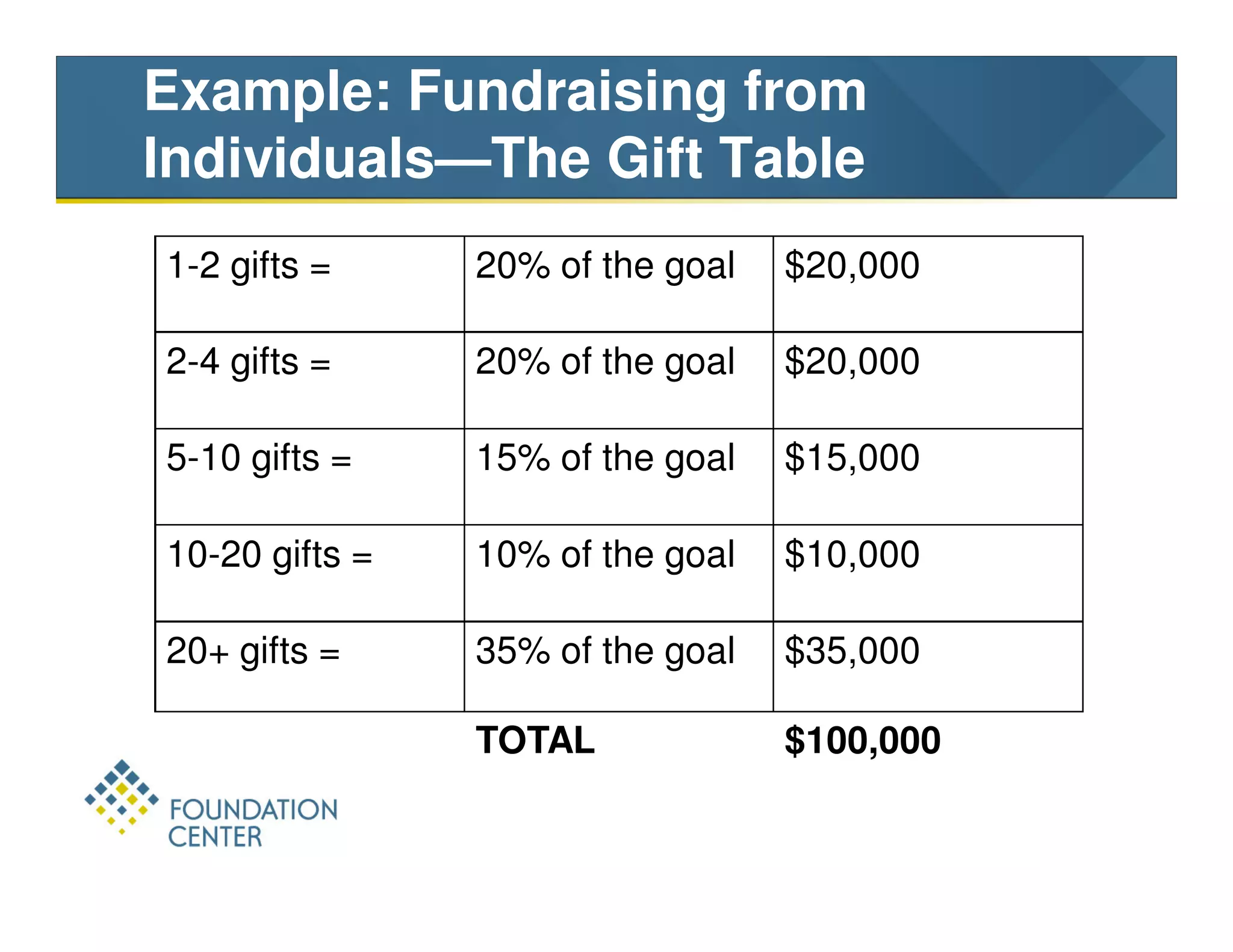
Example: Fundraising from
Individuals—The Gift Table
1-2 gifts =     20% of the goal   $20,000

2-4 gifts =     20% of the goal   $20,000

5-10 gifts =    15% of the goal   $15,000

10-20 gifts =   10% of the goal   $10,000

20+ gifts =     35% of the goal   $35,000

                TOTAL             $100,000
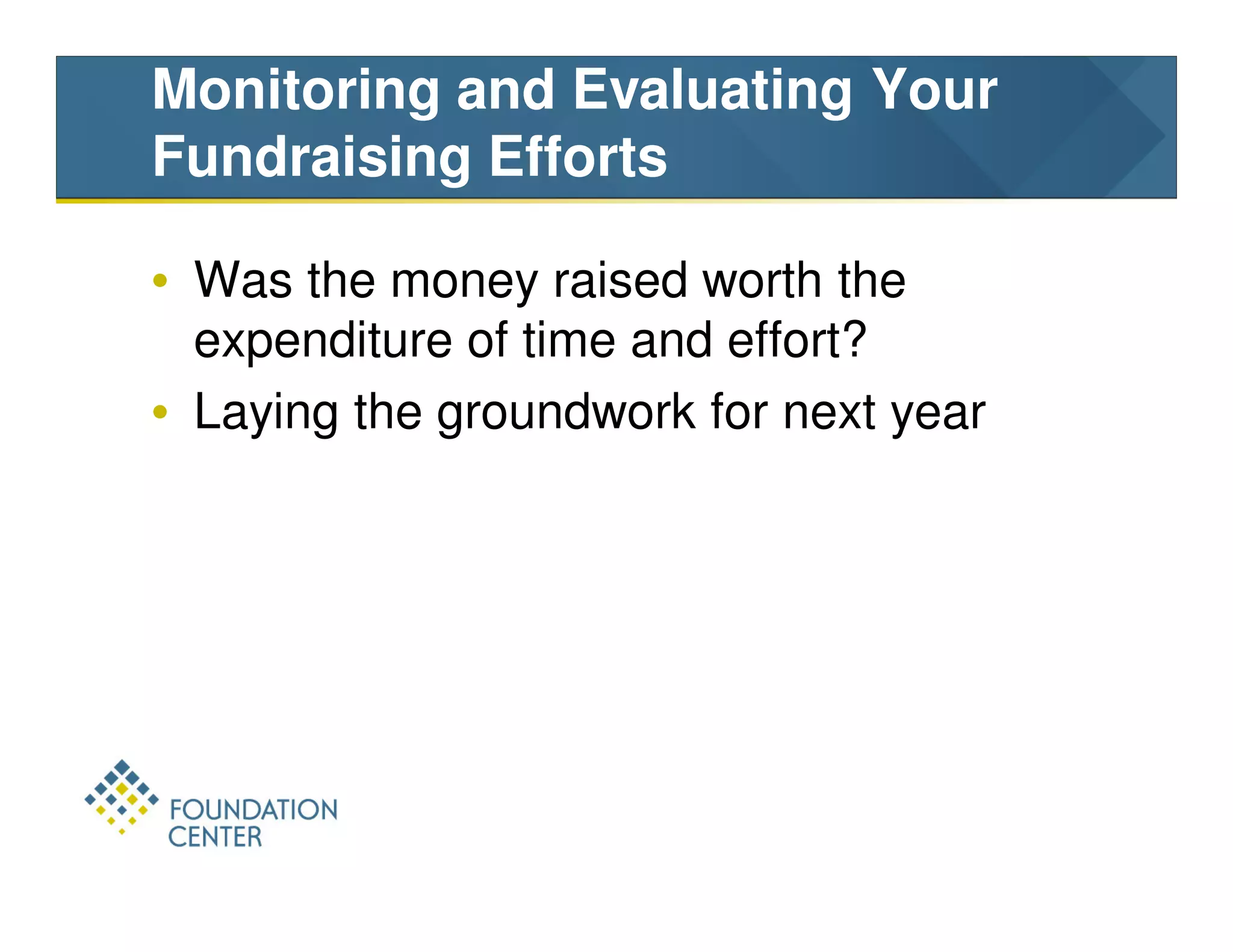
Monitoring and Evaluating Your
Fundraising Efforts

• Was the money raised worth the
  expenditure of time and effort?
• Laying the groundwork for next year
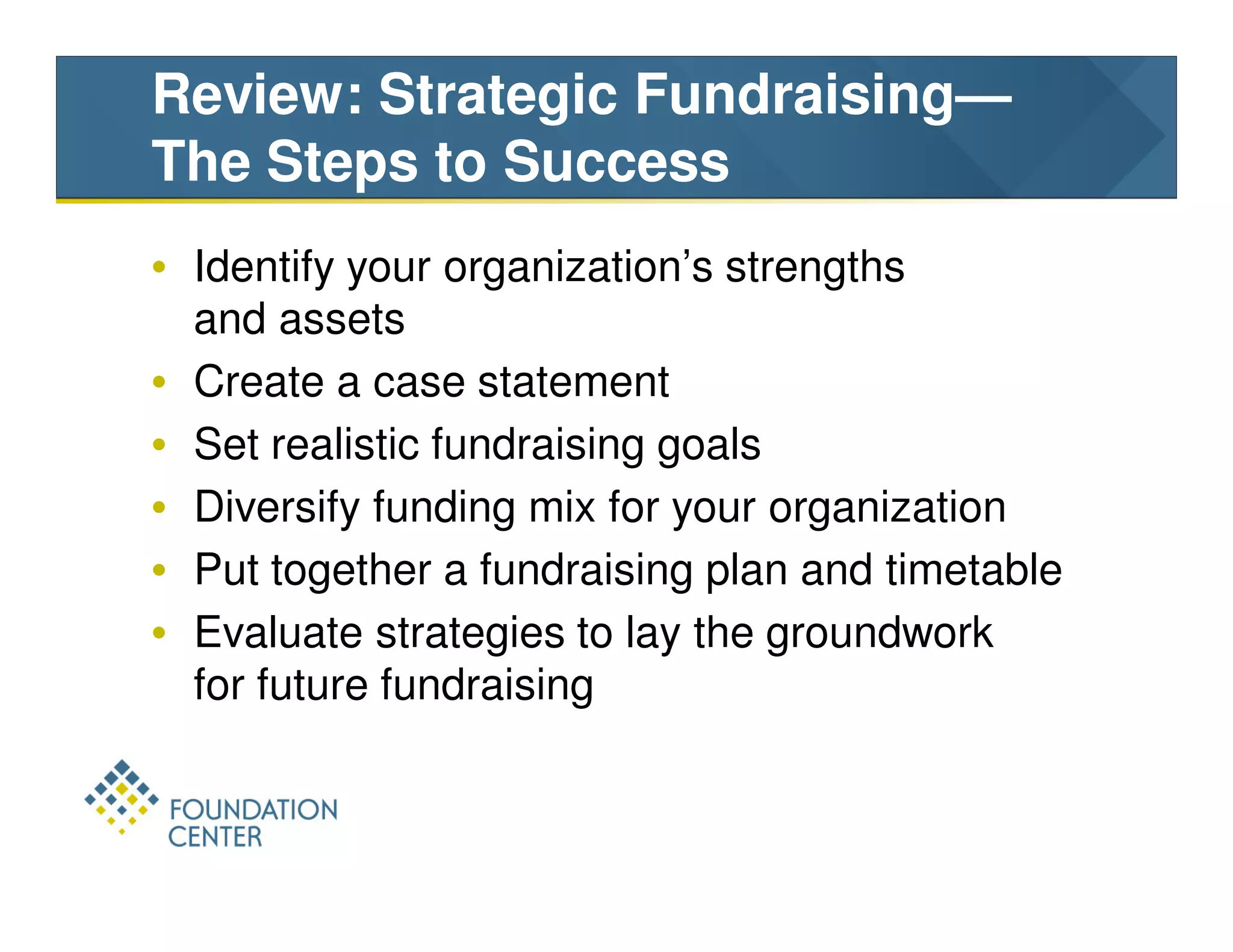
Review: Strategic Fundraising—
The Steps to Success
• Identify your organization’s strengths
  and assets
• Create a case statement
• Set realistic fundraising goals
• Diversify funding mix for your organization
• Put together a fundraising plan and timetable
• Evaluate strategies to lay the groundwork
  for future fundraising
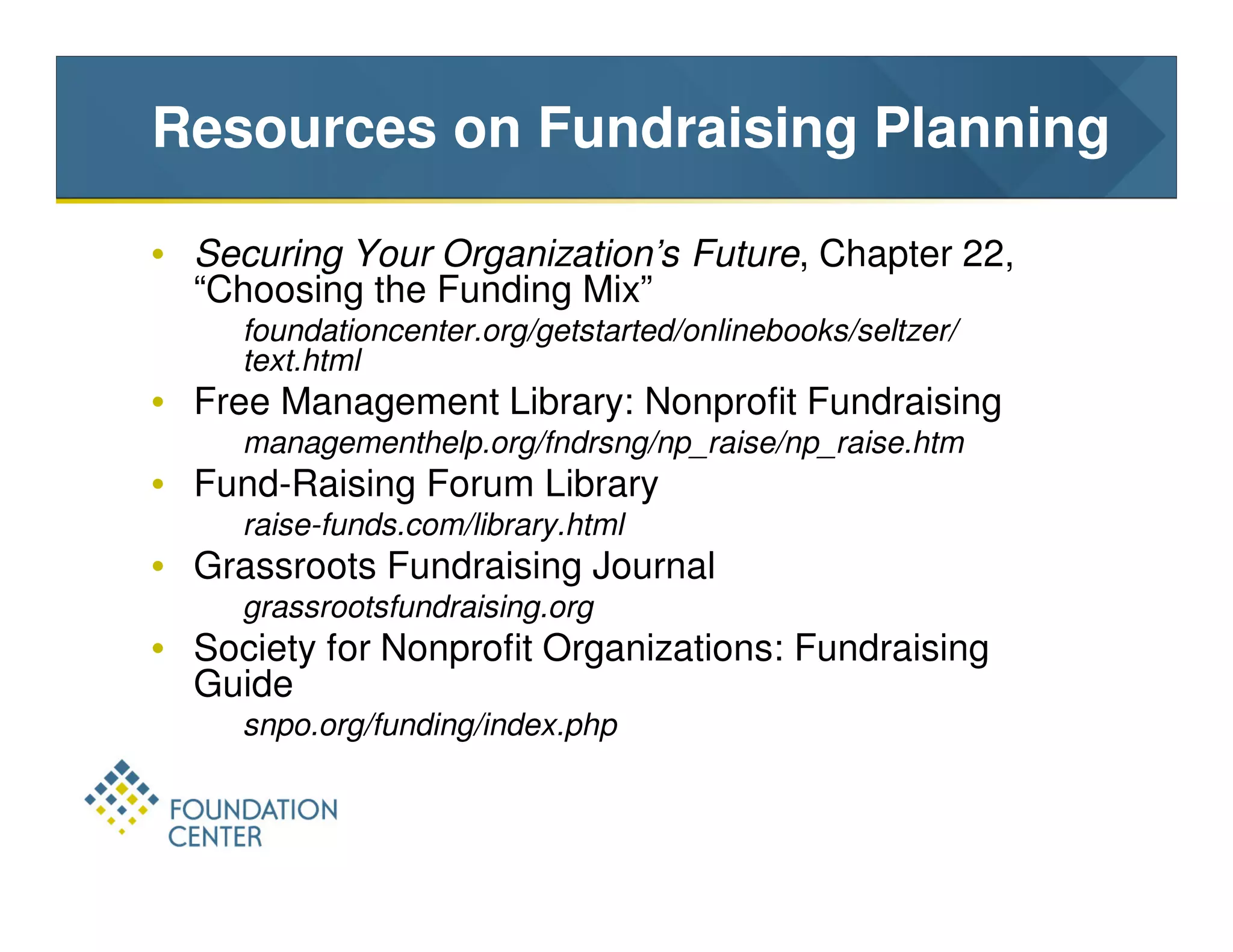
Resources on Fundraising Planning

• Securing Your Organization’s Future, Chapter 22,
  “Choosing the Funding Mix”
     foundationcenter.org/getstarted/onlinebooks/seltzer/
     text.html
• Free Management Library: Nonprofit Fundraising
     managementhelp.org/fndrsng/np_raise/np_raise.htm
• Fund-Raising Forum Library
     raise-funds.com/library.html
• Grassroots Fundraising Journal
     grassrootsfundraising.org
• Society for Nonprofit Organizations: Fundraising
  Guide
     snpo.org/funding/index.php
Questions
• Please type in chat at the bottom of the left hand
  viewing pane.


                            23
FYI
• Contact David: dmh <at>foundationcenter <dot> org
• Connect with Sage
   – Email nps <at> sage <dot> com
   – Download the presentation and handouts from
     www.slideshare.net/sagenonprofit
   – Read our blog, http://www.SageWords.net.
   – Like us on Facebook,
     http://www.facebook.com/sagenonprofit
   – Follow us on Twitter, http://www.twitter.com/sagenonprofit
   – Join the discussion in our group on LinkedIn.
   – Watch and follow on YouTube,
     http://www.youtube.com/user/SageNonprofit
   – Pin with us on www.Pinterest.com/SageNonprofit
                                24

Diversify Your Fundraising

  • 1.
    Welcome! Diversify Your Funding: AnIntroduction to Fundraising Planning
  • 2.
    Our Speaker David Holmes Regional Training Coordinator Foundation Center-Cleveland Currently responsible for creating, managing and delivering training programs in support of capacity building of nonprofits in Cleveland, and in the mid- western United States. BA in English from the University of Pittsburgh MA in Literature from Villanova University MS in Library Science from Kent State University 2
  • 3.
    What You WillLearn Today An overview of how to develop a diverse fundraising plan, including: • Conducting an assets inventory • Developing a case statement • Setting realistic fundraising goals • Diversifying funding partners • Preparing a timetable
  • 4.
    The Importance of FundraisingPlanning • Helps you set priorities • Increases board involvement • Assists in diversifying your fundraising vehicles • Limits crisis fundraising
  • 5.
    Sources of Revenuefor Reporting Public Charities, 2009 Fees for Services & Goods from Government 23.2% Fees for Services & Private Goods from Private Contributions Sources 13.6% 52.4% Government Grants 8.9% Source:The Nonprofit Sector in Brief, 2011. Other National Center for Charitable Statistics, The Urban Institute 2.1%
  • 6.
  • 7.
    A Step-by-Step Approach toFundraising Planning 1. Presenting a strong mission statement and vital programs 2. Conducting an assets inventory for your organization 3. Creating a dynamic case statement 4. Setting realistic fundraising goals 5. Diversifying funding mix for your organization
  • 8.
    A Step-by-Step Approach toFundraising Planning, continued 6. Formulating strategies for raising money from individual donors 7. Formulating strategies for raising money from institutions 8. Putting the fundraising plan/calendar together 9. Making the approach/Building relationships 10. Monitoring and evaluating your fundraising effort
  • 9.
    Presenting a StrongMission Statement Sample mission statement “The mission of the Biloxi AIDS Service Organization is to help people both infected and affected by HIV/AIDS to secure adequate nutritional and health support to enhance their lives.” Sample vision statement “Our ultimate goal is a world without HIV/AIDS.”
  • 10.
    Conducting an Assets Inventory for Your Organization
  • 11.
    Assess Strengths inthe Following Areas: • Program • Board and staff • Organizational • Funding
  • 12.
    Case Study: Youth forCommunity Action The Youth for Community Action (YFCA) program was launched two years ago by a large children/youth services agency to teach high school students leadership and community organizing skills. Annual activities include monthly meetings, skill- building retreats, a free one week summer camp (run with other youth service agencies), and educational events. In the past year, 25 youth participated from two high schools. The majority of participants from the first year stayed in the program. They currently have a waiting list and they would like to expand the program to other high schools for a total of 50 students. To do so, they need to almost double the program budget to $68,000. YFCA was made possible by $20,000 in seed grants from three foundations; to date, one has committed to continuing support. In addition, the youth have agreed to help with fundraising as part of their skills training, and some parents expressed interest in contributing or helping to raise funds. YFCA fulfills an important need. It is the only project in the region that works with teenagers to promote activism in partnership with community organizations, government and educational institutions. The program is successful, with the need to expand its services. The challenge is to find new funding sources and think of additional income streams.
  • 13.
    Establishing Your Casefor Support • The reasons why your organization both needs and merits philanthropic support • Include: – Mission – Programs and services – Accomplishments – Plans for the future – Budget needs
  • 14.
    Setting Fundraising Goals Typesof fundraising goals • Annual goal for the organization – Example: $150,000 total budget - $50,000 projected earned income = $100,000 annual goal • Program goal – Example: YFCA program: $68,000 budget for the year
  • 15.
    Diversifying the FundingMix for Your Organization • Which funding partners do you currently have? • Which funding partners are viable for your funding mix? Which partners will provide long-term security? • What level of support can you expect from each partner? • How much time and money will it take to secure additional partners?
  • 16.
    Putting the FundraisingPlan/ Calendar Together 1. Set a goal for each revenue strategy 2. Think through the details: who, when, what, where, and how. 3. Create a chart or narrative description outlining the details
  • 17.
    Example: Fundraising from Individuals—TheGift Table 1-2 gifts = 20% of the goal $20,000 2-4 gifts = 20% of the goal $20,000 5-10 gifts = 15% of the goal $15,000 10-20 gifts = 10% of the goal $10,000 20+ gifts = 35% of the goal $35,000 TOTAL $100,000
  • 18.
    Monitoring and EvaluatingYour Fundraising Efforts • Was the money raised worth the expenditure of time and effort? • Laying the groundwork for next year
  • 19.
    Review: Strategic Fundraising— TheSteps to Success • Identify your organization’s strengths and assets • Create a case statement • Set realistic fundraising goals • Diversify funding mix for your organization • Put together a fundraising plan and timetable • Evaluate strategies to lay the groundwork for future fundraising
  • 20.
    Resources on FundraisingPlanning • Securing Your Organization’s Future, Chapter 22, “Choosing the Funding Mix” foundationcenter.org/getstarted/onlinebooks/seltzer/ text.html • Free Management Library: Nonprofit Fundraising managementhelp.org/fndrsng/np_raise/np_raise.htm • Fund-Raising Forum Library raise-funds.com/library.html • Grassroots Fundraising Journal grassrootsfundraising.org • Society for Nonprofit Organizations: Fundraising Guide snpo.org/funding/index.php
  • 23.
    Questions • Please typein chat at the bottom of the left hand viewing pane. 23
  • 24.
    FYI • Contact David:dmh <at>foundationcenter <dot> org • Connect with Sage – Email nps <at> sage <dot> com – Download the presentation and handouts from www.slideshare.net/sagenonprofit – Read our blog, http://www.SageWords.net. – Like us on Facebook, http://www.facebook.com/sagenonprofit – Follow us on Twitter, http://www.twitter.com/sagenonprofit – Join the discussion in our group on LinkedIn. – Watch and follow on YouTube, http://www.youtube.com/user/SageNonprofit – Pin with us on www.Pinterest.com/SageNonprofit 24