Legacy Giving in Your “Spare” Time
An outcomes-based approach to attracting long-term support


               Greg Lassonde, CFRE
              Legacy Giving Specialist
                  (510) 482-1502
                 greglassonde.com
                 legacygiving.com
I. Why
 II. How
III. Random Questions
“Why” Overview
• Tremendous Revenue Opportunity
• Legacy Giving Building Blocks
  Philosophy
• Why Legacy Giving is Important
• Common Obstacles to starting a
  program
• Why People Create Legacy Gifts
• Measuring Success
Define Legacy Giving?

• To convey one's values through
  creation of a future gift to charity

• A foresighted action to strengthen a
  favorite cause
Legacy Gifts
• Provide future support for charity
  (sometimes current)
• Are contributions:
  – by will
  – trust
  – other forms of written designation
  – life-income arrangements
  – endowment gifts
                                         5
Legacy Gifts
• Are created by:
  – Any individual
  – At any point in his / her life


                                     6
Simple & Easy Via Beneficiary
           Form
•   Savings account
•   Checking account
•   Stocks or bonds
•   IRA or pension
•   Life Insurance policy
More Complicated Types
•   Will or living trust
•   Charitable gift annuity
•   Life income trust
•   Many others
Tremendous Opportunity
• Seven out of ten Americans make gifts
  to charity during their lifetime.

• Yet fewer than one in ten leaves a gift to
  charity in their will or trust. Why?

• Because most people have never been
  asked!
Building Blocks Philosophy
• Emphasize sustainability and resource
  management
• Describe long-term objectives and outcomes
• Engage volunteers, supporters and staff
• Focus on relationships, not techno-babble
Building Blocks Philosophy
• Express ongoing appreciation of legacy
  donors
• Communicate how legacy giving impacts
  mission
• Simple plan, consistently applied
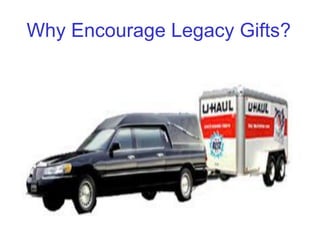
Why Encourage Legacy Gifts?
Why Legacy Gifts Are Important

• Almost everyone is a prospect
• For most people it’s the largest gift they
  make
• It has the lowest cost of fundraising
• Legacy donors make larger annual gifts


                                               13
Why Legacy Gifts Are Important

• Only a small percentage of donors asked
• Wide variety of options, many easy to
  create
• Only revenue that increases during
  recession
• Staggering transfer of wealth in next 50
  years

                                         14
Common Obstacles to
        Starting a Program
• Uncertain why it’s important
• Subject matter perceived to be too difficult
• Concern it takes a lot of staff time
• Fear that it requires a large budget
• Misconception that only wealthy create
  them
• Unsure how to obtain board / staff support
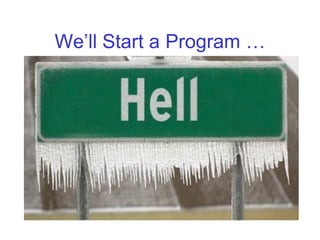
We’ll Start a Program …
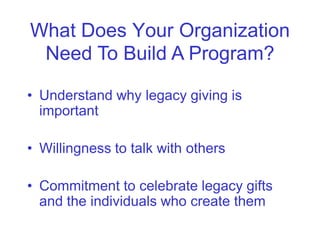
What Does Your Organization
 Need To Build A Program?

• Understand why legacy giving is
  important

• Willingness to talk with others

• Commitment to celebrate legacy gifts
  and the individuals who create them
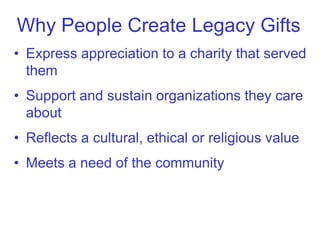
Why People Create Legacy Gifts
• Express appreciation to a charity that served
  them
• Support and sustain organizations they care
  about
• Reflects a cultural, ethical or religious value
• Meets a need of the community
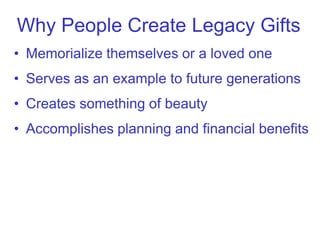
Why People Create Legacy Gifts
• Memorialize themselves or a loved one
• Serves as an example to future generations
• Creates something of beauty
• Accomplishes planning and financial benefits
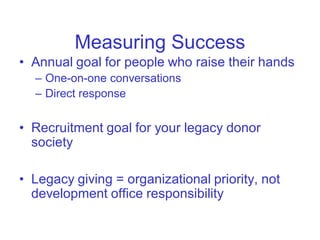
Measuring Success
• Annual goal for people who raise their hands
  – One-on-one conversations
  – Direct response


• Recruitment goal for your legacy donor
  society

• Legacy giving = organizational priority, not
  development office responsibility
Building Blocks

• Mission, Legacy Giving & Endowment
  – Understanding why legacy giving is important
• Case
  – Describing how legacy giving will help your
    organization
• Leadership
  – Involving board and staff leadership in your program
• Prospects
  – Identifying and approaching the best supporters


                                                       21
Building Blocks

• Stewardship
  – Fostering and supporting relationships with
    those who have committed
• Communications and Marketing
  – Sharing your story and promoting
    opportunities
• Program Plan
  – Defining and building a plan for sustainable
    revenue

                                                   22
Why Building Blocks Works
• Easy to understand

• Defines legacy giving goals

• Focuses on engaging staff and volunteer
  leaders

• Simple prospect education & cultivation
  strategies
Why Building Blocks Works
• Emphasizes stewarding relationships

• Promotes outcomes-based communication

• Straightforward plan, consistently applied
  over time

• Create culture that values long-term
  support
II. How

A.   Prepare for and Develop Your Case

B.   Launch Your Bequest Program

C.   Additional resources
A. Prepare for and Develop Case

• Organizational long term
  commitment
• Determine your market
  – Major donors =     MINORITY
  – Smaller donors =   MAJORITY
• Ask peer’s, “What’s working?”
A. Prepare for and Develop Case

• Volunteer and staff “buy in”
  – Development, administration, finance
  – Board officers, committees
• Be prepared to spend $ (even a
  little)
  – Basic brochure
  – Donor Recognition
A. Prepare for and Develop Case

 • Draft a case statement
   – Specific / unique needs for
     endowment
   – Dollars needed
      • For what
      • By when
   – Work through committees / board
      • Gift(s) at each stage
A. Prepare for and Develop Case

• Board resolution
  – Committee structure
  – Ethics (Model Standards of Practice)
  – Vehicles permitted
  – Gift uses
     • Endowment
     • Endowment & capital
     • Spend it now? (sometimes)
B. Launch Bequest Program

• Start with key volunteers
• Utilize direct response opportunities
  – Newsletter
  – Direct mail checkbox
  – Acknowledgement slip
  – Bequest Mailing
• Brochure
B. Launch Bequest Program

• Prompt Response to Inquiries
  – General letter with handouts
  – Follow up phone call(s)
• Legacy Giving Committee
  – Volunteers make the gift
B. Launch Bequest Program

• Legacy Giving Committee
  – Members make the gift
  – You staff volunteer efforts
     • scripts and other materials
     • regular contact
     • reward success
     • spread the word
B. Launch Bequest Program

• Recognition society
  – Personal name / key word
  – Welcome letter, enrollment form,
    certificate
  – Annual event
• Promote designations
  – Insurance, retirement plan / IRA,
    checking, saving, stocks / bonds
C. Additional resources
• Partnership for Philanthropic
  Planning
  – Journal of Gift Planning
• Northern CA Planned Giving
  Council
  – Basics Course, Primer Program,
    Annual Conference Fundamentals
    Track
• Planned Giving Today
C. Additional resources
• Planned Giving: Management,
  Marketing and Law; Second Edition
• The Complete Guide to Planned Giving;
  Revised Third Addition
Thank You!

For more information and resources:
      www.greglassonde.com
      www.legacygiving.com
Legacy Giving In Your Spare Time

  • 1.
    Legacy Giving inYour “Spare” Time An outcomes-based approach to attracting long-term support Greg Lassonde, CFRE Legacy Giving Specialist (510) 482-1502 greglassonde.com legacygiving.com
  • 2.
    I. Why II.How III. Random Questions
  • 3.
    “Why” Overview • TremendousRevenue Opportunity • Legacy Giving Building Blocks Philosophy • Why Legacy Giving is Important • Common Obstacles to starting a program • Why People Create Legacy Gifts • Measuring Success
  • 4.
    Define Legacy Giving? •To convey one's values through creation of a future gift to charity • A foresighted action to strengthen a favorite cause
  • 5.
    Legacy Gifts • Providefuture support for charity (sometimes current) • Are contributions: – by will – trust – other forms of written designation – life-income arrangements – endowment gifts 5
  • 6.
    Legacy Gifts • Arecreated by: – Any individual – At any point in his / her life 6
  • 7.
    Simple & EasyVia Beneficiary Form • Savings account • Checking account • Stocks or bonds • IRA or pension • Life Insurance policy
  • 8.
    More Complicated Types • Will or living trust • Charitable gift annuity • Life income trust • Many others
  • 9.
    Tremendous Opportunity • Sevenout of ten Americans make gifts to charity during their lifetime. • Yet fewer than one in ten leaves a gift to charity in their will or trust. Why? • Because most people have never been asked!
  • 10.
    Building Blocks Philosophy •Emphasize sustainability and resource management • Describe long-term objectives and outcomes • Engage volunteers, supporters and staff • Focus on relationships, not techno-babble
  • 11.
    Building Blocks Philosophy •Express ongoing appreciation of legacy donors • Communicate how legacy giving impacts mission • Simple plan, consistently applied
  • 12.
  • 13.
    Why Legacy GiftsAre Important • Almost everyone is a prospect • For most people it’s the largest gift they make • It has the lowest cost of fundraising • Legacy donors make larger annual gifts 13
  • 14.
    Why Legacy GiftsAre Important • Only a small percentage of donors asked • Wide variety of options, many easy to create • Only revenue that increases during recession • Staggering transfer of wealth in next 50 years 14
  • 15.
    Common Obstacles to Starting a Program • Uncertain why it’s important • Subject matter perceived to be too difficult • Concern it takes a lot of staff time • Fear that it requires a large budget • Misconception that only wealthy create them • Unsure how to obtain board / staff support
  • 16.
    We’ll Start aProgram …
  • 17.
    What Does YourOrganization Need To Build A Program? • Understand why legacy giving is important • Willingness to talk with others • Commitment to celebrate legacy gifts and the individuals who create them
  • 18.
    Why People CreateLegacy Gifts • Express appreciation to a charity that served them • Support and sustain organizations they care about • Reflects a cultural, ethical or religious value • Meets a need of the community
  • 19.
    Why People CreateLegacy Gifts • Memorialize themselves or a loved one • Serves as an example to future generations • Creates something of beauty • Accomplishes planning and financial benefits
  • 20.
    Measuring Success • Annualgoal for people who raise their hands – One-on-one conversations – Direct response • Recruitment goal for your legacy donor society • Legacy giving = organizational priority, not development office responsibility
  • 21.
    Building Blocks • Mission,Legacy Giving & Endowment – Understanding why legacy giving is important • Case – Describing how legacy giving will help your organization • Leadership – Involving board and staff leadership in your program • Prospects – Identifying and approaching the best supporters 21
  • 22.
    Building Blocks • Stewardship – Fostering and supporting relationships with those who have committed • Communications and Marketing – Sharing your story and promoting opportunities • Program Plan – Defining and building a plan for sustainable revenue 22
  • 23.
    Why Building BlocksWorks • Easy to understand • Defines legacy giving goals • Focuses on engaging staff and volunteer leaders • Simple prospect education & cultivation strategies
  • 24.
    Why Building BlocksWorks • Emphasizes stewarding relationships • Promotes outcomes-based communication • Straightforward plan, consistently applied over time • Create culture that values long-term support
  • 25.
    II. How A. Prepare for and Develop Your Case B. Launch Your Bequest Program C. Additional resources
  • 26.
    A. Prepare forand Develop Case • Organizational long term commitment • Determine your market – Major donors = MINORITY – Smaller donors = MAJORITY • Ask peer’s, “What’s working?”
  • 27.
    A. Prepare forand Develop Case • Volunteer and staff “buy in” – Development, administration, finance – Board officers, committees • Be prepared to spend $ (even a little) – Basic brochure – Donor Recognition
  • 28.
    A. Prepare forand Develop Case • Draft a case statement – Specific / unique needs for endowment – Dollars needed • For what • By when – Work through committees / board • Gift(s) at each stage
  • 29.
    A. Prepare forand Develop Case • Board resolution – Committee structure – Ethics (Model Standards of Practice) – Vehicles permitted – Gift uses • Endowment • Endowment & capital • Spend it now? (sometimes)
  • 30.
    B. Launch BequestProgram • Start with key volunteers • Utilize direct response opportunities – Newsletter – Direct mail checkbox – Acknowledgement slip – Bequest Mailing • Brochure
  • 31.
    B. Launch BequestProgram • Prompt Response to Inquiries – General letter with handouts – Follow up phone call(s) • Legacy Giving Committee – Volunteers make the gift
  • 32.
    B. Launch BequestProgram • Legacy Giving Committee – Members make the gift – You staff volunteer efforts • scripts and other materials • regular contact • reward success • spread the word
  • 33.
    B. Launch BequestProgram • Recognition society – Personal name / key word – Welcome letter, enrollment form, certificate – Annual event • Promote designations – Insurance, retirement plan / IRA, checking, saving, stocks / bonds
  • 34.
    C. Additional resources •Partnership for Philanthropic Planning – Journal of Gift Planning • Northern CA Planned Giving Council – Basics Course, Primer Program, Annual Conference Fundamentals Track • Planned Giving Today
  • 35.
    C. Additional resources •Planned Giving: Management, Marketing and Law; Second Edition • The Complete Guide to Planned Giving; Revised Third Addition
  • 36.
    Thank You! For moreinformation and resources: www.greglassonde.com www.legacygiving.com