Building
Sustainability
Miquel Leon-Canete
& Sarah Elliott
14th September 2018
Agenda
• Why do we need to plan?
• Fundraising methods
• Understanding the funder
• How HCF Training and Development can help you
Why do we need to plan?
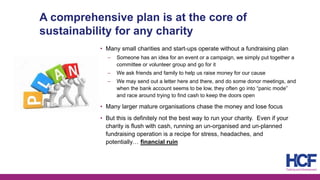
A comprehensive plan is at the core of
sustainability for any charity
• Many small charities and start-ups operate without a fundraising plan
‒ Someone has an idea for an event or a campaign, we simply put together a
committee or volunteer group and go for it
‒ We ask friends and family to help us raise money for our cause
‒ We may send out a letter here and there, and do some donor meetings, and
when the bank account seems to be low, they often go into “panic mode”
and race around trying to find cash to keep the doors open
• Many larger mature organisations chase the money and lose focus
• But this is definitely not the best way to run your charity. Even if your
charity is flush with cash, running an un-organised and un-planned
fundraising operation is a recipe for stress, headaches, and
potentially… financial ruin
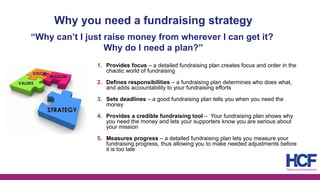
Why you need a fundraising strategy
“Why can’t I just raise money from wherever I can get it?
Why do I need a plan?”
1. Provides focus – a detailed fundraising plan creates focus and order in the
chaotic world of fundraising
2. Defines responsibilities – a fundraising plan determines who does what,
and adds accountability to your fundraising efforts
3. Sets deadlines – a good fundraising plan tells you when you need the
money
4. Provides a credible fundraising tool – Your fundraising plan shows why
you need the money and lets your supporters know you are serious about
your mission
5. Measures progress – a detailed fundraising plan lets you measure your
fundraising progress, thus allowing you to make needed adjustments before
it is too late
Finally – you will raise more money
You will have time to…
…. do the work required to court major donors
…. to plan an incredible gala
…. to develop a year-end fundraising campaign
or to get your web site donation process working
smoothly
Fundraising Methods
INDIVIDUALS
PROS
• The most effective of all fundraising
methods. Nothing beats personally
asking someone to give.
• Gifts can be large.
• Do your board members have wealthy
contacts?
• Personal relationships can increase
the chances of repeat giving or
perhaps a legacy
• In person, it's harder to say no.
• A gift from an individual paves the way
for more gifts, as well as other kinds of
help. (Gift Aid)
CONS
• Very labour intensive.
• May involve an intermediary (e.g.
solicitor) trying to sell your organisation
• You need a file of biographical data on
potential donors - research can be
time-consuming.
• Most people hate to ask for gifts,
because they fear rejection. (But the
fear can be conquered!)
CORPORATES
PROS
• A "win-win". The company gets
credit (CSR); you receive support
• Could increase your organisation's
visibility via the link to a high-profile
company
• Corporate collaboration often leads
to corporate philanthropy. Once you
establish relationships they're much
more likely to say "yes" to your grant
proposal
• Collaboration is the future. Very few
businesses are willing to give
"something for nothing" anymore
CONS
• "Who knows who" is key. If you don't
have a "contact" to open corporate
doors, you won't get far
• Developing relations takes time. You
must be willing to put in months of
alliance-building before seeing a
payoff
• You may have to educate
companies as well as your staff
about how valuable corporate
collaborations can be for both
parties
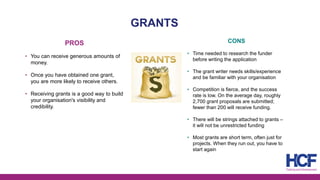
GRANTS
PROS
• You can receive generous amounts of
money.
• Once you have obtained one grant,
you are more likely to receive others.
• Receiving grants is a good way to build
your organisation's visibility and
credibility.
CONS
• Time needed to research the funder
before writing the application
• The grant writer needs skills/experience
and be familiar with your organisation
• Competition is fierce, and the success
rate is low. On the average day, roughly
2,700 grant proposals are submitted;
fewer than 200 will receive funding.
• There will be strings attached to grants –
it will not be unrestricted funding
• Most grants are short term, often just for
projects. When they run out, you have to
start again
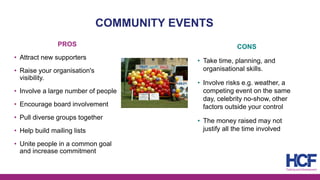
COMMUNITY EVENTS
PROS
• Attract new supporters
• Raise your organisation's
visibility.
• Involve a large number of people
• Encourage board involvement
• Pull diverse groups together
• Help build mailing lists
• Unite people in a common goal
and increase commitment
CONS
• Take time, planning, and
organisational skills.
• Involve risks e.g. weather, a
competing event on the same
day, celebrity no-show, other
factors outside your control
• The money raised may not
justify all the time involved
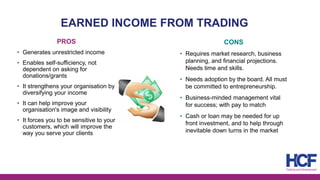
EARNED INCOME FROM TRADING
PROS
• Generates unrestricted income
• Enables self-sufficiency, not
dependent on asking for
donations/grants
• It strengthens your organisation by
diversifying your income
• It can help improve your
organisation's image and visibility
• It forces you to be sensitive to your
customers, which will improve the
way you serve your clients
CONS
• Requires market research, business
planning, and financial projections.
Needs time and skills.
• Needs adoption by the board. All must
be committed to entrepreneurship.
• Business-minded management vital
for success; with pay to match
• Cash or loan may be needed for up
front investment, and to help through
inevitable down turns in the market
Understanding the Funder
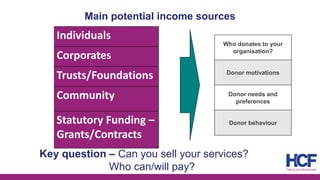
Main potential income sources
Individuals
Corporates
Trusts/Foundations
Community
Statutory Funding –
Grants/Contracts
Who donates to your
organisation?
Donor motivations
Donor needs and
preferences
Donor behaviour
Key question – Can you sell your services?
Who can/will pay?
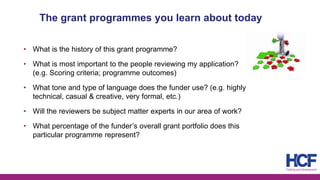
The grant programmes you learn about today
• What is the history of this grant programme?
• What is most important to the people reviewing my application?
(e.g. Scoring criteria; programme outcomes)
• What tone and type of language does the funder use? (e.g. highly
technical, casual & creative, very formal, etc.)
• Will the reviewers be subject matter experts in our area of work?
• What percentage of the funder’s overall grant portfolio does this
particular programme represent?
How we can help …
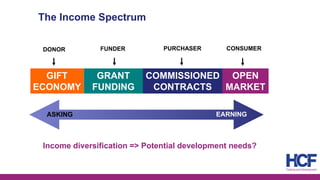
The Income Spectrum
GIFT
ECONOMY
GRANT
FUNDING
COMMISSIONED
CONTRACTS
OPEN
MARKET
DONOR FUNDER PURCHASER CONSUMER
ASKING EARNING
Income diversification => Potential development needs?
Do you have the right skills to thrive?
• Is your fundraising team the best it can be to
succeed in a competitive world?
• Do you have a fundraising strategy that is up to
date and fit for purpose?
• Do you have a good enough understanding of
the potential sources of income for your
organisation?
The right knowledge, skills and planning will
help to maximise your return in investment
from fundraising
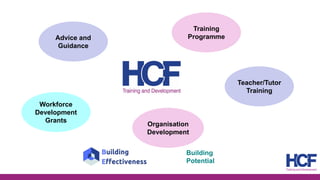
Advice and
Guidance
Training
Programme
Workforce
Development
Grants
Teacher/Tutor
Training
Organisation
Development
Building
Potential
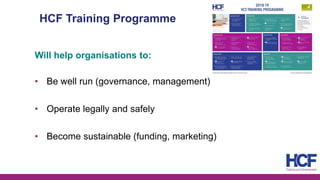
HCF Training Programme
Will help organisations to:
• Be well run (governance, management)
• Operate legally and safely
• Become sustainable (funding, marketing)
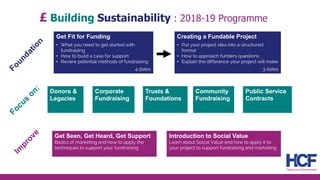
£ Building Sustainability : 2018-19 Programme
Get Fit for Funding
• What you need to get started with
fundraising
• How to build a case for support
• Review potential methods of fundraising
4 dates
Creating a Fundable Project
• Put your project idea into a structured
format
• How to approach funders questions
• Explain the difference your project will make
3 dates
Donors &
Legacies
Corporate
Fundraising
Trusts &
Foundations
Community
Fundraising
Public Service
Contracts
Get Seen, Get Heard, Get Support
Basics of marketing and how to apply the
techniques to support your fundraising
Introduction to Social Value
Learn about Social Value and how to apply it to
your project to support fundraising and marketing
Fundraising Strategy Development
• 3 x 3 hour workshops delivered in house to your team
• 1. Analysis of the organisation and its needs
• 2. Identify and choose priority income sources
• 3. Develop the plan
• Outcomes:
‒ Your bespoke fundraising plan
‒ Tools, templates and techniques for future reviews
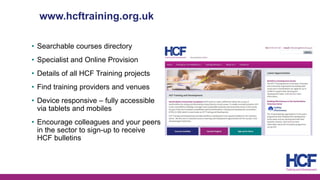
www.hcftraining.org.uk
• Searchable courses directory
• Specialist and Online Provision
• Details of all HCF Training projects
• Find training providers and venues
• Device responsive – fully accessible
via tablets and mobiles
• Encourage colleagues and your peers
in the sector to sign-up to receive
HCF bulletins
HCF Training - Building Sustainability Workshop

HCF Training - Building Sustainability Workshop

  • 1.
  • 2.
    Agenda • Why dowe need to plan? • Fundraising methods • Understanding the funder • How HCF Training and Development can help you
  • 3.
    Why do weneed to plan?
  • 4.
    A comprehensive planis at the core of sustainability for any charity • Many small charities and start-ups operate without a fundraising plan ‒ Someone has an idea for an event or a campaign, we simply put together a committee or volunteer group and go for it ‒ We ask friends and family to help us raise money for our cause ‒ We may send out a letter here and there, and do some donor meetings, and when the bank account seems to be low, they often go into “panic mode” and race around trying to find cash to keep the doors open • Many larger mature organisations chase the money and lose focus • But this is definitely not the best way to run your charity. Even if your charity is flush with cash, running an un-organised and un-planned fundraising operation is a recipe for stress, headaches, and potentially… financial ruin
  • 5.
    Why you needa fundraising strategy “Why can’t I just raise money from wherever I can get it? Why do I need a plan?” 1. Provides focus – a detailed fundraising plan creates focus and order in the chaotic world of fundraising 2. Defines responsibilities – a fundraising plan determines who does what, and adds accountability to your fundraising efforts 3. Sets deadlines – a good fundraising plan tells you when you need the money 4. Provides a credible fundraising tool – Your fundraising plan shows why you need the money and lets your supporters know you are serious about your mission 5. Measures progress – a detailed fundraising plan lets you measure your fundraising progress, thus allowing you to make needed adjustments before it is too late
  • 6.
    Finally – youwill raise more money You will have time to… …. do the work required to court major donors …. to plan an incredible gala …. to develop a year-end fundraising campaign or to get your web site donation process working smoothly
  • 7.
  • 8.
    INDIVIDUALS PROS • The mosteffective of all fundraising methods. Nothing beats personally asking someone to give. • Gifts can be large. • Do your board members have wealthy contacts? • Personal relationships can increase the chances of repeat giving or perhaps a legacy • In person, it's harder to say no. • A gift from an individual paves the way for more gifts, as well as other kinds of help. (Gift Aid) CONS • Very labour intensive. • May involve an intermediary (e.g. solicitor) trying to sell your organisation • You need a file of biographical data on potential donors - research can be time-consuming. • Most people hate to ask for gifts, because they fear rejection. (But the fear can be conquered!)
  • 9.
    CORPORATES PROS • A "win-win".The company gets credit (CSR); you receive support • Could increase your organisation's visibility via the link to a high-profile company • Corporate collaboration often leads to corporate philanthropy. Once you establish relationships they're much more likely to say "yes" to your grant proposal • Collaboration is the future. Very few businesses are willing to give "something for nothing" anymore CONS • "Who knows who" is key. If you don't have a "contact" to open corporate doors, you won't get far • Developing relations takes time. You must be willing to put in months of alliance-building before seeing a payoff • You may have to educate companies as well as your staff about how valuable corporate collaborations can be for both parties
  • 10.
    GRANTS PROS • You canreceive generous amounts of money. • Once you have obtained one grant, you are more likely to receive others. • Receiving grants is a good way to build your organisation's visibility and credibility. CONS • Time needed to research the funder before writing the application • The grant writer needs skills/experience and be familiar with your organisation • Competition is fierce, and the success rate is low. On the average day, roughly 2,700 grant proposals are submitted; fewer than 200 will receive funding. • There will be strings attached to grants – it will not be unrestricted funding • Most grants are short term, often just for projects. When they run out, you have to start again
  • 11.
    COMMUNITY EVENTS PROS • Attractnew supporters • Raise your organisation's visibility. • Involve a large number of people • Encourage board involvement • Pull diverse groups together • Help build mailing lists • Unite people in a common goal and increase commitment CONS • Take time, planning, and organisational skills. • Involve risks e.g. weather, a competing event on the same day, celebrity no-show, other factors outside your control • The money raised may not justify all the time involved
  • 12.
    EARNED INCOME FROMTRADING PROS • Generates unrestricted income • Enables self-sufficiency, not dependent on asking for donations/grants • It strengthens your organisation by diversifying your income • It can help improve your organisation's image and visibility • It forces you to be sensitive to your customers, which will improve the way you serve your clients CONS • Requires market research, business planning, and financial projections. Needs time and skills. • Needs adoption by the board. All must be committed to entrepreneurship. • Business-minded management vital for success; with pay to match • Cash or loan may be needed for up front investment, and to help through inevitable down turns in the market
  • 13.
  • 14.
    Main potential incomesources Individuals Corporates Trusts/Foundations Community Statutory Funding – Grants/Contracts Who donates to your organisation? Donor motivations Donor needs and preferences Donor behaviour Key question – Can you sell your services? Who can/will pay?
  • 15.
    The grant programmesyou learn about today • What is the history of this grant programme? • What is most important to the people reviewing my application? (e.g. Scoring criteria; programme outcomes) • What tone and type of language does the funder use? (e.g. highly technical, casual & creative, very formal, etc.) • Will the reviewers be subject matter experts in our area of work? • What percentage of the funder’s overall grant portfolio does this particular programme represent?
  • 16.
    How we canhelp …
  • 17.
    The Income Spectrum GIFT ECONOMY GRANT FUNDING COMMISSIONED CONTRACTS OPEN MARKET DONORFUNDER PURCHASER CONSUMER ASKING EARNING Income diversification => Potential development needs?
  • 18.
    Do you havethe right skills to thrive? • Is your fundraising team the best it can be to succeed in a competitive world? • Do you have a fundraising strategy that is up to date and fit for purpose? • Do you have a good enough understanding of the potential sources of income for your organisation? The right knowledge, skills and planning will help to maximise your return in investment from fundraising
  • 19.
  • 20.
    HCF Training Programme Willhelp organisations to: • Be well run (governance, management) • Operate legally and safely • Become sustainable (funding, marketing)
  • 21.
    £ Building Sustainability: 2018-19 Programme Get Fit for Funding • What you need to get started with fundraising • How to build a case for support • Review potential methods of fundraising 4 dates Creating a Fundable Project • Put your project idea into a structured format • How to approach funders questions • Explain the difference your project will make 3 dates Donors & Legacies Corporate Fundraising Trusts & Foundations Community Fundraising Public Service Contracts Get Seen, Get Heard, Get Support Basics of marketing and how to apply the techniques to support your fundraising Introduction to Social Value Learn about Social Value and how to apply it to your project to support fundraising and marketing
  • 22.
    Fundraising Strategy Development •3 x 3 hour workshops delivered in house to your team • 1. Analysis of the organisation and its needs • 2. Identify and choose priority income sources • 3. Develop the plan • Outcomes: ‒ Your bespoke fundraising plan ‒ Tools, templates and techniques for future reviews
  • 23.
    www.hcftraining.org.uk • Searchable coursesdirectory • Specialist and Online Provision • Details of all HCF Training projects • Find training providers and venues • Device responsive – fully accessible via tablets and mobiles • Encourage colleagues and your peers in the sector to sign-up to receive HCF bulletins