Political Framework Grassroots organizations should be “owned” by the grassroots communities they serve. Ownership means that the community provides significant support to the organization. This means that support comes from diverse sources, and that it takes the form of monetary and other contributions.  Social Change requires more than “ownership” of community organizations.  It requires changing the root causes for disenfranchisement, marginalization and poverty.

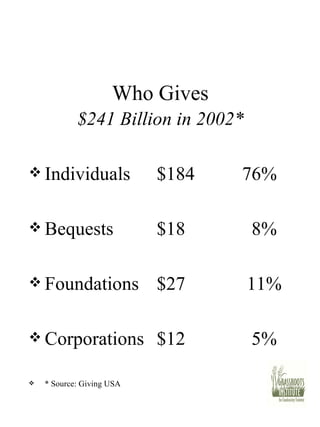
Who Gives $241 Billion in 2002* Individuals $184 76% Bequests $18   8% Foundations $27  11% Corporations $12   5% * Source: Giving USA
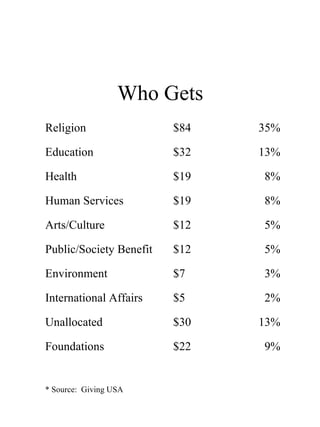
Who Gets Religion $84 35% Education $32 13% Health $19     8% Human Services $19     8% Arts/Culture $12     5% Public/Society Benefit $12     5% Environment $7     3% International Affairs $5     2% Unallocated $30 13% Foundations $22   9% * Source:  Giving USA
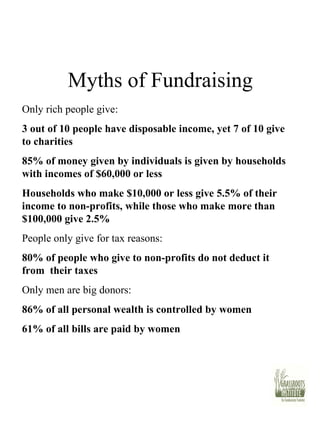
Myths of Fundraising Only rich people give: 3 out of 10 people have disposable income, yet 7 of 10 give to charities 85% of money given by individuals is given by households with incomes of $60,000 or less Households who make $10,000 or less give 5.5% of their income to non-profits, while those who make more than $100,000 give 2.5% People only give for tax reasons: 80% of people who give to non-profits do not deduct it from  their taxes Only men are big donors: 86% of all personal wealth is controlled by women 61% of all bills are paid by women
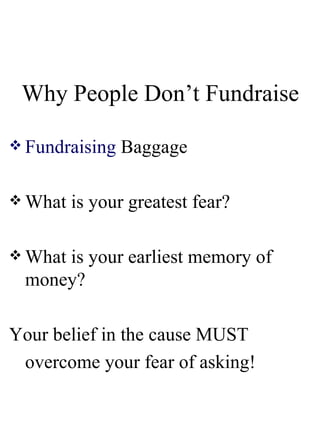
Why People Don’t Fundraise Fundraising   Baggage What is your greatest fear? What is your earliest memory of money? Your belief in the cause MUST overcome your fear of asking!
Sources of Funds Individual Donors Membership Drives Pledging Programs Mail Appeals Major Gift Campaign Canvassing Phone Appeals Payroll Deductions House Parties Grants Corporate Foundations Government (Local, State, Federal) National Religious Agencies Organizational Contributions Houses of Worship Local Business Civic Groups Community Organizations
Fees for Service/Information Newsletters Research/Surveys Training Directories Ad Books Sale of Products T-shirts Buttons Candy Crafts Special Events/Benefits Internal Event External Sponsor Small Business
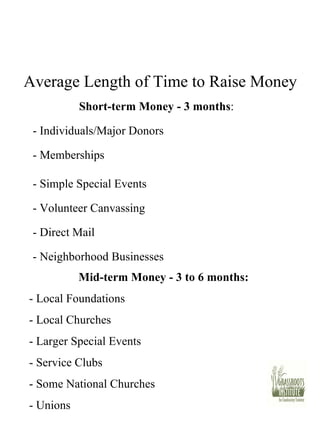
Average Length of Time to Raise Money Short-term Money - 3 months : - Individuals/Major Donors - Memberships - Simple Special Events - Volunteer Canvassing - Direct Mail - Neighborhood Businesses Mid-term Money - 3 to 6 months: - Local Foundations - Local Churches - Larger Special Events - Service Clubs - Some National Churches - Unions
Long-term Money - 6 to 18 months - National Foundations - Financial Institutions - Large Corporations - Branch Corporations - National Churches - Jurisdictional Churches - Professional Canvass - Workplace Giving (United Way, Community Shares) - Business Ventures
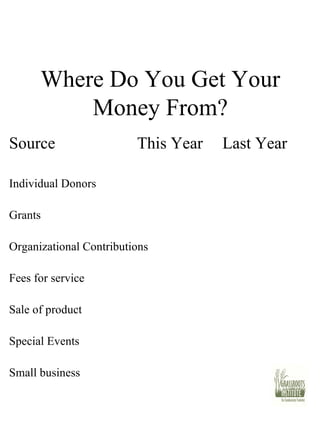
Where Do You Get Your Money From? Source This Year Last Year Individual Donors Grants Organizational Contributions Fees for service Sale of product Special Events Small business
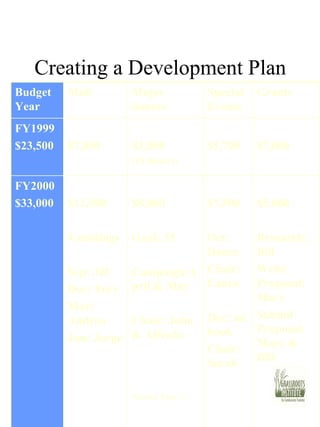
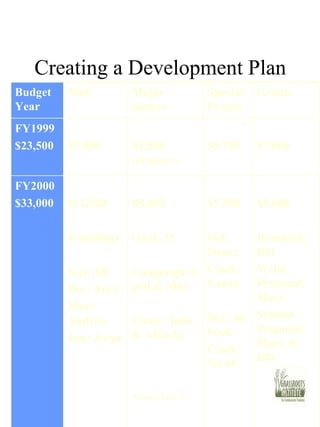
Creating a Development Plan $5,000 Research:  Bill Write Proposal:  Mary Submit Proposal:  Mary & Bill $7,500 Oct: Dance Chair: Laura Dec: ad book Chair: Sarah $8,000 Goal: 35 Campaign:April & May Chair: John & Alfreda $12,500 4 mailings Sep: Jill Dec: Tory Mar: Andrea Jun: Jorge FY2000 $33,000 $7,000 $5,700 $3,800 (15 donors) $7,000 FY1999 $23,500 Grants Special Events Major donors Mail Budget Year
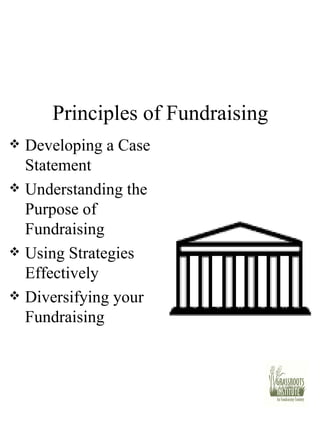
Principles of Fundraising Developing a Case Statement Understanding the Purpose of Fundraising Using Strategies Effectively Diversifying your  Fundraising
Case Statement Mission Statement (Why?) Goals (What?) Objectives (How?) History (How Long?) Structure (Who?) Budget (How Much, Who Pays)
Purpose of Fundraising The purpose of fundraising is? To raise money  To build relationships
Three categories  of fundraising strategies Acquisition Retention Upgrade
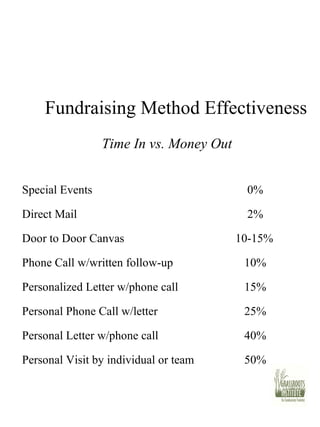
Fundraising Method Effectiveness Time In vs. Money Out Special Events   0% Direct Mail   2% Door to Door Canvas   10-15% Phone Call w/written follow-up   10% Personalized Letter w/phone call   15% Personal Phone Call w/letter   25% Personal Letter w/phone call   40% Personal Visit by individual or team   50%
Fundraising Diversity Sources People
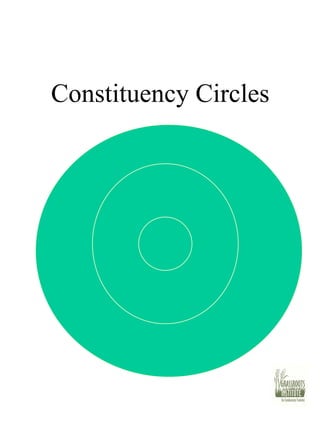
Constituency Circles
Board member involvement in fundraising Time is Not Money Board Leadership in Fundraising Not Everyone Has to Ask for Money All the Time Paid Staff Cannot Do It All Sharing the Work and the Power
Principles of Fundraising Developing a Case Statement Understanding the Purpose of Fundraising Using Strategies Effectively Diversifying your  Fundraising
Special Events Why do an event? Visibility New Money Thank people Must meet at least two of these reasons Estimate the cost Expect to pay for everything If you cannot afford to lose everything, do not do event Cost/fundraising ratio
Steps to doing an event Decide on Goals Recruit Planning Committee Select a Chair Create a Master Task List Program, Production Promotion Fundraising Timeline D-day Evaluate
Plan an Event What event are you going to do? Which criteria does it meet? How much will it cost? How much will it raise? Timeline When does the planning start? When does the event happen? Who will do the pitch?
Individual Donor Campaigns Outline Prospect Identification The Process of Asking Putting together a Gift Range Chart
Definition of an Individual Donor Campaign The process of raising money from individuals through face-to-face asks for your organization.
Four steps of an  Individual Donor Campaign Get names of potential donors Mail letters to these people Phone call follow-up to set up meeting Conduct personal visit
Identifying a Prospect A -- Ability to Give B -- Belief in the Cause C -- Contact to them
Types of Donors Bring Them In, Keep Them In, Move Them Up Planned Gifts  (Bequests) Thoughtful Givers  (upgrade) Habitual Givers  (retention) Impulse Givers  (acquisition) Prospects  (abc)
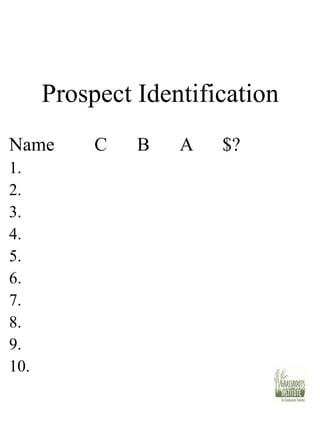
Prospect Identification Name C B A $? 1. 2. 3. 4. 5. 6. 7. 8. 9. 10.
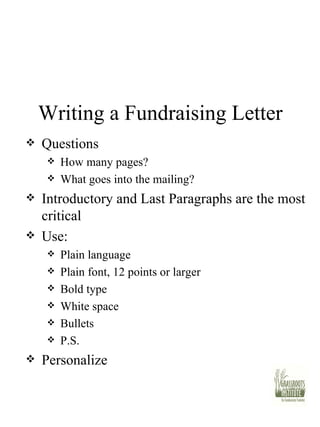
Writing a Fundraising Letter Questions How many pages? What goes into the mailing? Introductory and Last Paragraphs are the most critical Use: Plain language Plain font, 12 points or larger Bold type White space Bullets P.S. Personalize
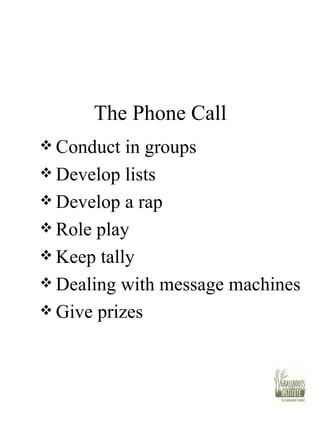
The Phone Call Conduct in groups Develop lists Develop a rap Role play Keep tally Dealing with message machines Give prizes
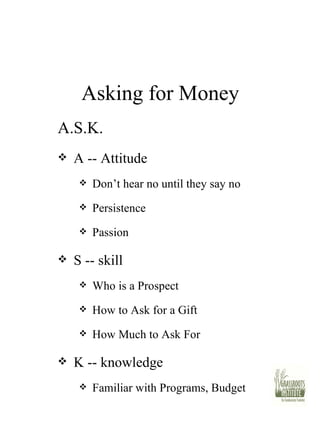
Asking for Money A.S.K. A -- Attitude Don’t hear no until they say no Persistence Passion S -- skill Who is a Prospect How to Ask for a Gift How Much to Ask For K -- knowledge Familiar with Programs, Budget
How to Ask for Money The Visit Smile, Keep Smiling, Say the name of your organization often Say your name, the name of the organization, and your position within the organization Describe your program and its effectiveness Describe your budget Describe your fundraising strategy Be aware of your body language
The Ask - Ask for a specific dollar amount - Say why you need the money now - Say the dollar amount that you want again - STOP TALKING.  Smile.  Wait for the person  to say yes - If your prospect has questions, answer them as  briefly as possible.  If you don’t know the  answer, tell them you will get back to them. -  Remind your prospect that you have given a  donation yourself. - Make arrangements for the payment of the gift  or set a date when you will get back to the  person for their answer - Send thank you note - Report the outcome to the office
How Not to Ask  for Money Not asking Not asking family and friends Beating around the bush Being dishonest Begging, apologizing, or demanding Not knowing the financial side of your program Having too low a budget Understanding giving potential Calling yourself out after only two strikes Taking yes for an answer The Most Common Mistakes
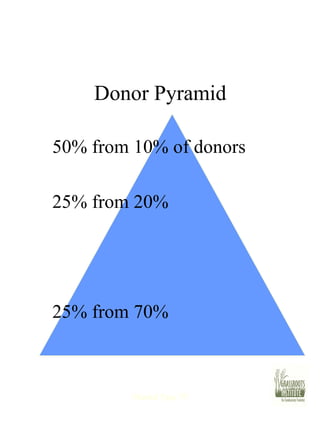
50% from 10% of donors 25% from 20% 25% from 70% Donor Pyramid
$10,000 from 100 donors $10,000 400+ 200+ 100 $2,500 280++ 140+ 70 $35 $2,500 80 40 20 $125 $5,000 40 20 10 $500 Total Prospects Asks Donors Average Gift
Individual Donor Campaigns Outline Prospect Identification The Process of Asking Putting together a Gift Range Chart
Using Mail to Build Your Base Direct Mail Letter Campaigns Thank You’s Email
Writing a Fundraising Letter Questions How many pages? What goes into the mailing? Introductory and Last Paragraphs are the most critical Use: Plain language Plain font, 12 points or larger Bold type White space Bullets P.S. Personalize
Creating a Development Plan $5,000 Research:  Bill Write Proposal:  Mary Submit Proposal:  Mary & Bill $7,500 Oct: Dance Chair: Laura Dec: ad book Chair: Sarah $8,000 Goal: 35 Campaign:April & May Chair: John & Alfreda $12,500 4 mailings Sep: Jill Dec: Tory Mar: Andrea Jun: Jorge FY2000 $33,000 $7,000 $5,700 $3,800 (15 donors) $7,000 FY1999 $23,500 Grants Special Events Major donors Mail Budget Year
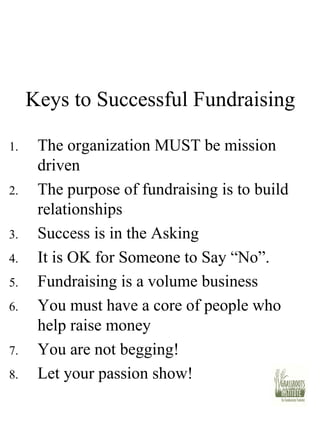
Keys to Successful Fundraising The organization MUST be mission driven The purpose of fundraising is to build relationships Success is in the Asking It is OK for Someone to Say “No”.  Fundraising is a volume business You must have a core of people who help raise money You are not begging! Let your passion show!
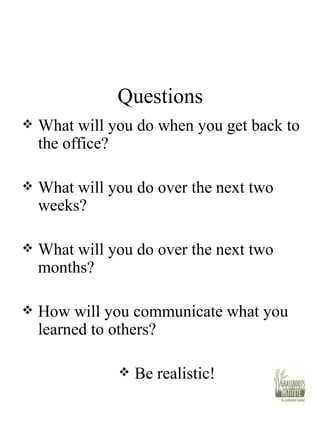
Questions What will you do when you get back to the office? What will you do over the next two weeks? What will you do over the next two months? How will you communicate what you learned to others? Be realistic!
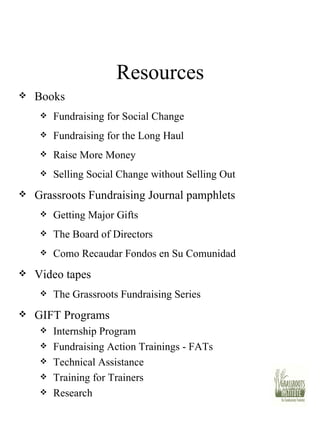
Resources Books Fundraising for Social Change Fundraising for the Long Haul Raise More Money Selling Social Change without Selling Out Grassroots Fundraising Journal pamphlets Getting Major Gifts The Board of Directors Como Recaudar Fondos en Su Comunidad Video tapes The Grassroots Fundraising Series GIFT Programs Internship Program Fundraising Action Trainings - FATs Technical Assistance Training for Trainers Research

Fundraising Presentation

  • 1.
    Political Framework Grassrootsorganizations should be “owned” by the grassroots communities they serve. Ownership means that the community provides significant support to the organization. This means that support comes from diverse sources, and that it takes the form of monetary and other contributions. Social Change requires more than “ownership” of community organizations. It requires changing the root causes for disenfranchisement, marginalization and poverty.
  • 2.
    Who Gives $241Billion in 2002* Individuals $184 76% Bequests $18 8% Foundations $27 11% Corporations $12 5% * Source: Giving USA
  • 3.
    Who Gets Religion$84 35% Education $32 13% Health $19 8% Human Services $19 8% Arts/Culture $12 5% Public/Society Benefit $12 5% Environment $7 3% International Affairs $5 2% Unallocated $30 13% Foundations $22 9% * Source: Giving USA
  • 4.
    Myths of FundraisingOnly rich people give: 3 out of 10 people have disposable income, yet 7 of 10 give to charities 85% of money given by individuals is given by households with incomes of $60,000 or less Households who make $10,000 or less give 5.5% of their income to non-profits, while those who make more than $100,000 give 2.5% People only give for tax reasons: 80% of people who give to non-profits do not deduct it from their taxes Only men are big donors: 86% of all personal wealth is controlled by women 61% of all bills are paid by women
  • 5.
    Why People Don’tFundraise Fundraising Baggage What is your greatest fear? What is your earliest memory of money? Your belief in the cause MUST overcome your fear of asking!
  • 6.
    Sources of FundsIndividual Donors Membership Drives Pledging Programs Mail Appeals Major Gift Campaign Canvassing Phone Appeals Payroll Deductions House Parties Grants Corporate Foundations Government (Local, State, Federal) National Religious Agencies Organizational Contributions Houses of Worship Local Business Civic Groups Community Organizations
  • 7.
    Fees for Service/InformationNewsletters Research/Surveys Training Directories Ad Books Sale of Products T-shirts Buttons Candy Crafts Special Events/Benefits Internal Event External Sponsor Small Business
  • 8.
    Average Length ofTime to Raise Money Short-term Money - 3 months : - Individuals/Major Donors - Memberships - Simple Special Events - Volunteer Canvassing - Direct Mail - Neighborhood Businesses Mid-term Money - 3 to 6 months: - Local Foundations - Local Churches - Larger Special Events - Service Clubs - Some National Churches - Unions
  • 9.
    Long-term Money -6 to 18 months - National Foundations - Financial Institutions - Large Corporations - Branch Corporations - National Churches - Jurisdictional Churches - Professional Canvass - Workplace Giving (United Way, Community Shares) - Business Ventures
  • 10.
    Where Do YouGet Your Money From? Source This Year Last Year Individual Donors Grants Organizational Contributions Fees for service Sale of product Special Events Small business
  • 11.
    Creating a DevelopmentPlan $5,000 Research: Bill Write Proposal: Mary Submit Proposal: Mary & Bill $7,500 Oct: Dance Chair: Laura Dec: ad book Chair: Sarah $8,000 Goal: 35 Campaign:April & May Chair: John & Alfreda $12,500 4 mailings Sep: Jill Dec: Tory Mar: Andrea Jun: Jorge FY2000 $33,000 $7,000 $5,700 $3,800 (15 donors) $7,000 FY1999 $23,500 Grants Special Events Major donors Mail Budget Year
  • 12.
    Principles of FundraisingDeveloping a Case Statement Understanding the Purpose of Fundraising Using Strategies Effectively Diversifying your Fundraising
  • 13.
    Case Statement MissionStatement (Why?) Goals (What?) Objectives (How?) History (How Long?) Structure (Who?) Budget (How Much, Who Pays)
  • 14.
    Purpose of FundraisingThe purpose of fundraising is? To raise money To build relationships
  • 15.
    Three categories of fundraising strategies Acquisition Retention Upgrade
  • 16.
    Fundraising Method EffectivenessTime In vs. Money Out Special Events 0% Direct Mail 2% Door to Door Canvas 10-15% Phone Call w/written follow-up 10% Personalized Letter w/phone call 15% Personal Phone Call w/letter 25% Personal Letter w/phone call 40% Personal Visit by individual or team 50%
  • 17.
  • 18.
  • 19.
    Board member involvementin fundraising Time is Not Money Board Leadership in Fundraising Not Everyone Has to Ask for Money All the Time Paid Staff Cannot Do It All Sharing the Work and the Power
  • 20.
    Principles of FundraisingDeveloping a Case Statement Understanding the Purpose of Fundraising Using Strategies Effectively Diversifying your Fundraising
  • 21.
    Special Events Whydo an event? Visibility New Money Thank people Must meet at least two of these reasons Estimate the cost Expect to pay for everything If you cannot afford to lose everything, do not do event Cost/fundraising ratio
  • 22.
    Steps to doingan event Decide on Goals Recruit Planning Committee Select a Chair Create a Master Task List Program, Production Promotion Fundraising Timeline D-day Evaluate
  • 23.
    Plan an EventWhat event are you going to do? Which criteria does it meet? How much will it cost? How much will it raise? Timeline When does the planning start? When does the event happen? Who will do the pitch?
  • 24.
    Individual Donor CampaignsOutline Prospect Identification The Process of Asking Putting together a Gift Range Chart
  • 25.
    Definition of anIndividual Donor Campaign The process of raising money from individuals through face-to-face asks for your organization.
  • 26.
    Four steps ofan Individual Donor Campaign Get names of potential donors Mail letters to these people Phone call follow-up to set up meeting Conduct personal visit
  • 27.
    Identifying a ProspectA -- Ability to Give B -- Belief in the Cause C -- Contact to them
  • 28.
    Types of DonorsBring Them In, Keep Them In, Move Them Up Planned Gifts (Bequests) Thoughtful Givers (upgrade) Habitual Givers (retention) Impulse Givers (acquisition) Prospects (abc)
  • 29.
    Prospect Identification NameC B A $? 1. 2. 3. 4. 5. 6. 7. 8. 9. 10.
  • 30.
    Writing a FundraisingLetter Questions How many pages? What goes into the mailing? Introductory and Last Paragraphs are the most critical Use: Plain language Plain font, 12 points or larger Bold type White space Bullets P.S. Personalize
  • 31.
    The Phone CallConduct in groups Develop lists Develop a rap Role play Keep tally Dealing with message machines Give prizes
  • 32.
    Asking for MoneyA.S.K. A -- Attitude Don’t hear no until they say no Persistence Passion S -- skill Who is a Prospect How to Ask for a Gift How Much to Ask For K -- knowledge Familiar with Programs, Budget
  • 33.
    How to Askfor Money The Visit Smile, Keep Smiling, Say the name of your organization often Say your name, the name of the organization, and your position within the organization Describe your program and its effectiveness Describe your budget Describe your fundraising strategy Be aware of your body language
  • 34.
    The Ask -Ask for a specific dollar amount - Say why you need the money now - Say the dollar amount that you want again - STOP TALKING. Smile. Wait for the person to say yes - If your prospect has questions, answer them as briefly as possible. If you don’t know the answer, tell them you will get back to them. - Remind your prospect that you have given a donation yourself. - Make arrangements for the payment of the gift or set a date when you will get back to the person for their answer - Send thank you note - Report the outcome to the office
  • 35.
    How Not toAsk for Money Not asking Not asking family and friends Beating around the bush Being dishonest Begging, apologizing, or demanding Not knowing the financial side of your program Having too low a budget Understanding giving potential Calling yourself out after only two strikes Taking yes for an answer The Most Common Mistakes
  • 36.
    50% from 10%of donors 25% from 20% 25% from 70% Donor Pyramid
  • 37.
    $10,000 from 100donors $10,000 400+ 200+ 100 $2,500 280++ 140+ 70 $35 $2,500 80 40 20 $125 $5,000 40 20 10 $500 Total Prospects Asks Donors Average Gift
  • 38.
    Individual Donor CampaignsOutline Prospect Identification The Process of Asking Putting together a Gift Range Chart
  • 39.
    Using Mail toBuild Your Base Direct Mail Letter Campaigns Thank You’s Email
  • 40.
    Writing a FundraisingLetter Questions How many pages? What goes into the mailing? Introductory and Last Paragraphs are the most critical Use: Plain language Plain font, 12 points or larger Bold type White space Bullets P.S. Personalize
  • 41.
    Creating a DevelopmentPlan $5,000 Research: Bill Write Proposal: Mary Submit Proposal: Mary & Bill $7,500 Oct: Dance Chair: Laura Dec: ad book Chair: Sarah $8,000 Goal: 35 Campaign:April & May Chair: John & Alfreda $12,500 4 mailings Sep: Jill Dec: Tory Mar: Andrea Jun: Jorge FY2000 $33,000 $7,000 $5,700 $3,800 (15 donors) $7,000 FY1999 $23,500 Grants Special Events Major donors Mail Budget Year
  • 42.
    Keys to SuccessfulFundraising The organization MUST be mission driven The purpose of fundraising is to build relationships Success is in the Asking It is OK for Someone to Say “No”. Fundraising is a volume business You must have a core of people who help raise money You are not begging! Let your passion show!
  • 43.
    Questions What willyou do when you get back to the office? What will you do over the next two weeks? What will you do over the next two months? How will you communicate what you learned to others? Be realistic!
  • 44.
    Resources Books Fundraisingfor Social Change Fundraising for the Long Haul Raise More Money Selling Social Change without Selling Out Grassroots Fundraising Journal pamphlets Getting Major Gifts The Board of Directors Como Recaudar Fondos en Su Comunidad Video tapes The Grassroots Fundraising Series GIFT Programs Internship Program Fundraising Action Trainings - FATs Technical Assistance Training for Trainers Research

Editor's Notes

  • #2 - review political framework (page 2 of packet)