The Year Before Your
Capital Campaign
The presentation will begin shortly.
3
This presentation is being recorded! 

The recording and slides will be emailed to you.
Please chat in any questions for our guest.
We will answer them in the formal Q&A session
at the end of the presentation.
Follow along on Twitter with #Bloomerang @BloomerangTech.
For best audio quality, dial in by phone.

(check your email for dial-in info from ReadyTalk)
Before we get started »
3
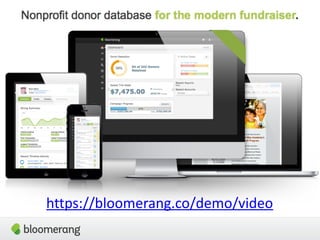
https://bloomerang.co/demo/video
3
Our guest presenter »
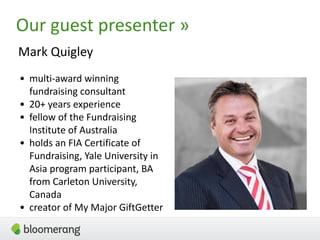
Mark Quigley
• multi-award winning
fundraising consultant
• 20+ years experience
• fellow of the Fundraising
Institute of Australia
• holds an FIA Certificate of
Fundraising, Yale University in
Asia program participant, BA
from Carleton University,
Canada
• creator of My Major GiftGetter
The one year before your capital campaign
Presented by:
Mark Quigley FFIA
&
TODAY’S OBJECTIVES
To identify and discuss the elements
necessary for positioning your capital
campaign for success; provide practical
advice and guidance which can be used
immediately…
…and to have a little fun along the way!
Mark Quigley FFIA
12 Months
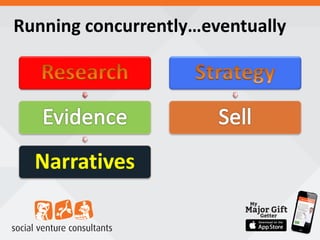
Running concurrently…eventually
• Ahead of budget
• At Budget
• Behind Budget
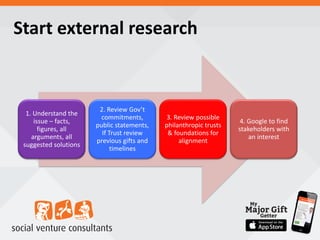
Start external research
1. Understand the
issue – facts,
figures, all
arguments, all
suggested solutions
2. Review Gov’t
commitments,
public statements,
If Trust review
previous gifts and
timelines
3. Review possible
philanthropic trusts
& foundations for
alignment
4. Google to find
stakeholders with
an interest
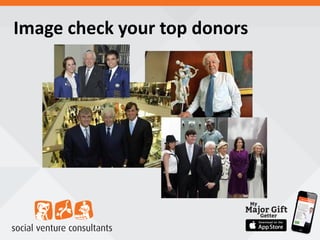
Image check your top donors
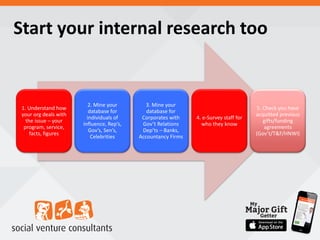
Start your internal research too
1. Understand how
your org deals with
the issue – your
program, service,
facts, figures
2. Mine your
database for
individuals of
influence, Rep’s,
Gov’s, Sen’s,
Celebrities
3. Mine your
database for
Corporates with
Gov’t Relations
Dep’ts – Banks,
Accountancy Firms
4. e-Survey staff for
who they know
5. Check you have
acquitted previous
gifts/funding
agreements
(Gov’t/T&F/HNWI)
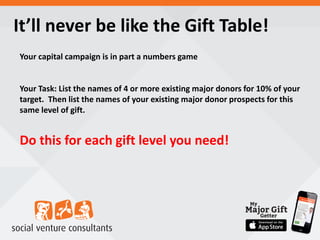
It’ll never be like the Gift Table!
Your capital campaign is in part a numbers game
Your Task: List the names of 4 or more existing major donors for 10% of your
target. Then list the names of your existing major donor prospects for this
same level of gift.
Do this for each gift level you need!
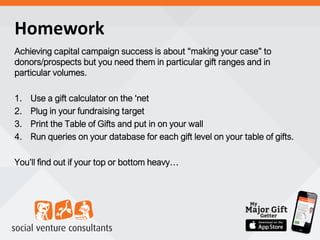
Homework
Achieving capital campaign success is about “making your case” to
donors/prospects but you need them in particular gift ranges and in
particular volumes.
1. Use a gift calculator on the ‘net
2. Plug in your fundraising target
3. Print the Table of Gifts and put in on your wall
4. Run queries on your database for each gift level on your table of gifts.
You’ll find out if your top or bottom heavy…
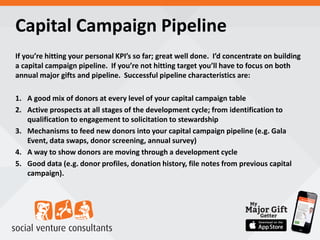
Capital Campaign Pipeline
If you’re hitting your personal KPI’s so far; great well done. I’d concentrate on building
a capital campaign pipeline. If you’re not hitting target you’ll have to focus on both
annual major gifts and pipeline. Successful pipeline characteristics are:
1. A good mix of donors at every level of your capital campaign table
2. Active prospects at all stages of the development cycle; from identification to
qualification to engagement to solicitation to stewardship
3. Mechanisms to feed new donors into your capital campaign pipeline (e.g. Gala
Event, data swaps, donor screening, annual survey)
4. A way to show donors are moving through a development cycle
5. Good data (e.g. donor profiles, donation history, file notes from previous capital
campaign).
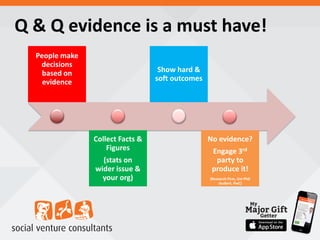
Q & Q evidence is a must have!
People make
decisions
based on
evidence
Collect Facts &
Figures
(stats on
wider issue &
your org)
Show hard &
soft outcomes
No evidence?
Engage 3rd
party to
produce it!
(Research Firm, Uni PhD
student, PwC)
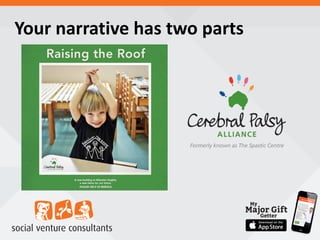
Your narrative has two parts
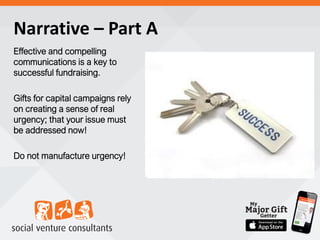
Narrative – Part A
Effective and compelling
communications is a key to
successful fundraising.
Gifts for capital campaigns rely
on creating a sense of real
urgency; that your issue must
be addressed now!
Do not manufacture urgency!
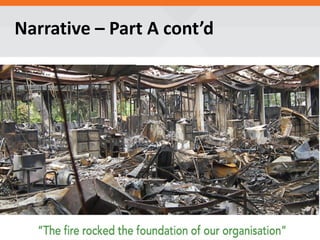
Narrative – Part A cont’d
Part B –
Your
Financial
Narrative
Start early on a case for support
A Case for Support is the
main “selling” document from
which all other campaign
collateral is developed.
You should have an early
draft Case for Support by
now and distributed it
internally inviting feedback
and including only what
makes your “case” stronger.
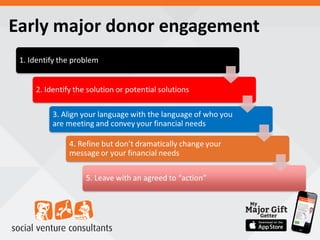
Early major donor engagement
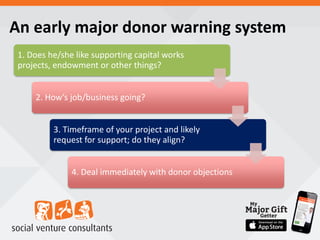
An early major donor warning system
1. Does he/she like supporting capital works
projects, endowment or other things?
2. How’s job/business going?
3. Timeframe of your project and likely
request for support; do they align?
4. Deal immediately with donor objections
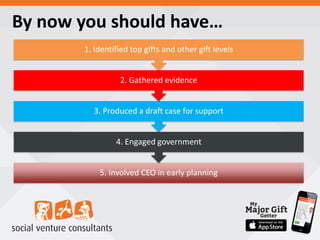
By now you should have…
5. Involved CEO in early planning
4. Engaged government
3. Produced a draft case for support
2. Gathered evidence
1. Identified top gifts and other gift levels
9 Months
We need to talk about…
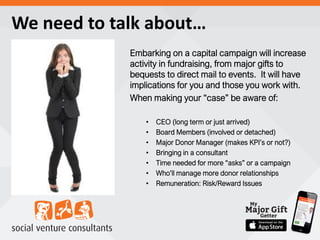
Embarking on a capital campaign will increase
activity in fundraising, from major gifts to
bequests to direct mail to events. It will have
implications for you and those you work with.
When making your “case” be aware of:
• CEO (long term or just arrived)
• Board Members (involved or detached)
• Major Donor Manager (makes KPI’s or not?)
• Bringing in a consultant
• Time needed for more “asks” or a campaign
• Who’ll manage more donor relationships
• Remuneration: Risk/Reward Issues
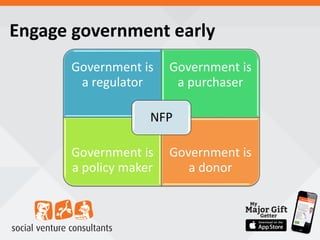
Engage government early
Government is
a regulator
Government is
a purchaser
Government is
a policy maker
Government is
a donor
NFP
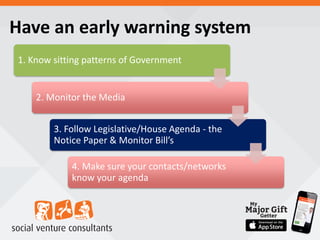
Have an early warning system
1. Know sitting patterns of Government
2. Monitor the Media
3. Follow Legislative/House Agenda - the
Notice Paper & Monitor Bill’s
4. Make sure your contacts/networks
know your agenda
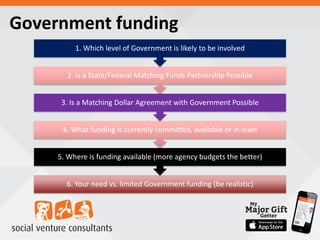
Government funding
6. Your need vs. limited Government funding (be realistic)
5. Where is funding available (more agency budgets the better)
4. What funding is currently committed, available or in-train
3. Is a Matching Dollar Agreement with Government Possible
2. Is a State/Federal Matching Funds Partnership Possible
1. Which level of Government is likely to be involved
E-survey staff
e-survey staff
& volunteers
Generate some ideas
A capital campaign may provide you a
unique “one-off” opportunity to increase
your annual fundraising activities but in
support of your capital campaign.
• Could you add another DM Appeal to
existing appeals
• Could you run an annual event twice in
one year, or introduce a new event
• Could you ask annual major donors for
a multi-year pledge. Lock them in.
Catch & Release
Engaging major donors
A major donor engagement plan to catch a select
group of your existing major donors to tell them face
to face about your need (i.e. campaign) within 30 days
or release them.
Clustering
Engaging major donors
Tactics which seek to bring existing major donors together in
one place (forming a cluster) to inform them of your need
(i.e. campaign). Clustering of major donors is around
similarities with other major donors:
– Gift level
– Membership (e.g. President’s Club/Friends of)
– Profession
– Geography
– Tagged support (donate to a specific program)
How are
your major
donors
feeling?
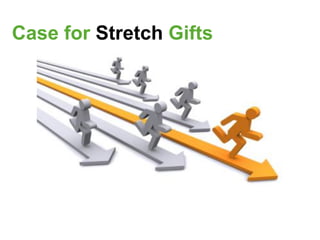
Case for Stretch Gifts
6 Months
CEO Roadtest
Get an early easy win…even a few!
Every fundraiser knows a few donors who “give like clockwork”. Why
not involve a Board Member in a few “easy wins”.
Talk to a few of your organisation’s closest donors and pre-solicit
(perhaps their annual gift) a specific amount over the ‘phone in advance
of a face to face meeting. Take your Board Member along to see the
donor and secure the gift knowing the donor had been prepared in
advance but your Board Member get her first “win”.
This approach will build her confidence when participating in other asks.
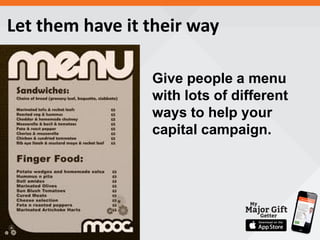
Give people a menu
with lots of different
ways to help your
capital campaign.
Let them have it their way
7 things for selling your campaign
1. Request meetings well in advance and take money off the
table
2. Factor in meeting postponements and re-scheduling
3. Be flexible with the time and date of your meeting
4. Have only the relevant materials with you
5. Know your key messages / outcomes
6. Be punctual, conscious of time during a meeting and watch
body language
7. Know your “script” which sells your case and be able to
deliver it in 20, 30 and 45 minutes.
Launch your charm offensive!
1. Little Things Every Week: call donors to say thanks
2. Sending articles/research reports which appear in
the media about you to them
3. Little Things: send small gift (e.g. merchandise)
4. Hold a VIP event (Chairman’s home)
5. Personalise contact.
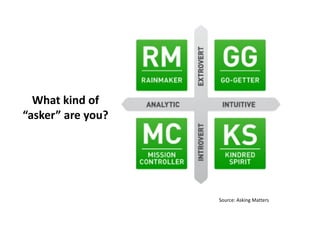
What kind of
“asker” are you?
Source: Asking Matters
Talk about your needs
at every event!
Launch your charm offensive!
If you face barriers at a gift solicitation…the meeting is your
chance to overcome these!
• Is it the project?
• Is it our organisation?
• Is it the gift?
• Is it the timing?
Will your capital campaign
have impact?
3 Months
4. The Script, Ask & Role Play:
“Could Be”
Script
Development
& Time
Management
Time is not your friend
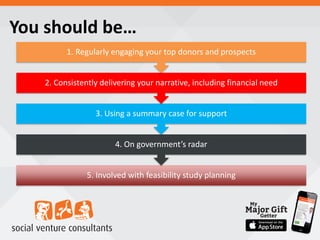
You should be…
5. Involved with feasibility study planning
4. On government’s radar
3. Using a summary case for support
2. Consistently delivering your narrative, including financial need
1. Regularly engaging your top donors and prospects
Focus on your top 5
Give some relationships priority
Draft your preferred list of feasibility study
interviewees.
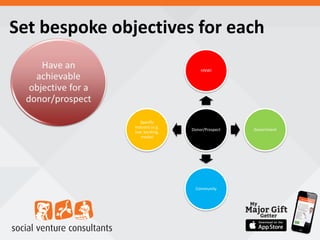
Set bespoke objectives for each
Donor/Prospect
HNWI
Government
Community
Specific
Industry (e.g.
law, banking,
media)
Roadtest Campaign Counsel
and Feasibility Study Methodology
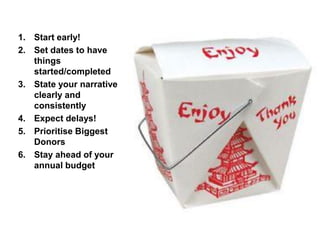
1. Start early!
2. Set dates to have
things
started/completed
3. State your narrative
clearly and
consistently
4. Expect delays!
5. Prioritise Biggest
Donors
6. Stay ahead of your
annual budget
Thank you for listening
Questions & Answers
https://bloomerang.co/resources
•Nonprofit Wrap-Up
•Bloomerang TV
•Bloomies
•eBooks
•Daily blog post
•Weekly webinars
•Templates
•Guides
Upcoming free webinars »
9/14 Convert Supporters with Powerful Landing Pages

w/ Jay Wilkinson
9/21 Writing for Digital w/ Tom Ahern
9/28 [TOWN HALL] 

Fundraising Challenges & Opportunities in the 

Wake of Natural Disasters
https://bloomerang.co/resources/webinars

The Year Before Your Capital Campaign

  • 1.
    The Year BeforeYour Capital Campaign The presentation will begin shortly.
  • 2.
    3 This presentation isbeing recorded! 
 The recording and slides will be emailed to you. Please chat in any questions for our guest. We will answer them in the formal Q&A session at the end of the presentation. Follow along on Twitter with #Bloomerang @BloomerangTech. For best audio quality, dial in by phone.
 (check your email for dial-in info from ReadyTalk) Before we get started »
  • 3.
  • 4.
    3 Our guest presenter» Mark Quigley • multi-award winning fundraising consultant • 20+ years experience • fellow of the Fundraising Institute of Australia • holds an FIA Certificate of Fundraising, Yale University in Asia program participant, BA from Carleton University, Canada • creator of My Major GiftGetter
  • 5.
    The one yearbefore your capital campaign Presented by: Mark Quigley FFIA &
  • 6.
    TODAY’S OBJECTIVES To identifyand discuss the elements necessary for positioning your capital campaign for success; provide practical advice and guidance which can be used immediately… …and to have a little fun along the way! Mark Quigley FFIA
  • 8.
  • 9.
  • 10.
    • Ahead ofbudget • At Budget • Behind Budget
  • 11.
    Start external research 1.Understand the issue – facts, figures, all arguments, all suggested solutions 2. Review Gov’t commitments, public statements, If Trust review previous gifts and timelines 3. Review possible philanthropic trusts & foundations for alignment 4. Google to find stakeholders with an interest
  • 12.
    Image check yourtop donors
  • 13.
    Start your internalresearch too 1. Understand how your org deals with the issue – your program, service, facts, figures 2. Mine your database for individuals of influence, Rep’s, Gov’s, Sen’s, Celebrities 3. Mine your database for Corporates with Gov’t Relations Dep’ts – Banks, Accountancy Firms 4. e-Survey staff for who they know 5. Check you have acquitted previous gifts/funding agreements (Gov’t/T&F/HNWI)
  • 14.
    It’ll never belike the Gift Table! Your capital campaign is in part a numbers game Your Task: List the names of 4 or more existing major donors for 10% of your target. Then list the names of your existing major donor prospects for this same level of gift. Do this for each gift level you need!
  • 15.
    Homework Achieving capital campaignsuccess is about “making your case” to donors/prospects but you need them in particular gift ranges and in particular volumes. 1. Use a gift calculator on the ‘net 2. Plug in your fundraising target 3. Print the Table of Gifts and put in on your wall 4. Run queries on your database for each gift level on your table of gifts. You’ll find out if your top or bottom heavy…
  • 17.
    Capital Campaign Pipeline Ifyou’re hitting your personal KPI’s so far; great well done. I’d concentrate on building a capital campaign pipeline. If you’re not hitting target you’ll have to focus on both annual major gifts and pipeline. Successful pipeline characteristics are: 1. A good mix of donors at every level of your capital campaign table 2. Active prospects at all stages of the development cycle; from identification to qualification to engagement to solicitation to stewardship 3. Mechanisms to feed new donors into your capital campaign pipeline (e.g. Gala Event, data swaps, donor screening, annual survey) 4. A way to show donors are moving through a development cycle 5. Good data (e.g. donor profiles, donation history, file notes from previous capital campaign).
  • 18.
    Q & Qevidence is a must have! People make decisions based on evidence Collect Facts & Figures (stats on wider issue & your org) Show hard & soft outcomes No evidence? Engage 3rd party to produce it! (Research Firm, Uni PhD student, PwC)
  • 19.
  • 20.
    Narrative – PartA Effective and compelling communications is a key to successful fundraising. Gifts for capital campaigns rely on creating a sense of real urgency; that your issue must be addressed now! Do not manufacture urgency!
  • 21.
  • 22.
  • 23.
    Start early ona case for support A Case for Support is the main “selling” document from which all other campaign collateral is developed. You should have an early draft Case for Support by now and distributed it internally inviting feedback and including only what makes your “case” stronger.
  • 24.
  • 25.
    An early majordonor warning system 1. Does he/she like supporting capital works projects, endowment or other things? 2. How’s job/business going? 3. Timeframe of your project and likely request for support; do they align? 4. Deal immediately with donor objections
  • 27.
    By now youshould have… 5. Involved CEO in early planning 4. Engaged government 3. Produced a draft case for support 2. Gathered evidence 1. Identified top gifts and other gift levels
  • 28.
  • 30.
    We need totalk about… Embarking on a capital campaign will increase activity in fundraising, from major gifts to bequests to direct mail to events. It will have implications for you and those you work with. When making your “case” be aware of: • CEO (long term or just arrived) • Board Members (involved or detached) • Major Donor Manager (makes KPI’s or not?) • Bringing in a consultant • Time needed for more “asks” or a campaign • Who’ll manage more donor relationships • Remuneration: Risk/Reward Issues
  • 31.
    Engage government early Governmentis a regulator Government is a purchaser Government is a policy maker Government is a donor NFP
  • 32.
    Have an earlywarning system 1. Know sitting patterns of Government 2. Monitor the Media 3. Follow Legislative/House Agenda - the Notice Paper & Monitor Bill’s 4. Make sure your contacts/networks know your agenda
  • 33.
    Government funding 6. Yourneed vs. limited Government funding (be realistic) 5. Where is funding available (more agency budgets the better) 4. What funding is currently committed, available or in-train 3. Is a Matching Dollar Agreement with Government Possible 2. Is a State/Federal Matching Funds Partnership Possible 1. Which level of Government is likely to be involved
  • 34.
  • 35.
    Generate some ideas Acapital campaign may provide you a unique “one-off” opportunity to increase your annual fundraising activities but in support of your capital campaign. • Could you add another DM Appeal to existing appeals • Could you run an annual event twice in one year, or introduce a new event • Could you ask annual major donors for a multi-year pledge. Lock them in.
  • 36.
  • 37.
    Engaging major donors Amajor donor engagement plan to catch a select group of your existing major donors to tell them face to face about your need (i.e. campaign) within 30 days or release them.
  • 38.
  • 39.
    Engaging major donors Tacticswhich seek to bring existing major donors together in one place (forming a cluster) to inform them of your need (i.e. campaign). Clustering of major donors is around similarities with other major donors: – Gift level – Membership (e.g. President’s Club/Friends of) – Profession – Geography – Tagged support (donate to a specific program)
  • 40.
  • 41.
  • 43.
  • 44.
  • 46.
    Get an earlyeasy win…even a few! Every fundraiser knows a few donors who “give like clockwork”. Why not involve a Board Member in a few “easy wins”. Talk to a few of your organisation’s closest donors and pre-solicit (perhaps their annual gift) a specific amount over the ‘phone in advance of a face to face meeting. Take your Board Member along to see the donor and secure the gift knowing the donor had been prepared in advance but your Board Member get her first “win”. This approach will build her confidence when participating in other asks.
  • 47.
    Give people amenu with lots of different ways to help your capital campaign. Let them have it their way
  • 48.
    7 things forselling your campaign 1. Request meetings well in advance and take money off the table 2. Factor in meeting postponements and re-scheduling 3. Be flexible with the time and date of your meeting 4. Have only the relevant materials with you 5. Know your key messages / outcomes 6. Be punctual, conscious of time during a meeting and watch body language 7. Know your “script” which sells your case and be able to deliver it in 20, 30 and 45 minutes.
  • 49.
    Launch your charmoffensive! 1. Little Things Every Week: call donors to say thanks 2. Sending articles/research reports which appear in the media about you to them 3. Little Things: send small gift (e.g. merchandise) 4. Hold a VIP event (Chairman’s home) 5. Personalise contact.
  • 50.
    What kind of “asker”are you? Source: Asking Matters
  • 51.
    Talk about yourneeds at every event!
  • 53.
    Launch your charmoffensive! If you face barriers at a gift solicitation…the meeting is your chance to overcome these! • Is it the project? • Is it our organisation? • Is it the gift? • Is it the timing?
  • 54.
    Will your capitalcampaign have impact?
  • 55.
  • 56.
    4. The Script,Ask & Role Play: “Could Be” Script Development & Time Management Time is not your friend
  • 57.
    You should be… 5.Involved with feasibility study planning 4. On government’s radar 3. Using a summary case for support 2. Consistently delivering your narrative, including financial need 1. Regularly engaging your top donors and prospects
  • 58.
  • 59.
    Give some relationshipspriority Draft your preferred list of feasibility study interviewees.
  • 60.
    Set bespoke objectivesfor each Donor/Prospect HNWI Government Community Specific Industry (e.g. law, banking, media)
  • 61.
    Roadtest Campaign Counsel andFeasibility Study Methodology
  • 62.
    1. Start early! 2.Set dates to have things started/completed 3. State your narrative clearly and consistently 4. Expect delays! 5. Prioritise Biggest Donors 6. Stay ahead of your annual budget
  • 63.
    Thank you forlistening Questions & Answers
  • 64.
  • 65.
    Upcoming free webinars» 9/14 Convert Supporters with Powerful Landing Pages
 w/ Jay Wilkinson 9/21 Writing for Digital w/ Tom Ahern 9/28 [TOWN HALL] 
 Fundraising Challenges & Opportunities in the 
 Wake of Natural Disasters https://bloomerang.co/resources/webinars