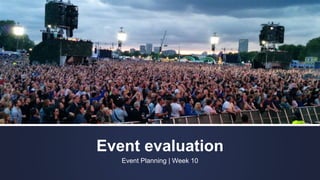

Event evaluation
Event Planning | Week 10
Learning outcomes
By the end of the session, you will be able to:
 Define evaluation in an events context
 Explain the relationship between the event objectives and evaluation
strategy
 Produce an evaluation plan for an event
What is
evaluation?
Source: Bowdin, G. Allen, J.
O’Toole, W. Harris, R.
McDonnell, I. (2011), Events
Management. 3rd edition. Oxford,
UK: Elsevier. p.630.
“Event evaluation is the process of critically observing,
measuring and monitoring the implementation of an
event in order to assess its outcomes accurately.”
Why?
Internal Reasons
 Engenders accountability
 Were objectives met?
 Address problems and challenges.
 Did management work effectively?
 To understand who attends.
 The value of the event to workers.
 Determining the future viability of such
events.
External Reasons
 Satisfying demands for accountability.
 Determining level of product awareness
for sponsors.
 Determining the level of media interest
and coverage.
 To satisfy to criteria of external funders
(e.g. Sports England/ Arts Council).
 Assessing event impact: on tourism, the
environment and local businesses.
 Satisfaction of stakeholder expectations.
Source: Tull, J. and Williams, N. (2017). Event Evaluation, in: N. Ferdinand and N. Williams (eds), Events Management: An international approach,
2nd Edn, London: Sage, pp. 241-268.
 Attendee profile
 Financial performance
 Event impacts (Social, Economic, Environmental)
 Stakeholder experience
 Reputation
 Management and organization processes
 Marketing and media effectiveness
It’s not just about what happens after the event!
Pre-event
 Expectations, market research, perceptions
During the event
 Experience, satisfaction, service recovery
Post-event
 Success, performance, perceptions, impact
Who?
Consider from all your
stakeholders
 Client
 Attendees
 Management
 Staff
 Volunteers
 Contractors
 Suppliers
 Sponsors
 Exhibitors
 Venue
 Local Authority
 Neighbours – residential and business
How?
There are a variety of different
methods available
 Surveys / questionnaires
 Financial analysis
 Interviews
 Focus groups
 Observation
 Document analysis
 Content analysis
 Situational analysis
 Incident reports
 Audits
Event
evaluation
strategy
Source: Watt, D.C. (1998). Event
Management in Leisure and
Tourism, Harlow, Essex:
Pearson.
 Clearly define the event objectives
 Clearly define the evaluation criteria for the event
 Design an Evaluation Process
 Informal and Formal
 Feedback from client
 Feedback from participants/visitors etc
 Feedback from event management team
 Individual
 Identify appropriate sources of information/data for
evaluation
 Collect data
 Analyse data
 Report.
Conducting an
evaluation
exercise
Source: Tull, J. and Williams, N.
(2017). Event Evaluation, in: N.
Ferdinand and N. Williams (eds),
Events Management: An
international approach, 2nd Edn,
London: Sage, pp. 241-268.
Step 1
• Determine the purpose of the event evaluation exercise,
including whether evaluation is necessary
Step 2
• Identify what should be the focus of the evaluation
Step 3
• Select the most suitable approach for conducting the
evaluation exercise
Step 4
• Select model(s) for evaluation as a framework for data
collection based on suitability, practicality and relevance
Step 5
• Develop appropriate instruments and data collection
strategies based on the methods selected
Step 6
• Collect and analyse data and findings
Step 7
• Prepare and disseminate event evaluation report
Step 8
• Formulate and implement decisions for improvement based
on findings of event evaluation report
Impact assessment
 Focuses on measuring economic, social, environmental and cultural impact of events,
particularly in instances where significant justification for the event may be required
Cost-benefit analysis
 Identifies and measures the costs and benefits of an event and takes into account 'externalities'
or spill-over benefits for the host community
Triple-bottom line evaluation
 A systematic framework for measuring and reporting the event's performance against economic,
social and environmental parameters, to determine negative or positive impacts on the host
community
Ethnographic profile
 Typically used in the evaluation of cultural festivals/special events, ethnography provides an
assessment of these experience-related events through a process of analysis which
encompasses participant observation, interviewing and documentary resources
Source: Tull, J. and Williams, N.
(2017). Event Evaluation, in: N.
Ferdinand and N. Williams (eds),
Events Management: An
international approach, 2nd Edn,
London: Sage, pp. 241-268.
• Content analysisImage maker
• Visitor exit surveyTourism product
• Economic Impact Analysis
Economic
development catalyst
• Social Impact Scale Analysis
Transformer of socio-
cultural landscape
• Environmental Impact
Assessment
Sustainable
Development Model
 Event Significance – assessing, measuring and monitoring the nature, purpose
and intent of the event and feasibility to realize the expected outcome
 Event Success – determining whether the event execution and contributing
elements have achieved the expected outcome
 Event Sustainability – measuring, assessing and monitoring the event's impact
on the environment and community and; the potential for the event to be
continued in future
Source: Getz, D. and Page, S. (2020). Event Studies: Theory, Research and Policy for Planned Events, 4th edn, Abingdon,
Oxon: Routledge.
Any questions?

Event Evaluation

  • 1.
  • 2.
    Learning outcomes By theend of the session, you will be able to:  Define evaluation in an events context  Explain the relationship between the event objectives and evaluation strategy  Produce an evaluation plan for an event
  • 3.
    What is evaluation? Source: Bowdin,G. Allen, J. O’Toole, W. Harris, R. McDonnell, I. (2011), Events Management. 3rd edition. Oxford, UK: Elsevier. p.630. “Event evaluation is the process of critically observing, measuring and monitoring the implementation of an event in order to assess its outcomes accurately.”
  • 4.
    Why? Internal Reasons  Engendersaccountability  Were objectives met?  Address problems and challenges.  Did management work effectively?  To understand who attends.  The value of the event to workers.  Determining the future viability of such events. External Reasons  Satisfying demands for accountability.  Determining level of product awareness for sponsors.  Determining the level of media interest and coverage.  To satisfy to criteria of external funders (e.g. Sports England/ Arts Council).  Assessing event impact: on tourism, the environment and local businesses.  Satisfaction of stakeholder expectations. Source: Tull, J. and Williams, N. (2017). Event Evaluation, in: N. Ferdinand and N. Williams (eds), Events Management: An international approach, 2nd Edn, London: Sage, pp. 241-268.
  • 5.
     Attendee profile Financial performance  Event impacts (Social, Economic, Environmental)  Stakeholder experience  Reputation  Management and organization processes  Marketing and media effectiveness
  • 6.
    It’s not justabout what happens after the event! Pre-event  Expectations, market research, perceptions During the event  Experience, satisfaction, service recovery Post-event  Success, performance, perceptions, impact
  • 7.
    Who? Consider from allyour stakeholders  Client  Attendees  Management  Staff  Volunteers  Contractors  Suppliers  Sponsors  Exhibitors  Venue  Local Authority  Neighbours – residential and business
  • 8.
    How? There are avariety of different methods available  Surveys / questionnaires  Financial analysis  Interviews  Focus groups  Observation  Document analysis  Content analysis  Situational analysis  Incident reports  Audits
  • 9.
    Event evaluation strategy Source: Watt, D.C.(1998). Event Management in Leisure and Tourism, Harlow, Essex: Pearson.  Clearly define the event objectives  Clearly define the evaluation criteria for the event  Design an Evaluation Process  Informal and Formal  Feedback from client  Feedback from participants/visitors etc  Feedback from event management team  Individual  Identify appropriate sources of information/data for evaluation  Collect data  Analyse data  Report.
  • 10.
    Conducting an evaluation exercise Source: Tull,J. and Williams, N. (2017). Event Evaluation, in: N. Ferdinand and N. Williams (eds), Events Management: An international approach, 2nd Edn, London: Sage, pp. 241-268. Step 1 • Determine the purpose of the event evaluation exercise, including whether evaluation is necessary Step 2 • Identify what should be the focus of the evaluation Step 3 • Select the most suitable approach for conducting the evaluation exercise Step 4 • Select model(s) for evaluation as a framework for data collection based on suitability, practicality and relevance Step 5 • Develop appropriate instruments and data collection strategies based on the methods selected Step 6 • Collect and analyse data and findings Step 7 • Prepare and disseminate event evaluation report Step 8 • Formulate and implement decisions for improvement based on findings of event evaluation report
  • 11.
    Impact assessment  Focuseson measuring economic, social, environmental and cultural impact of events, particularly in instances where significant justification for the event may be required Cost-benefit analysis  Identifies and measures the costs and benefits of an event and takes into account 'externalities' or spill-over benefits for the host community Triple-bottom line evaluation  A systematic framework for measuring and reporting the event's performance against economic, social and environmental parameters, to determine negative or positive impacts on the host community Ethnographic profile  Typically used in the evaluation of cultural festivals/special events, ethnography provides an assessment of these experience-related events through a process of analysis which encompasses participant observation, interviewing and documentary resources
  • 12.
    Source: Tull, J.and Williams, N. (2017). Event Evaluation, in: N. Ferdinand and N. Williams (eds), Events Management: An international approach, 2nd Edn, London: Sage, pp. 241-268. • Content analysisImage maker • Visitor exit surveyTourism product • Economic Impact Analysis Economic development catalyst • Social Impact Scale Analysis Transformer of socio- cultural landscape • Environmental Impact Assessment Sustainable Development Model
  • 13.
     Event Significance– assessing, measuring and monitoring the nature, purpose and intent of the event and feasibility to realize the expected outcome  Event Success – determining whether the event execution and contributing elements have achieved the expected outcome  Event Sustainability – measuring, assessing and monitoring the event's impact on the environment and community and; the potential for the event to be continued in future Source: Getz, D. and Page, S. (2020). Event Studies: Theory, Research and Policy for Planned Events, 4th edn, Abingdon, Oxon: Routledge.
  • 14.