



Rites and ritual
Celebration Events | By Ashley Garlick
Rites and ritual
Celebration Events | By Ashley Garlick
Definition
• A series of actions completed in a prescribed
order
• Usually associated with religion
• Intended to transform
Douglas, M. (1966). Purity & Danger, Oxon: Routledge, p.77
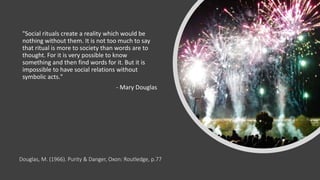
"Social rituals create a reality which would be
nothing without them. It is not too much to say
that ritual is more to society than words are to
thought. For it is very possible to know
something and then find words for it. But it is
impossible to have social relations without
symbolic acts."
- Mary Douglas
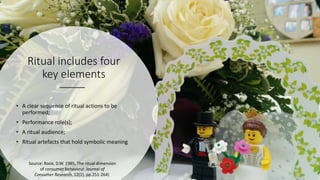
Ritual includes four
key elements
• A clear sequence of ritual actions to be
performed;
• Performance role(s);
• A ritual audience;
• Ritual artefacts that hold symbolic meaning
Source: Rook, D.W. 1985, The ritual dimension
of consumer behaviour. Journal of
Consumer Research, 12(1), pp.251-264)
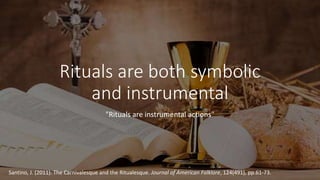
Rituals are both symbolic
and instrumental
"Rituals are instrumental actions"
Santino, J. (2011). The Carnivalesque and the Ritualesque. Journal of American Folklore, 124(491), pp.61-73.
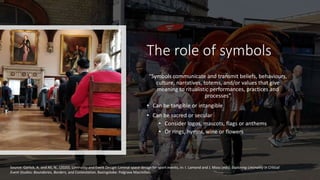
The role of symbols
“Symbols communicate and transmit beliefs, behaviours,
culture, narratives, totems, and/or values that give
meaning to ritualistic performances, practices and
processes”
• Can be tangible or intangible
• Can be sacred or secular
• Consider logos, mascots, flags or anthems
• Or rings, hymns, wine or flowers
Source: Garlick, A. and Ali, N., (2020). Liminality and Event Design: Liminal space design for sport events, in: I. Lamond and J. Moss (eds). Exploring Liminality in Critical
Event Studies: Boundaries, Borders, and Contestation, Basingstoke: Palgrave Macmillan.
Symbolic
interactionism
1. "Humans act toward things on the basis of
the meanings they ascribe to those
things."
2. "The meaning of such things is derived
from, or arises out of, the social
interaction that one has with others and
the society."
3. "The meanings are handled in, and
modified through, an interpretative
process used by the person in dealing with
the things he/she encounters."
Source: Blumer, H. (1969). Symbolic Interactionism: Perspective and method. Prentice-Hall: New Jersey.
Types of rites
Sympathetic versus contagious
Sympathetic
versus contagious
rites
Sympathetic
• Reciprocal action
• What happens to an image will
happen to the subject
• E.g. Voodoo dolls
Contagious
• Characteristics are material and
transmissible
• E.g. Holiness of holy water
Van Gennep, A. (1909). The Rites of Passage: a classic study of
cultural celebrations. Translated from French by M.B. Vizedom
and G.L.Caffee, 1960, Chicago: Chicago Free Press.
Types of rites
• Rites of purification
• Rites of passage
• Rites of reversal
• Rites of conspicuous display
• Rites of conspicuous consumption
• Ritual dramas
• Rites of exchange
• Rites of competition
• De-valorisation of rites
Andrews, H. and Leopold, T. (2013). Events and the Social Science. Abingdon, Oxon:
Routledge.
Rites of
passage
• Passage from one place to another
• Passage from one status to another
• Passage from one situation to another
• Passage of time
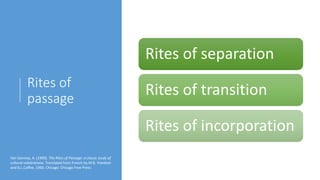
Rites of
passage
Rites of separation
Rites of transition
Rites of incorporation
Van Gennep, A. (1909). The Rites of Passage: a classic study of
cultural celebrations. Translated from French by M.B. Vizedom
and G.L.Caffee, 1960, Chicago: Chicago Free Press.
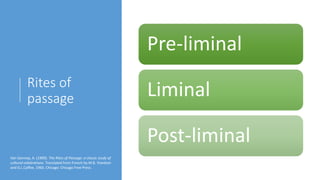
Rites of
passage
Pre-liminal
Liminal
Post-liminal
Van Gennep, A. (1909). The Rites of Passage: a classic study of
cultural celebrations. Translated from French by M.B. Vizedom
and G.L.Caffee, 1960, Chicago: Chicago Free Press.
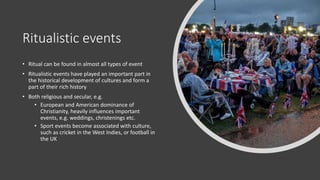
Ritualistic events
• Ritual can be found in almost all types of event
• Ritualistic events have played an important part in
the historical development of cultures and form a
part of their rich history
• Both religious and secular, e.g.
• European and American dominance of
Christianity, heavily influences important
events, e.g. weddings, christenings etc.
• Sport events become associated with culture,
such as cricket in the West Indies, or football in
the UK
The role of ritual in
modern day events
• Brown and James (2004) argue that ritual has been
sacrificed to give way to modern event management
techniques
• It’s now all about the money and the experience!
• In Garlick and Ali (2020), we argue that ritual is an
essential part of creating an authentic and meaningful
experience, and therefore ritual is more important than
ever.
Source: Garlick, A. and Ali, N., (2020). Liminality and Event Design: Liminal space design for sport events, in: I. Lamond and J. Moss (eds). Exploring Liminality in Critical Event Studies:
Boundaries, Borders, and Contestation, Basingstoke: Palgrave Macmillan.
Brown, S., and James, J. (2004). Event Design and Management: Ritual Sacrifice? In I. Yeoman, M. Robertson, J. Ali-Knight, S. Drummond and U. McMahon-Beattie (Eds) Festival and
Events Management, (pp.53-64). Oxford: Elsevier.
Conclusion
• Rituals are important in
helping society create and
share meaning
• There are different types of
ritual, which have different
characteristics
• Rites of passage have three
distinct stages
Any
questions?
Let’s look at an example: The Māori Haka
Discussion
1. What is the purpose of this ritual?
2. What is the significance to the
participants?
3. Identify the symbols associated
with a Rugby team
Reading before
next week:
• Garlick, A. and Ali, N., (2020). Liminality and Event
Design: Liminal space design for sport events, in: I.
Lamond and J. Moss (eds). Exploring Liminality in
Critical Event Studies: Boundaries, Borders, and
Contestation, Basingstoke: Palgrave Macmillan.
[Only available in the week 3 folder on Blackboard]

Rites and ritual

  • 1.
    Rites and ritual CelebrationEvents | By Ashley Garlick
  • 2.
    Rites and ritual CelebrationEvents | By Ashley Garlick
  • 3.
    Definition • A seriesof actions completed in a prescribed order • Usually associated with religion • Intended to transform
  • 4.
    Douglas, M. (1966).Purity & Danger, Oxon: Routledge, p.77 "Social rituals create a reality which would be nothing without them. It is not too much to say that ritual is more to society than words are to thought. For it is very possible to know something and then find words for it. But it is impossible to have social relations without symbolic acts." - Mary Douglas
  • 5.
    Ritual includes four keyelements • A clear sequence of ritual actions to be performed; • Performance role(s); • A ritual audience; • Ritual artefacts that hold symbolic meaning Source: Rook, D.W. 1985, The ritual dimension of consumer behaviour. Journal of Consumer Research, 12(1), pp.251-264)
  • 6.
    Rituals are bothsymbolic and instrumental "Rituals are instrumental actions" Santino, J. (2011). The Carnivalesque and the Ritualesque. Journal of American Folklore, 124(491), pp.61-73.
  • 7.
    The role ofsymbols “Symbols communicate and transmit beliefs, behaviours, culture, narratives, totems, and/or values that give meaning to ritualistic performances, practices and processes” • Can be tangible or intangible • Can be sacred or secular • Consider logos, mascots, flags or anthems • Or rings, hymns, wine or flowers Source: Garlick, A. and Ali, N., (2020). Liminality and Event Design: Liminal space design for sport events, in: I. Lamond and J. Moss (eds). Exploring Liminality in Critical Event Studies: Boundaries, Borders, and Contestation, Basingstoke: Palgrave Macmillan.
  • 8.
    Symbolic interactionism 1. "Humans acttoward things on the basis of the meanings they ascribe to those things." 2. "The meaning of such things is derived from, or arises out of, the social interaction that one has with others and the society." 3. "The meanings are handled in, and modified through, an interpretative process used by the person in dealing with the things he/she encounters." Source: Blumer, H. (1969). Symbolic Interactionism: Perspective and method. Prentice-Hall: New Jersey.
  • 9.
    Types of rites Sympatheticversus contagious
  • 10.
    Sympathetic versus contagious rites Sympathetic • Reciprocalaction • What happens to an image will happen to the subject • E.g. Voodoo dolls Contagious • Characteristics are material and transmissible • E.g. Holiness of holy water Van Gennep, A. (1909). The Rites of Passage: a classic study of cultural celebrations. Translated from French by M.B. Vizedom and G.L.Caffee, 1960, Chicago: Chicago Free Press.
  • 11.
    Types of rites •Rites of purification • Rites of passage • Rites of reversal • Rites of conspicuous display • Rites of conspicuous consumption • Ritual dramas • Rites of exchange • Rites of competition • De-valorisation of rites Andrews, H. and Leopold, T. (2013). Events and the Social Science. Abingdon, Oxon: Routledge.
  • 12.
    Rites of passage • Passagefrom one place to another • Passage from one status to another • Passage from one situation to another • Passage of time
  • 13.
    Rites of passage Rites ofseparation Rites of transition Rites of incorporation Van Gennep, A. (1909). The Rites of Passage: a classic study of cultural celebrations. Translated from French by M.B. Vizedom and G.L.Caffee, 1960, Chicago: Chicago Free Press.
  • 14.
    Rites of passage Pre-liminal Liminal Post-liminal Van Gennep,A. (1909). The Rites of Passage: a classic study of cultural celebrations. Translated from French by M.B. Vizedom and G.L.Caffee, 1960, Chicago: Chicago Free Press.
  • 15.
    Ritualistic events • Ritualcan be found in almost all types of event • Ritualistic events have played an important part in the historical development of cultures and form a part of their rich history • Both religious and secular, e.g. • European and American dominance of Christianity, heavily influences important events, e.g. weddings, christenings etc. • Sport events become associated with culture, such as cricket in the West Indies, or football in the UK
  • 16.
    The role ofritual in modern day events • Brown and James (2004) argue that ritual has been sacrificed to give way to modern event management techniques • It’s now all about the money and the experience! • In Garlick and Ali (2020), we argue that ritual is an essential part of creating an authentic and meaningful experience, and therefore ritual is more important than ever. Source: Garlick, A. and Ali, N., (2020). Liminality and Event Design: Liminal space design for sport events, in: I. Lamond and J. Moss (eds). Exploring Liminality in Critical Event Studies: Boundaries, Borders, and Contestation, Basingstoke: Palgrave Macmillan. Brown, S., and James, J. (2004). Event Design and Management: Ritual Sacrifice? In I. Yeoman, M. Robertson, J. Ali-Knight, S. Drummond and U. McMahon-Beattie (Eds) Festival and Events Management, (pp.53-64). Oxford: Elsevier.
  • 17.
    Conclusion • Rituals areimportant in helping society create and share meaning • There are different types of ritual, which have different characteristics • Rites of passage have three distinct stages
  • 18.
  • 19.
    Let’s look atan example: The Māori Haka
  • 20.
    Discussion 1. What isthe purpose of this ritual? 2. What is the significance to the participants? 3. Identify the symbols associated with a Rugby team
  • 21.
    Reading before next week: •Garlick, A. and Ali, N., (2020). Liminality and Event Design: Liminal space design for sport events, in: I. Lamond and J. Moss (eds). Exploring Liminality in Critical Event Studies: Boundaries, Borders, and Contestation, Basingstoke: Palgrave Macmillan. [Only available in the week 3 folder on Blackboard]