IV. – C EVENT DESIGN

DEVELOP THE CONCEPT

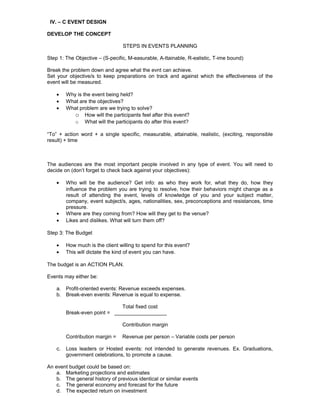
                                  STEPS IN EVENTS PLANNING

Step 1: The Objective – (S-pecific, M-easurable, A-ttainable, R-ealistic, T-ime bound)

Break the problem down and agree what the evnt can achieve.
Set your objective/s to keep preparations on track and against which the effectiveness of the
event will be measured.

    •    Why is the event being held?
    •    What are the objectives?
    •    What problem are we trying to solve?
            o How will the participants feel after this event?
            o What will the participants do after this event?

“To” + action word + a single specific, measurable, attainable, realistic, (exciting, responsible
result) + time


The audiences are the most important people involved in any type of event. You will need to
decide on (don’t forget to check back against your objectives):

    •    Who will be the audience? Get info: as who they work for, what they do, how they
         influence the problem you are trying to resolve, how their behaviors might change as a
         result of attending the event, levels of knowledge of you and your subject matter,
         company, event subject/s, ages, nationalities, sex, preconceptions and resistances, time
         pressure.
    •    Where are they coming from? How will they get to the venue?
    •    Likes and dislikes. What will turn them off?

Step 3: The Budget

    •    How much is the client willing to spend for this event?
    •    This will dictate the kind of event you can have.

The budget is an ACTION PLAN.

Events may either be:

    a. Profit-oriented events: Revenue exceeds expenses.
    b. Break-even events: Revenue is equal to expense.

                               Total fixed cost
         Break-even point = __________________

                                  Contribution margin

         Contribution margin =    Revenue per person – Variable costs per person

    c.   Loss leaders or Hosted events: not intended to generate revenues. Ex. Graduations,
         government celebrations, to promote a cause.

An event budget could be based on:
    a. Marketing projections and estimates
    b. The general history of previous identical or similar events
    c. The general economy and forecast for the future
    d. The expected return on investment
e. Type of financing that you chose to use to finace your event (borrowed funds,
       prepayment, existing fund).

    INCOME GENERATORS AND EXPENSES


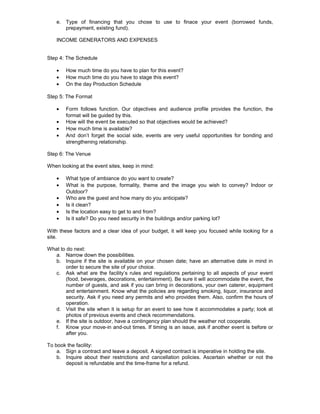
Step 4: The Schedule

    •   How much time do you have to plan for this event?
    •   How much time do you have to stage this event?
    •   On the day Production Schedule

Step 5: The Format

    •   Form follows function. Our objectives and audience profile provides the function, the
        format will be guided by this.
    •   How will the event be executed so that objectives would be achieved?
    •   How much time is available?
    •   And don’t forget the social side, events are very useful opportunities for bonding and
        strengthening relationship.

Step 6: The Venue

When looking at the event sites, keep in mind:

    •   What type of ambiance do you want to create?
    •   What is the purpose, formality, theme and the image you wish to convey? Indoor or
        Outdoor?
    •   Who are the guest and how many do you anticipate?
    •   Is it clean?
    •   Is the location easy to get to and from?
    •   Is it safe? Do you need security in the buildings and/or parking lot?

With these factors and a clear idea of your budget, it will keep you focused while looking for a
site.

What to do next:
  a. Narrow down the possibilities.
  b. Inquire if the site is available on your chosen date; have an alternative date in mind in
        order to secure the site of your choice.
  c. Ask what are the facility’s rules and regulations pertaining to all aspects of your event
        (food, beverages, decorations, entertainment). Be sure it will accommodate the event, the
        number of guests, and ask if you can bring in decorations, your own caterer, equipment
        and entertainment. Know what the policies are regarding smoking, liquor, insurance and
        security. Ask if you need any permits and who provides them. Also, confirm the hours of
        operation.
  d. Visit the site when it is setup for an event to see how it accommodates a party; look at
        photos of previous events and check recommendations.
  e. If the site is outdoor, have a contingency plan should the weather not cooperate.
  f. Know your move-in and-out times. If timing is an issue, ask if another event is before or
        after you.

To book the facility:
    a. Sign a contract and leave a deposit. A signed contract is imperative in holding the site.
    b. Inquire about their restrictions and cancellation policies. Ascertain whether or not the
       deposit is refundable and the time-frame for a refund.
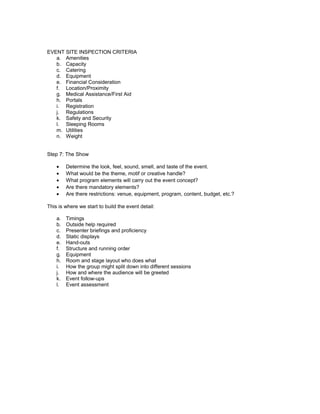
EVENT SITE INSPECTION CRITERIA
   a. Amenities
   b. Capacity
   c. Catering
   d. Equipment
   e. Financial Consideration
   f. Location/Proximity
   g. Medical Assistance/First Aid
   h. Portals
   i. Registration
   j. Regulations
   k. Safety and Security
   l. Sleeping Rooms
   m. Utilities
   n. Weight


Step 7: The Show

    •    Determine the look, feel, sound, smell, and taste of the event.
    •    What would be the theme, motif or creative handle?
    •    What program elements will carry out the event concept?
    •    Are there mandatory elements?
    •    Are there restrictions: venue, equipment, program, content, budget, etc.?

This is where we start to build the event detail:

    a.   Timings
    b.   Outside help required
    c.   Presenter briefings and proficiency
    d.   Static displays
    e.   Hand-outs
    f.   Structure and running order
    g.   Equipment
    h.   Room and stage layout who does what
    i.   How the group might split down into different sessions
    j.   How and where the audience will be greeted
    k.   Event follow-ups
    l.   Event assessment

Iv c. developing an event concept

  • 1.
    IV. – CEVENT DESIGN DEVELOP THE CONCEPT STEPS IN EVENTS PLANNING Step 1: The Objective – (S-pecific, M-easurable, A-ttainable, R-ealistic, T-ime bound) Break the problem down and agree what the evnt can achieve. Set your objective/s to keep preparations on track and against which the effectiveness of the event will be measured. • Why is the event being held? • What are the objectives? • What problem are we trying to solve? o How will the participants feel after this event? o What will the participants do after this event? “To” + action word + a single specific, measurable, attainable, realistic, (exciting, responsible result) + time The audiences are the most important people involved in any type of event. You will need to decide on (don’t forget to check back against your objectives): • Who will be the audience? Get info: as who they work for, what they do, how they influence the problem you are trying to resolve, how their behaviors might change as a result of attending the event, levels of knowledge of you and your subject matter, company, event subject/s, ages, nationalities, sex, preconceptions and resistances, time pressure. • Where are they coming from? How will they get to the venue? • Likes and dislikes. What will turn them off? Step 3: The Budget • How much is the client willing to spend for this event? • This will dictate the kind of event you can have. The budget is an ACTION PLAN. Events may either be: a. Profit-oriented events: Revenue exceeds expenses. b. Break-even events: Revenue is equal to expense. Total fixed cost Break-even point = __________________ Contribution margin Contribution margin = Revenue per person – Variable costs per person c. Loss leaders or Hosted events: not intended to generate revenues. Ex. Graduations, government celebrations, to promote a cause. An event budget could be based on: a. Marketing projections and estimates b. The general history of previous identical or similar events c. The general economy and forecast for the future d. The expected return on investment
  • 2.
    e. Type offinancing that you chose to use to finace your event (borrowed funds, prepayment, existing fund). INCOME GENERATORS AND EXPENSES Step 4: The Schedule • How much time do you have to plan for this event? • How much time do you have to stage this event? • On the day Production Schedule Step 5: The Format • Form follows function. Our objectives and audience profile provides the function, the format will be guided by this. • How will the event be executed so that objectives would be achieved? • How much time is available? • And don’t forget the social side, events are very useful opportunities for bonding and strengthening relationship. Step 6: The Venue When looking at the event sites, keep in mind: • What type of ambiance do you want to create? • What is the purpose, formality, theme and the image you wish to convey? Indoor or Outdoor? • Who are the guest and how many do you anticipate? • Is it clean? • Is the location easy to get to and from? • Is it safe? Do you need security in the buildings and/or parking lot? With these factors and a clear idea of your budget, it will keep you focused while looking for a site. What to do next: a. Narrow down the possibilities. b. Inquire if the site is available on your chosen date; have an alternative date in mind in order to secure the site of your choice. c. Ask what are the facility’s rules and regulations pertaining to all aspects of your event (food, beverages, decorations, entertainment). Be sure it will accommodate the event, the number of guests, and ask if you can bring in decorations, your own caterer, equipment and entertainment. Know what the policies are regarding smoking, liquor, insurance and security. Ask if you need any permits and who provides them. Also, confirm the hours of operation. d. Visit the site when it is setup for an event to see how it accommodates a party; look at photos of previous events and check recommendations. e. If the site is outdoor, have a contingency plan should the weather not cooperate. f. Know your move-in and-out times. If timing is an issue, ask if another event is before or after you. To book the facility: a. Sign a contract and leave a deposit. A signed contract is imperative in holding the site. b. Inquire about their restrictions and cancellation policies. Ascertain whether or not the deposit is refundable and the time-frame for a refund.
  • 3.
    EVENT SITE INSPECTIONCRITERIA a. Amenities b. Capacity c. Catering d. Equipment e. Financial Consideration f. Location/Proximity g. Medical Assistance/First Aid h. Portals i. Registration j. Regulations k. Safety and Security l. Sleeping Rooms m. Utilities n. Weight Step 7: The Show • Determine the look, feel, sound, smell, and taste of the event. • What would be the theme, motif or creative handle? • What program elements will carry out the event concept? • Are there mandatory elements? • Are there restrictions: venue, equipment, program, content, budget, etc.? This is where we start to build the event detail: a. Timings b. Outside help required c. Presenter briefings and proficiency d. Static displays e. Hand-outs f. Structure and running order g. Equipment h. Room and stage layout who does what i. How the group might split down into different sessions j. How and where the audience will be greeted k. Event follow-ups l. Event assessment