
EEventvent MManagementanagement
June 2012
2
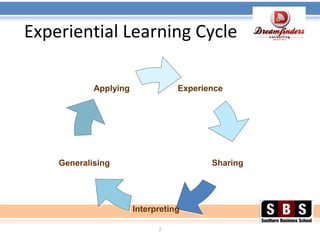
Experiential Learning Cycle
Experience
Generalising
Applying
Interpreting
Sharing
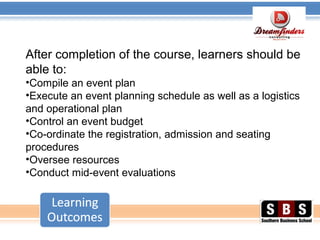
After completion of the course, learners should be
able to:
•Compile an event plan
•Execute an event planning schedule as well as a logistics
and operational plan
•Control an event budget
•Co-ordinate the registration, admission and seating
procedures
•Oversee resources
•Conduct mid-event evaluations
Why events management?
• Planning is important
• What makes an successful event?
• Where does the ideas come from?
Activity
• How would you define Events Management and
Planning?
• What are the critical success factors for planning an
event?
• How are we performing in terms of these factors?
• What are the obstacles to effective Event
Management and Planning in general?
The concept
• Event management is the application
of project management to the creation and
development of festivals, events and
conferences
The concept
• Event management involves
– studying the intricacies of the brand,
– identifying the target audience,
– devising the event concept,
– planning the logistics, and
– coordinating the technical aspects before actually
executing the modalities of the proposed event
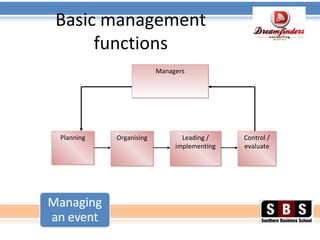
Basic management
functions
ManagersManagers
PlanningPlanning OrganisingOrganising Leading /
implementing
Leading /
implementing
Control /
evaluate
Control /
evaluate
The concept
• Event planning
• Event organising
• Event leading / implementation
• Event control
Event planning
• Steps:
1. Determine the purpose
2. Define the scope
3. Create a budget
4. Locate a venue and reserve
5. Create printed materials
6. Know event policies and procedures
7. Plan the event programme
1. Determine the purpose
• Determine the client’s needs for the event
– What objective is the client trying to achieve?
– What kind of event numbers does he/she have in mind?
– How much time will it take to present the information?
– Who is the target audience and where are they located?
• Staffing an event
• Modifying products
• Transportation and lodging
• Venue setup
2. Develop smart objectives
• Also referred to as the scope…
• Specific
• Measurable
• Achievable
• Realistic
• Timely
Activity
• Select a specific event and develop a number of
SMART objectives for the event.
Develop a planning
schedule
• Production schedule
– Event activities
– Tasks
– Staff assignments
– Program notes
– Key contacts
– Other information
• Timeline (see p18-23)
Activity
• Select a specific event and design a time line for the
event.
The venue
• Where will the event take place?
• How long will it last?
• Who will set-up?
• Who will clean up?
• General guidelines (p 26)
• Check list (p 28-31)
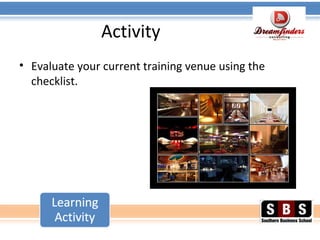
Activity
• Evaluate your current training venue using the
checklist.
Managing event risks
• Risk management process:
– Identification
– Assessment & evaluation
– Control
– (Financing)
Legal requirements
• National Fire Protection Association
• SABS – Health & Safety
• Occupational Health & Safety
• Other
– Explosives
– Regulation of gatherings
– By-laws
– Firearms control act
– Copyright act
Event budget
• Key aspects:
– Venue
– Catering
– Promotion
– Materials
– Presenters
– Documenting
– Subsidising participants
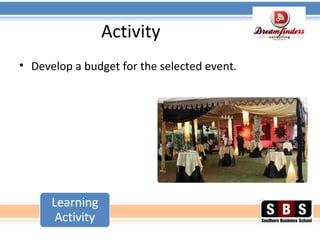
Activity
• Develop a budget for the selected event.
Financial principles
• Budgeting tips:
– Build in contingencies
– Be clear & specific
– Be realistic
– Integrate with the financial system
– Use activity based costing (ABC)
– Indicate whether budget is NET or GROSS
– Be aware of VAT
– Be conservative in terms of income
– Back-up
• Control
Co-ordinate Registration &
Admission
• Respond to inquiries & confirm attendance
• Delegates/Speakers/Media
– Welcome
– Registration
– Information/Registration desk
– Venue maintenance
– Staff
– Co-ordinate media
– Transportation
– Evaluation
– Record event
Co-ordinate Registration &
Admission
• Crown control
– Enough space
– Protect off-limit areas
– Guide crowds
– Lay out rules ahead of time
– Remove problem guests/delegates
Co-ordinate Registration &
Admission
• Oversee resources planning
– Role-players in the event
– Staff the event
– Service providers/contractors
• Funding
– ‘in-kind’ contribution
– Donations, contributions, grants
– Technical assistance
– Recognise donors
Conduct event evaluations
• Monitoring & Evaluation procedures
– Determine the extend to which objectives have been
achieved
– Get feedback from clients
• Quality & high standard performance
André Knipe
knipeandre@gmail.com

Event Management - AK2012

  • 1.
  • 2.
  • 3.
    After completion ofthe course, learners should be able to: •Compile an event plan •Execute an event planning schedule as well as a logistics and operational plan •Control an event budget •Co-ordinate the registration, admission and seating procedures •Oversee resources •Conduct mid-event evaluations
  • 4.
    Why events management? •Planning is important • What makes an successful event? • Where does the ideas come from?
  • 5.
    Activity • How wouldyou define Events Management and Planning? • What are the critical success factors for planning an event? • How are we performing in terms of these factors? • What are the obstacles to effective Event Management and Planning in general?
  • 6.
    The concept • Eventmanagement is the application of project management to the creation and development of festivals, events and conferences
  • 7.
    The concept • Eventmanagement involves – studying the intricacies of the brand, – identifying the target audience, – devising the event concept, – planning the logistics, and – coordinating the technical aspects before actually executing the modalities of the proposed event
  • 8.
    Basic management functions ManagersManagers PlanningPlanning OrganisingOrganisingLeading / implementing Leading / implementing Control / evaluate Control / evaluate
  • 9.
    The concept • Eventplanning • Event organising • Event leading / implementation • Event control
  • 10.
    Event planning • Steps: 1.Determine the purpose 2. Define the scope 3. Create a budget 4. Locate a venue and reserve 5. Create printed materials 6. Know event policies and procedures 7. Plan the event programme
  • 11.
    1. Determine thepurpose • Determine the client’s needs for the event – What objective is the client trying to achieve? – What kind of event numbers does he/she have in mind? – How much time will it take to present the information? – Who is the target audience and where are they located? • Staffing an event • Modifying products • Transportation and lodging • Venue setup
  • 12.
    2. Develop smartobjectives • Also referred to as the scope… • Specific • Measurable • Achievable • Realistic • Timely
  • 13.
    Activity • Select aspecific event and develop a number of SMART objectives for the event.
  • 14.
    Develop a planning schedule •Production schedule – Event activities – Tasks – Staff assignments – Program notes – Key contacts – Other information • Timeline (see p18-23)
  • 15.
    Activity • Select aspecific event and design a time line for the event.
  • 16.
    The venue • Wherewill the event take place? • How long will it last? • Who will set-up? • Who will clean up? • General guidelines (p 26) • Check list (p 28-31)
  • 17.
    Activity • Evaluate yourcurrent training venue using the checklist.
  • 18.
    Managing event risks •Risk management process: – Identification – Assessment & evaluation – Control – (Financing)
  • 19.
    Legal requirements • NationalFire Protection Association • SABS – Health & Safety • Occupational Health & Safety • Other – Explosives – Regulation of gatherings – By-laws – Firearms control act – Copyright act
  • 20.
    Event budget • Keyaspects: – Venue – Catering – Promotion – Materials – Presenters – Documenting – Subsidising participants
  • 21.
    Activity • Develop abudget for the selected event.
  • 22.
    Financial principles • Budgetingtips: – Build in contingencies – Be clear & specific – Be realistic – Integrate with the financial system – Use activity based costing (ABC) – Indicate whether budget is NET or GROSS – Be aware of VAT – Be conservative in terms of income – Back-up • Control
  • 23.
    Co-ordinate Registration & Admission •Respond to inquiries & confirm attendance • Delegates/Speakers/Media – Welcome – Registration – Information/Registration desk – Venue maintenance – Staff – Co-ordinate media – Transportation – Evaluation – Record event
  • 24.
    Co-ordinate Registration & Admission •Crown control – Enough space – Protect off-limit areas – Guide crowds – Lay out rules ahead of time – Remove problem guests/delegates
  • 25.
    Co-ordinate Registration & Admission •Oversee resources planning – Role-players in the event – Staff the event – Service providers/contractors • Funding – ‘in-kind’ contribution – Donations, contributions, grants – Technical assistance – Recognise donors
  • 26.
    Conduct event evaluations •Monitoring & Evaluation procedures – Determine the extend to which objectives have been achieved – Get feedback from clients • Quality & high standard performance
  • 27.