Structure of Eukaryotic cell
By
KAUSHAL KUMAR SAHU
Assistant Professor (Ad Hoc)
Department of Biotechnology
Govt. Digvijay Autonomous P. G. College
Raj-Nandgaon ( C. G. )
SYNOPSIS
 What is cell ?
 Type of cell
• Prokaryotic cell
• Eukaryotic cell
 Introduction
 History
 Definition
 Cell Structure
• Plasma membrane ,Ribosome ,Nucleus , Cytoskeleton , Cytoplasm ,
Mitochondria , Golgibody , Lysosome
Endoplasmic reticulum , Peroxisome , Chloroplast
Cell wall , Vacuole , Centriole , Centrosome
Microtubules , Microfilament , flagella and cilia
 Conclusion
 References
What is cell ?
 All living organisms on Earth are divided in pieces called cells.
 There are smaller pieces to cells that include proteins and
organelles.
 There are also larger pieces called tissues and systems.
fig : animal cell
TYPE OF CELL
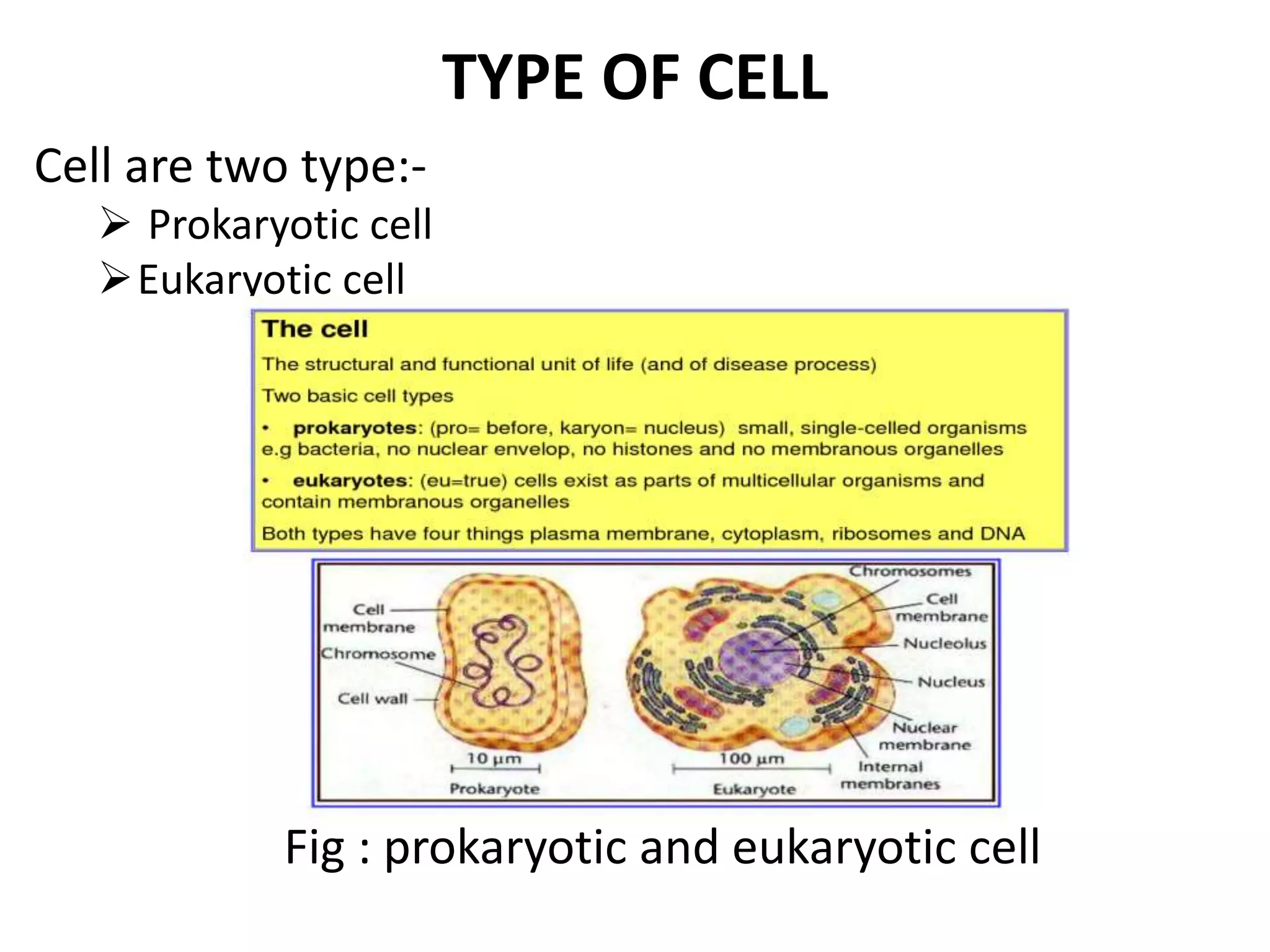
Cell are two type:-
 Prokaryotic cell
Eukaryotic cell
Fig : prokaryotic and eukaryotic cell
INTRODUCTION
 A cell is defined as eukaryotic if it has a membrane-bound nucleus.
 Any organism composed of eukaryotic cells is also considered a eukaryotic
organism.
 A living cell is a complex, multi-functional unit.
fig : eukaryotic cell
HISTORY
The cell was discovered by Robert Hooke in 1665.
The cell theory, first developed in 1839 by
Matthias Jakob Schleiden and Theoder Schwann.
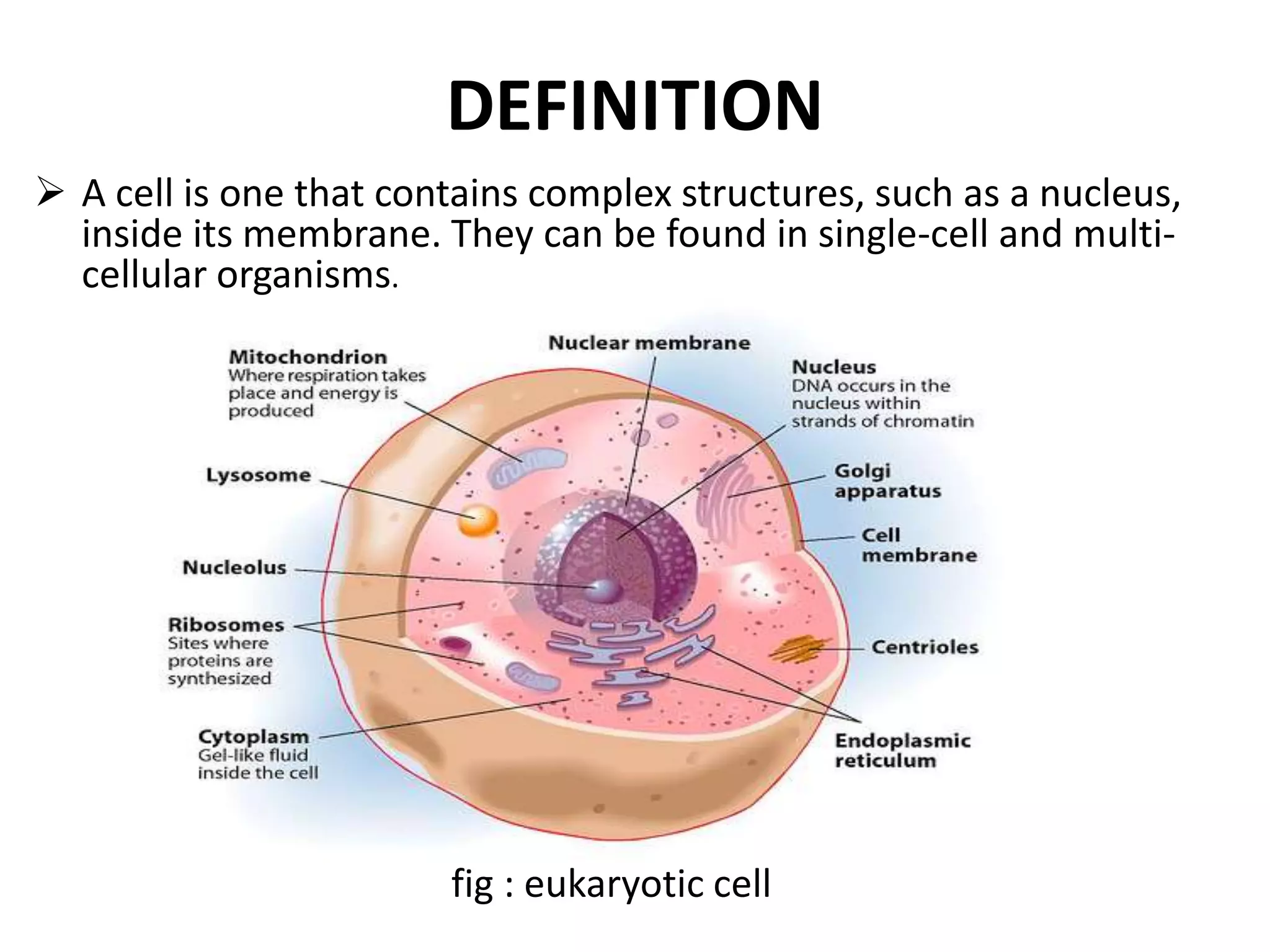
DEFINITION
 A cell is one that contains complex structures, such as a nucleus,
inside its membrane. They can be found in single-cell and multi-
cellular organisms.
fig : eukaryotic cell
CELL STRUCTURE
The cell is the structural unit of life.
They contain numerous internal structures.
some examples of eukaryotes:-
– Animals
– Plants
– Fungi (mushrooms,etc.)
– Protists (algae,plankton,etc.)
Plasma membrane
 In all type of cells weather plant, animal or naked a very
thin, semipermeable membrane is present around the
cells which are responsible for entry and exit of all types
of ions and molecules called as plasma membrane.
fig : plasma membrane
RIBOSOME
Ribosome’s are the components of cell that make
proteins from amino acid.
fig :eukaryotic cell
Fig: ribosome
Nucleus
The nucleus is a membrane-enclosed organelle
found in eukaryotic cells, contains most of the cell's
genetic material.
fig : nucleus
CYTOSKELETON
The cytoskeleton is a cellular skeleton contained
within a cell's cytoplasm.
In 1903 Nikolai K Koltsov proposed that the shape of
cells was determined by a network of tubules which
he termed the cytoskeleton.
fig: cytoskeleton
MICROFILAMENT
Microfilament is also called actin filaments, because
they are built from molecules called actin.
 A microfilament is a twisted double chain of actin
subunits.
fig : microfilament
MICROYUBULES
A microtubule is a polymer of globular tubulin
subunits.
Microtubules are hollow, tubular structures, and they
occur in nearly every eukaryotic cell.
fig : microtubules
CYTOPLASM
Cytoplasm is the fluid that fills the interior of
the cell.
cytoplasm is mostly water, but contains a large
assortment of molecular and structural
components.
MITOCHONDRIA
 Mitochondria are self-replicating organelles that occur in various
numbers, shapes, and sizes in the cytoplasm of all eukaryotic cells.
 Mitochondria play a critical role in generating energy in the
eukaryotic cell.
fig : mitochondria
GOLGI BODIES
Cell contains a number of Golgi bodies. "Golgi" is
the name of the person who first described these
structures.
fig : golgi body
LYSOSOME
Lysosome are cellular organelles that contain
acid hydrolase enzymes to break down waste
materials and cellular debris.
fig : lysosome
ENDOPLASMIC RETICULUM
 The endoplasmic reticulum (ER) is found in almost all animal
and plant cells.
 The endoplasmic reticulum concists of an interconnected
system of membrane-bound channels in the cytoplasm.
fig : endoplasmic reticulum
PEROXISOMES
Peroxisomes are simple, membrane-bound
vesicles with a diameter of 0.1 to 1.0 m that may
contain a dense, crystalline core of oxidative
enzymes.
fig : peroxisomes
CHLOROPLAST
Many plant and algae cells contain small, green
organelles called chloroplasts.
fig : chloroplast
CELL WALL
 Many types of prokaryotic and eukaryotic cells have a
cell wall.
 plant cell walls are primarily made up of pectin, fungi
cell walls are made up of chitin and bacteria cell walls
are made up of peptidoglycan.
fig : cell wall
VACUOLES
 Vacuoles store food and waste.
 Most plant cells have a large membrane-bound sac called a
vacuole.
fig: plant cell
CENTRIOLE
 The centriole is a small, barrel-shaped tube composed of protein
located in the cytoplasm.
 The centriole's main function is to aid in cell division and in the
spatial arrangement of structures within the cell.
fig : centriole
CENTROSOME
Centrosome is the cytoskeleton organizer.
The centrosome produces the microtubules of a
cell.
fig : centrosome
FLAGELLA AND CILIA
Cilia and flagella are microtubule-based
projections of the plasma membrane that are
responsible for movement of a variety of
eukaryotic cells.
CONCLUSION
Organelles serve specific functions within
eukaryotes, such as energy production,
photosynthesis, and membrane construction.
Most are membrane-bound structures that are
the sites of specific types of biochemical
reactions.
REFERENCES
Gerald Karp – cell and molecular biology 6th
Edition
Geoffrey M. Cooper – The cell a molecular
aproach 4th Edition
www.shmoop.com
En.wikipedia.org/wiki/cell biology (10:00pm)
En.wikipedia.org/wiki/eukaryote (10:00pm)

Eukaryotic cell By KK Sahu Sir

  • 1.
    Structure of Eukaryoticcell By KAUSHAL KUMAR SAHU Assistant Professor (Ad Hoc) Department of Biotechnology Govt. Digvijay Autonomous P. G. College Raj-Nandgaon ( C. G. )
  • 2.
    SYNOPSIS  What iscell ?  Type of cell • Prokaryotic cell • Eukaryotic cell  Introduction  History  Definition  Cell Structure • Plasma membrane ,Ribosome ,Nucleus , Cytoskeleton , Cytoplasm , Mitochondria , Golgibody , Lysosome Endoplasmic reticulum , Peroxisome , Chloroplast Cell wall , Vacuole , Centriole , Centrosome Microtubules , Microfilament , flagella and cilia  Conclusion  References
  • 3.
    What is cell?  All living organisms on Earth are divided in pieces called cells.  There are smaller pieces to cells that include proteins and organelles.  There are also larger pieces called tissues and systems. fig : animal cell
  • 4.
    TYPE OF CELL Cellare two type:-  Prokaryotic cell Eukaryotic cell Fig : prokaryotic and eukaryotic cell
  • 5.
    INTRODUCTION  A cellis defined as eukaryotic if it has a membrane-bound nucleus.  Any organism composed of eukaryotic cells is also considered a eukaryotic organism.  A living cell is a complex, multi-functional unit. fig : eukaryotic cell
  • 6.
    HISTORY The cell wasdiscovered by Robert Hooke in 1665. The cell theory, first developed in 1839 by Matthias Jakob Schleiden and Theoder Schwann.
  • 7.
    DEFINITION  A cellis one that contains complex structures, such as a nucleus, inside its membrane. They can be found in single-cell and multi- cellular organisms. fig : eukaryotic cell
  • 8.
    CELL STRUCTURE The cellis the structural unit of life. They contain numerous internal structures. some examples of eukaryotes:- – Animals – Plants – Fungi (mushrooms,etc.) – Protists (algae,plankton,etc.)
  • 10.
    Plasma membrane  Inall type of cells weather plant, animal or naked a very thin, semipermeable membrane is present around the cells which are responsible for entry and exit of all types of ions and molecules called as plasma membrane. fig : plasma membrane
  • 11.
    RIBOSOME Ribosome’s are thecomponents of cell that make proteins from amino acid. fig :eukaryotic cell Fig: ribosome
  • 12.
    Nucleus The nucleus isa membrane-enclosed organelle found in eukaryotic cells, contains most of the cell's genetic material. fig : nucleus
  • 13.
    CYTOSKELETON The cytoskeleton isa cellular skeleton contained within a cell's cytoplasm. In 1903 Nikolai K Koltsov proposed that the shape of cells was determined by a network of tubules which he termed the cytoskeleton. fig: cytoskeleton
  • 14.
    MICROFILAMENT Microfilament is alsocalled actin filaments, because they are built from molecules called actin.  A microfilament is a twisted double chain of actin subunits. fig : microfilament
  • 15.
    MICROYUBULES A microtubule isa polymer of globular tubulin subunits. Microtubules are hollow, tubular structures, and they occur in nearly every eukaryotic cell. fig : microtubules
  • 16.
    CYTOPLASM Cytoplasm is thefluid that fills the interior of the cell. cytoplasm is mostly water, but contains a large assortment of molecular and structural components.
  • 17.
    MITOCHONDRIA  Mitochondria areself-replicating organelles that occur in various numbers, shapes, and sizes in the cytoplasm of all eukaryotic cells.  Mitochondria play a critical role in generating energy in the eukaryotic cell. fig : mitochondria
  • 18.
    GOLGI BODIES Cell containsa number of Golgi bodies. "Golgi" is the name of the person who first described these structures. fig : golgi body
  • 19.
    LYSOSOME Lysosome are cellularorganelles that contain acid hydrolase enzymes to break down waste materials and cellular debris. fig : lysosome
  • 20.
    ENDOPLASMIC RETICULUM  Theendoplasmic reticulum (ER) is found in almost all animal and plant cells.  The endoplasmic reticulum concists of an interconnected system of membrane-bound channels in the cytoplasm. fig : endoplasmic reticulum
  • 21.
    PEROXISOMES Peroxisomes are simple,membrane-bound vesicles with a diameter of 0.1 to 1.0 m that may contain a dense, crystalline core of oxidative enzymes. fig : peroxisomes
  • 22.
    CHLOROPLAST Many plant andalgae cells contain small, green organelles called chloroplasts. fig : chloroplast
  • 23.
    CELL WALL  Manytypes of prokaryotic and eukaryotic cells have a cell wall.  plant cell walls are primarily made up of pectin, fungi cell walls are made up of chitin and bacteria cell walls are made up of peptidoglycan. fig : cell wall
  • 24.
    VACUOLES  Vacuoles storefood and waste.  Most plant cells have a large membrane-bound sac called a vacuole. fig: plant cell
  • 25.
    CENTRIOLE  The centrioleis a small, barrel-shaped tube composed of protein located in the cytoplasm.  The centriole's main function is to aid in cell division and in the spatial arrangement of structures within the cell. fig : centriole
  • 26.
    CENTROSOME Centrosome is thecytoskeleton organizer. The centrosome produces the microtubules of a cell. fig : centrosome
  • 27.
    FLAGELLA AND CILIA Ciliaand flagella are microtubule-based projections of the plasma membrane that are responsible for movement of a variety of eukaryotic cells.
  • 28.
    CONCLUSION Organelles serve specificfunctions within eukaryotes, such as energy production, photosynthesis, and membrane construction. Most are membrane-bound structures that are the sites of specific types of biochemical reactions.
  • 29.
    REFERENCES Gerald Karp –cell and molecular biology 6th Edition Geoffrey M. Cooper – The cell a molecular aproach 4th Edition www.shmoop.com En.wikipedia.org/wiki/cell biology (10:00pm) En.wikipedia.org/wiki/eukaryote (10:00pm)