FLUID MOSAIC MODEL
• S. J. SINGER and GARTH L. NICOLSON
L
DEFINITION
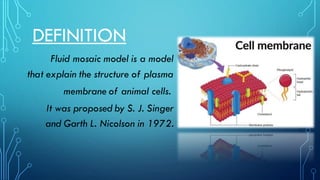
Fluid mosaic model is a model
that explain the structure of plasma
membrane of animal cells.
It was proposed by S. J. Singer
and Garth L. Nicolson in 1972.
SIGNIFICANT OF NAME
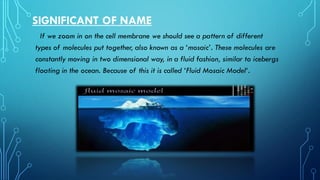
If we zoom in on the cell membrane we should see a pattern of different
types of molecules put together, also known as a ‘mosaic’. These molecules are
constantly moving in two dimensional way, in a fluid fashion, similar to icebergs
floating in the ocean. Because of this it is called ‘Fluid Mosaic Model‘.
PLASMA MEMBRANE
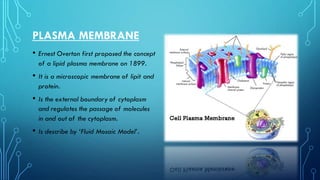
• Ernest Overton first proposed the concept
of a lipid plasma membrane on 1899.
• It is a microscopic membrane of lipit and
protein.
• Is the external boundary of cytoplasm
and regulates the passage of molecules
in and out of the cytoplasm.
• Is describe by ‘Fluid Mosaic Model’.
COMPOSITION
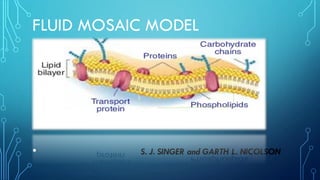
• Phospholipid ------- The main fabric of plasma membrane.
• Cholesterol ------- Between phospholipids and phospholipids bilayers.
• Protein ------- Inner or outer surface or embedded within
• phospholipids bilayers.
• Carbohydrate ------- Bound to glycolipids Or glycoproteins.
PHOSPHOLIPIDS
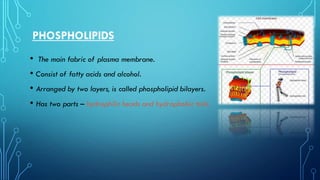
• The main fabric of plasma membrane.
• Consist of fatty acids and alcohol.
• Arranged by two layers, is called phospholipid bilayers.
• Has two parts – hydrophilic heads and hydrophobic tails.
PARTS OF PHOSPHOLIPIDS
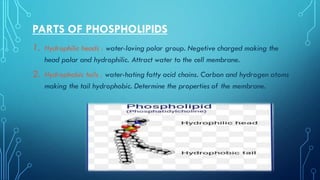
1. Hydrophilic heads : water-loving polar group. Negetive charged making the
head polar and hydrophilic. Attract water to the cell membrane.
2. Hydrophobic tails : water-hating fatty acid chains. Carbon and hydrogen atoms
making the tail hydrophobic. Determine the properties of the membrane.
CHOLESTEROL
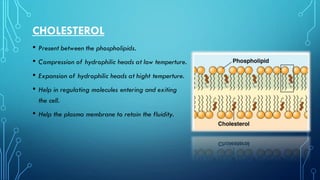
• Present between the phospholipids.
• Compression of hydrophilic heads at low temperture. ature.
• Expansion of hydrophilic heads at hight temperture. ature.
• Help in regulating molecules entering and exiting the
the cell.
• Help the plasma membrane to retain the fluidity.
PROTEIN
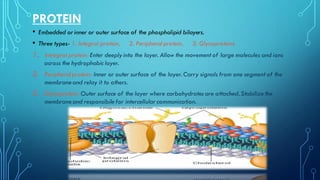
• Embedded orinner or outer surface of the phospholipid bilayers.
• Three types- 1. Integral protein, 2. Peripheral protein, 3. Glycoproteins
1. Intregral protein: Enter deeply into the layer. Allow the movement of large molecules and ions
across the hydrophobic layer.
2. Peripheral protein: Inner or outer surface of the layer. Carry signals from one segment of the
membrane and relay it to others.
3. Glycoprotein: Outer surface of the layer where carbohydrates are attached. Stabilize the
membrane and responsibile for intercellularcommunication.
CARBOHYDRATE
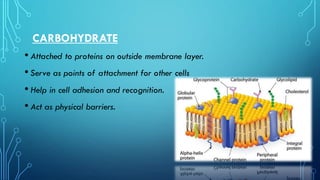
• Attached to proteins on outside membrane layer.
• Serve as points of attachment for other cells
• Help in cell adhesion and recognition.
• Act as physical barriers.
THANK YOU
Presented by ANUSHREE MAITY

fluid mosaic model.pdf

  • 1.
    FLUID MOSAIC MODEL •S. J. SINGER and GARTH L. NICOLSON L
  • 2.
    DEFINITION Fluid mosaic modelis a model that explain the structure of plasma membrane of animal cells. It was proposed by S. J. Singer and Garth L. Nicolson in 1972.
  • 3.
    SIGNIFICANT OF NAME Ifwe zoom in on the cell membrane we should see a pattern of different types of molecules put together, also known as a ‘mosaic’. These molecules are constantly moving in two dimensional way, in a fluid fashion, similar to icebergs floating in the ocean. Because of this it is called ‘Fluid Mosaic Model‘.
  • 4.
    PLASMA MEMBRANE • ErnestOverton first proposed the concept of a lipid plasma membrane on 1899. • It is a microscopic membrane of lipit and protein. • Is the external boundary of cytoplasm and regulates the passage of molecules in and out of the cytoplasm. • Is describe by ‘Fluid Mosaic Model’.
  • 5.
    COMPOSITION • Phospholipid -------The main fabric of plasma membrane. • Cholesterol ------- Between phospholipids and phospholipids bilayers. • Protein ------- Inner or outer surface or embedded within • phospholipids bilayers. • Carbohydrate ------- Bound to glycolipids Or glycoproteins.
  • 6.
    PHOSPHOLIPIDS • The mainfabric of plasma membrane. • Consist of fatty acids and alcohol. • Arranged by two layers, is called phospholipid bilayers. • Has two parts – hydrophilic heads and hydrophobic tails.
  • 7.
    PARTS OF PHOSPHOLIPIDS 1.Hydrophilic heads : water-loving polar group. Negetive charged making the head polar and hydrophilic. Attract water to the cell membrane. 2. Hydrophobic tails : water-hating fatty acid chains. Carbon and hydrogen atoms making the tail hydrophobic. Determine the properties of the membrane.
  • 8.
    CHOLESTEROL • Present betweenthe phospholipids. • Compression of hydrophilic heads at low temperture. ature. • Expansion of hydrophilic heads at hight temperture. ature. • Help in regulating molecules entering and exiting the the cell. • Help the plasma membrane to retain the fluidity.
  • 9.
    PROTEIN • Embedded orinneror outer surface of the phospholipid bilayers. • Three types- 1. Integral protein, 2. Peripheral protein, 3. Glycoproteins 1. Intregral protein: Enter deeply into the layer. Allow the movement of large molecules and ions across the hydrophobic layer. 2. Peripheral protein: Inner or outer surface of the layer. Carry signals from one segment of the membrane and relay it to others. 3. Glycoprotein: Outer surface of the layer where carbohydrates are attached. Stabilize the membrane and responsibile for intercellularcommunication.
  • 10.
    CARBOHYDRATE • Attached toproteins on outside membrane layer. • Serve as points of attachment for other cells • Help in cell adhesion and recognition. • Act as physical barriers.
  • 11.
    THANK YOU Presented byANUSHREE MAITY