Cytology
Cytology

is the “study of cells”
• Cyto = cell, ology = study of
The Cell Theory and its
Development
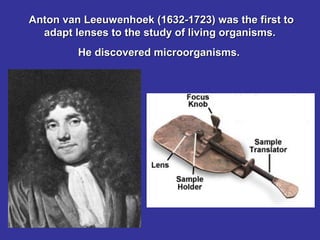
Anton van Leeuwenhoek (1632-1723) was the first to
adapt lenses to the study of living organisms.
He discovered microorganisms.
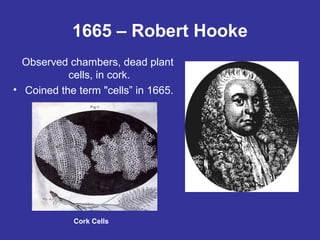
1665 – Robert Hooke
Observed chambers, dead plant
cells, in cork.
• Coined the term "cells” in 1665.

Cork Cells
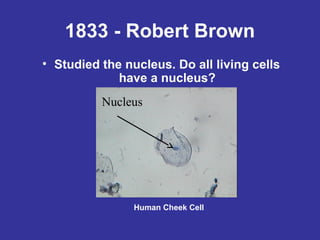
1833 - Robert Brown
• Studied the nucleus. Do all living cells
have a nucleus?
Nucleus

Human Cheek Cell
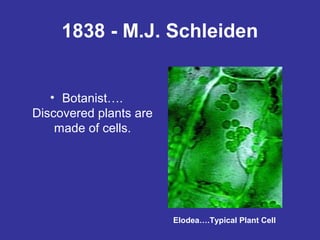
1838 - M.J. Schleiden
• Botanist….
Discovered plants are
made of cells.

Elodea….Typical Plant Cell
1839 - T. Schwann
• Zoologist….discovered
animals are made of
cells.

Nerve Cells
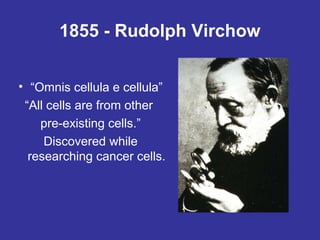
1855 - Rudolph Virchow
• “Omnis cellula e cellula”
“All cells are from other
pre-existing cells.”
Discovered while
researching cancer cells.
The Cell Theory
1. All living organisms are composed of one or more cells.
2. Cells are organisms' basic units of structure and function.
3. Cells come only from pre-existing cells.
How do you measure cells?
Cells are measured using “microns”.
A micron is another casual name for a
micrometer.

Note: 1.0 µ m = one millionth of a meter
What limits the size of a cell?
• Cell volume to surface area ratios favor
small size... an efficient amount of
materials must enter and leave the cell.
• Nucleus’ ability to control the cell is
limited by the size of the cell.
Types of Cells
Prokaryotes
•

Lack a nucleus and other
membrane bound
organelle.
First appeared 3.5 BYA
include bacteria
and cyanobacteria.

E. coli
Eukaryotes
Have a nucleus and membrane
bound organelle.
First appeared 2.0 BYA
include protists, fungi, plants
and animals.
Basic Cell Organization
• Cell (Plasma) Membrane
• Nucleus (eukaryotes only)
• Cytoplasm (an area!!)
• Organelles (structures with specialized functions)
Animal
Cell
Plant Cell
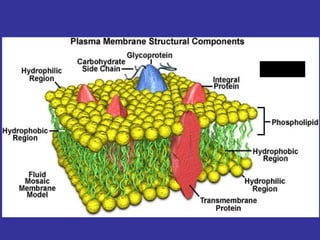
The Cell Membrane
AKA: Plasma Membrane
• Separates the cell from the
environment.
• Is “semi-permeable”…… regulates
the movement of materials in/out of
a cell.
• ALL cells have a plasma membrane
The Cytoplasm
• The Cytoplasm is an Area (not stuff)
between the plasma membrane and
the nuclear envelope. The cytoplasm
contains the cytosol, nucleus (if
present) and cell organelles.
Cytosol
• Semi-fluid portion of the cytoplasm (the
gooey stuff inside the cell)….
Composed mostly of water, nutrients.
nutrients
Nucleus
• Most conspicuous organelle.
• usually spherical, but can be lobed or
irregular in shape.
• Typically found near the center of a
eukaryotic cell…..prokaryotes do not have a
nucleus.
• Control center for the cell.
• Contains the genetic instructions.
Nuclear Envelope
… the outer boundary of the
nucleus which gives the
shape to the nucleus.
Nucleolus
• Dark area in the nucleus.
• 0 - 4 per nucleus.
• Storage area for ribosomes.
Chromatin
• DNA and Protein in a “loose” format
(stringy form of DNA) Will eventually
form the cell’s chromosomes. The DNA
holds the cell’s genetic information.
• Found in the nucleus of eukaryotes and
in the center region of prokaryotes.
The Cell Organelle
• Term means "small organ” Formed
body in a cell with a specialized
function.
• Keeps various enzymes separated in
space.
(bags of enzymes)
Ribosomes
• Structure: made up of protein and RNA
• No membrane.
• Function: site of protein synthesis.
Ribosome Locations
• Free in the cytosol…..make proteins for
use in cytosol.
• Attached to the Endoplasmic
Reticulum….. make proteins that are
exported from the cell.
Ribosomes
Endoplasmic Reticulum
• Often referred to as ER.
• Stacks of flattened stacks involved in
the production and transportation of
proteins, sugars, fats,…..etc
Rough ER
• Endoplasmic
reticulum with
attached
ribosomes.
The attached
ribosomes
create proteins
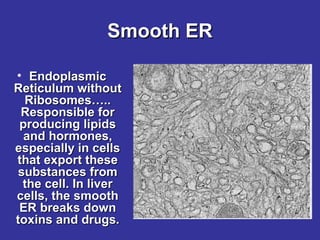
Smooth ER
• Endoplasmic
Reticulum without
Ribosomes…..
Responsible for
producing lipids
and hormones,
especially in cells
that export these
substances from
the cell. In liver
cells, the smooth
ER breaks down
toxins and drugs.
Golgi Apparatus
AKA Golgi bodies or Golgi Complex
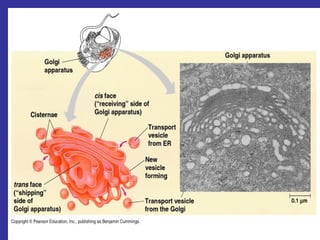
• Structure: flattened sacs arranged in a
stack. (looks like a stack of Pita bread)
• 3 to 20 per cell.
• The Golgi Apparatus package and modify
proteins and lipids into vesicles (small,
spherical shaped sacs that bud from the
Golgi apparatus). The vesicles often merge
with the plasma membrane to release
contents to the outside of the cell.
Lysosome
• Vesicles from the Golgi apparatus
that contain digestive enzymes.
They breakdown food, cellular
debris and foreign invaders such
as bacteria.
• Assist with cell death.
• Not present in plant cells.
Peroxisomes
• Organelles that breakdown various
substances. During digestion
0xygen is produced and combines
with H2O to form Hydrogen
Peroxide…. a toxin. Peroxisomes
break down Hydrogen Peroxide.
Mitochondria
• Function: Site of Cellular Respiration – Cellular
Respiration is the release of energy from food to
form ATP…. All cells use ATP as their energy
source.
• “Powerhouse” of the cell.
• Found in the cytosol.
• Have their own DNA. Can reproduce themselves.
Chloroplasts
• Function: Site of Photosynthesis - chloroplasts
use of light energy to make food, sugars, from
carbon dioxide and water.
• Contain the green pigment chlorophyll.
• Found in the Cytosol
• Have their own DNA. Can reproduce themselves.
Chloroplasts
Enzymes in a
crystal
Chromoplasts
Function: store plant pigments such as
chlorophyll (green) and carotene (orange, red).
• Found in plants only.
• Classified (named) by color….example:
• “Chloro” means green, therefore a
chloroplast is a green plastid that stores
chlorophyll
• “Leuco” means white, therefore
Leucoplasts (AKA Amyloplasts) are
white plastids that store starch.
Cytoskeleton
• Network of protein fibers and in the cytoplasm.
Functions
• Give Cells structure and shape.
• Involved in Cell movement.
• Cytoskeleton is composed of 2 different types of
fibers, which are organized in deceasing
diameter….they are:
1. Microtubules
2. Microfilaments
Microtubule Function
Maintenance of cell shape.
Hold organelles in place.
Microfilaments
Function
• Responsible for Muscle contractions.
• Cytoplasmic streaming in plants, like
Elodea.
• Maintenance and changes in a cell’s shape.
Cilia and Flagella

Classified by their lengths and numbers

• Function - to move cells or to sweep
materials past a cell.
• Cilia - short, but numerous.
• Flagella - long, but few (usually only one).
Centrioles
• Usually one pair per cell, located close
to the nucleus.
• Found in animal cells only.
• Help in cell division.
Basal Bodies
• Same structure as a centriole.
• Found at the base of the cilia and
flagella.
flagella
Basal Body
Plant Cell Walls
• All plant cells have a Primary Cell Wall.
• Some cells will develop a Secondary Cell
Wall.
Cell Walls
• Plant cell walls are made of cellulose
( a polysaccharide made of β -glucose).
• Fungi cell walls are made of chitin (a
polysaccharide)
• Function as the cell's exoskeleton for support and
protection.
Middle Lamella
• Thin layer rich in pectin (used to make
jelly) found between adjacent plant
cells.
• Glues cells together.
Vacuoles and Vesicles
Fluid-filled, membrane-bound bodies

3 Types of Vacuoles and Vesicles
• Food vacuoles
• Central water vacuoles
• Contractile vacuoles
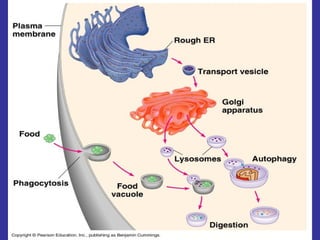
The function of the vacuole depends
on the organism.

In Protists
single-cell organisms …….“Food” vacuoles
store newly ingested food until the
lysosomes can digest it.
• “Contractile” vacuoles pump out excess
water.
Contractile Vacuole

Contractile Vacuole

Food Vacuoles
Central Water Vacuole
• Large single water containing vacuole
making up to 90% of the cell's volume.
• Stores Water
• Helps the cells maintain their shapes.
Central Water Vacuole
Comparing Plant Cells and
Animal Cells
Plant Cells
Have cell walls,
chloroplasts, and a
central water vacuole…
animal cells do not!!

Animal Cells
Have lysosomes and
centrioles…. Plant
cells do not!!

Cells2 091001182025-phpapp01

  • 1.
  • 2.
    Cytology is the “studyof cells” • Cyto = cell, ology = study of
  • 3.
    The Cell Theoryand its Development
  • 4.
    Anton van Leeuwenhoek(1632-1723) was the first to adapt lenses to the study of living organisms. He discovered microorganisms.
  • 5.
    1665 – RobertHooke Observed chambers, dead plant cells, in cork. • Coined the term "cells” in 1665. Cork Cells
  • 6.
    1833 - RobertBrown • Studied the nucleus. Do all living cells have a nucleus? Nucleus Human Cheek Cell
  • 7.
    1838 - M.J.Schleiden • Botanist…. Discovered plants are made of cells. Elodea….Typical Plant Cell
  • 8.
    1839 - T.Schwann • Zoologist….discovered animals are made of cells. Nerve Cells
  • 9.
    1855 - RudolphVirchow • “Omnis cellula e cellula” “All cells are from other pre-existing cells.” Discovered while researching cancer cells.
  • 10.
    The Cell Theory 1.All living organisms are composed of one or more cells. 2. Cells are organisms' basic units of structure and function. 3. Cells come only from pre-existing cells.
  • 11.
    How do youmeasure cells? Cells are measured using “microns”. A micron is another casual name for a micrometer. Note: 1.0 µ m = one millionth of a meter
  • 12.
    What limits thesize of a cell? • Cell volume to surface area ratios favor small size... an efficient amount of materials must enter and leave the cell. • Nucleus’ ability to control the cell is limited by the size of the cell.
  • 13.
  • 14.
    Prokaryotes • Lack a nucleusand other membrane bound organelle. First appeared 3.5 BYA include bacteria and cyanobacteria. E. coli
  • 15.
    Eukaryotes Have a nucleusand membrane bound organelle. First appeared 2.0 BYA include protists, fungi, plants and animals.
  • 16.
    Basic Cell Organization •Cell (Plasma) Membrane • Nucleus (eukaryotes only) • Cytoplasm (an area!!) • Organelles (structures with specialized functions)
  • 17.
  • 18.
  • 19.
    The Cell Membrane AKA:Plasma Membrane • Separates the cell from the environment. • Is “semi-permeable”…… regulates the movement of materials in/out of a cell. • ALL cells have a plasma membrane
  • 21.
    The Cytoplasm • TheCytoplasm is an Area (not stuff) between the plasma membrane and the nuclear envelope. The cytoplasm contains the cytosol, nucleus (if present) and cell organelles.
  • 22.
    Cytosol • Semi-fluid portionof the cytoplasm (the gooey stuff inside the cell)…. Composed mostly of water, nutrients. nutrients
  • 23.
    Nucleus • Most conspicuousorganelle. • usually spherical, but can be lobed or irregular in shape. • Typically found near the center of a eukaryotic cell…..prokaryotes do not have a nucleus. • Control center for the cell. • Contains the genetic instructions.
  • 25.
    Nuclear Envelope … theouter boundary of the nucleus which gives the shape to the nucleus.
  • 26.
    Nucleolus • Dark areain the nucleus. • 0 - 4 per nucleus. • Storage area for ribosomes.
  • 27.
    Chromatin • DNA andProtein in a “loose” format (stringy form of DNA) Will eventually form the cell’s chromosomes. The DNA holds the cell’s genetic information. • Found in the nucleus of eukaryotes and in the center region of prokaryotes.
  • 28.
    The Cell Organelle •Term means "small organ” Formed body in a cell with a specialized function. • Keeps various enzymes separated in space. (bags of enzymes)
  • 29.
    Ribosomes • Structure: madeup of protein and RNA • No membrane. • Function: site of protein synthesis.
  • 30.
    Ribosome Locations • Freein the cytosol…..make proteins for use in cytosol. • Attached to the Endoplasmic Reticulum….. make proteins that are exported from the cell.
  • 31.
  • 32.
    Endoplasmic Reticulum • Oftenreferred to as ER. • Stacks of flattened stacks involved in the production and transportation of proteins, sugars, fats,…..etc
  • 33.
    Rough ER • Endoplasmic reticulumwith attached ribosomes. The attached ribosomes create proteins
  • 34.
    Smooth ER • Endoplasmic Reticulumwithout Ribosomes….. Responsible for producing lipids and hormones, especially in cells that export these substances from the cell. In liver cells, the smooth ER breaks down toxins and drugs.
  • 36.
    Golgi Apparatus AKA Golgibodies or Golgi Complex • Structure: flattened sacs arranged in a stack. (looks like a stack of Pita bread) • 3 to 20 per cell. • The Golgi Apparatus package and modify proteins and lipids into vesicles (small, spherical shaped sacs that bud from the Golgi apparatus). The vesicles often merge with the plasma membrane to release contents to the outside of the cell.
  • 39.
    Lysosome • Vesicles fromthe Golgi apparatus that contain digestive enzymes. They breakdown food, cellular debris and foreign invaders such as bacteria. • Assist with cell death. • Not present in plant cells.
  • 41.
    Peroxisomes • Organelles thatbreakdown various substances. During digestion 0xygen is produced and combines with H2O to form Hydrogen Peroxide…. a toxin. Peroxisomes break down Hydrogen Peroxide.
  • 42.
    Mitochondria • Function: Siteof Cellular Respiration – Cellular Respiration is the release of energy from food to form ATP…. All cells use ATP as their energy source. • “Powerhouse” of the cell. • Found in the cytosol. • Have their own DNA. Can reproduce themselves.
  • 44.
    Chloroplasts • Function: Siteof Photosynthesis - chloroplasts use of light energy to make food, sugars, from carbon dioxide and water. • Contain the green pigment chlorophyll. • Found in the Cytosol • Have their own DNA. Can reproduce themselves.
  • 45.
  • 46.
  • 47.
    Chromoplasts Function: store plantpigments such as chlorophyll (green) and carotene (orange, red). • Found in plants only. • Classified (named) by color….example: • “Chloro” means green, therefore a chloroplast is a green plastid that stores chlorophyll • “Leuco” means white, therefore Leucoplasts (AKA Amyloplasts) are white plastids that store starch.
  • 48.
    Cytoskeleton • Network ofprotein fibers and in the cytoplasm. Functions • Give Cells structure and shape. • Involved in Cell movement. • Cytoskeleton is composed of 2 different types of fibers, which are organized in deceasing diameter….they are: 1. Microtubules 2. Microfilaments
  • 49.
    Microtubule Function Maintenance ofcell shape. Hold organelles in place.
  • 50.
    Microfilaments Function • Responsible forMuscle contractions. • Cytoplasmic streaming in plants, like Elodea. • Maintenance and changes in a cell’s shape.
  • 53.
    Cilia and Flagella Classifiedby their lengths and numbers • Function - to move cells or to sweep materials past a cell. • Cilia - short, but numerous. • Flagella - long, but few (usually only one).
  • 55.
    Centrioles • Usually onepair per cell, located close to the nucleus. • Found in animal cells only. • Help in cell division.
  • 56.
    Basal Bodies • Samestructure as a centriole. • Found at the base of the cilia and flagella. flagella
  • 57.
  • 58.
    Plant Cell Walls •All plant cells have a Primary Cell Wall. • Some cells will develop a Secondary Cell Wall.
  • 59.
    Cell Walls • Plantcell walls are made of cellulose ( a polysaccharide made of β -glucose). • Fungi cell walls are made of chitin (a polysaccharide) • Function as the cell's exoskeleton for support and protection.
  • 60.
    Middle Lamella • Thinlayer rich in pectin (used to make jelly) found between adjacent plant cells. • Glues cells together.
  • 62.
    Vacuoles and Vesicles Fluid-filled,membrane-bound bodies 3 Types of Vacuoles and Vesicles • Food vacuoles • Central water vacuoles • Contractile vacuoles
  • 63.
    The function ofthe vacuole depends on the organism. In Protists single-cell organisms …….“Food” vacuoles store newly ingested food until the lysosomes can digest it. • “Contractile” vacuoles pump out excess water.
  • 64.
  • 65.
    Central Water Vacuole •Large single water containing vacuole making up to 90% of the cell's volume. • Stores Water • Helps the cells maintain their shapes.
  • 66.
  • 67.
    Comparing Plant Cellsand Animal Cells Plant Cells Have cell walls, chloroplasts, and a central water vacuole… animal cells do not!! Animal Cells Have lysosomes and centrioles…. Plant cells do not!!