ETHNOGRAPHIC
RESEARCH
&
GROUNDED THEORY
Instructor: Lê Hoàng Dũng, PhD
Group 5: Khánh Minh
Thanh Thư
Bạch Vân
ETHNOGRAPHIC
RESEARCH
WHAT IS ETHNOGRAPHIC RESEARCH?
Ethnographic research is:
 the study of cultural patterns and
perspectives of participants in their
natural settings
Culture: ideas, languages, way of life,
customs, beliefs, behavior of a particular
society
 a qualitative research
 subjective
EXAMPLES
 E.g. gender influences on social
behavior of members at a private golf
club
WHEN TO USE ETHNOGRAPHIC RESEARCH
 Explore the nature of a particular social
phenomenon, rather than intend to test
hypotheses about it
 Tend to work primarily with unstructured
data (e.g. official government reports,
personal diaries, letters, minutes of
interviewing)
 Investigate of a small number of cases
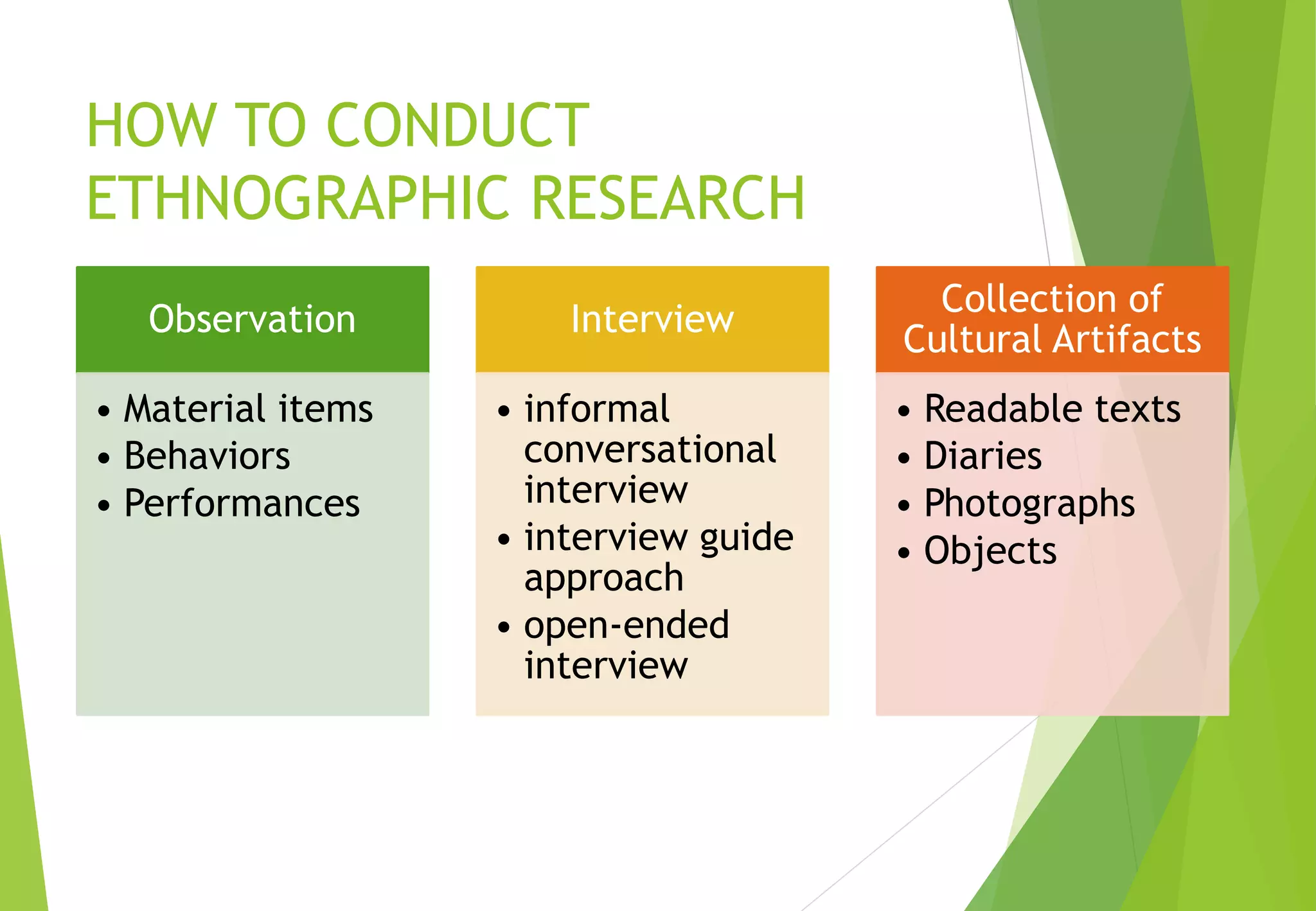
HOW TO CONDUCT
ETHNOGRAPHIC RESEARCH
Observation
• Material items
• Behaviors
• Performances
Interview
• informal
conversational
interview
• interview guide
approach
• open-ended
interview
Collection of
Cultural Artifacts
• Readable texts
• Diaries
• Photographs
• Objects
GROUNDED THEORY
WHAT IS GROUNDED THEORY?
The systematic generation of a theory from
data
Data collection -> Hypotheses formulation
Developed by Glaser and Strauss (1967)
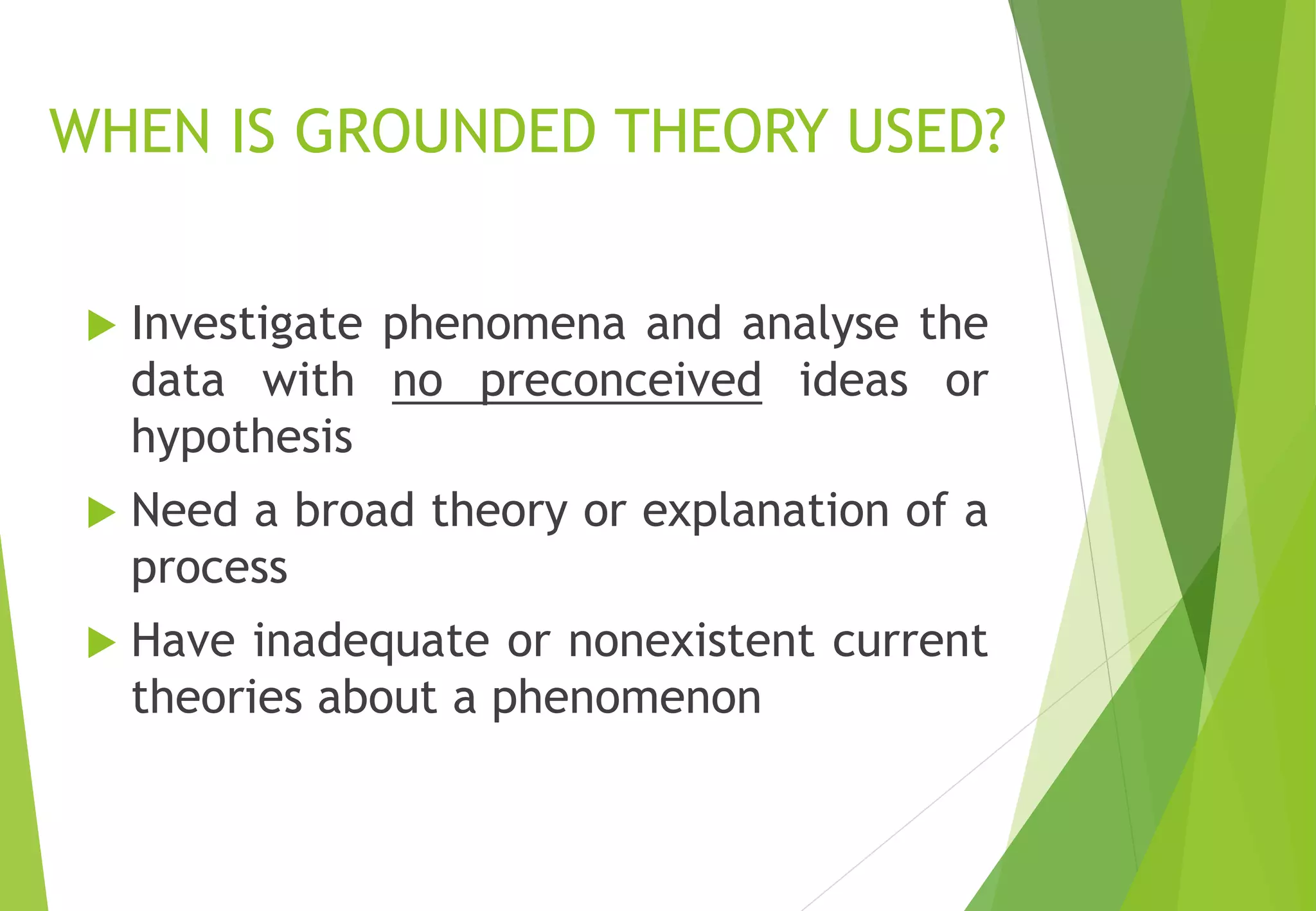
WHEN IS GROUNDED THEORY USED?
 Investigate phenomena and analyse the
data with no preconceived ideas or
hypothesis
 Need a broad theory or explanation of a
process
 Have inadequate or nonexistent current
theories about a phenomenon
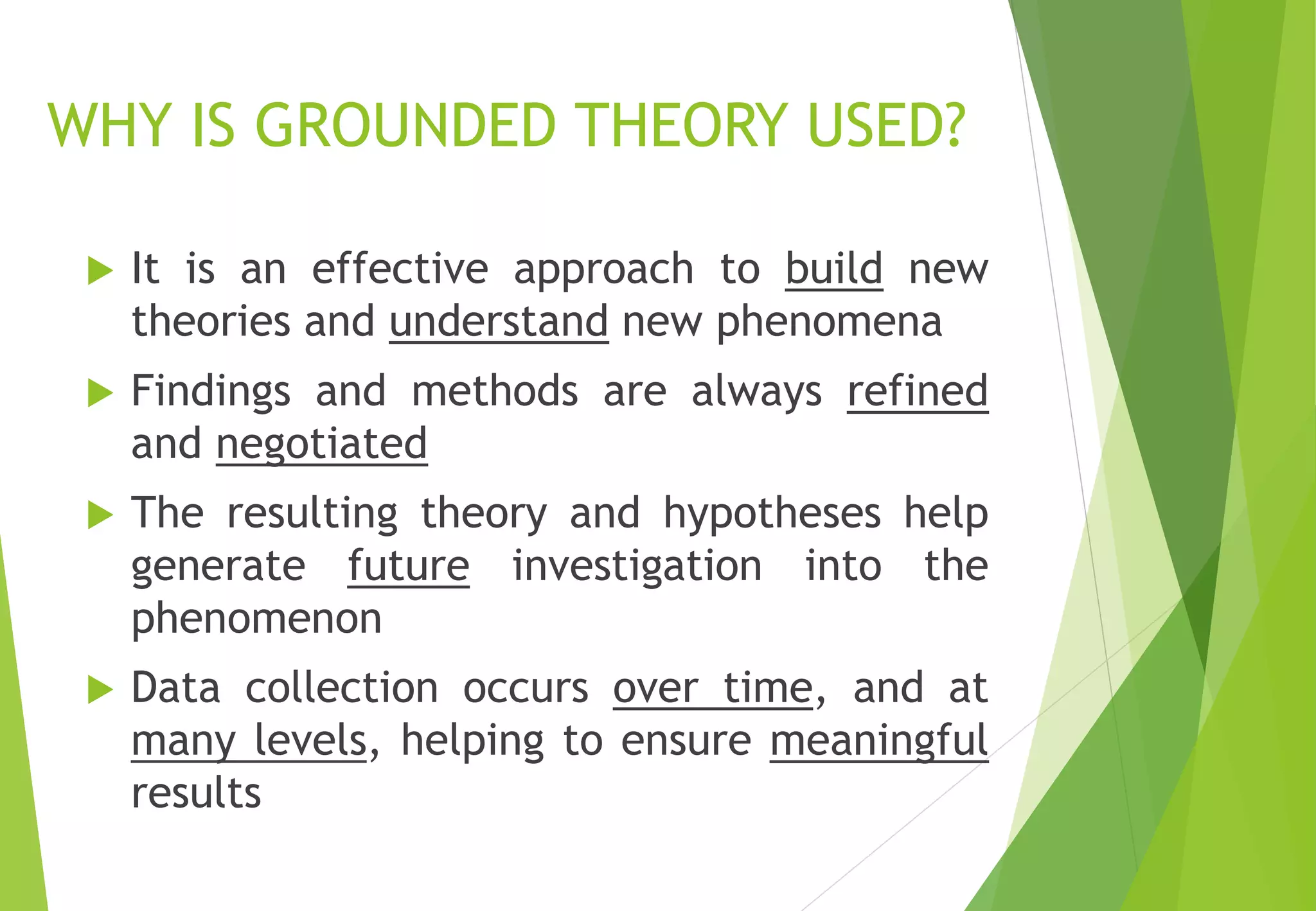
WHY IS GROUNDED THEORY USED?
 It is an effective approach to build new
theories and understand new phenomena
 Findings and methods are always refined
and negotiated
 The resulting theory and hypotheses help
generate future investigation into the
phenomenon
 Data collection occurs over time, and at
many levels, helping to ensure meaningful
results
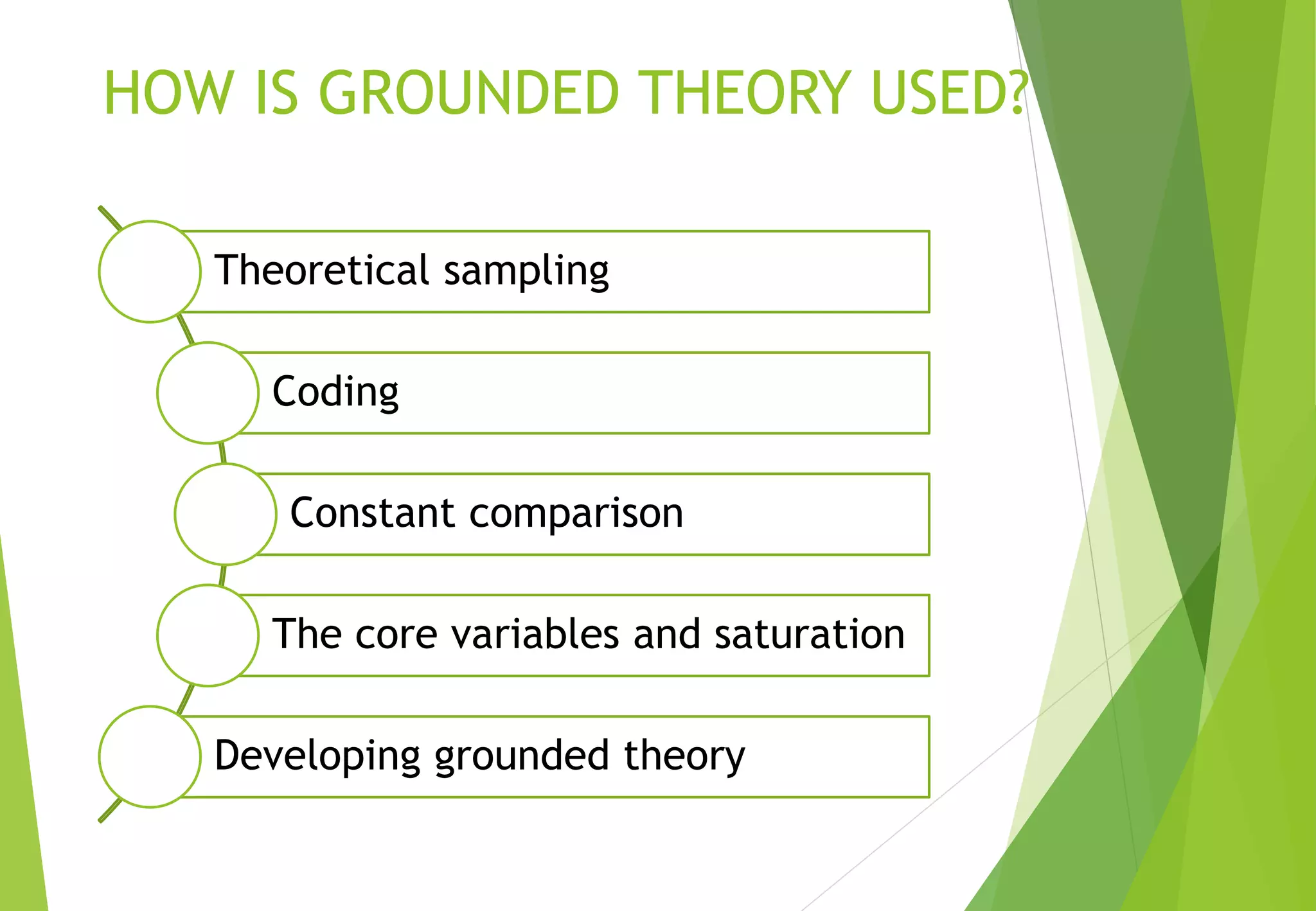
HOW IS GROUNDED THEORY USED?
Theoretical sampling
Coding
Constant comparison
The core variables and saturation
Developing grounded theory
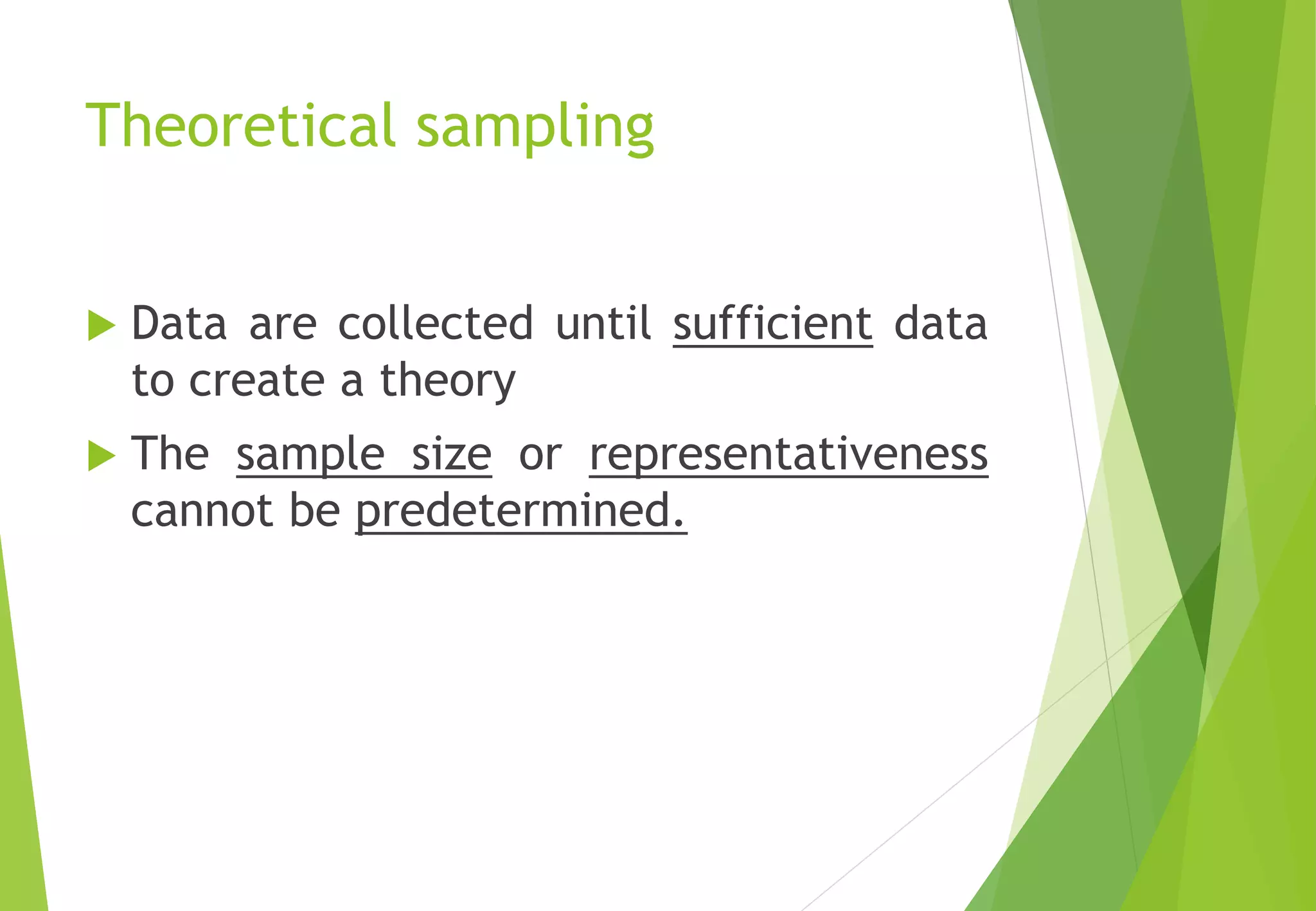
Theoretical sampling
 Data are collected until sufficient data
to create a theory
 The sample size or representativeness
cannot be predetermined.
Coding
 A form of content analysis to find and
conceptualize the underlying issues of
data
Coding
Example: “Pain relief is a major problem
when you have arthritis. Sometimes, the
pain is worse than other times, but when
it gets really bad, whew! It hurts so bad,
you don't want to get out of bed. You
don't feel like doing anything. Any relief
you get from drugs that you take is only
temporary or partial.” said an
interviewee .
=> PAIN -> INTENSITY -> PAIN RELIEF -> AGENT
OF PAIN RELIEF -> DURATION/EFFECTIVENESS
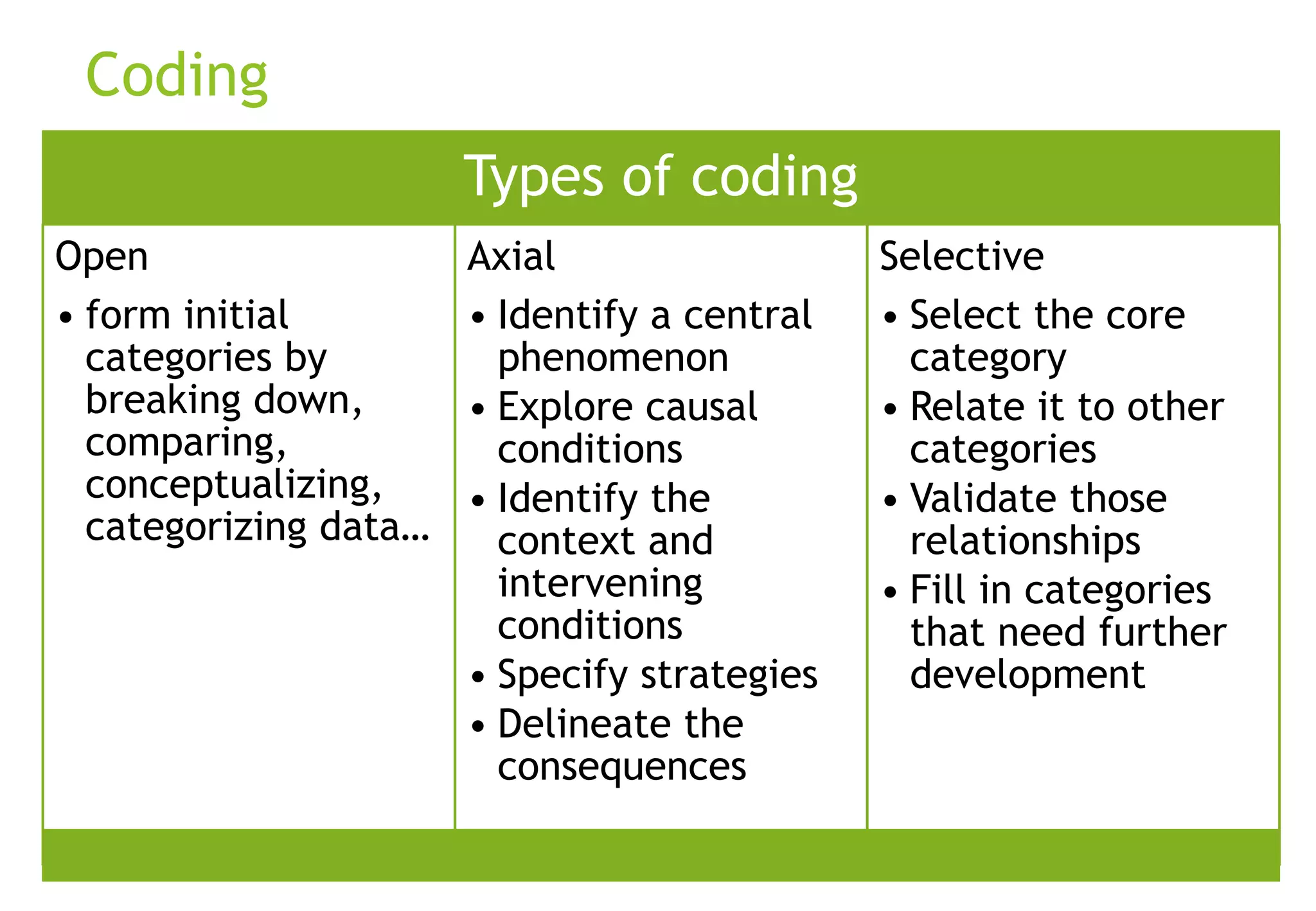
Coding
Types of coding
Open
• form initial
categories by
breaking down,
comparing,
conceptualizing,
categorizing data…
Axial
• Identify a central
phenomenon
• Explore causal
conditions
• Identify the
context and
intervening
conditions
• Specify strategies
• Delineate the
consequences
Selective
• Select the core
category
• Relate it to other
categories
• Validate those
relationships
• Fill in categories
that need further
development
CONSTANT COMPARISON
 Compare the new data with existing
data and categories -> the categories
achieve a perfect fit with the data
 Reach saturation
 Compare data across a range of
situations, times, groups of people and
methods
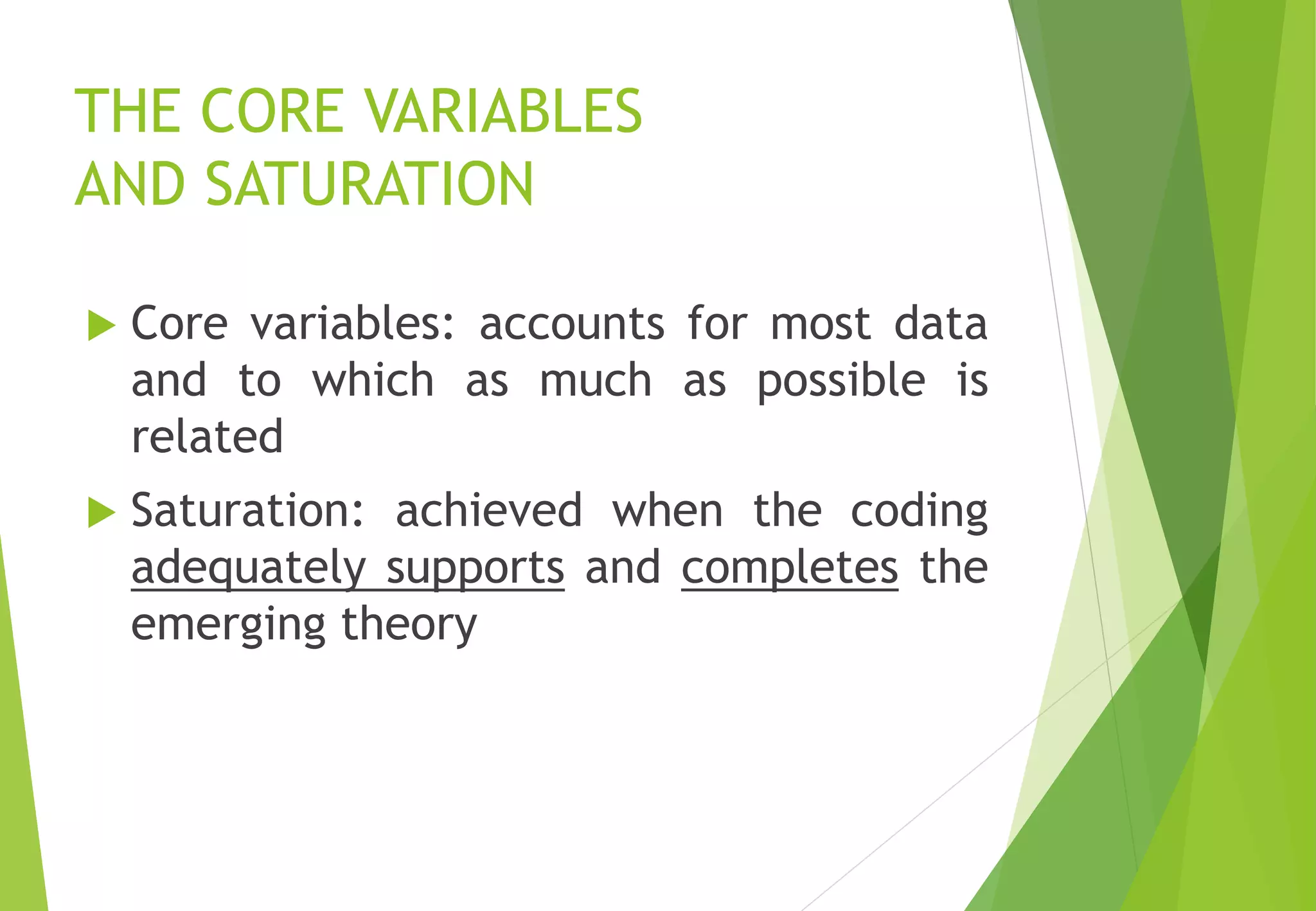
THE CORE VARIABLES
AND SATURATION
 Core variables: accounts for most data
and to which as much as possible is
related
 Saturation: achieved when the coding
adequately supports and completes the
emerging theory
DEVELOPING GROUNDED THEORY
 The grounded theory emerges from the
data in an unforced manner, accounting
for all of the data.
Ethnographic & Grounded Theory

Ethnographic & Grounded Theory

  • 1.
    ETHNOGRAPHIC RESEARCH & GROUNDED THEORY Instructor: LêHoàng Dũng, PhD Group 5: Khánh Minh Thanh Thư Bạch Vân
  • 2.
  • 3.
    WHAT IS ETHNOGRAPHICRESEARCH? Ethnographic research is:  the study of cultural patterns and perspectives of participants in their natural settings Culture: ideas, languages, way of life, customs, beliefs, behavior of a particular society  a qualitative research  subjective
  • 4.
    EXAMPLES  E.g. genderinfluences on social behavior of members at a private golf club
  • 5.
    WHEN TO USEETHNOGRAPHIC RESEARCH  Explore the nature of a particular social phenomenon, rather than intend to test hypotheses about it  Tend to work primarily with unstructured data (e.g. official government reports, personal diaries, letters, minutes of interviewing)  Investigate of a small number of cases
  • 6.
    HOW TO CONDUCT ETHNOGRAPHICRESEARCH Observation • Material items • Behaviors • Performances Interview • informal conversational interview • interview guide approach • open-ended interview Collection of Cultural Artifacts • Readable texts • Diaries • Photographs • Objects
  • 7.
  • 8.
    WHAT IS GROUNDEDTHEORY? The systematic generation of a theory from data Data collection -> Hypotheses formulation Developed by Glaser and Strauss (1967)
  • 9.
    WHEN IS GROUNDEDTHEORY USED?  Investigate phenomena and analyse the data with no preconceived ideas or hypothesis  Need a broad theory or explanation of a process  Have inadequate or nonexistent current theories about a phenomenon
  • 10.
    WHY IS GROUNDEDTHEORY USED?  It is an effective approach to build new theories and understand new phenomena  Findings and methods are always refined and negotiated  The resulting theory and hypotheses help generate future investigation into the phenomenon  Data collection occurs over time, and at many levels, helping to ensure meaningful results
  • 11.
    HOW IS GROUNDEDTHEORY USED? Theoretical sampling Coding Constant comparison The core variables and saturation Developing grounded theory
  • 12.
    Theoretical sampling  Dataare collected until sufficient data to create a theory  The sample size or representativeness cannot be predetermined.
  • 13.
    Coding  A formof content analysis to find and conceptualize the underlying issues of data
  • 14.
    Coding Example: “Pain reliefis a major problem when you have arthritis. Sometimes, the pain is worse than other times, but when it gets really bad, whew! It hurts so bad, you don't want to get out of bed. You don't feel like doing anything. Any relief you get from drugs that you take is only temporary or partial.” said an interviewee . => PAIN -> INTENSITY -> PAIN RELIEF -> AGENT OF PAIN RELIEF -> DURATION/EFFECTIVENESS
  • 15.
    Coding Types of coding Open •form initial categories by breaking down, comparing, conceptualizing, categorizing data… Axial • Identify a central phenomenon • Explore causal conditions • Identify the context and intervening conditions • Specify strategies • Delineate the consequences Selective • Select the core category • Relate it to other categories • Validate those relationships • Fill in categories that need further development
  • 16.
    CONSTANT COMPARISON  Comparethe new data with existing data and categories -> the categories achieve a perfect fit with the data  Reach saturation  Compare data across a range of situations, times, groups of people and methods
  • 17.
    THE CORE VARIABLES ANDSATURATION  Core variables: accounts for most data and to which as much as possible is related  Saturation: achieved when the coding adequately supports and completes the emerging theory
  • 18.
    DEVELOPING GROUNDED THEORY The grounded theory emerges from the data in an unforced manner, accounting for all of the data.

Editor's Notes

  • #4 To put it simply, ER is the study of people n cultures. Before going any further, you should understand the word “culture.”  Ethnographic Research is qualitative because it gathers information that is not numbers. ER is subjective. When you decide to conduct ER, your personal experiences, ideas, biases will affect your understanding of the culture you are studying. Therefore, this may be seen as a disadvantage of ER
  • #5 An ethnographic study of gender influences on social behaviour of members at a private golf club
  • #6 “Unstructured data” is the information that is often taken from a qualitative research. Such data consist mainly of written texts such as official government reports, personal diaries, letters, minutes of meetings, and so on
  • #7 There are 3 main ways to collect data of ethnographic research: 1. Observation is one of the main research methods. Observations can be made at home, at work, or in leisure environments. You can observe material items (tools, cultivated fields, houses, statues, clothing), individual behaviors and performances (ceremonies, fights, games, meals)  2. Select one of theses types of interview (or combine them together) as long as they are appropriate to the purposes of the research effort. Among them, open-ended interview is used most. An open-ended question is one that cannot be answered with a simple “yes” or “no.” Remember that successful interviewers encourage the participants to speak as much as possible. (different kinds of information one can collect through interviews: behavioral data; opinions; feelings; knowledge; sensory data; and background information.  Cai nay ko fai de cap toi, phong truong hop bi hoi thui) 3. Another research method is the collection of cultural artifacts that might help researchers understand that culture. Readable texts (diaries, transcripts of recordings); Objects (tools, musical instruments, foods, toys, jewelry, ceremonial objects, and clothes)
  • #9 The grounded theory method was developed by American sociologists Glaser and Strauss in 1967. It is the systematic generation of a theory from data. This method is used to formulate hypotheses from the analysis of collected data but not the vice versa - like many other methods: create hypotheses then collect and analyze data. In fact, the book Awareness of Dying was the first application of this theory.
  • #10 Grounded theory is used when you want to investigate the realities in the real world and analyse the data with no preconceived ideas or hypothesis. Furthermore, it is used when you need a broad theory or explanation of a process. It is especially helpful when current theories about a phenomenon are inadequate or nonexistent.
  • #11 Grounded theory is used because of its many strengths. First,… Second,…
  • #12 In order to understand how grounded theory is used, we will look at the five elements: theoretical sampling…
  • #13 Data are collected until there is enough data to create a theoretical explanation: what is happening and what sets up the key features. Besides, we cannot predetermine the sample size or representativeness until we are actually doing the research.
  • #14 Coding means a form of content analysis… We will give you an example of coding so that you can understand more about it.
  • #15 The problem discussed here is PAIN. From the text, we can see that the speaker mentioned one of the properties of PAIN, which is INTENSITY. It varies from a little to a lot. (When is it a lot and when is it little?) When it hurts a lot, there are consequences: don't want to get out of bed, don't feel like doing things. In order to solve this problem, you need PAIN RELIEF. One AGENT OF PAIN RELIEF is drugs. Pain relief has a certain DURATION (could be temporary), and EFFECTIVENESS (could be partial).
  • #16 There are three types of coding: open, axial and selective. First, open coding is to form initial categories. Second, axial coding means building the data in new ways. Last, selective coding is the integration of the categories in the axial coding model. You can look at the table for more details.
  • #17 Reach saturation means the properties and categories across the data are compared continuously until no more variation occurs.