SHAHID MEHMOOD
PhD SCHOLAR
UNIVERSITY OF OKARA
Outline
 Definition of grounded theory
 When do you use Grounded Theory?
 Types of grounded theory designs
 What are the steps in conducting Grounded Theory
Research?
 Advantages
 Disadvantages
 Conclusion
 Reference
Definition of GT
 Grounded theory method (GT) is a systematic
methodology in the social sciences involving the
discovery of theory through the analysis of data.
 A qualitative research method that uses a
systematic set of procedures to develop an
inductively derived grounded theory about a
phenomenon.
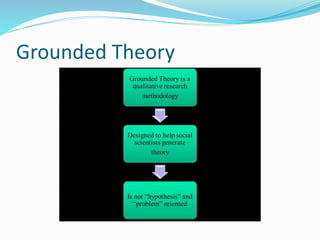
Grounded Theory
Cont..
 Grounded Theory is the most common, widely used,
and popular analytic
technic in qualitative analysis.
 A grounded theory design is a systematic, qualitative
procedure used to generate a theory that explains, at a
broad conceptual level, a process, an action, or
an
interaction about a substantive topic.
Development of the Grounded
Theory
 Two sociologists, Barney G. Glaser and Anselm L
Strauss, developed grounded theory in the late 1960s.
 Glaser and Strauss developed a pioneering book that
expounded in detail on their grounded theory
procedures, The Discovery of Grounded
Theory(1967).
When do you use Grounded
Theory?
 when you need a broad theory or explanation of a
process. especially helpful when current theories about
a phenomenon are either inadequate or nonexistent
.
 It allows for the emergence of original and rich
findings that are closely tied to the data
Cont..
 The purpose of grounded theory research in
education and management is to develop new
concepts and theories of education-related
phenomena, where these concepts and theories are
firmly grounded in qualitative data.
Conducting a Grounded Theory
Study
• Rather than beginning by researching and developing a
hypothesis, the first step is data collection, through a
variety of methods (This contrasts with the scientific
perspective that how you generate a theory).
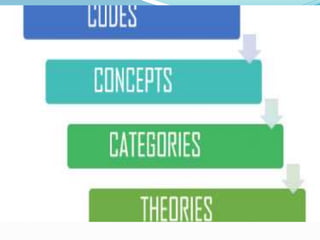
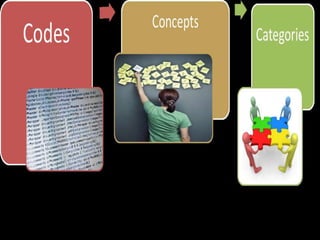
• From the data collected, the key points are marked
with a series of codes, which are extracted from the text.
• The codes are grouped into similar concepts in order
to make them more workable.
• From these concepts, categories are formed, which are
the basis for the creation of a theory.
Analysis and interpretation
 Analysis begins and continues when data are being
collected and transcribed (and translated)
 Therefore, the researcher him/herself should transcribe the
data because preliminary codes and themes will occur in
the process
 The analysis says as much about the researcher as about
the data being analysed
Coding
 Read the data several times to: get a general sense, note down
ideas, think about organising the data, check if more data are
needed.
 Then coding can start.
 Any researcher who wishes to become proficient at doing
qualitative analysis must learn to code well and easily.
 Coding means that we attach labels to segments of data that
depict what each segment is about.
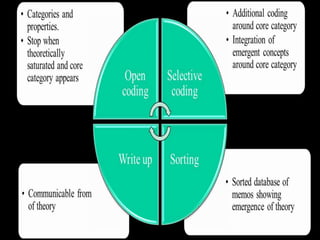
 Three types of coding: open, axial, and selective.
Coding the data
 Coding allows the researcher to deconstruct the data into
manageable chunks in order to understand the phenomena
in question
 Examining each line to construct the meaning.
 The early part of coding should be confusing, with a mass
of apparently unrelated material. However as coding
progresses and things emerge analysis becomes more
organised and structured.
The coding process
The researcher must interrogate the data
to identify units of analysis (categories).
 Highlight key points in each dataset (e.g. an interview)
 Give each key point a code to describe the data
 The codes will reveal patterns across the data
 Then group the patterns into categories
 Give each category a title
 New codes and subcategories will emerge.
Axial coding
 After open coding one set of data, you start to make
interconnections between categories and codes between
datasets (e.g. interviews and observations)
 Examine each open code in a dataset and compare and contrast
with other datasets.
 Common patterns (categories) will emerge from axial coding
 Codes categories and sub-categories need to be constantly
checked, rechecked and redefined.
Selective coding: Core categories
 After completing open and axial coding, the researcher
will select core categories, which must:
 1. Be central to the category system and the
phenomena, rather than peripheral
 2. appear frequently in the data
 3. fit the data, comfortably and logically
 4. enable variations to be explained
 5. have the greatest explanatory power
Interpreting the data
 The move beyond describing, coding, categorising and
comparing to make sense of the data.
 This stage demands a certain amount of creative
thinking…
 As it is concerned with articulating underlying concepts
and developing theories …
about why particular patterns of behaviours,
interactions or attitudes have emerged.
 … You may need to come back to the data several times to
pose questions, rethink the connections and develop
explanations of the bigger picture underpinning the
research.
Theoretical saturation
 Saturation is the point when the major themes are
fully developed, and no new information will add to
them.
 the analysed data can provide no new theoretical
insights.
 This is ultimately a subjective judgement
 The researcher is now ready to formulate a situated
explanation of the phenomenon that has been
investigated grounded in the data.
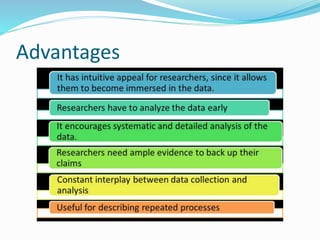
Advantages
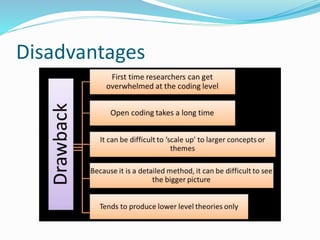
Disadvantages
Conclusion
 To sum up, Grounded Theory is recommended to use
in any research as it provides several advantages that
may ease the process of having the data/findings.
 Despite that, Grounded Theory helps researchers
analyzing the data early and it encourages detailed
analysis of the data.
 Grounded theory provides researchers an ample
evidence to back up their claims.
 Furthermore, Grounded Theory encourages a constant
interplay between data collection and analysis.
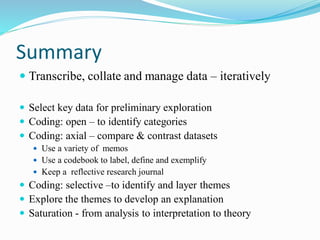
Summary
 Transcribe, collate and manage data – iteratively
 Select key data for preliminary exploration
 Coding: open – to identify categories
 Coding: axial – compare & contrast datasets
 Use a variety of memos
 Use a codebook to label, define and exemplify
 Keep a reflective research journal
 Coding: selective –to identify and layer themes
 Explore the themes to develop an explanation
 Saturation - from analysis to interpretation to theory
REFERENCES &KEY SOURCES
Glaser, B.G., & Strauss, A.L. (1967). The discovery of grounded
theory: Strategies for qualitative research. Chicago, IL:
Aldine.
Glaser, B. (1992). Basics of grounded theory analysis. Mill Valley, CA:
Sociology Press.
Strauss, A. (1987). Qualitative analysis for social scientists. Cambridge,
England: Cambridge University Press.
Strauss, A. L. & Corbin, J., 1990. Basics of Qualitative Research.
Grounded Theory Procedures and Techniques, Sage,
Newbury Park.
Thomas, G. and James, D. (2006). Reinventing grounded theory: some
questions about theory, ground and discovery, British
Educational Research Journal, 32, 6, 767–795.
Grounded theory

Grounded theory

  • 1.
  • 2.
    Outline  Definition ofgrounded theory  When do you use Grounded Theory?  Types of grounded theory designs  What are the steps in conducting Grounded Theory Research?  Advantages  Disadvantages  Conclusion  Reference
  • 3.
    Definition of GT Grounded theory method (GT) is a systematic methodology in the social sciences involving the discovery of theory through the analysis of data.  A qualitative research method that uses a systematic set of procedures to develop an inductively derived grounded theory about a phenomenon.
  • 4.
  • 5.
    Cont..  Grounded Theoryis the most common, widely used, and popular analytic technic in qualitative analysis.  A grounded theory design is a systematic, qualitative procedure used to generate a theory that explains, at a broad conceptual level, a process, an action, or an interaction about a substantive topic.
  • 6.
    Development of theGrounded Theory  Two sociologists, Barney G. Glaser and Anselm L Strauss, developed grounded theory in the late 1960s.  Glaser and Strauss developed a pioneering book that expounded in detail on their grounded theory procedures, The Discovery of Grounded Theory(1967).
  • 8.
    When do youuse Grounded Theory?  when you need a broad theory or explanation of a process. especially helpful when current theories about a phenomenon are either inadequate or nonexistent .  It allows for the emergence of original and rich findings that are closely tied to the data
  • 9.
    Cont..  The purposeof grounded theory research in education and management is to develop new concepts and theories of education-related phenomena, where these concepts and theories are firmly grounded in qualitative data.
  • 10.
    Conducting a GroundedTheory Study • Rather than beginning by researching and developing a hypothesis, the first step is data collection, through a variety of methods (This contrasts with the scientific perspective that how you generate a theory). • From the data collected, the key points are marked with a series of codes, which are extracted from the text. • The codes are grouped into similar concepts in order to make them more workable. • From these concepts, categories are formed, which are the basis for the creation of a theory.
  • 12.
    Analysis and interpretation Analysis begins and continues when data are being collected and transcribed (and translated)  Therefore, the researcher him/herself should transcribe the data because preliminary codes and themes will occur in the process  The analysis says as much about the researcher as about the data being analysed
  • 13.
    Coding  Read thedata several times to: get a general sense, note down ideas, think about organising the data, check if more data are needed.  Then coding can start.  Any researcher who wishes to become proficient at doing qualitative analysis must learn to code well and easily.  Coding means that we attach labels to segments of data that depict what each segment is about.  Three types of coding: open, axial, and selective.
  • 14.
    Coding the data Coding allows the researcher to deconstruct the data into manageable chunks in order to understand the phenomena in question  Examining each line to construct the meaning.  The early part of coding should be confusing, with a mass of apparently unrelated material. However as coding progresses and things emerge analysis becomes more organised and structured.
  • 15.
    The coding process Theresearcher must interrogate the data to identify units of analysis (categories).  Highlight key points in each dataset (e.g. an interview)  Give each key point a code to describe the data  The codes will reveal patterns across the data  Then group the patterns into categories  Give each category a title  New codes and subcategories will emerge.
  • 16.
    Axial coding  Afteropen coding one set of data, you start to make interconnections between categories and codes between datasets (e.g. interviews and observations)  Examine each open code in a dataset and compare and contrast with other datasets.  Common patterns (categories) will emerge from axial coding  Codes categories and sub-categories need to be constantly checked, rechecked and redefined.
  • 17.
    Selective coding: Corecategories  After completing open and axial coding, the researcher will select core categories, which must:  1. Be central to the category system and the phenomena, rather than peripheral  2. appear frequently in the data  3. fit the data, comfortably and logically  4. enable variations to be explained  5. have the greatest explanatory power
  • 18.
    Interpreting the data The move beyond describing, coding, categorising and comparing to make sense of the data.  This stage demands a certain amount of creative thinking…  As it is concerned with articulating underlying concepts and developing theories … about why particular patterns of behaviours, interactions or attitudes have emerged.  … You may need to come back to the data several times to pose questions, rethink the connections and develop explanations of the bigger picture underpinning the research.
  • 19.
    Theoretical saturation  Saturationis the point when the major themes are fully developed, and no new information will add to them.  the analysed data can provide no new theoretical insights.  This is ultimately a subjective judgement  The researcher is now ready to formulate a situated explanation of the phenomenon that has been investigated grounded in the data.
  • 21.
  • 22.
  • 23.
    Conclusion  To sumup, Grounded Theory is recommended to use in any research as it provides several advantages that may ease the process of having the data/findings.  Despite that, Grounded Theory helps researchers analyzing the data early and it encourages detailed analysis of the data.  Grounded theory provides researchers an ample evidence to back up their claims.  Furthermore, Grounded Theory encourages a constant interplay between data collection and analysis.
  • 24.
    Summary  Transcribe, collateand manage data – iteratively  Select key data for preliminary exploration  Coding: open – to identify categories  Coding: axial – compare & contrast datasets  Use a variety of memos  Use a codebook to label, define and exemplify  Keep a reflective research journal  Coding: selective –to identify and layer themes  Explore the themes to develop an explanation  Saturation - from analysis to interpretation to theory
  • 25.
    REFERENCES &KEY SOURCES Glaser,B.G., & Strauss, A.L. (1967). The discovery of grounded theory: Strategies for qualitative research. Chicago, IL: Aldine. Glaser, B. (1992). Basics of grounded theory analysis. Mill Valley, CA: Sociology Press. Strauss, A. (1987). Qualitative analysis for social scientists. Cambridge, England: Cambridge University Press. Strauss, A. L. & Corbin, J., 1990. Basics of Qualitative Research. Grounded Theory Procedures and Techniques, Sage, Newbury Park. Thomas, G. and James, D. (2006). Reinventing grounded theory: some questions about theory, ground and discovery, British Educational Research Journal, 32, 6, 767–795.