EXPLORING
GROUNDED
THEORY
E D U C 4 0 2 –
Q U A L I T A T I V E R E S E A R C H M E T H O D I N E D U C A T I O N
15 February, 2025
B y K E N N E T H B U R N S H E R N A N D E Z , L P T , M A E d
OBJECTIVES
The objectives of this discussion are to:
a. To explore the concept of Grounded
Theory as a qualitative research
methodology
b. To understand its key components,
processes, and applications; and
c. To reflect on the strengths and
limitations of using Grounded Theory in
research.
• Grounded Theory, introduced by sociologists Barney
Glaser and Anselm Strauss in the 1960s, has since become
a foundational methodology in qualitative research.
• Unlike other approaches, it does not begin with a
theoretical framework; rather, theories emerge directly
from the data.
• This makes it particularly useful for studying social
phenomena where little is known or where the researcher
aims to explore new concepts.
INTRODUCTION/RATIONALE
G R O U N D E D T H E O R Y
INTRODUCTION/RATIONALE
• Grounded Theory offers researchers the opportunity to
generate novel theories that are rooted in the lived
experiences of individuals.
• The rationale behind using Grounded Theory is to
develop a comprehensive understanding of a particular
social phenomenon by focusing on the meaning that
individuals attach to their experiences.
G R O U N D E D T H E O R Y
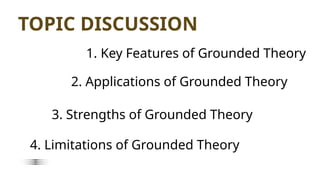
TOPIC DISCUSSION
1. Key Features of Grounded Theory
2. Applications of Grounded Theory
3. Strengths of Grounded Theory
4. Limitations of Grounded Theory
KEY
FEATURES
Grounded Theory is an inductive method,
meaning that researchers begin with raw
data and build theory from it, rather than
starting with existing theories or
hypotheses. This allows the research to
be flexible and open to new insights that
emerge as data is analyzed.
I N D U C T I V E N A T U R E
G R O U N D E D T H E O R Y
KEY
FEATURES
One of the defining features of Grounded Theory is the
simultaneous process of data collection and analysis.
Researchers begin analyzing data early in the research
process and refine their methods and questions as they
go along. This iterative process allows researchers to
adapt and evolve their approach based on what is
emerging from the data.
G R O U N D E D T H E O R Y
D A T A C O L L E C T I O N A N D
A N A L Y S I S
S I M U L T A N E O U S L Y
KEY
FEATURES
·The coding process in Grounded Theory
involves categorizing the data into
discrete chunks, labeling these chunks
with codes, and then continuously
refining these codes to develop themes
and concepts.
C O D I N G P R O C E S S
G R O U N D E D T H E O R Y
KEY
FEATURES
·Codes are typically open, axial, and selective in nature:
C O D I N G P R O C E S S
• O P E N C O D I N G
Breaking data into smaller segments to identify initial concepts.
• A X I A L C O D I N G
Grouping and relating concepts together based on their
relationships.
• S E L E C T I V E C O D I N G
Identifying the core category that ties together the various
themes.
KEY
FEATURES
·Grounded Theory uses a constant
comparison method, where data is
compared continuously across different
sources or groups to identify similarities,
differences, and emerging patterns. This
helps the researcher develop deeper
insights into the phenomenon being
studied.
C O N S T A N T C O M P A R I S O N
G R O U N D E D T H E O R Y
KEY
FEATURES
·The process continues until theoretical
saturation is reached, which means that
no new themes or categories are
emerging from the data. At this point, the
researcher can conclude that the theory
has been sufficiently developed.
T H E O R E T I C A L S A T U R A T I O N
G R O U N D E D T H E O R Y
APPLICATIONS • Grounded Theory is widely used in social
sciences, healthcare, education, and other fields
to explore areas where existing theories may
not adequately explain a phenomenon.
• It’s particularly useful for understanding
complex social processes, behaviors, and
experiences that may be difficult to quantify
through other research methods.
G R O U N D E D T H E O R Y
STRENGTHS
• It generates theories grounded in real-
world data.
• It allows flexibility and adaptability in
research design.
• It is suitable for exploring areas with
little prior theoretical development.
G R O U N D E D T H E O R Y
LIMITATIONS
• The process can be time-consuming due to the
iterative nature of data collection and analysis.
• Researchers may face challenges in
maintaining objectivity due to the deep
involvement with the data.
• It may be difficult to apply Grounded Theory in
large-scale studies with a high number of
participants.
G R O U N D E D T H E O R Y
REFLECTION
Reflecting on Grounded Theory’s approach, it becomes clear
that its strength lies in its adaptability and capacity to create
meaningful, context-driven theories. By emphasizing inductive
reasoning, the approach avoids imposing pre-existing biases
or frameworks onto the data. This is particularly important in
research where the understanding of the topic is still evolving
or where no strong theoretical foundation exists.
REFLECTION
However, one potential challenge when using Grounded
Theory is the risk of overwhelming amounts of data,
which can make the process of coding and identifying
patterns more difficult. It requires a deep commitment to
ongoing data collection and a willingness to adjust one's
approach based on emerging insights.
REFLECTION
The subjective nature of coding, as well as the reliance on
the researcher’s interpretation of the data, can also lead
to concerns about reliability and validity. Despite these
challenges, the methodology remains an invaluable tool
for generating theories that are not only grounded in
empirical evidence but also capable of explaining the
complexities of real-world phenomena.
CONCLUSION:
Grounded Theory is a powerful qualitative research
methodology that emphasizes the importance of
generating theory directly from the data. Its iterative
and flexible nature allows researchers to explore
complex phenomena in depth, without being
constrained by pre-existing theoretical frameworks.
CONCLUSION:
While it poses challenges in terms of data management and
the subjective nature of the analysis, the insights it provides
into human behavior and social processes are invaluable.
Researchers interested in exploring areas with limited
theoretical knowledge or understanding will find Grounded
Theory to be a highly effective and enriching approach.
REFERENCES
• Glaser, B. G., & Strauss, A. L. (1967). The Discovery of Grounded
Theory: Strategies for Qualitative Research. Aldine Publishing
Company.
• Charmaz, K. (2006). Constructing Grounded Theory: A Practical
Guide Through Qualitative Analysis. Sage Publications.
• Corbin, J., & Strauss, A. L. (2015). Basics of Qualitative Research:
Techniques and Procedures for Developing Grounded Theory (4th
ed.). Sage Publications.
THANK YOU

QUALITATIVE RESEARCH METHOD GROUNDED THEORY.pptx

  • 1.
    EXPLORING GROUNDED THEORY E D UC 4 0 2 – Q U A L I T A T I V E R E S E A R C H M E T H O D I N E D U C A T I O N 15 February, 2025 B y K E N N E T H B U R N S H E R N A N D E Z , L P T , M A E d
  • 2.
    OBJECTIVES The objectives ofthis discussion are to: a. To explore the concept of Grounded Theory as a qualitative research methodology b. To understand its key components, processes, and applications; and c. To reflect on the strengths and limitations of using Grounded Theory in research.
  • 3.
    • Grounded Theory,introduced by sociologists Barney Glaser and Anselm Strauss in the 1960s, has since become a foundational methodology in qualitative research. • Unlike other approaches, it does not begin with a theoretical framework; rather, theories emerge directly from the data. • This makes it particularly useful for studying social phenomena where little is known or where the researcher aims to explore new concepts. INTRODUCTION/RATIONALE G R O U N D E D T H E O R Y
  • 4.
    INTRODUCTION/RATIONALE • Grounded Theoryoffers researchers the opportunity to generate novel theories that are rooted in the lived experiences of individuals. • The rationale behind using Grounded Theory is to develop a comprehensive understanding of a particular social phenomenon by focusing on the meaning that individuals attach to their experiences. G R O U N D E D T H E O R Y
  • 5.
    TOPIC DISCUSSION 1. KeyFeatures of Grounded Theory 2. Applications of Grounded Theory 3. Strengths of Grounded Theory 4. Limitations of Grounded Theory
  • 6.
    KEY FEATURES Grounded Theory isan inductive method, meaning that researchers begin with raw data and build theory from it, rather than starting with existing theories or hypotheses. This allows the research to be flexible and open to new insights that emerge as data is analyzed. I N D U C T I V E N A T U R E G R O U N D E D T H E O R Y
  • 7.
    KEY FEATURES One of thedefining features of Grounded Theory is the simultaneous process of data collection and analysis. Researchers begin analyzing data early in the research process and refine their methods and questions as they go along. This iterative process allows researchers to adapt and evolve their approach based on what is emerging from the data. G R O U N D E D T H E O R Y D A T A C O L L E C T I O N A N D A N A L Y S I S S I M U L T A N E O U S L Y
  • 8.
    KEY FEATURES ·The coding processin Grounded Theory involves categorizing the data into discrete chunks, labeling these chunks with codes, and then continuously refining these codes to develop themes and concepts. C O D I N G P R O C E S S G R O U N D E D T H E O R Y
  • 9.
    KEY FEATURES ·Codes are typicallyopen, axial, and selective in nature: C O D I N G P R O C E S S • O P E N C O D I N G Breaking data into smaller segments to identify initial concepts. • A X I A L C O D I N G Grouping and relating concepts together based on their relationships. • S E L E C T I V E C O D I N G Identifying the core category that ties together the various themes.
  • 10.
    KEY FEATURES ·Grounded Theory usesa constant comparison method, where data is compared continuously across different sources or groups to identify similarities, differences, and emerging patterns. This helps the researcher develop deeper insights into the phenomenon being studied. C O N S T A N T C O M P A R I S O N G R O U N D E D T H E O R Y
  • 11.
    KEY FEATURES ·The process continuesuntil theoretical saturation is reached, which means that no new themes or categories are emerging from the data. At this point, the researcher can conclude that the theory has been sufficiently developed. T H E O R E T I C A L S A T U R A T I O N G R O U N D E D T H E O R Y
  • 12.
    APPLICATIONS • GroundedTheory is widely used in social sciences, healthcare, education, and other fields to explore areas where existing theories may not adequately explain a phenomenon. • It’s particularly useful for understanding complex social processes, behaviors, and experiences that may be difficult to quantify through other research methods. G R O U N D E D T H E O R Y
  • 13.
    STRENGTHS • It generatestheories grounded in real- world data. • It allows flexibility and adaptability in research design. • It is suitable for exploring areas with little prior theoretical development. G R O U N D E D T H E O R Y
  • 14.
    LIMITATIONS • The processcan be time-consuming due to the iterative nature of data collection and analysis. • Researchers may face challenges in maintaining objectivity due to the deep involvement with the data. • It may be difficult to apply Grounded Theory in large-scale studies with a high number of participants. G R O U N D E D T H E O R Y
  • 15.
    REFLECTION Reflecting on GroundedTheory’s approach, it becomes clear that its strength lies in its adaptability and capacity to create meaningful, context-driven theories. By emphasizing inductive reasoning, the approach avoids imposing pre-existing biases or frameworks onto the data. This is particularly important in research where the understanding of the topic is still evolving or where no strong theoretical foundation exists.
  • 16.
    REFLECTION However, one potentialchallenge when using Grounded Theory is the risk of overwhelming amounts of data, which can make the process of coding and identifying patterns more difficult. It requires a deep commitment to ongoing data collection and a willingness to adjust one's approach based on emerging insights.
  • 17.
    REFLECTION The subjective natureof coding, as well as the reliance on the researcher’s interpretation of the data, can also lead to concerns about reliability and validity. Despite these challenges, the methodology remains an invaluable tool for generating theories that are not only grounded in empirical evidence but also capable of explaining the complexities of real-world phenomena.
  • 18.
    CONCLUSION: Grounded Theory isa powerful qualitative research methodology that emphasizes the importance of generating theory directly from the data. Its iterative and flexible nature allows researchers to explore complex phenomena in depth, without being constrained by pre-existing theoretical frameworks.
  • 19.
    CONCLUSION: While it poseschallenges in terms of data management and the subjective nature of the analysis, the insights it provides into human behavior and social processes are invaluable. Researchers interested in exploring areas with limited theoretical knowledge or understanding will find Grounded Theory to be a highly effective and enriching approach.
  • 20.
    REFERENCES • Glaser, B.G., & Strauss, A. L. (1967). The Discovery of Grounded Theory: Strategies for Qualitative Research. Aldine Publishing Company. • Charmaz, K. (2006). Constructing Grounded Theory: A Practical Guide Through Qualitative Analysis. Sage Publications. • Corbin, J., & Strauss, A. L. (2015). Basics of Qualitative Research: Techniques and Procedures for Developing Grounded Theory (4th ed.). Sage Publications.
  • 21.