Teaching Fiction
GROUP:
NGUYỄN NGỌC CHÂU
NGUYỄN MỸ KHÁNH
PHẠM PHÚC KHÁNH MINH
NGUYỄN NGỌC PHƯƠNG THÀNH
ĐỖ THỊ BẠCH VÂN
NGÔ THẢO VY
Outline
The nature of literature
The nature of fiction
The elements of fiction
Other elements
1. The nature of literature
 “To analyze works of literature, you
need to know what literature is – what
typical components to expect and
how those components usually work
together.”
(Griffith, 1990)
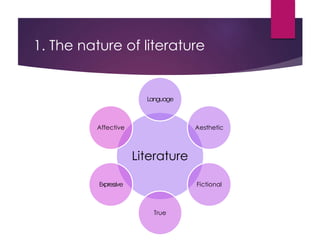
Literature
Language
Aesthetic
Fictional
True
Expressive
Affective
1. The nature of literature
Literature Is Language
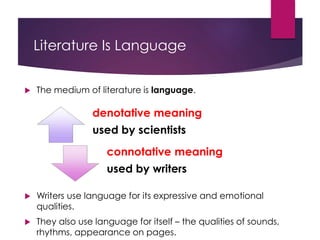
 The medium of literature is language.
 Writers use language for its expressive and emotional
qualities.
 They also use language for itself – the qualities of sounds,
rhythms, appearance on pages.
denotative meaning
used by scientists
connotative meaning
used by writers
Literature Is Aesthetic
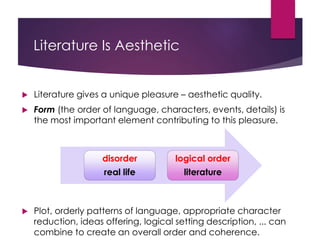
 Literature gives a unique pleasure – aesthetic quality.
 Form (the order of language, characters, events, details) is
the most important element contributing to this pleasure.
 Plot, orderly patterns of language, appropriate character
reduction, ideas offering, logical setting description, ... can
combine to create an overall order and coherence.
disorder
real life
logical order
literature
Literature Is Fictional
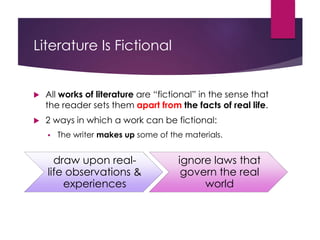
 All works of literature are “fictional” in the sense that
the reader sets them apart from the facts of real life.
 2 ways in which a work can be fictional:
 The writer makes up some of the materials.
draw upon real-
life observations &
experiences
ignore laws that
govern the real
world
Literature Is Fictional
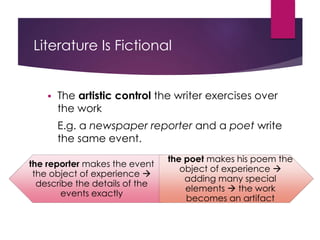
 The artistic control the writer exercises over
the work
E.g. a newspaper reporter and a poet write
the same event.
the reporter makes the event
the object of experience 
describe the details of the
events exactly
the poet makes his poem the
object of experience 
adding many special
elements  the work
becomes an artifact
Literature Is Fictional
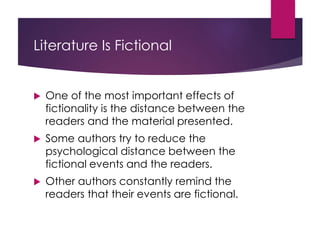
 One of the most important effects of
fictionality is the distance between the
readers and the material presented.
 Some authors try to reduce the
psychological distance between the
fictional events and the readers.
 Other authors constantly remind the
readers that their events are fictional.
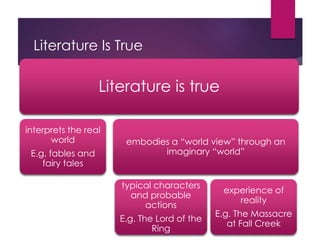
Literature Is True
Literature is true
interprets the real
world
E.g. fables and
fairy tales
embodies a “world view” through an
imaginary “world”
typical characters
and probable
actions
E.g. The Lord of the
Ring
experience of
reality
E.g. The Massacre
at Fall Creek
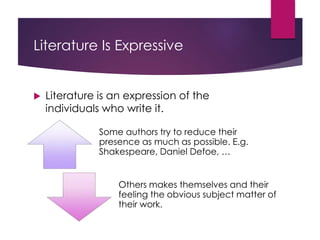
Literature Is Expressive
 Literature is an expression of the
individuals who write it.
Some authors try to reduce their
presence as much as possible. E.g.
Shakespeare, Daniel Defoe, …
Others makes themselves and their
feeling the obvious subject matter of
their work.
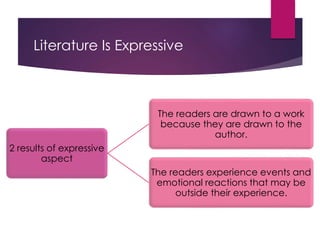
Literature Is Expressive
2 results of expressive
aspect
The readers are drawn to a work
because they are drawn to the
author.
The readers experience events and
emotional reactions that may be
outside their experience.
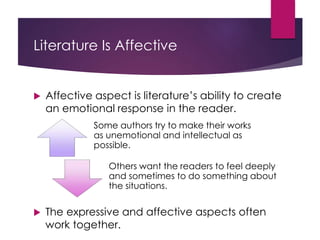
Literature Is Affective
 Affective aspect is literature’s ability to create
an emotional response in the reader.
 The expressive and affective aspects often
work together.
Some authors try to make their works
as unemotional and intellectual as
possible.
Others want the readers to feel deeply
and sometimes to do something about
the situations.
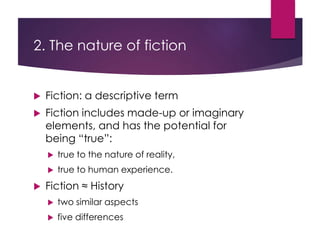
2. The nature of fiction
 Fiction: a descriptive term
 Fiction includes made-up or imaginary
elements, and has the potential for
being “true”:
 true to the nature of reality,
 true to human experience.
 Fiction ≈ History
 two similar aspects
 five differences
2. The nature of fiction
Fiction ≈
History
to create a
world
multiplicity
complexity
to speculate
the nature of
the real world
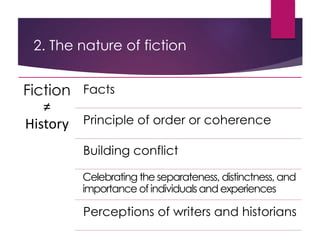
2. The nature of fiction
Fiction
≠
History
Facts
Principle of order or coherence
Building conflict
Celebrating the separateness, distinctness, and
importance of individualsand experiences
Perceptions of writers and historians
2. The nature of fiction
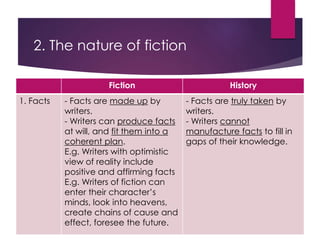
Fiction History
1. Facts - Facts are made up by
writers.
- Writers can produce facts
at will, and fit them into a
coherent plan.
E.g. Writers with optimistic
view of reality include
positive and affirming facts
E.g. Writers of fiction can
enter their character’s
minds, look into heavens,
create chains of cause and
effect, foresee the future.
- Facts are truly taken by
writers.
- Writers cannot
manufacture facts to fill in
gaps of their knowledge.
2. The nature of fiction
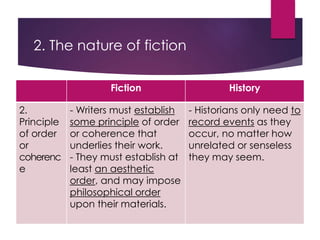
Fiction History
2.
Principle
of order
or
coherenc
e
- Writers must establish
some principle of order
or coherence that
underlies their work.
- They must establish at
least an aesthetic
order, and may impose
philosophical order
upon their materials.
- Historians only need to
record events as they
occur, no matter how
unrelated or senseless
they may seem.
2. The nature of fiction
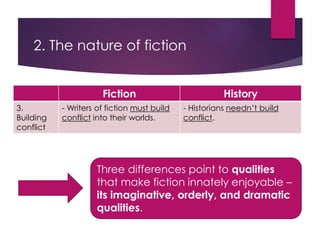
Fiction History
3.
Building
conflict
- Writers of fiction must build
conflict into their worlds.
- Historians needn’t build
conflict.
Three differences point to qualities
that make fiction innately enjoyable –
its imaginative, orderly, and dramatic
qualities.
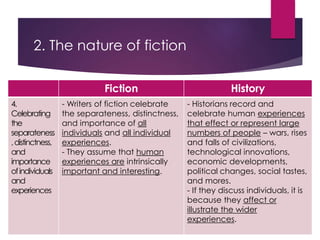
Fiction History
4.
Celebrating
the
separateness
,distinctness,
and
importance
ofindividuals
and
experiences
- Writers of fiction celebrate
the separateness, distinctness,
and importance of all
individuals and all individual
experiences.
- They assume that human
experiences are intrinsically
important and interesting.
- Historians record and
celebrate human experiences
that effect or represent large
numbers of people – wars, rises
and falls of civilizations,
technological innovations,
economic developments,
political changes, social tastes,
and mores.
- If they discuss individuals, it is
because they affect or
illustrate the wider
experiences.
2. The nature of fiction
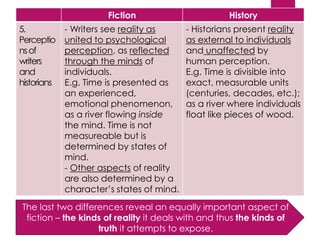
Fiction History
5.
Perceptio
nsof
writers
and
historians
- Writers see reality as
united to psychological
perception, as reflected
through the minds of
individuals.
E.g. Time is presented as
an experienced,
emotional phenomenon,
as a river flowing inside
the mind. Time is not
measureable but is
determined by states of
mind.
- Other aspects of reality
are also determined by a
character’s states of mind.
- Historians present reality
as external to individuals
and unaffected by
human perception.
E.g. Time is divisible into
exact, measurable units
(centuries, decades, etc.);
as a river where individuals
float like pieces of wood.
The last two differences reveal an equally important aspect of
fiction – the kinds of reality it deals with and thus the kinds of
truth it attempts to expose.
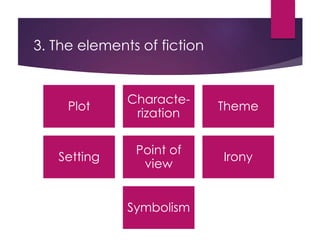
3. The elements of fiction
Plot
Characte-
rization
Theme
Setting
Point of
view
Irony
Symbolism
3.1 Plot
3.1 Plot
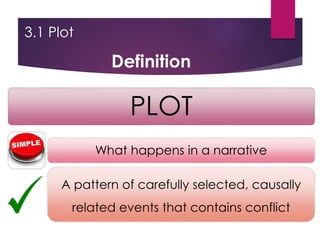
Definition
PLOT
What happens in a narrative
A pattern of carefully selected, causally
related events that contains conflict
3.1 Plot
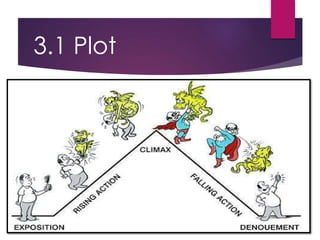
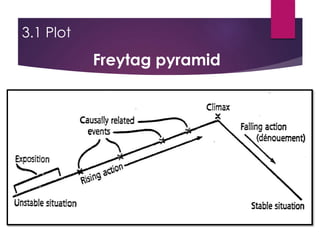
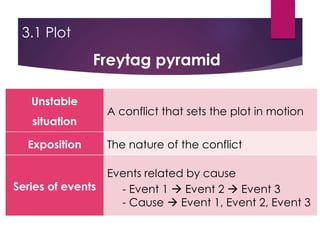
Freytag pyramid
Unstable
situation
A conflict that sets the plot in motion
Exposition The nature of the conflict
Series of events
Events related by cause
- Event 1  Event 2  Event 3
- Cause  Event 1, Event 2, Event 3
3.1 Plot
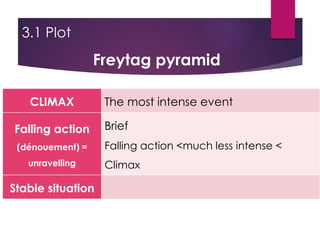
Freytag pyramid
CLIMAX The most intense event
Falling action
(dénouement) =
unravelling
Brief
Falling action <much less intense <
Climax
Stable situation
3.1 Plot
Freytag pyramid
3.1 Plot
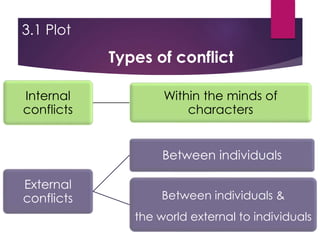
Types of conflict
Internal
conflicts
Within the minds of
characters
External
conflicts
Between individuals
Between individuals &
the world external to individuals
3.1 Plot
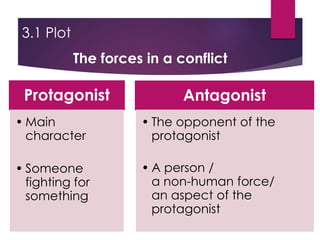
The forces in a conflict
Protagonist
• Main
character
• Someone
fighting for
something
Antagonist
• The opponent of the
protagonist
• A person /
a non-human force/
an aspect of the
protagonist
3.2 Characterization
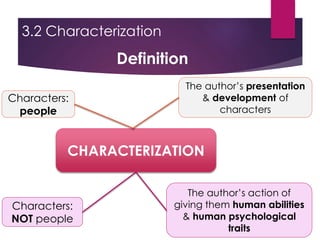
Definition
CHARACTERIZATION
Characters:
people
The author’s presentation
& development of
characters
Characters:
NOT people
The author’s action of
giving them human abilities
& human psychological
traits
3.2 Characterization
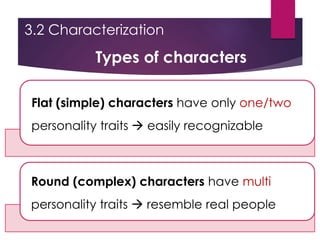
Types of characters
Flat (simple) characters have only one/two
personality traits  easily recognizable
Round (complex) characters have multi
personality traits  resemble real people
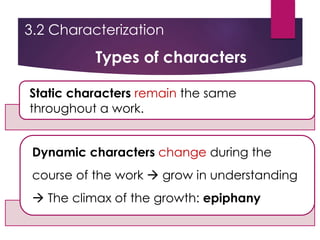
Static characters remain the same
throughout a work.
Dynamic characters change during the
course of the work  grow in understanding
 The climax of the growth: epiphany
3.2 Characterization
Types of characters
3.3 Theme – Definition
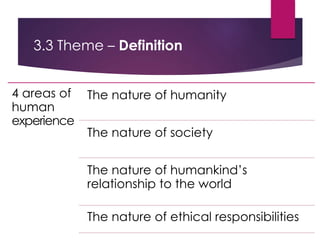
4 areas of
human
experience
The nature of humanity
The nature of society
The nature of humankind’s
relationship to the world
The nature of ethical responsibilities
3.3 Theme – Characteristics
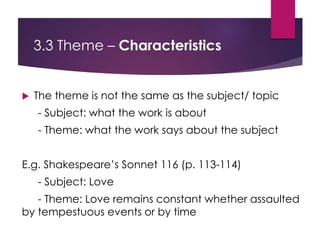
 The theme is not the same as the subject/ topic
- Subject: what the work is about
- Theme: what the work says about the subject
E.g. Shakespeare’s Sonnet 116 (p. 113-114)
- Subject: Love
- Theme: Love remains constant whether assaulted
by tempestuous events or by time
3.3 Theme – Characteristics
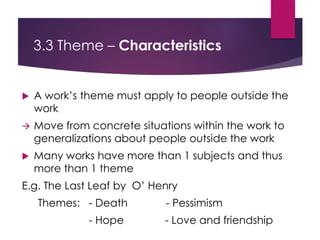
 A work’s theme must apply to people outside the
work
 Move from concrete situations within the work to
generalizations about people outside the work
 Many works have more than 1 subjects and thus
more than 1 theme
E.g. The Last Leaf by O’ Henry
Themes: - Death - Pessimism
- Hope - Love and friendship
3.3 Theme – Characteristics
 Some works may not have a subject or a theme
E.g. Edgar Allan Poe’s “The Raven” and “The Fall of
the House of Usher”
 The subjects and themes of complex works can
rarely be covered completely
+ Support the interpretations as logically and with
as much evidence as possible
+ May disagree with the author’s viewpoint
3.3 Theme – Characteristics
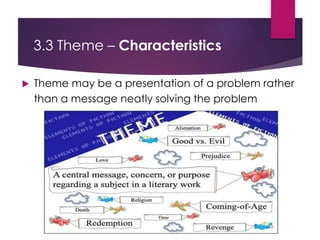
 Theme may be a presentation of a problem rather
than a message neatly solving the problem
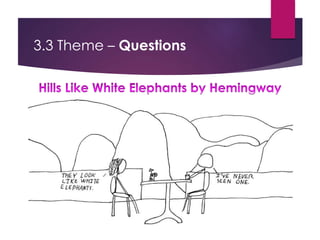
3.3 Theme – Questions
 What is the work about?

 What does the work say about the subject?

 In what direct and indirect ways does the
work communicate its theme?

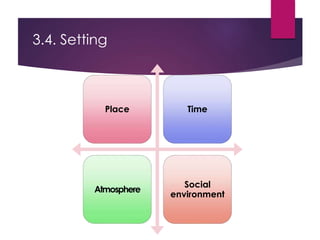
3.4. Setting
Place Time
Atmosphere
Social
environment
3.4. Setting – Place & Time
 The physical
setting
 The relationship
that place has to
characterization
and theme
 At what period in
history does the
action take place?
 How long does it take
for the action to
occur?
 How is the passage of
time perceived?
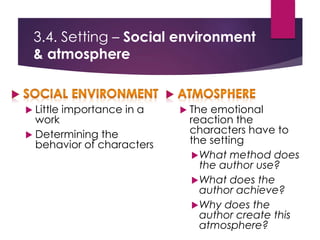
3.4. Setting – Social environment
& atmosphere
 Little importance in a
work
 Determining the
behavior of characters
 The emotional
reaction the
characters have to
the setting
What method does
the author use?
What does the
author achieve?
Why does the
author create this
atmosphere?
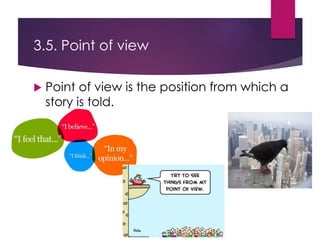
3.5. Point of view
 Point of view is the position from which a
story is told.
3.5. Point of view
 Who is telling the story?
 A story is told
through the eyes of
a narrator.
 It is the “voice” of
the story.
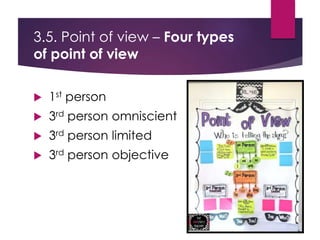
3.5. Point of view – Four types
of point of view
 1st person
 3rd person omniscient
 3rd person limited
 3rd person objective
3.5. Point of view – Four types
of point of view
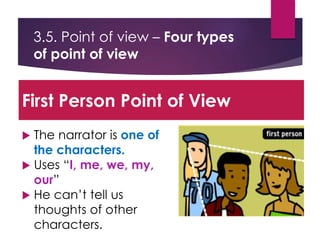
 The narrator is one of
the characters.
 Uses “I, me, we, my,
our”
 He can’t tell us
thoughts of other
characters.
First Person Point of View
3.5. Point of view – Four types
of point of view
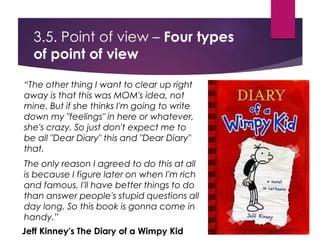
“The other thing I want to clear up right
away is that this was MOM's idea, not
mine. But if she thinks I'm going to write
down my "feelings" in here or whatever,
she's crazy. So just don't expect me to
be all "Dear Diary" this and "Dear Diary"
that.
The only reason I agreed to do this at all
is because I figure later on when I'm rich
and famous, I'll have better things to do
than answer people's stupid questions all
day long. So this book is gonna come in
handy.”
Jeff Kinney's The Diary of a Wimpy Kid
3.5. Point of view – Four types
of point of view
 The narrator is not a character.
 Uses he, she, him, her, they, them, their
and characters’ names.
 3 types of Third person point of view:
1. Omniscient
2. Limited
3. Objective
Third Person Point of View
3.5. Point of view – Four types
of point of view
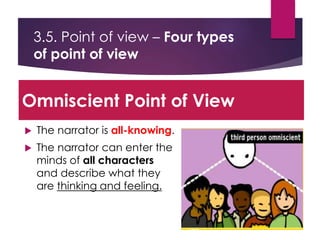
 The narrator is all-knowing.
 The narrator can enter the
minds of all characters
and describe what they
are thinking and feeling.
Omniscient Point of View
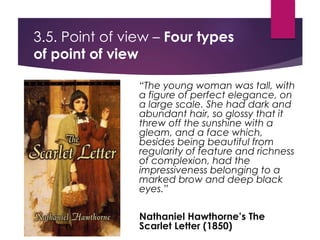
3.5. Point of view – Four types
of point of view
“The young woman was tall, with
a figure of perfect elegance, on
a large scale. She had dark and
abundant hair, so glossy that it
threw off the sunshine with a
gleam, and a face which,
besides being beautiful from
regularity of feature and richness
of complexion, had the
impressiveness belonging to a
marked brow and deep black
eyes.”
Nathaniel Hawthorne’s The
Scarlet Letter (1850)
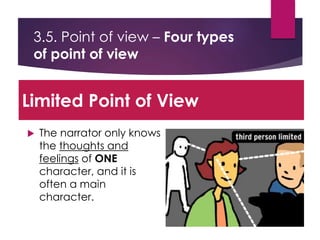
3.5. Point of view – Four types
of point of view
 The narrator only knows
the thoughts and
feelings of ONE
character, and it is
often a main
character.
Limited Point of View
3.5. Point of view – Four types
of point of view
“When he had been younger, Harry had
dreamed and dreamed of some
unknown relation coming to take him
away, but it had never happened; the
Dursleys were his only family. Yet
sometimes he thought (or maybe
hoped) that strangers in the street
seemed to know him. Very strange
strangers they were, too. A tiny man in a
violet top hat had bowed to him once
while out shopping with Aunt Petunia
and Dudley.”
J.K. Rowling’s Harry Potter and the
Sorcerers Stone (2001)
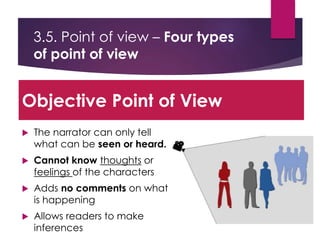
3.5. Point of view – Four types
of point of view
 The narrator can only tell
what can be seen or heard.
 Cannot know thoughts or
feelings of the characters
 Adds no comments on what
is happening
 Allows readers to make
inferences
Objective Point of View
3.5. Point of view – Four types
of point of view
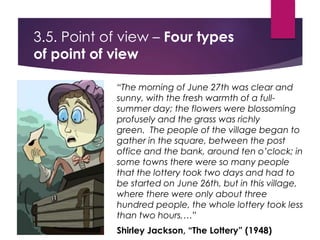
“The morning of June 27th was clear and
sunny, with the fresh warmth of a full-
summer day; the flowers were blossoming
profusely and the grass was richly
green. The people of the village began to
gather in the square, between the post
office and the bank, around ten o’clock; in
some towns there were so many people
that the lottery took two days and had to
be started on June 26th, but in this village,
where there were only about three
hundred people, the whole lottery took less
than two hours,…”
Shirley Jackson, “The Lottery” (1948)
3.5. Point of view – Multiple
Choice
 The narrator is an observer and knows
everything about all the characters.
A.) First person
B.) Third person omniscient
C.) Third person limited
D.) Third person objective
3.5. Point of view – Multiple
Choice
 The narrator is an observer and describes the
thoughts and feelings of just one character.
A.) First person
B.) Third person omniscient
C.) Third person limited
D.) Third person objective
3.5. Point of view – Multiple
Choice
 The narrator is a character in the story and
tells what he or she experiences.
A.) First person
B.) Third person omniscient
C.) Third person limited
D.) Third person objective
3.5. Point of view – Multiple
Choice
 The narrator just describes the facts, does not
enter the mind of the characters.
A.) First person
B.) Third person omniscient
C.) Third person limited
D.) Third person objective
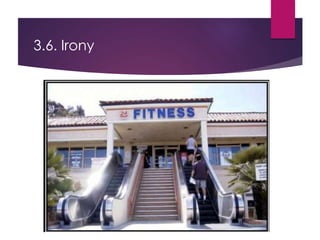
3.6. Irony
 It is the difference between what we
expect to happen, and what actually
does happen.
 It is often used to add suspense and
interest.
 It is also used to keep the reader
thinking about the moral of the story.
3.6. Irony
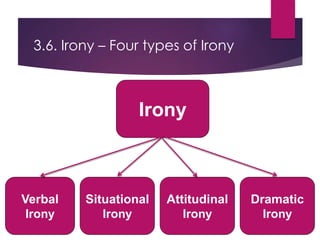
3.6. Irony – Four types of Irony
Irony
Verbal
Irony
Situational
Irony
Dramatic
Irony
Attitudinal
Irony
3.6. Irony – Four types of Irony –
Verbal Irony
 The simplest kind of irony.
 It occurs in a conversation where a person
aims to be understood as meaning something
different to what his or her words literally
mean.
 E.g. “Awesome! I can’t wait to read the seven
hundred page report.”
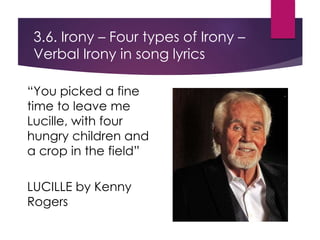
“You picked a fine
time to leave me
Lucille, with four
hungry children and
a crop in the field”
LUCILLE by Kenny
Rogers
3.6. Irony – Four types of Irony –
Verbal Irony in song lyrics
3.6. Irony – Four types of Irony –
Verbal Irony – Two types
 There are two types of verbal irony
1. Overstatement – when a person
exaggerates the character of something.
2. Understatement – when a person
undermines the character of something.
3.6. Irony – Four types of Irony –
Situational Irony
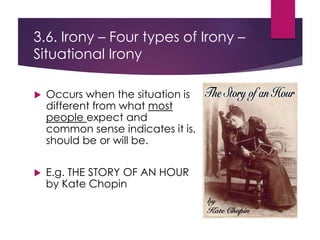
 Occurs when the situation is
different from what most
people expect and
common sense indicates it is,
should be or will be.
 E.g. THE STORY OF AN HOUR
by Kate Chopin
3.6. Irony – Four types of Irony –
Attitudinal Irony
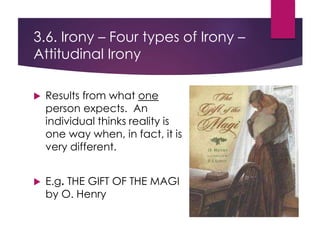
 Results from what one
person expects. An
individual thinks reality is
one way when, in fact, it is
very different.
 E.g. THE GIFT OF THE MAGI
by O. Henry
3.6. Irony – Four types of Irony –
Dramatic Irony
 Occurs when the audience knows something
that the characters do not know.
 This is used to engage the audience and
keep them actively involved in the storyline.
 E.g. In all of the Friday the 13th movies, we
know Jason is in the woods but the
characters do not. When they go out into the
woods, we are afraid for them because we
know that they are in danger.
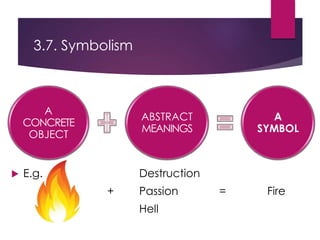
A
CONCRETE
OBJECT
ABSTRACT
MEANINGS
A
SYMBOL
3.7. Symbolism
 E.g. Destruction
+ Passion = Fire
Hell
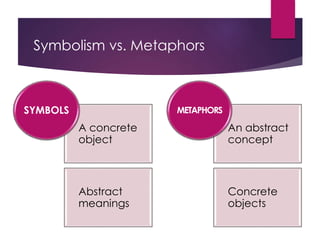
A concrete
object
Abstract
meanings
SYMBOLS
An abstract
concept
Concrete
objects
METAPHORS
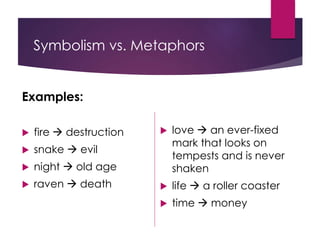
Symbolism vs. Metaphors
Examples:
 fire  destruction
 snake  evil
 night  old age
 raven  death
 love  an ever-fixed
mark that looks on
tempests and is never
shaken
 life  a roller coaster
 time  money
Symbolism vs. Metaphors
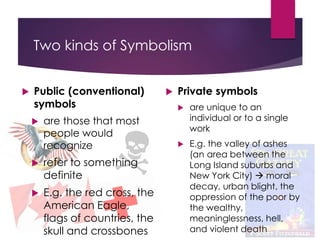
Two kinds of Symbolism
 Public (conventional)
symbols
 are those that most
people would
recognize
 refer to something
definite
 E.g. the red cross, the
American Eagle,
flags of countries, the
skull and crossbones
 Private symbols
 are unique to an
individual or to a single
work
 E.g. the valley of ashes
(an area between the
Long Island suburbs and
New York City)  moral
decay, urban blight, the
oppression of the poor by
the wealthy,
meaninglessness, hell,
and violent death
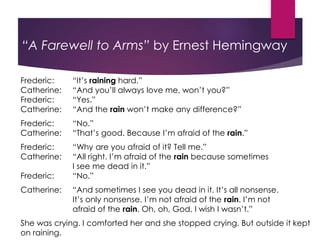
“A Farewell to Arms” by Ernest Hemingway
Frederic: “It’s raining hard.”
Catherine: “And you’ll always love me, won’t you?”
Frederic: “Yes.”
Catherine: “And the rain won’t make any difference?”
Frederic: “No.”
Catherine: “That’s good. Because I’m afraid of the rain.”
Frederic: “Why are you afraid of it? Tell me.”
Catherine: “All right. I’m afraid of the rain because sometimes
I see me dead in it.”
Frederic: “No.”
Catherine: “And sometimes I see you dead in it. It’s all nonsense.
It’s only nonsense. I’m not afraid of the rain. I’m not
afraid of the rain. Oh, oh, God, I wish I wasn’t.”
She was crying. I comforted her and she stopped crying. But outside it kept
on raining.
Questions
 What does the rain in “A Farewell to Arms” by
Ernest Hemingway represent?
Questions
 What does the rain in “A Farewell to Arms” by
Ernest Hemingway represent?
 The rain is a symbol of Catherine’s death, the
war, the cruelty of fate.
3.7. Symbolism
Not every work uses symbols, and
not every character, incident, or
object in a work has symbolic
values.
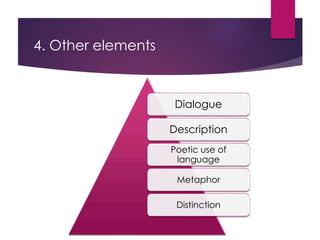
4. Other elements
Dialogue
Description
Poetic use of
language
Metaphor
Distinction
Thank you for your
attention!

How to Teach Fiction

  • 1.
    Teaching Fiction GROUP: NGUYỄN NGỌCCHÂU NGUYỄN MỸ KHÁNH PHẠM PHÚC KHÁNH MINH NGUYỄN NGỌC PHƯƠNG THÀNH ĐỖ THỊ BẠCH VÂN NGÔ THẢO VY
  • 2.
    Outline The nature ofliterature The nature of fiction The elements of fiction Other elements
  • 3.
    1. The natureof literature  “To analyze works of literature, you need to know what literature is – what typical components to expect and how those components usually work together.” (Griffith, 1990)
  • 4.
  • 5.
    Literature Is Language The medium of literature is language.  Writers use language for its expressive and emotional qualities.  They also use language for itself – the qualities of sounds, rhythms, appearance on pages. denotative meaning used by scientists connotative meaning used by writers
  • 6.
    Literature Is Aesthetic Literature gives a unique pleasure – aesthetic quality.  Form (the order of language, characters, events, details) is the most important element contributing to this pleasure.  Plot, orderly patterns of language, appropriate character reduction, ideas offering, logical setting description, ... can combine to create an overall order and coherence. disorder real life logical order literature
  • 7.
    Literature Is Fictional All works of literature are “fictional” in the sense that the reader sets them apart from the facts of real life.  2 ways in which a work can be fictional:  The writer makes up some of the materials. draw upon real- life observations & experiences ignore laws that govern the real world
  • 8.
    Literature Is Fictional The artistic control the writer exercises over the work E.g. a newspaper reporter and a poet write the same event. the reporter makes the event the object of experience  describe the details of the events exactly the poet makes his poem the object of experience  adding many special elements  the work becomes an artifact
  • 9.
    Literature Is Fictional One of the most important effects of fictionality is the distance between the readers and the material presented.  Some authors try to reduce the psychological distance between the fictional events and the readers.  Other authors constantly remind the readers that their events are fictional.
  • 10.
    Literature Is True Literatureis true interprets the real world E.g. fables and fairy tales embodies a “world view” through an imaginary “world” typical characters and probable actions E.g. The Lord of the Ring experience of reality E.g. The Massacre at Fall Creek
  • 11.
    Literature Is Expressive Literature is an expression of the individuals who write it. Some authors try to reduce their presence as much as possible. E.g. Shakespeare, Daniel Defoe, … Others makes themselves and their feeling the obvious subject matter of their work.
  • 12.
    Literature Is Expressive 2results of expressive aspect The readers are drawn to a work because they are drawn to the author. The readers experience events and emotional reactions that may be outside their experience.
  • 13.
    Literature Is Affective Affective aspect is literature’s ability to create an emotional response in the reader.  The expressive and affective aspects often work together. Some authors try to make their works as unemotional and intellectual as possible. Others want the readers to feel deeply and sometimes to do something about the situations.
  • 14.
    2. The natureof fiction  Fiction: a descriptive term  Fiction includes made-up or imaginary elements, and has the potential for being “true”:  true to the nature of reality,  true to human experience.  Fiction ≈ History  two similar aspects  five differences
  • 15.
    2. The natureof fiction Fiction ≈ History to create a world multiplicity complexity to speculate the nature of the real world
  • 16.
    2. The natureof fiction Fiction ≠ History Facts Principle of order or coherence Building conflict Celebrating the separateness, distinctness, and importance of individualsand experiences Perceptions of writers and historians
  • 17.
    2. The natureof fiction Fiction History 1. Facts - Facts are made up by writers. - Writers can produce facts at will, and fit them into a coherent plan. E.g. Writers with optimistic view of reality include positive and affirming facts E.g. Writers of fiction can enter their character’s minds, look into heavens, create chains of cause and effect, foresee the future. - Facts are truly taken by writers. - Writers cannot manufacture facts to fill in gaps of their knowledge.
  • 18.
    2. The natureof fiction Fiction History 2. Principle of order or coherenc e - Writers must establish some principle of order or coherence that underlies their work. - They must establish at least an aesthetic order, and may impose philosophical order upon their materials. - Historians only need to record events as they occur, no matter how unrelated or senseless they may seem.
  • 19.
    2. The natureof fiction Fiction History 3. Building conflict - Writers of fiction must build conflict into their worlds. - Historians needn’t build conflict. Three differences point to qualities that make fiction innately enjoyable – its imaginative, orderly, and dramatic qualities.
  • 20.
    Fiction History 4. Celebrating the separateness ,distinctness, and importance ofindividuals and experiences - Writersof fiction celebrate the separateness, distinctness, and importance of all individuals and all individual experiences. - They assume that human experiences are intrinsically important and interesting. - Historians record and celebrate human experiences that effect or represent large numbers of people – wars, rises and falls of civilizations, technological innovations, economic developments, political changes, social tastes, and mores. - If they discuss individuals, it is because they affect or illustrate the wider experiences. 2. The nature of fiction
  • 21.
    Fiction History 5. Perceptio nsof writers and historians - Writerssee reality as united to psychological perception, as reflected through the minds of individuals. E.g. Time is presented as an experienced, emotional phenomenon, as a river flowing inside the mind. Time is not measureable but is determined by states of mind. - Other aspects of reality are also determined by a character’s states of mind. - Historians present reality as external to individuals and unaffected by human perception. E.g. Time is divisible into exact, measurable units (centuries, decades, etc.); as a river where individuals float like pieces of wood. The last two differences reveal an equally important aspect of fiction – the kinds of reality it deals with and thus the kinds of truth it attempts to expose.
  • 22.
    3. The elementsof fiction Plot Characte- rization Theme Setting Point of view Irony Symbolism
  • 23.
  • 24.
    3.1 Plot Definition PLOT What happensin a narrative A pattern of carefully selected, causally related events that contains conflict
  • 25.
  • 26.
    Unstable situation A conflict thatsets the plot in motion Exposition The nature of the conflict Series of events Events related by cause - Event 1  Event 2  Event 3 - Cause  Event 1, Event 2, Event 3 3.1 Plot Freytag pyramid
  • 27.
    CLIMAX The mostintense event Falling action (dénouement) = unravelling Brief Falling action <much less intense < Climax Stable situation 3.1 Plot Freytag pyramid
  • 28.
    3.1 Plot Types ofconflict Internal conflicts Within the minds of characters External conflicts Between individuals Between individuals & the world external to individuals
  • 29.
    3.1 Plot The forcesin a conflict Protagonist • Main character • Someone fighting for something Antagonist • The opponent of the protagonist • A person / a non-human force/ an aspect of the protagonist
  • 30.
  • 31.
    3.2 Characterization Definition CHARACTERIZATION Characters: people The author’spresentation & development of characters Characters: NOT people The author’s action of giving them human abilities & human psychological traits
  • 32.
    3.2 Characterization Types ofcharacters Flat (simple) characters have only one/two personality traits  easily recognizable Round (complex) characters have multi personality traits  resemble real people
  • 33.
    Static characters remainthe same throughout a work. Dynamic characters change during the course of the work  grow in understanding  The climax of the growth: epiphany 3.2 Characterization Types of characters
  • 34.
    3.3 Theme –Definition 4 areas of human experience The nature of humanity The nature of society The nature of humankind’s relationship to the world The nature of ethical responsibilities
  • 35.
    3.3 Theme –Characteristics  The theme is not the same as the subject/ topic - Subject: what the work is about - Theme: what the work says about the subject E.g. Shakespeare’s Sonnet 116 (p. 113-114) - Subject: Love - Theme: Love remains constant whether assaulted by tempestuous events or by time
  • 36.
    3.3 Theme –Characteristics  A work’s theme must apply to people outside the work  Move from concrete situations within the work to generalizations about people outside the work  Many works have more than 1 subjects and thus more than 1 theme E.g. The Last Leaf by O’ Henry Themes: - Death - Pessimism - Hope - Love and friendship
  • 37.
    3.3 Theme –Characteristics  Some works may not have a subject or a theme E.g. Edgar Allan Poe’s “The Raven” and “The Fall of the House of Usher”  The subjects and themes of complex works can rarely be covered completely + Support the interpretations as logically and with as much evidence as possible + May disagree with the author’s viewpoint
  • 38.
    3.3 Theme –Characteristics  Theme may be a presentation of a problem rather than a message neatly solving the problem
  • 39.
    3.3 Theme –Questions
  • 40.
    3.3 Theme –Questions  What is the work about?   What does the work say about the subject?   In what direct and indirect ways does the work communicate its theme? 
  • 41.
  • 42.
    3.4. Setting –Place & Time  The physical setting  The relationship that place has to characterization and theme  At what period in history does the action take place?  How long does it take for the action to occur?  How is the passage of time perceived?
  • 43.
    3.4. Setting –Social environment & atmosphere  Little importance in a work  Determining the behavior of characters  The emotional reaction the characters have to the setting What method does the author use? What does the author achieve? Why does the author create this atmosphere?
  • 44.
    3.5. Point ofview  Point of view is the position from which a story is told.
  • 45.
    3.5. Point ofview  Who is telling the story?  A story is told through the eyes of a narrator.  It is the “voice” of the story.
  • 46.
    3.5. Point ofview – Four types of point of view  1st person  3rd person omniscient  3rd person limited  3rd person objective
  • 47.
    3.5. Point ofview – Four types of point of view  The narrator is one of the characters.  Uses “I, me, we, my, our”  He can’t tell us thoughts of other characters. First Person Point of View
  • 48.
    3.5. Point ofview – Four types of point of view “The other thing I want to clear up right away is that this was MOM's idea, not mine. But if she thinks I'm going to write down my "feelings" in here or whatever, she's crazy. So just don't expect me to be all "Dear Diary" this and "Dear Diary" that. The only reason I agreed to do this at all is because I figure later on when I'm rich and famous, I'll have better things to do than answer people's stupid questions all day long. So this book is gonna come in handy.” Jeff Kinney's The Diary of a Wimpy Kid
  • 49.
    3.5. Point ofview – Four types of point of view  The narrator is not a character.  Uses he, she, him, her, they, them, their and characters’ names.  3 types of Third person point of view: 1. Omniscient 2. Limited 3. Objective Third Person Point of View
  • 50.
    3.5. Point ofview – Four types of point of view  The narrator is all-knowing.  The narrator can enter the minds of all characters and describe what they are thinking and feeling. Omniscient Point of View
  • 51.
    3.5. Point ofview – Four types of point of view “The young woman was tall, with a figure of perfect elegance, on a large scale. She had dark and abundant hair, so glossy that it threw off the sunshine with a gleam, and a face which, besides being beautiful from regularity of feature and richness of complexion, had the impressiveness belonging to a marked brow and deep black eyes.” Nathaniel Hawthorne’s The Scarlet Letter (1850)
  • 52.
    3.5. Point ofview – Four types of point of view  The narrator only knows the thoughts and feelings of ONE character, and it is often a main character. Limited Point of View
  • 53.
    3.5. Point ofview – Four types of point of view “When he had been younger, Harry had dreamed and dreamed of some unknown relation coming to take him away, but it had never happened; the Dursleys were his only family. Yet sometimes he thought (or maybe hoped) that strangers in the street seemed to know him. Very strange strangers they were, too. A tiny man in a violet top hat had bowed to him once while out shopping with Aunt Petunia and Dudley.” J.K. Rowling’s Harry Potter and the Sorcerers Stone (2001)
  • 54.
    3.5. Point ofview – Four types of point of view  The narrator can only tell what can be seen or heard.  Cannot know thoughts or feelings of the characters  Adds no comments on what is happening  Allows readers to make inferences Objective Point of View
  • 55.
    3.5. Point ofview – Four types of point of view “The morning of June 27th was clear and sunny, with the fresh warmth of a full- summer day; the flowers were blossoming profusely and the grass was richly green. The people of the village began to gather in the square, between the post office and the bank, around ten o’clock; in some towns there were so many people that the lottery took two days and had to be started on June 26th, but in this village, where there were only about three hundred people, the whole lottery took less than two hours,…” Shirley Jackson, “The Lottery” (1948)
  • 56.
    3.5. Point ofview – Multiple Choice  The narrator is an observer and knows everything about all the characters. A.) First person B.) Third person omniscient C.) Third person limited D.) Third person objective
  • 57.
    3.5. Point ofview – Multiple Choice  The narrator is an observer and describes the thoughts and feelings of just one character. A.) First person B.) Third person omniscient C.) Third person limited D.) Third person objective
  • 58.
    3.5. Point ofview – Multiple Choice  The narrator is a character in the story and tells what he or she experiences. A.) First person B.) Third person omniscient C.) Third person limited D.) Third person objective
  • 59.
    3.5. Point ofview – Multiple Choice  The narrator just describes the facts, does not enter the mind of the characters. A.) First person B.) Third person omniscient C.) Third person limited D.) Third person objective
  • 60.
    3.6. Irony  Itis the difference between what we expect to happen, and what actually does happen.  It is often used to add suspense and interest.  It is also used to keep the reader thinking about the moral of the story.
  • 61.
  • 62.
    3.6. Irony –Four types of Irony Irony Verbal Irony Situational Irony Dramatic Irony Attitudinal Irony
  • 63.
    3.6. Irony –Four types of Irony – Verbal Irony  The simplest kind of irony.  It occurs in a conversation where a person aims to be understood as meaning something different to what his or her words literally mean.  E.g. “Awesome! I can’t wait to read the seven hundred page report.”
  • 64.
    “You picked afine time to leave me Lucille, with four hungry children and a crop in the field” LUCILLE by Kenny Rogers 3.6. Irony – Four types of Irony – Verbal Irony in song lyrics
  • 65.
    3.6. Irony –Four types of Irony – Verbal Irony – Two types  There are two types of verbal irony 1. Overstatement – when a person exaggerates the character of something. 2. Understatement – when a person undermines the character of something.
  • 66.
    3.6. Irony –Four types of Irony – Situational Irony  Occurs when the situation is different from what most people expect and common sense indicates it is, should be or will be.  E.g. THE STORY OF AN HOUR by Kate Chopin
  • 67.
    3.6. Irony –Four types of Irony – Attitudinal Irony  Results from what one person expects. An individual thinks reality is one way when, in fact, it is very different.  E.g. THE GIFT OF THE MAGI by O. Henry
  • 68.
    3.6. Irony –Four types of Irony – Dramatic Irony  Occurs when the audience knows something that the characters do not know.  This is used to engage the audience and keep them actively involved in the storyline.  E.g. In all of the Friday the 13th movies, we know Jason is in the woods but the characters do not. When they go out into the woods, we are afraid for them because we know that they are in danger.
  • 69.
  • 70.
  • 71.
    Examples:  fire destruction  snake  evil  night  old age  raven  death  love  an ever-fixed mark that looks on tempests and is never shaken  life  a roller coaster  time  money Symbolism vs. Metaphors
  • 72.
    Two kinds ofSymbolism  Public (conventional) symbols  are those that most people would recognize  refer to something definite  E.g. the red cross, the American Eagle, flags of countries, the skull and crossbones  Private symbols  are unique to an individual or to a single work  E.g. the valley of ashes (an area between the Long Island suburbs and New York City)  moral decay, urban blight, the oppression of the poor by the wealthy, meaninglessness, hell, and violent death
  • 73.
    “A Farewell toArms” by Ernest Hemingway Frederic: “It’s raining hard.” Catherine: “And you’ll always love me, won’t you?” Frederic: “Yes.” Catherine: “And the rain won’t make any difference?” Frederic: “No.” Catherine: “That’s good. Because I’m afraid of the rain.” Frederic: “Why are you afraid of it? Tell me.” Catherine: “All right. I’m afraid of the rain because sometimes I see me dead in it.” Frederic: “No.” Catherine: “And sometimes I see you dead in it. It’s all nonsense. It’s only nonsense. I’m not afraid of the rain. I’m not afraid of the rain. Oh, oh, God, I wish I wasn’t.” She was crying. I comforted her and she stopped crying. But outside it kept on raining.
  • 74.
    Questions  What doesthe rain in “A Farewell to Arms” by Ernest Hemingway represent?
  • 75.
    Questions  What doesthe rain in “A Farewell to Arms” by Ernest Hemingway represent?  The rain is a symbol of Catherine’s death, the war, the cruelty of fate.
  • 76.
    3.7. Symbolism Not everywork uses symbols, and not every character, incident, or object in a work has symbolic values.
  • 77.
    4. Other elements Dialogue Description Poeticuse of language Metaphor Distinction
  • 78.
    Thank you foryour attention!

Editor's Notes

  • #3 Phần 1, 2: Châu, Minh Phần 3, 4: Vy, Thành, Khánh, Vân [theo thứ tự].
  • #70 Fire  destruction
  • #72 Love is clarified with a concrete object that nothing cannot move it. it suggests that time is valuable and we have to treasure every moment in life.  it indicates that there will be ups and downs in life that you have to weather.  
  • #73 Only from clues in the work itself can we learn the symbolic value of the object. In the Great Gatsby , the author associates the area which the main characters drive through at various times with many possible meanings like moral decay,..
  • #74 The following dialogue bwt C and F In this dialogue, H intended a symbolic meaning for rain, it also suggests what the symbol represents.
  • #77 You should beware of finding symbols where none were intended
  • #78 In this chapter, we have treated the elements which are most obviously identified with fiction. But other elements are also sometimes important in fiction: dialogue, … However, these elements deal with drama and poetry more than stories or novels. Therefore, these elements will be discussed more in the parts of drama and poetry.