Variables
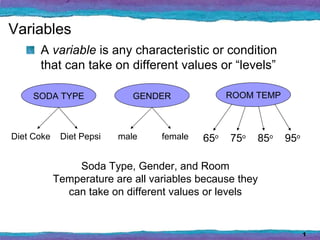
      A variable is any characteristic or condition
      that can take on different values or “levels”

     SODA TYPE               GENDER              ROOM TEMP


Diet Coke    Diet Pepsi   male    female   65o   75o   85o   95o

                Soda Type, Gender, and Room
            Temperature are all variables because they
              can take on different values or levels


                                                                   1
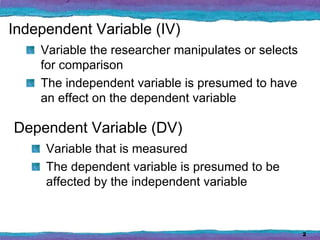
Independent Variable (IV)
    Variable the researcher manipulates or selects
    for comparison
    The independent variable is presumed to have
    an effect on the dependent variable

Dependent Variable (DV)
     Variable that is measured
     The dependent variable is presumed to be
     affected by the independent variable


                                                     2
A tip to distinguish IV and DV
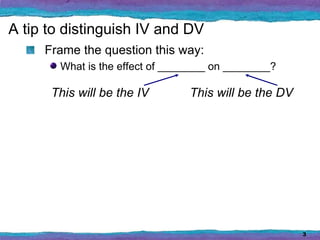
     Frame the question this way:
       What is the effect of ________ on ________?

      This will be the IV       This will be the DV


                                                      3
A tip to distinguish IV and DV
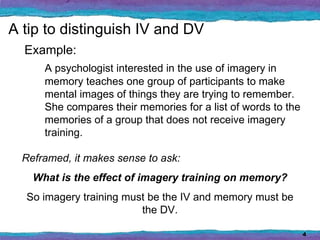
  Example:
      A psychologist interested in the use of imagery in
      memory teaches one group of participants to make
      mental images of things they are trying to remember.
      She compares their memories for a list of words to the
      memories of a group that does not receive imagery
      training.

  Reframed, it makes sense to ask:
    What is the effect of imagery training on memory?
  So imagery training must be the IV and memory must be
                         the DV.

                                                               4
Extraneous Variables
    Variables the researcher wants to control so
    that they do not have an influence on the
    outcome of the study.
    For example, if you were conducting a taste
    test between two sodas, you would want to
    control:
       Temperature of the soda so that both are the same
       How long the soda had been on the shelf
       The container, so that both look the same
       Many others!
    You control extraneous variables so that they
    don’t impact the effect of the independent
    variable on the dependent variable.
                                                           5
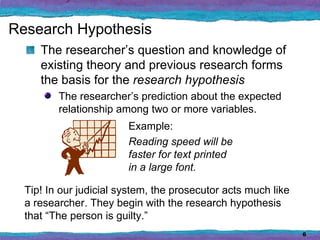
Research Hypothesis
     The researcher’s question and knowledge of
     existing theory and previous research forms
     the basis for the research hypothesis
         The researcher’s prediction about the expected
         relationship among two or more variables.
                        Example:
                        Reading speed will be
                        faster for text printed
                        in a large font.

  Tip! In our judicial system, the prosecutor acts much like
  a researcher. They begin with the research hypothesis
  that “The person is guilty.”
                                                               6
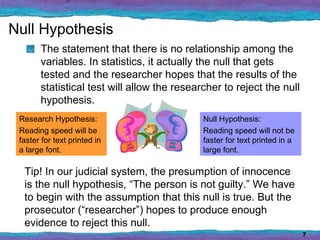
Null Hypothesis
       The statement that there is no relationship among the
       variables. In statistics, it actually the null that gets
       tested and the researcher hopes that the results of the
       statistical test will allow the researcher to reject the null
       hypothesis.
 Research Hypothesis:                        Null Hypothesis:
 Reading speed will be                       Reading speed will not be
 faster for text printed in                  faster for text printed in a
 a large font.                               large font.

  Tip! In our judicial system, the presumption of innocence
  is the null hypothesis, “The person is not guilty.” We have
  to begin with the assumption that this null is true. But the
  prosecutor (“researcher”) hopes to produce enough
  evidence to reject this null.
                                                                            7
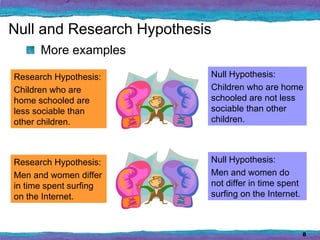
Null and Research Hypothesis
      More examples

Research Hypothesis:       Null Hypothesis:
Children who are           Children who are home
home schooled are          schooled are not less
less sociable than         sociable than other
other children.            children.


Research Hypothesis:       Null Hypothesis:
Men and women differ       Men and women do
in time spent surfing      not differ in time spent
on the Internet.           surfing on the Internet.


                                                      8

Variables and Hypotheses

  • 1.
    Variables A variable is any characteristic or condition that can take on different values or “levels” SODA TYPE GENDER ROOM TEMP Diet Coke Diet Pepsi male female 65o 75o 85o 95o Soda Type, Gender, and Room Temperature are all variables because they can take on different values or levels 1
  • 2.
    Independent Variable (IV) Variable the researcher manipulates or selects for comparison The independent variable is presumed to have an effect on the dependent variable Dependent Variable (DV) Variable that is measured The dependent variable is presumed to be affected by the independent variable 2
  • 3.
    A tip todistinguish IV and DV Frame the question this way: What is the effect of ________ on ________? This will be the IV This will be the DV 3
  • 4.
    A tip todistinguish IV and DV Example: A psychologist interested in the use of imagery in memory teaches one group of participants to make mental images of things they are trying to remember. She compares their memories for a list of words to the memories of a group that does not receive imagery training. Reframed, it makes sense to ask: What is the effect of imagery training on memory? So imagery training must be the IV and memory must be the DV. 4
  • 5.
    Extraneous Variables Variables the researcher wants to control so that they do not have an influence on the outcome of the study. For example, if you were conducting a taste test between two sodas, you would want to control: Temperature of the soda so that both are the same How long the soda had been on the shelf The container, so that both look the same Many others! You control extraneous variables so that they don’t impact the effect of the independent variable on the dependent variable. 5
  • 6.
    Research Hypothesis The researcher’s question and knowledge of existing theory and previous research forms the basis for the research hypothesis The researcher’s prediction about the expected relationship among two or more variables. Example: Reading speed will be faster for text printed in a large font. Tip! In our judicial system, the prosecutor acts much like a researcher. They begin with the research hypothesis that “The person is guilty.” 6
  • 7.
    Null Hypothesis The statement that there is no relationship among the variables. In statistics, it actually the null that gets tested and the researcher hopes that the results of the statistical test will allow the researcher to reject the null hypothesis. Research Hypothesis: Null Hypothesis: Reading speed will be Reading speed will not be faster for text printed in faster for text printed in a a large font. large font. Tip! In our judicial system, the presumption of innocence is the null hypothesis, “The person is not guilty.” We have to begin with the assumption that this null is true. But the prosecutor (“researcher”) hopes to produce enough evidence to reject this null. 7
  • 8.
    Null and ResearchHypothesis More examples Research Hypothesis: Null Hypothesis: Children who are Children who are home home schooled are schooled are not less less sociable than sociable than other other children. children. Research Hypothesis: Null Hypothesis: Men and women differ Men and women do in time spent surfing not differ in time spent on the Internet. surfing on the Internet. 8

Editor's Notes

  • #4 In class practice on identifying IV and DV for #15
  • #5 In class practice on identifying IV and DV for #15