Group 2
Khánh Minh Thanh Thư
Hoài Phương Bạch Vân
Phương Thành Thảo Vy
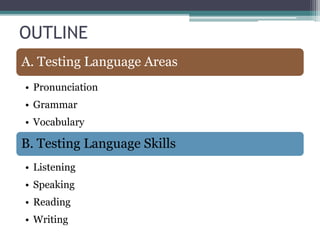
OUTLINE
A. Testing Language Areas
• Pronunciation
• Grammar
• Vocabulary
B. Testing Language Skills
• Listening
• Speaking
• Reading
• Writing
1. TESTING PRONUNCIATION
1.1 Pronunciation Tests
1.2 Types of Pronunciation Tests
A. TESTING LANGUAGE AREAS
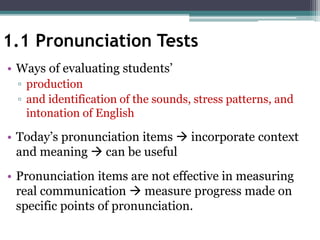
1.1 Pronunciation Tests
• Ways of evaluating students’
▫ production
▫ and identification of the sounds, stress patterns, and
intonation of English
• Today’s pronunciation items  incorporate context
and meaning  can be useful
• Pronunciation items are not effective in measuring
real communication  measure progress made on
specific points of pronunciation.
• On a speaking test, pronunciation becomes important
when it interferes with communication.
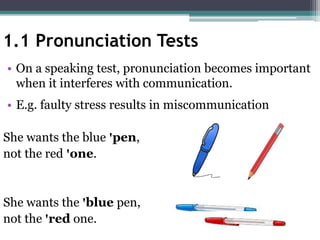
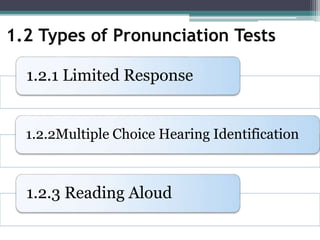
• E.g. faulty stress results in miscommunication
She wants the blue ꞌpen,
not the red ꞌone.
She wants the ꞌblue pen,
not the ꞌred one.
1.1 Pronunciation Tests
1.2 Types of Pronunciation Tests
1.2.1 Limited Response
1.2.2Multiple Choice Hearing Identification
1.2.3 Reading Aloud
1.2.1 LIMITED RESPONSE
• Providing ways for testing beginning students
• 2 ways:
#1 Individual Testing: Oral Repetition
#2 Group Testing: Hearing Identification
#1 Individual Testing: Oral Repetition
• For students who cannot read or write
• Students simply listen and repeat.
• One of the easiest of all exams
• No distractors, clever sentence frames, or drawings
needed
• Every pronunciation feature can be tested.
E.g. “Did you say I stole the meat?”
 key vowels, diphthongs, consonants, vowel reduction,
word linking, assimilation, consonant clusters, pitch,
intonation, stress or rhythm.
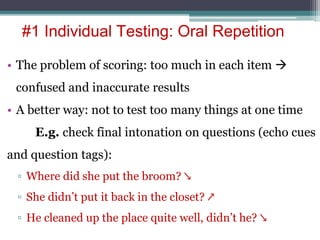
• The problem of scoring: too much in each item 
confused and inaccurate results
• A better way: not to test too many things at one time
E.g. check final intonation on questions (echo cues
and question tags):
▫ Where did she put the broom? ↘
▫ She didn’t put it back in the closet? ↗
▫ He cleaned up the place quite well, didn’t he? ↘
#1 Individual Testing: Oral Repetition
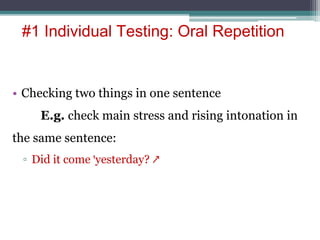
• Checking two things in one sentence
E.g. check main stress and rising intonation in
the same sentence:
▫ Did it come ꞌyesterday? ↗
#1 Individual Testing: Oral Repetition
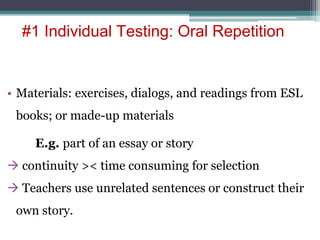
• Materials: exercises, dialogs, and readings from ESL
books; or made-up materials
E.g. part of an essay or story
 continuity >< time consuming for selection
 Teachers use unrelated sentences or construct their
own story.
#1 Individual Testing: Oral Repetition
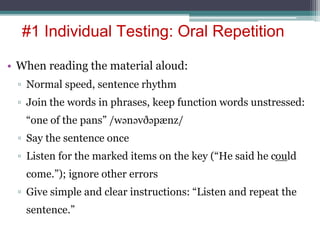
• When reading the material aloud:
▫ Normal speed, sentence rhythm
▫ Join the words in phrases, keep function words unstressed:
“one of the pans” /wənəvðəpænz/
▫ Say the sentence once
▫ Listen for the marked items on the key (“He said he could
come.”); ignore other errors
▫ Give simple and clear instructions: “Listen and repeat the
sentence.”
#1 Individual Testing: Oral Repetition
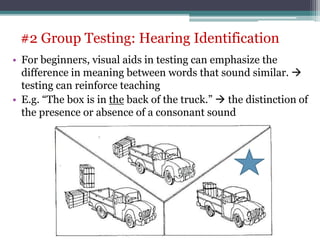
• For beginners, visual aids in testing can emphasize the
difference in meaning between words that sound similar. 
testing can reinforce teaching
• E.g. “The box is in the back of the truck.”  the distinction of
the presence or absence of a consonant sound
#2 Group Testing: Hearing Identification
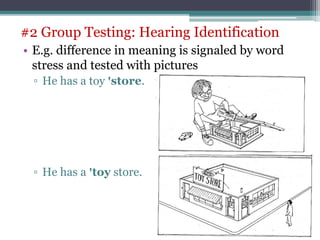
• E.g. difference in meaning is signaled by word
stress and tested with pictures
▫ He has a toy ꞌstore.
▫ He has a ꞌtoy store.
#2 Group Testing: Hearing Identification
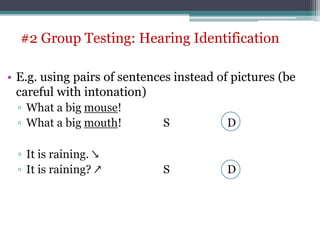
• E.g. using pairs of sentences instead of pictures (be
careful with intonation)
▫ What a big mouse!
▫ What a big mouth! S D
▫ It is raining. ↘
▫ It is raining? ↗ S D
#2 Group Testing: Hearing Identification
Limited-Response Items – Pros and Cons
Oral Repetition:
• Easy to prepare
• Good for students who
cannot read yet; do not
mix reading
comprehension and
pronunciation
• Can test all
pronunciation features
Oral Repetition:
• Can test English aptitude
as much as present skill
in pronouncing English
• Time consuming when
conducted individually
• A need for a native
speaker to model the
sentence
Limited-Response Items – Pros and Cons
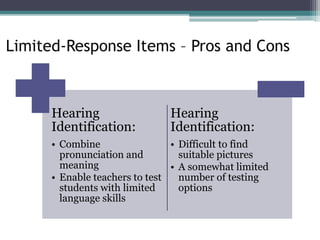
Hearing
Identification:
• Combine
pronunciation and
meaning
• Enable teachers to test
students with limited
language skills
Hearing
Identification:
• Difficult to find
suitable pictures
• A somewhat limited
number of testing
options
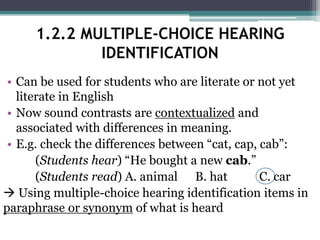
• Can be used for students who are literate or not yet
literate in English
• Now sound contrasts are contextualized and
associated with differences in meaning.
• E.g. check the differences between “cat, cap, cab”:
(Students hear) “He bought a new cab.”
(Students read) A. animal B. hat C. car
 Using multiple-choice hearing identification items in
paraphrase or synonym of what is heard
1.2.2 MULTIPLE-CHOICE HEARING
IDENTIFICATION
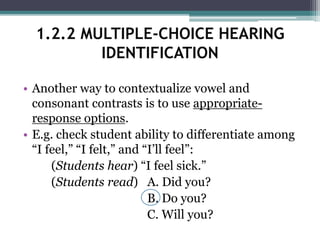
• Another way to contextualize vowel and
consonant contrasts is to use appropriate-
response options.
• E.g. check student ability to differentiate among
“I feel,” “I felt,” and “I’ll feel”:
(Students hear) “I feel sick.”
(Students read) A. Did you?
B. Do you?
C. Will you?
1.2.2 MULTIPLE-CHOICE HEARING
IDENTIFICATION
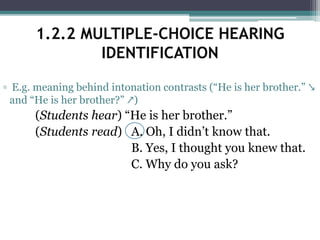
▫ E.g. meaning behind intonation contrasts (“He is her brother.” ↘
and “He is her brother?” ↗)
(Students hear) “He is her brother.”
(Students read) A. Oh, I didn’t know that.
B. Yes, I thought you knew that.
C. Why do you ask?
1.2.2 MULTIPLE-CHOICE HEARING
IDENTIFICATION
• A good way to contrastive stress is to use
multiple-choice paraphrase
• E.g. “ꞌJack just walked into the ꞌstore” can
express different meanings
(Students hear) “Jack just walked ꞌinto the
store.”
(Students read) A. It wasn’t Mary.
B. He didn’t run.
C. He didn’t walk out of it.
1.2.2 MULTIPLE-CHOICE HEARING
IDENTIFICATION
• E.g. using sentence completion (checking the
hid/ hit/ ’ll hit contrast)
(Students hear) “She hit the thief ...”
(Students read) A. in the face.
B. from the police.
C. tomorrow.
1.2.2 MULTIPLE-CHOICE HEARING
IDENTIFICATION
A helpful
combination
of
pronunciation
and meaning
Difficult to
prepare
suitable
distractors
MULTIPLE-CHOICE HEARING IDENTIFICATION
– PROS AND CONS
1.2.3 READING ALOUD
• Like Oral Repetition, this provides excellent control.
• One problem: the skill of reading aloud is different from
that of taking conversationally
• An ideal way to test mastery of sound-symbol
correspondence (e.g. “said” = /sed/, not /sayd/)
• 3 important points:
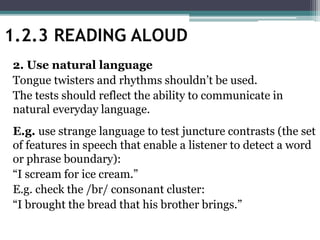
1. Evaluate one or two points per sentence
When checking too many things at the same time  difficult to
be accurate and consistent
E.g. check the pronunciation difference between “th” and “d”:
“My father feels quite bad about it.” (no underline in student’s
copy)
E.g. check the use of rising intonation: “Do you need any help?”
↗ (no intonation cue in student’s copy)
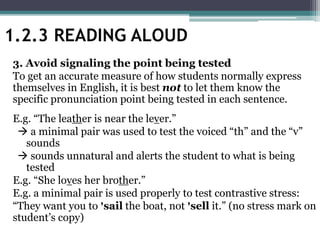
2. Use natural language
Tongue twisters and rhythms shouldn’t be used.
The tests should reflect the ability to communicate in
natural everyday language.
E.g. use strange language to test juncture contrasts (the set
of features in speech that enable a listener to detect a word
or phrase boundary):
“I scream for ice cream.”
E.g. check the /br/ consonant cluster:
“I brought the bread that his brother brings.”
1.2.3 READING ALOUD
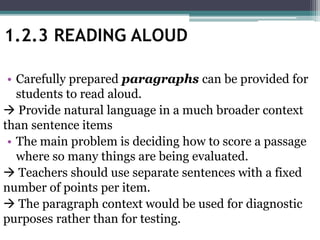
3. Avoid signaling the point being tested
To get an accurate measure of how students normally express
themselves in English, it is best not to let them know the
specific pronunciation point being tested in each sentence.
E.g. “The leather is near the lever.”
 a minimal pair was used to test the voiced “th” and the “v”
sounds
 sounds unnatural and alerts the student to what is being
tested
E.g. “She loves her brother.”
E.g. a minimal pair is used properly to test contrastive stress:
“They want you to ꞌsail the boat, not ꞌsell it.” (no stress mark on
student’s copy)
1.2.3 READING ALOUD
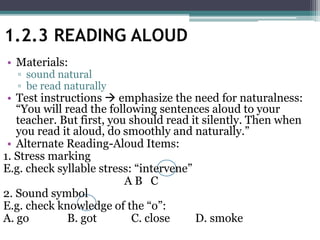
• Carefully prepared paragraphs can be provided for
students to read aloud.
 Provide natural language in a much broader context
than sentence items
• The main problem is deciding how to score a passage
where so many things are being evaluated.
 Teachers should use separate sentences with a fixed
number of points per item.
 The paragraph context would be used for diagnostic
purposes rather than for testing.
1.2.3 READING ALOUD
• Materials:
▫ sound natural
▫ be read naturally
• Test instructions  emphasize the need for naturalness:
“You will read the following sentences aloud to your
teacher. But first, you should read it silently. Then when
you read it aloud, do smoothly and naturally.”
• Alternate Reading-Aloud Items:
1. Stress marking
E.g. check syllable stress: “intervene”
A B C
2. Sound symbol
E.g. check knowledge of the “o”:
A. go B. got C. close D. smoke
1.2.3 READING ALOUD
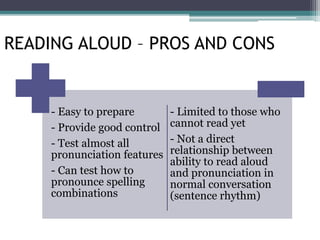
- Easy to prepare
- Provide good control
- Test almost all
pronunciation features
- Can test how to
pronounce spelling
combinations
- Limited to those who
cannot read yet
- Not a direct
relationship between
ability to read aloud
and pronunciation in
normal conversation
(sentence rhythm)
READING ALOUD – PROS AND CONS
2. TESTING GRAMMAR
A. TESTING LANGUAGE AREAS
2.1 WHY TEST GRAMMAR?
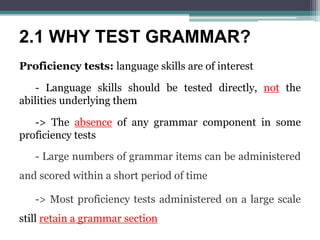
Proficiency tests: language skills are of interest
- Language skills should be tested directly, not the
abilities underlying them
-> The absence of any grammar component in some
proficiency tests
- Large numbers of grammar items can be administered
and scored within a short period of time
-> Most proficiency tests administered on a large scale
still retain a grammar section
2.1 WHY TEST GRAMMAR?
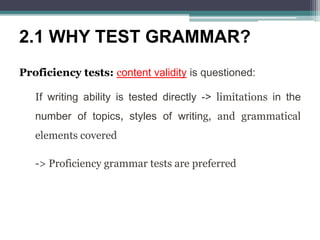
Proficiency tests: content validity is questioned:
If writing ability is tested directly -> limitations in the
number of topics, styles of writing, and grammatical
elements covered
-> Proficiency grammar tests are preferred
2.1 WHY TEST GRAMMAR?
Achievement tests: a grammar component should be
included
-> Not to give grammar component too much prominence
in relation to tests of skills which are the primary objectives
of language courses.
2.1 WHY TEST GRAMMAR?
Placement tests: knowledge of a student’s grammatical
ability is useful to place his/her in the most appropriate
class
Diagnostic tests: gaps in students’ grammatical
performance are discovered -> students can fill the gaps
=> Grammatical ability, or rather the lack of it, sets limits to
what can be achieved in the way of skills performance.
2.2 WRITING SPECIFICATIONS
Sampling
• Select widely from the structures specified to
give the test content validity
• Take into account of what are regarded as the
most important structures
• Don’t deliberately concentrate on the structure
that happen to be easiest to test
2.2 WRITING SPECIFICATIONS
Writing items
Whatever techniques are chosen, it is important for the text
of the item to be written grammatically correct and in
natural language.
Some techniques can be used for testing grammar: limited
response, multiple choice, simple completion, and cloze
procedure.
Limited response
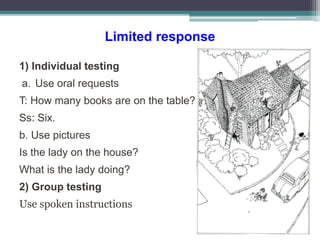
1) Individual testing
a. Use oral requests
T: How many books are on the table?
Ss: Six.
b. Use pictures
Is the lady on the house?
What is the lady doing?
2) Group testing
Use spoken instructions
Limited response
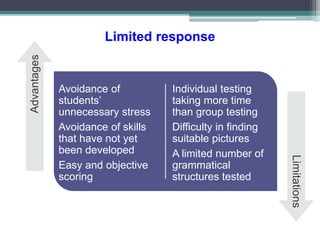
Avoidance of
students’
unnecessary stress
Avoidance of skills
that have not yet
been developed
Easy and objective
scoring
Individual testing
taking more time
than group testing
Difficulty in finding
suitable pictures
A limited number of
grammatical
structures tested
Advantages
Limitations
Simple completion
• Simple completion items consist of a sentence from
which a grammatical element has been removed.
E.g. I would have gone if he had invited me.
• Examinees may be asked to:
• Decide from the context what word or phrase to write in
the blank
• Write in an option from a list
• Change the form of a key word
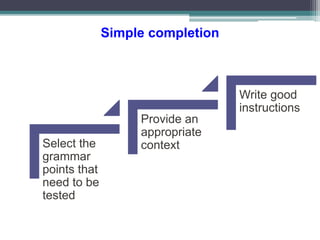
Simple completion
Select the
grammar
points that
need to be
tested
Provide an
appropriate
context
Write good
instructions
Simple completion
The three basic kinds of simple completion grammar tests
vary in difficulty and in objectivity and in the degree of
active or passive response that is required:
(1)The option form
(2)The inflection form
(3)The free-response form
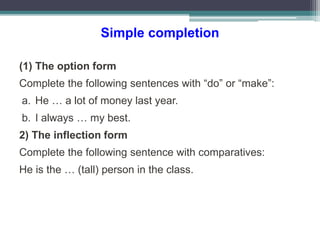
Simple completion
(1) The option form
Complete the following sentences with “do” or “make”:
a. He … a lot of money last year.
b. I always … my best.
2) The inflection form
Complete the following sentence with comparatives:
He is the … (tall) person in the class.
Simple completion
3) The Free-Response Form
Add a question tag to these sentences:
a. Hamlet was indecisive, …?
b. Nobody knew that problem,...?
Simple completion
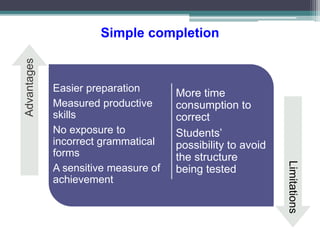
Easier preparation
Measured productive
skills
No exposure to
incorrect grammatical
forms
A sensitive measure of
achievement
More time
consumption to
correct
Students’
possibility to avoid
the structure
being tested
Advantages
Limitations
Multiple choice
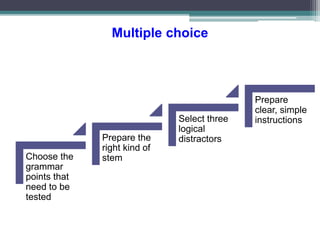
Choose the
grammar
points that
need to be
tested
Prepare the
right kind of
stem
Select three
logical
distractors
Prepare
clear, simple
instructions
Multiple choice
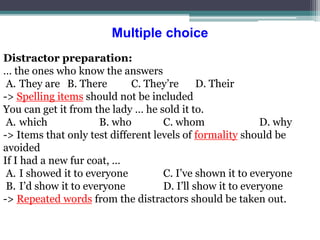
Distractor preparation:
… the ones who know the answers
A. They are B. There C. They’re D. Their
-> Spelling items should not be included
You can get it from the lady … he sold it to.
A. which B. who C. whom D. why
-> Items that only test different levels of formality should be
avoided
If I had a new fur coat, …
A. I showed it to everyone C. I’ve shown it to everyone
B. I’d show it to everyone D. I’ll show it to everyone
-> Repeated words from the distractors should be taken out.
Multiple choice
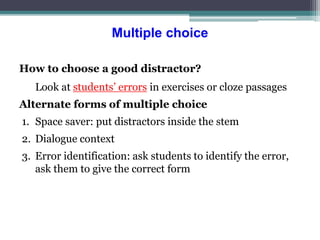
How to choose a good distractor?
Look at students’ errors in exercises or cloze passages
Alternate forms of multiple choice
1. Space saver: put distractors inside the stem
2. Dialogue context
3. Error identification: ask students to identify the error,
ask them to give the correct form
Multiple choice
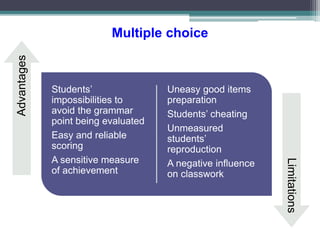
Students’
impossibilities to
avoid the grammar
point being evaluated
Easy and reliable
scoring
A sensitive measure
of achievement
Uneasy good items
preparation
Students’ cheating
Unmeasured
students’
reproduction
A negative influence
on classwork
Advantages
Limitations
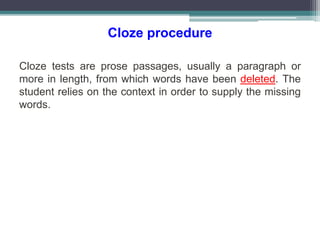
Cloze procedure
Cloze tests are prose passages, usually a paragraph or
more in length, from which words have been deleted. The
student relies on the context in order to supply the missing
words.
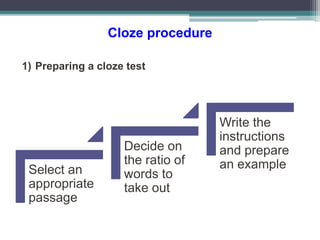
Cloze procedure
1) Preparing a cloze test
Select an
appropriate
passage
Decide on
the ratio of
words to
take out
Write the
instructions
and prepare
an example
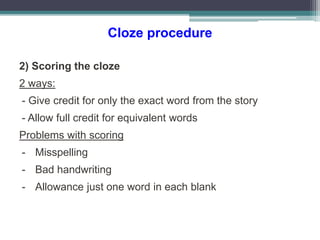
Cloze procedure
2) Scoring the cloze
2 ways:
- Give credit for only the exact word from the story
- Allow full credit for equivalent words
Problems with scoring
- Misspelling
- Bad handwriting
- Allowance just one word in each blank
Cloze procedure
3) Adapting the cloze to test grammar: Delete the
grammar item that has been studied
Remember:
- Don’t need to have exactly the same number of words
between each blank
- Don’t delete the same word too many times
WRITING SPECIFICATIONS
Scoring production grammar tests
• Be clear about what each item is testing, and award
points for that only
• Don’t subtract scores for errors in elements of grammar
which are not being tested by the item
• Assign points to each element that is being tested in an
item or just award if all elements are correct
-> To ensure scoring is valid and reliable, careful
preparation of the scoring key is necessary.
A. TESTING LANGUAGE AREAS
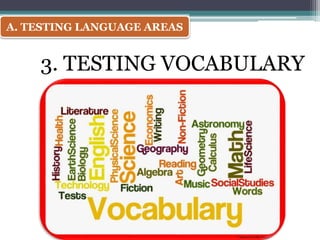
3. TESTING VOCABULARY
WHY TEST VOCABULARY?
Essential to the development and demonstration of linguistics skills
To measure the comprehension and production of words used in
speaking or writing
WHAT WORDS TO TEST?
Choosing difficult words or random lists of words doesn’t make
much sense
Based on the syllabus, textbook, reading materials or lexical errors in
students’ written works.
Michael West (1953): The General Service List (GSL)
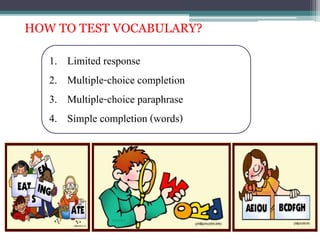
HOW TO TEST VOCABULARY?
1. Limited response
2. Multiple-choice completion
3. Multiple-choice paraphrase
4. Simple completion (words)
1. LIMITED RESPONSE
o For beginners
o To avoid language skills that haven’t been mastered yet
o Require either a simple physical action or a very simple
verbal answer
o For example:
• Is the book green? What color is the book?
• Please go to the window
• Draw a circle around the tree
- Less stress or nervousness
- Avoid language skills that
haven’t been mastered yet
- Be scored easily and
objectively
- Difficult to test abstract
words
- Ambiguous sketches
1. LIMITED RESPONSE
2. MULTIPLE-CHOICE COMPLETION
o Depend on context clue and sentence meaning
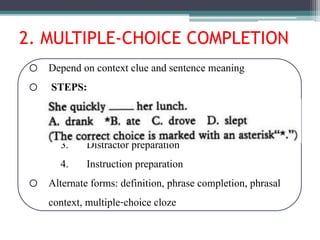
o STEPS:
1. Vocabulary choice
2. Context preparation
3. Distractor preparation
4. Instruction preparation
o Alternate forms: definition, phrase completion, phrasal
context, multiple-choice cloze
2. MULTIPLE-CHOICE COMPLETION
o STEPS:
1. Vocabulary choice
- Good way to test more difficult vocabulary items
- Only include content words (N, V, Adj, Adv)
- Be careful of bias (e.g. cultural bias or sex bias)
2. MULTIPLE-CHOICE COMPLETION
o STEPS:
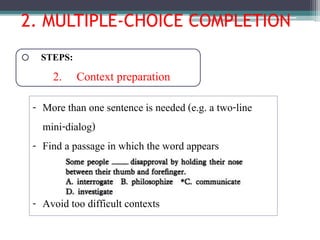
2. Context preparation
- More than one sentence is needed (e.g. a two-line
mini-dialog)
- Find a passage in which the word appears
- Avoid too difficult contexts
2. MULTIPLE-CHOICE COMPLETION
o STEPS:
3. Distractor preparation
- 2 ways:
• Teachers create their own distractors
• Teachers use students’ errors as distractors
(composition, speech, homework and classroom
exercises on vocabulary)
o STEPS:
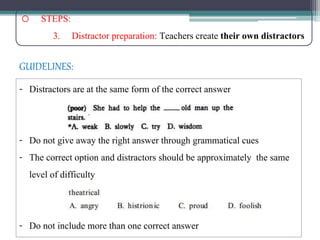
3. Distractor preparation: Teachers create their own distractors
- Distractors are at the same form of the correct answer
- Do not give away the right answer through grammatical cues
- The correct option and distractors should be approximately the same
level of difficulty
- Do not include more than one correct answer
GUIDELINES:
2. MULTIPLE-CHOICE COMPLETION
o STEPS:
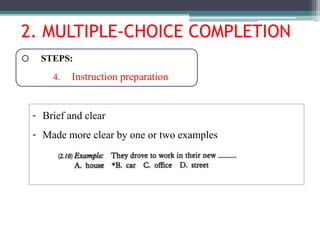
4. Instruction preparation
- Brief and clear
- Made more clear by one or two examples
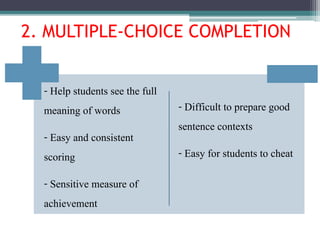
- Help students see the full
meaning of words
- Easy and consistent
scoring
- Sensitive measure of
achievement
- Difficult to prepare good
sentence contexts
- Easy for students to cheat
2. MULTIPLE-CHOICE COMPLETION
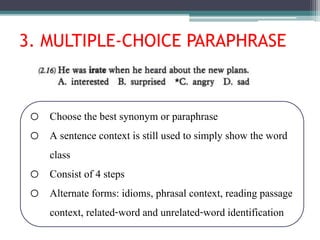
3. MULTIPLE-CHOICE PARAPHRASE
o Choose the best synonym or paraphrase
o A sentence context is still used to simply show the word
class
o Consist of 4 steps
o Alternate forms: idioms, phrasal context, reading passage
context, related-word and unrelated-word identification
3. MULTIPLE-CHOICE PARAPHRASE
o STEPS:
1 & 2. Vocabulary choice and Context preparation
4. Instruction preparation
- The meaning comes from the emphasized word than its
context  Less effort in preparing sentence contexts
 Follow the guidelines for multiple-choice completion
3. MULTIPLE-CHOICE PARAPHRASE
o STEPS:
3. Distractor preparation
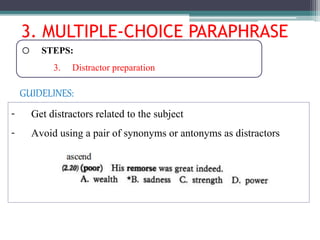
- Get distractors related to the subject
- Avoid using a pair of synonyms or antonyms as distractors
GUIDELINES:
3. MULTIPLE-CHOICE PARAPHRASE
o STEPS:
3. Distractor preparation
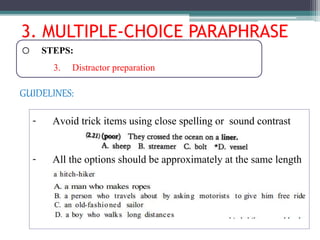
- Avoid trick items using close spelling or sound contrast
- All the options should be approximately at the same length
GUIDELINES:
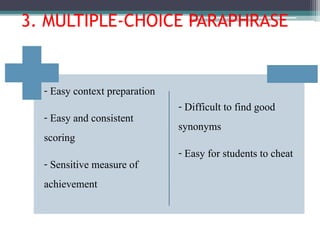
- Easy context preparation
- Easy and consistent
scoring
- Sensitive measure of
achievement
- Difficult to find good
synonyms
- Easy for students to cheat
3. MULTIPLE-CHOICE PARAPHRASE
4. SIMPLE COMPLETION (WORDS)
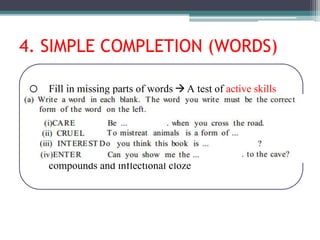
o Fill in missing parts of words A test of active skills
o Emphasize on word building
o Consist of 3 steps, no distractor preparation
o Alternate forms: stem-first procedure, phrasal context,
compounds and inflectional cloze
o STEPS:
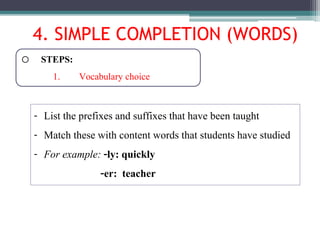
1. Vocabulary choice
- List the prefixes and suffixes that have been taught
- Match these with content words that students have studied
- For example: -ly: quickly
-er: teacher
4. SIMPLE COMPLETION (WORDS)
o STEPS:
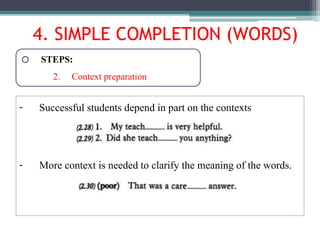
2. Context preparation
- Successful students depend in part on the contexts
- More context is needed to clarify the meaning of the words.
4. SIMPLE COMPLETION (WORDS)
o STEPS:
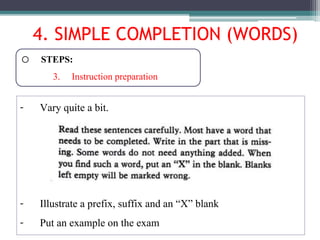
3. Instruction preparation
- Vary quite a bit.
- Illustrate a prefix, suffix and an “X” blank
- Put an example on the exam
4. SIMPLE COMPLETION (WORDS)
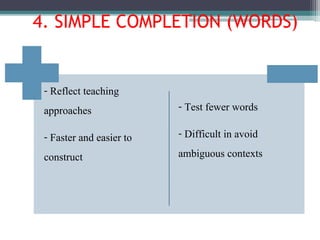
- Reflect teaching
approaches
- Faster and easier to
construct
- Test fewer words
- Difficult in avoid
ambiguous contexts
4. SIMPLE COMPLETION (WORDS)
1. TESTING LISTENING
1.1 LIMITED RESPONSE
1.2 MULTIPLE-CHOICE APPROPRIATE RESPONSE
1.3 TESTING EXTENDED COMMUNICATION
B. TESTING LANGUAGE SKILLS
1.1 LIMITED RESPONSE
1.1.1 Native-Language Responses
1.1.2 Picture Cues
1.1.3 Task Responses
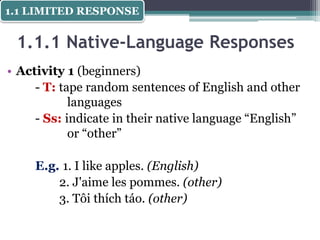
1.1.1 Native-Language Responses
• Activity 1 (beginners)
- T: tape random sentences of English and other
languages
- Ss: indicate in their native language “English”
or “other”
E.g. 1. I like apples. (English)
2. J'aime les pommes. (other)
3. Tôi thích táo. (other)
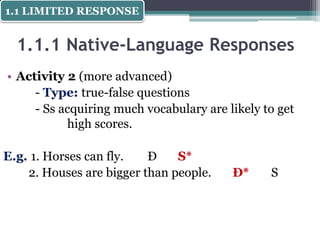
1.1 LIMITED RESPONSE
1.1.1 Native-Language Responses
• Activity 2 (more advanced)
- Type: true-false questions
- Ss acquiring much vocabulary are likely to get
high scores.
E.g. 1. Horses can fly. Đ S*
2. Houses are bigger than people. Đ* S
1.1 LIMITED RESPONSE
1.1.1 Native-Language Responses
• Activity 3 (more advanced)
- Type: single utterances, dialogs, longer material
- Ss: answer in their native language.
E.g. 1. How far is it to New York?
A. Không xa lắm.
B. Phía Nam của Boston.
C. Khoảng 200 km.
1.1 LIMITED RESPONSE
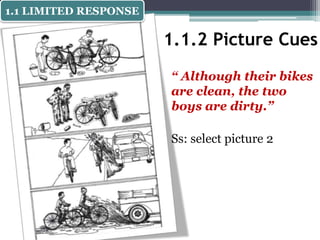
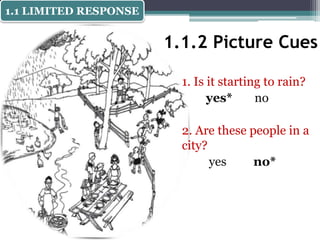
1.1.2 Picture Cues
“ Although their bikes
are clean, the two
boys are dirty.”
Ss: select picture 2
1.1 LIMITED RESPONSE
1.1.2 Picture Cues
1. Is it starting to rain?
yes* no
2. Are these people in a
city?
yes no*
1.1 LIMITED RESPONSE
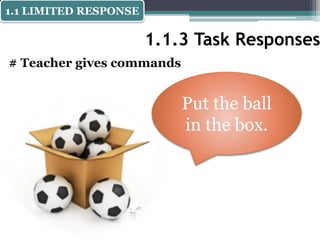
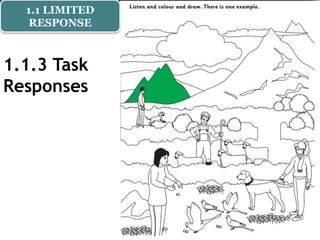
1.1.3 Task Responses
# Teacher gives commands
Put the ball
in the box.
1.1 LIMITED RESPONSE
1.1.3 Task
Responses
1.1 LIMITED
RESPONSE
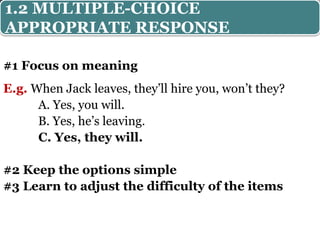
#1 Focus on meaning
E.g. When Jack leaves, they’ll hire you, won’t they?
A. Yes, you will.
B. Yes, he’s leaving.
C. Yes, they will.
#2 Keep the options simple
#3 Learn to adjust the difficulty of the items
1.2 MULTIPLE-CHOICE
APPROPRIATE RESPONSE
3.1 Short lecture contexts
- 3 or 4 brief lectures > 1 long lecture
- Ss should be told to take notes.
3.2 Social/Business contexts
- It should not be too difficult to understand.
- T should not ask Ss to take notes (it is not
authentic).
1.3 TESTING EXTENDED
COMMUNICATION
2. TESTING SPEAKING
B. TESTING LANGUAGE SKILLS
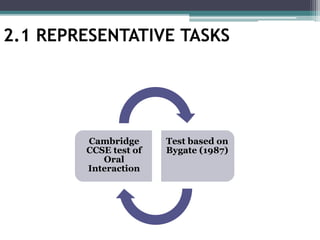
2.1 REPRESENTATIVE TASKS
Cambridge
CCSE test of
Oral
Interaction
Test based on
Bygate (1987)
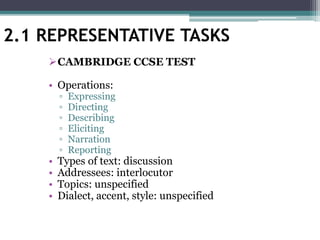
CAMBRIDGE CCSE TEST
• Operations:
▫ Expressing
▫ Directing
▫ Describing
▫ Eliciting
▫ Narration
▫ Reporting
• Types of text: discussion
• Addressees: interlocutor
• Topics: unspecified
• Dialect, accent, style: unspecified
2.1 REPRESENTATIVE TASKS
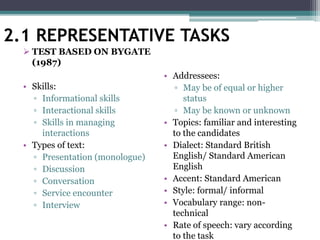
 TEST BASED ON BYGATE
(1987)
• Skills:
▫ Informational skills
▫ Interactional skills
▫ Skills in managing
interactions
• Types of text:
▫ Presentation (monologue)
▫ Discussion
▫ Conversation
▫ Service encounter
▫ Interview
• Addressees:
▫ May be of equal or higher
status
▫ May be known or unknown
• Topics: familiar and interesting
to the candidates
• Dialect: Standard British
English/ Standard American
English
• Accent: Standard American
• Style: formal/ informal
• Vocabulary range: non-
technical
• Rate of speech: vary according
to the task
2.1 REPRESENTATIVE TASKS
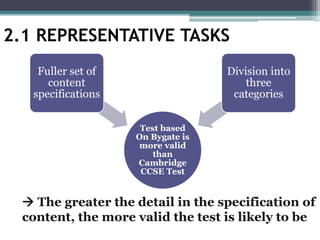
Test based
On Bygate is
more valid
than
Cambridge
CCSE Test
Fuller set of
content
specifications
Division into
three
categories
 The greater the detail in the specification of
content, the more valid the test is likely to be
2.1 REPRESENTATIVE TASKS
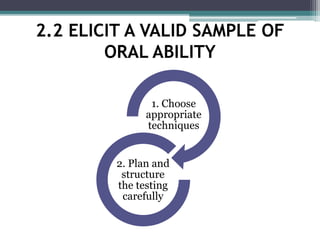
2.2 ELICIT A VALID SAMPLE OF
ORAL ABILITY
1. Choose
appropriate
techniques
2. Plan and
structure
the testing
carefully
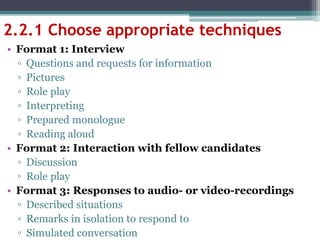
2.2.1 Choose appropriate techniques
• Format 1: Interview
▫ Questions and requests for information
▫ Pictures
▫ Role play
▫ Interpreting
▫ Prepared monologue
▫ Reading aloud
• Format 2: Interaction with fellow candidates
▫ Discussion
▫ Role play
• Format 3: Responses to audio- or video-recordings
▫ Described situations
▫ Remarks in isolation to respond to
▫ Simulated conversation
2.2.2 Plan and structure the testing
carefully
Make the oral test as long as is feasible
Plan the test carefully
Give the candidate as many “fresh start” as
possible
Use a second tester for interviews
Set tasks and topics causing no difficulty in the
candidate’s own language
Carry out the interview in a quiet room with
good acoustics
Put candidates at ease
Collect enough relevant information
Do not talk too much
Select interviewers carefully and train them
2.2.2 Plan and structure the testing
carefully
2.3 ENSURE VALID AND RELIABLE
SCORING
Create appropriate scales for scoring
Rating scales may be holistic or analytic.
• The ratings are weighted and totaled based on
weighting table holistic scoring
• The resultant scores are looked up in a conversion
table  analytic scoring
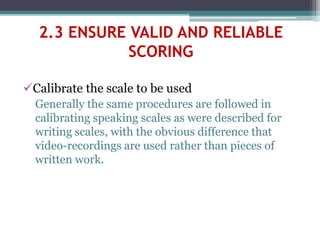
Scales for scoring speaking ability
▫ Accuracy
▫ Appropriateness
▫ Flexibility
▫ Range
▫ Size
▫ Accent
▫ Grammar
▫ Vocabulary
▫ Fluency
▫ Comprehension
Calibrate the scale to be used
Generally the same procedures are followed in
calibrating speaking scales as were described for
writing scales, with the obvious difference that
video-recordings are used rather than pieces of
written work.
2.3 ENSURE VALID AND RELIABLE
SCORING
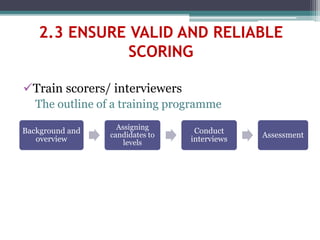
Train scorers/ interviewers
The outline of a training programme
Background and
overview
Assigning
candidates to
levels
Conduct
interviews
Assessment
2.3 ENSURE VALID AND RELIABLE
SCORING
Follow acceptable scoring procedures
Great care must be taken to ignore personal
qualities of the candidates that are irrelevant to an
assessment of their language ability
2.3 ENSURE VALID AND RELIABLE
SCORING
3. TESTING READING
3.1 Limited response
3.2 Testing sentence comprehension
3.3 Testing passage comprehension
B. TESTING LANGUAGE SKILLS
3.1.1 Purpose: to check students’ ability
to tell the difference between words that
look very similar to each other
3.1 LIMITED RESPONSE
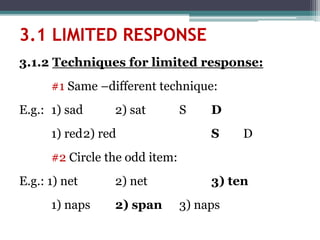
3.1.2 Techniques for limited response:
#1 Same –different technique:
E.g.: 1) sad 2) sat S D
1) red2) red S D
#2 Circle the odd item:
E.g.: 1) net 2) net 3) ten
1) naps 2) span 3) naps
3.1 LIMITED RESPONSE
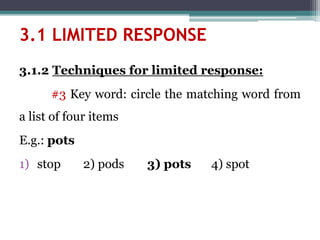
3.1.2 Techniques for limited response:
#3 Key word: circle the matching word from
a list of four items
E.g.: pots
1) stop 2) pods 3) pots 4) spot
3.1 LIMITED RESPONSE
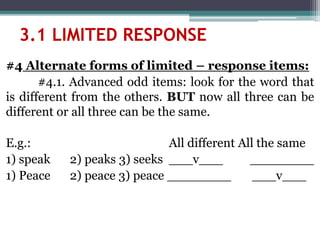
#4 Alternate forms of limited – response items:
#4.1. Advanced odd items: look for the word that
is different from the others. BUT now all three can be
different or all three can be the same.
E.g.: All different All the same
1) speak 2) peaks 3) seeks ___v___ ________
1) Peace 2) peace 3) peace ________ ___v___
3.1 LIMITED RESPONSE
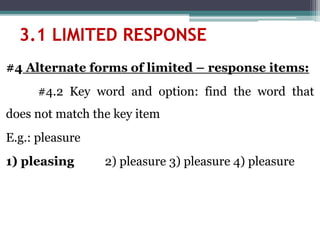
#4 Alternate forms of limited – response items:
#4.2 Key word and option: find the word that
does not match the key item
E.g.: pleasure
1) pleasing 2) pleasure 3) pleasure 4) pleasure
3.1 LIMITED RESPONSE
- Be easy to construct
and score
- Require only the
recognition of letters
 simple task for
beginning students
- Be not an
integrative skill
involving actual
reading
- Reduce of reading
speed
3.1 LIMITED RESPONSE
3.2 TESTING SENTENCE IN COMPREHENSION
3.2.1 Purpose: to check vocabulary, grammar and
sometimes even social appropriateness all the same
time
3.2.2 Technique of testing sentence in
comprehension
#1 Elicitation techniques
#2 Picture cues
3.2 TESTING SENTENCE IN COMPREHENSION
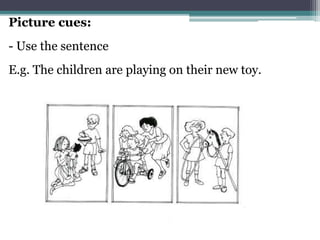
Picture cues:
- Use the sentence
E.g. The children are playing on their new toy.
Picture cues:
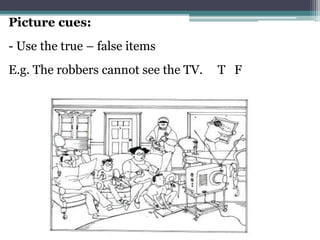
- Use the true – false items
E.g. The robbers cannot see the TV. T F
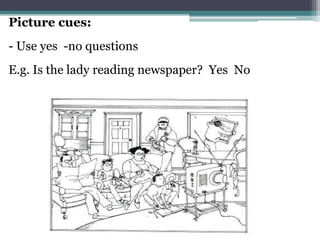
Picture cues:
- Use yes -no questions
E.g. Is the lady reading newspaper? Yes No
- Be easy to write true –
false items on pictures
- Be good for testing the
skills of near beginning
students
- Be a rapid way to test
reading comprehension
- Be time –
consuming when
choosing good
pictures
- Not cover all
reading skills
3.2 TESTING SENTENCE COMPREHENSION
3.3.1 Context selection
- Depend on what kind of reading matter teachers
have used with their students
- Sources: articles, stories, advertisements…
3.3.2 Question techniques for beginners
- Use true – false items
- Use matching technique
3.3 TESTING PASSAGE COMPREHENSION
3.3.3 Question techniques for more advanced students
#1 Standard multiple – choice:
+ Selections for less advanced students will run from
about 100 – 200 words
+ More advanced students will range from 150 – 300
words
+ Types of question
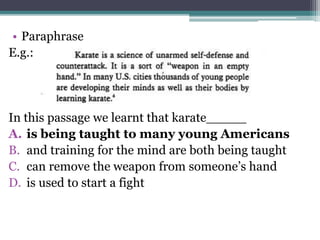
• Paraphrase
3.3 TESTING PASSAGE COMPREHENSION
• Paraphrase
E.g.:
In this passage we learnt that karate_____
A. is being taught to many young Americans
B. and training for the mind are both being taught
C. can remove the weapon from someone’s hand
D. is used to start a fight
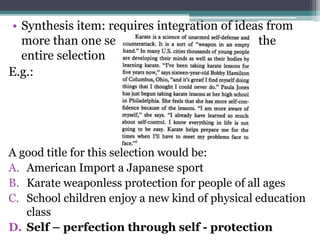
• Synthesis item: requires integration of ideas from
more than one sentence – sometimes from the
entire selection
E.g.:
A good title for this selection would be:
A. American Import a Japanese sport
B. Karate weaponless protection for people of all ages
C. School children enjoy a new kind of physical education
class
D. Self – perfection through self - protection
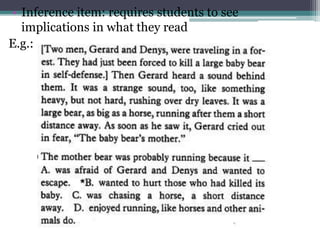
• Inference item: requires students to see
implications in what they read
E.g.:
3.3.3 Question techniques for more advanced students
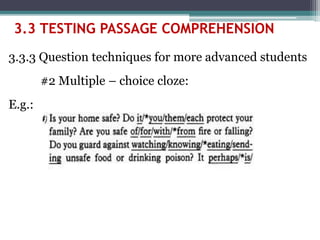
#2 Multiple – choice cloze:
E.g.:
3.3 TESTING PASSAGE COMPREHENSION
- Be objective and
easy to score
- Be the most
integrative type of
reading test
- Can evaluate
students at every
level of reading
development
- Be time consuming
to take than other
kinds of tests
- Utilize questions
that deal with trivial
details
- Use questions on
trivial details
 Encourage word –
by – word reading
3.3 TESTING PASSAGE COMPREHENSION
4. TESTING WRITING
4.1 Limited response
4.2 Guided writing
4.3 Free writing
4.1.1 Purpose: to check vocabulary, grammar
4.1.2 Techniques:
#1 Sentence combining
- Adding a connective: demonstrate the
understanding of what various connective mean
E.g.: He likes ice cream but he won’t eat any.
- Combining sentences: ask students to make
internal changes in the grammar
E.g.: Some people come late. They will not get good
seats
 People that come late will not get good seats.
4.1 LIMITED RESPONSE
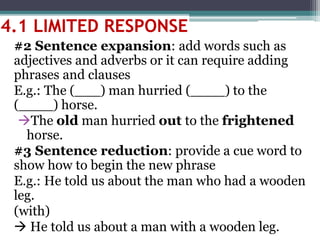
#2 Sentence expansion: add words such as
adjectives and adverbs or it can require adding
phrases and clauses
E.g.: The (___) man hurried (____) to the
(____) horse.
The old man hurried out to the frightened
horse.
#3 Sentence reduction: provide a cue word to
show how to begin the new phrase
E.g.: He told us about the man who had a wooden
leg.
(with)
 He told us about a man with a wooden leg.
4.1 LIMITED RESPONSE
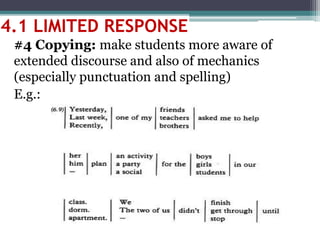
#4 Copying: make students more aware of
extended discourse and also of mechanics
(especially punctuation and spelling)
E.g.:
4.1 LIMITED RESPONSE
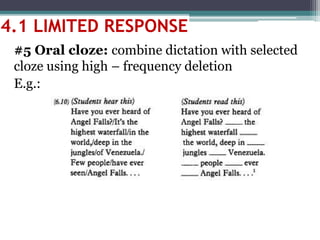
#5 Oral cloze: combine dictation with selected
cloze using high – frequency deletion
E.g.:
4.1 LIMITED RESPONSE
- Be easy to construct
- Be suitable for
students with limited
ability in English
- Be rather objective
for a writing –
related task
-Not measure actual
writing skill
- Be rather slow to
correct – especially
the open – ended
variety
4.1 LIMITED RESPONSE
4.2 GUIDED WRITING
4.2.1 Purpose: to check student ability to handle
controlled or directed writing tasks
4.2.2 Techniques:
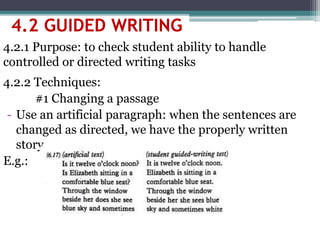
#1 Changing a passage
- Use an artificial paragraph: when the sentences are
changed as directed, we have the properly written
story
E.g.:
#1 Changing a passage
- Use passive sentences
E.g.: The broken typewriter was fixed.
Anwar fixed the broken typewriter.
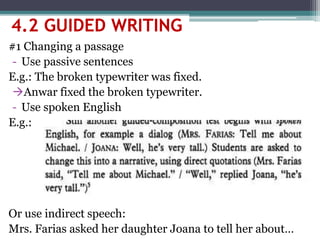
- Use spoken English
E.g.:
Or use indirect speech:
Mrs. Farias asked her daughter Joana to tell her about…
4.2 GUIDED WRITING
#1 Changing a passage:
- Use a specific grammatical change
E.g.: change the passage from the singular form to the
plural form or from the present continuous to the
past…
4.2 GUIDED WRITING
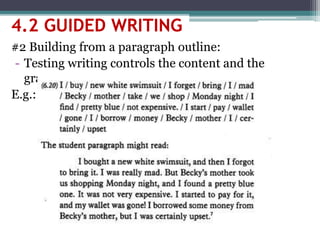
#2 Building from a paragraph outline:
- Testing writing controls the content and the
grammar
E.g.:
4.2 GUIDED WRITING
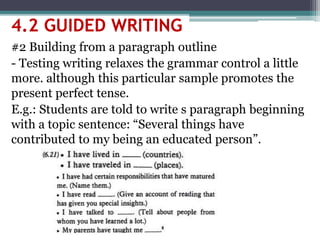
#2 Building from a paragraph outline
- Testing writing relaxes the grammar control a little
more. although this particular sample promotes the
present perfect tense.
E.g.: Students are told to write s paragraph beginning
with a topic sentence: “Several things have
contributed to my being an educated person”.
4.2 GUIDED WRITING
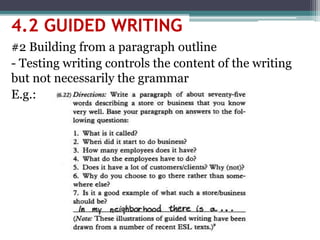
#2 Building from a paragraph outline
- Testing writing controls the content of the writing
but not necessarily the grammar
E.g.:
4.2 GUIDED WRITING
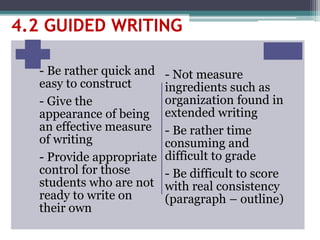
- Be rather quick and
easy to construct
- Give the
appearance of being
an effective measure
of writing
- Provide appropriate
control for those
students who are not
ready to write on
their own
- Not measure
ingredients such as
organization found in
extended writing
- Be rather time
consuming and
difficult to grade
- Be difficult to score
with real consistency
(paragraph – outline)
4.2 GUIDED WRITING
4.3 FREE WRITING
4.3.1 Purpose: evaluate the effectiveness of the total
composition including sentence – level accuracy,
larger rhetorical matters such as unity, coherence and
organization as well as effectiveness in conveying ideas
to the intended audience - including socially
appropriate language and appropriate selection of
supporting details.
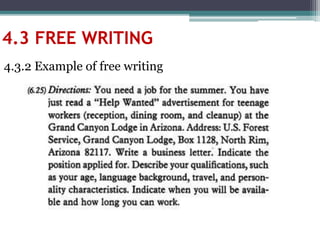
4.3.2 Example of free writing
4.3 FREE WRITING
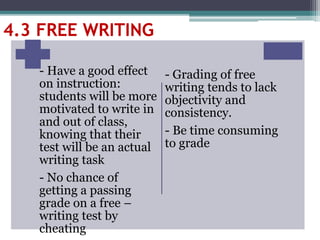
- Have a good effect
on instruction:
students will be more
motivated to write in
and out of class,
knowing that their
test will be an actual
writing task
- No chance of
getting a passing
grade on a free –
writing test by
cheating
- Grading of free
writing tends to lack
objectivity and
consistency.
- Be time consuming
to grade
4.3 FREE WRITING
4.4 EVALUATING WRITING
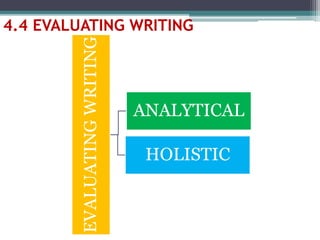
EVALUATINGWRITING
ANALYTICAL
HOLISTIC
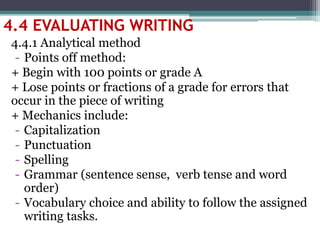
4.4.1 Analytical method
- Points off method:
+ Begin with 100 points or grade A
+ Lose points or fractions of a grade for errors that
occur in the piece of writing
+ Mechanics include:
- Capitalization
- Punctuation
- Spelling
- Grammar (sentence sense, verb tense and word
order)
- Vocabulary choice and ability to follow the assigned
writing tasks.
4.4 EVALUATING WRITING
4.4.1 Analytical method
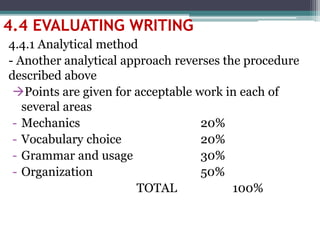
- Another analytical approach reverses the procedure
described above
Points are given for acceptable work in each of
several areas
- Mechanics 20%
- Vocabulary choice 20%
- Grammar and usage 30%
- Organization 50%
TOTAL 100%
4.4 EVALUATING WRITING
4.4.2 Holistic method
- Be one of the best way to evaluate the complex
communicative act of writing
4.4 EVALUATING WRITING

Testing language areas and skills

  • 1.
    Group 2 Khánh MinhThanh Thư Hoài Phương Bạch Vân Phương Thành Thảo Vy
  • 2.
    OUTLINE A. Testing LanguageAreas • Pronunciation • Grammar • Vocabulary B. Testing Language Skills • Listening • Speaking • Reading • Writing
  • 3.
    1. TESTING PRONUNCIATION 1.1Pronunciation Tests 1.2 Types of Pronunciation Tests A. TESTING LANGUAGE AREAS
  • 4.
    1.1 Pronunciation Tests •Ways of evaluating students’ ▫ production ▫ and identification of the sounds, stress patterns, and intonation of English • Today’s pronunciation items  incorporate context and meaning  can be useful • Pronunciation items are not effective in measuring real communication  measure progress made on specific points of pronunciation.
  • 5.
    • On aspeaking test, pronunciation becomes important when it interferes with communication. • E.g. faulty stress results in miscommunication She wants the blue ꞌpen, not the red ꞌone. She wants the ꞌblue pen, not the ꞌred one. 1.1 Pronunciation Tests
  • 6.
    1.2 Types ofPronunciation Tests 1.2.1 Limited Response 1.2.2Multiple Choice Hearing Identification 1.2.3 Reading Aloud
  • 7.
    1.2.1 LIMITED RESPONSE •Providing ways for testing beginning students • 2 ways: #1 Individual Testing: Oral Repetition #2 Group Testing: Hearing Identification
  • 8.
    #1 Individual Testing:Oral Repetition • For students who cannot read or write • Students simply listen and repeat. • One of the easiest of all exams • No distractors, clever sentence frames, or drawings needed • Every pronunciation feature can be tested. E.g. “Did you say I stole the meat?”  key vowels, diphthongs, consonants, vowel reduction, word linking, assimilation, consonant clusters, pitch, intonation, stress or rhythm.
  • 9.
    • The problemof scoring: too much in each item  confused and inaccurate results • A better way: not to test too many things at one time E.g. check final intonation on questions (echo cues and question tags): ▫ Where did she put the broom? ↘ ▫ She didn’t put it back in the closet? ↗ ▫ He cleaned up the place quite well, didn’t he? ↘ #1 Individual Testing: Oral Repetition
  • 10.
    • Checking twothings in one sentence E.g. check main stress and rising intonation in the same sentence: ▫ Did it come ꞌyesterday? ↗ #1 Individual Testing: Oral Repetition
  • 11.
    • Materials: exercises,dialogs, and readings from ESL books; or made-up materials E.g. part of an essay or story  continuity >< time consuming for selection  Teachers use unrelated sentences or construct their own story. #1 Individual Testing: Oral Repetition
  • 12.
    • When readingthe material aloud: ▫ Normal speed, sentence rhythm ▫ Join the words in phrases, keep function words unstressed: “one of the pans” /wənəvðəpænz/ ▫ Say the sentence once ▫ Listen for the marked items on the key (“He said he could come.”); ignore other errors ▫ Give simple and clear instructions: “Listen and repeat the sentence.” #1 Individual Testing: Oral Repetition
  • 13.
    • For beginners,visual aids in testing can emphasize the difference in meaning between words that sound similar.  testing can reinforce teaching • E.g. “The box is in the back of the truck.”  the distinction of the presence or absence of a consonant sound #2 Group Testing: Hearing Identification
  • 14.
    • E.g. differencein meaning is signaled by word stress and tested with pictures ▫ He has a toy ꞌstore. ▫ He has a ꞌtoy store. #2 Group Testing: Hearing Identification
  • 15.
    • E.g. usingpairs of sentences instead of pictures (be careful with intonation) ▫ What a big mouse! ▫ What a big mouth! S D ▫ It is raining. ↘ ▫ It is raining? ↗ S D #2 Group Testing: Hearing Identification
  • 16.
    Limited-Response Items –Pros and Cons Oral Repetition: • Easy to prepare • Good for students who cannot read yet; do not mix reading comprehension and pronunciation • Can test all pronunciation features Oral Repetition: • Can test English aptitude as much as present skill in pronouncing English • Time consuming when conducted individually • A need for a native speaker to model the sentence
  • 17.
    Limited-Response Items –Pros and Cons Hearing Identification: • Combine pronunciation and meaning • Enable teachers to test students with limited language skills Hearing Identification: • Difficult to find suitable pictures • A somewhat limited number of testing options
  • 18.
    • Can beused for students who are literate or not yet literate in English • Now sound contrasts are contextualized and associated with differences in meaning. • E.g. check the differences between “cat, cap, cab”: (Students hear) “He bought a new cab.” (Students read) A. animal B. hat C. car  Using multiple-choice hearing identification items in paraphrase or synonym of what is heard 1.2.2 MULTIPLE-CHOICE HEARING IDENTIFICATION
  • 19.
    • Another wayto contextualize vowel and consonant contrasts is to use appropriate- response options. • E.g. check student ability to differentiate among “I feel,” “I felt,” and “I’ll feel”: (Students hear) “I feel sick.” (Students read) A. Did you? B. Do you? C. Will you? 1.2.2 MULTIPLE-CHOICE HEARING IDENTIFICATION
  • 20.
    ▫ E.g. meaningbehind intonation contrasts (“He is her brother.” ↘ and “He is her brother?” ↗) (Students hear) “He is her brother.” (Students read) A. Oh, I didn’t know that. B. Yes, I thought you knew that. C. Why do you ask? 1.2.2 MULTIPLE-CHOICE HEARING IDENTIFICATION
  • 21.
    • A goodway to contrastive stress is to use multiple-choice paraphrase • E.g. “ꞌJack just walked into the ꞌstore” can express different meanings (Students hear) “Jack just walked ꞌinto the store.” (Students read) A. It wasn’t Mary. B. He didn’t run. C. He didn’t walk out of it. 1.2.2 MULTIPLE-CHOICE HEARING IDENTIFICATION
  • 22.
    • E.g. usingsentence completion (checking the hid/ hit/ ’ll hit contrast) (Students hear) “She hit the thief ...” (Students read) A. in the face. B. from the police. C. tomorrow. 1.2.2 MULTIPLE-CHOICE HEARING IDENTIFICATION
  • 23.
    A helpful combination of pronunciation and meaning Difficultto prepare suitable distractors MULTIPLE-CHOICE HEARING IDENTIFICATION – PROS AND CONS
  • 24.
    1.2.3 READING ALOUD •Like Oral Repetition, this provides excellent control. • One problem: the skill of reading aloud is different from that of taking conversationally • An ideal way to test mastery of sound-symbol correspondence (e.g. “said” = /sed/, not /sayd/) • 3 important points: 1. Evaluate one or two points per sentence When checking too many things at the same time  difficult to be accurate and consistent E.g. check the pronunciation difference between “th” and “d”: “My father feels quite bad about it.” (no underline in student’s copy) E.g. check the use of rising intonation: “Do you need any help?” ↗ (no intonation cue in student’s copy)
  • 25.
    2. Use naturallanguage Tongue twisters and rhythms shouldn’t be used. The tests should reflect the ability to communicate in natural everyday language. E.g. use strange language to test juncture contrasts (the set of features in speech that enable a listener to detect a word or phrase boundary): “I scream for ice cream.” E.g. check the /br/ consonant cluster: “I brought the bread that his brother brings.” 1.2.3 READING ALOUD
  • 26.
    3. Avoid signalingthe point being tested To get an accurate measure of how students normally express themselves in English, it is best not to let them know the specific pronunciation point being tested in each sentence. E.g. “The leather is near the lever.”  a minimal pair was used to test the voiced “th” and the “v” sounds  sounds unnatural and alerts the student to what is being tested E.g. “She loves her brother.” E.g. a minimal pair is used properly to test contrastive stress: “They want you to ꞌsail the boat, not ꞌsell it.” (no stress mark on student’s copy) 1.2.3 READING ALOUD
  • 27.
    • Carefully preparedparagraphs can be provided for students to read aloud.  Provide natural language in a much broader context than sentence items • The main problem is deciding how to score a passage where so many things are being evaluated.  Teachers should use separate sentences with a fixed number of points per item.  The paragraph context would be used for diagnostic purposes rather than for testing. 1.2.3 READING ALOUD
  • 28.
    • Materials: ▫ soundnatural ▫ be read naturally • Test instructions  emphasize the need for naturalness: “You will read the following sentences aloud to your teacher. But first, you should read it silently. Then when you read it aloud, do smoothly and naturally.” • Alternate Reading-Aloud Items: 1. Stress marking E.g. check syllable stress: “intervene” A B C 2. Sound symbol E.g. check knowledge of the “o”: A. go B. got C. close D. smoke 1.2.3 READING ALOUD
  • 29.
    - Easy toprepare - Provide good control - Test almost all pronunciation features - Can test how to pronounce spelling combinations - Limited to those who cannot read yet - Not a direct relationship between ability to read aloud and pronunciation in normal conversation (sentence rhythm) READING ALOUD – PROS AND CONS
  • 30.
    2. TESTING GRAMMAR A.TESTING LANGUAGE AREAS
  • 31.
    2.1 WHY TESTGRAMMAR? Proficiency tests: language skills are of interest - Language skills should be tested directly, not the abilities underlying them -> The absence of any grammar component in some proficiency tests - Large numbers of grammar items can be administered and scored within a short period of time -> Most proficiency tests administered on a large scale still retain a grammar section
  • 32.
    2.1 WHY TESTGRAMMAR? Proficiency tests: content validity is questioned: If writing ability is tested directly -> limitations in the number of topics, styles of writing, and grammatical elements covered -> Proficiency grammar tests are preferred
  • 33.
    2.1 WHY TESTGRAMMAR? Achievement tests: a grammar component should be included -> Not to give grammar component too much prominence in relation to tests of skills which are the primary objectives of language courses.
  • 34.
    2.1 WHY TESTGRAMMAR? Placement tests: knowledge of a student’s grammatical ability is useful to place his/her in the most appropriate class Diagnostic tests: gaps in students’ grammatical performance are discovered -> students can fill the gaps => Grammatical ability, or rather the lack of it, sets limits to what can be achieved in the way of skills performance.
  • 35.
    2.2 WRITING SPECIFICATIONS Sampling •Select widely from the structures specified to give the test content validity • Take into account of what are regarded as the most important structures • Don’t deliberately concentrate on the structure that happen to be easiest to test
  • 36.
    2.2 WRITING SPECIFICATIONS Writingitems Whatever techniques are chosen, it is important for the text of the item to be written grammatically correct and in natural language. Some techniques can be used for testing grammar: limited response, multiple choice, simple completion, and cloze procedure.
  • 37.
    Limited response 1) Individualtesting a. Use oral requests T: How many books are on the table? Ss: Six. b. Use pictures Is the lady on the house? What is the lady doing? 2) Group testing Use spoken instructions
  • 38.
    Limited response Avoidance of students’ unnecessarystress Avoidance of skills that have not yet been developed Easy and objective scoring Individual testing taking more time than group testing Difficulty in finding suitable pictures A limited number of grammatical structures tested Advantages Limitations
  • 39.
    Simple completion • Simplecompletion items consist of a sentence from which a grammatical element has been removed. E.g. I would have gone if he had invited me. • Examinees may be asked to: • Decide from the context what word or phrase to write in the blank • Write in an option from a list • Change the form of a key word
  • 40.
    Simple completion Select the grammar pointsthat need to be tested Provide an appropriate context Write good instructions
  • 41.
    Simple completion The threebasic kinds of simple completion grammar tests vary in difficulty and in objectivity and in the degree of active or passive response that is required: (1)The option form (2)The inflection form (3)The free-response form
  • 42.
    Simple completion (1) Theoption form Complete the following sentences with “do” or “make”: a. He … a lot of money last year. b. I always … my best. 2) The inflection form Complete the following sentence with comparatives: He is the … (tall) person in the class.
  • 43.
    Simple completion 3) TheFree-Response Form Add a question tag to these sentences: a. Hamlet was indecisive, …? b. Nobody knew that problem,...?
  • 44.
    Simple completion Easier preparation Measuredproductive skills No exposure to incorrect grammatical forms A sensitive measure of achievement More time consumption to correct Students’ possibility to avoid the structure being tested Advantages Limitations
  • 45.
    Multiple choice Choose the grammar pointsthat need to be tested Prepare the right kind of stem Select three logical distractors Prepare clear, simple instructions
  • 46.
    Multiple choice Distractor preparation: …the ones who know the answers A. They are B. There C. They’re D. Their -> Spelling items should not be included You can get it from the lady … he sold it to. A. which B. who C. whom D. why -> Items that only test different levels of formality should be avoided If I had a new fur coat, … A. I showed it to everyone C. I’ve shown it to everyone B. I’d show it to everyone D. I’ll show it to everyone -> Repeated words from the distractors should be taken out.
  • 47.
    Multiple choice How tochoose a good distractor? Look at students’ errors in exercises or cloze passages Alternate forms of multiple choice 1. Space saver: put distractors inside the stem 2. Dialogue context 3. Error identification: ask students to identify the error, ask them to give the correct form
  • 48.
    Multiple choice Students’ impossibilities to avoidthe grammar point being evaluated Easy and reliable scoring A sensitive measure of achievement Uneasy good items preparation Students’ cheating Unmeasured students’ reproduction A negative influence on classwork Advantages Limitations
  • 49.
    Cloze procedure Cloze testsare prose passages, usually a paragraph or more in length, from which words have been deleted. The student relies on the context in order to supply the missing words.
  • 50.
    Cloze procedure 1) Preparinga cloze test Select an appropriate passage Decide on the ratio of words to take out Write the instructions and prepare an example
  • 51.
    Cloze procedure 2) Scoringthe cloze 2 ways: - Give credit for only the exact word from the story - Allow full credit for equivalent words Problems with scoring - Misspelling - Bad handwriting - Allowance just one word in each blank
  • 52.
    Cloze procedure 3) Adaptingthe cloze to test grammar: Delete the grammar item that has been studied Remember: - Don’t need to have exactly the same number of words between each blank - Don’t delete the same word too many times
  • 53.
    WRITING SPECIFICATIONS Scoring productiongrammar tests • Be clear about what each item is testing, and award points for that only • Don’t subtract scores for errors in elements of grammar which are not being tested by the item • Assign points to each element that is being tested in an item or just award if all elements are correct -> To ensure scoring is valid and reliable, careful preparation of the scoring key is necessary.
  • 54.
    A. TESTING LANGUAGEAREAS 3. TESTING VOCABULARY
  • 55.
    WHY TEST VOCABULARY? Essentialto the development and demonstration of linguistics skills To measure the comprehension and production of words used in speaking or writing WHAT WORDS TO TEST? Choosing difficult words or random lists of words doesn’t make much sense Based on the syllabus, textbook, reading materials or lexical errors in students’ written works. Michael West (1953): The General Service List (GSL)
  • 56.
    HOW TO TESTVOCABULARY? 1. Limited response 2. Multiple-choice completion 3. Multiple-choice paraphrase 4. Simple completion (words)
  • 57.
    1. LIMITED RESPONSE oFor beginners o To avoid language skills that haven’t been mastered yet o Require either a simple physical action or a very simple verbal answer o For example: • Is the book green? What color is the book? • Please go to the window • Draw a circle around the tree
  • 58.
    - Less stressor nervousness - Avoid language skills that haven’t been mastered yet - Be scored easily and objectively - Difficult to test abstract words - Ambiguous sketches 1. LIMITED RESPONSE
  • 59.
    2. MULTIPLE-CHOICE COMPLETION oDepend on context clue and sentence meaning o STEPS: 1. Vocabulary choice 2. Context preparation 3. Distractor preparation 4. Instruction preparation o Alternate forms: definition, phrase completion, phrasal context, multiple-choice cloze
  • 60.
    2. MULTIPLE-CHOICE COMPLETION oSTEPS: 1. Vocabulary choice - Good way to test more difficult vocabulary items - Only include content words (N, V, Adj, Adv) - Be careful of bias (e.g. cultural bias or sex bias)
  • 61.
    2. MULTIPLE-CHOICE COMPLETION oSTEPS: 2. Context preparation - More than one sentence is needed (e.g. a two-line mini-dialog) - Find a passage in which the word appears - Avoid too difficult contexts
  • 62.
    2. MULTIPLE-CHOICE COMPLETION oSTEPS: 3. Distractor preparation - 2 ways: • Teachers create their own distractors • Teachers use students’ errors as distractors (composition, speech, homework and classroom exercises on vocabulary)
  • 63.
    o STEPS: 3. Distractorpreparation: Teachers create their own distractors - Distractors are at the same form of the correct answer - Do not give away the right answer through grammatical cues - The correct option and distractors should be approximately the same level of difficulty - Do not include more than one correct answer GUIDELINES:
  • 64.
    2. MULTIPLE-CHOICE COMPLETION oSTEPS: 4. Instruction preparation - Brief and clear - Made more clear by one or two examples
  • 65.
    - Help studentssee the full meaning of words - Easy and consistent scoring - Sensitive measure of achievement - Difficult to prepare good sentence contexts - Easy for students to cheat 2. MULTIPLE-CHOICE COMPLETION
  • 66.
    3. MULTIPLE-CHOICE PARAPHRASE oChoose the best synonym or paraphrase o A sentence context is still used to simply show the word class o Consist of 4 steps o Alternate forms: idioms, phrasal context, reading passage context, related-word and unrelated-word identification
  • 67.
    3. MULTIPLE-CHOICE PARAPHRASE oSTEPS: 1 & 2. Vocabulary choice and Context preparation 4. Instruction preparation - The meaning comes from the emphasized word than its context  Less effort in preparing sentence contexts  Follow the guidelines for multiple-choice completion
  • 68.
    3. MULTIPLE-CHOICE PARAPHRASE oSTEPS: 3. Distractor preparation - Get distractors related to the subject - Avoid using a pair of synonyms or antonyms as distractors GUIDELINES:
  • 69.
    3. MULTIPLE-CHOICE PARAPHRASE oSTEPS: 3. Distractor preparation - Avoid trick items using close spelling or sound contrast - All the options should be approximately at the same length GUIDELINES:
  • 70.
    - Easy contextpreparation - Easy and consistent scoring - Sensitive measure of achievement - Difficult to find good synonyms - Easy for students to cheat 3. MULTIPLE-CHOICE PARAPHRASE
  • 71.
    4. SIMPLE COMPLETION(WORDS) o Fill in missing parts of words A test of active skills o Emphasize on word building o Consist of 3 steps, no distractor preparation o Alternate forms: stem-first procedure, phrasal context, compounds and inflectional cloze
  • 72.
    o STEPS: 1. Vocabularychoice - List the prefixes and suffixes that have been taught - Match these with content words that students have studied - For example: -ly: quickly -er: teacher 4. SIMPLE COMPLETION (WORDS)
  • 73.
    o STEPS: 2. Contextpreparation - Successful students depend in part on the contexts - More context is needed to clarify the meaning of the words. 4. SIMPLE COMPLETION (WORDS)
  • 74.
    o STEPS: 3. Instructionpreparation - Vary quite a bit. - Illustrate a prefix, suffix and an “X” blank - Put an example on the exam 4. SIMPLE COMPLETION (WORDS)
  • 75.
    - Reflect teaching approaches -Faster and easier to construct - Test fewer words - Difficult in avoid ambiguous contexts 4. SIMPLE COMPLETION (WORDS)
  • 76.
    1. TESTING LISTENING 1.1LIMITED RESPONSE 1.2 MULTIPLE-CHOICE APPROPRIATE RESPONSE 1.3 TESTING EXTENDED COMMUNICATION B. TESTING LANGUAGE SKILLS
  • 77.
    1.1 LIMITED RESPONSE 1.1.1Native-Language Responses 1.1.2 Picture Cues 1.1.3 Task Responses
  • 78.
    1.1.1 Native-Language Responses •Activity 1 (beginners) - T: tape random sentences of English and other languages - Ss: indicate in their native language “English” or “other” E.g. 1. I like apples. (English) 2. J'aime les pommes. (other) 3. Tôi thích táo. (other) 1.1 LIMITED RESPONSE
  • 79.
    1.1.1 Native-Language Responses •Activity 2 (more advanced) - Type: true-false questions - Ss acquiring much vocabulary are likely to get high scores. E.g. 1. Horses can fly. Đ S* 2. Houses are bigger than people. Đ* S 1.1 LIMITED RESPONSE
  • 80.
    1.1.1 Native-Language Responses •Activity 3 (more advanced) - Type: single utterances, dialogs, longer material - Ss: answer in their native language. E.g. 1. How far is it to New York? A. Không xa lắm. B. Phía Nam của Boston. C. Khoảng 200 km. 1.1 LIMITED RESPONSE
  • 81.
    1.1.2 Picture Cues “Although their bikes are clean, the two boys are dirty.” Ss: select picture 2 1.1 LIMITED RESPONSE
  • 82.
    1.1.2 Picture Cues 1.Is it starting to rain? yes* no 2. Are these people in a city? yes no* 1.1 LIMITED RESPONSE
  • 83.
    1.1.3 Task Responses #Teacher gives commands Put the ball in the box. 1.1 LIMITED RESPONSE
  • 84.
  • 85.
    #1 Focus onmeaning E.g. When Jack leaves, they’ll hire you, won’t they? A. Yes, you will. B. Yes, he’s leaving. C. Yes, they will. #2 Keep the options simple #3 Learn to adjust the difficulty of the items 1.2 MULTIPLE-CHOICE APPROPRIATE RESPONSE
  • 86.
    3.1 Short lecturecontexts - 3 or 4 brief lectures > 1 long lecture - Ss should be told to take notes. 3.2 Social/Business contexts - It should not be too difficult to understand. - T should not ask Ss to take notes (it is not authentic). 1.3 TESTING EXTENDED COMMUNICATION
  • 87.
    2. TESTING SPEAKING B.TESTING LANGUAGE SKILLS
  • 88.
    2.1 REPRESENTATIVE TASKS Cambridge CCSEtest of Oral Interaction Test based on Bygate (1987)
  • 89.
    CAMBRIDGE CCSE TEST •Operations: ▫ Expressing ▫ Directing ▫ Describing ▫ Eliciting ▫ Narration ▫ Reporting • Types of text: discussion • Addressees: interlocutor • Topics: unspecified • Dialect, accent, style: unspecified 2.1 REPRESENTATIVE TASKS
  • 90.
     TEST BASEDON BYGATE (1987) • Skills: ▫ Informational skills ▫ Interactional skills ▫ Skills in managing interactions • Types of text: ▫ Presentation (monologue) ▫ Discussion ▫ Conversation ▫ Service encounter ▫ Interview • Addressees: ▫ May be of equal or higher status ▫ May be known or unknown • Topics: familiar and interesting to the candidates • Dialect: Standard British English/ Standard American English • Accent: Standard American • Style: formal/ informal • Vocabulary range: non- technical • Rate of speech: vary according to the task 2.1 REPRESENTATIVE TASKS
  • 91.
    Test based On Bygateis more valid than Cambridge CCSE Test Fuller set of content specifications Division into three categories  The greater the detail in the specification of content, the more valid the test is likely to be 2.1 REPRESENTATIVE TASKS
  • 92.
    2.2 ELICIT AVALID SAMPLE OF ORAL ABILITY 1. Choose appropriate techniques 2. Plan and structure the testing carefully
  • 93.
    2.2.1 Choose appropriatetechniques • Format 1: Interview ▫ Questions and requests for information ▫ Pictures ▫ Role play ▫ Interpreting ▫ Prepared monologue ▫ Reading aloud • Format 2: Interaction with fellow candidates ▫ Discussion ▫ Role play • Format 3: Responses to audio- or video-recordings ▫ Described situations ▫ Remarks in isolation to respond to ▫ Simulated conversation
  • 94.
    2.2.2 Plan andstructure the testing carefully Make the oral test as long as is feasible Plan the test carefully Give the candidate as many “fresh start” as possible Use a second tester for interviews Set tasks and topics causing no difficulty in the candidate’s own language
  • 95.
    Carry out theinterview in a quiet room with good acoustics Put candidates at ease Collect enough relevant information Do not talk too much Select interviewers carefully and train them 2.2.2 Plan and structure the testing carefully
  • 96.
    2.3 ENSURE VALIDAND RELIABLE SCORING Create appropriate scales for scoring Rating scales may be holistic or analytic. • The ratings are weighted and totaled based on weighting table holistic scoring • The resultant scores are looked up in a conversion table  analytic scoring
  • 97.
    Scales for scoringspeaking ability ▫ Accuracy ▫ Appropriateness ▫ Flexibility ▫ Range ▫ Size ▫ Accent ▫ Grammar ▫ Vocabulary ▫ Fluency ▫ Comprehension
  • 98.
    Calibrate the scaleto be used Generally the same procedures are followed in calibrating speaking scales as were described for writing scales, with the obvious difference that video-recordings are used rather than pieces of written work. 2.3 ENSURE VALID AND RELIABLE SCORING
  • 99.
    Train scorers/ interviewers Theoutline of a training programme Background and overview Assigning candidates to levels Conduct interviews Assessment 2.3 ENSURE VALID AND RELIABLE SCORING
  • 100.
    Follow acceptable scoringprocedures Great care must be taken to ignore personal qualities of the candidates that are irrelevant to an assessment of their language ability 2.3 ENSURE VALID AND RELIABLE SCORING
  • 101.
    3. TESTING READING 3.1Limited response 3.2 Testing sentence comprehension 3.3 Testing passage comprehension B. TESTING LANGUAGE SKILLS
  • 102.
    3.1.1 Purpose: tocheck students’ ability to tell the difference between words that look very similar to each other 3.1 LIMITED RESPONSE
  • 103.
    3.1.2 Techniques forlimited response: #1 Same –different technique: E.g.: 1) sad 2) sat S D 1) red2) red S D #2 Circle the odd item: E.g.: 1) net 2) net 3) ten 1) naps 2) span 3) naps 3.1 LIMITED RESPONSE
  • 104.
    3.1.2 Techniques forlimited response: #3 Key word: circle the matching word from a list of four items E.g.: pots 1) stop 2) pods 3) pots 4) spot 3.1 LIMITED RESPONSE
  • 105.
    #4 Alternate formsof limited – response items: #4.1. Advanced odd items: look for the word that is different from the others. BUT now all three can be different or all three can be the same. E.g.: All different All the same 1) speak 2) peaks 3) seeks ___v___ ________ 1) Peace 2) peace 3) peace ________ ___v___ 3.1 LIMITED RESPONSE
  • 106.
    #4 Alternate formsof limited – response items: #4.2 Key word and option: find the word that does not match the key item E.g.: pleasure 1) pleasing 2) pleasure 3) pleasure 4) pleasure 3.1 LIMITED RESPONSE
  • 107.
    - Be easyto construct and score - Require only the recognition of letters  simple task for beginning students - Be not an integrative skill involving actual reading - Reduce of reading speed 3.1 LIMITED RESPONSE
  • 108.
    3.2 TESTING SENTENCEIN COMPREHENSION 3.2.1 Purpose: to check vocabulary, grammar and sometimes even social appropriateness all the same time
  • 109.
    3.2.2 Technique oftesting sentence in comprehension #1 Elicitation techniques #2 Picture cues 3.2 TESTING SENTENCE IN COMPREHENSION
  • 110.
    Picture cues: - Usethe sentence E.g. The children are playing on their new toy.
  • 111.
    Picture cues: - Usethe true – false items E.g. The robbers cannot see the TV. T F
  • 112.
    Picture cues: - Useyes -no questions E.g. Is the lady reading newspaper? Yes No
  • 113.
    - Be easyto write true – false items on pictures - Be good for testing the skills of near beginning students - Be a rapid way to test reading comprehension - Be time – consuming when choosing good pictures - Not cover all reading skills 3.2 TESTING SENTENCE COMPREHENSION
  • 114.
    3.3.1 Context selection -Depend on what kind of reading matter teachers have used with their students - Sources: articles, stories, advertisements… 3.3.2 Question techniques for beginners - Use true – false items - Use matching technique 3.3 TESTING PASSAGE COMPREHENSION
  • 115.
    3.3.3 Question techniquesfor more advanced students #1 Standard multiple – choice: + Selections for less advanced students will run from about 100 – 200 words + More advanced students will range from 150 – 300 words + Types of question • Paraphrase 3.3 TESTING PASSAGE COMPREHENSION
  • 116.
    • Paraphrase E.g.: In thispassage we learnt that karate_____ A. is being taught to many young Americans B. and training for the mind are both being taught C. can remove the weapon from someone’s hand D. is used to start a fight
  • 117.
    • Synthesis item:requires integration of ideas from more than one sentence – sometimes from the entire selection E.g.: A good title for this selection would be: A. American Import a Japanese sport B. Karate weaponless protection for people of all ages C. School children enjoy a new kind of physical education class D. Self – perfection through self - protection
  • 118.
    • Inference item:requires students to see implications in what they read E.g.:
  • 119.
    3.3.3 Question techniquesfor more advanced students #2 Multiple – choice cloze: E.g.: 3.3 TESTING PASSAGE COMPREHENSION
  • 120.
    - Be objectiveand easy to score - Be the most integrative type of reading test - Can evaluate students at every level of reading development - Be time consuming to take than other kinds of tests - Utilize questions that deal with trivial details - Use questions on trivial details  Encourage word – by – word reading 3.3 TESTING PASSAGE COMPREHENSION
  • 121.
    4. TESTING WRITING 4.1Limited response 4.2 Guided writing 4.3 Free writing
  • 122.
    4.1.1 Purpose: tocheck vocabulary, grammar 4.1.2 Techniques: #1 Sentence combining - Adding a connective: demonstrate the understanding of what various connective mean E.g.: He likes ice cream but he won’t eat any. - Combining sentences: ask students to make internal changes in the grammar E.g.: Some people come late. They will not get good seats  People that come late will not get good seats. 4.1 LIMITED RESPONSE
  • 123.
    #2 Sentence expansion:add words such as adjectives and adverbs or it can require adding phrases and clauses E.g.: The (___) man hurried (____) to the (____) horse. The old man hurried out to the frightened horse. #3 Sentence reduction: provide a cue word to show how to begin the new phrase E.g.: He told us about the man who had a wooden leg. (with)  He told us about a man with a wooden leg. 4.1 LIMITED RESPONSE
  • 124.
    #4 Copying: makestudents more aware of extended discourse and also of mechanics (especially punctuation and spelling) E.g.: 4.1 LIMITED RESPONSE
  • 125.
    #5 Oral cloze:combine dictation with selected cloze using high – frequency deletion E.g.: 4.1 LIMITED RESPONSE
  • 126.
    - Be easyto construct - Be suitable for students with limited ability in English - Be rather objective for a writing – related task -Not measure actual writing skill - Be rather slow to correct – especially the open – ended variety 4.1 LIMITED RESPONSE
  • 127.
    4.2 GUIDED WRITING 4.2.1Purpose: to check student ability to handle controlled or directed writing tasks 4.2.2 Techniques: #1 Changing a passage - Use an artificial paragraph: when the sentences are changed as directed, we have the properly written story E.g.:
  • 128.
    #1 Changing apassage - Use passive sentences E.g.: The broken typewriter was fixed. Anwar fixed the broken typewriter. - Use spoken English E.g.: Or use indirect speech: Mrs. Farias asked her daughter Joana to tell her about… 4.2 GUIDED WRITING
  • 129.
    #1 Changing apassage: - Use a specific grammatical change E.g.: change the passage from the singular form to the plural form or from the present continuous to the past… 4.2 GUIDED WRITING
  • 130.
    #2 Building froma paragraph outline: - Testing writing controls the content and the grammar E.g.: 4.2 GUIDED WRITING
  • 131.
    #2 Building froma paragraph outline - Testing writing relaxes the grammar control a little more. although this particular sample promotes the present perfect tense. E.g.: Students are told to write s paragraph beginning with a topic sentence: “Several things have contributed to my being an educated person”. 4.2 GUIDED WRITING
  • 132.
    #2 Building froma paragraph outline - Testing writing controls the content of the writing but not necessarily the grammar E.g.: 4.2 GUIDED WRITING
  • 133.
    - Be ratherquick and easy to construct - Give the appearance of being an effective measure of writing - Provide appropriate control for those students who are not ready to write on their own - Not measure ingredients such as organization found in extended writing - Be rather time consuming and difficult to grade - Be difficult to score with real consistency (paragraph – outline) 4.2 GUIDED WRITING
  • 134.
    4.3 FREE WRITING 4.3.1Purpose: evaluate the effectiveness of the total composition including sentence – level accuracy, larger rhetorical matters such as unity, coherence and organization as well as effectiveness in conveying ideas to the intended audience - including socially appropriate language and appropriate selection of supporting details.
  • 135.
    4.3.2 Example offree writing 4.3 FREE WRITING
  • 136.
    - Have agood effect on instruction: students will be more motivated to write in and out of class, knowing that their test will be an actual writing task - No chance of getting a passing grade on a free – writing test by cheating - Grading of free writing tends to lack objectivity and consistency. - Be time consuming to grade 4.3 FREE WRITING
  • 137.
  • 138.
    4.4.1 Analytical method -Points off method: + Begin with 100 points or grade A + Lose points or fractions of a grade for errors that occur in the piece of writing + Mechanics include: - Capitalization - Punctuation - Spelling - Grammar (sentence sense, verb tense and word order) - Vocabulary choice and ability to follow the assigned writing tasks. 4.4 EVALUATING WRITING
  • 139.
    4.4.1 Analytical method -Another analytical approach reverses the procedure described above Points are given for acceptable work in each of several areas - Mechanics 20% - Vocabulary choice 20% - Grammar and usage 30% - Organization 50% TOTAL 100% 4.4 EVALUATING WRITING
  • 140.
    4.4.2 Holistic method -Be one of the best way to evaluate the complex communicative act of writing 4.4 EVALUATING WRITING

Editor's Notes

  • #25 PAGE 66 IN BOOK TECHNIQUES IN…
  • #26 PAGE 66 IN BOOK TECHNIQUES IN…
  • #27 PAGE 66 IN BOOK TECHNIQUES IN…