ENGLISH LANGUAGE
LEARNING MATERIALS
Brian Tomlinson
(Chapter 2)
Group 4: Nguyễn Trần Hoài Phương
Phạm Phúc Khánh Minh
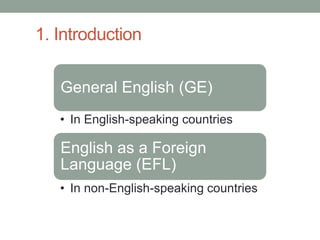
1. Introduction
General English (GE)
• In English-speaking countries
English as a Foreign
Language (EFL)
• In non-English-speaking countries
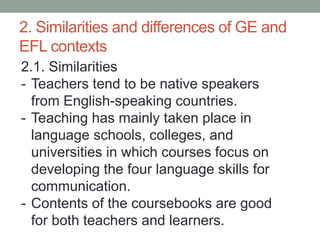
2. Similarities and differences of GE and
EFL contexts
2.1. Similarities
- Teachers tend to be native speakers
from English-speaking countries.
- Teaching has mainly taken place in
language schools, colleges, and
universities in which courses focus on
developing the four language skills for
communication.
- Contents of the coursebooks are good
for both teachers and learners.
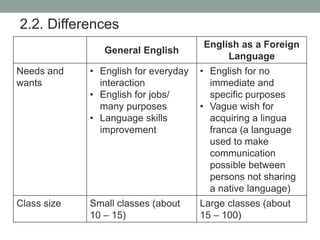
2.2. Differences
General English
English as a Foreign
Language
Needs and
wants
• English for everyday
interaction
• English for jobs/
many purposes
• Language skills
improvement
• English for no
immediate and
specific purposes
• Vague wish for
acquiring a lingua
franca (a language
used to make
communication
possible between
persons not sharing
a native language)
Class size Small classes (about
10 – 15)
Large classes (about
15 – 100)
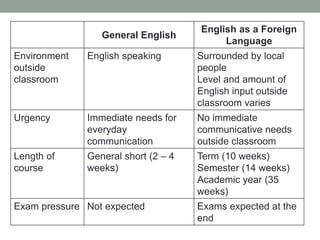
General English
English as a Foreign
Language
Environment
outside
classroom
English speaking Surrounded by local
people
Level and amount of
English input outside
classroom varies
Urgency Immediate needs for
everyday
communication
No immediate
communicative needs
outside classroom
Length of
course
General short (2 – 4
weeks)
Term (10 weeks)
Semester (14 weeks)
Academic year (35
weeks)
Exam pressure Not expected Exams expected at the
end
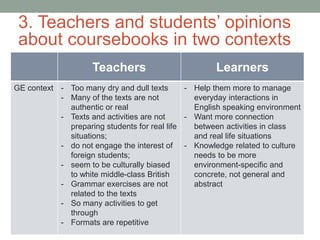
3. Teachers and students’ opinions
about coursebooks in two contexts
Teachers Learners
GE context - Too many dry and dull texts
- Many of the texts are not
authentic or real
- Texts and activities are not
preparing students for real life
situations;
- do not engage the interest of
foreign students;
- seem to be culturally biased
to white middle-class British
- Grammar exercises are not
related to the texts
- So many activities to get
through
- Formats are repetitive
- Help them more to manage
everyday interactions in
English speaking environment
- Want more connection
between activities in class
and real life situations
- Knowledge related to culture
needs to be more
environment-specific and
concrete, not general and
abstract
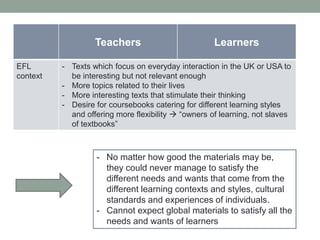
Teachers Learners
EFL
context
- Texts which focus on everyday interaction in the UK or USA to
be interesting but not relevant enough
- More topics related to their lives
- More interesting texts that stimulate their thinking
- Desire for coursebooks catering for different learning styles
and offering more flexibility  “owners of learning, not slaves
of textbooks”
- No matter how good the materials may be,
they could never manage to satisfy the
different needs and wants that come from the
different learning contexts and styles, cultural
standards and experiences of individuals.
- Cannot expect global materials to satisfy all the
needs and wants of learners
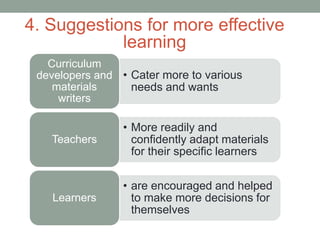
• Cater more to various
needs and wants
Curriculum
developers and
materials
writers
• More readily and
confidently adapt materials
for their specific learners
Teachers
• are encouraged and helped
to make more decisions for
themselves
Learners
4. Suggestions for more effective
learning
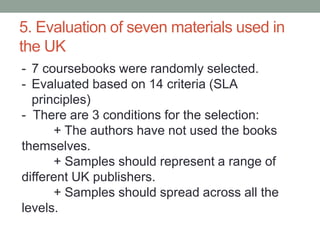
5. Evaluation of seven materials used in
the UK
- 7 coursebooks were randomly selected.
- Evaluated based on 14 criteria (SLA
principles)
- There are 3 conditions for the selection:
+ The authors have not used the books
themselves.
+ Samples should represent a range of
different UK publishers.
+ Samples should spread across all the
levels.
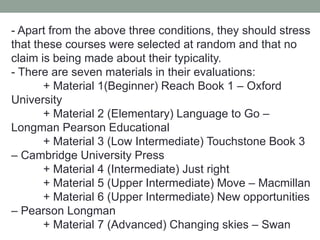
- Apart from the above three conditions, they should stress
that these courses were selected at random and that no
claim is being made about their typicality.
- There are seven materials in their evaluations:
+ Material 1(Beginner) Reach Book 1 – Oxford
University
+ Material 2 (Elementary) Language to Go –
Longman Pearson Educational
+ Material 3 (Low Intermediate) Touchstone Book 3
– Cambridge University Press
+ Material 4 (Intermediate) Just right
+ Material 5 (Upper Intermediate) Move – Macmillan
+ Material 6 (Upper Intermediate) New opportunities
– Pearson Longman
+ Material 7 (Advanced) Changing skies – Swan
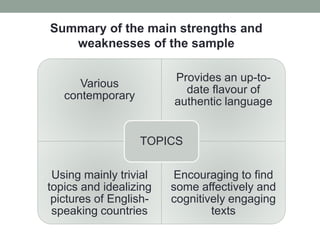
Summary of the main strengths and
weaknesses of the sample
Various
contemporary
Provides an up-to-
date flavour of
authentic language
Using mainly trivial
topics and idealizing
pictures of English-
speaking countries
Encouraging to find
some affectively and
cognitively engaging
texts
TOPICS
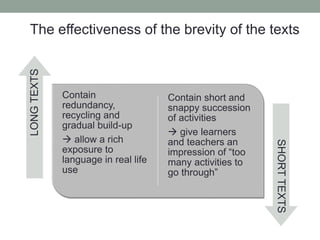
Contain
redundancy,
recycling and
gradual build-up
 allow a rich
exposure to
language in real life
use
Contain short and
snappy succession
of activities
 give learners
and teachers an
impression of “too
many activities to
go through”
LONGTEXTS
SHORTTEXTS
The effectiveness of the brevity of the texts
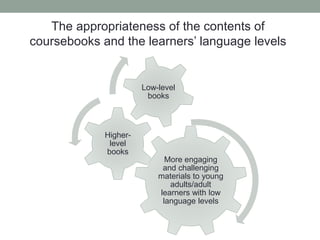
The appropriateness of the contents of
coursebooks and the learners’ language levels
More engaging
and challenging
materials to young
adults/adult
learners with low
language levels
Higher-
level
books
Low-level
books
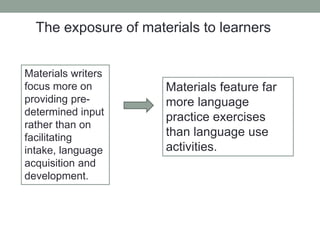
The exposure of materials to learners
Materials writers
focus more on
providing pre-
determined input
rather than on
facilitating
intake, language
acquisition and
development.
Materials feature far
more language
practice exercises
than language use
activities.
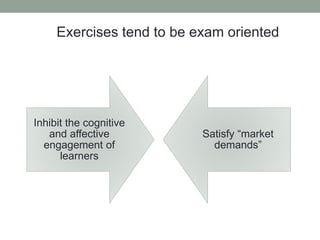
Exercises tend to be exam oriented
Inhibit the cognitive
and affective
engagement of
learners
Satisfy “market
demands”
Application of the language used
in coursebooks in real life
Apart from the English environment
that materials provide, learners can
also make use of the language
through television, radio, the press,
the cinema, the web or face-to-face
interaction with English speakers.
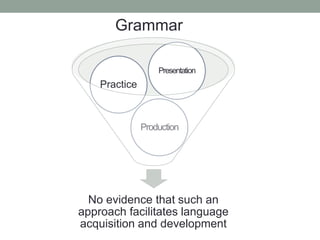
Grammar
No evidence that such an
approach facilitates language
acquisition and development
Production
Practice
Presentation
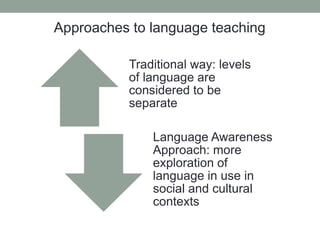
Approaches to language teaching
Traditional way: levels
of language are
considered to be
separate
Language Awareness
Approach: more
exploration of
language in use in
social and cultural
contexts
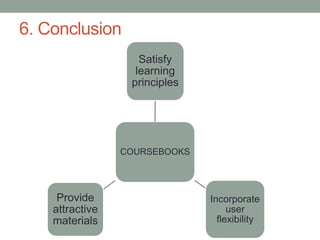
6. Conclusion
COURSEBOOKS
Satisfy
learning
principles
Incorporate
user
flexibility
Provide
attractive
materials
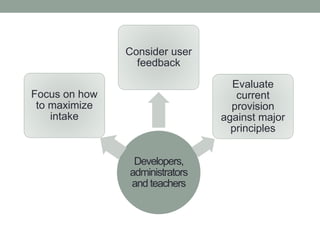
Developers,
administrators
and teachers
Focus on how
to maximize
intake
Consider user
feedback
Evaluate
current
provision
against major
principles
Thank you for your listening

Materials for General English

  • 1.
    ENGLISH LANGUAGE LEARNING MATERIALS BrianTomlinson (Chapter 2) Group 4: Nguyễn Trần Hoài Phương Phạm Phúc Khánh Minh
  • 2.
    1. Introduction General English(GE) • In English-speaking countries English as a Foreign Language (EFL) • In non-English-speaking countries
  • 3.
    2. Similarities anddifferences of GE and EFL contexts 2.1. Similarities - Teachers tend to be native speakers from English-speaking countries. - Teaching has mainly taken place in language schools, colleges, and universities in which courses focus on developing the four language skills for communication. - Contents of the coursebooks are good for both teachers and learners.
  • 4.
    2.2. Differences General English Englishas a Foreign Language Needs and wants • English for everyday interaction • English for jobs/ many purposes • Language skills improvement • English for no immediate and specific purposes • Vague wish for acquiring a lingua franca (a language used to make communication possible between persons not sharing a native language) Class size Small classes (about 10 – 15) Large classes (about 15 – 100)
  • 5.
    General English English asa Foreign Language Environment outside classroom English speaking Surrounded by local people Level and amount of English input outside classroom varies Urgency Immediate needs for everyday communication No immediate communicative needs outside classroom Length of course General short (2 – 4 weeks) Term (10 weeks) Semester (14 weeks) Academic year (35 weeks) Exam pressure Not expected Exams expected at the end
  • 6.
    3. Teachers andstudents’ opinions about coursebooks in two contexts Teachers Learners GE context - Too many dry and dull texts - Many of the texts are not authentic or real - Texts and activities are not preparing students for real life situations; - do not engage the interest of foreign students; - seem to be culturally biased to white middle-class British - Grammar exercises are not related to the texts - So many activities to get through - Formats are repetitive - Help them more to manage everyday interactions in English speaking environment - Want more connection between activities in class and real life situations - Knowledge related to culture needs to be more environment-specific and concrete, not general and abstract
  • 7.
    Teachers Learners EFL context - Textswhich focus on everyday interaction in the UK or USA to be interesting but not relevant enough - More topics related to their lives - More interesting texts that stimulate their thinking - Desire for coursebooks catering for different learning styles and offering more flexibility  “owners of learning, not slaves of textbooks” - No matter how good the materials may be, they could never manage to satisfy the different needs and wants that come from the different learning contexts and styles, cultural standards and experiences of individuals. - Cannot expect global materials to satisfy all the needs and wants of learners
  • 8.
    • Cater moreto various needs and wants Curriculum developers and materials writers • More readily and confidently adapt materials for their specific learners Teachers • are encouraged and helped to make more decisions for themselves Learners 4. Suggestions for more effective learning
  • 9.
    5. Evaluation ofseven materials used in the UK - 7 coursebooks were randomly selected. - Evaluated based on 14 criteria (SLA principles) - There are 3 conditions for the selection: + The authors have not used the books themselves. + Samples should represent a range of different UK publishers. + Samples should spread across all the levels.
  • 10.
    - Apart fromthe above three conditions, they should stress that these courses were selected at random and that no claim is being made about their typicality. - There are seven materials in their evaluations: + Material 1(Beginner) Reach Book 1 – Oxford University + Material 2 (Elementary) Language to Go – Longman Pearson Educational + Material 3 (Low Intermediate) Touchstone Book 3 – Cambridge University Press + Material 4 (Intermediate) Just right + Material 5 (Upper Intermediate) Move – Macmillan + Material 6 (Upper Intermediate) New opportunities – Pearson Longman + Material 7 (Advanced) Changing skies – Swan
  • 11.
    Summary of themain strengths and weaknesses of the sample Various contemporary Provides an up-to- date flavour of authentic language Using mainly trivial topics and idealizing pictures of English- speaking countries Encouraging to find some affectively and cognitively engaging texts TOPICS
  • 12.
    Contain redundancy, recycling and gradual build-up allow a rich exposure to language in real life use Contain short and snappy succession of activities  give learners and teachers an impression of “too many activities to go through” LONGTEXTS SHORTTEXTS The effectiveness of the brevity of the texts
  • 13.
    The appropriateness ofthe contents of coursebooks and the learners’ language levels More engaging and challenging materials to young adults/adult learners with low language levels Higher- level books Low-level books
  • 14.
    The exposure ofmaterials to learners Materials writers focus more on providing pre- determined input rather than on facilitating intake, language acquisition and development. Materials feature far more language practice exercises than language use activities.
  • 15.
    Exercises tend tobe exam oriented Inhibit the cognitive and affective engagement of learners Satisfy “market demands”
  • 16.
    Application of thelanguage used in coursebooks in real life Apart from the English environment that materials provide, learners can also make use of the language through television, radio, the press, the cinema, the web or face-to-face interaction with English speakers.
  • 17.
    Grammar No evidence thatsuch an approach facilitates language acquisition and development Production Practice Presentation
  • 18.
    Approaches to languageteaching Traditional way: levels of language are considered to be separate Language Awareness Approach: more exploration of language in use in social and cultural contexts
  • 19.
  • 20.
    Developers, administrators and teachers Focus onhow to maximize intake Consider user feedback Evaluate current provision against major principles
  • 21.
    Thank you foryour listening