1. Research Design in Survey &
Experimental Research
2. Internal & External Threats to
Validity of Research
Ms. Zehra Habib
MPhil, ETE (3751)
30th May, 2022
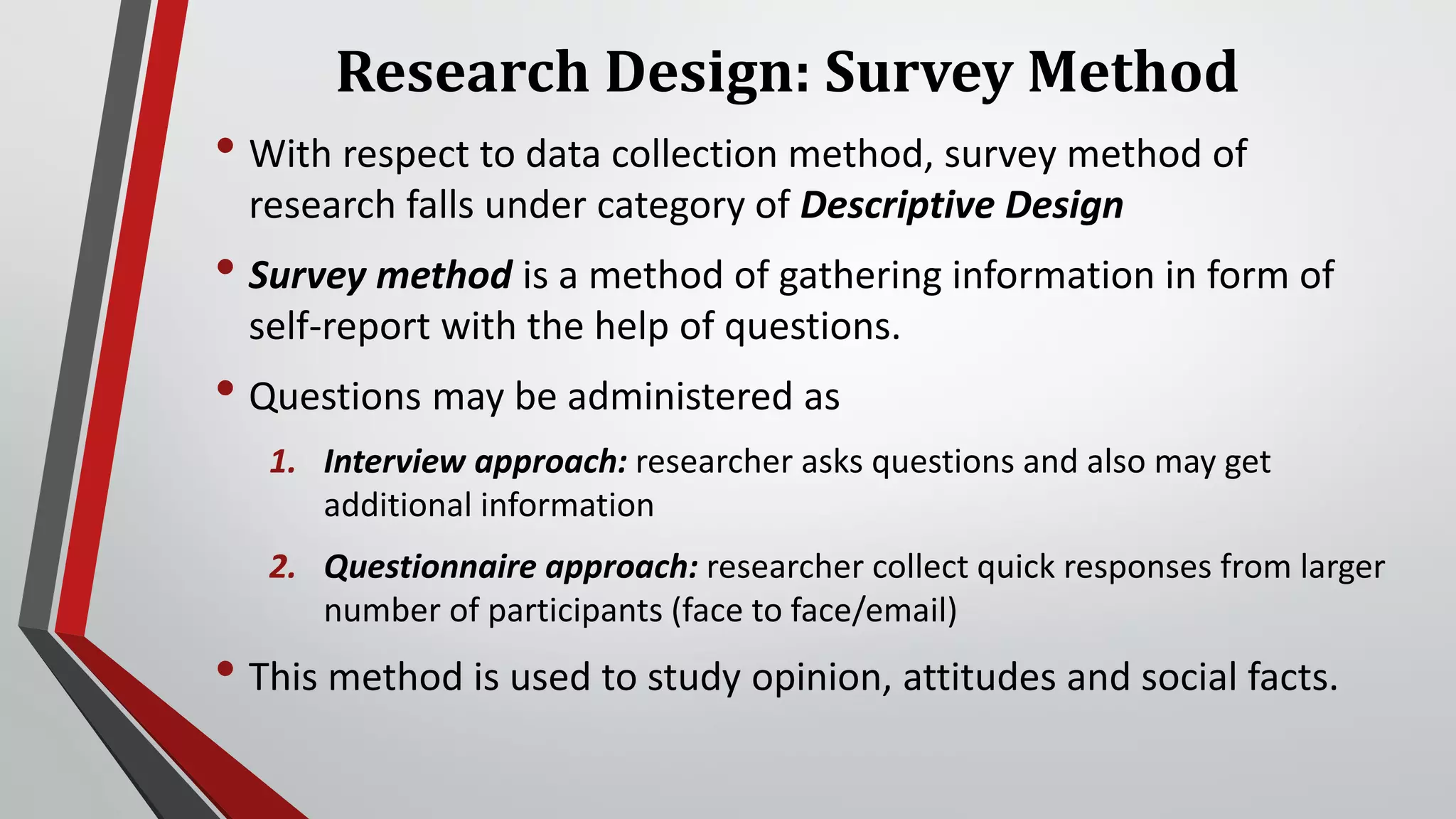
Research Design: Survey Method
• With respect to data collection method, survey method of
research falls under category of Descriptive Design
• Survey method is a method of gathering information in form of
self-report with the help of questions.
• Questions may be administered as
1. Interview approach: researcher asks questions and also may get
additional information
2. Questionnaire approach: researcher collect quick responses from larger
number of participants (face to face/email)
• This method is used to study opinion, attitudes and social facts.
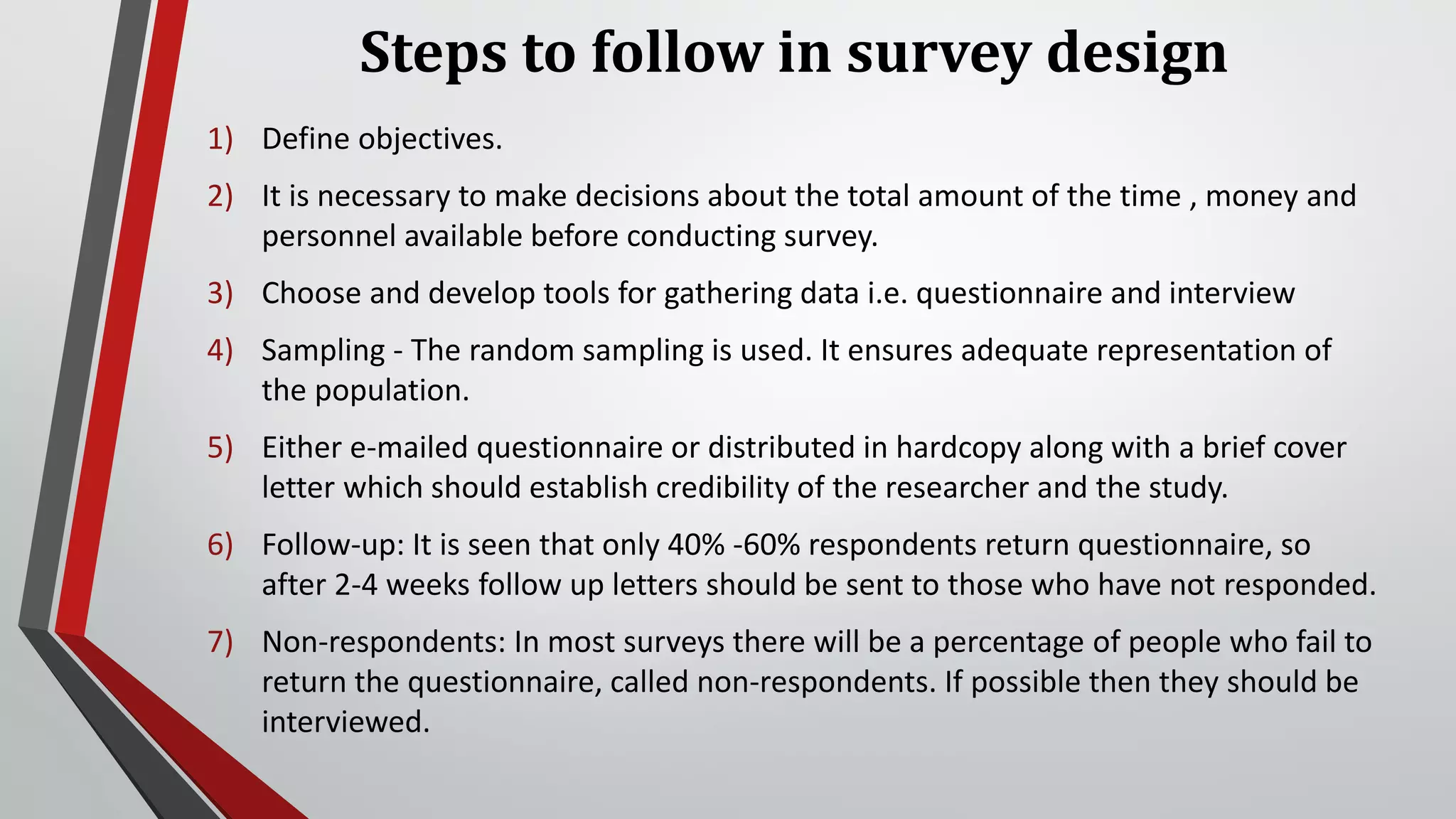
Steps to follow in survey design
1) Define objectives.
2) It is necessary to make decisions about the total amount of the time , money and
personnel available before conducting survey.
3) Choose and develop tools for gathering data i.e. questionnaire and interview
4) Sampling - The random sampling is used. It ensures adequate representation of
the population.
5) Either e-mailed questionnaire or distributed in hardcopy along with a brief cover
letter which should establish credibility of the researcher and the study.
6) Follow-up: It is seen that only 40% -60% respondents return questionnaire, so
after 2-4 weeks follow up letters should be sent to those who have not responded.
7) Non-respondents: In most surveys there will be a percentage of people who fail to
return the questionnaire, called non-respondents. If possible then they should be
interviewed.
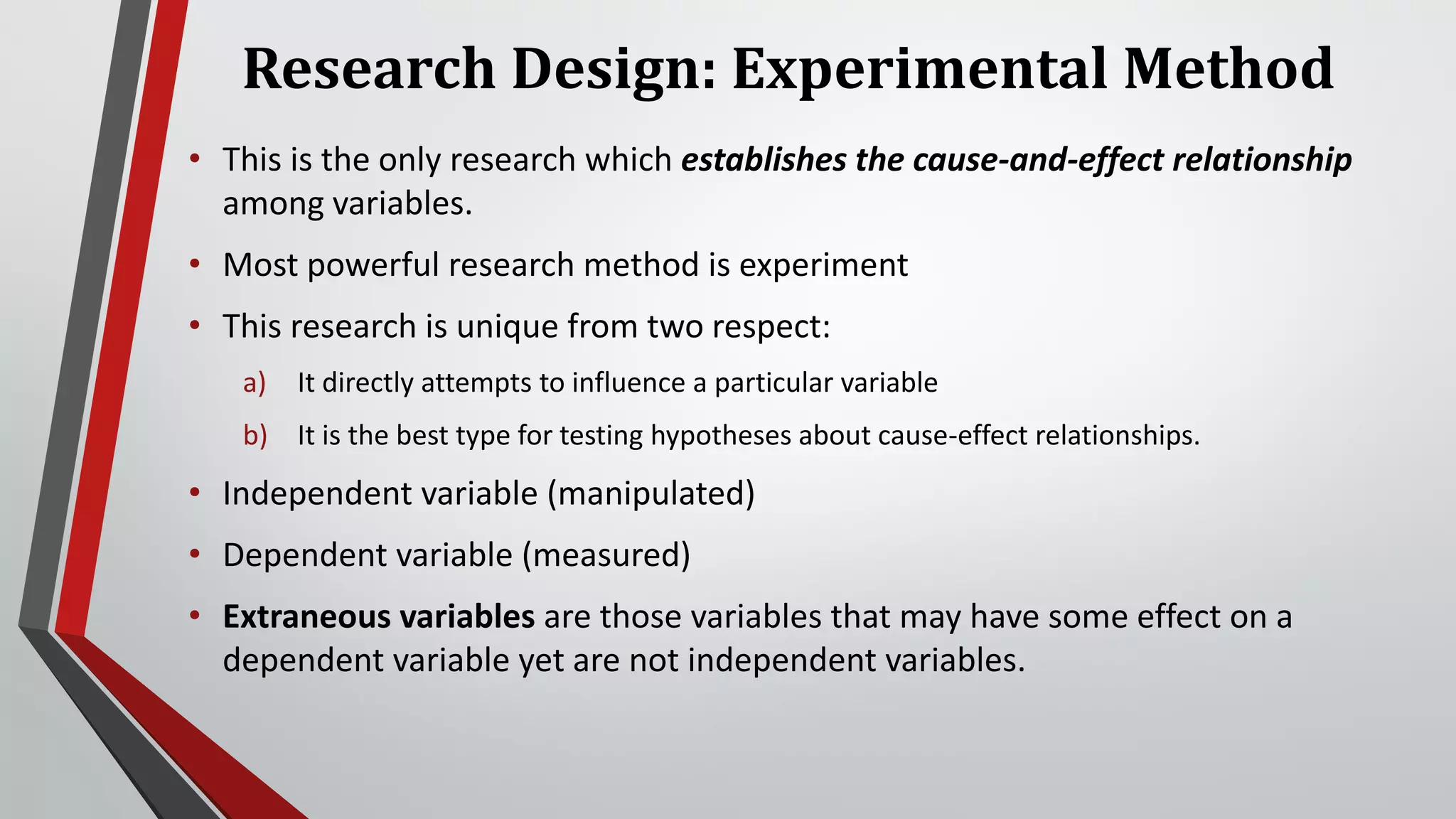
Research Design: Experimental Method
• This is the only research which establishes the cause-and-effect relationship
among variables.
• Most powerful research method is experiment
• This research is unique from two respect:
a) It directly attempts to influence a particular variable
b) It is the best type for testing hypotheses about cause-effect relationships.
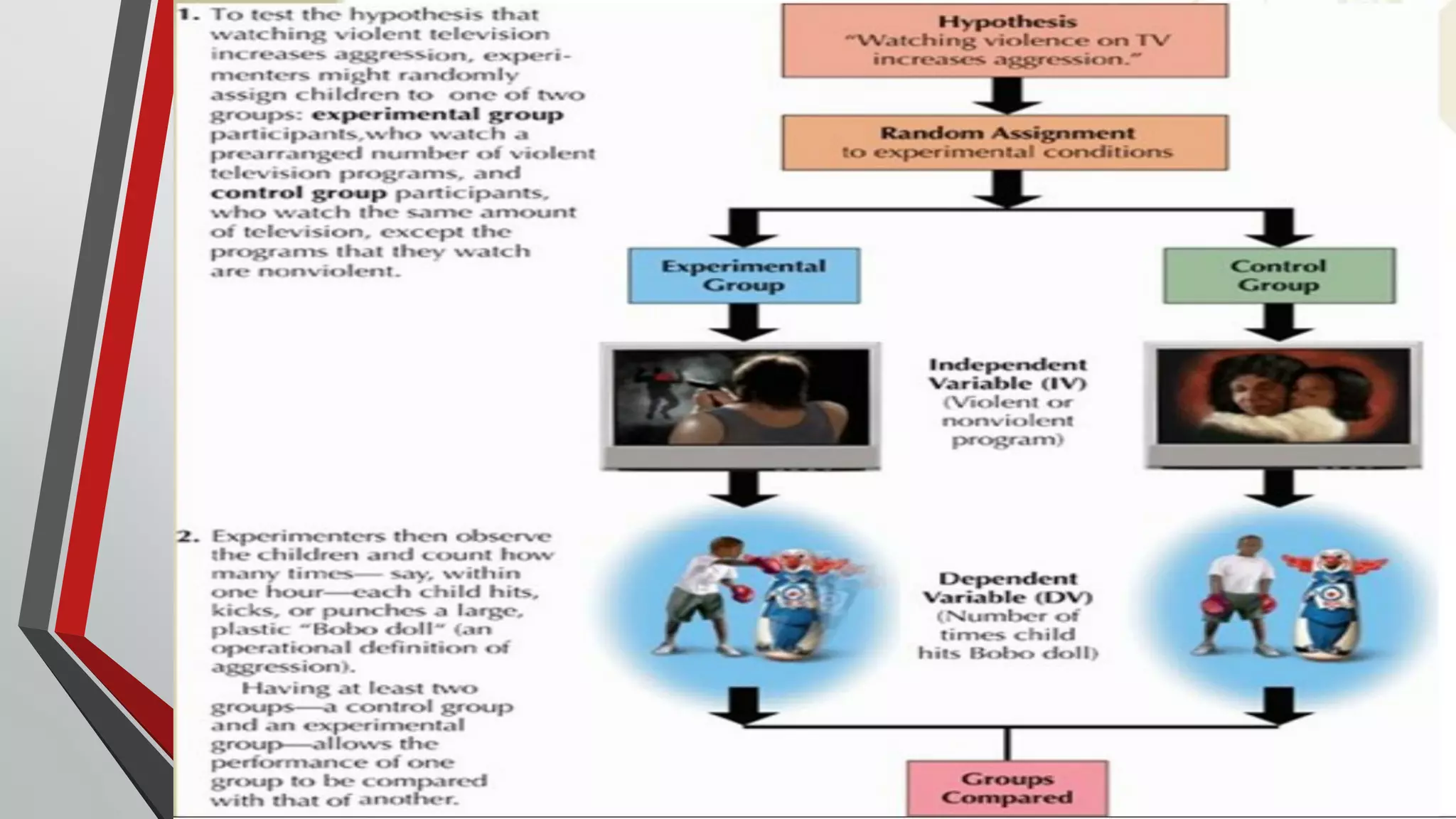
• Independent variable (manipulated)
• Dependent variable (measured)
• Extraneous variables are those variables that may have some effect on a
dependent variable yet are not independent variables.
Group in Experimental Design
Control groups are essential to experimental design.
When researchers are interested in the impact of a new treatment,
they randomly divide their study participants into at least two
groups:
• The treatment group (also called the experimental group) receives the
treatment whose effect the researcher is interested in.
• The control group receives either no treatment, a standard treatment
whose effect is already known.
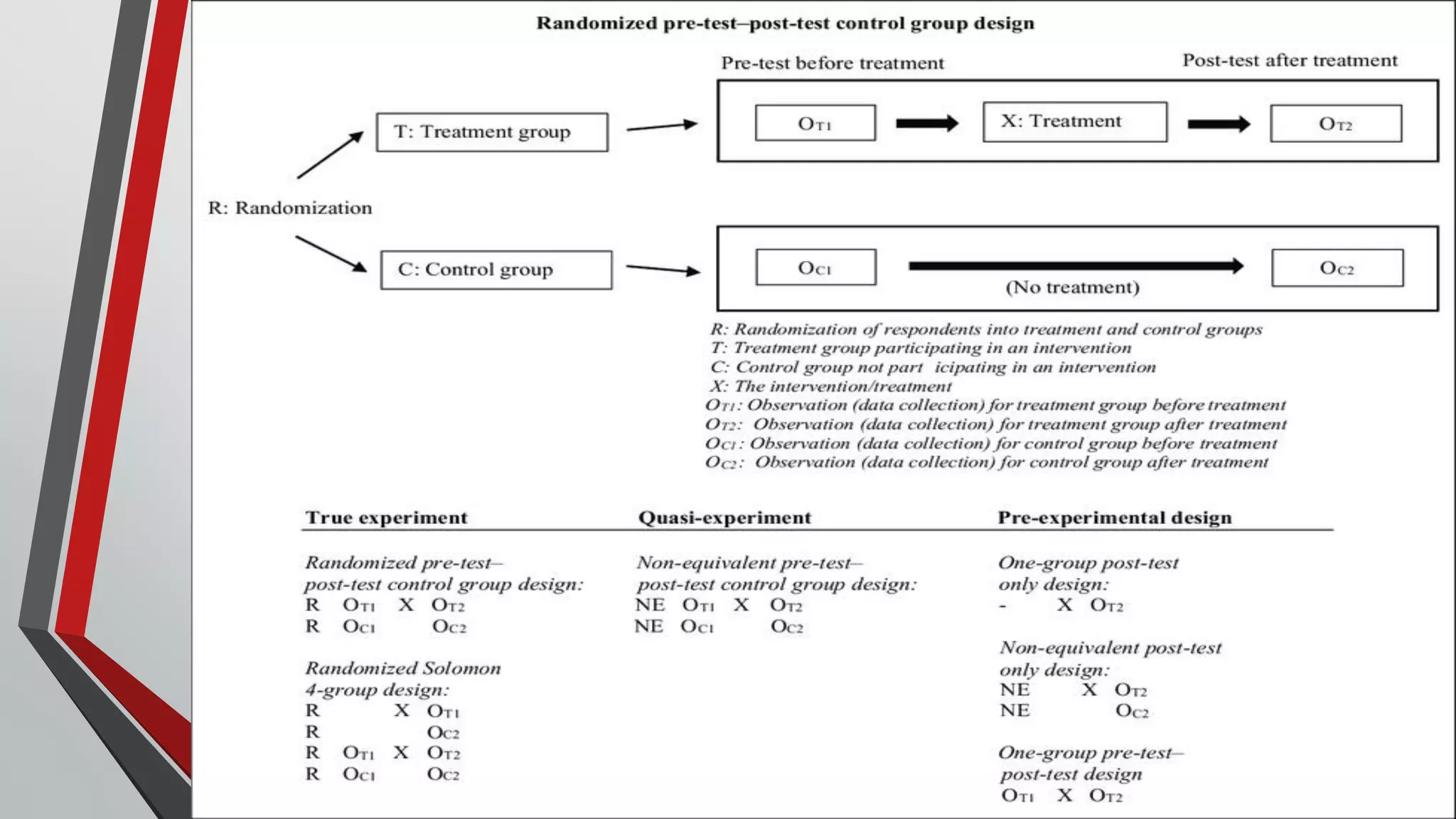
Types of Experimental Design
1. Pre-Experimental Design:
• A group kept under observation after implementing factors of cause and effect. This
research is conducted to understand whether further investigation is necessary for these
particular groups.
2. True- experimental design:
• relies on statistical analysis to prove or disprove a hypothesis
• This experimental research method commonly occurs in the physical
sciences.
3. Quasi-experimental design:
• the participants are not randomly assigned and they are used in settings where
randomization is difficult or impossible.
• Uses in educational research, where administrators are unwilling to allow the random
selection of students for experimental samples.
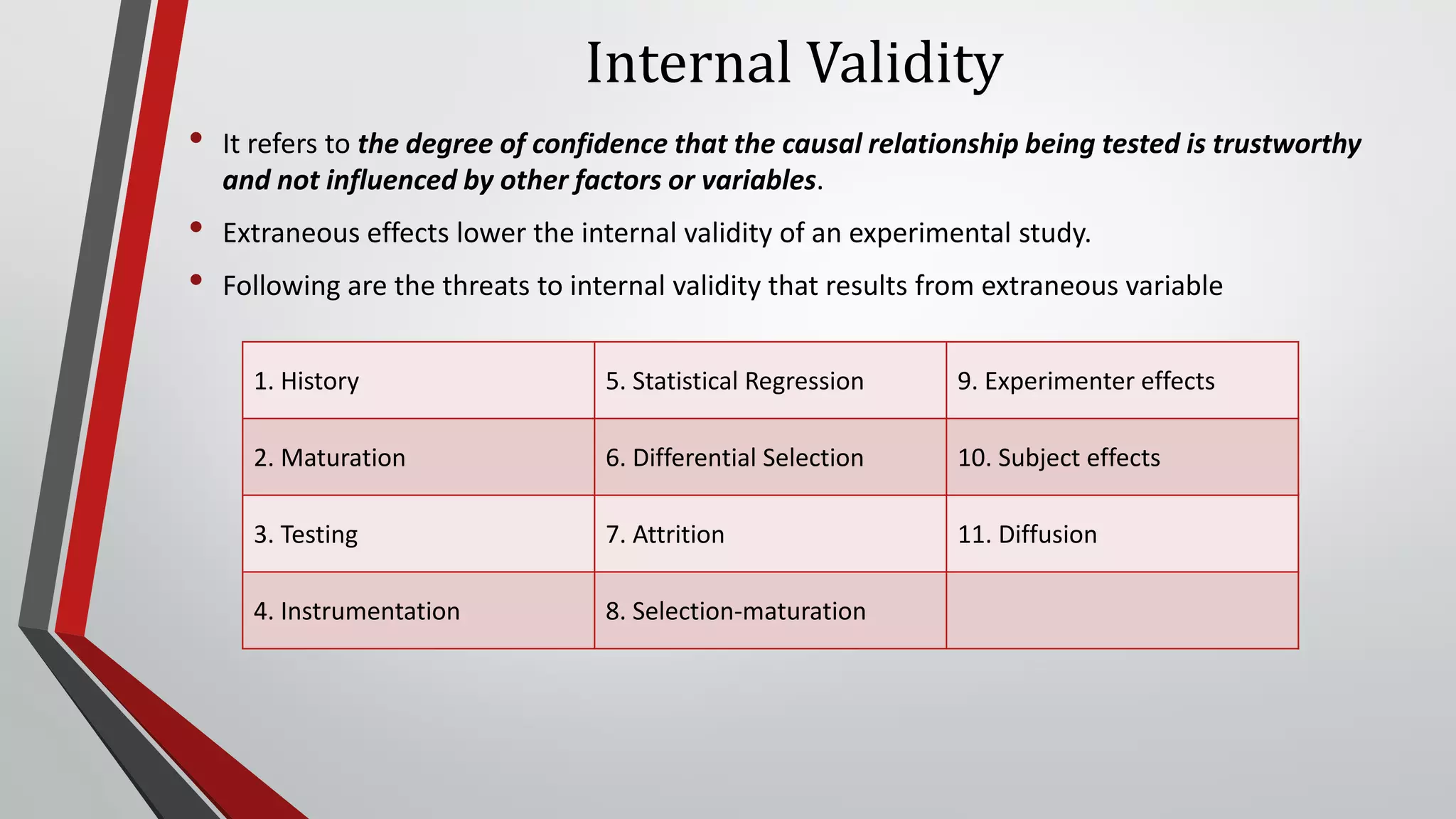
Internal Validity
• It refers to the degree of confidence that the causal relationship being tested is trustworthy
and not influenced by other factors or variables.
• Extraneous effects lower the internal validity of an experimental study.
• Following are the threats to internal validity that results from extraneous variable
1. History 5. Statistical Regression 9. Experimenter effects
2. Maturation 6. Differential Selection 10. Subject effects
3. Testing 7. Attrition 11. Diffusion
4. Instrumentation 8. Selection-maturation
Threats to Internal Validity
1. History
• Unexpected events that are not part of the experimental manipulation but influence
the dependent variable.
• It refers to events occur during the study, e.g., participant watch science show or visit
to science exhibition/field trip/zoo, may affect the variable of researcher i.e. comparing
the effectiveness of different methods of Science Instruction
2. Maturation
• It refers passage of time in which participants naturally changes their behavior over
time.
• During the six-month experiment, employees become more experienced and better at
their jobs. Therefore, job satisfaction may improve.
3. Testing
• Improvement in performance resulting from familiarity with a test, when dependent
variable focuses on factual knowledge, concrete skills, etc.
• develop two different test paper that are comparably same or comparable version of a
test and can be used as pretest and posttest.
Threats, Continue ….
4. Instrumentation
• Changes in performance of participants resulting from changes in the measurement
used.
• For instance, two moderator may give the instructions differently, OR pretest/posttest
differs in length, difficulty or interest to the participants may affect results of
intervention
5. Statistical Regression
• Tendency for the participants who make extreme scores on pretest measures to score
nearer to the mean at posttest.
• Participants with the highest pretest scores have nowhere to go down, whereas
participants with the lowest scores can only improve.
Continue ….
6. Differential selection
• Pre-existing differences between experimental and control groups such as ability level,
difference in experience and age.
• Threat may be the change in posttest result is due to initial group differences rather
than intervention of independent variable
7. Attrition
• Withdrawal or loss of participants from a study due to illness, declining motivation, or
resentment at being assigned to a particular condition.
• Validity will be compromised if mortality is extensive, or if there is a selective loss of
participants across group.
8. Selection-maturation
• Differential selection effects that result specifically from maturation.
• Selection-driven participants change the result. For example, the two different teachers
selected for two different classes represents an initial group difference (a differential
selection effect) that creates a difference in student progress (maturation effect)
Continue …
9. Experimenter effects
• Unwanted influence or expectation, the researcher has on a study as well as
experimenter characteristics and behavior that affect the way participants respond.
• Presence of researcher during the study
10. Subject effects
• Changes in participant attitudes and behavior towards experimenter
• Hawthorne effect: any change in behavior that occur when individuals are aware of
receiving special attention by researchers during their participation in experiment.
11. Diffusion
• Communication between groups results in sharing of information and resources
between them.
• Sharing of resources of information between participants of control and experimental
group
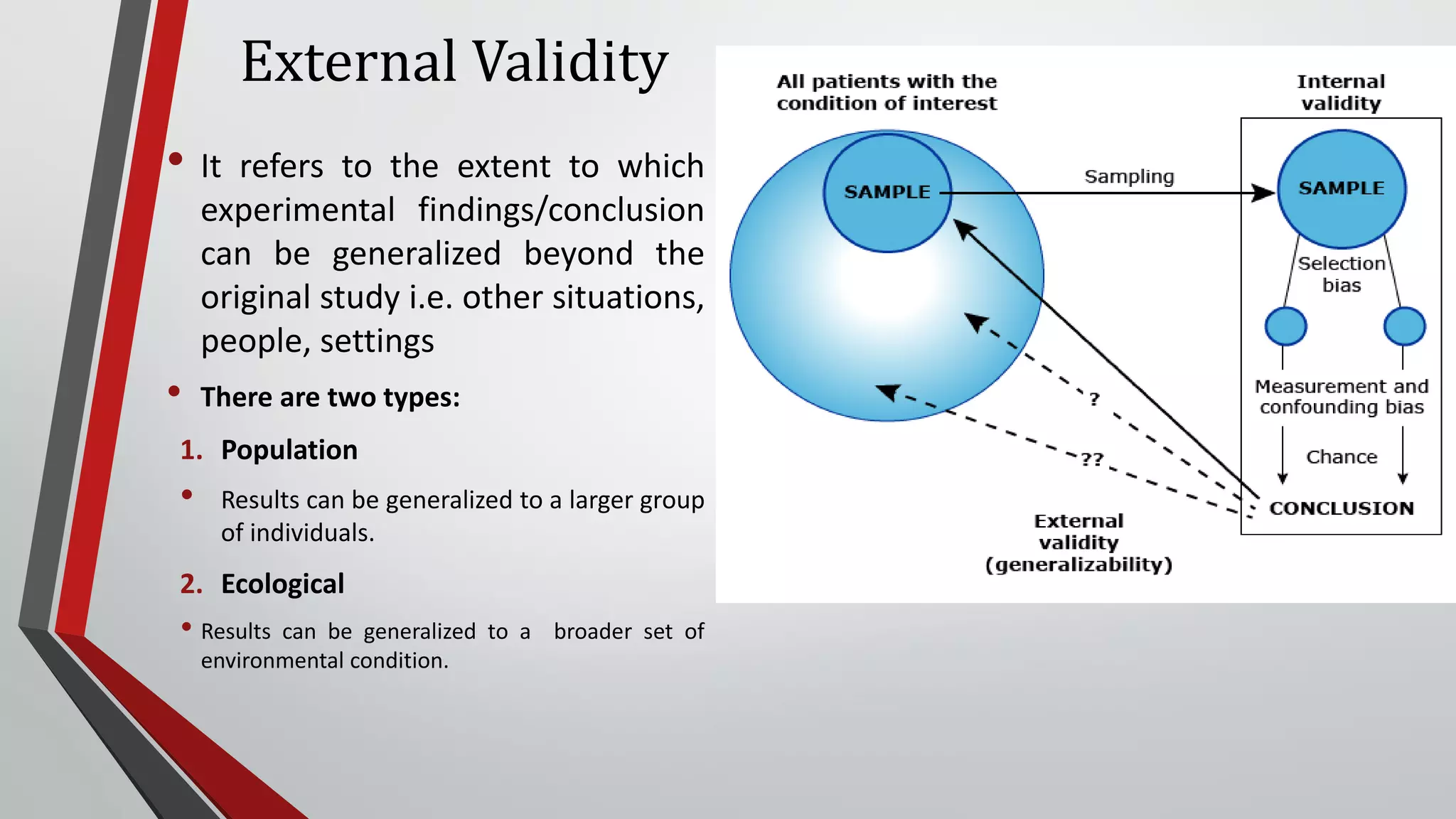
External Validity
• It refers to the extent to which
experimental findings/conclusion
can be generalized beyond the
original study i.e. other situations,
people, settings
• There are two types:
1. Population
• Results can be generalized to a larger group
of individuals.
2. Ecological
• Results can be generalized to a broader set of
environmental condition.
Threats to External Validity
Following are three types of interactions involving the experimental manipulation
(Cool & Campbell, 1979; Parker, 1993):
1. Selection-treatment interaction
• It refers to interaction between participant characteristics and experimental treatment.
• Effects depends on the nature of participants. (E.g. parenting intervention benefit low-
income families might not work for middle-class families)
2. Setting-treatment interaction
• It refers to interaction between the experimental setting and experimental treatment.
• Effects depends on the nature of experimental setting. (e.g. academic enrichment program
may effective for students with facilities rather than without facilities)
3. Pretest-treatment interaction
• It refers to interaction between participation in the pre-test and experimental treatment.
• Exposure to a pretest may change response of participants to experimental treatment.
(e.g. due to appearing in pre-test of behavioral issues of high-school students, during
intervention group change their attitude rather than those who do not appear)
Thank you!

Internal and External threat to Validity

  • 1.
    1. Research Designin Survey & Experimental Research 2. Internal & External Threats to Validity of Research Ms. Zehra Habib MPhil, ETE (3751) 30th May, 2022
  • 2.
    Research Design: SurveyMethod • With respect to data collection method, survey method of research falls under category of Descriptive Design • Survey method is a method of gathering information in form of self-report with the help of questions. • Questions may be administered as 1. Interview approach: researcher asks questions and also may get additional information 2. Questionnaire approach: researcher collect quick responses from larger number of participants (face to face/email) • This method is used to study opinion, attitudes and social facts.
  • 3.
    Steps to followin survey design 1) Define objectives. 2) It is necessary to make decisions about the total amount of the time , money and personnel available before conducting survey. 3) Choose and develop tools for gathering data i.e. questionnaire and interview 4) Sampling - The random sampling is used. It ensures adequate representation of the population. 5) Either e-mailed questionnaire or distributed in hardcopy along with a brief cover letter which should establish credibility of the researcher and the study. 6) Follow-up: It is seen that only 40% -60% respondents return questionnaire, so after 2-4 weeks follow up letters should be sent to those who have not responded. 7) Non-respondents: In most surveys there will be a percentage of people who fail to return the questionnaire, called non-respondents. If possible then they should be interviewed.
  • 4.
    Research Design: ExperimentalMethod • This is the only research which establishes the cause-and-effect relationship among variables. • Most powerful research method is experiment • This research is unique from two respect: a) It directly attempts to influence a particular variable b) It is the best type for testing hypotheses about cause-effect relationships. • Independent variable (manipulated) • Dependent variable (measured) • Extraneous variables are those variables that may have some effect on a dependent variable yet are not independent variables.
  • 5.
    Group in ExperimentalDesign Control groups are essential to experimental design. When researchers are interested in the impact of a new treatment, they randomly divide their study participants into at least two groups: • The treatment group (also called the experimental group) receives the treatment whose effect the researcher is interested in. • The control group receives either no treatment, a standard treatment whose effect is already known.
  • 6.
    Types of ExperimentalDesign 1. Pre-Experimental Design: • A group kept under observation after implementing factors of cause and effect. This research is conducted to understand whether further investigation is necessary for these particular groups. 2. True- experimental design: • relies on statistical analysis to prove or disprove a hypothesis • This experimental research method commonly occurs in the physical sciences. 3. Quasi-experimental design: • the participants are not randomly assigned and they are used in settings where randomization is difficult or impossible. • Uses in educational research, where administrators are unwilling to allow the random selection of students for experimental samples.
  • 9.
    Internal Validity • Itrefers to the degree of confidence that the causal relationship being tested is trustworthy and not influenced by other factors or variables. • Extraneous effects lower the internal validity of an experimental study. • Following are the threats to internal validity that results from extraneous variable 1. History 5. Statistical Regression 9. Experimenter effects 2. Maturation 6. Differential Selection 10. Subject effects 3. Testing 7. Attrition 11. Diffusion 4. Instrumentation 8. Selection-maturation
  • 10.
    Threats to InternalValidity 1. History • Unexpected events that are not part of the experimental manipulation but influence the dependent variable. • It refers to events occur during the study, e.g., participant watch science show or visit to science exhibition/field trip/zoo, may affect the variable of researcher i.e. comparing the effectiveness of different methods of Science Instruction 2. Maturation • It refers passage of time in which participants naturally changes their behavior over time. • During the six-month experiment, employees become more experienced and better at their jobs. Therefore, job satisfaction may improve. 3. Testing • Improvement in performance resulting from familiarity with a test, when dependent variable focuses on factual knowledge, concrete skills, etc. • develop two different test paper that are comparably same or comparable version of a test and can be used as pretest and posttest.
  • 11.
    Threats, Continue …. 4.Instrumentation • Changes in performance of participants resulting from changes in the measurement used. • For instance, two moderator may give the instructions differently, OR pretest/posttest differs in length, difficulty or interest to the participants may affect results of intervention 5. Statistical Regression • Tendency for the participants who make extreme scores on pretest measures to score nearer to the mean at posttest. • Participants with the highest pretest scores have nowhere to go down, whereas participants with the lowest scores can only improve.
  • 12.
    Continue …. 6. Differentialselection • Pre-existing differences between experimental and control groups such as ability level, difference in experience and age. • Threat may be the change in posttest result is due to initial group differences rather than intervention of independent variable 7. Attrition • Withdrawal or loss of participants from a study due to illness, declining motivation, or resentment at being assigned to a particular condition. • Validity will be compromised if mortality is extensive, or if there is a selective loss of participants across group. 8. Selection-maturation • Differential selection effects that result specifically from maturation. • Selection-driven participants change the result. For example, the two different teachers selected for two different classes represents an initial group difference (a differential selection effect) that creates a difference in student progress (maturation effect)
  • 13.
    Continue … 9. Experimentereffects • Unwanted influence or expectation, the researcher has on a study as well as experimenter characteristics and behavior that affect the way participants respond. • Presence of researcher during the study 10. Subject effects • Changes in participant attitudes and behavior towards experimenter • Hawthorne effect: any change in behavior that occur when individuals are aware of receiving special attention by researchers during their participation in experiment. 11. Diffusion • Communication between groups results in sharing of information and resources between them. • Sharing of resources of information between participants of control and experimental group
  • 14.
    External Validity • Itrefers to the extent to which experimental findings/conclusion can be generalized beyond the original study i.e. other situations, people, settings • There are two types: 1. Population • Results can be generalized to a larger group of individuals. 2. Ecological • Results can be generalized to a broader set of environmental condition.
  • 15.
    Threats to ExternalValidity Following are three types of interactions involving the experimental manipulation (Cool & Campbell, 1979; Parker, 1993): 1. Selection-treatment interaction • It refers to interaction between participant characteristics and experimental treatment. • Effects depends on the nature of participants. (E.g. parenting intervention benefit low- income families might not work for middle-class families) 2. Setting-treatment interaction • It refers to interaction between the experimental setting and experimental treatment. • Effects depends on the nature of experimental setting. (e.g. academic enrichment program may effective for students with facilities rather than without facilities) 3. Pretest-treatment interaction • It refers to interaction between participation in the pre-test and experimental treatment. • Exposure to a pretest may change response of participants to experimental treatment. (e.g. due to appearing in pre-test of behavioral issues of high-school students, during intervention group change their attitude rather than those who do not appear)
  • 16.