SECTION 5
Concepts, Construct & Variables
GRACE C. MERINILLO
(Masters of Arts in Language Education)
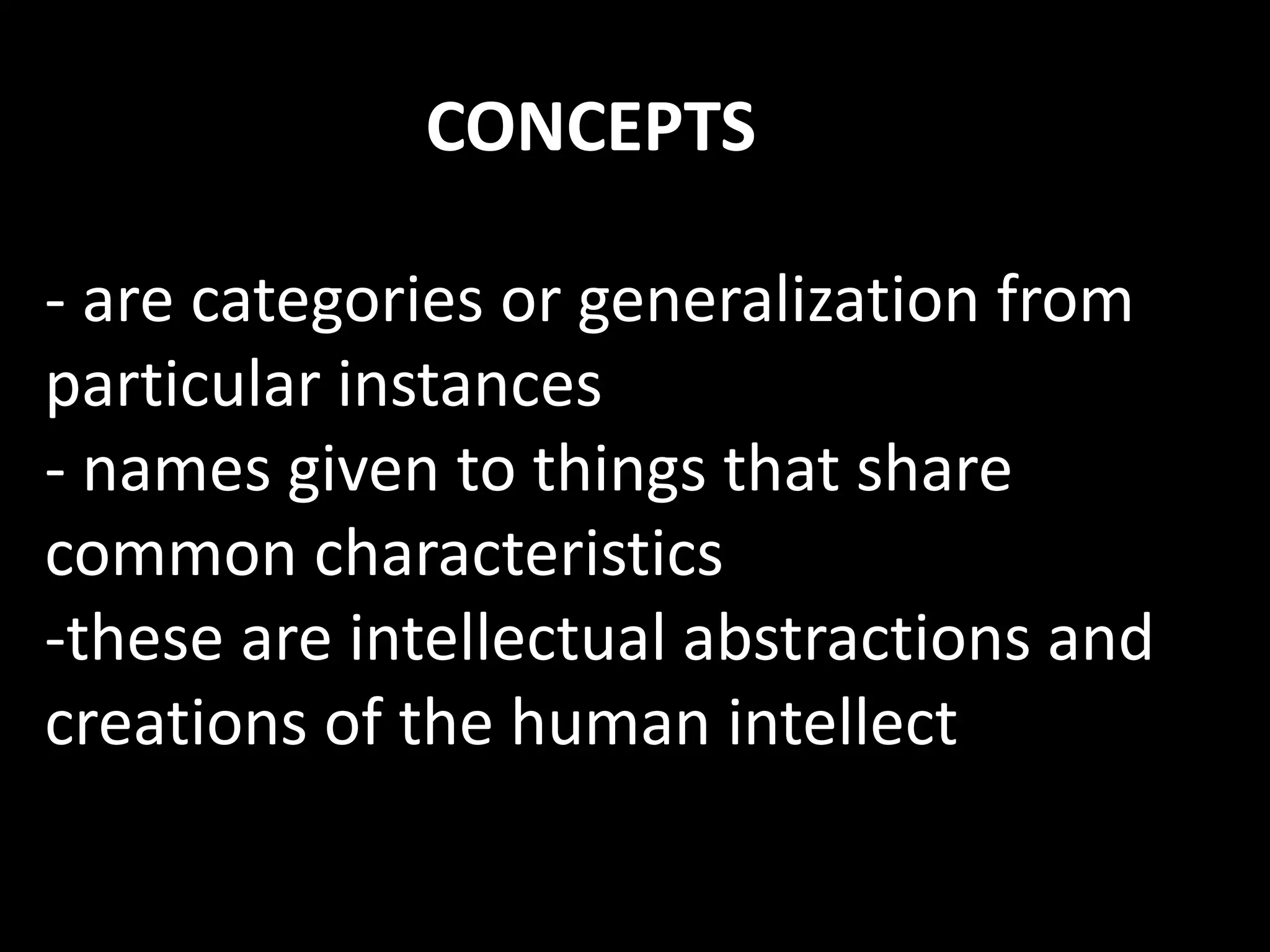
CONCEPTS
- are categories or generalization from
particular instances
- names given to things that share
common characteristics
-these are intellectual abstractions and
creations of the human intellect
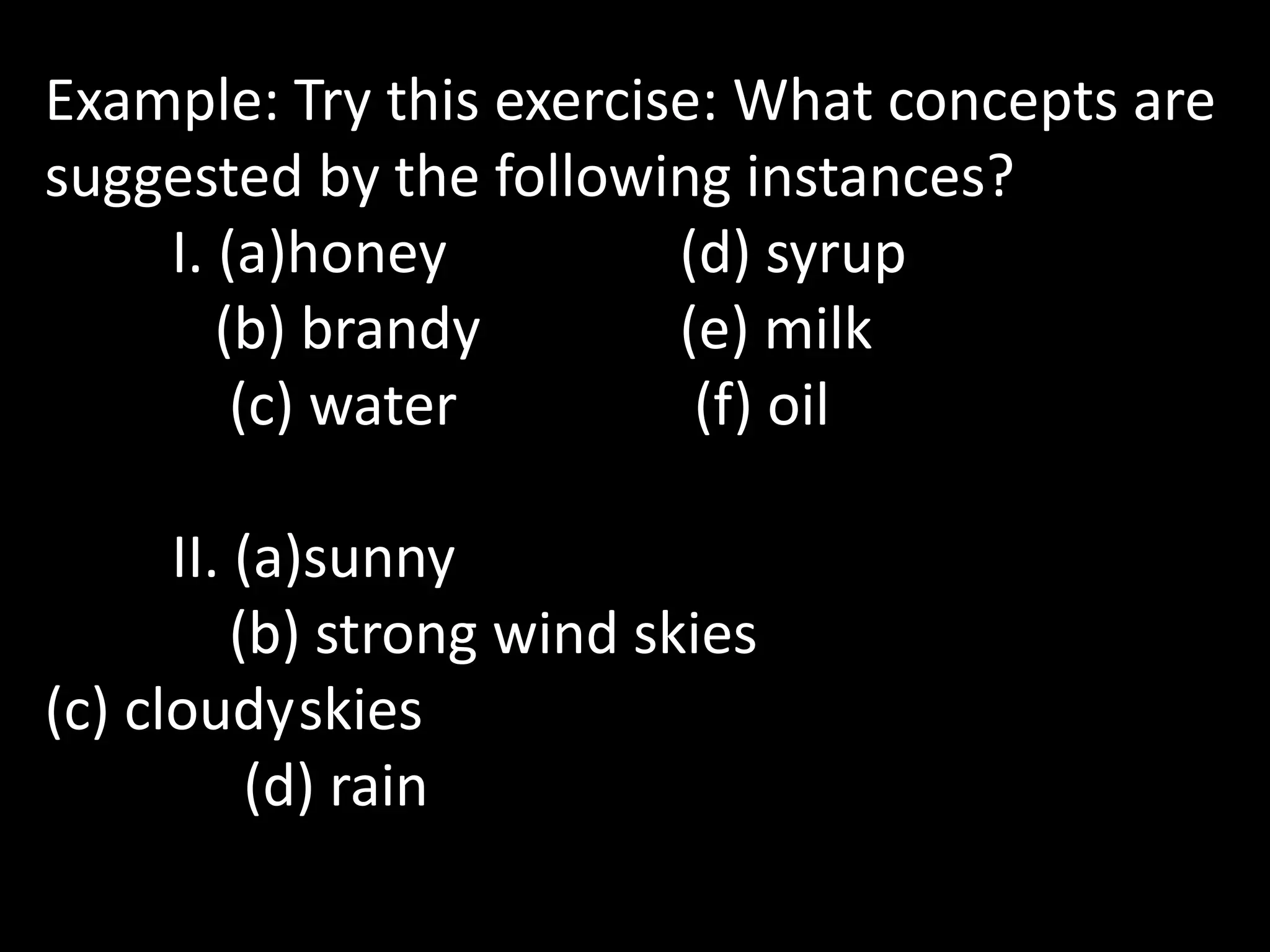
Example: Try this exercise: What concepts are
suggested by the following instances?
I. (a)honey (d) syrup
(b) brandy (e) milk
(c) water (f) oil
II. (a)sunny
(b) strong wind skies
(c) cloudyskies
(d) rain
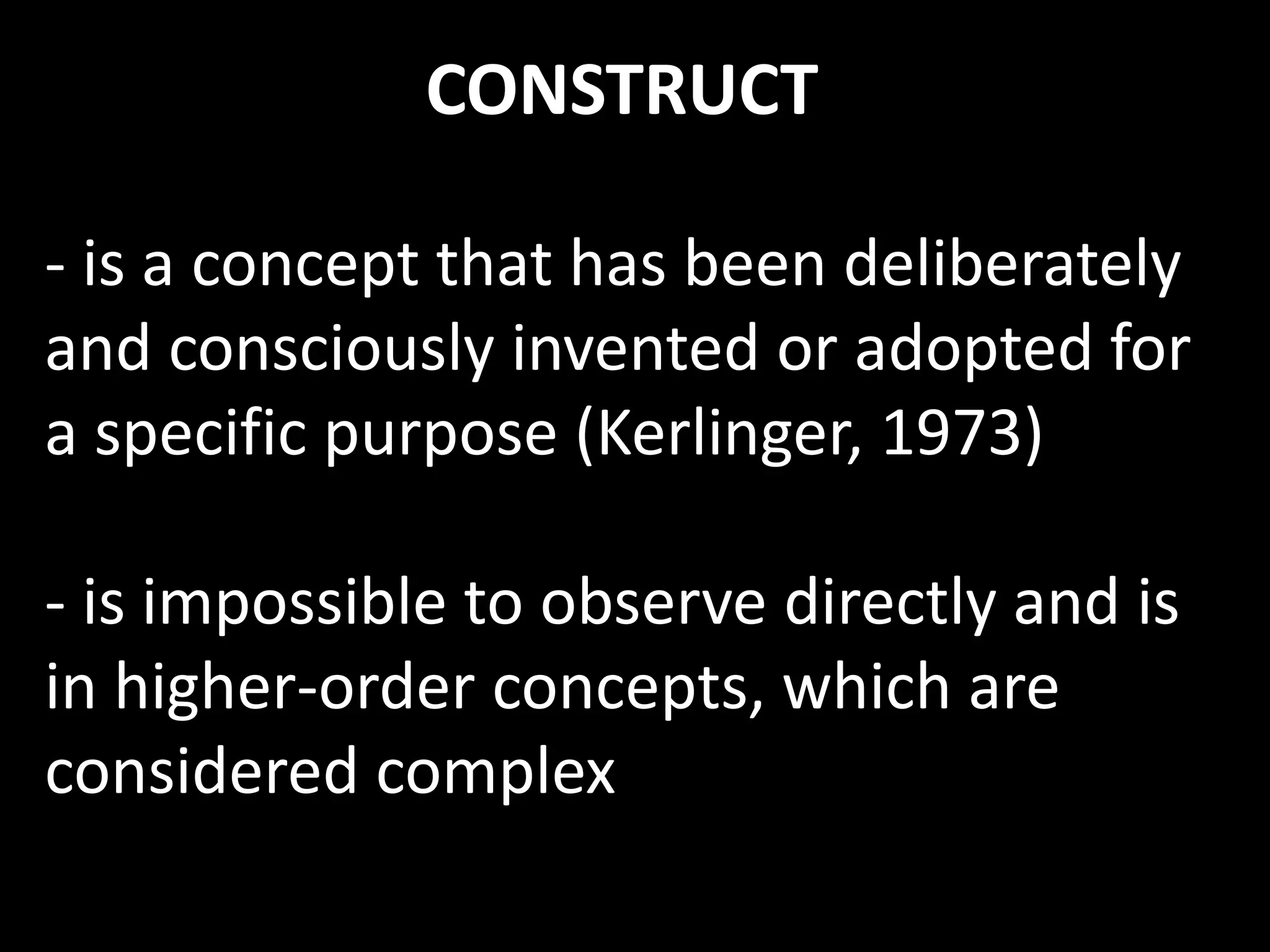
CONSTRUCT
- is a concept that has been deliberately
and consciously invented or adopted for
a specific purpose (Kerlinger, 1973)
- is impossible to observe directly and is
in higher-order concepts, which are
considered complex
CONCEPTS CONSTRUCTS
Income & Educational
Attainment
Socio-economic Status
Love between parents,
Love between siblings,
Love between friends,
Love of God
Love
OPERATIONALIZING CONSTRUCTS
AND VARIABLES
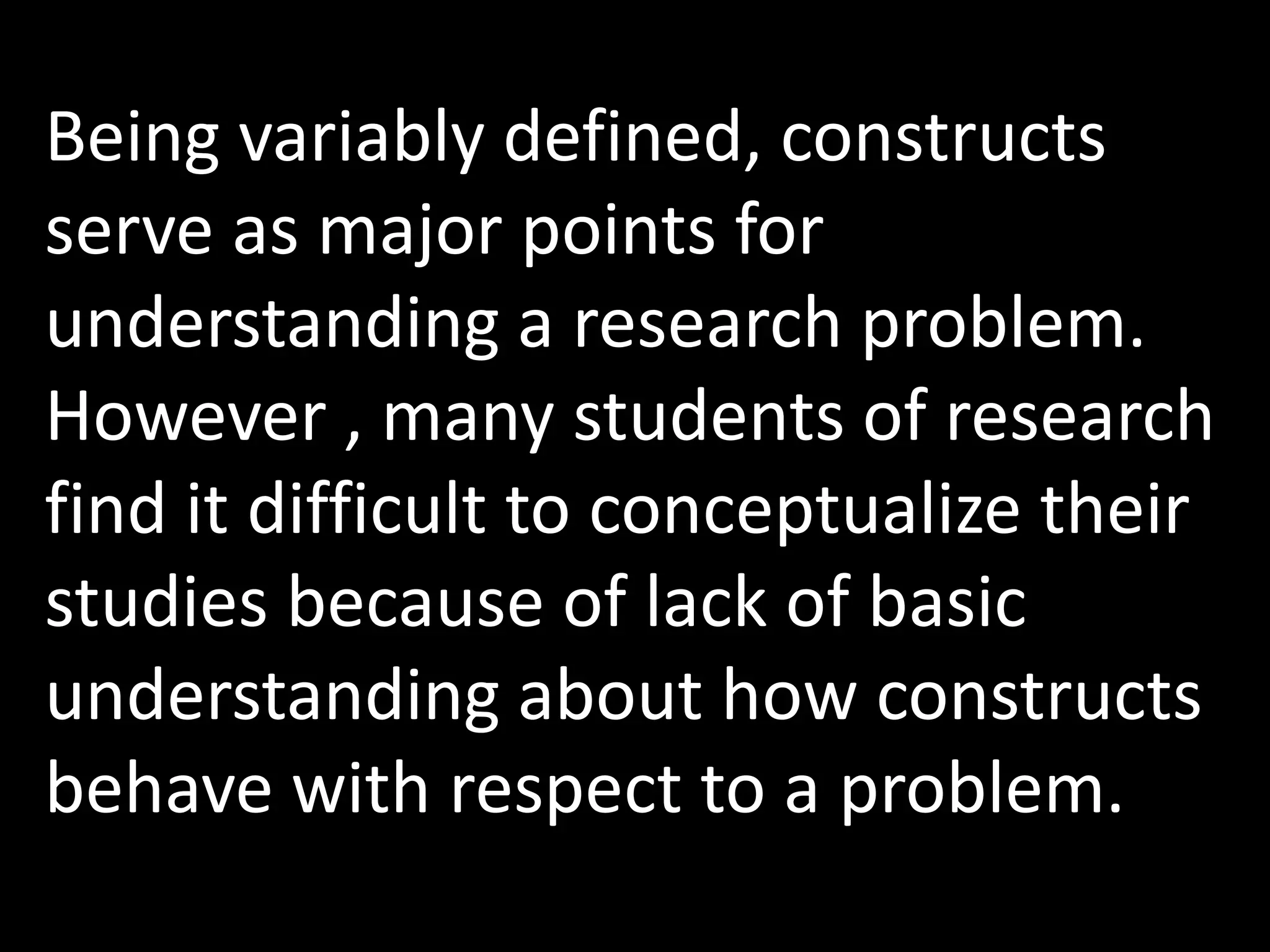
Being variably defined, constructs
serve as major points for
understanding a research problem.
However , many students of research
find it difficult to conceptualize their
studies because of lack of basic
understanding about how constructs
behave with respect to a problem.
The process of “pinning down” the
construct has to begin by realizing
that whatever the researcher would
like to measure the indicants of
some property of the objects or
entities.
Van Dalen (1979) concretizes it with
the following example:
“A student cannot be measured , but
indicants of his weight, intellectual
capacity, achievement in
Mathematics, punctuality, and other
properties can be”
Property
- A concept or logical construct that
describes particular characteristics
which is common to all members of
a set, but on which members of a
set vary.
Example: Punctuality
Indicants
- Something that points to the property
and helps define it.
Example:
(a) Is never late for class
(b) Hands in term of paper on or before
the due date
(c) is among the first people to arrive for
meeting
Determining the constructs as a property
in terms of indicants is called
“operationalizing of a construct or
concept”. This process is necessary so
that the researcher would be able to
progress on his research plans from the
realm of theory to the realm of practical
investigation. In this way, constructs are
rendered more measurable and become
referred to as “variable”
VARIABLES
- are concepts that assume more than
one value
- are qualities, properties or
characteristics of persons, things , or
situations that change or vary (Burns
and Grove, 1995)
Two kinds of a Variable
( Kerlinger, 1993)
1. Measured Operational Definition
2. Experimental Operational Definition
Measured Operational Definition
- describes how a variable will be
measured
Experimental Operational Definition
- spells out the details (operations) that
the researcher’s manipulations of the
variable
Example: (MOD)
Variable Definition
1. Achievement 1. (a) Standardized
achievement test score
(b) Teacher-made
achievement test score
(c) Grades
2. Intelligence 2. I.Q test
3. Attitude 3. Scores on an attitude
scale
Example: (EOD)
Variable Definition
1. Reinforcement 1. Describes how the
subjects of the research
to be reinforced
(rewarded) or not
reinforced.
It is clear that constructs cannot be directly
seen and are not easily quantifiable, their
presence may be inferred from their
operational definitions.
KINDS OF VARIABLES
- Attribute & Active Variables
-Continuous & Discrete
Variables
- Two-Category & Multiple
Category Variables
1. How old are you?
2. Are you a boy or a girl?
3. What is your height ?( ___ in
meters). Would you describe
yourself as a “tall” or “short”?
4. What is your weight?
5. To what
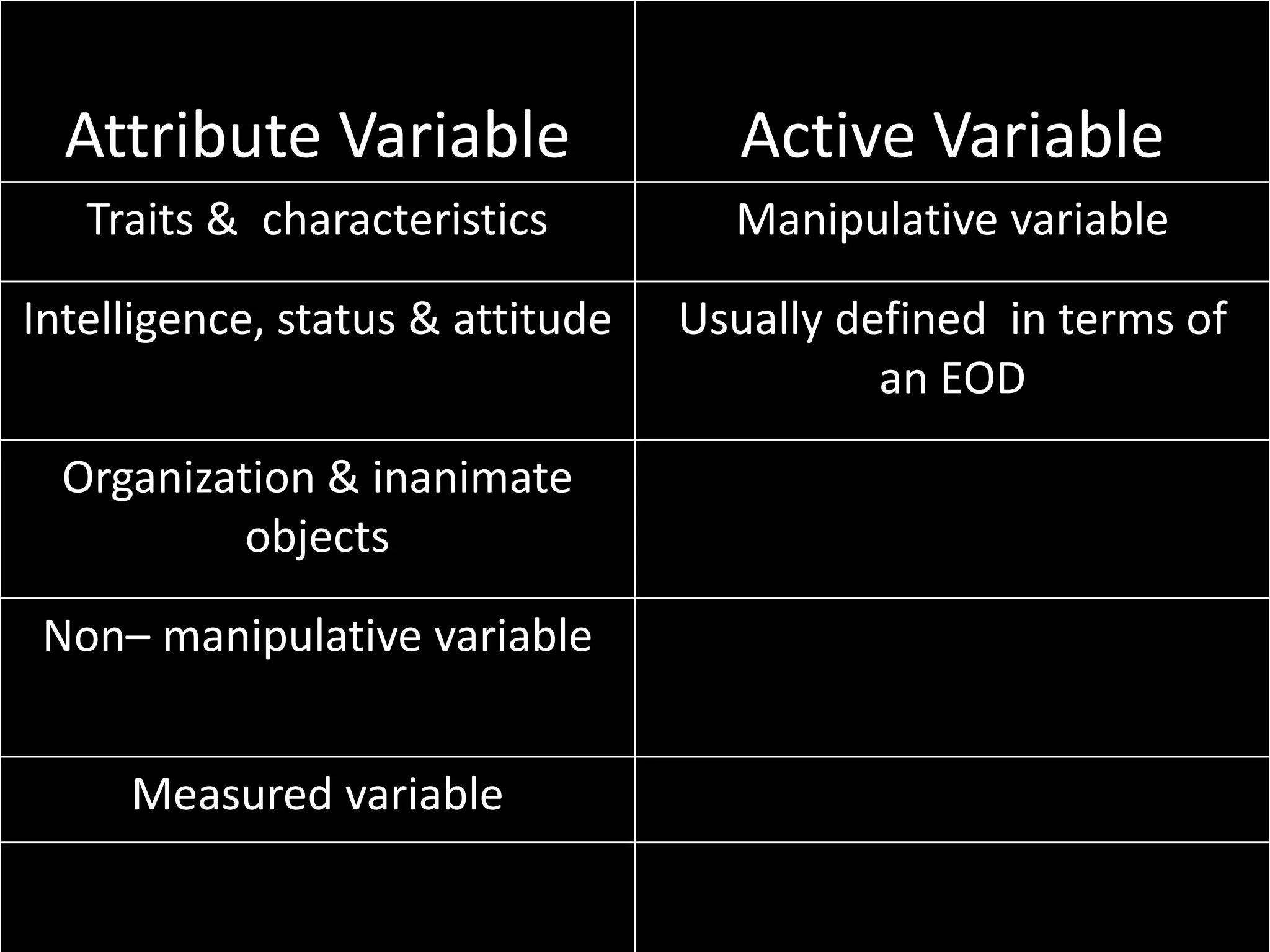
Attribute Variable Active Variable
Traits & characteristics Manipulative variable
Intelligence, status & attitude Usually defined in terms of
an EOD
Organization & inanimate
objects
Non– manipulative variable
Measured variable
Continuous Variable Discrete Variable
Variables that exists a
continuous range of values
Measurement and
classification are possible only
in whole units
Ranges from smallest to the
largest possible amount
Measurement is theoretically
possible at any point along
continuum
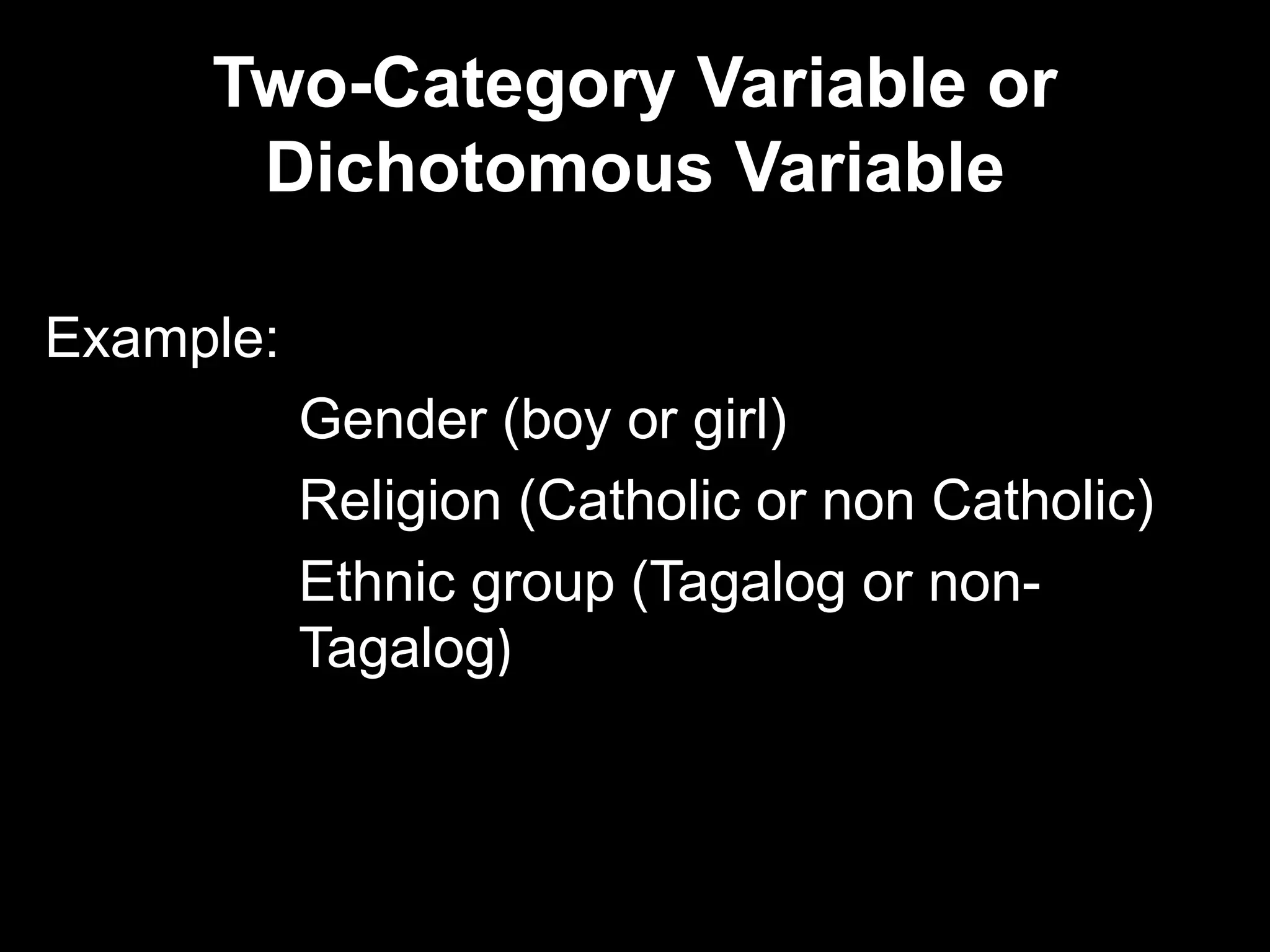
Two-Category Variable or
Dichotomous Variable
Example:
Gender (boy or girl)
Religion (Catholic or non Catholic)
Ethnic group (Tagalog or non-
Tagalog)
Multiple Category Variables
Example:
Religion (Catholicism, Islam,
Buddhism or
Protestantism)
These Two-Category Variables (Dichotomous
Variable) & Multiple Variables are expressed in
terms in discrete and continuous categories.
Example: Continuous &multiple categories
-Height (tall, average, or short)
-Weight (heavy, average, or light)
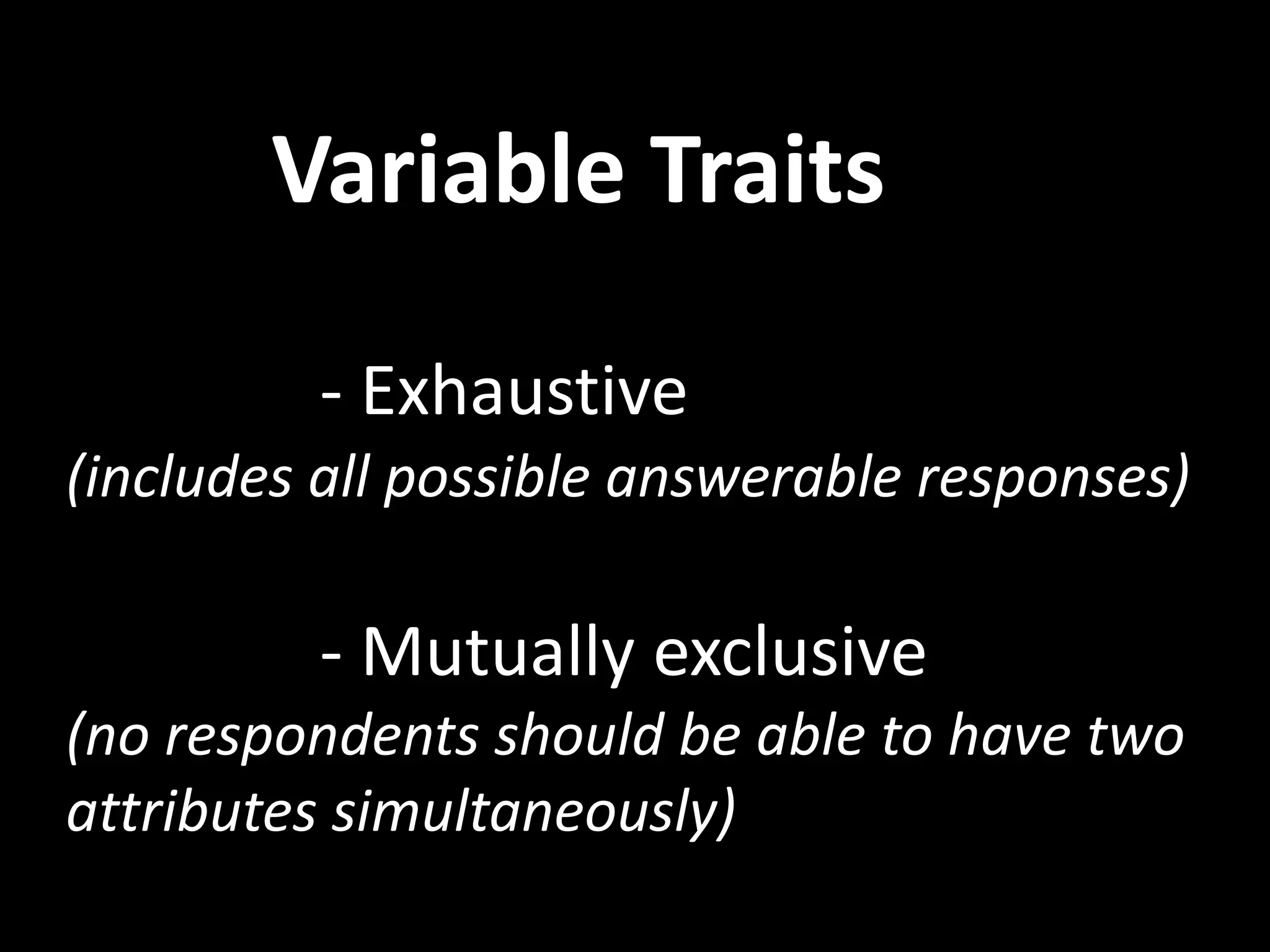
Variable Traits
- Exhaustive
(includes all possible answerable responses)
- Mutually exclusive
(no respondents should be able to have two
attributes simultaneously)
Types of Data According to
Measurement Scale Used
Nominal Data
Ordinal Data
Interval Data
Ratio Data
Nominal Data
Categories of qualitative variables like gender,
religion, and marital status maybe assigned to
numerical codes in order to identify the members
with in a given class.
Example:
1- Male
Gender = 2- Female
Nominal Data
- these codes for nominal data do not
possess arithmetic properties such as equality
and inequality.
STATISTICAL TOOLS/ TECHNIQUES
-chi-squares test, and the contingency
coefficient
ORDINAL DATA
-Ordinal data are those that may be
ordered in some way, highest to lowest or vice
versa.
- They reflect the rank order of the
individual rank.
Example:
ORDINAL DATA
STATISTICAL TOOLS/ TECHNIQUES
- median, centiles, Spearman rank-order
correlation coefficient, Kendall’s tau, Kendall’s
coefficient of concordance, Mann-Whitney U test,
& Kruskal-Walls One-Way Analysis of Variance
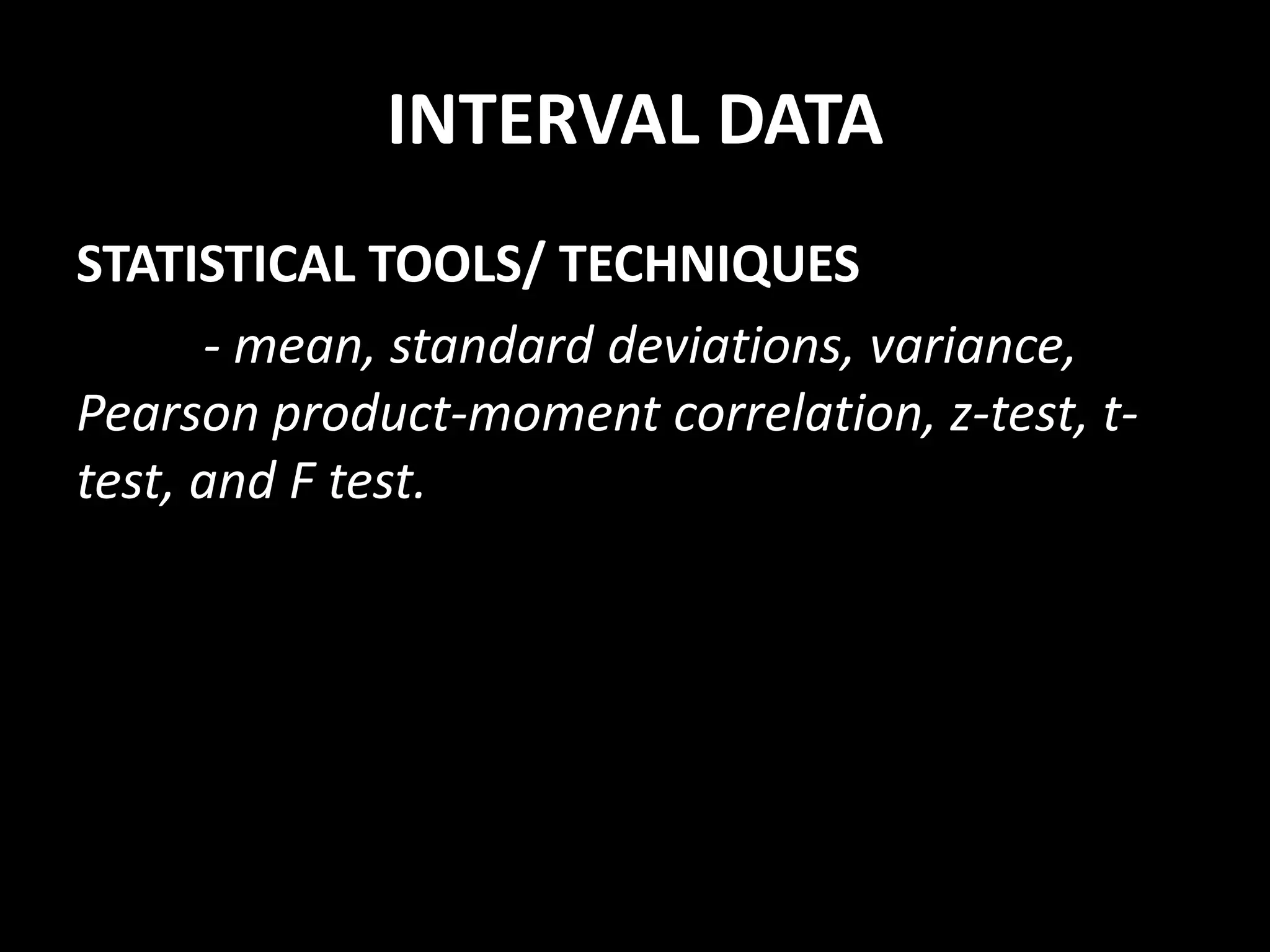
INTERVAL DATA
- share the same properties with those of
ordinal data with one additional property: the
distances between the points or the interval
scale are equal.
Examples: Academic Achievement, Intelligence
test scores, and Personality Test scores
INTERVAL DATA
STATISTICAL TOOLS/ TECHNIQUES
- mean, standard deviations, variance,
Pearson product-moment correlation, z-test, t-
test, and F test.
RATIO DATA
- the highest type of measurement scale
-possesses an actual or true zero point
-mathematical and statistical manipulated
RATIO DATA
STATISTICAL TOOLS/ TECHNIQUES
- mean, standard deviations, variance,
Pearson product-moment correlation, z-test, t-
test, and F test
DEPENDENT AND INDEPENDENT
VARIABLE
Independent Variable is a variable that
affects ( or is presumed to affect) the dependent
variable under study and is included in research
design so that its effect can be determined.
Dependent Variable is one that is affected
or expected to be affected by the independent
variable. (Fraenkel & Wallen, 1993)
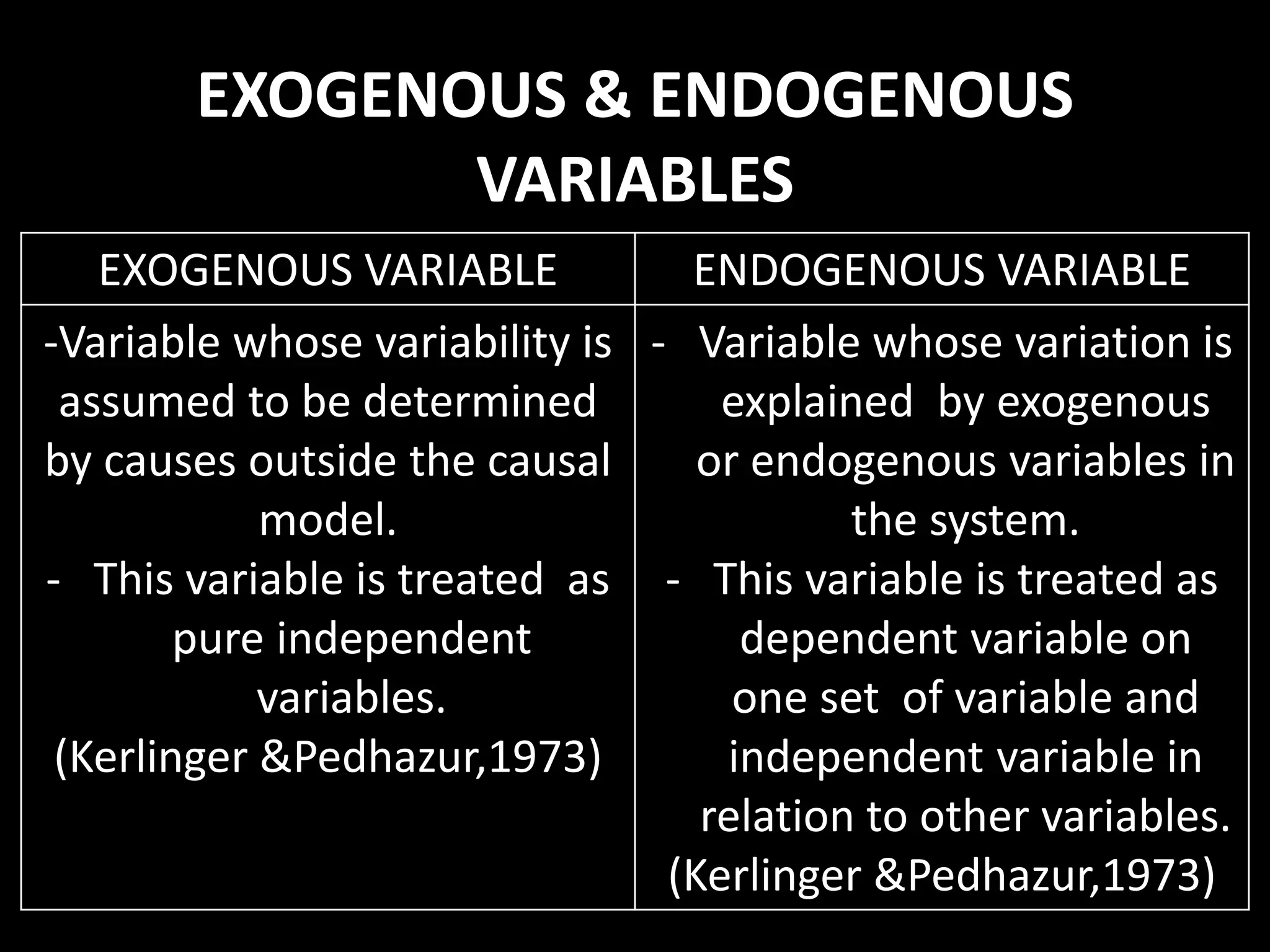
EXOGENOUS & ENDOGENOUS
VARIABLES
EXOGENOUS VARIABLE ENDOGENOUS VARIABLE
-Variable whose variability is
assumed to be determined
by causes outside the causal
model.
- This variable is treated as
pure independent
variables.
(Kerlinger &Pedhazur,1973)
- Variable whose variation is
explained by exogenous
or endogenous variables in
the system.
- This variable is treated as
dependent variable on
one set of variable and
independent variable in
relation to other variables.
(Kerlinger &Pedhazur,1973)
Teacher’s
Educational
Attainment
Teacher’s
Teaching
Competence
Student’s
Academic
Achievement
In a sample illustration above, “teacher’s educational
attainment” is an exogenous variable while “teacher’s
teaching competence” is an endogenous variable.
“Teacher’s teaching competence” acts as dependent
variable with respect to the independent variable
“teacher’s educational attainment”; however, it acts as an
independent variable with respect to the dependent
variable “student’s academic achievement.”
MODERATOR VARIABLE
-it is a secondary independent variable
- it is that factor which is measured,
manipulated or selected by the experimenter to
discover whether it modifies the relationship of the
independent variable to an observed
phenomenon.
Example:
If the researcher is interested in
knowing the effects of the independent
variable X on the dependent variable Y, but
suspects that a third factor Z alters or
modifies the relationship between X & Y, then
Z is considered the moderator variable ( DE
Jesus et al.,1984)
EXTRANEOUS VARIABLES
- Exist in all studies and can affect the
measurement of study variables and the
relationship among these variables (Burns & Grove,
1995)
-They are classified as recognized or
unrecognized and controlled or uncontrolled.
Confounding variables are extraneous
variables which either not recognized until the study
is in progress, or are recognized before the study is
initiated but cannot be controlled.
In some cases this kind of variable can be
measured during the study and can be controlled
statistically during the analysis but in other cases
this cannot be controlled or measured directly.
Intervening variables are confounding
variables that intervene between the cause and
effect.
Example
In a study of students’ demographic
characteristics on their test performance, variables
such as anxiety, fatigue, unpreparedness, or
motivation are called intervening variables.
They cannot be observed directly but they
influence student’s test performance.
ENVIRONMENTAL VARIABLES
- are extraneous variables composing the
setting where the study is conducted, such as
climate, family, health care system, and
governmental organizations (Burns & Grove,
1995).
DEMOGRAPHIC VARIABLES
- these are attributes or characteristics of
subjects or respondents that are gathered to
describe the sample of the study.
- these variables are analyzed to provide a
typical picture of the respondents of the study.
Examples:
Gender Educational Attainment Religion
Age Civil Status Monthly Income
Years of Experience

Section 5 CONCEPTS, CONSTRUCTS & VARIABLES

  • 1.
    SECTION 5 Concepts, Construct& Variables GRACE C. MERINILLO (Masters of Arts in Language Education)
  • 2.
    CONCEPTS - are categoriesor generalization from particular instances - names given to things that share common characteristics -these are intellectual abstractions and creations of the human intellect
  • 3.
    Example: Try thisexercise: What concepts are suggested by the following instances? I. (a)honey (d) syrup (b) brandy (e) milk (c) water (f) oil II. (a)sunny (b) strong wind skies (c) cloudyskies (d) rain
  • 4.
    CONSTRUCT - is aconcept that has been deliberately and consciously invented or adopted for a specific purpose (Kerlinger, 1973) - is impossible to observe directly and is in higher-order concepts, which are considered complex
  • 5.
    CONCEPTS CONSTRUCTS Income &Educational Attainment Socio-economic Status Love between parents, Love between siblings, Love between friends, Love of God Love
  • 6.
  • 7.
    Being variably defined,constructs serve as major points for understanding a research problem. However , many students of research find it difficult to conceptualize their studies because of lack of basic understanding about how constructs behave with respect to a problem.
  • 8.
    The process of“pinning down” the construct has to begin by realizing that whatever the researcher would like to measure the indicants of some property of the objects or entities.
  • 9.
    Van Dalen (1979)concretizes it with the following example: “A student cannot be measured , but indicants of his weight, intellectual capacity, achievement in Mathematics, punctuality, and other properties can be”
  • 10.
    Property - A conceptor logical construct that describes particular characteristics which is common to all members of a set, but on which members of a set vary. Example: Punctuality
  • 11.
    Indicants - Something thatpoints to the property and helps define it. Example: (a) Is never late for class (b) Hands in term of paper on or before the due date (c) is among the first people to arrive for meeting
  • 12.
    Determining the constructsas a property in terms of indicants is called “operationalizing of a construct or concept”. This process is necessary so that the researcher would be able to progress on his research plans from the realm of theory to the realm of practical investigation. In this way, constructs are rendered more measurable and become referred to as “variable”
  • 13.
    VARIABLES - are conceptsthat assume more than one value - are qualities, properties or characteristics of persons, things , or situations that change or vary (Burns and Grove, 1995)
  • 14.
    Two kinds ofa Variable ( Kerlinger, 1993) 1. Measured Operational Definition 2. Experimental Operational Definition
  • 15.
    Measured Operational Definition -describes how a variable will be measured Experimental Operational Definition - spells out the details (operations) that the researcher’s manipulations of the variable
  • 16.
    Example: (MOD) Variable Definition 1.Achievement 1. (a) Standardized achievement test score (b) Teacher-made achievement test score (c) Grades 2. Intelligence 2. I.Q test 3. Attitude 3. Scores on an attitude scale
  • 17.
    Example: (EOD) Variable Definition 1.Reinforcement 1. Describes how the subjects of the research to be reinforced (rewarded) or not reinforced.
  • 18.
    It is clearthat constructs cannot be directly seen and are not easily quantifiable, their presence may be inferred from their operational definitions.
  • 19.
    KINDS OF VARIABLES -Attribute & Active Variables -Continuous & Discrete Variables - Two-Category & Multiple Category Variables
  • 20.
    1. How oldare you? 2. Are you a boy or a girl? 3. What is your height ?( ___ in meters). Would you describe yourself as a “tall” or “short”? 4. What is your weight? 5. To what
  • 21.
    Attribute Variable ActiveVariable Traits & characteristics Manipulative variable Intelligence, status & attitude Usually defined in terms of an EOD Organization & inanimate objects Non– manipulative variable Measured variable
  • 22.
    Continuous Variable DiscreteVariable Variables that exists a continuous range of values Measurement and classification are possible only in whole units Ranges from smallest to the largest possible amount Measurement is theoretically possible at any point along continuum
  • 23.
    Two-Category Variable or DichotomousVariable Example: Gender (boy or girl) Religion (Catholic or non Catholic) Ethnic group (Tagalog or non- Tagalog)
  • 24.
    Multiple Category Variables Example: Religion(Catholicism, Islam, Buddhism or Protestantism)
  • 25.
    These Two-Category Variables(Dichotomous Variable) & Multiple Variables are expressed in terms in discrete and continuous categories. Example: Continuous &multiple categories -Height (tall, average, or short) -Weight (heavy, average, or light)
  • 26.
    Variable Traits - Exhaustive (includesall possible answerable responses) - Mutually exclusive (no respondents should be able to have two attributes simultaneously)
  • 27.
    Types of DataAccording to Measurement Scale Used Nominal Data Ordinal Data Interval Data Ratio Data
  • 28.
    Nominal Data Categories ofqualitative variables like gender, religion, and marital status maybe assigned to numerical codes in order to identify the members with in a given class. Example: 1- Male Gender = 2- Female
  • 29.
    Nominal Data - thesecodes for nominal data do not possess arithmetic properties such as equality and inequality. STATISTICAL TOOLS/ TECHNIQUES -chi-squares test, and the contingency coefficient
  • 30.
    ORDINAL DATA -Ordinal dataare those that may be ordered in some way, highest to lowest or vice versa. - They reflect the rank order of the individual rank. Example:
  • 31.
    ORDINAL DATA STATISTICAL TOOLS/TECHNIQUES - median, centiles, Spearman rank-order correlation coefficient, Kendall’s tau, Kendall’s coefficient of concordance, Mann-Whitney U test, & Kruskal-Walls One-Way Analysis of Variance
  • 32.
    INTERVAL DATA - sharethe same properties with those of ordinal data with one additional property: the distances between the points or the interval scale are equal. Examples: Academic Achievement, Intelligence test scores, and Personality Test scores
  • 33.
    INTERVAL DATA STATISTICAL TOOLS/TECHNIQUES - mean, standard deviations, variance, Pearson product-moment correlation, z-test, t- test, and F test.
  • 34.
    RATIO DATA - thehighest type of measurement scale -possesses an actual or true zero point -mathematical and statistical manipulated
  • 35.
    RATIO DATA STATISTICAL TOOLS/TECHNIQUES - mean, standard deviations, variance, Pearson product-moment correlation, z-test, t- test, and F test
  • 36.
    DEPENDENT AND INDEPENDENT VARIABLE IndependentVariable is a variable that affects ( or is presumed to affect) the dependent variable under study and is included in research design so that its effect can be determined. Dependent Variable is one that is affected or expected to be affected by the independent variable. (Fraenkel & Wallen, 1993)
  • 37.
    EXOGENOUS & ENDOGENOUS VARIABLES EXOGENOUSVARIABLE ENDOGENOUS VARIABLE -Variable whose variability is assumed to be determined by causes outside the causal model. - This variable is treated as pure independent variables. (Kerlinger &Pedhazur,1973) - Variable whose variation is explained by exogenous or endogenous variables in the system. - This variable is treated as dependent variable on one set of variable and independent variable in relation to other variables. (Kerlinger &Pedhazur,1973)
  • 38.
    Teacher’s Educational Attainment Teacher’s Teaching Competence Student’s Academic Achievement In a sampleillustration above, “teacher’s educational attainment” is an exogenous variable while “teacher’s teaching competence” is an endogenous variable. “Teacher’s teaching competence” acts as dependent variable with respect to the independent variable “teacher’s educational attainment”; however, it acts as an independent variable with respect to the dependent variable “student’s academic achievement.”
  • 39.
    MODERATOR VARIABLE -it isa secondary independent variable - it is that factor which is measured, manipulated or selected by the experimenter to discover whether it modifies the relationship of the independent variable to an observed phenomenon.
  • 40.
    Example: If the researcheris interested in knowing the effects of the independent variable X on the dependent variable Y, but suspects that a third factor Z alters or modifies the relationship between X & Y, then Z is considered the moderator variable ( DE Jesus et al.,1984)
  • 41.
    EXTRANEOUS VARIABLES - Existin all studies and can affect the measurement of study variables and the relationship among these variables (Burns & Grove, 1995) -They are classified as recognized or unrecognized and controlled or uncontrolled.
  • 42.
    Confounding variables areextraneous variables which either not recognized until the study is in progress, or are recognized before the study is initiated but cannot be controlled. In some cases this kind of variable can be measured during the study and can be controlled statistically during the analysis but in other cases this cannot be controlled or measured directly. Intervening variables are confounding variables that intervene between the cause and effect.
  • 43.
    Example In a studyof students’ demographic characteristics on their test performance, variables such as anxiety, fatigue, unpreparedness, or motivation are called intervening variables. They cannot be observed directly but they influence student’s test performance.
  • 44.
    ENVIRONMENTAL VARIABLES - areextraneous variables composing the setting where the study is conducted, such as climate, family, health care system, and governmental organizations (Burns & Grove, 1995).
  • 45.
    DEMOGRAPHIC VARIABLES - theseare attributes or characteristics of subjects or respondents that are gathered to describe the sample of the study. - these variables are analyzed to provide a typical picture of the respondents of the study. Examples: Gender Educational Attainment Religion Age Civil Status Monthly Income Years of Experience