MAULANA AZAD INSTITUTE OF
PHARMACY (JODHPUR)
SUBMITED BY
TONI BLAIR
VIKRAM PATEL
VIVEK VISHNOI
PUSHPA
RUKHSAR
SUBMITED TO
DR. NEETU SONI MA’AM
ESTIMATIONS
CONTENT
ESTIMATION OF SODIUM BENZOATE
ESTIMATION OF EPHEDRINE HYDRO-
CHLORIC ACID
ESTIMATION OF SODIUM CHLORIDE
ESTIMATION OF CALCIUM GLUCONATE
ESTIMATION OF BARIUM SULPHATE
NON AQUEOUS SOLVENT
ESTIMATION OF SODIUM BENZOATE
Molecular formula :- C7H5NaO2
Molecular weight :- 144.1 gm/mole
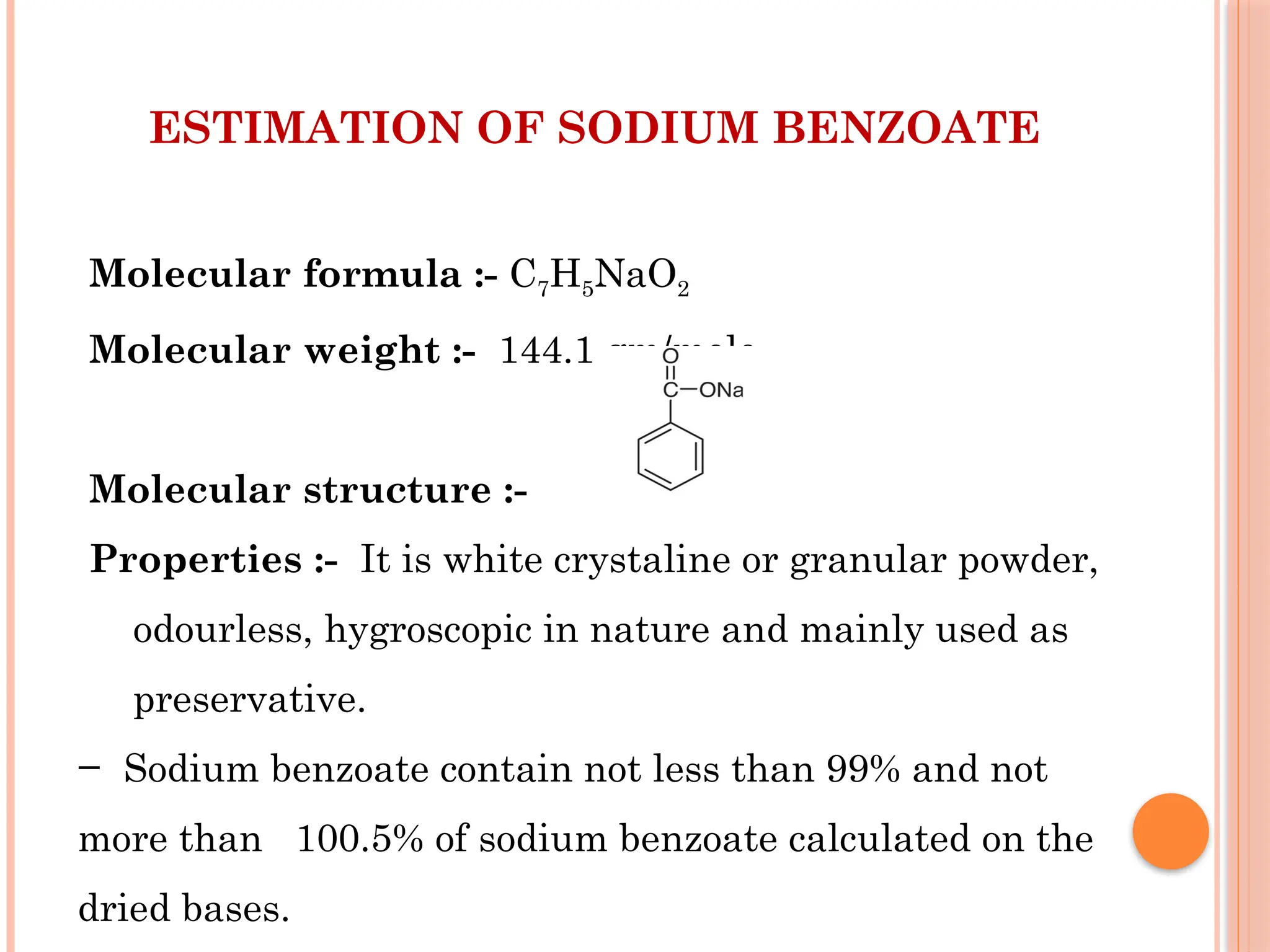
Molecular structure :-
Properties :- It is white crystaline or granular powder,
odourless, hygroscopic in nature and mainly used as
preservative.
− Sodium benzoate contain not less than 99% and not
more than 100.5% of sodium benzoate calculated on the
dried bases.
PRINCIPLE :-
 It is based on non aqueous titration.
 It is an acidimetry titration in which measure
amount of acid ( perchloric acid ) used in titration
for analysis of base ( soium bezoate ) using
nepthenol bezode solution as an indicator.
 Glacial acetic acid used as solvent to dissolved
sodium bezoate.
PREPARATION OF 0.1 N SOLUTION OF
PERCHLORIC ACID :-
 Dissolve 8.5ml of perchloric acid in 900ml glacial acetic
acid and add about 90ml acetic anhydride and make up
the volume 1000ml with glacial acetic acid and keep the
mixture for 24 hours.
 Acetic anhydride absorb all the water from perchloric acid
and glacial acetic acid
 Perchloric acid must be well diluted with glacial acetic
acid before adding acetic anhydride because reaction
between perchloric acid and acetic anhydride is explosive.
STANDARLIZATION OF PERCHLORIC ACID
:-
 To 500mg of potassium pthalate with 25ml of
glacial acetic acid and add crystal violet .
 The solution is titrated with 0.1 N perchloric acid.
 The colour changes from blue to blue green.
 indicator are used in 1- nephtholbenzein solution
PER CHLORIC ACID
SODIUM BENZOATE + INDICATOR
ASSAY PROCEDURE :-
 Weigh accurately about 0.25gm or sodium benzoate
dissolve in 20ml glacial acetic acid then warm at 50
degree C then cool the solution.
 Titrated with 0.1 N perchloric acid using 0.05ml of
naphthol benzene solution as an indicator carry out a
blank titration.
 End point is dark green.
 EQUIVALENT POINT :- 1ml of perchloric acid is
equivalent to 0.01441gm of sodium benzoate.
ESTIMATION OF EPHEDRINE
HYDROCHLORIC ACID
 Molecular formula :- C10H15NO.
HCl
 Molecular weight :- 201.7 gm/mole
 Ephedrine hydrochloride contain not less then
99% and not more then 101% of C10H15NO.
HCl
calculated on the dried bases.
 Description :- Colourless crystal or a white
crystalline powder odourless and it is affected by
light.
PRINCIPLE :-
 Assay of ephedrine hydrochloride based on non
aqueous titration.
 In this titration ephedrine act as base and
perchloric act as acid.
 Glacial acetic acid act as solvent to dissolve
ephedrine.
PREPARATION OF 0.1 N SOLUTION OF
PERCHLORIC ACID :-
 Dissolve 8.5ml of perchloric acid in 900ml glacial
acetic acid and add about 90ml acetic anhydride
and make up the volume 1000ml with glacial
acetic acid and keep the mixture for 24 hours.
PREPARATION OF 0.1 N SOLUTION OF
PERCHLORIC ACID :-
 Acetic anhydride absorb all the water from
perchloric acid and glacial acetic acid
 Perchloric acid must be well diluted with glacial
acetic acid before adding acetic anhydride because
reaction between perchloric acid and acetic
anhydride is explosive.
STANDARLIZATION OF PERCHLORIC ACID :-
 To 500mg of potassium pthalate with 25ml of
glacial acetic acid and add crystal violet .
 The solution is titrated with 0.1 N perchloric acid.
 The colour changes from blue to blue green.
ASSAY PROCEDURE :-
 Weigh 0.17gm of ephedrine HCl dissolve in 10ml
of mercuric acetate solution warm gently.
 Add 50ml of acetone and mix then titrated with
0.1 N HClO4 using 1ml of saturated solution
methyl orange in acetone as indicator until the
red colour is obtained.
EQUIVALENT FACTOR :- 1ml of 0.1 N perchloric
acid is equivalent to 0.02017 gm ephedrine HCl.
ESTIMATION OF SODIUM CHLORIDE
 Molecular weight :- 58.44 gm/mole
 Molecular formula :- NaCl
 Solubility :- water, ammonia, ethanol,
methanol, glycerol, formic acid etc.
 Equlivalent weight :- 58.5
 Description :- it is a crystalline solid white
odourless. In its aqueous form called saline
solution.
 This compound is water soluble and
consists of sodium cation and chloride
anion.
PRINCIPLE :-
Assay of sodium chloride solution is carried out by standard
silver nitrate solution and method is based on the principle of
precipitation.
AgNO3 + NaCl AgCl + NaNO3
Indicator :- 5% potassium chromate K2CrO4 (for formation of PPT of
reddish – brown Ag2CrO4
2AgNO3 + K2CrO4 Ag2CrO4 + 2KNO3
PREPARATION OF REAGENTS
Preparation of 0.1N AgNO3
Take about 100 ml of water in a cleaned and dried
1000ml volumetric flask
Add about 16.989gm of silver nitrate with
continues stirring.
Add more about 700 ml of distilled water, mix.
Make up the volume 1000ml with water. Mix
solution thoroughly.
Keep the solution for at least one hour and then
carry out the standardization.
Silver Nitrate Solution Standardization Transfer about
50 mg, of reagent sodium chloride, previously dried at
110° for 2 hours, to a 150-ml conical flask.
Dissolve in 5 ml of distilled water.
Add 2.5 ml of acetic acid, 25 ml of methanol, and
about 0.25 ml of Eosin Y indicator.
Stir, preferably with a magnetic stirrer.
Titrate with the silver nitrate solution.
Calculate the molarity of solution by the following
formula:-
NaCl in mg M = --------------------------- AgNO3 in ml x 58.44
STANDARLIZATION
Dissolve 50mg of Sodium Chloride, accurately
weighed, in water, and dilute with water to
50mL.
Titrate with 0.1 N silver nitrate VS, determining
the endpoint.
1ml of 0.1 m AgNO3 is equivalent to 0.005844g
of NaCl.
Potassium chromate is used as indicator.
ASSAY
ESTIMATION OF MAGNESIUM SULPHATE
 Molecular formula :- MgSO4
 Molecular weight :- 120.36 gm/mole
 Description :- Colourless crystals or white
crystalline powder.
 MgSO4 is also known as Epsom salt.
 It contains not less than 99% and not more than
100.5% of MgSO4 calculated on the dried basis.
PRINCIPLE :-
 It is a complexometric titration which involves
titration of magnesium sulphate against
disodium edatate using mordant black 2 as an
indicator.
PREPARATION OF 0.05 M DISODIUM EDETATE :-
 Dissolve 18.6gm of disodium edetate in 1000ml
water.
STANDARLIZATION OF DISODIUM
EDETATE :-
 Weigh accurately about 0.8gm of granulated zinc
dissolve by gentle warming in 12ml dilute HCl
and 0.1ml bromine water. Boil to remove excess
bromine, cool and add sufficient water to produce
200ml.
 10ml of above solution into a conical flask and
neutralize with 2 M NaOH . Dilute to about 75ml
with water, add sufficient ammonia to dissolve
the precipitate and add 5ml oin excess. Add 50mg
of mordant black-2 as an indicator and titrate
with 0.05 M disodium edetate solution until the
solution turns green.
ASSAY PROCEDURE :-
 Weigh accurately 0.3gm of magnesium sulphate
and dissolve in 50ml of distilled water and add
10ml of strong ammonia- ammonium chloride
solution and titrate with 0.05 M disodium
edetate using mordant black-2 mixture as an
indicator, until pink colour changes to blue
colour.
EQUIVALENT POINT :- 1ml 0.05 M disodium
edetate is equivalent to 0.00602 gm of MgSO4 .
ESTIMATION OF CALCIUM GLUCONATE
 Molecular formula :- C12H22CaO14
.
H2O
 Molecular weight :- 448.40 gm/mole
 Description :- It occurs as white crystalline powder or
granules.
 It contains not less than 98.5 % and not more than 102 % of
C12H22CaO14
.
H2O.
 It is used to treat bone related diseases and in decreased
activity of parathyroid gland.
 Estimation of calcium gluconate can be done by using
titrimetric analysis.
PRINCIPLE IT IS A COMPLEXOMETRIC
TITRATION WHICH INVOLVES REPLACEMENT OF
MAGNESIUM ION FROM ITS MG IN COMPLEX.
PREPARATION OF 0.05 M DISODIUM EDETATE :-
 Dissolve 18.6 gm of disodium edetate in 1000ml
water.
 Weigh accurately about 0.8gm of granulated zinc
dissolve by gentle warming in 12ml dilute HCl
and 0.1ml bromine water. Boil to remove excess
bromine, cool and add sufficient water to produce
200ml.
 10ml of above solution into a conical flask and
neutralize with 2 M NaOH . Dilute to about 75ml
with water, add sufficient ammonia to dissolve
the precipitate and add 5ml oin excess. Add 50mg
of mordant black-2 as an indicator and titrate
with 0.05 M disodium edetate solution until the
solution turns green.
STANDARLIZATION OF DISODIUM
EDETATE :-
ASSAY PROCEDURE :-
 Weigh accurately 0.5 gm calcium gluconate and
dissolve in 50ml of warm water, cool, add 5ml of
0.05 M magnesium sulphate and 10ml of strong
ammonia solution and titrate with 0.05 M
disodium etetate using mordant black-2 as
indicator till colour changes from pink to blue.
EQUIVALENT POINT :- 1ml 0.05 M disodium edeteta
is equivalent to 0.002242gm of calcium gluconate.
ESTIMATION OF BARIUM SULPHATE
Formula: BaSO4
Molar mass: 233.38 g/mol
Density: 4.5 g/cm³
Melting point: 1,580 °C
Soluble in: Sulfuric acid
Classification: Sulfate
decription: Barium sulfate is the inorganic compound
with the chemDesical formula BaSO₄. It is a white
crystalline solid that is odorless and insoluble in water. It
occurs as the mineral barite, which is the main
commercial source of barium and materials prepared
from
The Gravimetric Estimation of Barium:
The given barium chloride solution is made up to
a definite volume.
A measured volume of it is then treated with
dilute sulphuric acid and then treated with dilute
sulphuric acid and barium precipitated as
barium sulphate.
BaCl2 + H2SO4 BaSO4 + 2HCl
The precipitated barium sulphate is separated
and weighed.
PRINCIPLE
The mass of barium in solution is calculated that
233.36g of BaSO4 contains 137.36g of barium.
NON AQUEOUS SOLVENT
 Solvents which are used in non aqueous titration
are called as non-aqueous solvent because in the
aqueous solvent the weak acidic drug and weak
base drug cannot dissociate 100%, so we are
using non-aqueous solvent.
TYPES OF NON-AQUEOUS SOLVENT :-
I. Protogenic solvent
II. Protophillic solvent
III. Aprotic solvent
IV. Amphiprolic solvent
1. PROTOGENIC SOLVENT :-
 Proto – proton
Genic – H+
ions release.
 They are acidic in nature, so they are used in
weak basic nature.
ex. – HNO3 and H2SO4
 Anhydrous acid such as HF ( hydrogen fluriod )
due to their strength and ability to donate
proton.
 They enhance the strength of weak base.
2. PROTOPHILLIC SOLVENT :-
 Proto – proton
Phillic – acceptor
 They are basic in nature and these are the
substances they are high affinity of protons.
 So they are used for weak acidic drug.
 Ex. – Strong acid such as perchloric acid exhibit
more strongly acidic property then a weak acid
such as acetic acid when dissolve in weakly basic
solvent . Ex. – BH2 , NH3 .
3. APROTIC SOLVENT :-
 These type of solvent is neither accept nor donate
protons.
 They are neither acidic nor basic , they are in
neutral form and they are used in non-polar drugs..
Ex. – benzene, chloroform, carban tetra chloride.
 Picric acid gives a colourless solution , when
dissolve in benzene and becomes yellow on adding
aniline , so picric acid is not dissociated in benzene
but in the presence of the base aniline, it function
as an acid the development of yellow colour being
due to formation of the picrate ion.
4. AMPHIPROTIC SOLVENT :-
 Amphi – dual nature
Phillic _ acceptor or donator
 So they are both protophillic and protogenic
property in being able to donate and accept
proton.
Ex. – water, acetic acid, and alcohol.
EXAMPLES OF NON-AQUEOUS
SOLVENT
1. Glacial acetic acid :- It is the most frequently
used for non-aqueous solvent, before it is used, it is
advisible to check the water content. This may be
between 0.1 – 10 % .
2. Acetonitrile :- It is used with other solvent such
as chloroform and phenol, specially with acetic
acid. It gives very sharp end point in the titration
of metal accetate when titrated with perchloric
acid.
EXAMPLES OF NON-AQUEOUS SOLVENT :-
3. Alcohol :- It is mainly used for the
determination of salt of organic acid. Specially
of soaps in mixtures of glycols and alcohols acid.
4. DMF ( Dimethyl formamide ) :- DMF is a
protophillic solvent which is used for titration
between organic compound such as benzoic acid
and amids.

Pharmaceutical analysis estimations and their chemical analysis

  • 1.
    MAULANA AZAD INSTITUTEOF PHARMACY (JODHPUR) SUBMITED BY TONI BLAIR VIKRAM PATEL VIVEK VISHNOI PUSHPA RUKHSAR SUBMITED TO DR. NEETU SONI MA’AM ESTIMATIONS
  • 2.
    CONTENT ESTIMATION OF SODIUMBENZOATE ESTIMATION OF EPHEDRINE HYDRO- CHLORIC ACID ESTIMATION OF SODIUM CHLORIDE ESTIMATION OF CALCIUM GLUCONATE ESTIMATION OF BARIUM SULPHATE NON AQUEOUS SOLVENT
  • 3.
    ESTIMATION OF SODIUMBENZOATE Molecular formula :- C7H5NaO2 Molecular weight :- 144.1 gm/mole Molecular structure :- Properties :- It is white crystaline or granular powder, odourless, hygroscopic in nature and mainly used as preservative. − Sodium benzoate contain not less than 99% and not more than 100.5% of sodium benzoate calculated on the dried bases.
  • 4.
    PRINCIPLE :-  Itis based on non aqueous titration.  It is an acidimetry titration in which measure amount of acid ( perchloric acid ) used in titration for analysis of base ( soium bezoate ) using nepthenol bezode solution as an indicator.  Glacial acetic acid used as solvent to dissolved sodium bezoate.
  • 5.
    PREPARATION OF 0.1N SOLUTION OF PERCHLORIC ACID :-  Dissolve 8.5ml of perchloric acid in 900ml glacial acetic acid and add about 90ml acetic anhydride and make up the volume 1000ml with glacial acetic acid and keep the mixture for 24 hours.  Acetic anhydride absorb all the water from perchloric acid and glacial acetic acid  Perchloric acid must be well diluted with glacial acetic acid before adding acetic anhydride because reaction between perchloric acid and acetic anhydride is explosive.
  • 6.
    STANDARLIZATION OF PERCHLORICACID :-  To 500mg of potassium pthalate with 25ml of glacial acetic acid and add crystal violet .  The solution is titrated with 0.1 N perchloric acid.  The colour changes from blue to blue green.  indicator are used in 1- nephtholbenzein solution PER CHLORIC ACID SODIUM BENZOATE + INDICATOR
  • 7.
    ASSAY PROCEDURE :- Weigh accurately about 0.25gm or sodium benzoate dissolve in 20ml glacial acetic acid then warm at 50 degree C then cool the solution.  Titrated with 0.1 N perchloric acid using 0.05ml of naphthol benzene solution as an indicator carry out a blank titration.  End point is dark green.  EQUIVALENT POINT :- 1ml of perchloric acid is equivalent to 0.01441gm of sodium benzoate.
  • 8.
    ESTIMATION OF EPHEDRINE HYDROCHLORICACID  Molecular formula :- C10H15NO. HCl  Molecular weight :- 201.7 gm/mole  Ephedrine hydrochloride contain not less then 99% and not more then 101% of C10H15NO. HCl calculated on the dried bases.  Description :- Colourless crystal or a white crystalline powder odourless and it is affected by light.
  • 9.
    PRINCIPLE :-  Assayof ephedrine hydrochloride based on non aqueous titration.  In this titration ephedrine act as base and perchloric act as acid.  Glacial acetic acid act as solvent to dissolve ephedrine. PREPARATION OF 0.1 N SOLUTION OF PERCHLORIC ACID :-  Dissolve 8.5ml of perchloric acid in 900ml glacial acetic acid and add about 90ml acetic anhydride and make up the volume 1000ml with glacial acetic acid and keep the mixture for 24 hours.
  • 10.
    PREPARATION OF 0.1N SOLUTION OF PERCHLORIC ACID :-  Acetic anhydride absorb all the water from perchloric acid and glacial acetic acid  Perchloric acid must be well diluted with glacial acetic acid before adding acetic anhydride because reaction between perchloric acid and acetic anhydride is explosive. STANDARLIZATION OF PERCHLORIC ACID :-  To 500mg of potassium pthalate with 25ml of glacial acetic acid and add crystal violet .  The solution is titrated with 0.1 N perchloric acid.  The colour changes from blue to blue green.
  • 11.
    ASSAY PROCEDURE :- Weigh 0.17gm of ephedrine HCl dissolve in 10ml of mercuric acetate solution warm gently.  Add 50ml of acetone and mix then titrated with 0.1 N HClO4 using 1ml of saturated solution methyl orange in acetone as indicator until the red colour is obtained. EQUIVALENT FACTOR :- 1ml of 0.1 N perchloric acid is equivalent to 0.02017 gm ephedrine HCl.
  • 12.
    ESTIMATION OF SODIUMCHLORIDE  Molecular weight :- 58.44 gm/mole  Molecular formula :- NaCl  Solubility :- water, ammonia, ethanol, methanol, glycerol, formic acid etc.  Equlivalent weight :- 58.5  Description :- it is a crystalline solid white odourless. In its aqueous form called saline solution.  This compound is water soluble and consists of sodium cation and chloride anion.
  • 13.
    PRINCIPLE :- Assay ofsodium chloride solution is carried out by standard silver nitrate solution and method is based on the principle of precipitation. AgNO3 + NaCl AgCl + NaNO3 Indicator :- 5% potassium chromate K2CrO4 (for formation of PPT of reddish – brown Ag2CrO4 2AgNO3 + K2CrO4 Ag2CrO4 + 2KNO3
  • 14.
    PREPARATION OF REAGENTS Preparationof 0.1N AgNO3 Take about 100 ml of water in a cleaned and dried 1000ml volumetric flask Add about 16.989gm of silver nitrate with continues stirring. Add more about 700 ml of distilled water, mix. Make up the volume 1000ml with water. Mix solution thoroughly. Keep the solution for at least one hour and then carry out the standardization.
  • 15.
    Silver Nitrate SolutionStandardization Transfer about 50 mg, of reagent sodium chloride, previously dried at 110° for 2 hours, to a 150-ml conical flask. Dissolve in 5 ml of distilled water. Add 2.5 ml of acetic acid, 25 ml of methanol, and about 0.25 ml of Eosin Y indicator. Stir, preferably with a magnetic stirrer. Titrate with the silver nitrate solution. Calculate the molarity of solution by the following formula:- NaCl in mg M = --------------------------- AgNO3 in ml x 58.44 STANDARLIZATION
  • 16.
    Dissolve 50mg ofSodium Chloride, accurately weighed, in water, and dilute with water to 50mL. Titrate with 0.1 N silver nitrate VS, determining the endpoint. 1ml of 0.1 m AgNO3 is equivalent to 0.005844g of NaCl. Potassium chromate is used as indicator. ASSAY
  • 17.
    ESTIMATION OF MAGNESIUMSULPHATE  Molecular formula :- MgSO4  Molecular weight :- 120.36 gm/mole  Description :- Colourless crystals or white crystalline powder.  MgSO4 is also known as Epsom salt.  It contains not less than 99% and not more than 100.5% of MgSO4 calculated on the dried basis.
  • 18.
    PRINCIPLE :-  Itis a complexometric titration which involves titration of magnesium sulphate against disodium edatate using mordant black 2 as an indicator. PREPARATION OF 0.05 M DISODIUM EDETATE :-  Dissolve 18.6gm of disodium edetate in 1000ml water.
  • 19.
    STANDARLIZATION OF DISODIUM EDETATE:-  Weigh accurately about 0.8gm of granulated zinc dissolve by gentle warming in 12ml dilute HCl and 0.1ml bromine water. Boil to remove excess bromine, cool and add sufficient water to produce 200ml.  10ml of above solution into a conical flask and neutralize with 2 M NaOH . Dilute to about 75ml with water, add sufficient ammonia to dissolve the precipitate and add 5ml oin excess. Add 50mg of mordant black-2 as an indicator and titrate with 0.05 M disodium edetate solution until the solution turns green.
  • 20.
    ASSAY PROCEDURE :- Weigh accurately 0.3gm of magnesium sulphate and dissolve in 50ml of distilled water and add 10ml of strong ammonia- ammonium chloride solution and titrate with 0.05 M disodium edetate using mordant black-2 mixture as an indicator, until pink colour changes to blue colour. EQUIVALENT POINT :- 1ml 0.05 M disodium edetate is equivalent to 0.00602 gm of MgSO4 .
  • 21.
    ESTIMATION OF CALCIUMGLUCONATE  Molecular formula :- C12H22CaO14 . H2O  Molecular weight :- 448.40 gm/mole  Description :- It occurs as white crystalline powder or granules.  It contains not less than 98.5 % and not more than 102 % of C12H22CaO14 . H2O.  It is used to treat bone related diseases and in decreased activity of parathyroid gland.  Estimation of calcium gluconate can be done by using titrimetric analysis.
  • 22.
    PRINCIPLE IT ISA COMPLEXOMETRIC TITRATION WHICH INVOLVES REPLACEMENT OF MAGNESIUM ION FROM ITS MG IN COMPLEX. PREPARATION OF 0.05 M DISODIUM EDETATE :-  Dissolve 18.6 gm of disodium edetate in 1000ml water.
  • 23.
     Weigh accuratelyabout 0.8gm of granulated zinc dissolve by gentle warming in 12ml dilute HCl and 0.1ml bromine water. Boil to remove excess bromine, cool and add sufficient water to produce 200ml.  10ml of above solution into a conical flask and neutralize with 2 M NaOH . Dilute to about 75ml with water, add sufficient ammonia to dissolve the precipitate and add 5ml oin excess. Add 50mg of mordant black-2 as an indicator and titrate with 0.05 M disodium edetate solution until the solution turns green. STANDARLIZATION OF DISODIUM EDETATE :-
  • 24.
    ASSAY PROCEDURE :- Weigh accurately 0.5 gm calcium gluconate and dissolve in 50ml of warm water, cool, add 5ml of 0.05 M magnesium sulphate and 10ml of strong ammonia solution and titrate with 0.05 M disodium etetate using mordant black-2 as indicator till colour changes from pink to blue. EQUIVALENT POINT :- 1ml 0.05 M disodium edeteta is equivalent to 0.002242gm of calcium gluconate.
  • 25.
    ESTIMATION OF BARIUMSULPHATE Formula: BaSO4 Molar mass: 233.38 g/mol Density: 4.5 g/cm³ Melting point: 1,580 °C Soluble in: Sulfuric acid Classification: Sulfate decription: Barium sulfate is the inorganic compound with the chemDesical formula BaSO₄. It is a white crystalline solid that is odorless and insoluble in water. It occurs as the mineral barite, which is the main commercial source of barium and materials prepared from
  • 26.
    The Gravimetric Estimationof Barium: The given barium chloride solution is made up to a definite volume. A measured volume of it is then treated with dilute sulphuric acid and then treated with dilute sulphuric acid and barium precipitated as barium sulphate. BaCl2 + H2SO4 BaSO4 + 2HCl The precipitated barium sulphate is separated and weighed. PRINCIPLE The mass of barium in solution is calculated that 233.36g of BaSO4 contains 137.36g of barium.
  • 27.
    NON AQUEOUS SOLVENT Solvents which are used in non aqueous titration are called as non-aqueous solvent because in the aqueous solvent the weak acidic drug and weak base drug cannot dissociate 100%, so we are using non-aqueous solvent. TYPES OF NON-AQUEOUS SOLVENT :- I. Protogenic solvent II. Protophillic solvent III. Aprotic solvent IV. Amphiprolic solvent
  • 28.
    1. PROTOGENIC SOLVENT:-  Proto – proton Genic – H+ ions release.  They are acidic in nature, so they are used in weak basic nature. ex. – HNO3 and H2SO4  Anhydrous acid such as HF ( hydrogen fluriod ) due to their strength and ability to donate proton.  They enhance the strength of weak base.
  • 29.
    2. PROTOPHILLIC SOLVENT:-  Proto – proton Phillic – acceptor  They are basic in nature and these are the substances they are high affinity of protons.  So they are used for weak acidic drug.  Ex. – Strong acid such as perchloric acid exhibit more strongly acidic property then a weak acid such as acetic acid when dissolve in weakly basic solvent . Ex. – BH2 , NH3 .
  • 30.
    3. APROTIC SOLVENT:-  These type of solvent is neither accept nor donate protons.  They are neither acidic nor basic , they are in neutral form and they are used in non-polar drugs.. Ex. – benzene, chloroform, carban tetra chloride.  Picric acid gives a colourless solution , when dissolve in benzene and becomes yellow on adding aniline , so picric acid is not dissociated in benzene but in the presence of the base aniline, it function as an acid the development of yellow colour being due to formation of the picrate ion.
  • 31.
    4. AMPHIPROTIC SOLVENT:-  Amphi – dual nature Phillic _ acceptor or donator  So they are both protophillic and protogenic property in being able to donate and accept proton. Ex. – water, acetic acid, and alcohol.
  • 32.
    EXAMPLES OF NON-AQUEOUS SOLVENT 1.Glacial acetic acid :- It is the most frequently used for non-aqueous solvent, before it is used, it is advisible to check the water content. This may be between 0.1 – 10 % . 2. Acetonitrile :- It is used with other solvent such as chloroform and phenol, specially with acetic acid. It gives very sharp end point in the titration of metal accetate when titrated with perchloric acid.
  • 33.
    EXAMPLES OF NON-AQUEOUSSOLVENT :- 3. Alcohol :- It is mainly used for the determination of salt of organic acid. Specially of soaps in mixtures of glycols and alcohols acid. 4. DMF ( Dimethyl formamide ) :- DMF is a protophillic solvent which is used for titration between organic compound such as benzoic acid and amids.