Primary & Secondary Standard
Presentation by,
Mr. Prashant B. Patil
Assistant Professor
H R Patel Institute of Pharmaceutical Education and Research, Shirpur
 Standards
 In Pharmaceutical Analysis, the word standard means a material
containing a substance of our interest with a known
concentration. We can express this with definite numbers with
proper units.
 Functions
 To provide a reference using which we can determine unknown
concentration of solution
 To standardization of volumetric solutions
 Preparation of secondary standard
 To calibrate an instrument
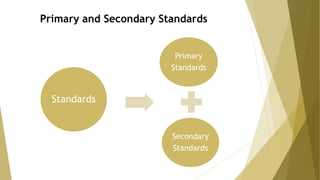
Primary
Standards
Secondary
Standards
Standards
Primary and Secondary Standards
 Primary Standards
 Primary standard is a reagent which is very pure,
generally representative of the number of moles the
substance contains and easily weighed.
 A Primary standard is a reagent that’s stable, it’s not
a hydrate /has no water of hydration, and has a
high molecular weight.
 Primary standards are typically used in titration to determine
an unknown concentration and in other analytical techniques.
 High level of purity, low reactivity (high stability), high
equivalent weight (to reduce error from mass measurements)
 Not hygroscopic (to reduce changes in mass in humid versus dry
environments), non-toxic, inexpensive and readily available
 It should have a high relative molecular weight so that weighing
errors may be negligible.
 The substance should be readily soluble under the conditions in
which it is employed.
 The substance commonly employed as primary standards are
mention below…
 Acid- base reactions: sodium carbonate Na2CO3, sodium
tetraborate Na2B4O7, potassium hydrogenphthalate KH(C8H4O4),
potassium hydrogeniodate KH(IO3)2.
 Complex formation reactions: pure metals ( zinc, copper,
magnesium and manganese) and salts, depending upon the
reaction used.
 Precipitation reactions: silver, silver nitrate, sodium chloride,
potassium chloride and potassium bromide.
 Oxidation- reduction reaction: potassium dichromate
(K2Cr2O7), potassium bromate (KBr), potassium iodate ( KIO3),
sodium oxalate Na2C2O4 and pure iron.
 Secondary standard
 Secondary standard is a chemical that has been
standardized against a primary standard for use in a
specific analysis. Secondary standards are commonly used
to calibrate analytical methods.
 A secondary standard is a substance which may be used
for standardization
 A secondary standard is a standard that is prepared in
the laboratory for a specific analysis. It is usually
standardized against a primary standard.
 It follows that a secondary standard solution is a solution in
which the concentration of dissolved solute has not been
determined from the weight of the compound dissolved but by
reaction (titration) of a volume of the solution against a
measured volume of a primary standard solution.
 A secondary standard is a chemical or reagent which has
certain properties such as….
• It has less purity than primary standard
• Less stable and more reactive than primary standard But
its solution remains stable for a long time
• Titrated against primary standard
 References
• A.H. Beckett & J.B. Stenlake's, Practical Pharmaceutical Chemistry Vol I,
Stahlone Press of University of London
• A.I. Vogel, Text Book of Quantitative Inorganic Analysis
• Bentley and Driver's Textbook of Pharmaceutical Chemistry
• John H. Kennedy, Analytical Chemistry Principles
• Indian Pharmacopoeia & Merck Index
Thank You…!!!

Priamary & Secondary standard

  • 1.
    Primary & SecondaryStandard Presentation by, Mr. Prashant B. Patil Assistant Professor H R Patel Institute of Pharmaceutical Education and Research, Shirpur
  • 2.
     Standards  InPharmaceutical Analysis, the word standard means a material containing a substance of our interest with a known concentration. We can express this with definite numbers with proper units.  Functions  To provide a reference using which we can determine unknown concentration of solution  To standardization of volumetric solutions  Preparation of secondary standard  To calibrate an instrument
  • 3.
  • 4.
     Primary Standards Primary standard is a reagent which is very pure, generally representative of the number of moles the substance contains and easily weighed.  A Primary standard is a reagent that’s stable, it’s not a hydrate /has no water of hydration, and has a high molecular weight.
  • 5.
     Primary standardsare typically used in titration to determine an unknown concentration and in other analytical techniques.  High level of purity, low reactivity (high stability), high equivalent weight (to reduce error from mass measurements)  Not hygroscopic (to reduce changes in mass in humid versus dry environments), non-toxic, inexpensive and readily available  It should have a high relative molecular weight so that weighing errors may be negligible.  The substance should be readily soluble under the conditions in which it is employed.
  • 6.
     The substancecommonly employed as primary standards are mention below…  Acid- base reactions: sodium carbonate Na2CO3, sodium tetraborate Na2B4O7, potassium hydrogenphthalate KH(C8H4O4), potassium hydrogeniodate KH(IO3)2.  Complex formation reactions: pure metals ( zinc, copper, magnesium and manganese) and salts, depending upon the reaction used.
  • 7.
     Precipitation reactions:silver, silver nitrate, sodium chloride, potassium chloride and potassium bromide.  Oxidation- reduction reaction: potassium dichromate (K2Cr2O7), potassium bromate (KBr), potassium iodate ( KIO3), sodium oxalate Na2C2O4 and pure iron.
  • 8.
     Secondary standard Secondary standard is a chemical that has been standardized against a primary standard for use in a specific analysis. Secondary standards are commonly used to calibrate analytical methods.  A secondary standard is a substance which may be used for standardization  A secondary standard is a standard that is prepared in the laboratory for a specific analysis. It is usually standardized against a primary standard.
  • 9.
     It followsthat a secondary standard solution is a solution in which the concentration of dissolved solute has not been determined from the weight of the compound dissolved but by reaction (titration) of a volume of the solution against a measured volume of a primary standard solution.
  • 10.
     A secondarystandard is a chemical or reagent which has certain properties such as…. • It has less purity than primary standard • Less stable and more reactive than primary standard But its solution remains stable for a long time • Titrated against primary standard
  • 11.
     References • A.H.Beckett & J.B. Stenlake's, Practical Pharmaceutical Chemistry Vol I, Stahlone Press of University of London • A.I. Vogel, Text Book of Quantitative Inorganic Analysis • Bentley and Driver's Textbook of Pharmaceutical Chemistry • John H. Kennedy, Analytical Chemistry Principles • Indian Pharmacopoeia & Merck Index
  • 12.