Gravimetric Analysis
Santosh Kumar
Assistant Professor
Department of Pharmacy
Sarala Birla University, Ranchi
Email: santosh.kr@sbu.ac.in
Chapter 3, Unit 3 - Pharmaceutical Analysis (P.A.)
Syllabus
• Understanding the principles and steps in gravimetric analysis.
• Ensuring the purity of precipitates: managing co-precipitation and
post-precipitation.
• Estimation of barium sulfate as an example.
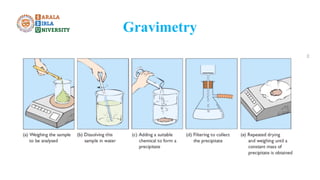
Gravimetry
• Gravimetry is a method used to measure the weight or amount of a
substance by converting it into a solid form (precipitate) through a
chemical reaction.
• The process determines the amount of the substance in its pure form as
a solid precipitate.
• Breakdown of Terms
• Gravi means mass, and metry means measurement.
• Together, gravimetry means measuring the mass of the precipitate to
determine the amount of substance.
Gravimetry
Gravimetry
Principle of Gravimetry
• Gravimetric analysis is based on converting ions or elements into a
pure, solid form through a precipitation reaction. This solid, or
precipitate, can then be easily weighed and measured to determine
the amount of the substance.
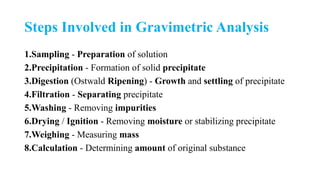
Steps Involved in Gravimetric Analysis
1.Sampling - Preparation of solution
2.Precipitation - Formation of solid precipitate
3.Digestion (Ostwald Ripening) - Growth and settling of precipitate
4.Filtration - Separating precipitate
5.Washing - Removing impurities
6.Drying / Ignition - Removing moisture or stabilizing precipitate
7.Weighing - Measuring mass
8.Calculation - Determining amount of original substance
Sampling
Precipitation
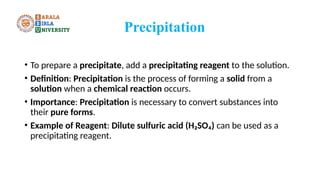
• To prepare a precipitate, add a precipitating reagent to the solution.
• Definition: Precipitation is the process of forming a solid from a
solution when a chemical reaction occurs.
• Importance: Precipitation is necessary to convert substances into
their pure forms.
• Example of Reagent: Dilute sulfuric acid (H₂SO₄) can be used as a
precipitating reagent.
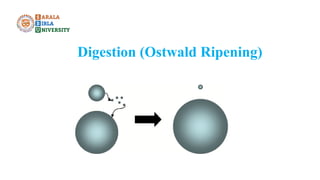
Digestion (Ostwald Ripening)
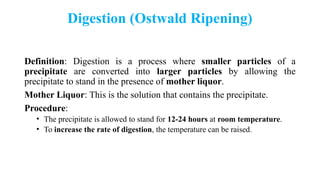
Definition: Digestion is a process where smaller particles of a
precipitate are converted into larger particles by allowing the
precipitate to stand in the presence of mother liquor.
Mother Liquor: This is the solution that contains the precipitate.
Procedure:
• The precipitate is allowed to stand for 12-24 hours at room temperature.
• To increase the rate of digestion, the temperature can be raised.
Digestion (Ostwald Ripening)
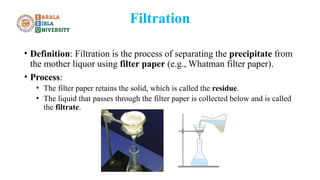
Filtration
• Definition: Filtration is the process of separating the precipitate from
the mother liquor using filter paper (e.g., Whatman filter paper).
• Process:
• The filter paper retains the solid, which is called the residue.
• The liquid that passes through the filter paper is collected below and is called
the filtrate.
Washing
• Definition: During the washing process, precipitate may be
contaminated with impurities.
• Purpose: It is necessary to wash the precipitate to remove these
impurities.
• Method:
• Wash the precipitate using warm water or a suitable solvent.
Drying
• Definition: Drying (or ignition) is used to remove the water from the
precipitate that remains after washing.
• Procedure:
• Drying can be done by heating the precipitate at 110°C to 120°C for 1 to 2
hours.
• Ignition: This can be performed at much higher temperatures if the precipitate
needs to be converted into a more suitable form for weighing.
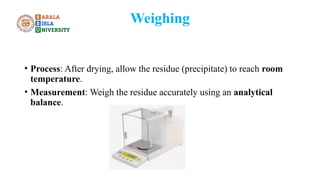
Weighing
• Process: After drying, allow the residue (precipitate) to reach room
temperature.
• Measurement: Weigh the residue accurately using an analytical
balance.
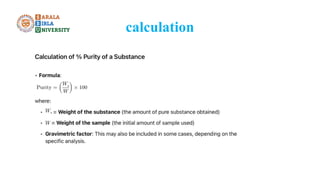
calculation
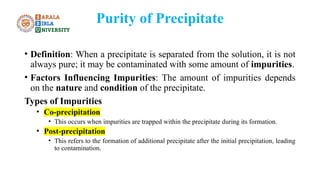
Purity of Precipitate
• Definition: When a precipitate is separated from the solution, it is not
always pure; it may be contaminated with some amount of impurities.
• Factors Influencing Impurities: The amount of impurities depends
on the nature and condition of the precipitate.
Types of Impurities
• Co-precipitation
• This occurs when impurities are trapped within the precipitate during its formation.
• Post-precipitation
• This refers to the formation of additional precipitate after the initial precipitation, leading
to contamination.
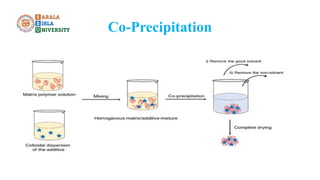
Co-Precipitation
• Definition: Co-precipitation is a condition/process during the
formation of a precipitate in which the precipitate is contaminated by
substances that are soluble in the mother liquor.
• Types of Co-Precipitation:
• Surface Adsorption:
• In this process, impurities are adsorbed on the surface of the precipitate.
• Occlusion:
• In this process, impurities get trapped inside the precipitate during the growth of the
precipitate crystals.
• Example: AgI can adsorb on BaSO₄ precipitate in alkali nitrates.
Co-Precipitation
Post-Precipitation
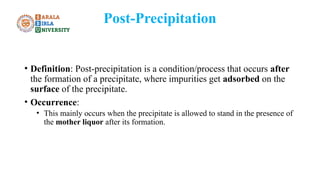
• Definition: Post-precipitation is a condition/process that occurs after
the formation of a precipitate, where impurities get adsorbed on the
surface of the precipitate.
• Occurrence:
• This mainly occurs when the precipitate is allowed to stand in the presence of
the mother liquor after its formation.
Post-Precipitation
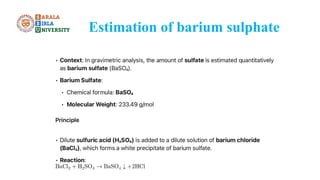
Estimation of barium sulphate
Procedure
calculation
Applications of Gravimetry
1. Analysis of Standard Solutions: Gravimetry is used in the analysis
of standard solutions to determine concentrations accurately.
2. Accuracy in Analysis:
1. While gravimetric methods can be time-consuming, they provide better
accuracy and reliable results compared to some other methods.
3. Determination of Various Ions:
1. Chloride as silver chloride (AgCl).
2. Lead as lead chromate (PbCrO )
₄ .

Gravimetric Analysis full notes B Pharm 1sem

  • 1.
    Gravimetric Analysis Santosh Kumar AssistantProfessor Department of Pharmacy Sarala Birla University, Ranchi Email: santosh.kr@sbu.ac.in
  • 2.
    Chapter 3, Unit3 - Pharmaceutical Analysis (P.A.) Syllabus • Understanding the principles and steps in gravimetric analysis. • Ensuring the purity of precipitates: managing co-precipitation and post-precipitation. • Estimation of barium sulfate as an example.
  • 3.
    Gravimetry • Gravimetry isa method used to measure the weight or amount of a substance by converting it into a solid form (precipitate) through a chemical reaction. • The process determines the amount of the substance in its pure form as a solid precipitate. • Breakdown of Terms • Gravi means mass, and metry means measurement. • Together, gravimetry means measuring the mass of the precipitate to determine the amount of substance.
  • 4.
  • 5.
    Gravimetry Principle of Gravimetry •Gravimetric analysis is based on converting ions or elements into a pure, solid form through a precipitation reaction. This solid, or precipitate, can then be easily weighed and measured to determine the amount of the substance.
  • 6.
    Steps Involved inGravimetric Analysis 1.Sampling - Preparation of solution 2.Precipitation - Formation of solid precipitate 3.Digestion (Ostwald Ripening) - Growth and settling of precipitate 4.Filtration - Separating precipitate 5.Washing - Removing impurities 6.Drying / Ignition - Removing moisture or stabilizing precipitate 7.Weighing - Measuring mass 8.Calculation - Determining amount of original substance
  • 7.
  • 8.
    Precipitation • To preparea precipitate, add a precipitating reagent to the solution. • Definition: Precipitation is the process of forming a solid from a solution when a chemical reaction occurs. • Importance: Precipitation is necessary to convert substances into their pure forms. • Example of Reagent: Dilute sulfuric acid (H₂SO₄) can be used as a precipitating reagent.
  • 9.
    Digestion (Ostwald Ripening) Definition:Digestion is a process where smaller particles of a precipitate are converted into larger particles by allowing the precipitate to stand in the presence of mother liquor. Mother Liquor: This is the solution that contains the precipitate. Procedure: • The precipitate is allowed to stand for 12-24 hours at room temperature. • To increase the rate of digestion, the temperature can be raised.
  • 10.
  • 11.
    Filtration • Definition: Filtrationis the process of separating the precipitate from the mother liquor using filter paper (e.g., Whatman filter paper). • Process: • The filter paper retains the solid, which is called the residue. • The liquid that passes through the filter paper is collected below and is called the filtrate.
  • 12.
    Washing • Definition: Duringthe washing process, precipitate may be contaminated with impurities. • Purpose: It is necessary to wash the precipitate to remove these impurities. • Method: • Wash the precipitate using warm water or a suitable solvent.
  • 13.
    Drying • Definition: Drying(or ignition) is used to remove the water from the precipitate that remains after washing. • Procedure: • Drying can be done by heating the precipitate at 110°C to 120°C for 1 to 2 hours. • Ignition: This can be performed at much higher temperatures if the precipitate needs to be converted into a more suitable form for weighing.
  • 14.
    Weighing • Process: Afterdrying, allow the residue (precipitate) to reach room temperature. • Measurement: Weigh the residue accurately using an analytical balance.
  • 15.
  • 16.
    Purity of Precipitate •Definition: When a precipitate is separated from the solution, it is not always pure; it may be contaminated with some amount of impurities. • Factors Influencing Impurities: The amount of impurities depends on the nature and condition of the precipitate. Types of Impurities • Co-precipitation • This occurs when impurities are trapped within the precipitate during its formation. • Post-precipitation • This refers to the formation of additional precipitate after the initial precipitation, leading to contamination.
  • 17.
    Co-Precipitation • Definition: Co-precipitationis a condition/process during the formation of a precipitate in which the precipitate is contaminated by substances that are soluble in the mother liquor. • Types of Co-Precipitation: • Surface Adsorption: • In this process, impurities are adsorbed on the surface of the precipitate. • Occlusion: • In this process, impurities get trapped inside the precipitate during the growth of the precipitate crystals. • Example: AgI can adsorb on BaSO₄ precipitate in alkali nitrates.
  • 18.
  • 19.
    Post-Precipitation • Definition: Post-precipitationis a condition/process that occurs after the formation of a precipitate, where impurities get adsorbed on the surface of the precipitate. • Occurrence: • This mainly occurs when the precipitate is allowed to stand in the presence of the mother liquor after its formation.
  • 20.
  • 21.
  • 22.
  • 23.
  • 24.
    Applications of Gravimetry 1.Analysis of Standard Solutions: Gravimetry is used in the analysis of standard solutions to determine concentrations accurately. 2. Accuracy in Analysis: 1. While gravimetric methods can be time-consuming, they provide better accuracy and reliable results compared to some other methods. 3. Determination of Various Ions: 1. Chloride as silver chloride (AgCl). 2. Lead as lead chromate (PbCrO ) ₄ .