Catholic University of El Salvador
UNICAES
Subject
English
Theme
ERCP
Profesor
Lic. Karla Hernández
Student´s Name
Berganza Mancia, María Estela
Figueroa Hernández, Jacqueline Abigail
Guerra Díaz, Diana Estefania
Mendoza Segura, Erick Steve
Morán Martínez, Jessica Maricela
Section “B”
Date of Delivery
Friday, April 15th, 2016
Santa Ana, Sunday, March 12th, 2016
2
Introduction
ERCP stands for Endoscopic Retrograde CholangioPancreatography. It is a
procedure used to diagnose and treat many conditions of the liver, gall bladder and
pancreas. In this procedure, a long tube called an endoscope is moved down your
throat, through your stomach and into the upper part of your intestines where the
bile and pancreatic ducts drain. If your doctor recommends ERCP for you, it is your
decision whether to have this procedure or not. This patient education tutorial
explains ERCP. It first discusses endoscopy and when ERCP is needed. It then
describes what happens before, during, and after the procedure. The tutorial also
lists the potential risks and complications of the procedure.
3
Index
Introduction ........................................................................................................... 2
What is ERCP? ................................................................................................... 4
How is ERCP performed?.................................................................................. 7
Points to Remember..................................................................................... 10
4
What is ERCP?
Endoscopic retrogradecholangiopancreatography
is a procedure that combines upper gastrointestinal
(GI) endoscopy and x rays to treat problems of the
bile and pancreatic ducts. ERCP is also used to
diagnose problems, but the availability of non-
invasive tests such as magnetic resonance
cholangiography has allowed ERCP to be used
primarily for cases in which it is expected that
treatment will be delivered during the procedure.
What is upper gastrointestinal (GI) endoscopy?
Upper GI endoscopy is a procedure that uses a lighted, flexible endoscope to see
and perform procedures inside the upper GI tract. The upper GI tract includes the
esophagus, stomach, and duodenum—the first part of the small intestine.
The bile ducts carry bile from the liver to the
duodenum. The pancreatic ducts carry pancreatic
juice from the pancreas to the duodenum.
5
What are the bile and pancreatic ducts?
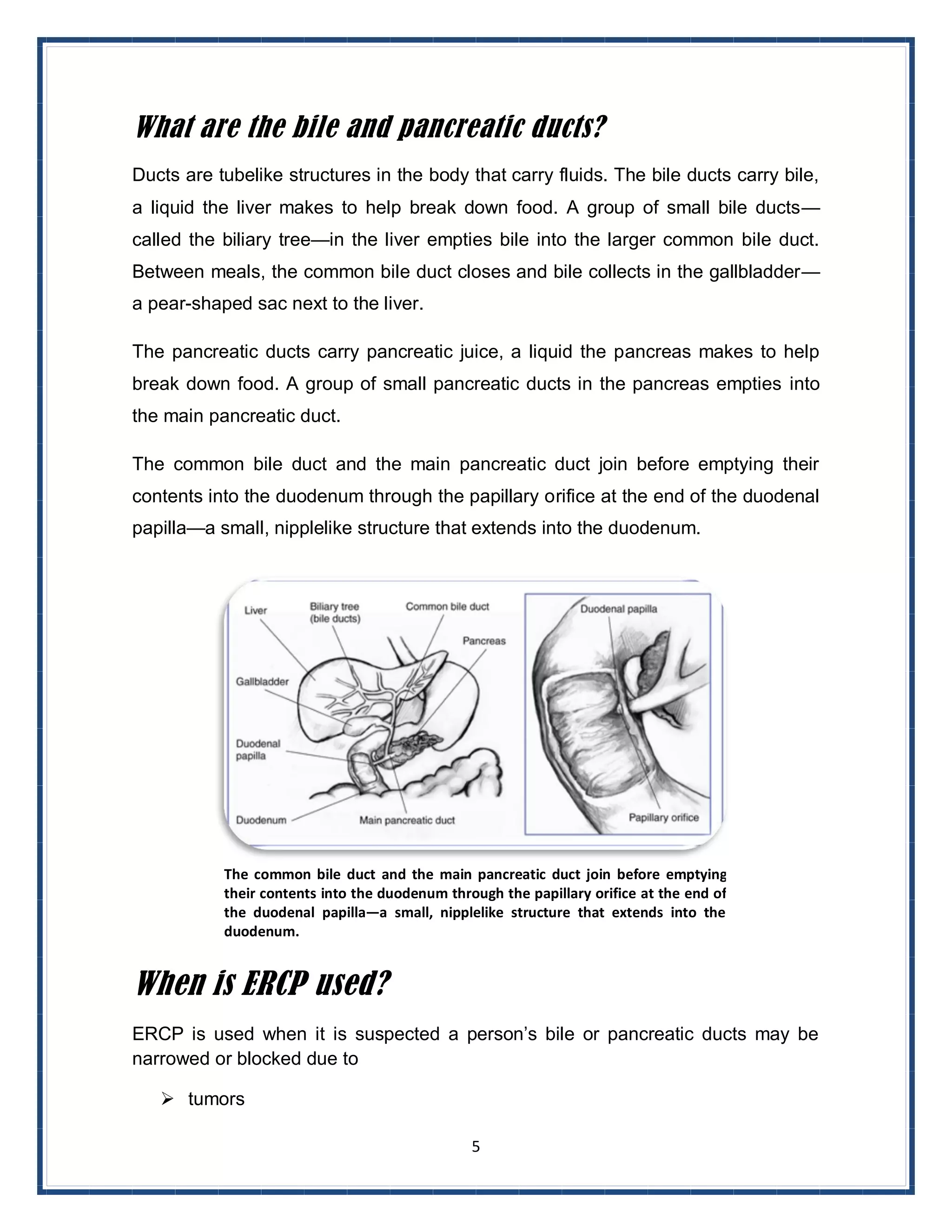
Ducts are tubelike structures in the body that carry fluids. The bile ducts carry bile,
a liquid the liver makes to help break down food. A group of small bile ducts—
called the biliary tree—in the liver empties bile into the larger common bile duct.
Between meals, the common bile duct closes and bile collects in the gallbladder—
a pear-shaped sac next to the liver.
The pancreatic ducts carry pancreatic juice, a liquid the pancreas makes to help
break down food. A group of small pancreatic ducts in the pancreas empties into
the main pancreatic duct.
The common bile duct and the main pancreatic duct join before emptying their
contents into the duodenum through the papillary orifice at the end of the duodenal
papilla—a small, nipplelike structure that extends into the duodenum.
When is ERCP used?
ERCP is used when it is suspected a person’s bile or pancreatic ducts may be
narrowed or blocked due to
 tumors
The common bile duct and the main pancreatic duct join before emptying
their contents into the duodenum through the papillary orifice at the end of
the duodenal papilla—a small, nipplelike structure that extends into the
duodenum.
6
 gallstones that form in the gallbladder and become stuck in the ducts
 inflammation due to trauma or illness, such as pancreatitis—inflammation of
the pancreas
 infection
 valves in the ducts, called sphincters, that won’t open properly
 scarring of the ducts, called sclerosis
 pseudocysts—accumulations of fluid and tissue debris
How does a person prepare for ERCP?
The health care provider usually provides written
instructions about how to prepare for ERCP.
The upper GI tract must be empty. Generally, no
eating or drinking is allowed 8 hours before ERCP.
Smoking and chewing gum are also prohibited
during this time.
7
Patients should tell their health care provider about all health conditions they have,
especially heart and lung problems, diabetes, and allergies. Patients should also
tell their health care provider about all medications they take. Patients may be
asked to temporarily stop taking medications that affect blood clotting or interact
with sedatives, which are usually given during ERCP to help patients relax and
stay comfortable.
Medications and vitamins that may be restricted before and after ERCP include
 nonsteroidal anti-inflammatory drugs, such as aspirin, ibuprofen (Advil), and
naproxen (Aleve)
 blood thinners
 high blood pressure medication
 diabetes medications
 antidepressants
 dietary supplements
Driving is not permitted for 12 to 24 hours after ERCP to allow the sedatives time to
completely wear off. Before the appointment, patients should make plans for a ride
home.
How is ERCP performed?
ERCP is conducted at a hospital or outpatient center by a doctor and assistants
who have specialized training in this procedure. Patients receive a local anesthetic
that is gargled or sprayed on the back of the throat. The anesthetic numbs the
throat and calms the gag reflex.
An intravenous needle is inserted into a vein in the arm if sedatives will be given.
Doctors and other medical staff monitor vital signs while patients are sedated.
During ERCP, patients lie on their back or side on an x-ray table. The doctor
inserts an endoscope down the esophagus, through the stomach, and into the
duodenum. Video is transmitted from a small camera attached to the endoscope to
8
a computer screen within the doctor’s view. Air is pumped through the endoscope
to inflate the stomach and duodenum, making them easier for the doctor to
examine.
When the doctor locates the duodenal papilla, a blunt tube called a catheter is slid
through the endoscope and guided through the papillary opening. Once the
catheter is inside the papilla, the doctor injects a dye into the ducts. The dye, also
called contrast medium, allows the ducts to be seen on x rays. X rays are then
taken to see the ducts and to look for narrowed areas or blockages.
Procedures to treat narrowed areas or blockages can be performed during ERCP.
To see the ducts during treatment procedures, the doctor uses x-ray video, also
called fluoroscopy. Special tools guided through the endoscope and into the ducts
allow the doctor to open blocked ducts, break up or remove gallstones, remove
tumors in the ducts, or insert stents. Stents are plastic or expandable metal tubes
that are left in narrowed ducts to restore the flow of bile or pancreatic juice. A kind
of biopsy called brush cytology allows the doctor to remove cells from inside the
ducts using a brush that fits through the endoscope. The collected cells are later
examined with a microscope for signs of infection or cancer.
Occasionally, ERCP is done after gallbladder surgery, if a surgical bile leak is
suspected, to find and stop the leak with a temporary stent.
9
What does recovery from ERCP involve?
After ERCP, patients are moved to a recovery room where they wait for about an
hour for the sedatives to wear off. Patients may not remember conversations with
health care staff, as the sedatives reduce memory of events during and after the
procedure. During this time, patients may feel bloated or nauseous. Patients may
also have a sore throat, which can last a day or two.
Patients can go home after the sedatives wear off. Patients will likely feel tired and
should plan to rest for the remainder of the day.
Some ERCP results are available immediately after the procedure. Biopsy results
are usually ready in a few days.
Eating, Diet, and Nutrition
Unless otherwise directed, patients may immediately resume their normal diet and
medications after having an ERCP. The health care provider can answer any
specific questions about eating, diet, and nutrition.
What are the risks associated with ERCP?
Significant risks associated with ERCP include:
 infection
 pancreatitis
 allergic reaction to sedatives
 excessive bleeding, called hemorrhage
 puncture of the GI tract or ducts
 tissue damage from radiation exposure
 death, in rare circumstances
When ERCP is performed by an experienced doctor, complications occur in about
6 to 10 percent of patients and these often require hospitalization.1 Patients who
10
experience any of the following symptoms after ERCP should contact their health
care provider immediately:
 swallowing difficulties
 throat, chest, or abdominal pain that worsens
 vomiting
 bloody or dark stool
 fever
Points to Remember
ERCP is a procedure that combines upper gastrointestinal (GI) endoscopy and x
rays to treat problems of the bile and pancreatic ducts.
Upper GI endoscopy is a procedure that uses a lighted, flexible endoscope to see
and perform procedures inside the upper GI tract.
Ducts are tubelike structures in the body that carry fluids. The bile ducts carry bile,
a liquid the liver makes to help break down food. The pancreatic ducts carry
pancreatic juice, a liquid the pancreas makes to help break down food.
The common bile duct and the main pancreatic duct join before emptying their
contents into the duodenum, the first part of the small intestine.
The health care provider usually provides written instructions about how to prepare
for ERCP.
Driving is not permitted for 12 to 24 hours after ERCP to allow the sedatives time to
completely wear off. Before the appointment, patients should make plans for a ride
home.
During ERCP, the doctor inserts an endoscope down the esophagus, through the
stomach, and into the duodenum.
The doctor injects contrast medium into the ducts and x rays are taken to see the
ducts.
11
Conclusion
An ERCP is a safe procedure for examining the liver, pancreas and biliary ducts. It
can be used to diagnose and treat medical problems of the duodenum, biliary
ducts and pancreatic duct. It is important to communicate with your doctor about
your health condition and any medications you are taking. You should also not eat
or drink anything for 8 hours before the procedure. Some medical conditions, such
as diabetes, will affect the length of time you may eat or drink. Check with your
doctor. Thanks to advances in medical technology, endoscopy makes it possible to
better diagnose problems than X-rays alone. Endoscopy can also be used to treat
some medical conditions and help some patients avoid surgery.
12
Bibliographic
ERCP (Endoscopic Retrograde Cholangiopancreatography), National Intitute of
Diabetes and Digestive and Kidney Diseases. http://www.niddk.nih.gov/health-
information/health-topics/diagnostic-tests/ercp/Pages/diagnostic-test.aspx
ERCP, MedinePlus. https://www.nlm.nih.gov/medlineplus/ency/article/007479.htm

ERCP

  • 1.
    Catholic University ofEl Salvador UNICAES Subject English Theme ERCP Profesor Lic. Karla Hernández Student´s Name Berganza Mancia, María Estela Figueroa Hernández, Jacqueline Abigail Guerra Díaz, Diana Estefania Mendoza Segura, Erick Steve Morán Martínez, Jessica Maricela Section “B” Date of Delivery Friday, April 15th, 2016 Santa Ana, Sunday, March 12th, 2016
  • 2.
    2 Introduction ERCP stands forEndoscopic Retrograde CholangioPancreatography. It is a procedure used to diagnose and treat many conditions of the liver, gall bladder and pancreas. In this procedure, a long tube called an endoscope is moved down your throat, through your stomach and into the upper part of your intestines where the bile and pancreatic ducts drain. If your doctor recommends ERCP for you, it is your decision whether to have this procedure or not. This patient education tutorial explains ERCP. It first discusses endoscopy and when ERCP is needed. It then describes what happens before, during, and after the procedure. The tutorial also lists the potential risks and complications of the procedure.
  • 3.
    3 Index Introduction ........................................................................................................... 2 Whatis ERCP? ................................................................................................... 4 How is ERCP performed?.................................................................................. 7 Points to Remember..................................................................................... 10
  • 4.
    4 What is ERCP? Endoscopicretrogradecholangiopancreatography is a procedure that combines upper gastrointestinal (GI) endoscopy and x rays to treat problems of the bile and pancreatic ducts. ERCP is also used to diagnose problems, but the availability of non- invasive tests such as magnetic resonance cholangiography has allowed ERCP to be used primarily for cases in which it is expected that treatment will be delivered during the procedure. What is upper gastrointestinal (GI) endoscopy? Upper GI endoscopy is a procedure that uses a lighted, flexible endoscope to see and perform procedures inside the upper GI tract. The upper GI tract includes the esophagus, stomach, and duodenum—the first part of the small intestine. The bile ducts carry bile from the liver to the duodenum. The pancreatic ducts carry pancreatic juice from the pancreas to the duodenum.
  • 5.
    5 What are thebile and pancreatic ducts? Ducts are tubelike structures in the body that carry fluids. The bile ducts carry bile, a liquid the liver makes to help break down food. A group of small bile ducts— called the biliary tree—in the liver empties bile into the larger common bile duct. Between meals, the common bile duct closes and bile collects in the gallbladder— a pear-shaped sac next to the liver. The pancreatic ducts carry pancreatic juice, a liquid the pancreas makes to help break down food. A group of small pancreatic ducts in the pancreas empties into the main pancreatic duct. The common bile duct and the main pancreatic duct join before emptying their contents into the duodenum through the papillary orifice at the end of the duodenal papilla—a small, nipplelike structure that extends into the duodenum. When is ERCP used? ERCP is used when it is suspected a person’s bile or pancreatic ducts may be narrowed or blocked due to  tumors The common bile duct and the main pancreatic duct join before emptying their contents into the duodenum through the papillary orifice at the end of the duodenal papilla—a small, nipplelike structure that extends into the duodenum.
  • 6.
    6  gallstones thatform in the gallbladder and become stuck in the ducts  inflammation due to trauma or illness, such as pancreatitis—inflammation of the pancreas  infection  valves in the ducts, called sphincters, that won’t open properly  scarring of the ducts, called sclerosis  pseudocysts—accumulations of fluid and tissue debris How does a person prepare for ERCP? The health care provider usually provides written instructions about how to prepare for ERCP. The upper GI tract must be empty. Generally, no eating or drinking is allowed 8 hours before ERCP. Smoking and chewing gum are also prohibited during this time.
  • 7.
    7 Patients should telltheir health care provider about all health conditions they have, especially heart and lung problems, diabetes, and allergies. Patients should also tell their health care provider about all medications they take. Patients may be asked to temporarily stop taking medications that affect blood clotting or interact with sedatives, which are usually given during ERCP to help patients relax and stay comfortable. Medications and vitamins that may be restricted before and after ERCP include  nonsteroidal anti-inflammatory drugs, such as aspirin, ibuprofen (Advil), and naproxen (Aleve)  blood thinners  high blood pressure medication  diabetes medications  antidepressants  dietary supplements Driving is not permitted for 12 to 24 hours after ERCP to allow the sedatives time to completely wear off. Before the appointment, patients should make plans for a ride home. How is ERCP performed? ERCP is conducted at a hospital or outpatient center by a doctor and assistants who have specialized training in this procedure. Patients receive a local anesthetic that is gargled or sprayed on the back of the throat. The anesthetic numbs the throat and calms the gag reflex. An intravenous needle is inserted into a vein in the arm if sedatives will be given. Doctors and other medical staff monitor vital signs while patients are sedated. During ERCP, patients lie on their back or side on an x-ray table. The doctor inserts an endoscope down the esophagus, through the stomach, and into the duodenum. Video is transmitted from a small camera attached to the endoscope to
  • 8.
    8 a computer screenwithin the doctor’s view. Air is pumped through the endoscope to inflate the stomach and duodenum, making them easier for the doctor to examine. When the doctor locates the duodenal papilla, a blunt tube called a catheter is slid through the endoscope and guided through the papillary opening. Once the catheter is inside the papilla, the doctor injects a dye into the ducts. The dye, also called contrast medium, allows the ducts to be seen on x rays. X rays are then taken to see the ducts and to look for narrowed areas or blockages. Procedures to treat narrowed areas or blockages can be performed during ERCP. To see the ducts during treatment procedures, the doctor uses x-ray video, also called fluoroscopy. Special tools guided through the endoscope and into the ducts allow the doctor to open blocked ducts, break up or remove gallstones, remove tumors in the ducts, or insert stents. Stents are plastic or expandable metal tubes that are left in narrowed ducts to restore the flow of bile or pancreatic juice. A kind of biopsy called brush cytology allows the doctor to remove cells from inside the ducts using a brush that fits through the endoscope. The collected cells are later examined with a microscope for signs of infection or cancer. Occasionally, ERCP is done after gallbladder surgery, if a surgical bile leak is suspected, to find and stop the leak with a temporary stent.
  • 9.
    9 What does recoveryfrom ERCP involve? After ERCP, patients are moved to a recovery room where they wait for about an hour for the sedatives to wear off. Patients may not remember conversations with health care staff, as the sedatives reduce memory of events during and after the procedure. During this time, patients may feel bloated or nauseous. Patients may also have a sore throat, which can last a day or two. Patients can go home after the sedatives wear off. Patients will likely feel tired and should plan to rest for the remainder of the day. Some ERCP results are available immediately after the procedure. Biopsy results are usually ready in a few days. Eating, Diet, and Nutrition Unless otherwise directed, patients may immediately resume their normal diet and medications after having an ERCP. The health care provider can answer any specific questions about eating, diet, and nutrition. What are the risks associated with ERCP? Significant risks associated with ERCP include:  infection  pancreatitis  allergic reaction to sedatives  excessive bleeding, called hemorrhage  puncture of the GI tract or ducts  tissue damage from radiation exposure  death, in rare circumstances When ERCP is performed by an experienced doctor, complications occur in about 6 to 10 percent of patients and these often require hospitalization.1 Patients who
  • 10.
    10 experience any ofthe following symptoms after ERCP should contact their health care provider immediately:  swallowing difficulties  throat, chest, or abdominal pain that worsens  vomiting  bloody or dark stool  fever Points to Remember ERCP is a procedure that combines upper gastrointestinal (GI) endoscopy and x rays to treat problems of the bile and pancreatic ducts. Upper GI endoscopy is a procedure that uses a lighted, flexible endoscope to see and perform procedures inside the upper GI tract. Ducts are tubelike structures in the body that carry fluids. The bile ducts carry bile, a liquid the liver makes to help break down food. The pancreatic ducts carry pancreatic juice, a liquid the pancreas makes to help break down food. The common bile duct and the main pancreatic duct join before emptying their contents into the duodenum, the first part of the small intestine. The health care provider usually provides written instructions about how to prepare for ERCP. Driving is not permitted for 12 to 24 hours after ERCP to allow the sedatives time to completely wear off. Before the appointment, patients should make plans for a ride home. During ERCP, the doctor inserts an endoscope down the esophagus, through the stomach, and into the duodenum. The doctor injects contrast medium into the ducts and x rays are taken to see the ducts.
  • 11.
    11 Conclusion An ERCP isa safe procedure for examining the liver, pancreas and biliary ducts. It can be used to diagnose and treat medical problems of the duodenum, biliary ducts and pancreatic duct. It is important to communicate with your doctor about your health condition and any medications you are taking. You should also not eat or drink anything for 8 hours before the procedure. Some medical conditions, such as diabetes, will affect the length of time you may eat or drink. Check with your doctor. Thanks to advances in medical technology, endoscopy makes it possible to better diagnose problems than X-rays alone. Endoscopy can also be used to treat some medical conditions and help some patients avoid surgery.
  • 12.
    12 Bibliographic ERCP (Endoscopic RetrogradeCholangiopancreatography), National Intitute of Diabetes and Digestive and Kidney Diseases. http://www.niddk.nih.gov/health- information/health-topics/diagnostic-tests/ercp/Pages/diagnostic-test.aspx ERCP, MedinePlus. https://www.nlm.nih.gov/medlineplus/ency/article/007479.htm