Cystoscopy / urethroscopy
From Mehr un nisa
group 13
5th sem
What is cystoscopy?
Cystoscopy is an
examination of the
inside of the bladder.
What is uretroscopy?
Also known as Uretero
Renoscopy (URS) is a
examination of the
inside of the upper
urinary Tract(ureters
and renal pelvis and
calyces).
CYSTOSCOPY
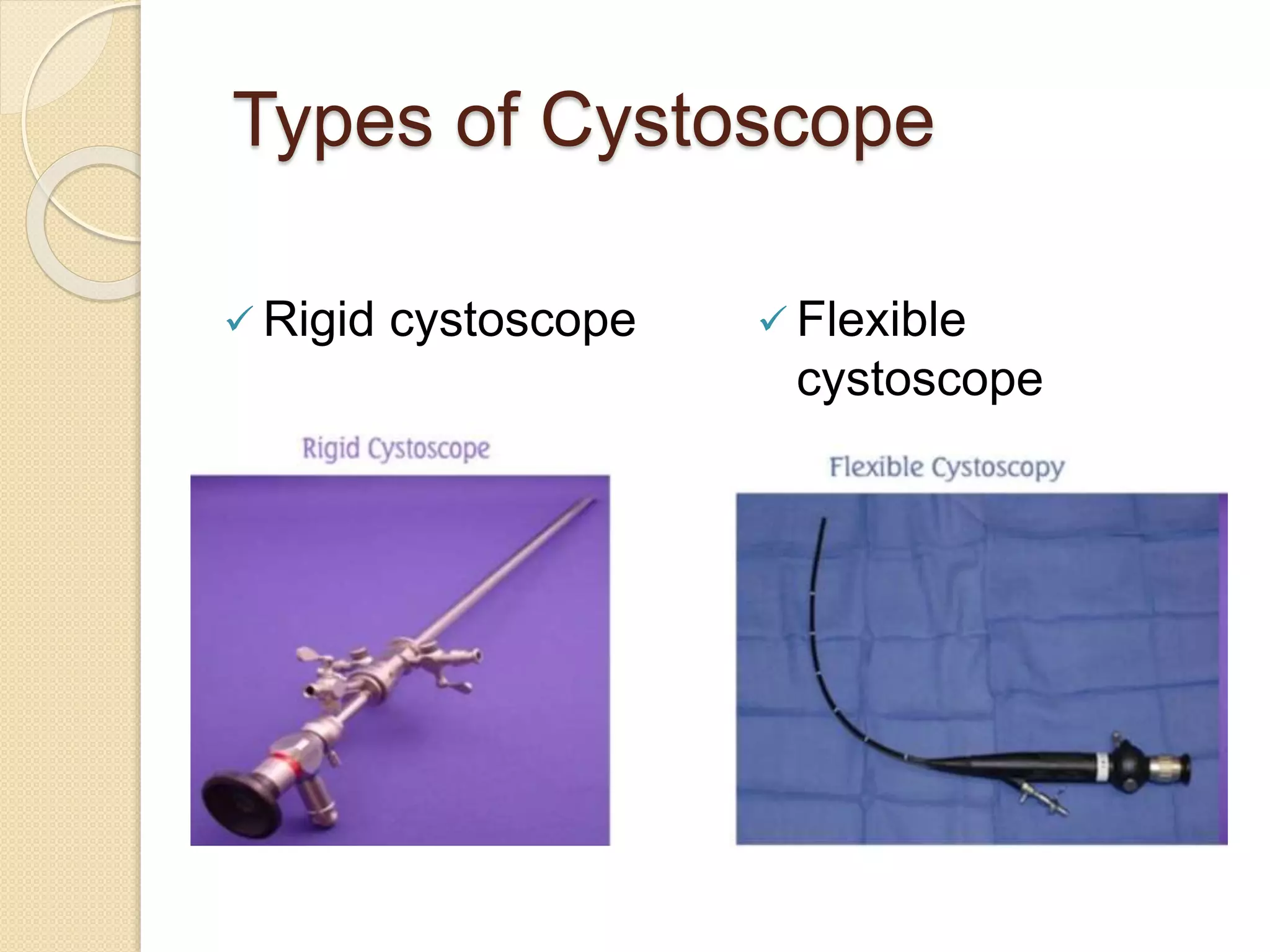
• A cystoscope is a long , thin ,optical
instrument with an eyepiece at one end,a
rigid or flexible tube in the middle,and the
tiny lens and the light at the other end of
the tube.
• The cystoscope is inserted into the
patient’s urethra,and the small lens
magnifies the inner lining of urethra and
bladder,allowing to see inside the hollow
bladder.
Uretroscope
 A uretroscope like a cystoscope, is an
instrument for examining the inside of
the ureters and the kidneys.
 A uretroscope is longer and thinner
than a cystoscope and is used to see
beyond the bladder into the ureters,
the tubes that carry urine from the
kidneys to the bladder and the renal
pelvis and calyces.
Types of Cystoscope
 Rigid cystoscope  Flexible
cystoscope
Types of uretroscope
 Rigid uretroscope  Flexible
uretroscope
When does patient require
cystoscope?
Frequent urinary tract infections.
Blood in the urine,which is called
hematuria.
A frequent and urgent need to urinate.
Unusual cells found in urine sample.
Painful urination,chronic pelvic pain.
A stone in the urinary bladder.
An usual growth,tumor in the bladder.
When does patient require
uretroscopy?
 For treatment of stones in the ureters
and in the kidney(RIRS).
Urinary blockage caused by an
abnormal narrowing of the ureter.
How does the patient prepare for
a cystoscopy?
In many cases,the patient does not
need special preprations for
cystoscopy, but the health care
provider will provide instructions
before this procedure such as
• When to stop certain medications,
such as blood thinners.
• When to stop eating and drinking.
• When to empty the bladder before
the procedure.
How is a cystoscopy
performed?
 It is an outpatient test, which means
you can get it at your doctor’s office.
 The doctor inserts a tube into urethra,
if you’re a man, the opening is at the
end of the penis.if you’re a women,
it's just above your vagina.
 The test lets your doctor check the
complete length of the urethra &
bladder for polyps, abnormal growth &
other problems.
 This procedure takes about 15 to 20
minutes.
What can a patient expect after a
cystoscopy?
 Have a mild burning feeling when
urinating
 See small amounts of blood in the
urine.
Need to urinate more frequently or
urgently.
Risks of cystoscopy
o UTIs
o Abnormal bleeding
o Abdominal pain
o Injury to the urethra, bladder or ureters
o A burning feeling or pain during
urination.
Cystoscopy

Cystoscopy

  • 1.
    Cystoscopy / urethroscopy FromMehr un nisa group 13 5th sem
  • 2.
    What is cystoscopy? Cystoscopyis an examination of the inside of the bladder.
  • 3.
    What is uretroscopy? Alsoknown as Uretero Renoscopy (URS) is a examination of the inside of the upper urinary Tract(ureters and renal pelvis and calyces).
  • 4.
    CYSTOSCOPY • A cystoscopeis a long , thin ,optical instrument with an eyepiece at one end,a rigid or flexible tube in the middle,and the tiny lens and the light at the other end of the tube. • The cystoscope is inserted into the patient’s urethra,and the small lens magnifies the inner lining of urethra and bladder,allowing to see inside the hollow bladder.
  • 5.
    Uretroscope  A uretroscopelike a cystoscope, is an instrument for examining the inside of the ureters and the kidneys.  A uretroscope is longer and thinner than a cystoscope and is used to see beyond the bladder into the ureters, the tubes that carry urine from the kidneys to the bladder and the renal pelvis and calyces.
  • 6.
    Types of Cystoscope Rigid cystoscope  Flexible cystoscope
  • 7.
    Types of uretroscope Rigid uretroscope  Flexible uretroscope
  • 9.
    When does patientrequire cystoscope? Frequent urinary tract infections. Blood in the urine,which is called hematuria. A frequent and urgent need to urinate. Unusual cells found in urine sample. Painful urination,chronic pelvic pain. A stone in the urinary bladder. An usual growth,tumor in the bladder.
  • 10.
    When does patientrequire uretroscopy?  For treatment of stones in the ureters and in the kidney(RIRS). Urinary blockage caused by an abnormal narrowing of the ureter.
  • 11.
    How does thepatient prepare for a cystoscopy? In many cases,the patient does not need special preprations for cystoscopy, but the health care provider will provide instructions before this procedure such as • When to stop certain medications, such as blood thinners. • When to stop eating and drinking. • When to empty the bladder before the procedure.
  • 12.
    How is acystoscopy performed?  It is an outpatient test, which means you can get it at your doctor’s office.  The doctor inserts a tube into urethra, if you’re a man, the opening is at the end of the penis.if you’re a women, it's just above your vagina.  The test lets your doctor check the complete length of the urethra & bladder for polyps, abnormal growth & other problems.  This procedure takes about 15 to 20 minutes.
  • 13.
    What can apatient expect after a cystoscopy?  Have a mild burning feeling when urinating  See small amounts of blood in the urine. Need to urinate more frequently or urgently.
  • 14.
    Risks of cystoscopy oUTIs o Abnormal bleeding o Abdominal pain o Injury to the urethra, bladder or ureters o A burning feeling or pain during urination.