DEPARTMENT OF UROLOGY EDUCATION
Production Team
Dr Abraham Benjamin - Manager Medical Informatics
Mr. Naresh Kumar - Coordinator Medical Informatics
Cystoscopy/Urethroscopy
What is Cystoscopy?
 Cystoscopy is an examination of the inside
of the bladder.
What is Uretroscopy?
 Also known as Uretero Renoscopy
(URS) is a examination of the inside
of the Upper Urinary Tract (ureters
and renal pelvis and calyces)
What is a Cystoscope ?
A cystoscope is a long, thin instrument with an
eyepiece on the external end and a tiny lens
and a light on the end that is inserted into the
bladder. The cystoscope is inserted into the
patient’s urethra, and the small lens magnifies
the inner lining of the urethra and bladder,
allowing to see inside the hollow bladder.
What is a Cystoscope ?
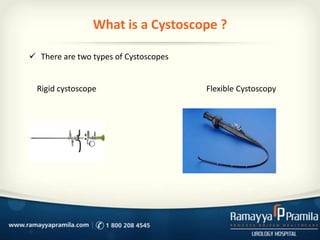
 There are two types of Cystoscopes
Rigid cystoscope Flexible Cystoscopy
What is a Uretroscope ?
 A ureteroscope, like a cystoscope, is an instrument
for examining the inside of the urinary tract.
 A ureteroscope is longer and thinner than a
cystoscope and is used to see beyond the bladder
into the ureters, the tubes that carry urine from the
kidneys to the bladder and the renal pelvis and
calyces.
What is a Uretroscope ?
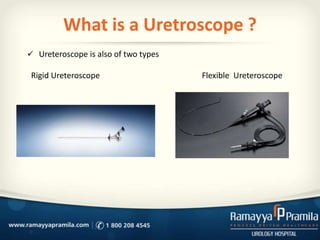
 Ureteroscope is also of two types
Rigid Ureteroscope Flexible Ureteroscope
Anatomy of the Urinary Tract
When does the patient require Cystoscopy?
 frequent urinary tract infections.
 blood in the urine, which is called hematuria
 a frequent and urgent need to urinate.
 unusual cells found in a urine sample.
 painful urination, chronic pelvic pain.
 urinary blockage caused by prostate enlargement or some
other abnormal narrowing of the urinary tract.
 a stone in the urinary bladder.
 an unusual growth, polyp, tumor, in the bladder.
When does the patient require Uretroscopy?
For Treatment of Stones in the Ureters and in
the kidney (RIRS).
Urinary blockage caused by an abnormal
narrowing of the ureter.
Cystoscopy Procedure
Rigid Cystoscopy Flexible Cystoscopy
Urethroscopy Procedure
Rigid Urethroscopy Flexible Urethroscopy
Important Information
 If you need more details to get this test
done or meet our team of Urologists
for Consultation click on the link below.
 http://www.ramayyapramila.com/
Superior and Compassionate Care
More topics
 Circumcision
 Blood In Urine
 Benign Prostatic Hypertrophy
 Vasectomy
 Kidney and Urinary stone Medical Treatment
 Andrology-Male Infertility
 Urodynamics / Uroflowmetry.
 Testicular Torsion.
Please click the icon to navigate

Cystoscopy /uretroscopy

  • 1.
    DEPARTMENT OF UROLOGYEDUCATION Production Team Dr Abraham Benjamin - Manager Medical Informatics Mr. Naresh Kumar - Coordinator Medical Informatics Cystoscopy/Urethroscopy
  • 2.
    What is Cystoscopy? Cystoscopy is an examination of the inside of the bladder.
  • 3.
    What is Uretroscopy? Also known as Uretero Renoscopy (URS) is a examination of the inside of the Upper Urinary Tract (ureters and renal pelvis and calyces)
  • 4.
    What is aCystoscope ? A cystoscope is a long, thin instrument with an eyepiece on the external end and a tiny lens and a light on the end that is inserted into the bladder. The cystoscope is inserted into the patient’s urethra, and the small lens magnifies the inner lining of the urethra and bladder, allowing to see inside the hollow bladder.
  • 5.
    What is aCystoscope ?  There are two types of Cystoscopes Rigid cystoscope Flexible Cystoscopy
  • 6.
    What is aUretroscope ?  A ureteroscope, like a cystoscope, is an instrument for examining the inside of the urinary tract.  A ureteroscope is longer and thinner than a cystoscope and is used to see beyond the bladder into the ureters, the tubes that carry urine from the kidneys to the bladder and the renal pelvis and calyces.
  • 7.
    What is aUretroscope ?  Ureteroscope is also of two types Rigid Ureteroscope Flexible Ureteroscope
  • 8.
    Anatomy of theUrinary Tract
  • 9.
    When does thepatient require Cystoscopy?  frequent urinary tract infections.  blood in the urine, which is called hematuria  a frequent and urgent need to urinate.  unusual cells found in a urine sample.  painful urination, chronic pelvic pain.  urinary blockage caused by prostate enlargement or some other abnormal narrowing of the urinary tract.  a stone in the urinary bladder.  an unusual growth, polyp, tumor, in the bladder.
  • 10.
    When does thepatient require Uretroscopy? For Treatment of Stones in the Ureters and in the kidney (RIRS). Urinary blockage caused by an abnormal narrowing of the ureter.
  • 11.
  • 12.
  • 13.
    Important Information  Ifyou need more details to get this test done or meet our team of Urologists for Consultation click on the link below.  http://www.ramayyapramila.com/
  • 14.
  • 15.
    More topics  Circumcision Blood In Urine  Benign Prostatic Hypertrophy  Vasectomy  Kidney and Urinary stone Medical Treatment  Andrology-Male Infertility  Urodynamics / Uroflowmetry.  Testicular Torsion. Please click the icon to navigate