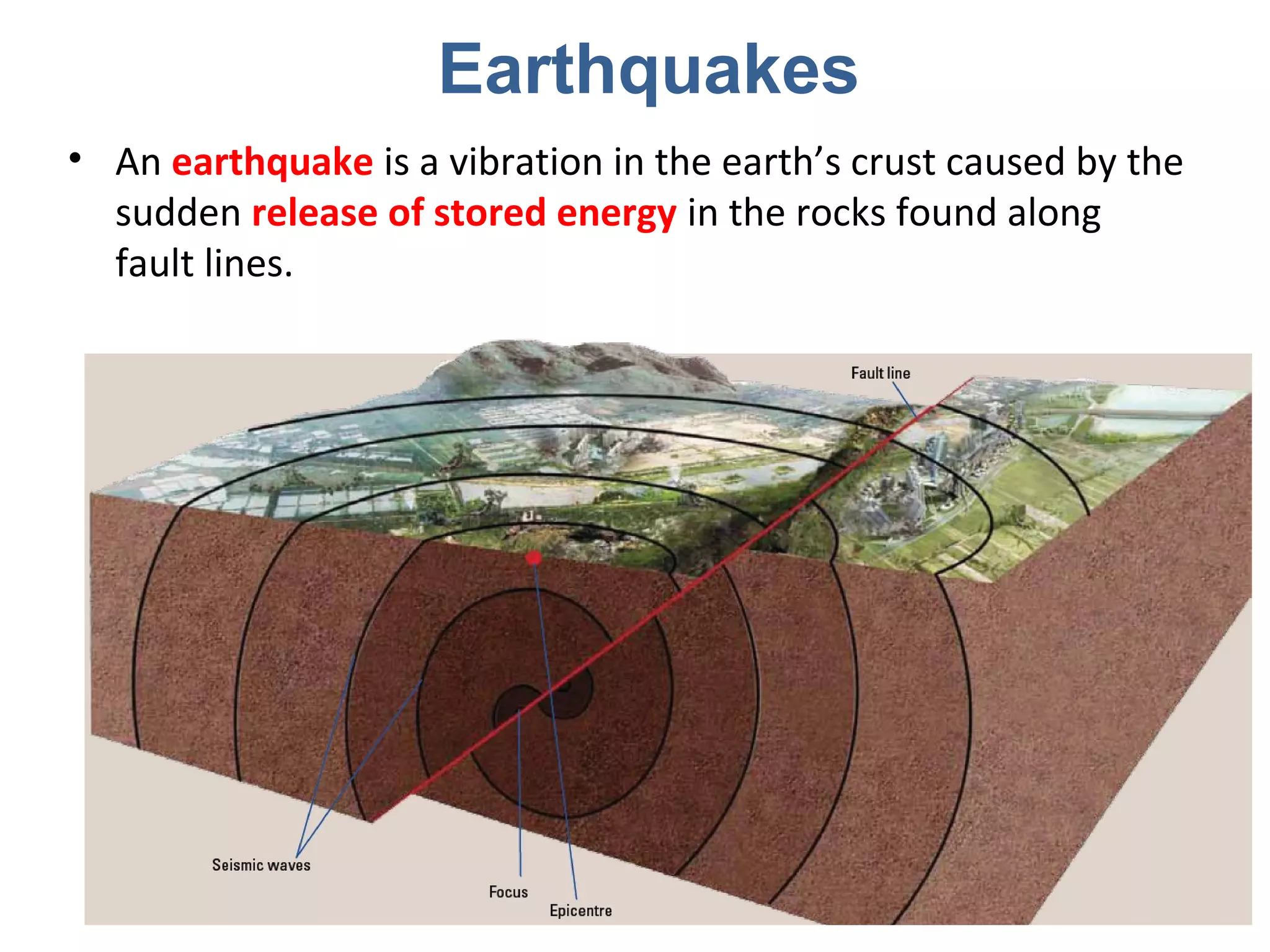
• An earthquake is a vibration in the earth’s crust caused by the
sudden release of stored energy in the rocks found along
fault lines.
Earthquakes
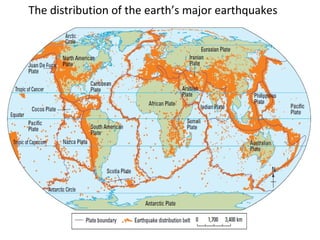
The distribution of the earth’s major earthquakes
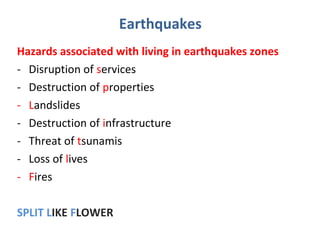
Hazards associated with living in earthquakes zones
- Disruption of services
- Destruction of properties
- Landslides
- Destruction of infrastructure
- Threat of tsunamis
- Loss of lives
- Fires
SPLIT LIKE FLOWER
Earthquakes
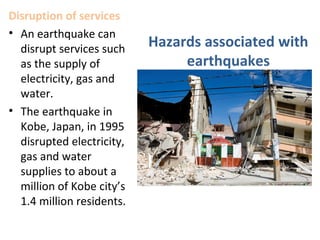
Disruption of services
• An earthquake can
disrupt services such
as the supply of
electricity, gas and
water.
• The earthquake in
Kobe, Japan, in 1995
disrupted electricity,
gas and water
supplies to about a
million of Kobe city’s
1.4 million residents.
Hazards associated with
earthquakes
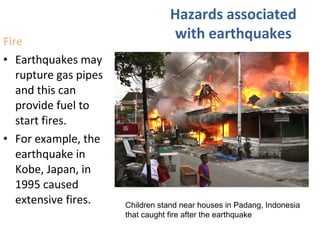
Fire
• Earthquakes may
rupture gas pipes
and this can
provide fuel to
start fires.
• For example, the
earthquake in
Kobe, Japan, in
1995 caused
extensive fires.
Hazards associated
with earthquakes
Children stand near houses in Padang, Indonesia
that caught fire after the earthquake
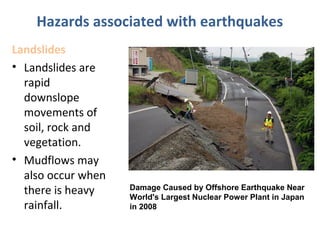
Landslides
• Landslides are
rapid
downslope
movements of
soil, rock and
vegetation.
• Mudflows may
also occur when
there is heavy
rainfall.
Hazards associated with earthquakes
Damage Caused by Offshore Earthquake Near
World's Largest Nuclear Power Plant in Japan
in 2008
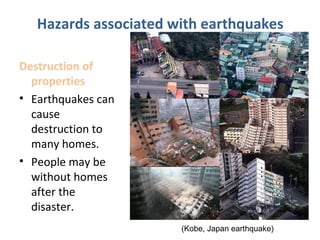
Destruction of
properties
• Earthquakes can
cause
destruction to
many homes.
• People may be
without homes
after the
disaster.
Hazards associated with earthquakes
(Kobe, Japan earthquake)
Hazards associated with earthquakes
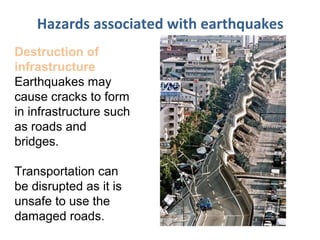
Destruction of
infrastructure
Earthquakes may
cause cracks to form
in infrastructure such
as roads and
bridges.
Transportation can
be disrupted as it is
unsafe to use the
damaged roads.
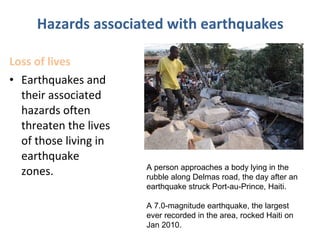
Loss of lives
• Earthquakes and
their associated
hazards often
threaten the lives
of those living in
earthquake
zones.
Hazards associated with earthquakes
A person approaches a body lying in the
rubble along Delmas road, the day after an
earthquake struck Port-au-Prince, Haiti.
A 7.0-magnitude earthquake, the largest
ever recorded in the area, rocked Haiti on
Jan 2010.
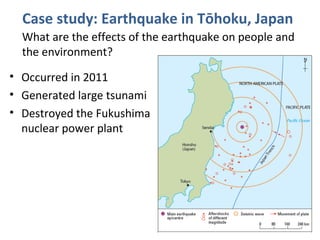
Case study: Earthquake in Tōhoku, Japan
What are the effects of the earthquake on people and
the environment?
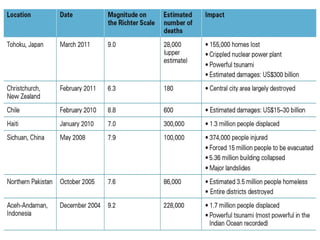
• Occurred in 2011
• Generated large tsunami
• Destroyed the Fukushima
nuclear power plant
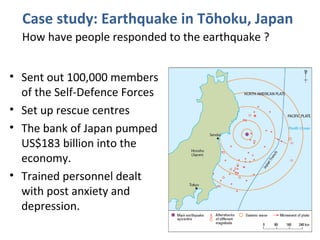
Case study: Earthquake in Tōhoku, Japan
How have people responded to the earthquake ?
• Sent out 100,000 members
of the Self-Defence Forces
• Set up rescue centres
• The bank of Japan pumped
US$183 billion into the
economy.
• Trained personnel dealt
with post anxiety and
depression.
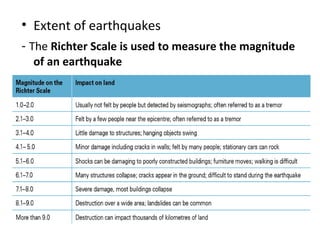
• Extent of earthquakes
- The Richter Scale is used to measure the magnitude
of an earthquake
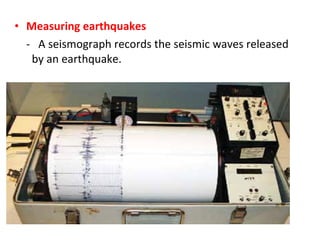
• Measuring earthquakes
- A seismograph records the seismic waves released
by an earthquake.
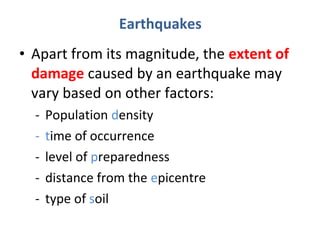
• Apart from its magnitude, the extent of
damage caused by an earthquake may
vary based on other factors:
- Population density
- time of occurrence
- level of preparedness
- distance from the epicentre
- type of soil
Earthquakes
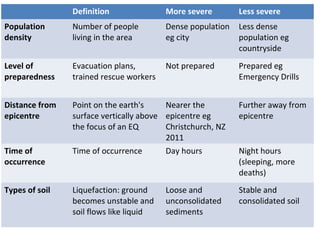
Definition More severe Less severe
Population
density
Number of people
living in the area
Dense population
eg city
Less dense
population eg
countryside
Level of
preparedness
Evacuation plans,
trained rescue workers
Not prepared Prepared eg
Emergency Drills
Distance from
epicentre
Point on the earth's
surface vertically above
the focus of an EQ
Nearer the
epicentre eg
Christchurch, NZ
2011
Further away from
epicentre
Time of
occurrence
Time of occurrence Day hours Night hours
(sleeping, more
deaths)
Types of soil Liquefaction: ground
becomes unstable and
soil flows like liquid
Loose and
unconsolidated
sediments
Stable and
consolidated soil
P67
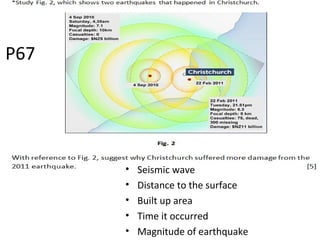
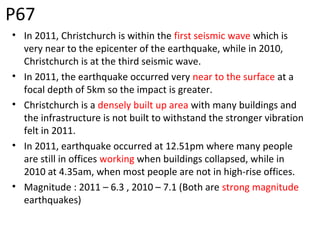
• Seismic wave
• Distance to the surface
• Built up area
• Time it occurred
• Magnitude of earthquake
• In 2011, Christchurch is within the first seismic wave which is
very near to the epicenter of the earthquake, while in 2010,
Christchurch is at the third seismic wave.
• In 2011, the earthquake occurred very near to the surface at a
focal depth of 5km so the impact is greater.
• Christchurch is a densely built up area with many buildings and
the infrastructure is not built to withstand the stronger vibration
felt in 2011.
• In 2011, earthquake occurred at 12.51pm where many people
are still in offices working when buildings collapsed, while in
2010 at 4.35am, when most people are not in high-rise offices.
• Magnitude : 2011 – 6.3 , 2010 – 7.1 (Both are strong magnitude
earthquakes)
P67
P68
“The extent of damages caused by an earthquake is solely
determined by an area’s proximity to the epicentre.”
How true is this statement? Give reasons and relevant
examples in your answer
Answer in PEE format
1.Magnitude of Earthquake
2.Population density
3.Level of preparedness
4.Distance from epicentre
5.Time of occurrence
6.Type of soil
Magnitude of the Earthquake
P : The strength of an earthquake, based on the energy released from
the focus.
E: The higher the magnitude of an earthquake, the higher the
possibility of infrastructure collapsing, as they are unable to
withstand the force exerted by the earthquake, the greater the
extent of damages. This may result in the death of more people who
are buried under the debris, and the country’s economy will be
crippled as resources will be diverted to rebuild the country while
investors lose confidence in the country.
Eg : The Great Kobe Earthquake in 1995 (7.2 on Richter Scale; lasted
20 secs, 5000 people died, 300000 people became homeless. The
Great East Japan Earthquake in 2011 (8.9 on Richter Scale; 16000
deaths; tsunami with wave height up to 10m)
Population density
Point: The higher the population density of an earthquake-prone area,
the higher the chances of people getting killed or injured.
Elaboration: When people are living in close proximity, the destruction
of an infrastructure in an area will have an impact on a larger number
of people. A stampede may also occur when so many people are trying
to escape from an earthquake-prone area at the same time. All these
may lead to a greater extent of damages as lives are loss when high-
rise buildings topple over. Hence, a magnitude 9.0 earthquake will
only cause extensive damages if the area is densely populated.
Example
•Earthquake in Anchorage, Alaska in 1964
•Magnitude 9.2 on the Richter Scale
•Only 115 people died as the area had a small and sparse population
Level of preparedness
P : Refers to how well the people know what to do in the event of an
earthquake, such as having evacuation plans and trained rescue
workers.
E: This will reduce the number of casualties that may arise from a
stampede, and will also ensure that those who are injured receive
timely medical assistance. Hence, a magnitude 9.0 earthquake may not
cause extensive damages if the people know what to do and are able
to evacuate safely before getting injured.
Example: In Japan, students are taught how to react when the
earthquake warning signal goes off. They are to crouch under the
nearest table, so as to prevent falling objects from injuring them
Distance from epicentre
P : Generally, the nearer to the epicentre, the stronger the
shockwaves receive
E: The energy of the earthquake is absorbed and weakened as it
radiates outwards from the epicentre to the surrounding land. Hence,
a magnitude 9.0 earthquake may not cause extensive damages if the
area involved is located far away from the epicentre.
Eg: During the 2011 Christchurch earthquake in New Zealand, the
epicentre was in a town a few km away from the city centre. Thus, the
city centre suffered more damages than areas further away from the
city.
Time of occurrence
P: The time of the day during which the earthquake occurs determines
where people are and what they are doing, which will affect their
chances of survival.
E: If the earthquake occurs when most people are sleeping, there is a
higher chance that these people will be trapped in their houses and
more deaths may occur. Hence, a magnitude 9.0 earthquake may not
cause extensive damages if the earthquake occurs during the day and
people are more aware and thus have sufficient time to escape.
Eg: More than 2400 people died when an earthquake occurred a couple
of hours after midnight in the Sun Moon Lake Region in Taiwan in 1999.
Type of soil
P : Where sediments are loose and unconsolidated, the seismic waves
are amplified. Structures built on saturated and unconsolidated
sediments can be affected by liquefaction, where the ground becomes
unstable and the saturated soil flows like a liquid
E: When sediments are loose and unconsolidated or saturated, the
effects of the earthquake are amplified, which could lead to the
collapse of infrastructure. Hence, a magnitude 9.0 earthquake may not
cause extensive damages if the type of soil found in that area is well-
consolidated and more resistant to the movements of the ground.
Eg: In the 2011 Christchurch earthquake in New Zealand, many houses
and buildings had to be abandoned because of liquefaction after the
earthquake.
Conclusion
The extent of damages experienced by an area
is not just dependent on the magnitude of the
earthquake, but also other factors as mentioned
above.
These factors are interlinked and will determine
how badly affected an area is.
However, men can reduce the extent of
damages experienced by adopting the various
adaptation measures like earthquake resistant
buildings or installing earthquake monitoring
and warning systems.
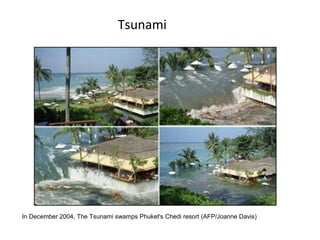
In December 2004, The Tsunami swamps Phuket's Chedi resort (AFP/Joanne Davis)
Tsunami
Threat of tsunamis
• Tsunami refers to an usually large sea wave.
• Tsunamis may be formed by:
- The movement of the sea floor during a large earthquake
at subduction zones;
- An underwater volcanic eruption;
- An underwater landslide; and
- A landslide above sea level which causes materials to
plunge into the water.
Hazards associated with earthquakes
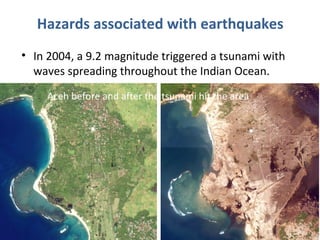
• In 2004, a 9.2 magnitude triggered a tsunami with
waves spreading throughout the Indian Ocean.
Aceh before and after the tsunami hit the area
Hazards associated with earthquakes
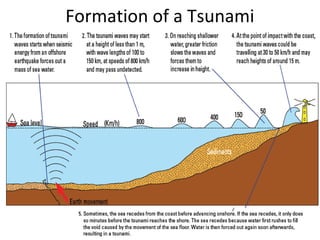
Formation of a Tsunami
• The tsunami is formed by the movement of the sea floor during a
large earthquake at the ________ zone. [1]
• The offshore earthquake forces out a ____________. [1]
• On reaching shallower water, greater friction slows the waves
and forces the waves to increase in __________. [1]
• At the point of impact on the coast, the tsunami waves could
reach heights of 15m. [1]
P64
• The tsunami is formed by the movement of the sea floor during a
large earthquake at the subduction zone. [1]
• The offshore earthquake forces out a mass of sea water. [1]
• On reaching shallower water, greater friction slows the waves
and forces the waves to increase in height. [1]
• At the point of impact on the coast, the tsunami waves could
reach heights of 15m. [1]
P64
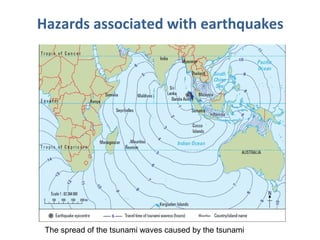
Singapore is protected to a significant degree
[1]
by the southern end of Malaysia Peninsula [1]
and the island of Sumatra to the west [1].
The energy of waves travelling southwards
would have been absorbed by the coastlines of
those land masses. [1]
P64
Explain why the impact of the tsunami on Singapore was
minimal.
[4]
The spread of the tsunami waves caused by the tsunami
Hazards associated with earthquakes
P=Point Tsunamis can have an impact on the lives of the people.
D=Describe Tsunamis are unusually large waves caused by underwater earthquakes.
E=Explain Tsunamis can travel long distances and caused great destruction to coastal areas when they
sweep inland. At the point of contact on the coast, the tsunami waves could be travelling at
50km/h and may reach heights of around 15metres.
E=Example In 2004, a 9.2 magnitude earthquake occurred in the Indian Ocean and caused a tsunami with
waves that spread throughout the Indian Ocean. The most damage was experienced in the low-
lying coastal areas of western Sumatra, Indonesia.
There was loss of lives and destruction of properties along this stretch of the coast.
P=Point Earthquakes can have an impact on the lives of the people. Earthquakes can cause fire.
D=Describe Earthquakes may rupture gas pipes and the gas can provide fuel to start fires. Earthquakes may
expose electrical cables which may ignite flammable items like gas and oil.
E=Explain Once these items are ignited, fires can spread quickly to a large area, increasing the number of
deaths and injured.
E=Example For example, the 1995 earthquake in Kobe, Japan. The earthquake caused extensive fires that went
on for 2 days. Firemen were unable to control the fires as the ruptured water pipes meant that
there was no water supply to put out the fire.
Complete Worksheet
‘The impact of a tsunami on people’s lives can be more devastating than that of an
earthquake.’ How far do you agree with this statement? Give reasons for your answer.
[6]
Impact of a tsunami on people’s lives (1 example)
Impact of an earthquake on people’s lives (1 example)

Eq and tsunamis

  • 1.
    • An earthquakeis a vibration in the earth’s crust caused by the sudden release of stored energy in the rocks found along fault lines. Earthquakes
  • 2.
    The distribution ofthe earth’s major earthquakes
  • 3.
    Hazards associated withliving in earthquakes zones - Disruption of services - Destruction of properties - Landslides - Destruction of infrastructure - Threat of tsunamis - Loss of lives - Fires SPLIT LIKE FLOWER Earthquakes
  • 4.
    Disruption of services •An earthquake can disrupt services such as the supply of electricity, gas and water. • The earthquake in Kobe, Japan, in 1995 disrupted electricity, gas and water supplies to about a million of Kobe city’s 1.4 million residents. Hazards associated with earthquakes
  • 5.
    Fire • Earthquakes may rupturegas pipes and this can provide fuel to start fires. • For example, the earthquake in Kobe, Japan, in 1995 caused extensive fires. Hazards associated with earthquakes Children stand near houses in Padang, Indonesia that caught fire after the earthquake
  • 6.
    Landslides • Landslides are rapid downslope movementsof soil, rock and vegetation. • Mudflows may also occur when there is heavy rainfall. Hazards associated with earthquakes Damage Caused by Offshore Earthquake Near World's Largest Nuclear Power Plant in Japan in 2008
  • 7.
    Destruction of properties • Earthquakescan cause destruction to many homes. • People may be without homes after the disaster. Hazards associated with earthquakes (Kobe, Japan earthquake)
  • 8.
    Hazards associated withearthquakes Destruction of infrastructure Earthquakes may cause cracks to form in infrastructure such as roads and bridges. Transportation can be disrupted as it is unsafe to use the damaged roads.
  • 9.
    Loss of lives •Earthquakes and their associated hazards often threaten the lives of those living in earthquake zones. Hazards associated with earthquakes A person approaches a body lying in the rubble along Delmas road, the day after an earthquake struck Port-au-Prince, Haiti. A 7.0-magnitude earthquake, the largest ever recorded in the area, rocked Haiti on Jan 2010.
  • 10.
    Case study: Earthquakein Tōhoku, Japan What are the effects of the earthquake on people and the environment? • Occurred in 2011 • Generated large tsunami • Destroyed the Fukushima nuclear power plant
  • 11.
    Case study: Earthquakein Tōhoku, Japan How have people responded to the earthquake ? • Sent out 100,000 members of the Self-Defence Forces • Set up rescue centres • The bank of Japan pumped US$183 billion into the economy. • Trained personnel dealt with post anxiety and depression.
  • 13.
    • Extent ofearthquakes - The Richter Scale is used to measure the magnitude of an earthquake
  • 14.
    • Measuring earthquakes -A seismograph records the seismic waves released by an earthquake.
  • 16.
    • Apart fromits magnitude, the extent of damage caused by an earthquake may vary based on other factors: - Population density - time of occurrence - level of preparedness - distance from the epicentre - type of soil Earthquakes
  • 17.
    Definition More severeLess severe Population density Number of people living in the area Dense population eg city Less dense population eg countryside Level of preparedness Evacuation plans, trained rescue workers Not prepared Prepared eg Emergency Drills Distance from epicentre Point on the earth's surface vertically above the focus of an EQ Nearer the epicentre eg Christchurch, NZ 2011 Further away from epicentre Time of occurrence Time of occurrence Day hours Night hours (sleeping, more deaths) Types of soil Liquefaction: ground becomes unstable and soil flows like liquid Loose and unconsolidated sediments Stable and consolidated soil
  • 18.
    P67 • Seismic wave •Distance to the surface • Built up area • Time it occurred • Magnitude of earthquake
  • 19.
    • In 2011,Christchurch is within the first seismic wave which is very near to the epicenter of the earthquake, while in 2010, Christchurch is at the third seismic wave. • In 2011, the earthquake occurred very near to the surface at a focal depth of 5km so the impact is greater. • Christchurch is a densely built up area with many buildings and the infrastructure is not built to withstand the stronger vibration felt in 2011. • In 2011, earthquake occurred at 12.51pm where many people are still in offices working when buildings collapsed, while in 2010 at 4.35am, when most people are not in high-rise offices. • Magnitude : 2011 – 6.3 , 2010 – 7.1 (Both are strong magnitude earthquakes) P67
  • 20.
    P68 “The extent ofdamages caused by an earthquake is solely determined by an area’s proximity to the epicentre.” How true is this statement? Give reasons and relevant examples in your answer Answer in PEE format 1.Magnitude of Earthquake 2.Population density 3.Level of preparedness 4.Distance from epicentre 5.Time of occurrence 6.Type of soil
  • 21.
    Magnitude of theEarthquake P : The strength of an earthquake, based on the energy released from the focus. E: The higher the magnitude of an earthquake, the higher the possibility of infrastructure collapsing, as they are unable to withstand the force exerted by the earthquake, the greater the extent of damages. This may result in the death of more people who are buried under the debris, and the country’s economy will be crippled as resources will be diverted to rebuild the country while investors lose confidence in the country. Eg : The Great Kobe Earthquake in 1995 (7.2 on Richter Scale; lasted 20 secs, 5000 people died, 300000 people became homeless. The Great East Japan Earthquake in 2011 (8.9 on Richter Scale; 16000 deaths; tsunami with wave height up to 10m)
  • 22.
    Population density Point: Thehigher the population density of an earthquake-prone area, the higher the chances of people getting killed or injured. Elaboration: When people are living in close proximity, the destruction of an infrastructure in an area will have an impact on a larger number of people. A stampede may also occur when so many people are trying to escape from an earthquake-prone area at the same time. All these may lead to a greater extent of damages as lives are loss when high- rise buildings topple over. Hence, a magnitude 9.0 earthquake will only cause extensive damages if the area is densely populated. Example •Earthquake in Anchorage, Alaska in 1964 •Magnitude 9.2 on the Richter Scale •Only 115 people died as the area had a small and sparse population
  • 23.
    Level of preparedness P: Refers to how well the people know what to do in the event of an earthquake, such as having evacuation plans and trained rescue workers. E: This will reduce the number of casualties that may arise from a stampede, and will also ensure that those who are injured receive timely medical assistance. Hence, a magnitude 9.0 earthquake may not cause extensive damages if the people know what to do and are able to evacuate safely before getting injured. Example: In Japan, students are taught how to react when the earthquake warning signal goes off. They are to crouch under the nearest table, so as to prevent falling objects from injuring them
  • 24.
    Distance from epicentre P: Generally, the nearer to the epicentre, the stronger the shockwaves receive E: The energy of the earthquake is absorbed and weakened as it radiates outwards from the epicentre to the surrounding land. Hence, a magnitude 9.0 earthquake may not cause extensive damages if the area involved is located far away from the epicentre. Eg: During the 2011 Christchurch earthquake in New Zealand, the epicentre was in a town a few km away from the city centre. Thus, the city centre suffered more damages than areas further away from the city.
  • 25.
    Time of occurrence P:The time of the day during which the earthquake occurs determines where people are and what they are doing, which will affect their chances of survival. E: If the earthquake occurs when most people are sleeping, there is a higher chance that these people will be trapped in their houses and more deaths may occur. Hence, a magnitude 9.0 earthquake may not cause extensive damages if the earthquake occurs during the day and people are more aware and thus have sufficient time to escape. Eg: More than 2400 people died when an earthquake occurred a couple of hours after midnight in the Sun Moon Lake Region in Taiwan in 1999.
  • 26.
    Type of soil P: Where sediments are loose and unconsolidated, the seismic waves are amplified. Structures built on saturated and unconsolidated sediments can be affected by liquefaction, where the ground becomes unstable and the saturated soil flows like a liquid E: When sediments are loose and unconsolidated or saturated, the effects of the earthquake are amplified, which could lead to the collapse of infrastructure. Hence, a magnitude 9.0 earthquake may not cause extensive damages if the type of soil found in that area is well- consolidated and more resistant to the movements of the ground. Eg: In the 2011 Christchurch earthquake in New Zealand, many houses and buildings had to be abandoned because of liquefaction after the earthquake.
  • 27.
    Conclusion The extent ofdamages experienced by an area is not just dependent on the magnitude of the earthquake, but also other factors as mentioned above. These factors are interlinked and will determine how badly affected an area is. However, men can reduce the extent of damages experienced by adopting the various adaptation measures like earthquake resistant buildings or installing earthquake monitoring and warning systems.
  • 29.
    In December 2004,The Tsunami swamps Phuket's Chedi resort (AFP/Joanne Davis) Tsunami
  • 30.
    Threat of tsunamis •Tsunami refers to an usually large sea wave. • Tsunamis may be formed by: - The movement of the sea floor during a large earthquake at subduction zones; - An underwater volcanic eruption; - An underwater landslide; and - A landslide above sea level which causes materials to plunge into the water. Hazards associated with earthquakes
  • 31.
    • In 2004,a 9.2 magnitude triggered a tsunami with waves spreading throughout the Indian Ocean. Aceh before and after the tsunami hit the area Hazards associated with earthquakes
  • 32.
  • 33.
    • The tsunamiis formed by the movement of the sea floor during a large earthquake at the ________ zone. [1] • The offshore earthquake forces out a ____________. [1] • On reaching shallower water, greater friction slows the waves and forces the waves to increase in __________. [1] • At the point of impact on the coast, the tsunami waves could reach heights of 15m. [1] P64
  • 34.
    • The tsunamiis formed by the movement of the sea floor during a large earthquake at the subduction zone. [1] • The offshore earthquake forces out a mass of sea water. [1] • On reaching shallower water, greater friction slows the waves and forces the waves to increase in height. [1] • At the point of impact on the coast, the tsunami waves could reach heights of 15m. [1] P64
  • 35.
    Singapore is protectedto a significant degree [1] by the southern end of Malaysia Peninsula [1] and the island of Sumatra to the west [1]. The energy of waves travelling southwards would have been absorbed by the coastlines of those land masses. [1] P64 Explain why the impact of the tsunami on Singapore was minimal. [4]
  • 36.
    The spread ofthe tsunami waves caused by the tsunami Hazards associated with earthquakes
  • 37.
    P=Point Tsunamis canhave an impact on the lives of the people. D=Describe Tsunamis are unusually large waves caused by underwater earthquakes. E=Explain Tsunamis can travel long distances and caused great destruction to coastal areas when they sweep inland. At the point of contact on the coast, the tsunami waves could be travelling at 50km/h and may reach heights of around 15metres. E=Example In 2004, a 9.2 magnitude earthquake occurred in the Indian Ocean and caused a tsunami with waves that spread throughout the Indian Ocean. The most damage was experienced in the low- lying coastal areas of western Sumatra, Indonesia. There was loss of lives and destruction of properties along this stretch of the coast. P=Point Earthquakes can have an impact on the lives of the people. Earthquakes can cause fire. D=Describe Earthquakes may rupture gas pipes and the gas can provide fuel to start fires. Earthquakes may expose electrical cables which may ignite flammable items like gas and oil. E=Explain Once these items are ignited, fires can spread quickly to a large area, increasing the number of deaths and injured. E=Example For example, the 1995 earthquake in Kobe, Japan. The earthquake caused extensive fires that went on for 2 days. Firemen were unable to control the fires as the ruptured water pipes meant that there was no water supply to put out the fire. Complete Worksheet ‘The impact of a tsunami on people’s lives can be more devastating than that of an earthquake.’ How far do you agree with this statement? Give reasons for your answer. [6] Impact of a tsunami on people’s lives (1 example) Impact of an earthquake on people’s lives (1 example)

Editor's Notes

  • #3 Suggested activity: Ask students to describe the location of the earth’s major earthquakes. Along plate boundaries.
  • #7 How does earthquakes lead to landslides ?
  • #9 Suggested activity: Allow students to visit the website: http://abcnews.go.com/Archives/video/jan-17-1995-earthquake-japan-9421417. Ask them about the effects of the earthquake they observe from the video. Fires, collapsed buildings and infrastructure, floods, lives lost, people made homeless, people trapped under rubble
  • #11 Suggested activity Show students satellite images of the impact of the Tōhoku earthquake and tsunami from the website: http://earthobservatory.nasa.gov/Features/Gallery/tsunami.php
  • #16 Suggested activity: Ask students to explain why the earthquake that took place in Haiti (magnitude 7.0) caused more damage and higher number of deaths than the earthquake that took place in Tohoku, Japan (magnitude 9.0). The earthquake in Haiti could have taken place in areas that are densely populated as compared to Tohoku. The people in Tohoku, Japan could be more prepared to deal with earthquakes than the people in Haiti. The structures of the buildings in Japan are more earthquake-resistant.
  • #30 Qns 1 - Using what you have learnt about plate boundaries, identify the type of plate boundary caused the tsunami. (Express/Normal) -transform boundary, divergent boundary 2. From the series of photos above, describe different stages of tsunami in your own words. -calm conditions on the sea surfaces. -heightened level of seawater -seawall approaching the shore, flooding the structures and buildings -seawater level remained high and did not subside. - 2. Suggest why the tsunami was able to reach inland. (Express)