
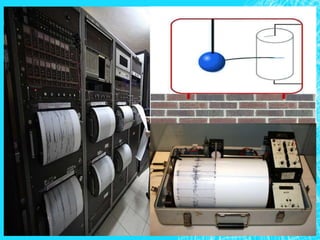

Earthquake Intensity
Mustafa Fahmi HasanMustafa Mohammed Rashid
201311 November
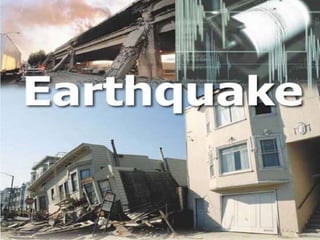
 DEFINITION OF AN EARTHQUAKE
• An earthquake (also known as a quake, tremor or
temblor) is the result of a sudden release of energy in the
Earth's crust that creates seismic wave’s. The seismicity,
seismic or seismic activity of an area refers to the
frequency, type and size of earthquakes experienced over
a period of time. Earthquakes are measured using
observations from seismometers .
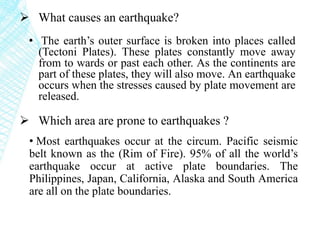
 What causes an earthquake?
• The earth’s outer surface is broken into places called
(Tectoni Plates). These plates constantly move away
from to wards or past each other. As the continents are
part of these plates, they will also move. An earthquake
occurs when the stresses caused by plate movement are
released.
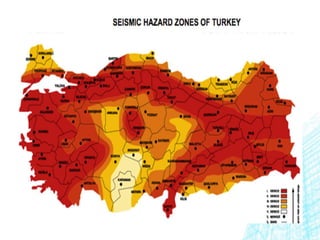
 Which area are prone to earthquakes ?
• Most earthquakes occur at the circum. Pacific seismic
belt known as the (Rim of Fire). 95% of all the world’s
earthquake occur at active plate boundaries. The
Philippines, Japan, California, Alaska and South America
are all on the plate boundaries.
 EARTHQUAKE INTENSITY
Earthquake intensity (Geology) a measure of the
size of an earthquake based on observation of the
effects of the shock at the earth's surface.
Specified on the Mercalli scale .
 INTENSITY
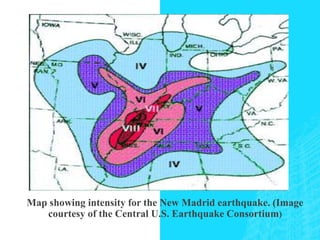
The intensity is a number (written as a roman numeral)
describing the severity of an earthquake in terms of its effects
on the earth's surface and on humans and their structures.
Several scales exist, but the ones most commonly used in the
united states are the modified mercalli scale and the rossi-forel
scale. There are many intensities for an earthquake, depending
on where you are, unlike the magnitude, which is one number
for each earthquake.
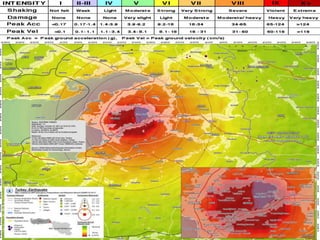
Map showing intensity for the New Madrid earthquake. (Image
courtesy of the Central U.S. Earthquake Consortium)
 MORE INFORMATION ABOUT INTENSITY
1- the state or quality of being intense
2- extreme force, degree, or amount
3- Physics:
a- a measure of field strength or of the energy
transmitted by radiation
See → radiant intensity → luminous intensity
b- (of sound in a specified direction) the average rate of
flow of sound energy, usually in watts, for one period
through unit area at right angles to the specified
direction .
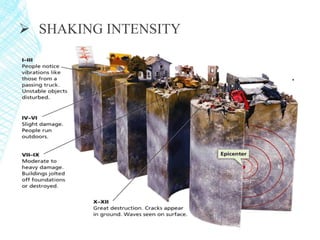
 SHAKING INTENSITY
• The size of an earthquake is often described using
magnitude, which is the amount of energy released
during an earthquake. However, not all of the energy
released in an earthquake will necessarily be felt at
the surface, depending on the earthquake's depth.
• In New Zealand, where earthquakes occur from near
the surface right down to a depth of over 600 km, the
Modified Mercalli intensity scale is a better indicator
of an earthquake's effects on people and their
environment.
 SHAKING INTENSITY
.
 MODIFIED MERCALLI
INTENSITY SCALE:
The Mercalli intensity scale is a seismic scale used for
measuring the intensity of an earthquake. It measures
the effects of an earthquake, and is distinct from the
moment magnitude usually reported for an earthquake
(sometimes misreported as the Richter magnitude),
which is a measure of the energy released. The intensity
of an earthquake is not totally determined by its
magnitude.
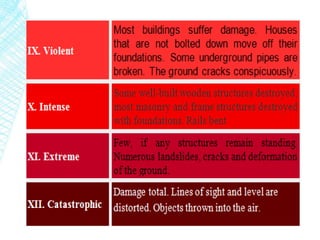
The lower degrees of the Modified Mercalli Intensity
scale generally deal with the manner in which the
earthquake is felt by people. The higher numbers of the
scale are based on observed structural damage.
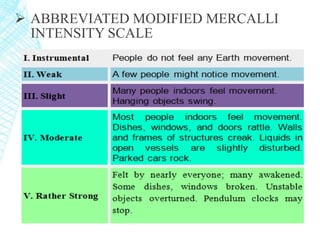
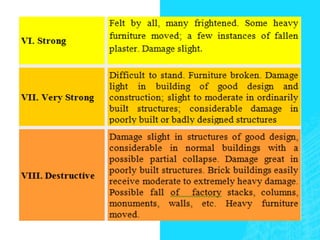
 The small table is a rough guide to the degrees of
the Modified Mercalli Intensity scale. The colors
and descriptive names shown here differ from those
used on certain shake maps in other articles.
The large table gives Modified Mercalli scale
intensities that are typically observed at locations
near the epicenter of the earthquake.
 ABBREVIATED MODIFIED MERCALLI
INTENSITY SCALE
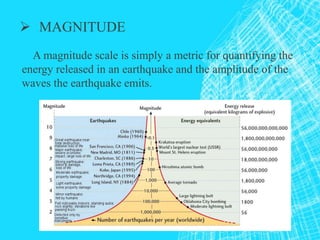
A magnitude scale is simply a metric for quantifying the
energy released in an earthquake and the amplitude of the
waves the earthquake emits.
 MAGNITUDE
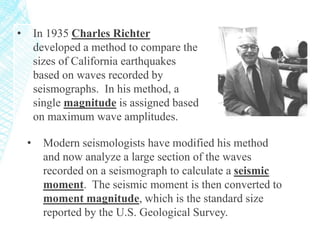
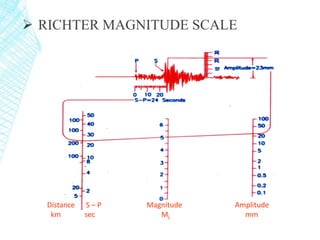
• In 1935 Charles Richter
developed a method to compare the
sizes of California earthquakes
based on waves recorded by
seismographs. In his method, a
single magnitude is assigned based
on maximum wave amplitudes.
• Modern seismologists have modified his method
and now analyze a large section of the waves
recorded on a seismograph to calculate a seismic
moment. The seismic moment is then converted to
moment magnitude, which is the standard size
reported by the U.S. Geological Survey.
 RICHTER MAGNITUDE SCALE
Distance S – P Magnitude Amplitude
km sec ML mm
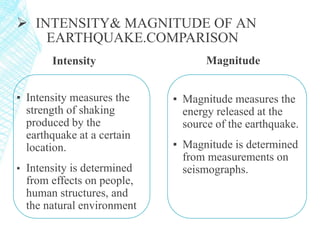
 INTENSITY& MAGNITUDE OF AN
EARTHQUAKE.COMPARISON
Intensity
▪ Intensity measures the
strength of shaking
produced by the
earthquake at a certain
location.
▪ Intensity is determined
from effects on people,
human structures, and
the natural environment
Magnitude
▪ Magnitude measures the
energy released at the
source of the earthquake.
▪ Magnitude is determined
from measurements on
seismographs.
 RELATIONSHIP BETWEEN INTENSITYAND
MAGNITUDE OF AN EARTHQUAKE
• The relation between intensity and magnitude, which are
substantially different quantities by nature. In consideration
of the necessity “to translate” magnitude values into
intensity values, to find magnitude values for historical
earthquakes, we have searched for a correspondence that
may exist between intensity and magnitude, hypothesizing
that magnitude values were distributed as a known function.
• Therefore, we have analyzed two distribution functions,
first the Gaussian distribution, then a box function, of which
the goodness of fit has been estimated by the χ2 test. In
conclusion, the probability distribution of magnitude vs
intensity seems better described by a Gaussian curve.
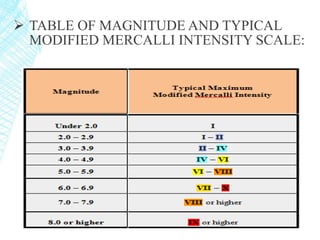
 TABLE OF MAGNITUDE AND TYPICAL
MODIFIED MERCALLI INTENSITY SCALE:
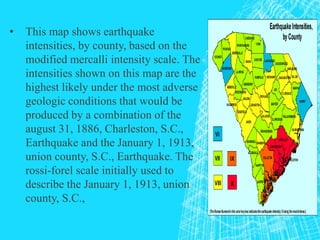
• This map shows earthquake
intensities, by county, based on the
modified mercalli intensity scale. The
intensities shown on this map are the
highest likely under the most adverse
geologic conditions that would be
produced by a combination of the
august 31, 1886, Charleston, S.C.,
Earthquake and the January 1, 1913,
union county, S.C., Earthquake. The
rossi-forel scale initially used to
describe the January 1, 1913, union
county, S.C.,
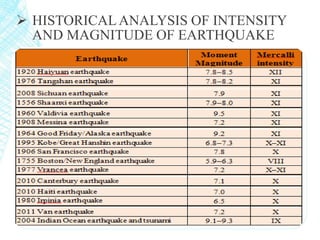
 HISTORICALANALYSIS OF INTENSITY
AND MAGNITUDE OF EARTHQUAKE
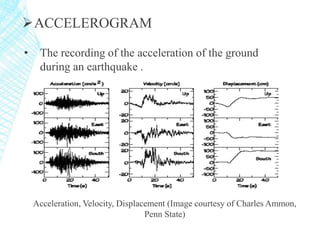
• The recording of the acceleration of the ground
during an earthquake .
Acceleration, Velocity, Displacement (Image courtesy of Charles Ammon,
Penn State)
ACCELEROGRAM
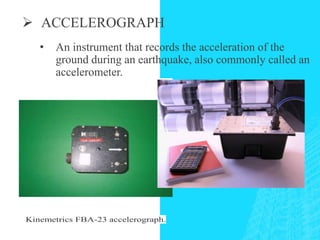
 ACCELEROGRAPH
Kinemetrics FBA-23 accelerograph.
• An instrument that records the acceleration of the
ground during an earthquake, also commonly called an
accelerometer.
Earthquake Intensity

Earthquake Intensity

  • 1.
    Earthquake Intensity Mustafa FahmiHasanMustafa Mohammed Rashid 201311 November
  • 3.
     DEFINITION OFAN EARTHQUAKE • An earthquake (also known as a quake, tremor or temblor) is the result of a sudden release of energy in the Earth's crust that creates seismic wave’s. The seismicity, seismic or seismic activity of an area refers to the frequency, type and size of earthquakes experienced over a period of time. Earthquakes are measured using observations from seismometers .
  • 4.
     What causesan earthquake? • The earth’s outer surface is broken into places called (Tectoni Plates). These plates constantly move away from to wards or past each other. As the continents are part of these plates, they will also move. An earthquake occurs when the stresses caused by plate movement are released.  Which area are prone to earthquakes ? • Most earthquakes occur at the circum. Pacific seismic belt known as the (Rim of Fire). 95% of all the world’s earthquake occur at active plate boundaries. The Philippines, Japan, California, Alaska and South America are all on the plate boundaries.
  • 5.
     EARTHQUAKE INTENSITY Earthquakeintensity (Geology) a measure of the size of an earthquake based on observation of the effects of the shock at the earth's surface. Specified on the Mercalli scale .
  • 7.
     INTENSITY The intensityis a number (written as a roman numeral) describing the severity of an earthquake in terms of its effects on the earth's surface and on humans and their structures. Several scales exist, but the ones most commonly used in the united states are the modified mercalli scale and the rossi-forel scale. There are many intensities for an earthquake, depending on where you are, unlike the magnitude, which is one number for each earthquake.
  • 8.
    Map showing intensityfor the New Madrid earthquake. (Image courtesy of the Central U.S. Earthquake Consortium)
  • 9.
     MORE INFORMATIONABOUT INTENSITY 1- the state or quality of being intense 2- extreme force, degree, or amount 3- Physics: a- a measure of field strength or of the energy transmitted by radiation See → radiant intensity → luminous intensity b- (of sound in a specified direction) the average rate of flow of sound energy, usually in watts, for one period through unit area at right angles to the specified direction .
  • 10.
     SHAKING INTENSITY •The size of an earthquake is often described using magnitude, which is the amount of energy released during an earthquake. However, not all of the energy released in an earthquake will necessarily be felt at the surface, depending on the earthquake's depth. • In New Zealand, where earthquakes occur from near the surface right down to a depth of over 600 km, the Modified Mercalli intensity scale is a better indicator of an earthquake's effects on people and their environment.
  • 11.
  • 12.
     MODIFIED MERCALLI INTENSITYSCALE: The Mercalli intensity scale is a seismic scale used for measuring the intensity of an earthquake. It measures the effects of an earthquake, and is distinct from the moment magnitude usually reported for an earthquake (sometimes misreported as the Richter magnitude), which is a measure of the energy released. The intensity of an earthquake is not totally determined by its magnitude. The lower degrees of the Modified Mercalli Intensity scale generally deal with the manner in which the earthquake is felt by people. The higher numbers of the scale are based on observed structural damage.
  • 13.
     The smalltable is a rough guide to the degrees of the Modified Mercalli Intensity scale. The colors and descriptive names shown here differ from those used on certain shake maps in other articles. The large table gives Modified Mercalli scale intensities that are typically observed at locations near the epicenter of the earthquake.
  • 14.
     ABBREVIATED MODIFIEDMERCALLI INTENSITY SCALE
  • 19.
    A magnitude scaleis simply a metric for quantifying the energy released in an earthquake and the amplitude of the waves the earthquake emits.  MAGNITUDE
  • 20.
    • In 1935Charles Richter developed a method to compare the sizes of California earthquakes based on waves recorded by seismographs. In his method, a single magnitude is assigned based on maximum wave amplitudes. • Modern seismologists have modified his method and now analyze a large section of the waves recorded on a seismograph to calculate a seismic moment. The seismic moment is then converted to moment magnitude, which is the standard size reported by the U.S. Geological Survey.
  • 22.
     RICHTER MAGNITUDESCALE Distance S – P Magnitude Amplitude km sec ML mm
  • 23.
     INTENSITY& MAGNITUDEOF AN EARTHQUAKE.COMPARISON Intensity ▪ Intensity measures the strength of shaking produced by the earthquake at a certain location. ▪ Intensity is determined from effects on people, human structures, and the natural environment Magnitude ▪ Magnitude measures the energy released at the source of the earthquake. ▪ Magnitude is determined from measurements on seismographs.
  • 24.
     RELATIONSHIP BETWEENINTENSITYAND MAGNITUDE OF AN EARTHQUAKE • The relation between intensity and magnitude, which are substantially different quantities by nature. In consideration of the necessity “to translate” magnitude values into intensity values, to find magnitude values for historical earthquakes, we have searched for a correspondence that may exist between intensity and magnitude, hypothesizing that magnitude values were distributed as a known function. • Therefore, we have analyzed two distribution functions, first the Gaussian distribution, then a box function, of which the goodness of fit has been estimated by the χ2 test. In conclusion, the probability distribution of magnitude vs intensity seems better described by a Gaussian curve.
  • 25.
     TABLE OFMAGNITUDE AND TYPICAL MODIFIED MERCALLI INTENSITY SCALE:
  • 26.
    • This mapshows earthquake intensities, by county, based on the modified mercalli intensity scale. The intensities shown on this map are the highest likely under the most adverse geologic conditions that would be produced by a combination of the august 31, 1886, Charleston, S.C., Earthquake and the January 1, 1913, union county, S.C., Earthquake. The rossi-forel scale initially used to describe the January 1, 1913, union county, S.C.,
  • 27.
     HISTORICALANALYSIS OFINTENSITY AND MAGNITUDE OF EARTHQUAKE
  • 28.
    • The recordingof the acceleration of the ground during an earthquake . Acceleration, Velocity, Displacement (Image courtesy of Charles Ammon, Penn State) ACCELEROGRAM
  • 29.
     ACCELEROGRAPH Kinemetrics FBA-23accelerograph. • An instrument that records the acceleration of the ground during an earthquake, also commonly called an accelerometer.