Natural hazards
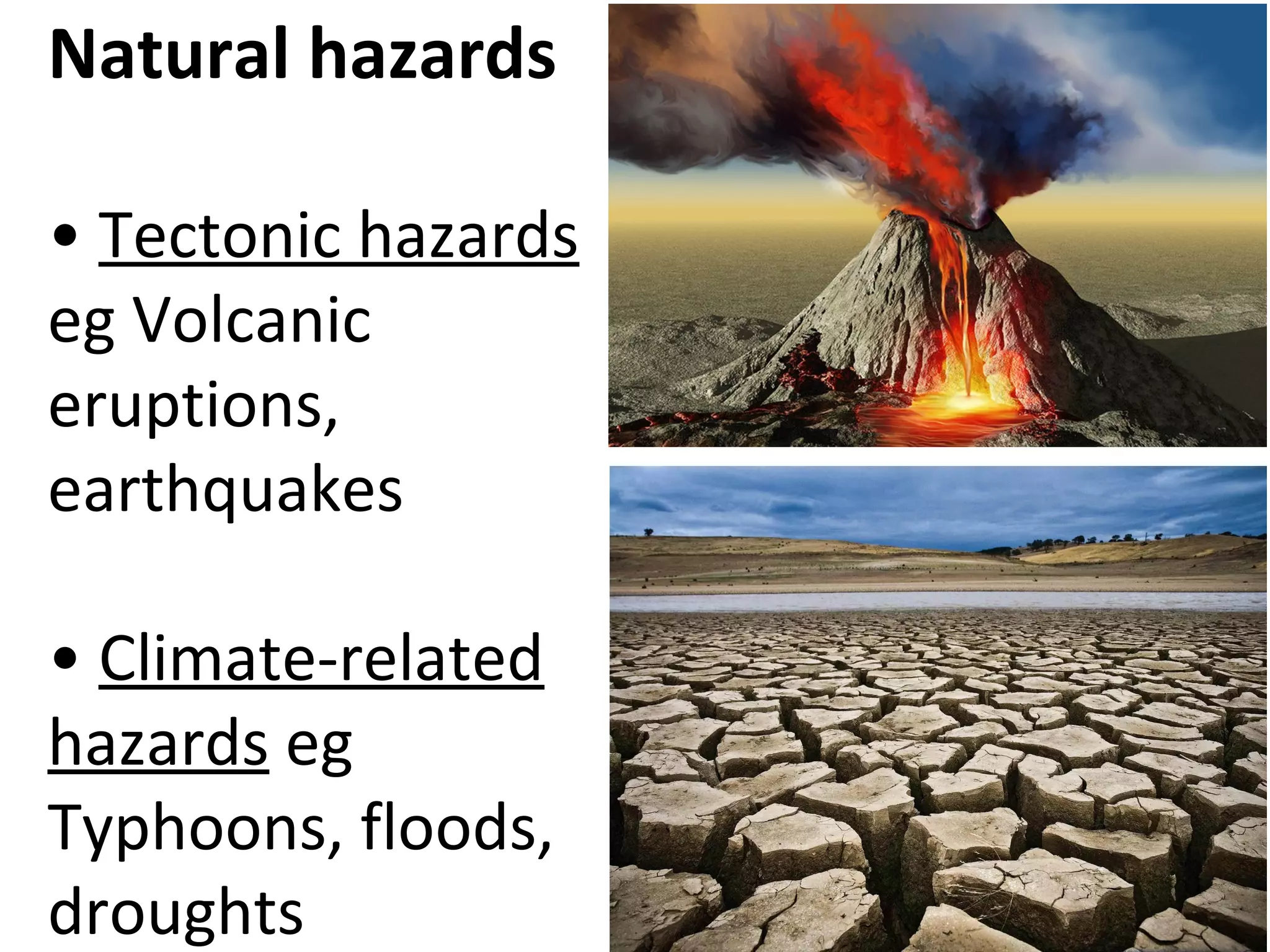
• Tectonic hazards
eg Volcanic
eruptions,
earthquakes
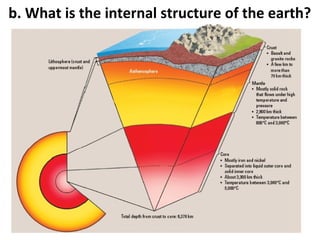
• Climate-related
hazards eg
Typhoons, floods,
droughts
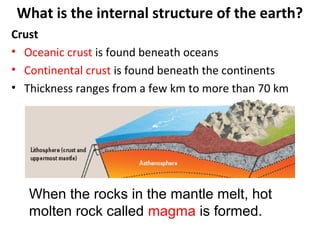
b. What is the internal structure of the earth?
Crust
• Oceanic crust is found beneath oceans
• Continental crust is found beneath the continents
• Thickness ranges from a few km to more than 70 km
What is the internal structure of the earth?
When the rocks in the mantle melt, hot
molten rock called magma is formed.
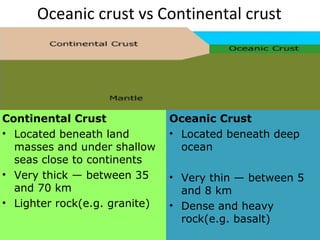
Oceanic crust vs Continental crust
Oceanic Crust
• Located beneath deep
ocean
• Very thin — between 5
and 8 km
• Dense and heavy
rock(e.g. basalt)
Continental Crust
• Located beneath land
masses and under shallow
seas close to continents
• Very thick — between 35
and 70 km
• Lighter rock(e.g. granite)
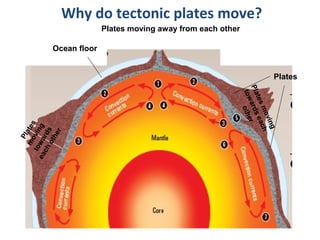
Plates moving away from each other
Platesmoving
towards
eachother
Platesmoving
towardseach
other
Plates
Ocean floor
Why do tectonic plates move?
Nearpod
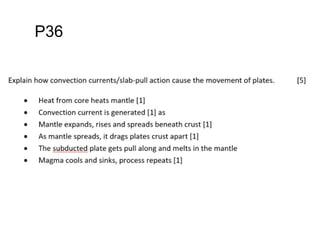
P36
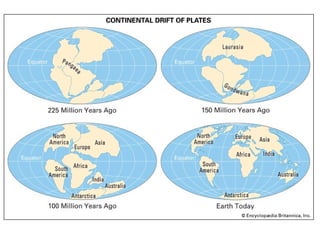
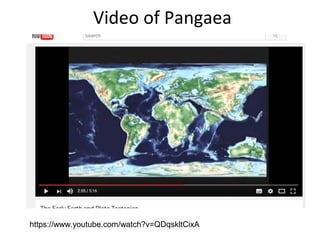
Video of Pangaea
https://www.youtube.com/watch?v=QDqskltCixA
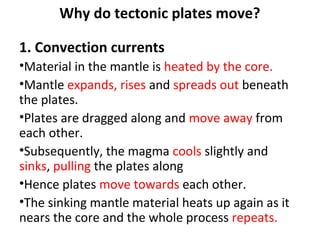
1. Convection currents
•Material in the mantle is heated by the core.
•Mantle expands, rises and spreads out beneath
the plates.
•Plates are dragged along and move away from
each other.
•Subsequently, the magma cools slightly and
sinks, pulling the plates along
•Hence plates move towards each other.
•The sinking mantle material heats up again as it
nears the core and the whole process repeats.
Why do tectonic plates move?
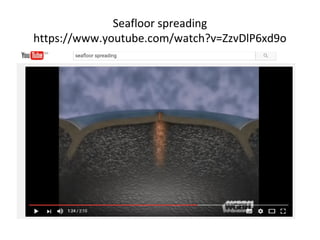
Seafloor spreading
https://www.youtube.com/watch?v=ZzvDlP6xd9o
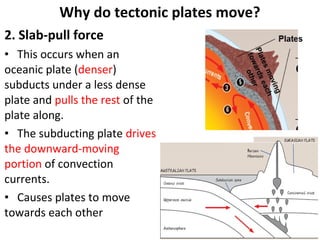
2. Slab-pull force
• This occurs when an
oceanic plate (denser)
subducts under a less dense
plate and pulls the rest of the
plate along.
• The subducting plate drives
the downward-moving
portion of convection
currents.
• Causes plates to move
towards each other
Why do tectonic plates move?
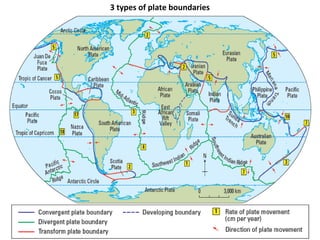
3 types of plate boundaries
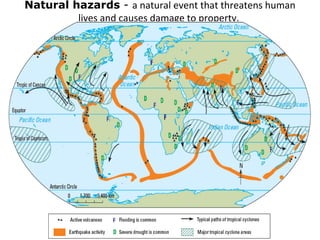
Natural hazards - a natural event that threatens human
lives and causes damage to property.
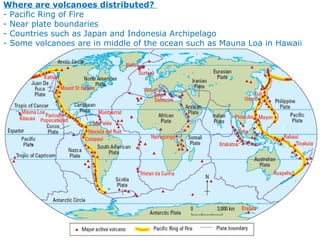
Where are volcanoes distributed?
- Pacific Ring of Fire
- Near plate boundaries
- Countries such as Japan and Indonesia Archipelago
- Some volcanoes are in middle of the ocean such as Mauna Loa in Hawaii
Identify if the age of the rocks at zone A is younger or older
than that found in zone B and explain why this is so. [5]
- Zone A is the youngest and newest rock
- It is nearest to the plate boundary where the
opening of the crust is at.
- Magma rises through the crack and forms new
sea floor at Zone A.
- As the plates move further away from each other
(divergent), Zone B would have the older rocks.
- Eventually the oldest rocks would be found in
Zone C.
P37
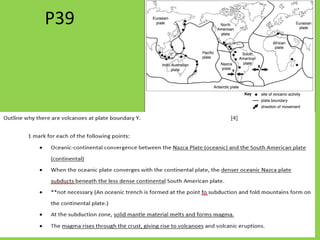
• With reference to Figure 2, describe the tectonic
plate movements and explain why they move. [5]
With reference to Figure 2, describe the tectonic plate
movements and explain why they move. [5]
Describe
-In Fig, 2, we can see the South America and Nazca plate
moving towards each other at the convergent boundary.
-The Nazca and Pacific plate moving away from each other
at the divergent boundary
Explain
-Plates move due to convection current in the mantle.
-Magma rise and expands from the core, cools and sinks
near the surface. Cycle repeats
-Slab pull force causes plates to drive downwards into the
Homework P118 B
Describe three differences between the oceanic
and continental crust. [3]
- Location : oceanic crust is beneath the deep
ocean, but continental crust is beneath land
masses and under shallow sea.
- Thickness : oceanic crust is very thin (5-8km), but
continental crust is very thick (30 – 60 km)
- Density : oceanic crust is denser (eg basalt) but
continental crust is less dense (eg granite)
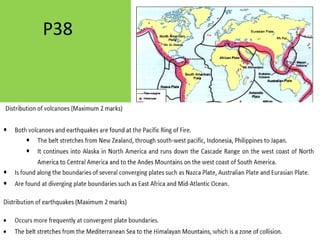
P38
P39
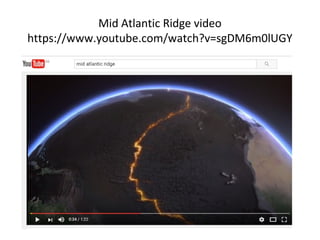
Mid Atlantic Ridge video
https://www.youtube.com/watch?v=sgDM6m0lUGY
DIVERGENCE
- OCEANIC OCEANIC PLATES
- RIDGES
(1H COM2 14/7)
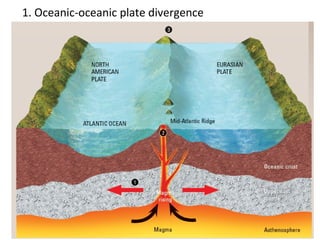
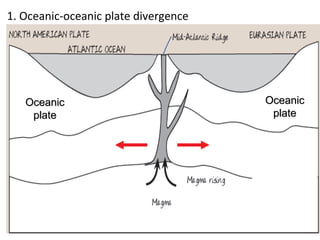
1. Oceanic-oceanic plate divergence
OceanicOceanic
plateplate
OceanicOceanic
plateplate
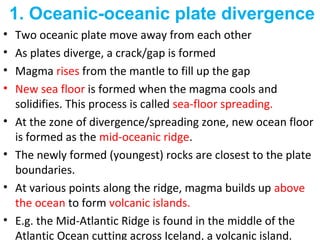
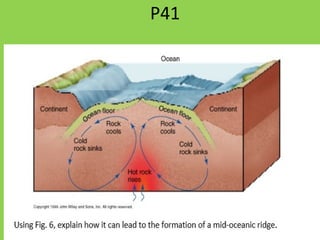
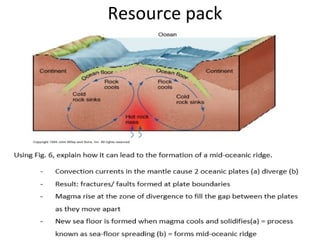
• Two oceanic plate move away from each other
• As plates diverge, a crack/gap is formed
• Magma rises from the mantle to fill up the gap
• New sea floor is formed when the magma cools and
solidifies. This process is called sea-floor spreading.
• At the zone of divergence/spreading zone, new ocean floor
is formed as the mid-oceanic ridge.
• The newly formed (youngest) rocks are closest to the plate
boundaries.
• At various points along the ridge, magma builds up above
the ocean to form volcanic islands.
• E.g. the Mid-Atlantic Ridge is found in the middle of the
Atlantic Ocean cutting across Iceland, a volcanic island.
1. Oceanic-oceanic plate divergence
P41
Resource pack
DIVERGENCE
- CONTINENTAL CONTINENTAL
- RIFT VALLEYS AND BLOCK
MOUNTAINS
Rift valley video
https://www.youtube.com/watch?
v=w7Y2R4KBwvo&list=PLFNb1e9QgTgfMK2kT_xtKrm-exIP8j0yw
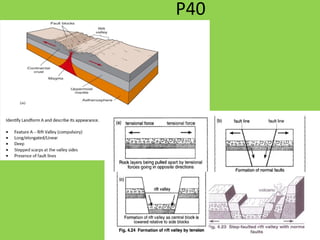
• A fault is a fracture in the rocks along which
the rocks are displaced.
• The tensional forces result in parts of the
crust being fractured.
• This process is called faulting.
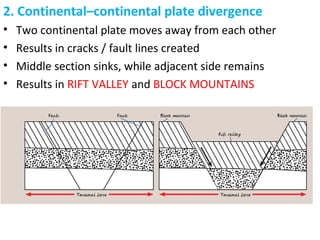
2. Continental–continental plate divergence
• Two continental plate moves away from each other
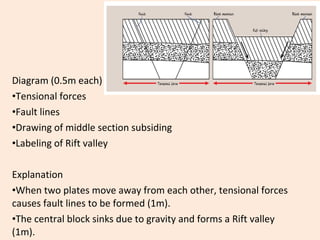
• Results in cracks / fault lines created
• Middle section sinks, while adjacent side remains
• Results in RIFT VALLEY and BLOCK MOUNTAINS
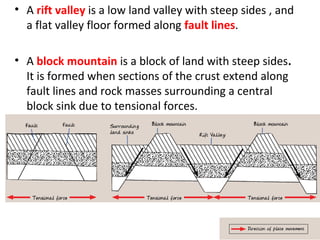
• A rift valley is a low land valley with steep sides , and
a flat valley floor formed along fault lines.
• A block mountain is a block of land with steep sides.
It is formed when sections of the crust extend along
fault lines and rock masses surrounding a central
block sink due to tensional forces.
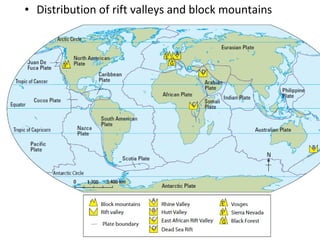
• Distribution of rift valleys and block mountains
P40
• Homework P115
Diagram (0.5m each)
•Tensional forces
•Fault lines
•Drawing of middle section subsiding
•Labeling of Rift valley
Explanation
•When two plates move away from each other, tensional forces
causes fault lines to be formed (1m).
•The central block sinks due to gravity and forms a Rift valley
(1m).
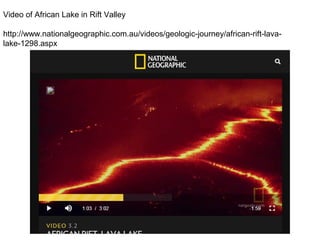
Video of African Lake in Rift Valley
http://www.nationalgeographic.com.au/videos/geologic-journey/african-rift-lava-
lake-1298.aspx
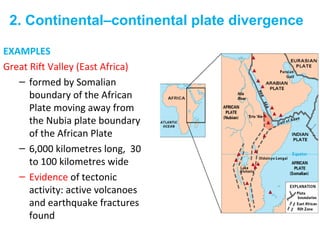
EXAMPLES
Great Rift Valley (East Africa)
– formed by Somalian
boundary of the African
Plate moving away from
the Nubia plate boundary
of the African Plate
– 6,000 kilometres long, 30
to 100 kilometres wide
– Evidence of tectonic
activity: active volcanoes
and earthquake fractures
found
2. Continental–continental plate divergence
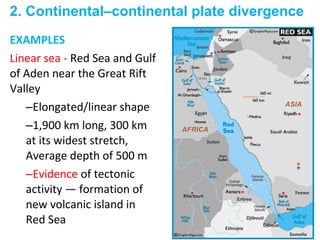
EXAMPLES
Linear sea - Red Sea and Gulf
of Aden near the Great Rift
Valley
–Elongated/linear shape
–1,900 km long, 300 km
at its widest stretch,
Average depth of 500 m
–Evidence of tectonic
activity — formation of
new volcanic island in
Red Sea
2. Continental–continental plate divergence
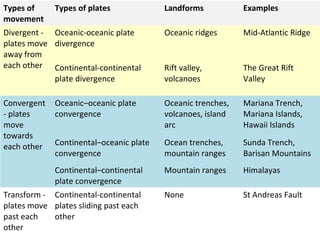
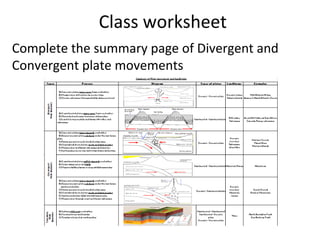
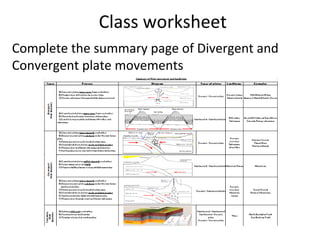
Types of
movement
Types of plates Landforms Examples
Divergent -
plates move
away from
each other
Oceanic-oceanic plate
divergence
Oceanic ridges Mid-Atlantic Ridge
Continental-continental
plate divergence
Rift valley,
volcanoes
The Great Rift
Valley
Convergent
- plates
move
towards
each other
Oceanic–oceanic plate
convergence
Oceanic trenches,
volcanoes, island
arc
Mariana Trench,
Mariana Islands,
Hawaii Islands
Continental–oceanic plate
convergence
Ocean trenches,
mountain ranges
Sunda Trench,
Barisan Mountains
Continental–continental
plate convergence
Mountain ranges Himalayas
Transform -
plates move
past each
other
Continental-continental
plates sliding past each
other
None St Andreas Fault
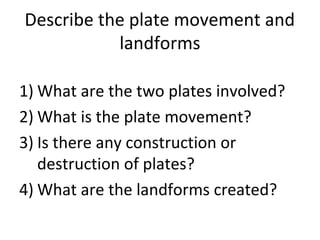
Describe the plate movement and
landforms
1) What are the two plates involved?
2) What is the plate movement?
3) Is there any construction or
destruction of plates?
4) What are the landforms created?
CONVERGENCE
- OCEANIC OCEANIC PLATES
-VOLCANIC ISLAND ARCS
-TRENCH
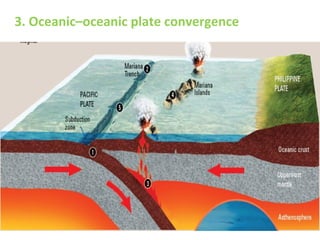
3. Oceanic–oceanic plate convergence
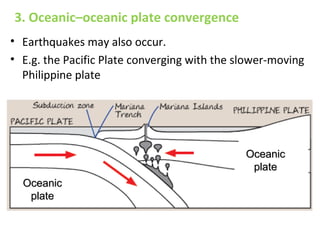
• Earthquakes may also occur.
• E.g. the Pacific Plate converging with the slower-moving
Philippine plate
3. Oceanic–oceanic plate convergence
OceanicOceanic
plateplate
OceanicOceanic
plateplate
3. Oceanic–oceanic plate convergence
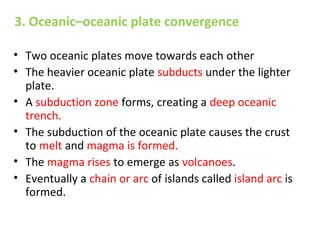
• Two oceanic plates move towards each other
• The heavier oceanic plate subducts under the lighter
plate.
• A subduction zone forms, creating a deep oceanic
trench.
• The subduction of the oceanic plate causes the crust
to melt and magma is formed.
• The magma rises to emerge as volcanoes.
• Eventually a chain or arc of islands called island arc is
formed.
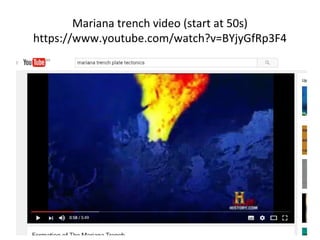
Mariana trench video (start at 50s)
https://www.youtube.com/watch?v=BYjyGfRp3F4
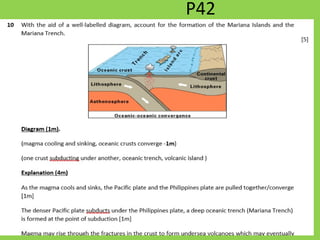
P42
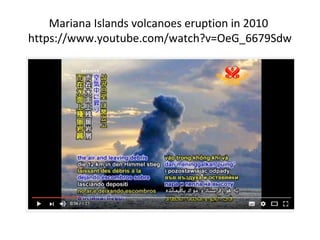
Mariana Islands volcanoes eruption in 2010
https://www.youtube.com/watch?v=OeG_6679Sdw
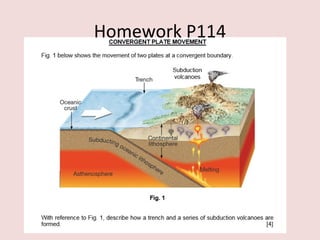
Homework P114
With reference to Fig 1, describe how a trench and a
series of subduction volcanoes are formed. [4]
Trench
•The two oceanic plates converge and move towards each other. (1m)
•Subduction of the denser oceanic plate occurs whereby the heavier
plate is pushed into the mantle, and a trench is formed at the
subduction zone. (1m)
Subduction volcanoes
•The subducted plate melts into the mantle due to high heat from the
core, and results in excess magma being produced. (1m)
•The magma rises through the openings of the earth’s surface as
volcanoes, a series of subduction volcanoes are formed. (1m)
CONVERGENCE
- CONTINENTAL
CONTINENTAL PLATES
- FOLD MOUNTAINS
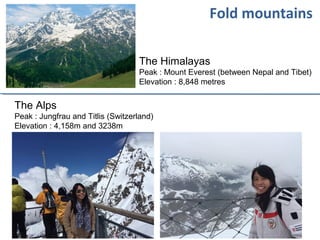
Fold mountains
The Himalayas
Peak : Mount Everest (between Nepal and Tibet)
Elevation : 8,848 metres
The Alps
Peak : Jungfrau and Titlis (Switzerland)
Elevation : 4,158m and 3238m
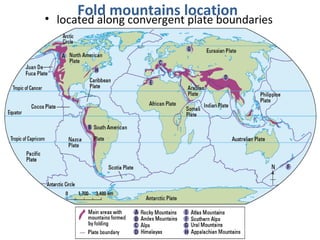
• located along convergent plate boundaries
Fold mountains location
Fold mountains
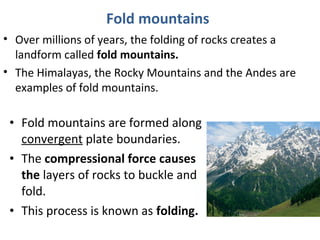
• Over millions of years, the folding of rocks creates a
landform called fold mountains.
• The Himalayas, the Rocky Mountains and the Andes are
examples of fold mountains.
• Fold mountains are formed along
convergent plate boundaries.
• The compressional force causes
the layers of rocks to buckle and
fold.
• This process is known as folding.
Continental crust
Continental crust
Himalayas
Tibetan
Plateau
Uppermost mantle
Asthenosphere
EURASIAN
PLATE
INDIAN
PLATE
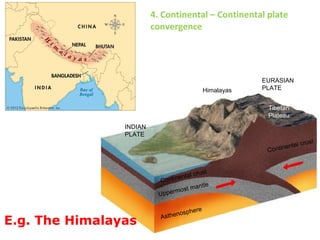
4. Continental – Continental plate
convergence
E.g. The Himalayas
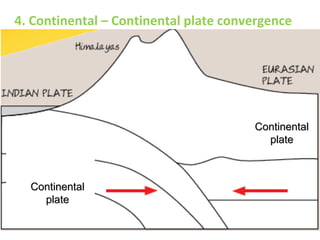
4. Continental – Continental plate convergence
ContinentalContinental
plateplate
ContinentalContinental
plateplate
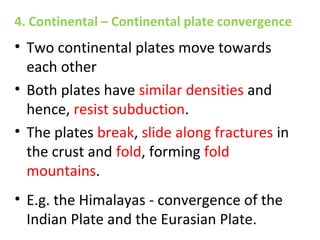
• Two continental plates move towards
each other
• Both plates have similar densities and
hence, resist subduction.
• The plates break, slide along fractures in
the crust and fold, forming fold
mountains.
• E.g. the Himalayas - convergence of the
Indian Plate and the Eurasian Plate.
4. Continental – Continental plate convergence
Class quiz
• What is the difference between
fold mountains and block
mountains?
• What is the difference between
volcanoes and mountains?
CONVERGENCE
-OCEANIC & CONTINENTAL
PLATES
-Fold mountains and
volcanoes
-Trench
(1H COM2 28/7)
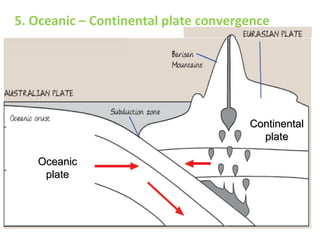
5. Oceanic – Continental plate convergence
ContinentalContinental
plateplate
OceanicOceanic
plateplate
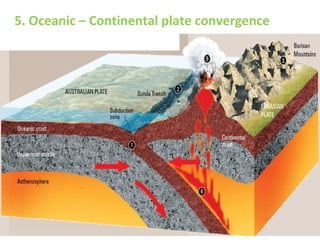
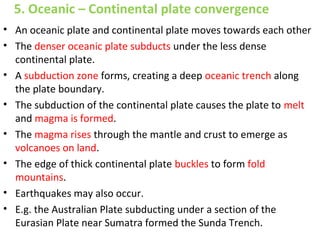
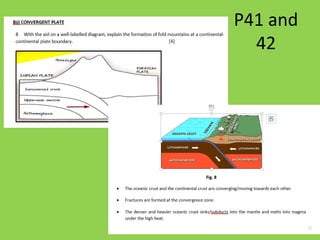
• An oceanic plate and continental plate moves towards each other
• The denser oceanic plate subducts under the less dense
continental plate.
• A subduction zone forms, creating a deep oceanic trench along
the plate boundary.
• The subduction of the continental plate causes the plate to melt
and magma is formed.
• The magma rises through the mantle and crust to emerge as
volcanoes on land.
• The edge of thick continental plate buckles to form fold
mountains.
• Earthquakes may also occur.
• E.g. the Australian Plate subducting under a section of the
Eurasian Plate near Sumatra formed the Sunda Trench.
5. Oceanic – Continental plate convergence
Nearpod
P41 and
42
Class worksheet
Complete the summary page of Divergent and
Convergent plate movements
P43
P43
TRANSFORM
- CONTINENTAL
CONTINENTAL PLATES
- FAULTS AND EARTHQUAKES
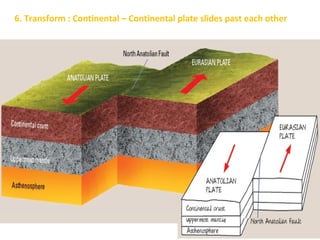
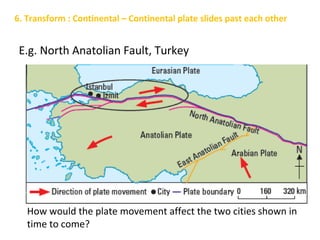
6. Transform : Continental – Continental plate slides past each other
• Plates slide past each
other.
• As they do so,
tremendous stress
builds up.
• This stress is eventually
released, often as a
violent earthquake.
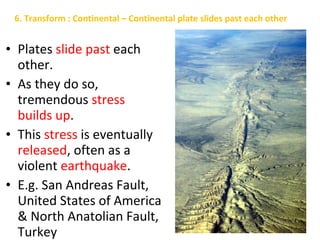
• E.g. San Andreas Fault,
United States of America
& North Anatolian Fault,
Turkey
6. Transform : Continental – Continental plate slides past each other
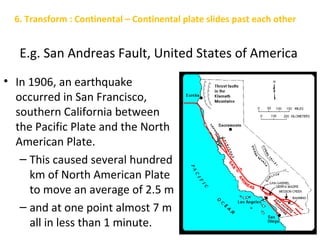
E.g. San Andreas Fault, United States of America
• In 1906, an earthquake
occurred in San Francisco,
southern California between
the Pacific Plate and the North
American Plate.
– This caused several hundred
km of North American Plate
to move an average of 2.5 m
– and at one point almost 7 m
all in less than 1 minute.
6. Transform : Continental – Continental plate slides past each other
E.g. North Anatolian Fault, Turkey
How would the plate movement affect the two cities shown in
time to come?
6. Transform : Continental – Continental plate slides past each other
Class worksheet
Complete the summary page of Divergent and
Convergent plate movements
VOLCANOES
Volcanoes
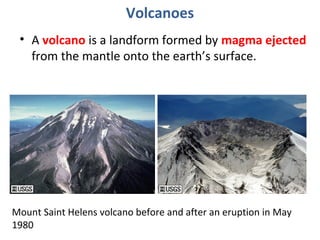
• A volcano is a landform formed by magma ejected
from the mantle onto the earth’s surface.
Mount Saint Helens volcano before and after an eruption in May
1980
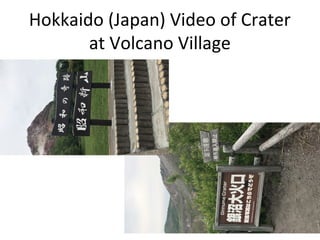
Hokkaido (Japan) Video of Crater
at Volcano Village
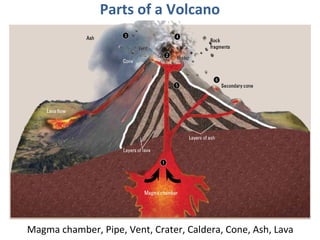
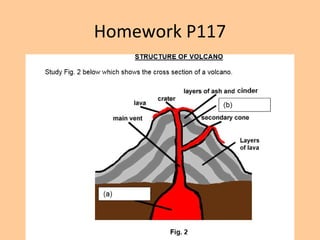
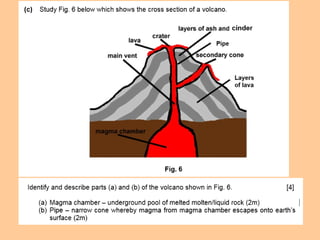
Parts of a Volcano
Magma chamber, Pipe, Vent, Crater, Caldera, Cone, Ash, Lava
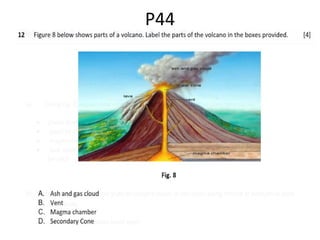
P44
Homework P117
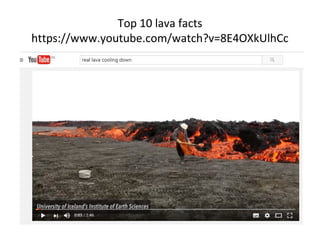
Top 10 lava facts
https://www.youtube.com/watch?v=8E4OXkUlhCc
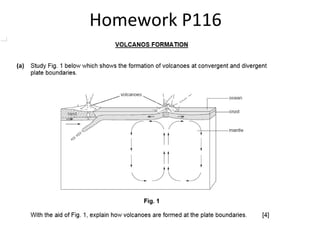
Homework P116
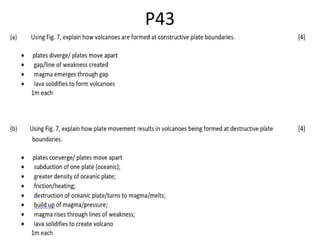
• Convergent plate boundary: collision of plates
cause subduction (1m) and melting of plates,
this results in excess magma produced and
magma rises through cracks on the Earth’s
crust to form subduction volcanoes (1m)
• Divergent plate boundary: plates moving away
from each other (1m) results in cracks on the
earth’s surface, which causes magma to seep
up from the ground, resulting in formation of
volcanoes (1m)
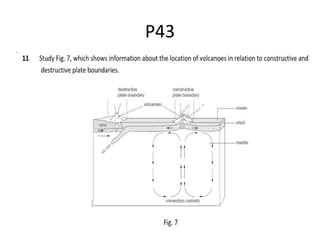
With the aid of Fig. 1, explain how volcanoes are formed at the plate boundaries.
[4]
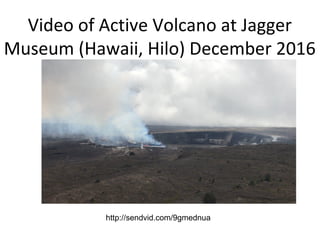
Video of Active Volcano at Jagger
Museum (Hawaii, Hilo) December 2016
http://sendvid.com/9gmednua
Video of Active Volcano in Hawaii,
Hilo (December 2016)
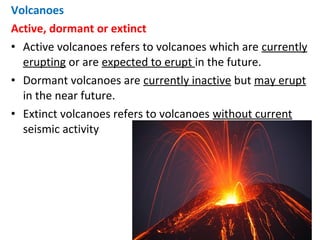
Volcanoes
Active, dormant or extinct
• Active volcanoes refers to volcanoes which are currently
erupting or are expected to erupt in the future.
• Dormant volcanoes are currently inactive but may erupt
in the near future.
• Extinct volcanoes refers to volcanoes without current
seismic activity
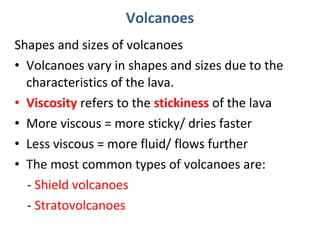
Shapes and sizes of volcanoes
• Volcanoes vary in shapes and sizes due to the
characteristics of the lava.
• Viscosity refers to the stickiness of the lava
• More viscous = more sticky/ dries faster
• Less viscous = more fluid/ flows further
• The most common types of volcanoes are:
- Shield volcanoes
- Stratovolcanoes
Volcanoes
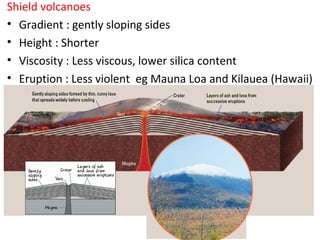
Shield volcanoes
• Gradient : gently sloping sides
• Height : Shorter
• Viscosity : Less viscous, lower silica content
• Eruption : Less violent eg Mauna Loa and Kilauea (Hawaii)
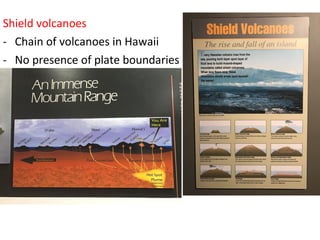
Shield volcanoes
- Chain of volcanoes in Hawaii
- No presence of plate boundaries
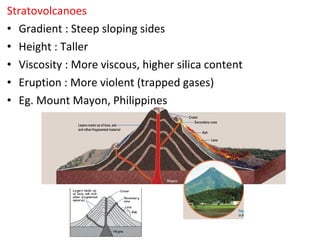
Stratovolcanoes
• Gradient : Steep sloping sides
• Height : Taller
• Viscosity : More viscous, higher silica content
• Eruption : More violent (trapped gases)
• Eg. Mount Mayon, Philippines
P45
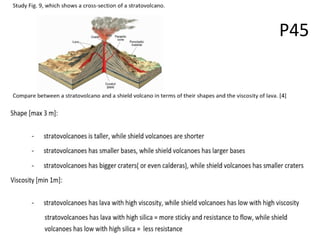
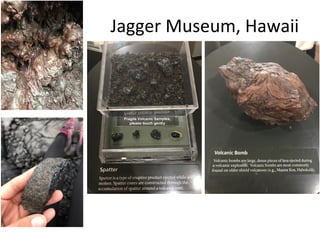
Jagger Museum, Hawaii
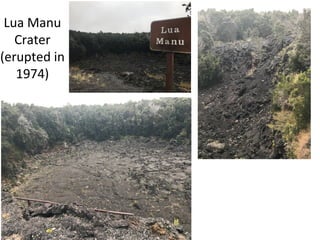
Lua Manu
Crater
(erupted in
1974)
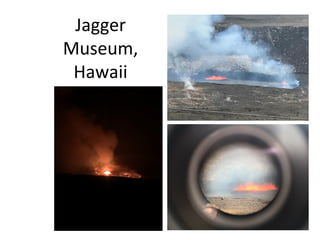
Jagger
Museum,
Hawaii
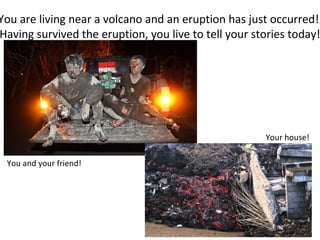
You are living near a volcano and an eruption has just occurred!
Having survived the eruption, you live to tell your stories today!
You and your friend!
Your house!
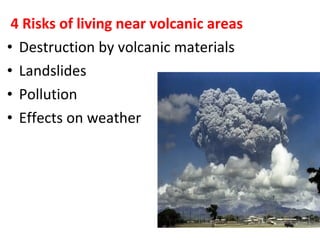
4 Risks of living near volcanic areas
• Destruction by volcanic materials
• Landslides
• Pollution
• Effects on weather
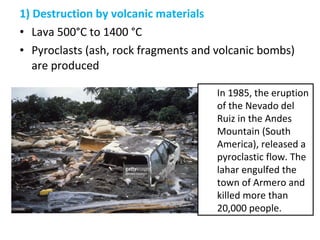
1) Destruction by volcanic materials
• Lava 500°C to 1400 °C
• Pyroclasts (ash, rock fragments and volcanic bombs)
are produced
In 1985, the eruption
of the Nevado del
Ruiz in the Andes
Mountain (South
America), released a
pyroclastic flow. The
lahar engulfed the
town of Armero and
killed more than
20,000 people.
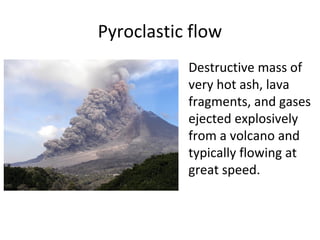
Pyroclastic flow
Destructive mass of
very hot ash, lava
fragments, and gases
ejected explosively
from a volcano and
typically flowing at
great speed.
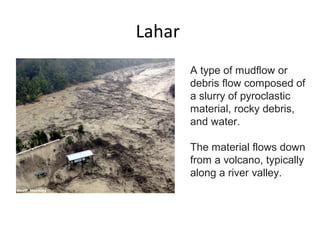
Lahar
A type of mudflow or
debris flow composed of
a slurry of pyroclastic
material, rocky debris,
and water.
The material flows down
from a volcano, typically
along a river valley.
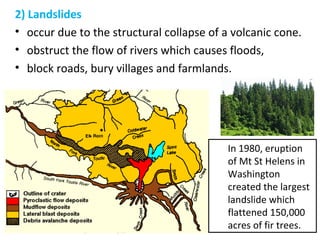
2) Landslides
• occur due to the structural collapse of a volcanic cone.
• obstruct the flow of rivers which causes floods,
• block roads, bury villages and farmlands.
In 1980, eruption
of Mt St Helens in
Washington
created the largest
landslide which
flattened 150,000
acres of fir trees.
3) Pollution
• Ash particles may block sunlight, suffocate crops, and cause
severe respiratory problems for people and animals.
• Release of gases may be harmful to people.
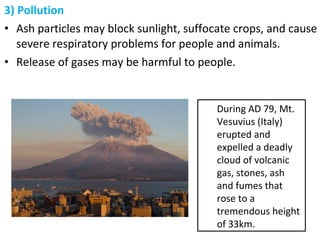
During AD 79, Mt.
Vesuvius (Italy)
erupted and
expelled a deadly
cloud of volcanic
gas, stones, ash
and fumes that
rose to a
tremendous height
of 33km.
4) Effects on weather
• Sulphur dioxide released from volcanic eruptions has
impacts on the environment
• It may react with water vapour and other chemicals in the
atmosphere to form sulphur-based particles.
• These particles reflect the sun’s energy back into space and
temporarily cool the earth for periods of time.
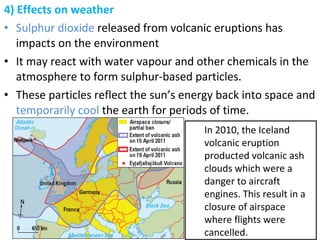
In 2010, the Iceland
volcanic eruption
producted volcanic ash
clouds which were a
danger to aircraft
engines. This result in a
closure of airspace
where flights were
cancelled.
• ‘There are more risks than benefits of staying
in a volcanic area.’ To what extent do you
agree with this statement?
• Support your answer with examples [6]
P46and P47
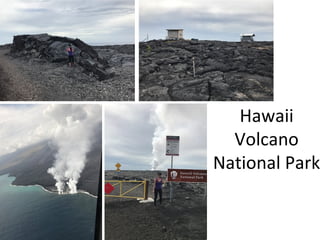
Hawaii
Volcano
National Park
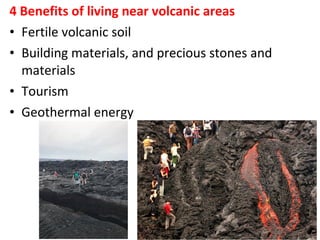
4 Benefits of living near volcanic areas
• Fertile volcanic soil
• Building materials, and precious stones and
materials
• Tourism
• Geothermal energy
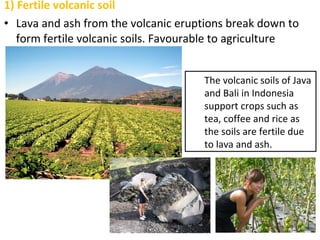
1) Fertile volcanic soil
• Lava and ash from the volcanic eruptions break down to
form fertile volcanic soils. Favourable to agriculture
The volcanic soils of Java
and Bali in Indonesia
support crops such as
tea, coffee and rice as
the soils are fertile due
to lava and ash.
2) Precious stones and minerals, building materials
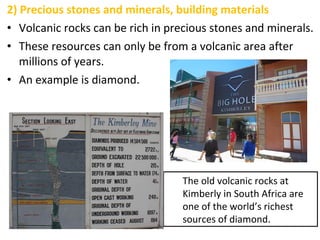
• Volcanic rocks can be rich in precious stones and minerals.
• These resources can only be from a volcanic area after
millions of years.
• An example is diamond.
The old volcanic rocks at
Kimberly in South Africa are
one of the world’s richest
sources of diamond.
3) Tourism
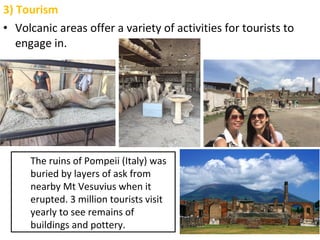
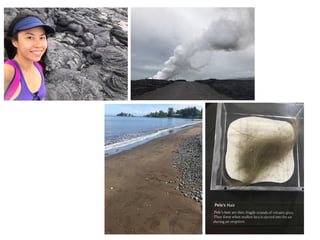
• Volcanic areas offer a variety of activities for tourists to
engage in.
The ruins of Pompeii (Italy) was
buried by layers of ask from
nearby Mt Vesuvius when it
erupted. 3 million tourists visit
yearly to see remains of
buildings and pottery.
4) Geothermal energy
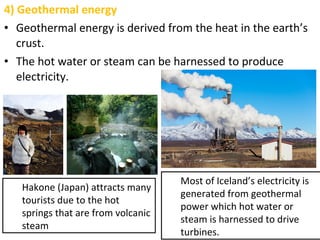
• Geothermal energy is derived from the heat in the earth’s
crust.
• The hot water or steam can be harnessed to produce
electricity.
Most of Iceland’s electricity is
generated from geothermal
power which hot water or
steam is harnessed to drive
turbines.
Hakone (Japan) attracts many
tourists due to the hot
springs that are from volcanic
steam
P=Point Destruction by volcanic materials is a risk that people living in volcanic
areas faced.
D=Describe Volcanic materials include lava and volcanic bombs or rock fragments.
E=Explain People who living in volcanic areas are faced with volcanic eruptions that
produce lava and rock fragments. These volcanic materials can lead to
widespread damage of property. The lava with high temperatures of
between 500° C and 1400° C burns the areas it flows through.
E=Example The ongoing eruption of Kilauea in Hawaii since 1983 has destroyed many
homes and highway.
VOLCANO RISKS AND BENEFITS
Question: The risk of living in volcanic areas outweighs the benefits.” How far do
you agree with this statement? [6]
Using the same format of PDEE, write an answer with 1 set of risk and 1 set of benefit
Introduction:
Risk of living in Volcanic Areas (1 example of risk)
Homework P120
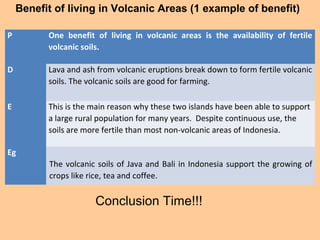
P One benefit of living in volcanic areas is the availability of fertile
volcanic soils.
D Lava and ash from volcanic eruptions break down to form fertile volcanic
soils. The volcanic soils are good for farming.
E This is the main reason why these two islands have been able to support
a large rural population for many years. Despite continuous use, the
soils are more fertile than most non-volcanic areas of Indonesia.
Eg
The volcanic soils of Java and Bali in Indonesia support the growing of
crops like rice, tea and coffee.
Benefit of living in Volcanic Areas (1 example of benefit)
Conclusion Time!!!
Conclusion
There are many benefits of staying
near the volcanoes and it has
supported many in their livelihood.
But people should also remember the
great risks of the eruptions and the
government should closely monitor
the volcanic activities so that they can
warn people of potential threat.
EARTHQUAKES
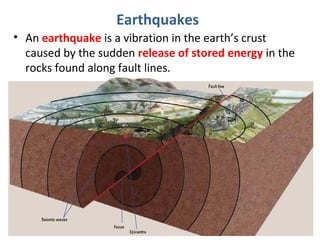
• An earthquake is a vibration in the earth’s crust
caused by the sudden release of stored energy in the
rocks found along fault lines.
Earthquakes
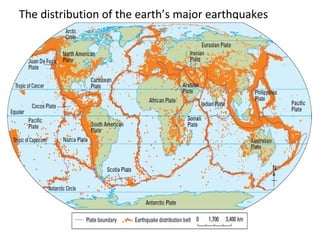
The distribution of the earth’s major earthquakes
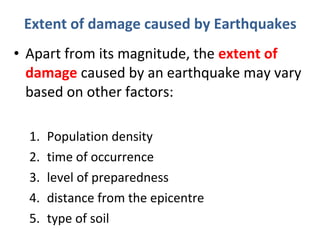
• Apart from its magnitude, the extent of
damage caused by an earthquake may vary
based on other factors:
1. Population density
2. time of occurrence
3. level of preparedness
4. distance from the epicentre
5. type of soil
Extent of damage caused by Earthquakes
Homework P122
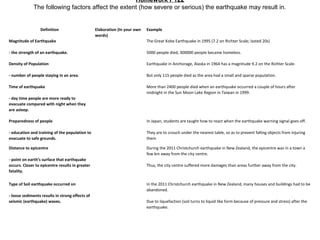
The following factors affect the extent (how severe or serious) the earthquake may result in.
Definition Elaboration (In your own
words)
Example
Magnitude of Earthquake
- the strength of an earthquake.
The Great Kobe Earthquake in 1995 (7.2 on Richter Scale; lasted 20s)
5000 people died, 300000 people became homeless.
Density of Population
- number of people staying in an area.
Earthquake in Anchorage, Alaska in 1964 has a magnitude 9.2 on the Richter Scale.
But only 115 people died as the area had a small and sparse population.
Time of earthquake
- day time people are more ready to
evacuate compared with night when they
are asleep.
More than 2400 people died when an earthquake occurred a couple of hours after
midnight in the Sun Moon Lake Region in Taiwan in 1999.
Preparedness of people
- education and training of the population to
evacuate to safe grounds.
In Japan, students are taught how to react when the earthquake warning signal goes off.
They are to crouch under the nearest table, so as to prevent falling objects from injuring
them
Distance to epicentre
- point on earth’s surface that earthquake
occurs. Closer to epicentre results in greater
fatality.
During the 2011 Christchurch earthquake in New Zealand, the epicentre was in a town a
few km away from the city centre.
Thus, the city centre suffered more damages than areas further away from the city.
Type of Soil earthquake occurred on
- loose sediments results in strong effects of
seismic (earthquake) waves.
In the 2011 Christchurch earthquake in New Zealand, many houses and buildings had to be
abandoned.
Due to liquefaction (soil turns to liquid like form because of pressure and stress) after the
earthquake.
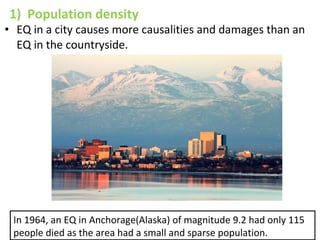
1) Population density
• EQ in a city causes more causalities and damages than an
EQ in the countryside.
In 1964, an EQ in Anchorage(Alaska) of magnitude 9.2 had only 115
people died as the area had a small and sparse population.
2) Time of occurrence
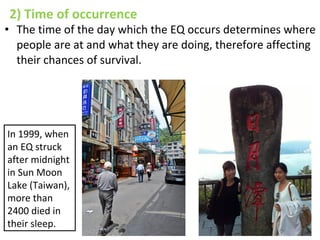
• The time of the day which the EQ occurs determines where
people are at and what they are doing, therefore affecting
their chances of survival.
In 1999, when
an EQ struck
after midnight
in Sun Moon
Lake (Taiwan),
more than
2400 died in
their sleep.
3) Level of preparedness
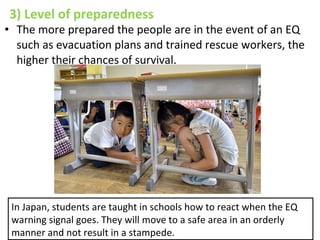
• The more prepared the people are in the event of an EQ
such as evacuation plans and trained rescue workers, the
higher their chances of survival.
In Japan, students are taught in schools how to react when the EQ
warning signal goes. They will move to a safe area in an orderly
manner and not result in a stampede.
4) Distance from epicenter
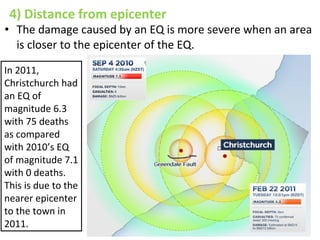
• The damage caused by an EQ is more severe when an area
is closer to the epicenter of the EQ.
In 2011,
Christchurch had
an EQ of
magnitude 6.3
with 75 deaths
as compared
with 2010’s EQ
of magnitude 7.1
with 0 deaths.
This is due to the
nearer epicenter
to the town in
2011.
5) Type of soil
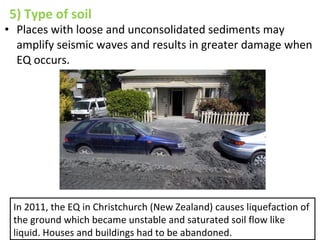
• Places with loose and unconsolidated sediments may
amplify seismic waves and results in greater damage when
EQ occurs.
In 2011, the EQ in Christchurch (New Zealand) causes liquefaction of
the ground which became unstable and saturated soil flow like
liquid. Houses and buildings had to be abandoned.
P49 and P50
• ‘The extent of damages caused by an
earthquake is solely determined by an area’s
proximity to the epicentre.’
• How true is this statement?
• Give reasons and relevant examples in your
answer. [6]
1. Threat of tsunamis
2. Disruption of services
3. Fires
4. Landslides
5. Destruction of properties
6. Destruction of infrastructure
7. Loss of lives
SPLIT Like Flower
Damages caused by Earthquakes
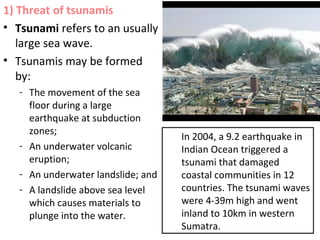
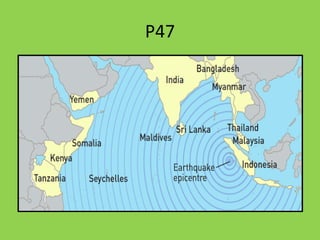
1) Threat of tsunamis
• Tsunami refers to an usually
large sea wave.
• Tsunamis may be formed
by:
- The movement of the sea
floor during a large
earthquake at subduction
zones;
- An underwater volcanic
eruption;
- An underwater landslide; and
- A landslide above sea level
which causes materials to
plunge into the water.
In 2004, a 9.2 earthquake in
Indian Ocean triggered a
tsunami that damaged
coastal communities in 12
countries. The tsunami waves
were 4-39m high and went
inland to 10km in western
Sumatra.
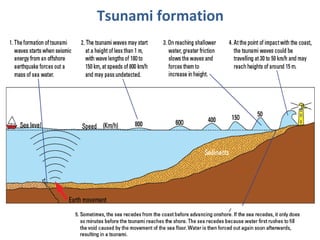
Tsunami formation
P47
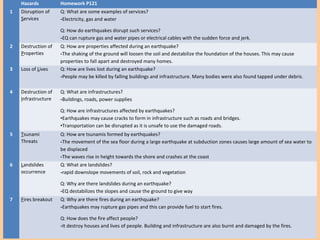
Hazards Homework P121
1 Disruption of
Services
Q: What are some examples of services?
-Electricity, gas and water
Q: How do earthquakes disrupt such services?
-EQ can rupture gas and water pipes or electrical cables with the sudden force and jerk.
2 Destruction of
Properties
Q: How are properties affected during an earthquake?
-The shaking of the ground will loosen the soil and destabilize the foundation of the houses. This may cause
properties to fall apart and destroyed many homes.
3 Loss of Lives Q: How are lives lost during an earthquake?
-People may be killed by falling buildings and infrastructure. Many bodies were also found tapped under debris.
4 Destruction of
Infrastructure
Q: What are infrastructures?
-Buildings, roads, power supplies
Q: How are infrastructures affected by earthquakes?
•Earthquakes may cause cracks to form in infrastructure such as roads and bridges.
•Transportation can be disrupted as it is unsafe to use the damaged roads.
5 Tsunami
Threats
Q: How are tsunamis formed by earthquakes?
-The movement of the sea floor during a large earthquake at subduction zones causes large amount of sea water to
be displaced
-The waves rise in height towards the shore and crashes at the coast
6 Landslides
occurrence
Q: What are landslides?
-rapid downslope movements of soil, rock and vegetation
Q: Why are there landslides during an earthquake?
-EQ destabilizes the slopes and cause the ground to give way
7 Fires breakout Q: Why are there fires during an earthquake?
-Earthquakes may rupture gas pipes and this can provide fuel to start fires.
Q: How does the fire affect people?
-It destroy houses and lives of people. Building and infrastructure are also burnt and damaged by the fires.
P=Point Tsunamis can have an impact on the lives of the people.
D=Describe Tsunamis are unusually large waves caused by underwater earthquakes.
E=Explain Tsunamis can travel long distances and caused great destruction to coastal areas
when they sweep inland. At the point of contact on the coast, the tsunami waves
could be travelling at 50km/h and may reach heights of around 15metres.
E=Example In 2004, a 9.2 magnitude earthquake occurred in the Indian Ocean and caused a
tsunami with waves that spread throughout the Indian Ocean. The most damage was
experienced in the low-lying coastal areas of western Sumatra, Indonesia. There was
a loss of lives and destruction of properties along this stretch of the coast.
TSUNAMI AND EARTHQUAKE IMPACT
Question:
‘The impact of a tsunami on people’s lives can be more devastating than that of an earthquake.’
How far do you agree with this statement? Give reasons for your answer. [6]
Introduction:
Yes I agree to a large extent as the devastation by a tsunami is very great on the coastal
communities as it catches many unprepared. This essay will discuss the impact of tsunami and
earthquake on the lives of people.
Impact of a tsunami on people’s lives (1 example)
Homework P119
P=Point Earthquakes can have an impact on the lives of the people.
Earthquakes can cause fire.
D=Describe Earthquakes may rupture gas pipes and the gas can provide fuel to
start fires. Earthquakes may expose electrical cables which may
ignite flammable items like gas and oil.
E=Explain Once these items are ignited, fires can spread quickly to a large area,
increasing the number of deaths and injured.
E=Example The 1995 earthquake in Kobe, Earthquake caused extensive fires that
went on for two days. Firemen were unable to control the fires as the
ruptured water pipes meant that were no water supply to put out the
fire.
Impact of an earthquake on people’s lives (1 example)
Conclusion: In conclusion, both Tsunami and Earthquakes causes extensive
damage to people. There the implementation of tsunami and earthquake warning
system is necessary so that people can be better prepared in times of
emergency for evacuation.
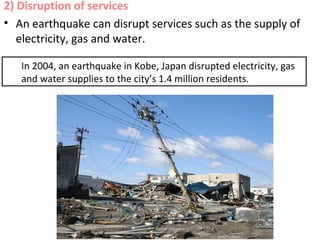
2) Disruption of services
• An earthquake can disrupt services such as the supply of
electricity, gas and water.
In 2004, an earthquake in Kobe, Japan disrupted electricity, gas
and water supplies to the city’s 1.4 million residents.
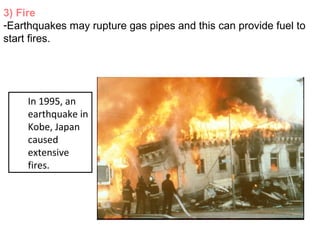
3) Fire
-Earthquakes may rupture gas pipes and this can provide fuel to
start fires.
In 1995, an
earthquake in
Kobe, Japan
caused
extensive
fires.
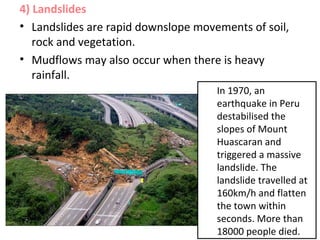
4) Landslides
• Landslides are rapid downslope movements of soil,
rock and vegetation.
• Mudflows may also occur when there is heavy
rainfall.
In 1970, an
earthquake in Peru
destabilised the
slopes of Mount
Huascaran and
triggered a massive
landslide. The
landslide travelled at
160km/h and flatten
the town within
seconds. More than
18000 people died.
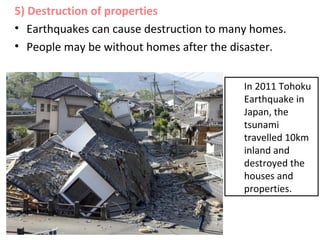
5) Destruction of properties
• Earthquakes can cause destruction to many homes.
• People may be without homes after the disaster.
In 2011 Tohoku
Earthquake in
Japan, the
tsunami
travelled 10km
inland and
destroyed the
houses and
properties.
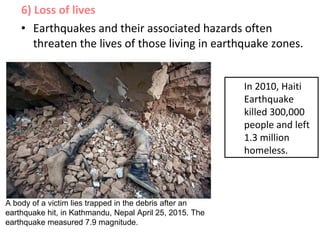
6) Loss of lives
• Earthquakes and their associated hazards often
threaten the lives of those living in earthquake zones.
A body of a victim lies trapped in the debris after an
earthquake hit, in Kathmandu, Nepal April 25, 2015. The
earthquake measured 7.9 magnitude.
In 2010, Haiti
Earthquake
killed 300,000
people and left
1.3 million
homeless.
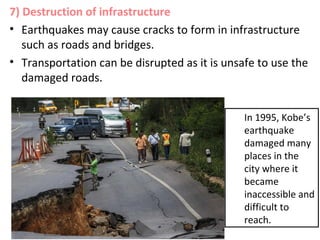
7) Destruction of infrastructure
• Earthquakes may cause cracks to form in infrastructure
such as roads and bridges.
• Transportation can be disrupted as it is unsafe to use the
damaged roads.
In 1995, Kobe’s
earthquake
damaged many
places in the
city where it
became
inaccessible and
difficult to
reach.
P48
With reference to Fig. 2, suggest why Christchurch suffered more damage from the 2011
earthquake. [5]
• In 2011, Christchurch is within the first seismic wave which is very near to the epicenter
of the earthquake, while in 2010, Christchurch is at the third seismic wave. In 2011, the
earthquake occurred very near to the surface at a focal depth of 5km so the impact is
greater. Christchurch is a densely built up area with many buildings and the
infrastructure is not built to withstand the stronger vibration felt in 2011. In 2011,
earthquake occurred at 12.51pm where many people are still in offices working when
buildings collapsed, while in 2010 at 4.35am, when most people are not in high-rise
offices. More liquefaction could have occurred in 2011 which makes the infrastructure
unstable.
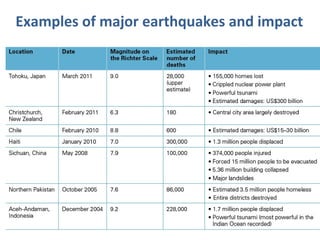
Examples of major earthquakes and impact
With the help of Fig. 1, explain the impact caused by an earthquake. [3]
- Destruction of properties : structural damage to houses
- Destruction of infrastructure : cracks to form on roads and buildings
- Tsunami : floods and damage coastal communities
Homework P118 A

Plates

  • 1.
    Natural hazards • Tectonichazards eg Volcanic eruptions, earthquakes • Climate-related hazards eg Typhoons, floods, droughts
  • 2.
    b. What isthe internal structure of the earth?
  • 3.
    Crust • Oceanic crustis found beneath oceans • Continental crust is found beneath the continents • Thickness ranges from a few km to more than 70 km What is the internal structure of the earth? When the rocks in the mantle melt, hot molten rock called magma is formed.
  • 4.
    Oceanic crust vsContinental crust Oceanic Crust • Located beneath deep ocean • Very thin — between 5 and 8 km • Dense and heavy rock(e.g. basalt) Continental Crust • Located beneath land masses and under shallow seas close to continents • Very thick — between 35 and 70 km • Lighter rock(e.g. granite)
  • 5.
    Plates moving awayfrom each other Platesmoving towards eachother Platesmoving towardseach other Plates Ocean floor Why do tectonic plates move?
  • 6.
  • 7.
  • 9.
  • 10.
    1. Convection currents •Materialin the mantle is heated by the core. •Mantle expands, rises and spreads out beneath the plates. •Plates are dragged along and move away from each other. •Subsequently, the magma cools slightly and sinks, pulling the plates along •Hence plates move towards each other. •The sinking mantle material heats up again as it nears the core and the whole process repeats. Why do tectonic plates move?
  • 11.
  • 12.
    2. Slab-pull force •This occurs when an oceanic plate (denser) subducts under a less dense plate and pulls the rest of the plate along. • The subducting plate drives the downward-moving portion of convection currents. • Causes plates to move towards each other Why do tectonic plates move?
  • 13.
    3 types ofplate boundaries
  • 14.
    Natural hazards -a natural event that threatens human lives and causes damage to property.
  • 15.
    Where are volcanoesdistributed? - Pacific Ring of Fire - Near plate boundaries - Countries such as Japan and Indonesia Archipelago - Some volcanoes are in middle of the ocean such as Mauna Loa in Hawaii
  • 16.
    Identify if theage of the rocks at zone A is younger or older than that found in zone B and explain why this is so. [5] - Zone A is the youngest and newest rock - It is nearest to the plate boundary where the opening of the crust is at. - Magma rises through the crack and forms new sea floor at Zone A. - As the plates move further away from each other (divergent), Zone B would have the older rocks. - Eventually the oldest rocks would be found in Zone C.
  • 17.
    P37 • With referenceto Figure 2, describe the tectonic plate movements and explain why they move. [5]
  • 18.
    With reference toFigure 2, describe the tectonic plate movements and explain why they move. [5] Describe -In Fig, 2, we can see the South America and Nazca plate moving towards each other at the convergent boundary. -The Nazca and Pacific plate moving away from each other at the divergent boundary Explain -Plates move due to convection current in the mantle. -Magma rise and expands from the core, cools and sinks near the surface. Cycle repeats -Slab pull force causes plates to drive downwards into the
  • 19.
    Homework P118 B Describethree differences between the oceanic and continental crust. [3] - Location : oceanic crust is beneath the deep ocean, but continental crust is beneath land masses and under shallow sea. - Thickness : oceanic crust is very thin (5-8km), but continental crust is very thick (30 – 60 km) - Density : oceanic crust is denser (eg basalt) but continental crust is less dense (eg granite)
  • 20.
  • 21.
  • 22.
    Mid Atlantic Ridgevideo https://www.youtube.com/watch?v=sgDM6m0lUGY
  • 23.
    DIVERGENCE - OCEANIC OCEANICPLATES - RIDGES (1H COM2 14/7)
  • 24.
  • 25.
    1. Oceanic-oceanic platedivergence OceanicOceanic plateplate OceanicOceanic plateplate
  • 26.
    • Two oceanicplate move away from each other • As plates diverge, a crack/gap is formed • Magma rises from the mantle to fill up the gap • New sea floor is formed when the magma cools and solidifies. This process is called sea-floor spreading. • At the zone of divergence/spreading zone, new ocean floor is formed as the mid-oceanic ridge. • The newly formed (youngest) rocks are closest to the plate boundaries. • At various points along the ridge, magma builds up above the ocean to form volcanic islands. • E.g. the Mid-Atlantic Ridge is found in the middle of the Atlantic Ocean cutting across Iceland, a volcanic island. 1. Oceanic-oceanic plate divergence
  • 27.
  • 28.
  • 29.
    DIVERGENCE - CONTINENTAL CONTINENTAL -RIFT VALLEYS AND BLOCK MOUNTAINS
  • 30.
  • 31.
    • A faultis a fracture in the rocks along which the rocks are displaced. • The tensional forces result in parts of the crust being fractured. • This process is called faulting. 2. Continental–continental plate divergence
  • 32.
    2. Continental–continental platedivergence • Two continental plate moves away from each other • Results in cracks / fault lines created • Middle section sinks, while adjacent side remains • Results in RIFT VALLEY and BLOCK MOUNTAINS
  • 33.
    • A riftvalley is a low land valley with steep sides , and a flat valley floor formed along fault lines. • A block mountain is a block of land with steep sides. It is formed when sections of the crust extend along fault lines and rock masses surrounding a central block sink due to tensional forces.
  • 34.
    • Distribution ofrift valleys and block mountains
  • 35.
  • 36.
  • 37.
    Diagram (0.5m each) •Tensionalforces •Fault lines •Drawing of middle section subsiding •Labeling of Rift valley Explanation •When two plates move away from each other, tensional forces causes fault lines to be formed (1m). •The central block sinks due to gravity and forms a Rift valley (1m).
  • 38.
    Video of AfricanLake in Rift Valley http://www.nationalgeographic.com.au/videos/geologic-journey/african-rift-lava- lake-1298.aspx
  • 39.
    EXAMPLES Great Rift Valley(East Africa) – formed by Somalian boundary of the African Plate moving away from the Nubia plate boundary of the African Plate – 6,000 kilometres long, 30 to 100 kilometres wide – Evidence of tectonic activity: active volcanoes and earthquake fractures found 2. Continental–continental plate divergence
  • 40.
    EXAMPLES Linear sea -Red Sea and Gulf of Aden near the Great Rift Valley –Elongated/linear shape –1,900 km long, 300 km at its widest stretch, Average depth of 500 m –Evidence of tectonic activity — formation of new volcanic island in Red Sea 2. Continental–continental plate divergence
  • 41.
    Types of movement Types ofplates Landforms Examples Divergent - plates move away from each other Oceanic-oceanic plate divergence Oceanic ridges Mid-Atlantic Ridge Continental-continental plate divergence Rift valley, volcanoes The Great Rift Valley Convergent - plates move towards each other Oceanic–oceanic plate convergence Oceanic trenches, volcanoes, island arc Mariana Trench, Mariana Islands, Hawaii Islands Continental–oceanic plate convergence Ocean trenches, mountain ranges Sunda Trench, Barisan Mountains Continental–continental plate convergence Mountain ranges Himalayas Transform - plates move past each other Continental-continental plates sliding past each other None St Andreas Fault
  • 42.
    Describe the platemovement and landforms 1) What are the two plates involved? 2) What is the plate movement? 3) Is there any construction or destruction of plates? 4) What are the landforms created?
  • 43.
    CONVERGENCE - OCEANIC OCEANICPLATES -VOLCANIC ISLAND ARCS -TRENCH
  • 44.
  • 45.
    • Earthquakes mayalso occur. • E.g. the Pacific Plate converging with the slower-moving Philippine plate 3. Oceanic–oceanic plate convergence OceanicOceanic plateplate OceanicOceanic plateplate
  • 46.
    3. Oceanic–oceanic plateconvergence • Two oceanic plates move towards each other • The heavier oceanic plate subducts under the lighter plate. • A subduction zone forms, creating a deep oceanic trench. • The subduction of the oceanic plate causes the crust to melt and magma is formed. • The magma rises to emerge as volcanoes. • Eventually a chain or arc of islands called island arc is formed.
  • 47.
    Mariana trench video(start at 50s) https://www.youtube.com/watch?v=BYjyGfRp3F4
  • 48.
  • 49.
    Mariana Islands volcanoeseruption in 2010 https://www.youtube.com/watch?v=OeG_6679Sdw
  • 50.
  • 51.
    With reference toFig 1, describe how a trench and a series of subduction volcanoes are formed. [4] Trench •The two oceanic plates converge and move towards each other. (1m) •Subduction of the denser oceanic plate occurs whereby the heavier plate is pushed into the mantle, and a trench is formed at the subduction zone. (1m) Subduction volcanoes •The subducted plate melts into the mantle due to high heat from the core, and results in excess magma being produced. (1m) •The magma rises through the openings of the earth’s surface as volcanoes, a series of subduction volcanoes are formed. (1m)
  • 52.
  • 53.
    Fold mountains The Himalayas Peak: Mount Everest (between Nepal and Tibet) Elevation : 8,848 metres The Alps Peak : Jungfrau and Titlis (Switzerland) Elevation : 4,158m and 3238m
  • 54.
    • located alongconvergent plate boundaries Fold mountains location
  • 55.
    Fold mountains • Overmillions of years, the folding of rocks creates a landform called fold mountains. • The Himalayas, the Rocky Mountains and the Andes are examples of fold mountains. • Fold mountains are formed along convergent plate boundaries. • The compressional force causes the layers of rocks to buckle and fold. • This process is known as folding.
  • 56.
    Continental crust Continental crust Himalayas Tibetan Plateau Uppermostmantle Asthenosphere EURASIAN PLATE INDIAN PLATE 4. Continental – Continental plate convergence E.g. The Himalayas
  • 57.
    4. Continental –Continental plate convergence ContinentalContinental plateplate ContinentalContinental plateplate
  • 58.
    • Two continentalplates move towards each other • Both plates have similar densities and hence, resist subduction. • The plates break, slide along fractures in the crust and fold, forming fold mountains. • E.g. the Himalayas - convergence of the Indian Plate and the Eurasian Plate. 4. Continental – Continental plate convergence
  • 59.
    Class quiz • Whatis the difference between fold mountains and block mountains? • What is the difference between volcanoes and mountains?
  • 60.
    CONVERGENCE -OCEANIC & CONTINENTAL PLATES -Foldmountains and volcanoes -Trench (1H COM2 28/7)
  • 61.
    5. Oceanic –Continental plate convergence
  • 62.
    5. Oceanic –Continental plate convergence ContinentalContinental plateplate OceanicOceanic plateplate
  • 63.
    • An oceanicplate and continental plate moves towards each other • The denser oceanic plate subducts under the less dense continental plate. • A subduction zone forms, creating a deep oceanic trench along the plate boundary. • The subduction of the continental plate causes the plate to melt and magma is formed. • The magma rises through the mantle and crust to emerge as volcanoes on land. • The edge of thick continental plate buckles to form fold mountains. • Earthquakes may also occur. • E.g. the Australian Plate subducting under a section of the Eurasian Plate near Sumatra formed the Sunda Trench. 5. Oceanic – Continental plate convergence
  • 64.
  • 65.
  • 66.
    Class worksheet Complete thesummary page of Divergent and Convergent plate movements
  • 68.
  • 69.
  • 70.
  • 71.
    6. Transform :Continental – Continental plate slides past each other
  • 72.
    • Plates slidepast each other. • As they do so, tremendous stress builds up. • This stress is eventually released, often as a violent earthquake. • E.g. San Andreas Fault, United States of America & North Anatolian Fault, Turkey 6. Transform : Continental – Continental plate slides past each other
  • 73.
    E.g. San AndreasFault, United States of America • In 1906, an earthquake occurred in San Francisco, southern California between the Pacific Plate and the North American Plate. – This caused several hundred km of North American Plate to move an average of 2.5 m – and at one point almost 7 m all in less than 1 minute. 6. Transform : Continental – Continental plate slides past each other
  • 74.
    E.g. North AnatolianFault, Turkey How would the plate movement affect the two cities shown in time to come? 6. Transform : Continental – Continental plate slides past each other
  • 75.
    Class worksheet Complete thesummary page of Divergent and Convergent plate movements
  • 76.
  • 78.
    Volcanoes • A volcanois a landform formed by magma ejected from the mantle onto the earth’s surface. Mount Saint Helens volcano before and after an eruption in May 1980
  • 79.
    Hokkaido (Japan) Videoof Crater at Volcano Village
  • 80.
    Parts of aVolcano Magma chamber, Pipe, Vent, Crater, Caldera, Cone, Ash, Lava
  • 81.
  • 82.
  • 84.
    Top 10 lavafacts https://www.youtube.com/watch?v=8E4OXkUlhCc
  • 85.
  • 86.
    • Convergent plateboundary: collision of plates cause subduction (1m) and melting of plates, this results in excess magma produced and magma rises through cracks on the Earth’s crust to form subduction volcanoes (1m) • Divergent plate boundary: plates moving away from each other (1m) results in cracks on the earth’s surface, which causes magma to seep up from the ground, resulting in formation of volcanoes (1m) With the aid of Fig. 1, explain how volcanoes are formed at the plate boundaries. [4]
  • 87.
    Video of ActiveVolcano at Jagger Museum (Hawaii, Hilo) December 2016 http://sendvid.com/9gmednua
  • 88.
    Video of ActiveVolcano in Hawaii, Hilo (December 2016)
  • 90.
    Volcanoes Active, dormant orextinct • Active volcanoes refers to volcanoes which are currently erupting or are expected to erupt in the future. • Dormant volcanoes are currently inactive but may erupt in the near future. • Extinct volcanoes refers to volcanoes without current seismic activity
  • 91.
    Shapes and sizesof volcanoes • Volcanoes vary in shapes and sizes due to the characteristics of the lava. • Viscosity refers to the stickiness of the lava • More viscous = more sticky/ dries faster • Less viscous = more fluid/ flows further • The most common types of volcanoes are: - Shield volcanoes - Stratovolcanoes Volcanoes
  • 92.
    Shield volcanoes • Gradient: gently sloping sides • Height : Shorter • Viscosity : Less viscous, lower silica content • Eruption : Less violent eg Mauna Loa and Kilauea (Hawaii)
  • 93.
    Shield volcanoes - Chainof volcanoes in Hawaii - No presence of plate boundaries
  • 94.
    Stratovolcanoes • Gradient :Steep sloping sides • Height : Taller • Viscosity : More viscous, higher silica content • Eruption : More violent (trapped gases) • Eg. Mount Mayon, Philippines
  • 95.
  • 96.
  • 97.
  • 98.
  • 99.
    You are livingnear a volcano and an eruption has just occurred! Having survived the eruption, you live to tell your stories today! You and your friend! Your house!
  • 100.
    4 Risks ofliving near volcanic areas • Destruction by volcanic materials • Landslides • Pollution • Effects on weather
  • 101.
    1) Destruction byvolcanic materials • Lava 500°C to 1400 °C • Pyroclasts (ash, rock fragments and volcanic bombs) are produced In 1985, the eruption of the Nevado del Ruiz in the Andes Mountain (South America), released a pyroclastic flow. The lahar engulfed the town of Armero and killed more than 20,000 people.
  • 102.
    Pyroclastic flow Destructive massof very hot ash, lava fragments, and gases ejected explosively from a volcano and typically flowing at great speed.
  • 103.
    Lahar A type ofmudflow or debris flow composed of a slurry of pyroclastic material, rocky debris, and water. The material flows down from a volcano, typically along a river valley.
  • 104.
    2) Landslides • occurdue to the structural collapse of a volcanic cone. • obstruct the flow of rivers which causes floods, • block roads, bury villages and farmlands. In 1980, eruption of Mt St Helens in Washington created the largest landslide which flattened 150,000 acres of fir trees.
  • 105.
    3) Pollution • Ashparticles may block sunlight, suffocate crops, and cause severe respiratory problems for people and animals. • Release of gases may be harmful to people. During AD 79, Mt. Vesuvius (Italy) erupted and expelled a deadly cloud of volcanic gas, stones, ash and fumes that rose to a tremendous height of 33km.
  • 106.
    4) Effects onweather • Sulphur dioxide released from volcanic eruptions has impacts on the environment • It may react with water vapour and other chemicals in the atmosphere to form sulphur-based particles. • These particles reflect the sun’s energy back into space and temporarily cool the earth for periods of time. In 2010, the Iceland volcanic eruption producted volcanic ash clouds which were a danger to aircraft engines. This result in a closure of airspace where flights were cancelled.
  • 107.
    • ‘There aremore risks than benefits of staying in a volcanic area.’ To what extent do you agree with this statement? • Support your answer with examples [6] P46and P47
  • 108.
  • 110.
    4 Benefits ofliving near volcanic areas • Fertile volcanic soil • Building materials, and precious stones and materials • Tourism • Geothermal energy
  • 111.
    1) Fertile volcanicsoil • Lava and ash from the volcanic eruptions break down to form fertile volcanic soils. Favourable to agriculture The volcanic soils of Java and Bali in Indonesia support crops such as tea, coffee and rice as the soils are fertile due to lava and ash.
  • 112.
    2) Precious stonesand minerals, building materials • Volcanic rocks can be rich in precious stones and minerals. • These resources can only be from a volcanic area after millions of years. • An example is diamond. The old volcanic rocks at Kimberly in South Africa are one of the world’s richest sources of diamond.
  • 113.
    3) Tourism • Volcanicareas offer a variety of activities for tourists to engage in. The ruins of Pompeii (Italy) was buried by layers of ask from nearby Mt Vesuvius when it erupted. 3 million tourists visit yearly to see remains of buildings and pottery.
  • 115.
    4) Geothermal energy •Geothermal energy is derived from the heat in the earth’s crust. • The hot water or steam can be harnessed to produce electricity. Most of Iceland’s electricity is generated from geothermal power which hot water or steam is harnessed to drive turbines. Hakone (Japan) attracts many tourists due to the hot springs that are from volcanic steam
  • 116.
    P=Point Destruction byvolcanic materials is a risk that people living in volcanic areas faced. D=Describe Volcanic materials include lava and volcanic bombs or rock fragments. E=Explain People who living in volcanic areas are faced with volcanic eruptions that produce lava and rock fragments. These volcanic materials can lead to widespread damage of property. The lava with high temperatures of between 500° C and 1400° C burns the areas it flows through. E=Example The ongoing eruption of Kilauea in Hawaii since 1983 has destroyed many homes and highway. VOLCANO RISKS AND BENEFITS Question: The risk of living in volcanic areas outweighs the benefits.” How far do you agree with this statement? [6] Using the same format of PDEE, write an answer with 1 set of risk and 1 set of benefit Introduction: Risk of living in Volcanic Areas (1 example of risk) Homework P120
  • 117.
    P One benefitof living in volcanic areas is the availability of fertile volcanic soils. D Lava and ash from volcanic eruptions break down to form fertile volcanic soils. The volcanic soils are good for farming. E This is the main reason why these two islands have been able to support a large rural population for many years. Despite continuous use, the soils are more fertile than most non-volcanic areas of Indonesia. Eg The volcanic soils of Java and Bali in Indonesia support the growing of crops like rice, tea and coffee. Benefit of living in Volcanic Areas (1 example of benefit) Conclusion Time!!!
  • 118.
    Conclusion There are manybenefits of staying near the volcanoes and it has supported many in their livelihood. But people should also remember the great risks of the eruptions and the government should closely monitor the volcanic activities so that they can warn people of potential threat.
  • 119.
  • 120.
    • An earthquakeis a vibration in the earth’s crust caused by the sudden release of stored energy in the rocks found along fault lines. Earthquakes
  • 121.
    The distribution ofthe earth’s major earthquakes
  • 122.
    • Apart fromits magnitude, the extent of damage caused by an earthquake may vary based on other factors: 1. Population density 2. time of occurrence 3. level of preparedness 4. distance from the epicentre 5. type of soil Extent of damage caused by Earthquakes
  • 123.
    Homework P122 The followingfactors affect the extent (how severe or serious) the earthquake may result in. Definition Elaboration (In your own words) Example Magnitude of Earthquake - the strength of an earthquake. The Great Kobe Earthquake in 1995 (7.2 on Richter Scale; lasted 20s) 5000 people died, 300000 people became homeless. Density of Population - number of people staying in an area. Earthquake in Anchorage, Alaska in 1964 has a magnitude 9.2 on the Richter Scale. But only 115 people died as the area had a small and sparse population. Time of earthquake - day time people are more ready to evacuate compared with night when they are asleep. More than 2400 people died when an earthquake occurred a couple of hours after midnight in the Sun Moon Lake Region in Taiwan in 1999. Preparedness of people - education and training of the population to evacuate to safe grounds. In Japan, students are taught how to react when the earthquake warning signal goes off. They are to crouch under the nearest table, so as to prevent falling objects from injuring them Distance to epicentre - point on earth’s surface that earthquake occurs. Closer to epicentre results in greater fatality. During the 2011 Christchurch earthquake in New Zealand, the epicentre was in a town a few km away from the city centre. Thus, the city centre suffered more damages than areas further away from the city. Type of Soil earthquake occurred on - loose sediments results in strong effects of seismic (earthquake) waves. In the 2011 Christchurch earthquake in New Zealand, many houses and buildings had to be abandoned. Due to liquefaction (soil turns to liquid like form because of pressure and stress) after the earthquake.
  • 124.
    1) Population density •EQ in a city causes more causalities and damages than an EQ in the countryside. In 1964, an EQ in Anchorage(Alaska) of magnitude 9.2 had only 115 people died as the area had a small and sparse population.
  • 125.
    2) Time ofoccurrence • The time of the day which the EQ occurs determines where people are at and what they are doing, therefore affecting their chances of survival. In 1999, when an EQ struck after midnight in Sun Moon Lake (Taiwan), more than 2400 died in their sleep.
  • 126.
    3) Level ofpreparedness • The more prepared the people are in the event of an EQ such as evacuation plans and trained rescue workers, the higher their chances of survival. In Japan, students are taught in schools how to react when the EQ warning signal goes. They will move to a safe area in an orderly manner and not result in a stampede.
  • 127.
    4) Distance fromepicenter • The damage caused by an EQ is more severe when an area is closer to the epicenter of the EQ. In 2011, Christchurch had an EQ of magnitude 6.3 with 75 deaths as compared with 2010’s EQ of magnitude 7.1 with 0 deaths. This is due to the nearer epicenter to the town in 2011.
  • 128.
    5) Type ofsoil • Places with loose and unconsolidated sediments may amplify seismic waves and results in greater damage when EQ occurs. In 2011, the EQ in Christchurch (New Zealand) causes liquefaction of the ground which became unstable and saturated soil flow like liquid. Houses and buildings had to be abandoned.
  • 129.
    P49 and P50 •‘The extent of damages caused by an earthquake is solely determined by an area’s proximity to the epicentre.’ • How true is this statement? • Give reasons and relevant examples in your answer. [6]
  • 130.
    1. Threat oftsunamis 2. Disruption of services 3. Fires 4. Landslides 5. Destruction of properties 6. Destruction of infrastructure 7. Loss of lives SPLIT Like Flower Damages caused by Earthquakes
  • 131.
    1) Threat oftsunamis • Tsunami refers to an usually large sea wave. • Tsunamis may be formed by: - The movement of the sea floor during a large earthquake at subduction zones; - An underwater volcanic eruption; - An underwater landslide; and - A landslide above sea level which causes materials to plunge into the water. In 2004, a 9.2 earthquake in Indian Ocean triggered a tsunami that damaged coastal communities in 12 countries. The tsunami waves were 4-39m high and went inland to 10km in western Sumatra.
  • 133.
  • 134.
  • 135.
    Hazards Homework P121 1Disruption of Services Q: What are some examples of services? -Electricity, gas and water Q: How do earthquakes disrupt such services? -EQ can rupture gas and water pipes or electrical cables with the sudden force and jerk. 2 Destruction of Properties Q: How are properties affected during an earthquake? -The shaking of the ground will loosen the soil and destabilize the foundation of the houses. This may cause properties to fall apart and destroyed many homes. 3 Loss of Lives Q: How are lives lost during an earthquake? -People may be killed by falling buildings and infrastructure. Many bodies were also found tapped under debris. 4 Destruction of Infrastructure Q: What are infrastructures? -Buildings, roads, power supplies Q: How are infrastructures affected by earthquakes? •Earthquakes may cause cracks to form in infrastructure such as roads and bridges. •Transportation can be disrupted as it is unsafe to use the damaged roads. 5 Tsunami Threats Q: How are tsunamis formed by earthquakes? -The movement of the sea floor during a large earthquake at subduction zones causes large amount of sea water to be displaced -The waves rise in height towards the shore and crashes at the coast 6 Landslides occurrence Q: What are landslides? -rapid downslope movements of soil, rock and vegetation Q: Why are there landslides during an earthquake? -EQ destabilizes the slopes and cause the ground to give way 7 Fires breakout Q: Why are there fires during an earthquake? -Earthquakes may rupture gas pipes and this can provide fuel to start fires. Q: How does the fire affect people? -It destroy houses and lives of people. Building and infrastructure are also burnt and damaged by the fires.
  • 136.
    P=Point Tsunamis canhave an impact on the lives of the people. D=Describe Tsunamis are unusually large waves caused by underwater earthquakes. E=Explain Tsunamis can travel long distances and caused great destruction to coastal areas when they sweep inland. At the point of contact on the coast, the tsunami waves could be travelling at 50km/h and may reach heights of around 15metres. E=Example In 2004, a 9.2 magnitude earthquake occurred in the Indian Ocean and caused a tsunami with waves that spread throughout the Indian Ocean. The most damage was experienced in the low-lying coastal areas of western Sumatra, Indonesia. There was a loss of lives and destruction of properties along this stretch of the coast. TSUNAMI AND EARTHQUAKE IMPACT Question: ‘The impact of a tsunami on people’s lives can be more devastating than that of an earthquake.’ How far do you agree with this statement? Give reasons for your answer. [6] Introduction: Yes I agree to a large extent as the devastation by a tsunami is very great on the coastal communities as it catches many unprepared. This essay will discuss the impact of tsunami and earthquake on the lives of people. Impact of a tsunami on people’s lives (1 example) Homework P119
  • 137.
    P=Point Earthquakes canhave an impact on the lives of the people. Earthquakes can cause fire. D=Describe Earthquakes may rupture gas pipes and the gas can provide fuel to start fires. Earthquakes may expose electrical cables which may ignite flammable items like gas and oil. E=Explain Once these items are ignited, fires can spread quickly to a large area, increasing the number of deaths and injured. E=Example The 1995 earthquake in Kobe, Earthquake caused extensive fires that went on for two days. Firemen were unable to control the fires as the ruptured water pipes meant that were no water supply to put out the fire. Impact of an earthquake on people’s lives (1 example) Conclusion: In conclusion, both Tsunami and Earthquakes causes extensive damage to people. There the implementation of tsunami and earthquake warning system is necessary so that people can be better prepared in times of emergency for evacuation.
  • 138.
    2) Disruption ofservices • An earthquake can disrupt services such as the supply of electricity, gas and water. In 2004, an earthquake in Kobe, Japan disrupted electricity, gas and water supplies to the city’s 1.4 million residents.
  • 139.
    3) Fire -Earthquakes mayrupture gas pipes and this can provide fuel to start fires. In 1995, an earthquake in Kobe, Japan caused extensive fires.
  • 140.
    4) Landslides • Landslidesare rapid downslope movements of soil, rock and vegetation. • Mudflows may also occur when there is heavy rainfall. In 1970, an earthquake in Peru destabilised the slopes of Mount Huascaran and triggered a massive landslide. The landslide travelled at 160km/h and flatten the town within seconds. More than 18000 people died.
  • 141.
    5) Destruction ofproperties • Earthquakes can cause destruction to many homes. • People may be without homes after the disaster. In 2011 Tohoku Earthquake in Japan, the tsunami travelled 10km inland and destroyed the houses and properties.
  • 142.
    6) Loss oflives • Earthquakes and their associated hazards often threaten the lives of those living in earthquake zones. A body of a victim lies trapped in the debris after an earthquake hit, in Kathmandu, Nepal April 25, 2015. The earthquake measured 7.9 magnitude. In 2010, Haiti Earthquake killed 300,000 people and left 1.3 million homeless.
  • 143.
    7) Destruction ofinfrastructure • Earthquakes may cause cracks to form in infrastructure such as roads and bridges. • Transportation can be disrupted as it is unsafe to use the damaged roads. In 1995, Kobe’s earthquake damaged many places in the city where it became inaccessible and difficult to reach.
  • 144.
    P48 With reference toFig. 2, suggest why Christchurch suffered more damage from the 2011 earthquake. [5] • In 2011, Christchurch is within the first seismic wave which is very near to the epicenter of the earthquake, while in 2010, Christchurch is at the third seismic wave. In 2011, the earthquake occurred very near to the surface at a focal depth of 5km so the impact is greater. Christchurch is a densely built up area with many buildings and the infrastructure is not built to withstand the stronger vibration felt in 2011. In 2011, earthquake occurred at 12.51pm where many people are still in offices working when buildings collapsed, while in 2010 at 4.35am, when most people are not in high-rise offices. More liquefaction could have occurred in 2011 which makes the infrastructure unstable.
  • 145.
    Examples of majorearthquakes and impact
  • 147.
    With the helpof Fig. 1, explain the impact caused by an earthquake. [3] - Destruction of properties : structural damage to houses - Destruction of infrastructure : cracks to form on roads and buildings - Tsunami : floods and damage coastal communities Homework P118 A

Editor's Notes

  • #11 Suggested activity: Demonstrate convection currents with the video: http://www.youtube.com/watch?v=PdWYBAOqHrk&feature=fvwrel
  • #16 For Express students
  • #25 Suggested activity: Let students watch a video on seafloor spreading: http://earthguide.ucsd.edu/eoc/teachers/t_tectonics/p_paleomag.html An example of a volcanic island formed from oceanic-oceanic plate divergence is Iceland. Let students watch a video on it: http://www.youtube.com/watch?v=_rG6q2Npw8Y&feature=related
  • #32 Explain to students the difference between faulting and folding. Folding is (i) caused due to horizontal movements. (ii) Forces move towards a common centre. (iii) Due to compression, different types of folds are formed. Faulting is (i) caused generally due to vertical movements. (ii) Forces move away from the common centre. (iii) Due to tension, faults occur along which displacement of rocks take place. -
  • #34 Explain to students the difference between a fold mountain and a block mountain. Block mountains are formed by the downward movement of masses of land along lines of weakness while fold mountains are formed from the sideways motion of land being compressed.
  • #35 Suggested activity: Compare the maps on i) the location of fold mountains and ii) the location of rift valleys and block mountains. Describe the relationship between the plate boundaries and the location of fold mountains, rift valleys and block mountains. The landforms are located along the plate boundaries. Locations of fold mountains and block mountains are generally different. Except along the Eurasian and African plates, there is a cluster of block mountains, rift valleys and fold mountains.
  • #54 Suggested activity: Ask students to identify the plate boundaries along which the Himalayas are located. Eurasian Plate and Indian Plate
  • #57 Suggested activity: Let students watch a video on continental-continental plate convergence: http://www.youtube.com/watch?v=ngV66m00UvU&feature=related
  • #58 Suggested activity: Let students watch a video on continental-continental plate convergence: http://www.youtube.com/watch?v=ngV66m00UvU&feature=related
  • #74 Suggested activity Let students learn more by visiting the website: http://www.youtube.com/watch?v=ZxPTLmg0ZCw
  • #75 For Express students
  • #92 Explain to students that stratovolcanoes tend to form at subduction zones, where an oceanic plate slides beneath a continental plate and contributes to the rise of magma to the surface. Shield volcanoes tend to form at zones where two oceanic plates divergeand magma moves upward through the gap.
  • #106 Suggested activity: Ask students to visit the following website to learn more about how the eruption of Eyjafjallajokull affected jets. http://mountaincatgeology.wordpress.com/2011/02/19/the-2010-eruptions-ofeyjafjallajokull
  • #116 Suggested activity Ask students if it is possible to harness geothermal energy in Singapore. No, Singapore is not located within a tectonic zone.
  • #122 Suggested activity: Ask students to describe the location of the earth’s major earthquakes. Along plate boundaries.
  • #141 How does earthquakes lead to landslides ?
  • #142 How does earthquakes lead to landslides ?
  • #143 Suggested activity: Allow students to visit the website: http://abcnews.go.com/Archives/video/jan-17-1995-earthquake-japan-9421417. Ask them about the effects of the earthquake they observe from the video. Fires, collapsed buildings and infrastructure, floods, lives lost, people made homeless, people trapped under rubble
  • #144 Suggested activity: Allow students to visit the website: http://abcnews.go.com/Archives/video/jan-17-1995-earthquake-japan-9421417. Ask them about the effects of the earthquake they observe from the video. Fires, collapsed buildings and infrastructure, floods, lives lost, people made homeless, people trapped under rubble
  • #146 Suggested activity: Ask students to explain why the earthquake that took place in Haiti (magnitude 7.0) caused more damage and higher number of deaths than the earthquake that took place in Tohoku, Japan (magnitude 9.0). The earthquake in Haiti could have taken place in areas that are densely populated as compared to Tohoku. The people in Tohoku, Japan could be more prepared to deal with earthquakes than the people in Haiti. The structures of the buildings in Japan are more earthquake-resistant.