Endocrine System
The endocrine system is the systemic group of organs
that function to facilitate hormonal balance. It helps to
maintain a constant internal environment by ensuring the
correct proportions of hormonal secretions.
The endocrine system communicates with the nervous
system to allow rapid transmission of information
between different body regions.
PROFILE
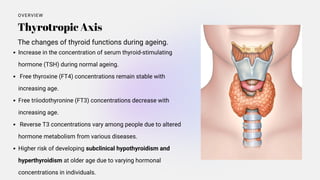
Thyrotropic Axis
Increase in the concentration of serum thyroid-stimulating
hormone (TSH) during normal ageing.
Free thyroxine (FT4) concentrations remain stable with
increasing age.
Free triiodothyronine (FT3) concentrations decrease with
increasing age.
Reverse T3 concentrations vary among people due to altered
hormone metabolism from various diseases.
Higher risk of developing subclinical hypothyroidism and
hyperthyroidism at older age due to varying hormonal
concentrations in individuals.
OVERVIEW
The changes of thyroid functions during ageing.
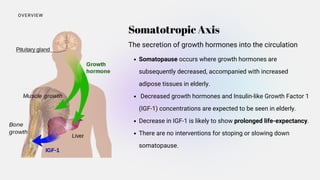
Somatotropic Axis
Somatopause occurs where growth hormones are
subsequently decreased, accompanied with increased
adipose tissues in elderly.
Decreased growth hormones and Insulin-like Growth Factor 1
(IGF-1) concentrations are expected to be seen in elderly.
Decrease in IGF-1 is likely to show prolonged life-expectancy.
There are no interventions for stoping or slowing down
somatopause.
OVERVIEW
The secretion of growth hormones into the circulation
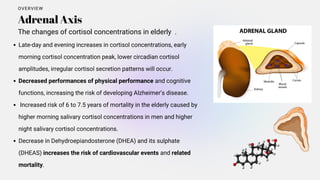
Late-day and evening increases in cortisol concentrations, early
morning cortisol concentration peak, lower circadian cortisol
amplitudes, irregular cortisol secretion patterns will occur.
Decreased performances of physical performance and cognitive
functions, increasing the risk of developing Alzheimer’s disease.
Increased risk of 6 to 7.5 years of mortality in the elderly caused by
higher morning salivary cortisol concentrations in men and higher
night salivary cortisol concentrations.
Decrease in Dehydroepiandosterone (DHEA) and its sulphate
(DHEAS) increases the risk of cardiovascular events and related
mortality.
Adrenal Axis
OVERVIEW
The changes of cortisol concentrations in elderly .
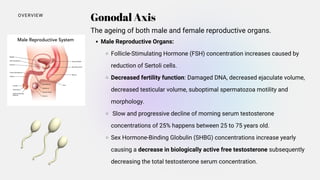
Male Reproductive Organs:
Follicle-Stimulating Hormone (FSH) concentration increases caused by
reduction of Sertoli cells.
Decreased fertility function: Damaged DNA, decreased ejaculate volume,
decreased testicular volume, suboptimal spermatozoa motility and
morphology.
Slow and progressive decline of morning serum testosterone
concentrations of 25% happens between 25 to 75 years old.
Sex Hormone-Binding Globulin (SHBG) concentrations increase yearly
causing a decrease in biologically active free testosterone subsequently
decreasing the total testosterone serum concentration.
Gonodal Axis
OVERVIEW
The ageing of both male and female reproductive organs.
Female Reproductive Organs:
Number of Follicle-Stimulating Hormone (FSH) sensitivive antral follicles
decrease and reserve of primordial follicles reduce.
Insufficient follicle availability due to rapid shrinking of ovarian reserve.
Changes in gonadotropin secretion happens, which is characterised by increased
LH and FSH amplitude and loss of pre-ovulatory gonadotropin surges.
Menstruation cycle irregularity: Longer cycle duration, missed periods,
prolonged intervals of amenorrhoea.
Menopause happens and causes hormonal changes, mainly oestrogen
production
Altered vasomotor regulation, bone metabolism, urogenital status will lead to
multi-organ clinical consequences such as bone fracture and breast cancer.
Gonodal Axis
OVERVIEW
The ageing of both male and female reproductive organs.
INSULIN SENSITIVITY
Impact of hormonal changes in elderly
1) Metabolism
With age, insulin sensitivity tends to decrease, leading to a higher
likelihood of insulin resistance.
Cells become less responsive to insulin, resulting in impaired
glucose uptake and utilization.
As a result, blood glucose levels may rise, increasing the risk of
developing type 2 diabetes and metabolic syndrome
THYROID HORMONES
Age-related changes in thyroid function
decreased production of thyroid hormones
reduce sensitivity on thyroid hormone receptor sensitivity
Hypothyroidism: low thyroid hormone levels, can lead to a
slowdown in metabolism, weight gain, and fatigue.
Hyperthyroidism: excessive thyroid hormone production, can
cause an increase in metabolic rate, weight loss, and other
metabolic disturbances.
GROWTH HORMONES
Levels of growth hormone (GH) and
insulin-like growth factor 1 (IGF-1)
decline with age.
play important roles in regulating
metabolism, body composition, and
tissue repair
Reduced GH and IGF-1 levels may
contribute to age-related changes in
body composition, including loss of
muscle mass and increased fat
deposition.
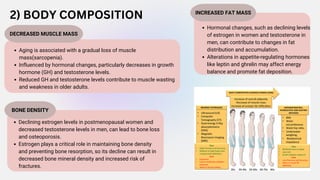
2) BODY COMPOSITION
DECREASED MUSCLE MASS
Aging is associated with a gradual loss of muscle
mass(sarcopenia).
Influenced by hormonal changes, particularly decreases in growth
hormone (GH) and testosterone levels.
Reduced GH and testosterone levels contribute to muscle wasting
and weakness in older adults.
INCREASED FAT MASS
Hormonal changes, such as declining levels
of estrogen in women and testosterone in
men, can contribute to changes in fat
distribution and accumulation.
Alterations in appetite-regulating hormones
like leptin and ghrelin may affect energy
balance and promote fat deposition.
BONE DENSITY
Declining estrogen levels in postmenopausal women and
decreased testosterone levels in men, can lead to bone loss
and osteoporosis.
Estrogen plays a critical role in maintaining bone density
and preventing bone resorption, so its decline can result in
decreased bone mineral density and increased risk of
fractures.
METABOLIC RATE
APPETITE REGULATION
3) ENERGY REGULATION
thyroid hormones, growth hormone, and cortisol play key roles in
regulating metabolic rate.
Thyroid hormone: stimulate cellular metabolism
Growth hormone: promotes protein synthesis and fat metabolism
Age-related declines in these hormones can lead to a decrease in
metabolic rate, resulting in reduced energy expenditure and
potentially contributing to weight gain or difficulty maintaining a
healthy weight.
Insulin resistance results in decreased effectiveness of
insulin in promoting glucose uptake by cells.
As a result, glucose uptake into tissues, particularly muscle
cells, is reduced.
This can lead to reduced energy availability to tissues,
including muscles and organs, contributing to feelings of
fatigue or lethargy
Leptin and ghrelin help regulate appetite and
food intake
Leptin: signals satiety and suppresses
appetite
Ghrelin: stimulates hunger
Changes in hormone levels, such as
alterations in leptin sensitivity or ghrelin
secretion, can affect appetite regulation in
the elderly, leading to changes in energy
intake and potentially impacting overall
energy balance.
IMPAIRED GLUCOSE UPTAKE
Age-related endocrine disorders
1)Diabetes
Type 2 diabetes usually begins in people older than 30 years and
becomes progressively more common with age.
About 30% of people older than 65 have type 2 diabetes.
Aging human cells become less sensitive to the effect of insulin
This gradual insulin resistance goes hand in hand with an increase in
blood glucose concentration
Since older people's cells are less receptive to insulin, the pancreas
often responds by producing more, leading to increased insulin levels in
the blood (hyperinsulinaemia), this can put excessive stress on the beta
cells, leading to their exhaustion
Age-related endocrine disorders
2) Thyroid disorder
Thyroid disease is common in older adults
Hypothyroidism is the most common thyroid condition in patients over
60 years of age and steadily increases with age.
The symptoms of hypothyroidism are very non-specific in all patients, ,
and even more so in older people, the severity and extent of symptoms
also depend on the degree of hypothyroidism.
memory loss or a decrease in cognitive functioning
constipation
weight gain
tiredness
Thyroid cancer is the most common of endocrine malignancies.
Thyroid cancer is more aggressive in elderly patients due to biological causes related
to age, histotype, and the advanced stage at diagnosis.
With increasing age, an increased risk of recurrence was observed together with a
reduction in overall survival (OS)
Factors that significantly increase the risk of recurrence in DTC patients >65 years old
are the tumor size and lymph node metastasis (LNM)
Age-related endocrine disorders
2) Endocrine malignancies
(LAURETTA ET AL., 2023)
Age-related endocrine disorders
4) Addison’s disease (adrenocortical insufficiency)
Addison disease can occur at any age but most often presents during
the second or third decades of life.
The initial presenting features include fatigue, generalized weakness,
weight loss, nausea, vomiting, abdominal pain, dizziness, tachycardia,
and hypotension.
It affects glucocorticoid and mineralocorticoid function.
The onset of disease usually occurs when 90% or more of both adrenal
cortices are dysfunctional or destroyed.
(GEORGE T GRIFFING, 2022)
HORMONAL IMBALANCES
Hormonal
Imbalances
A hormonal imbalance happens when you have too much
or too little of one or more hormones. It’s a broad term
that can represent many different hormone-related
conditions.
Hormones are powerful signals. For many hormones,
having even slightly too much or too little of them can
cause major changes to your body and lead to certain
conditions that require treatment.
Some hormonal imbalances can be temporary while
others are chronic (long-term). In addition, some
hormonal imbalances require treatment so you can stay
physically healthy, while others may not impact your
health but can negatively affect your quality of life.
HORMONAL IMBALANCES
What causes Hormonal Imbalances ?
Puberty
Pregnancy
Menopause
Chronic stress
Steroids And Certain medications
Autoimmune conditions, including Graves’ disease, type 1 diabetes, Hashimoto’s
disease, polyglandular syndromes and Addison’s disease
Endocrine gland injury caused by radiation therapy, infection, trauma, excessive
blood loss or damage from surgery
Tumors, growths or adenomas (noncancerous tumors on the pituitary, parathyroid or
adrenal glands)
HORMONAL IMBALANCES
Hormonal Imbalances Example
Insulin resistance
-identified as an impaired biologic response to insulin stimulation of target tissues, primarily
involves liver, muscle, and adipose tissue. Insulin resistance impairs glucose disposal, resulting
in a compensatory increase in beta-cell insulin production and hyperinsulinemia.
-Most of the complications from insulin resistance are related to the development of vascular
complications and nonalcoholic fatty liver disease.
-The direct result of muscle insulin resistance is decreased glucose uptake by muscle tissue.
Glucose is shunted from muscle to the liver, where de novo lipogenesis (DNL) occurs. With
increased glucose substrate, the liver develops insulin resistance as well. Higher rates of DNL
increase plasma triglyceride content and create an environment of excess energy substrate,
which increases insulin resistance throughout the body, contributing to ectopic lipid deposition
in and around visceral organs.
GERIATRIC
ENDOCRINE DISORDER
THINGS TO CONSIDER
COMORBIDITY
Managements
LIFE EXPECTANCY
LEVEL OF INDEPENDENCE
FUNCTIONAL CAPACITY
ABILITY & WILLINGNESS
SOCIAL & ECONOMIC
GERIATRIC
ENDOCRINE DISORDER
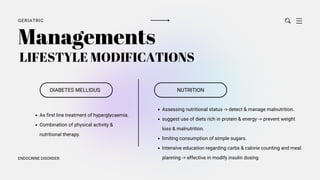
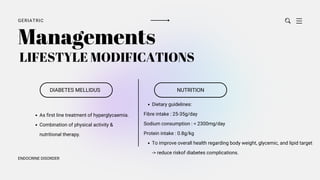
LIFESTYLE MODIFICATIONS
DIABETES MELLIDUS
Managements
As first line treatment of hyperglycaemia.
Combination of physical activity &
nutritional therapy.
PHYSICAL ACTIVITY
Reduce sedentary behaviour.
Emphasise on moderate intensity aerobic activity.
MUST consider pt’s aerobic fitness & ability after medical
evaluation ( BP & HR monitoring)
Aim to increase flexibility, muscle strength, and balance.
GERIATRIC
ENDOCRINE DISORDER
LIFESTYLE MODIFICATIONS
DIABETES MELLIDUS
Managements
As first line treatment of hyperglycaemia.
Combination of physical activity &
nutritional therapy.
NUTRITION
Assessing nutritional status -> detect & manage malnutrition.
suggest use of diets rich in protein & energy -> prevent weight
loss & malnutrition.
limiting consumption of simple sugars.
Intensive education regarding carbs & calorie counting and meal
planning -> effective in modify insulin dosing
GERIATRIC
ENDOCRINE DISORDER
LIFESTYLE MODIFICATIONS
DIABETES MELLIDUS
Managements
As first line treatment of hyperglycaemia.
Combination of physical activity &
nutritional therapy.
NUTRITION
Dietary guidelines:
Fibre intake : 25-35g/day
Sodium consumption : < 2300mg/day
Protein intake : 0.8g/kg
To improve overall health regarding body weight, glycemic, and lipid target
-> reduce riskof diabetes complications.
GERIATRIC
ENDOCRINE DISORDER
PHARMACEUTICAL APPROACH
METFORMIN
Managements
THIAZOLIDINEDIONES
INSULIN
GLP-1 RECEPTOR AGONIST
ALPHA- GLUCOSIDASE
INHIBITORS
GERIATRIC
ENDOCRINE DISORDER
LIFESTYLE MODIFICATIONS
HYPOTHYROIDISM
Managements
lower serum T3 levels and higher rT3 levels
were only detected in the institutionalized
elderly adults
THYROID HORMONE
REPLACEMENT
typically start with sodium levothyroxine
most experts recommend gradually increasing daily doses by
12.5-25 mcg every four to six weeks until adequate replacement
is confirmed by repeat TSH measurement.
Serial measurements of TSH levels four to six weeks after each
change in thyroxine dosage should be used to monitor thyroid
hormone replacement therapy
GERIATRIC
ENDOCRINE DISORDER
LIFESTYLE MODIFICATIONS
HYPOTHYROIDISM
Managements
lower serum T3 levels and higher rT3 levels
were only detected in the institutionalized
elderly adults
THYROID HORMONE
REPLACEMENT
Thyroxine dose requirements may be related to several factors
including declining metabolic clearance, progression of
underlying thyroid failure, declining body mass, and interactions
with other medications prescribed for the treatment of co-
morbid conditions
A number of medications used to treat other comorbid
conditions in the elderly may interfere with absorption and
metabolism of thyroxine
GERIATRIC
ENDOCRINE DISORDER
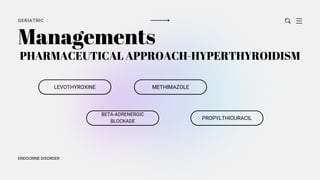
PHARMACEUTICAL APPROACH-HYPERTHYROIDISM
LEVOTHYROXINE
Managements
BETA-ADRENERGIC
BLOCKADE
METHIMAZOLE
PROPYLTHIOURACIL
GERIATRIC
ENDOCRINE DISORDER
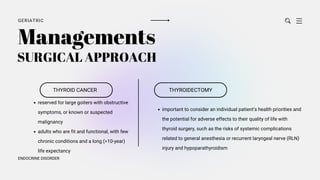
THYROID CANCER
Managements
reserved for large goiters with obstructive
symptoms, or known or suspected
malignancy
adults who are fit and functional, with few
chronic conditions and a long (>10-year)
life expectancy
THYROIDECTOMY
important to consider an individual patient's health priorities and
the potential for adverse effects to their quality of life with
thyroid surgery, such as the risks of systemic complications
related to general anesthesia or recurrent laryngeal nerve (RLN)
injury and hypoparathyroidism
SURGICAL APPROACH
GERIATRIC
ENDOCRINE DISORDER
Managements
reserved for large goiters with obstructive
symptoms, or known or suspected
malignancy
adults who are fit and functional, with few
chronic conditions and a long (>10-year)
life expectancy
THYROIDECTOMY
offers rapid resolution of hyperthyroidism with low recurrence
rates, should be counseled on these geriatric-specific risks and
the potential benefits of total thyroidectomy so that informed
treatment decisions can be made.
SURGICAL APPROACH
THYROID CANCER
GERIATRIC
ENDOCRINE DISORDER
Managements
reserved for large goiters with obstructive
symptoms, or known or suspected
malignancy
adults who are fit and functional, with few
chronic conditions and a long (>10-year)
life expectancy
THYROID RADIOFREQUENCY
ABLATION (RFA)
effective in reducing compressive symptoms related to benign
thyroid nodules
second-line option for the management of toxic adenomas in
patients who have contraindications to radioactive iodine or
surgery
allows many patients to preserve innate thyroid function and
avoid general anesthesia
SURGICAL APPROACH
THYROID CANCER
ANNEWIEKE W VAN DEN BELD, PROF JEAN-MARC KAUFMAN, M CAROLA ZILLIKENS, PROF STEVEN WJ
LAMBERTS, JOSEPHINE M EGAN, PROF AART J VAN DER LELY. (2018). THE PHYSIOLOGY OF ENDOCRINE SYSTEM
WITH AGEING. LANCET DIABETES ENDOCRINOL. RETRIEVED FROM: HTTPS://DOI.ORG/10.1016%2FS2213-
8587(18)30026-3
PATAKY MW, YOUNG WF, NAIR KS. HORMONAL AND METABOLIC CHANGES OF AGING AND THE INFLUENCE OF
LIFESTYLE MODIFICATIONS. MAYO CLIN PROC. 2021 MAR;96(3):788-814. DOI: 10.1016/J.MAYOCP.2020.07.033.
PMID: 33673927; PMCID: PMC8020896.
BIAGETTI B, PUIG-DOMINGO M. AGE-RELATED HORMONES CHANGES AND ITS IMPACT ON HEALTH STATUS AND
LIFESPAN. AGING DIS. 2023 JUN 1;14(3):605-620. DOI: 10.14336/AD.2022.1109. PMID: 37191429; PMCID:
PMC10187696.
MØLLER N, JØRGENSEN JO. EFFECTS OF GROWTH HORMONE ON GLUCOSE, LIPID, AND PROTEIN METABOLISM
IN HUMAN SUBJECTS. ENDOCR REV. 2009 APR;30(2):152-77. DOI: 10.1210/ER.2008-0027. EPUB 2009 FEB 24.
PMID: 19240267.
LAURETTA, R., BIANCHINI, M., MORMANDO, M., PULIANI, G., & APPETECCHIA, M. (2023). FOCUS ON THYROID
CANCER IN ELDERLY PATIENTS. ENDOCRINES, 4(4), 757–771. HTTPS://DOI.ORG/10.3390/ENDOCRINES4040055
GEORGE T GRIFFING. (2022). ADDISON DISEASE: PRACTICE ESSENTIALS, EPIDEMIOLOGY. EMEDICINE.
HTTPS://EMEDICINE.MEDSCAPE.COM/ARTICLE/116467-OVERVIEW?FORM=FPF
VARGHESE, J., & ALI, M. S. (2023, JANUARY 1). 46 - THYROID CANCER (J. HERRMANN, ED.). SCIENCEDIRECT;
ELSEVIER. HTTPS://WWW.SCIENCEDIRECT.COM/SCIENCE/ARTICLE/ABS/PII/B9780323681353000556
ANDREW M. FREEMAN; LUIS A. ACEVEDO; NICHOLAS PENNINGS(AUGUST,2023) INSULIN RESISTANCE
HTTPS://WWW.NCBI.NLM.NIH.GOV/BOOKS/NBK507839/#:~:TEXT=INSULIN%20RESISTANCE%20IS%20THOUGHT
%20TO,IS%20A%20CORNERSTONE%20OF%20TREATMENT.
References
Thank You
SAMIRA HADID
WWW.REALLYGREATSITE.COM 19 AUGUST, 2021
Visual

geriatric changes in endocrine system.pdf

  • 1.
    Endocrine System The endocrinesystem is the systemic group of organs that function to facilitate hormonal balance. It helps to maintain a constant internal environment by ensuring the correct proportions of hormonal secretions. The endocrine system communicates with the nervous system to allow rapid transmission of information between different body regions. PROFILE
  • 2.
    Thyrotropic Axis Increase inthe concentration of serum thyroid-stimulating hormone (TSH) during normal ageing. Free thyroxine (FT4) concentrations remain stable with increasing age. Free triiodothyronine (FT3) concentrations decrease with increasing age. Reverse T3 concentrations vary among people due to altered hormone metabolism from various diseases. Higher risk of developing subclinical hypothyroidism and hyperthyroidism at older age due to varying hormonal concentrations in individuals. OVERVIEW The changes of thyroid functions during ageing.
  • 3.
    Somatotropic Axis Somatopause occurswhere growth hormones are subsequently decreased, accompanied with increased adipose tissues in elderly. Decreased growth hormones and Insulin-like Growth Factor 1 (IGF-1) concentrations are expected to be seen in elderly. Decrease in IGF-1 is likely to show prolonged life-expectancy. There are no interventions for stoping or slowing down somatopause. OVERVIEW The secretion of growth hormones into the circulation
  • 4.
    Late-day and eveningincreases in cortisol concentrations, early morning cortisol concentration peak, lower circadian cortisol amplitudes, irregular cortisol secretion patterns will occur. Decreased performances of physical performance and cognitive functions, increasing the risk of developing Alzheimer’s disease. Increased risk of 6 to 7.5 years of mortality in the elderly caused by higher morning salivary cortisol concentrations in men and higher night salivary cortisol concentrations. Decrease in Dehydroepiandosterone (DHEA) and its sulphate (DHEAS) increases the risk of cardiovascular events and related mortality. Adrenal Axis OVERVIEW The changes of cortisol concentrations in elderly .
  • 5.
    Male Reproductive Organs: Follicle-StimulatingHormone (FSH) concentration increases caused by reduction of Sertoli cells. Decreased fertility function: Damaged DNA, decreased ejaculate volume, decreased testicular volume, suboptimal spermatozoa motility and morphology. Slow and progressive decline of morning serum testosterone concentrations of 25% happens between 25 to 75 years old. Sex Hormone-Binding Globulin (SHBG) concentrations increase yearly causing a decrease in biologically active free testosterone subsequently decreasing the total testosterone serum concentration. Gonodal Axis OVERVIEW The ageing of both male and female reproductive organs.
  • 6.
    Female Reproductive Organs: Numberof Follicle-Stimulating Hormone (FSH) sensitivive antral follicles decrease and reserve of primordial follicles reduce. Insufficient follicle availability due to rapid shrinking of ovarian reserve. Changes in gonadotropin secretion happens, which is characterised by increased LH and FSH amplitude and loss of pre-ovulatory gonadotropin surges. Menstruation cycle irregularity: Longer cycle duration, missed periods, prolonged intervals of amenorrhoea. Menopause happens and causes hormonal changes, mainly oestrogen production Altered vasomotor regulation, bone metabolism, urogenital status will lead to multi-organ clinical consequences such as bone fracture and breast cancer. Gonodal Axis OVERVIEW The ageing of both male and female reproductive organs.
  • 7.
    INSULIN SENSITIVITY Impact ofhormonal changes in elderly 1) Metabolism With age, insulin sensitivity tends to decrease, leading to a higher likelihood of insulin resistance. Cells become less responsive to insulin, resulting in impaired glucose uptake and utilization. As a result, blood glucose levels may rise, increasing the risk of developing type 2 diabetes and metabolic syndrome THYROID HORMONES Age-related changes in thyroid function decreased production of thyroid hormones reduce sensitivity on thyroid hormone receptor sensitivity Hypothyroidism: low thyroid hormone levels, can lead to a slowdown in metabolism, weight gain, and fatigue. Hyperthyroidism: excessive thyroid hormone production, can cause an increase in metabolic rate, weight loss, and other metabolic disturbances. GROWTH HORMONES Levels of growth hormone (GH) and insulin-like growth factor 1 (IGF-1) decline with age. play important roles in regulating metabolism, body composition, and tissue repair Reduced GH and IGF-1 levels may contribute to age-related changes in body composition, including loss of muscle mass and increased fat deposition.
  • 8.
    2) BODY COMPOSITION DECREASEDMUSCLE MASS Aging is associated with a gradual loss of muscle mass(sarcopenia). Influenced by hormonal changes, particularly decreases in growth hormone (GH) and testosterone levels. Reduced GH and testosterone levels contribute to muscle wasting and weakness in older adults. INCREASED FAT MASS Hormonal changes, such as declining levels of estrogen in women and testosterone in men, can contribute to changes in fat distribution and accumulation. Alterations in appetite-regulating hormones like leptin and ghrelin may affect energy balance and promote fat deposition. BONE DENSITY Declining estrogen levels in postmenopausal women and decreased testosterone levels in men, can lead to bone loss and osteoporosis. Estrogen plays a critical role in maintaining bone density and preventing bone resorption, so its decline can result in decreased bone mineral density and increased risk of fractures.
  • 9.
    METABOLIC RATE APPETITE REGULATION 3)ENERGY REGULATION thyroid hormones, growth hormone, and cortisol play key roles in regulating metabolic rate. Thyroid hormone: stimulate cellular metabolism Growth hormone: promotes protein synthesis and fat metabolism Age-related declines in these hormones can lead to a decrease in metabolic rate, resulting in reduced energy expenditure and potentially contributing to weight gain or difficulty maintaining a healthy weight. Insulin resistance results in decreased effectiveness of insulin in promoting glucose uptake by cells. As a result, glucose uptake into tissues, particularly muscle cells, is reduced. This can lead to reduced energy availability to tissues, including muscles and organs, contributing to feelings of fatigue or lethargy Leptin and ghrelin help regulate appetite and food intake Leptin: signals satiety and suppresses appetite Ghrelin: stimulates hunger Changes in hormone levels, such as alterations in leptin sensitivity or ghrelin secretion, can affect appetite regulation in the elderly, leading to changes in energy intake and potentially impacting overall energy balance. IMPAIRED GLUCOSE UPTAKE
  • 10.
    Age-related endocrine disorders 1)Diabetes Type2 diabetes usually begins in people older than 30 years and becomes progressively more common with age. About 30% of people older than 65 have type 2 diabetes. Aging human cells become less sensitive to the effect of insulin This gradual insulin resistance goes hand in hand with an increase in blood glucose concentration Since older people's cells are less receptive to insulin, the pancreas often responds by producing more, leading to increased insulin levels in the blood (hyperinsulinaemia), this can put excessive stress on the beta cells, leading to their exhaustion
  • 11.
    Age-related endocrine disorders 2)Thyroid disorder Thyroid disease is common in older adults Hypothyroidism is the most common thyroid condition in patients over 60 years of age and steadily increases with age. The symptoms of hypothyroidism are very non-specific in all patients, , and even more so in older people, the severity and extent of symptoms also depend on the degree of hypothyroidism. memory loss or a decrease in cognitive functioning constipation weight gain tiredness
  • 12.
    Thyroid cancer isthe most common of endocrine malignancies. Thyroid cancer is more aggressive in elderly patients due to biological causes related to age, histotype, and the advanced stage at diagnosis. With increasing age, an increased risk of recurrence was observed together with a reduction in overall survival (OS) Factors that significantly increase the risk of recurrence in DTC patients >65 years old are the tumor size and lymph node metastasis (LNM) Age-related endocrine disorders 2) Endocrine malignancies (LAURETTA ET AL., 2023)
  • 13.
    Age-related endocrine disorders 4)Addison’s disease (adrenocortical insufficiency) Addison disease can occur at any age but most often presents during the second or third decades of life. The initial presenting features include fatigue, generalized weakness, weight loss, nausea, vomiting, abdominal pain, dizziness, tachycardia, and hypotension. It affects glucocorticoid and mineralocorticoid function. The onset of disease usually occurs when 90% or more of both adrenal cortices are dysfunctional or destroyed. (GEORGE T GRIFFING, 2022)
  • 14.
    HORMONAL IMBALANCES Hormonal Imbalances A hormonalimbalance happens when you have too much or too little of one or more hormones. It’s a broad term that can represent many different hormone-related conditions. Hormones are powerful signals. For many hormones, having even slightly too much or too little of them can cause major changes to your body and lead to certain conditions that require treatment. Some hormonal imbalances can be temporary while others are chronic (long-term). In addition, some hormonal imbalances require treatment so you can stay physically healthy, while others may not impact your health but can negatively affect your quality of life.
  • 15.
    HORMONAL IMBALANCES What causesHormonal Imbalances ? Puberty Pregnancy Menopause Chronic stress Steroids And Certain medications Autoimmune conditions, including Graves’ disease, type 1 diabetes, Hashimoto’s disease, polyglandular syndromes and Addison’s disease Endocrine gland injury caused by radiation therapy, infection, trauma, excessive blood loss or damage from surgery Tumors, growths or adenomas (noncancerous tumors on the pituitary, parathyroid or adrenal glands)
  • 16.
    HORMONAL IMBALANCES Hormonal ImbalancesExample Insulin resistance -identified as an impaired biologic response to insulin stimulation of target tissues, primarily involves liver, muscle, and adipose tissue. Insulin resistance impairs glucose disposal, resulting in a compensatory increase in beta-cell insulin production and hyperinsulinemia. -Most of the complications from insulin resistance are related to the development of vascular complications and nonalcoholic fatty liver disease. -The direct result of muscle insulin resistance is decreased glucose uptake by muscle tissue. Glucose is shunted from muscle to the liver, where de novo lipogenesis (DNL) occurs. With increased glucose substrate, the liver develops insulin resistance as well. Higher rates of DNL increase plasma triglyceride content and create an environment of excess energy substrate, which increases insulin resistance throughout the body, contributing to ectopic lipid deposition in and around visceral organs.
  • 17.
    GERIATRIC ENDOCRINE DISORDER THINGS TOCONSIDER COMORBIDITY Managements LIFE EXPECTANCY LEVEL OF INDEPENDENCE FUNCTIONAL CAPACITY ABILITY & WILLINGNESS SOCIAL & ECONOMIC
  • 18.
    GERIATRIC ENDOCRINE DISORDER LIFESTYLE MODIFICATIONS DIABETESMELLIDUS Managements As first line treatment of hyperglycaemia. Combination of physical activity & nutritional therapy. PHYSICAL ACTIVITY Reduce sedentary behaviour. Emphasise on moderate intensity aerobic activity. MUST consider pt’s aerobic fitness & ability after medical evaluation ( BP & HR monitoring) Aim to increase flexibility, muscle strength, and balance.
  • 19.
    GERIATRIC ENDOCRINE DISORDER LIFESTYLE MODIFICATIONS DIABETESMELLIDUS Managements As first line treatment of hyperglycaemia. Combination of physical activity & nutritional therapy. NUTRITION Assessing nutritional status -> detect & manage malnutrition. suggest use of diets rich in protein & energy -> prevent weight loss & malnutrition. limiting consumption of simple sugars. Intensive education regarding carbs & calorie counting and meal planning -> effective in modify insulin dosing
  • 20.
    GERIATRIC ENDOCRINE DISORDER LIFESTYLE MODIFICATIONS DIABETESMELLIDUS Managements As first line treatment of hyperglycaemia. Combination of physical activity & nutritional therapy. NUTRITION Dietary guidelines: Fibre intake : 25-35g/day Sodium consumption : < 2300mg/day Protein intake : 0.8g/kg To improve overall health regarding body weight, glycemic, and lipid target -> reduce riskof diabetes complications.
  • 21.
  • 22.
    GERIATRIC ENDOCRINE DISORDER LIFESTYLE MODIFICATIONS HYPOTHYROIDISM Managements lowerserum T3 levels and higher rT3 levels were only detected in the institutionalized elderly adults THYROID HORMONE REPLACEMENT typically start with sodium levothyroxine most experts recommend gradually increasing daily doses by 12.5-25 mcg every four to six weeks until adequate replacement is confirmed by repeat TSH measurement. Serial measurements of TSH levels four to six weeks after each change in thyroxine dosage should be used to monitor thyroid hormone replacement therapy
  • 23.
    GERIATRIC ENDOCRINE DISORDER LIFESTYLE MODIFICATIONS HYPOTHYROIDISM Managements lowerserum T3 levels and higher rT3 levels were only detected in the institutionalized elderly adults THYROID HORMONE REPLACEMENT Thyroxine dose requirements may be related to several factors including declining metabolic clearance, progression of underlying thyroid failure, declining body mass, and interactions with other medications prescribed for the treatment of co- morbid conditions A number of medications used to treat other comorbid conditions in the elderly may interfere with absorption and metabolism of thyroxine
  • 24.
  • 25.
    GERIATRIC ENDOCRINE DISORDER THYROID CANCER Managements reservedfor large goiters with obstructive symptoms, or known or suspected malignancy adults who are fit and functional, with few chronic conditions and a long (>10-year) life expectancy THYROIDECTOMY important to consider an individual patient's health priorities and the potential for adverse effects to their quality of life with thyroid surgery, such as the risks of systemic complications related to general anesthesia or recurrent laryngeal nerve (RLN) injury and hypoparathyroidism SURGICAL APPROACH
  • 26.
    GERIATRIC ENDOCRINE DISORDER Managements reserved forlarge goiters with obstructive symptoms, or known or suspected malignancy adults who are fit and functional, with few chronic conditions and a long (>10-year) life expectancy THYROIDECTOMY offers rapid resolution of hyperthyroidism with low recurrence rates, should be counseled on these geriatric-specific risks and the potential benefits of total thyroidectomy so that informed treatment decisions can be made. SURGICAL APPROACH THYROID CANCER
  • 27.
    GERIATRIC ENDOCRINE DISORDER Managements reserved forlarge goiters with obstructive symptoms, or known or suspected malignancy adults who are fit and functional, with few chronic conditions and a long (>10-year) life expectancy THYROID RADIOFREQUENCY ABLATION (RFA) effective in reducing compressive symptoms related to benign thyroid nodules second-line option for the management of toxic adenomas in patients who have contraindications to radioactive iodine or surgery allows many patients to preserve innate thyroid function and avoid general anesthesia SURGICAL APPROACH THYROID CANCER
  • 28.
    ANNEWIEKE W VANDEN BELD, PROF JEAN-MARC KAUFMAN, M CAROLA ZILLIKENS, PROF STEVEN WJ LAMBERTS, JOSEPHINE M EGAN, PROF AART J VAN DER LELY. (2018). THE PHYSIOLOGY OF ENDOCRINE SYSTEM WITH AGEING. LANCET DIABETES ENDOCRINOL. RETRIEVED FROM: HTTPS://DOI.ORG/10.1016%2FS2213- 8587(18)30026-3 PATAKY MW, YOUNG WF, NAIR KS. HORMONAL AND METABOLIC CHANGES OF AGING AND THE INFLUENCE OF LIFESTYLE MODIFICATIONS. MAYO CLIN PROC. 2021 MAR;96(3):788-814. DOI: 10.1016/J.MAYOCP.2020.07.033. PMID: 33673927; PMCID: PMC8020896. BIAGETTI B, PUIG-DOMINGO M. AGE-RELATED HORMONES CHANGES AND ITS IMPACT ON HEALTH STATUS AND LIFESPAN. AGING DIS. 2023 JUN 1;14(3):605-620. DOI: 10.14336/AD.2022.1109. PMID: 37191429; PMCID: PMC10187696. MØLLER N, JØRGENSEN JO. EFFECTS OF GROWTH HORMONE ON GLUCOSE, LIPID, AND PROTEIN METABOLISM IN HUMAN SUBJECTS. ENDOCR REV. 2009 APR;30(2):152-77. DOI: 10.1210/ER.2008-0027. EPUB 2009 FEB 24. PMID: 19240267. LAURETTA, R., BIANCHINI, M., MORMANDO, M., PULIANI, G., & APPETECCHIA, M. (2023). FOCUS ON THYROID CANCER IN ELDERLY PATIENTS. ENDOCRINES, 4(4), 757–771. HTTPS://DOI.ORG/10.3390/ENDOCRINES4040055 GEORGE T GRIFFING. (2022). ADDISON DISEASE: PRACTICE ESSENTIALS, EPIDEMIOLOGY. EMEDICINE. HTTPS://EMEDICINE.MEDSCAPE.COM/ARTICLE/116467-OVERVIEW?FORM=FPF VARGHESE, J., & ALI, M. S. (2023, JANUARY 1). 46 - THYROID CANCER (J. HERRMANN, ED.). SCIENCEDIRECT; ELSEVIER. HTTPS://WWW.SCIENCEDIRECT.COM/SCIENCE/ARTICLE/ABS/PII/B9780323681353000556 ANDREW M. FREEMAN; LUIS A. ACEVEDO; NICHOLAS PENNINGS(AUGUST,2023) INSULIN RESISTANCE HTTPS://WWW.NCBI.NLM.NIH.GOV/BOOKS/NBK507839/#:~:TEXT=INSULIN%20RESISTANCE%20IS%20THOUGHT %20TO,IS%20A%20CORNERSTONE%20OF%20TREATMENT. References
  • 29.