GYANIKA SHUKLA
Pre-PhD
1. Introduction to epigenetics and epigenomics
2. Different epigenetic modifications
3. Development of epigenomics in crop
research
4. Crop improvement by epigenomics
5. Ongoing epigenomics projects on plants
6. Future prospects
 Greek word “epigenesis” which means “extra
growth”.
 Epigenetics is the study of chromosome changes that
alter the expression of genes without any alteration in
the gene sequences Riggs et al, 1996.
 First coined by Conrad Waddington in 1942 to
describe the impact of environment over the gene
expression Murrel et al, 2005.
 Reversible or non-reversible.
 Heritable or non-heritable Berger et al, 2009.
 Epigenomics is the study of the all the
epigenetic changes in a genome of a cell,
such genome is also called as epigenome Russel, 2010.
 Epialleles, which refers to the genes with
identical nucleotide sequence but altered
expression abilities due to epigenetic events Weigel and
Colot, 2012.
1. DNA methylation
2. Histone modification
3. Non-coding RNAs
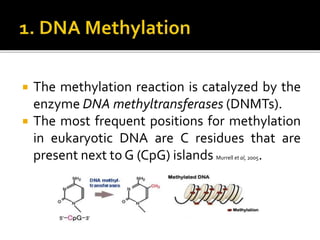
 The methylation reaction is catalyzed by the
enzyme DNA methyltransferases (DNMTs).
 The most frequent positions for methylation
in eukaryotic DNA are C residues that are
present next to G (CpG) islands Murrell et al, 2005.
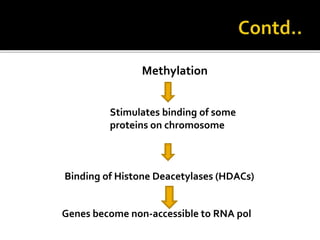
Methylation
Stimulates binding of some
proteins on chromosome
Binding of Histone Deacetylases (HDACs)
Genes become non-accessible to RNA pol
 The unwrapping of DNA from
histones is necessary for expression
of gene. Hence, change in the
structure of chromatin leads to
variation in the gene expression.
This is called as chromatin
remodeling.

1. Methylation
2. Acetylation and deacetylation
3. Phosphorylation
4. Ubiquitylation
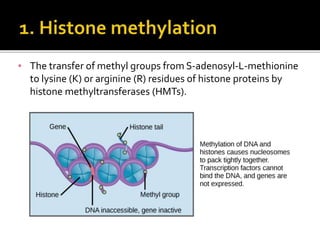
▪ The transfer of methyl groups from S-adenosyl-L-methionine
to lysine (K) or arginine (R) residues of histone proteins by
histone methyltransferases (HMTs).
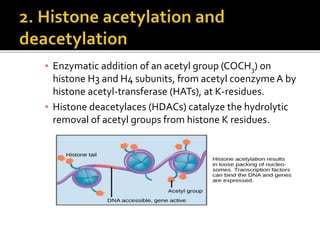
▪ Enzymatic addition of an acetyl group (COCH3) on
histone H3 and H4 subunits, from acetyl coenzymeA by
histone acetyl-transferase (HATs), at K-residues.
▪ Histone deacetylaces (HDACs) catalyze the hydrolytic
removal of acetyl groups from histone K residues.
 Occurs at S,T &Y residues.
 Unlike acetylation and methylation, histone
phosphorylation seems to function by
establishing interactions between other
histone modifications and serving as a
platform for effector proteins.
 Histone H2A and H2B are two of the most highly
ubiquitylated proteins found in the nucleus.
 The most abundant forms are
monoubiquitylated H2A on K119 and
monoubiquitylated H2B on K123
 Ubiquitylated H2B is associated with
transcription activation.
 Ubiquitylation of H2A and H2B is reversible, and
is tightly regulated by histone ubiquitin ligases
and deubiquitylating enzymes.
 About 90% of the eukaryotic genome is
transcribed. Interestingly, only 1 – 2% of
these transcripts encode for proteins; the
majority are transcribed as non-coding RNAs
(ncRNAs).
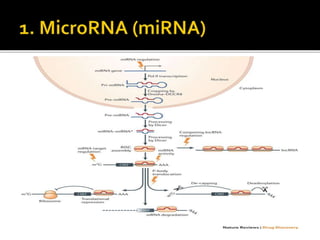
1. MicroRNA (miRNA)
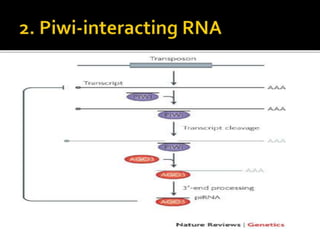
2. Piwi-interacting RNA (piRNA)
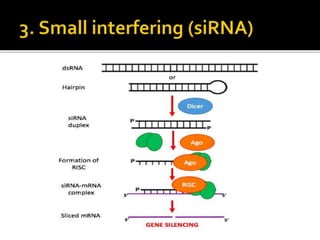
3. Small-interacting RNA (siRNA)
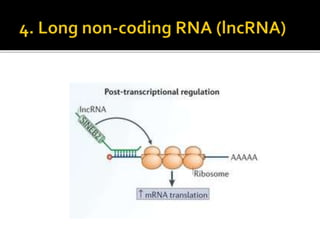
4. Long non-coding RNA (lncRNA)
 Transcription
 Gene silencing
 Cell cycle progression
 Apoptosis
 Differentiation
 DNA replication
 DNA repair
 Nuclear import
 Tumorigenesis
 Cancer progression
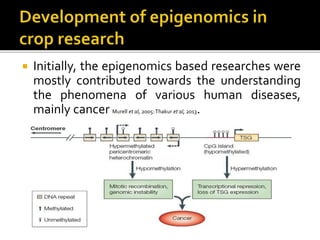
 Initially, the epigenomics based researches were
mostly contributed towards the understanding
the phenomena of various human diseases,
mainly cancer Murell et al, 2005:Thakur et al, 2013.
 The conceptual idea of epigenomics research for crop
improvement has well emerged in the past decade when
whole genome data of various crop plants (wheat, rice,
maize etc) became available.
 The epigenetic modifications occur in response to various
environmental pressures and it has been determined that
such modifications play a crucial role in mediating
productivity and stability in plant populations Latzel et al, 2013; Wang et al,
2014.
 Many model plant species have been studied to evaluate
the changes in expression profile due to epigenetic events
and it has been found that such changes may lead to
either silencing or over expression of genes Sarma et al, 2015.
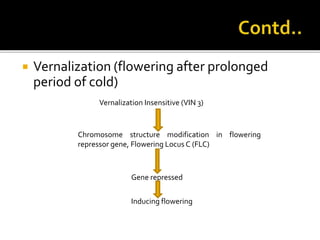
 Vernalization (flowering after prolonged
period of cold)
Vernalization Insensitive (VIN 3)
Chromosome structure modification in flowering
repressor gene, Flowering Locus C (FLC)
Gene repressed
Inducing flowering
 Song et al (2015) studied the role of methylation & miRNA in the
development of flowering in monoecious plants.
 Ortiz-Morea et al (2013) studied the role of sRNAs in the
development of axillary bud outgrowth in sugarcane.
 In one of the studies on recombinant inbred lines (RILs) of
soybean, it was found that the differentially methylated regions
(DMRs) were heritable and contributed to the phenotype of the
plant Schmitz et al, 2017.
 However, the possible extent of heritability cannot be significantly
determined by currently available techniques (Hirsch et al, 2013),
which provides scope for future research.
1. Wheat (Triticum sp)
2. Rice (Oryza sativa)
3. Maize (Zea mays)
 Bottley et al (2008) demonstrated that polyploids are
affected by homoeologous gene silencing, a process in
which sub-genomic copies are selectively transcriptionally
inactivated. The results suggested that much of the
homoeologous silencing observed in differentiated tissues
during wheat callus development, is probably under
epigenetic control.
 Yao et al (2010) analyzed the expression of small RNAs in
seedling of wheat by northern blot, which indicated that
some small RNAs were responsive to abiotic stress
treatments. It may be proved to be a promising approach
to develop abiotic stress resistance in wheat crops.
 Miura et al (2009) studied the effect of epigenetic changes
on the rice plant height. They identified a spontaneous rice
mutant, Epi-d1, showing a tall phenotype. The phenotype
is inheritable and corresponds to the metastable
epigenetic silencing of the DWARF1 (D1) gene.
 Wen et al (2016) studied the expression pattern of mRNA
and miRNA in six accessions of two rice varieties Oryza
sativa L. ssp. indica and Oryza sativa L. ssp. Japonica. They
found about 11% differentially expressing miRNA among
accessions. Genes involved in various metabolic processes
and stress responses are enriched in the differentially
expressed genes between rice indica and japonica
subspecies.
 Bousios et al (2017) studied 6456 carefully
annotated; full-length Sirevirus LTR
retrotransposons in maize and showed that
their silencing is associated with underlying
characteristics of the TE sequences. They also
uncovered features of the host–TE
interactions in host epigenetic response
against pathogen.
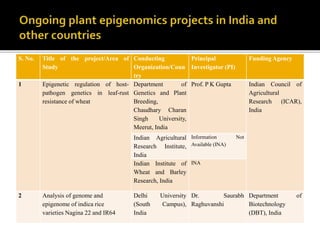
S. No. Title of the project/Area of
Study
Conducting
Organization/Coun
try
Principal
Investigator (PI)
Funding Agency
1 Epigenetic regulation of host-
pathogen genetics in leaf-rust
resistance of wheat
Department of
Genetics and Plant
Breeding,
Chaudhary Charan
Singh University,
Meerut, India
Prof. P K Gupta Indian Council of
Agricultural
Research (ICAR),
India
Indian Agricultural
Research Institute,
India
Information Not
Available (INA)
Indian Institute of
Wheat and Barley
Research, India
INA
2 Analysis of genome and
epigenome of indica rice
varieties Nagina 22 and IR64
Delhi University
(South Campus),
India
Dr. Saurabh
Raghuvanshi
Department of
Biotechnology
(DBT), India
S. No. Title of the project/Area of Study Conducting
Organization/Country
Principal Investigator
(PI)
Funding Agency
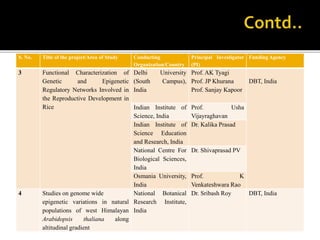
3 Functional Characterization of
Genetic and Epigenetic
Regulatory Networks Involved in
the Reproductive Development in
Rice
Delhi University
(South Campus),
India
Prof. AK Tyagi
Prof. JP Khurana
Prof. Sanjay Kapoor
DBT, India
Indian Institute of
Science, India
Prof. Usha
Vijayraghavan
Indian Institute of
Science Education
and Research, India
Dr. Kalika Prasad
National Centre For
Biological Sciences,
India
Dr. Shivaprasad PV
Osmania University,
India
Prof. K
Venkateshwara Rao
4 Studies on genome wide
epigenetic variations in natural
populations of west Himalayan
Arabidopsis thaliana along
altitudinal gradient
National Botanical
Research Institute,
India
Dr. Sribash Roy DBT, India
S. No. Title of the project/Area of Study Conducting
Organization/Country
Principal Investigator
(PI)
Funding Agency
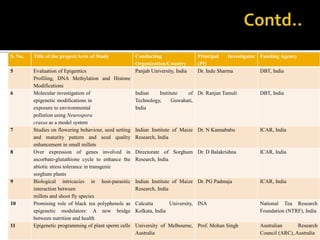
5 Evaluation of Epigentics
Profiling, DNA Methylation and Histone
Modifications
Panjab University, India Dr. Indu Sharma DBT, India
6 Molecular investigation of
epigenetic modifications in
exposure to environmental
pollution using Neurospora
crassa as a model system
Indian Institute of
Technology, Guwahati,
India
Dr. Ranjan Tamuli DBT, India
7 Studies on flowering behaviour, seed setting
and maturity pattern and seed quality
enhancement in small millets
Indian Institute of Maize
Research, India
Dr. N Kannababu ICAR, India
8 Over expression of genes involved in
ascorbate-glutathione cycle to enhance the
abiotic stress tolerance in transgenic
sorghum plants
Directorate of Sorghum
Research, India
Dr. D Balakrishna ICAR, India
9 Biological intricacies in host-parasitic
interaction between
millets and shoot fly species
Indian Institute of Maize
Research, India
Dr. PG Padmaja ICAR, India
10 Promising role of black tea polyphenols as
epigenetic modulators: A new bridge
between nutrition and health
Calcutta University,
Kolkata, India
INA National Tea Research
Foundation (NTRF), India
11 Epigenetic programming of plant sperm cells University of Melbourne,
Australia
Prof. Mohan Singh Australian Research
Council (ARC), Australia
S. No. Title of the project/Area of Study Conducting
Organization/Country
Principal Investigator
(PI)
Funding Agency
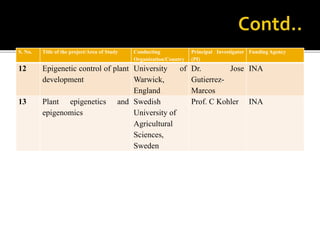
12 Epigenetic control of plant
development
University of
Warwick,
England
Dr. Jose
Gutierrez-
Marcos
INA
13 Plant epigenetics and
epigenomics
Swedish
University of
Agricultural
Sciences,
Sweden
Prof. C Kohler INA
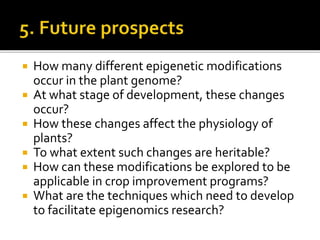
 How many different epigenetic modifications
occur in the plant genome?
 At what stage of development, these changes
occur?
 How these changes affect the physiology of
plants?
 To what extent such changes are heritable?
 How can these modifications be explored to be
applicable in crop improvement programs?
 What are the techniques which need to develop
to facilitate epigenomics research?
 Lane et al (2014) enforced the development
of pENCODE (Plant Encyclopedia of DNA
Elements). The goal of such a project would
be, to coordinate the ongoing work in
individual laboratories across the globe, to
focus community efforts on a set of high
priorities and to standardize sample/data
preparation, acquisition, and dissemination.
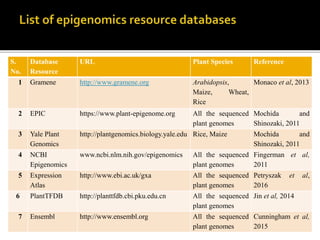
S.
No.
Database
Resource
URL Plant Species Reference
1 Gramene http://www.gramene.org Arabidopsis,
Maize, Wheat,
Rice
Monaco et al, 2013
2 EPIC https://www.plant-epigenome.org All the sequenced
plant genomes
Mochida and
Shinozaki, 2011
3 Yale Plant
Genomics
http://plantgenomics.biology.yale.edu Rice, Maize Mochida and
Shinozaki, 2011
4 NCBI
Epigenomics
www.ncbi.nlm.nih.gov/epigenomics All the sequenced
plant genomes
Fingerman et al,
2011
5 Expression
Atlas
http://www.ebi.ac.uk/gxa All the sequenced
plant genomes
Petryszak et al,
2016
6 PlantTFDB http://planttfdb.cbi.pku.edu.cn All the sequenced
plant genomes
Jin et al, 2014
7 Ensembl http://www.ensembl.org All the sequenced
plant genomes
Cunningham et al,
2015
Epigenomics   gyanika

Epigenomics gyanika

  • 1.
  • 2.
    1. Introduction toepigenetics and epigenomics 2. Different epigenetic modifications 3. Development of epigenomics in crop research 4. Crop improvement by epigenomics 5. Ongoing epigenomics projects on plants 6. Future prospects
  • 3.
     Greek word“epigenesis” which means “extra growth”.  Epigenetics is the study of chromosome changes that alter the expression of genes without any alteration in the gene sequences Riggs et al, 1996.  First coined by Conrad Waddington in 1942 to describe the impact of environment over the gene expression Murrel et al, 2005.  Reversible or non-reversible.  Heritable or non-heritable Berger et al, 2009.
  • 4.
     Epigenomics isthe study of the all the epigenetic changes in a genome of a cell, such genome is also called as epigenome Russel, 2010.  Epialleles, which refers to the genes with identical nucleotide sequence but altered expression abilities due to epigenetic events Weigel and Colot, 2012.
  • 5.
    1. DNA methylation 2.Histone modification 3. Non-coding RNAs
  • 6.
     The methylationreaction is catalyzed by the enzyme DNA methyltransferases (DNMTs).  The most frequent positions for methylation in eukaryotic DNA are C residues that are present next to G (CpG) islands Murrell et al, 2005.
  • 7.
    Methylation Stimulates binding ofsome proteins on chromosome Binding of Histone Deacetylases (HDACs) Genes become non-accessible to RNA pol
  • 8.
     The unwrappingof DNA from histones is necessary for expression of gene. Hence, change in the structure of chromatin leads to variation in the gene expression. This is called as chromatin remodeling.
  • 9.
    1. Methylation 2. Acetylationand deacetylation 3. Phosphorylation 4. Ubiquitylation
  • 10.
    ▪ The transferof methyl groups from S-adenosyl-L-methionine to lysine (K) or arginine (R) residues of histone proteins by histone methyltransferases (HMTs).
  • 11.
    ▪ Enzymatic additionof an acetyl group (COCH3) on histone H3 and H4 subunits, from acetyl coenzymeA by histone acetyl-transferase (HATs), at K-residues. ▪ Histone deacetylaces (HDACs) catalyze the hydrolytic removal of acetyl groups from histone K residues.
  • 12.
     Occurs atS,T &Y residues.  Unlike acetylation and methylation, histone phosphorylation seems to function by establishing interactions between other histone modifications and serving as a platform for effector proteins.
  • 13.
     Histone H2Aand H2B are two of the most highly ubiquitylated proteins found in the nucleus.  The most abundant forms are monoubiquitylated H2A on K119 and monoubiquitylated H2B on K123  Ubiquitylated H2B is associated with transcription activation.  Ubiquitylation of H2A and H2B is reversible, and is tightly regulated by histone ubiquitin ligases and deubiquitylating enzymes.
  • 14.
     About 90%of the eukaryotic genome is transcribed. Interestingly, only 1 – 2% of these transcripts encode for proteins; the majority are transcribed as non-coding RNAs (ncRNAs). 1. MicroRNA (miRNA) 2. Piwi-interacting RNA (piRNA) 3. Small-interacting RNA (siRNA) 4. Long non-coding RNA (lncRNA)
  • 19.
     Transcription  Genesilencing  Cell cycle progression  Apoptosis  Differentiation  DNA replication  DNA repair  Nuclear import  Tumorigenesis  Cancer progression
  • 20.
     Initially, theepigenomics based researches were mostly contributed towards the understanding the phenomena of various human diseases, mainly cancer Murell et al, 2005:Thakur et al, 2013.
  • 21.
     The conceptualidea of epigenomics research for crop improvement has well emerged in the past decade when whole genome data of various crop plants (wheat, rice, maize etc) became available.  The epigenetic modifications occur in response to various environmental pressures and it has been determined that such modifications play a crucial role in mediating productivity and stability in plant populations Latzel et al, 2013; Wang et al, 2014.  Many model plant species have been studied to evaluate the changes in expression profile due to epigenetic events and it has been found that such changes may lead to either silencing or over expression of genes Sarma et al, 2015.
  • 22.
     Vernalization (floweringafter prolonged period of cold) Vernalization Insensitive (VIN 3) Chromosome structure modification in flowering repressor gene, Flowering Locus C (FLC) Gene repressed Inducing flowering
  • 23.
     Song etal (2015) studied the role of methylation & miRNA in the development of flowering in monoecious plants.  Ortiz-Morea et al (2013) studied the role of sRNAs in the development of axillary bud outgrowth in sugarcane.  In one of the studies on recombinant inbred lines (RILs) of soybean, it was found that the differentially methylated regions (DMRs) were heritable and contributed to the phenotype of the plant Schmitz et al, 2017.  However, the possible extent of heritability cannot be significantly determined by currently available techniques (Hirsch et al, 2013), which provides scope for future research.
  • 24.
    1. Wheat (Triticumsp) 2. Rice (Oryza sativa) 3. Maize (Zea mays)
  • 25.
     Bottley etal (2008) demonstrated that polyploids are affected by homoeologous gene silencing, a process in which sub-genomic copies are selectively transcriptionally inactivated. The results suggested that much of the homoeologous silencing observed in differentiated tissues during wheat callus development, is probably under epigenetic control.  Yao et al (2010) analyzed the expression of small RNAs in seedling of wheat by northern blot, which indicated that some small RNAs were responsive to abiotic stress treatments. It may be proved to be a promising approach to develop abiotic stress resistance in wheat crops.
  • 26.
     Miura etal (2009) studied the effect of epigenetic changes on the rice plant height. They identified a spontaneous rice mutant, Epi-d1, showing a tall phenotype. The phenotype is inheritable and corresponds to the metastable epigenetic silencing of the DWARF1 (D1) gene.  Wen et al (2016) studied the expression pattern of mRNA and miRNA in six accessions of two rice varieties Oryza sativa L. ssp. indica and Oryza sativa L. ssp. Japonica. They found about 11% differentially expressing miRNA among accessions. Genes involved in various metabolic processes and stress responses are enriched in the differentially expressed genes between rice indica and japonica subspecies.
  • 27.
     Bousios etal (2017) studied 6456 carefully annotated; full-length Sirevirus LTR retrotransposons in maize and showed that their silencing is associated with underlying characteristics of the TE sequences. They also uncovered features of the host–TE interactions in host epigenetic response against pathogen.
  • 28.
    S. No. Titleof the project/Area of Study Conducting Organization/Coun try Principal Investigator (PI) Funding Agency 1 Epigenetic regulation of host- pathogen genetics in leaf-rust resistance of wheat Department of Genetics and Plant Breeding, Chaudhary Charan Singh University, Meerut, India Prof. P K Gupta Indian Council of Agricultural Research (ICAR), India Indian Agricultural Research Institute, India Information Not Available (INA) Indian Institute of Wheat and Barley Research, India INA 2 Analysis of genome and epigenome of indica rice varieties Nagina 22 and IR64 Delhi University (South Campus), India Dr. Saurabh Raghuvanshi Department of Biotechnology (DBT), India
  • 29.
    S. No. Titleof the project/Area of Study Conducting Organization/Country Principal Investigator (PI) Funding Agency 3 Functional Characterization of Genetic and Epigenetic Regulatory Networks Involved in the Reproductive Development in Rice Delhi University (South Campus), India Prof. AK Tyagi Prof. JP Khurana Prof. Sanjay Kapoor DBT, India Indian Institute of Science, India Prof. Usha Vijayraghavan Indian Institute of Science Education and Research, India Dr. Kalika Prasad National Centre For Biological Sciences, India Dr. Shivaprasad PV Osmania University, India Prof. K Venkateshwara Rao 4 Studies on genome wide epigenetic variations in natural populations of west Himalayan Arabidopsis thaliana along altitudinal gradient National Botanical Research Institute, India Dr. Sribash Roy DBT, India
  • 30.
    S. No. Titleof the project/Area of Study Conducting Organization/Country Principal Investigator (PI) Funding Agency 5 Evaluation of Epigentics Profiling, DNA Methylation and Histone Modifications Panjab University, India Dr. Indu Sharma DBT, India 6 Molecular investigation of epigenetic modifications in exposure to environmental pollution using Neurospora crassa as a model system Indian Institute of Technology, Guwahati, India Dr. Ranjan Tamuli DBT, India 7 Studies on flowering behaviour, seed setting and maturity pattern and seed quality enhancement in small millets Indian Institute of Maize Research, India Dr. N Kannababu ICAR, India 8 Over expression of genes involved in ascorbate-glutathione cycle to enhance the abiotic stress tolerance in transgenic sorghum plants Directorate of Sorghum Research, India Dr. D Balakrishna ICAR, India 9 Biological intricacies in host-parasitic interaction between millets and shoot fly species Indian Institute of Maize Research, India Dr. PG Padmaja ICAR, India 10 Promising role of black tea polyphenols as epigenetic modulators: A new bridge between nutrition and health Calcutta University, Kolkata, India INA National Tea Research Foundation (NTRF), India 11 Epigenetic programming of plant sperm cells University of Melbourne, Australia Prof. Mohan Singh Australian Research Council (ARC), Australia
  • 31.
    S. No. Titleof the project/Area of Study Conducting Organization/Country Principal Investigator (PI) Funding Agency 12 Epigenetic control of plant development University of Warwick, England Dr. Jose Gutierrez- Marcos INA 13 Plant epigenetics and epigenomics Swedish University of Agricultural Sciences, Sweden Prof. C Kohler INA
  • 32.
     How manydifferent epigenetic modifications occur in the plant genome?  At what stage of development, these changes occur?  How these changes affect the physiology of plants?  To what extent such changes are heritable?  How can these modifications be explored to be applicable in crop improvement programs?  What are the techniques which need to develop to facilitate epigenomics research?
  • 33.
     Lane etal (2014) enforced the development of pENCODE (Plant Encyclopedia of DNA Elements). The goal of such a project would be, to coordinate the ongoing work in individual laboratories across the globe, to focus community efforts on a set of high priorities and to standardize sample/data preparation, acquisition, and dissemination.
  • 34.
    S. No. Database Resource URL Plant SpeciesReference 1 Gramene http://www.gramene.org Arabidopsis, Maize, Wheat, Rice Monaco et al, 2013 2 EPIC https://www.plant-epigenome.org All the sequenced plant genomes Mochida and Shinozaki, 2011 3 Yale Plant Genomics http://plantgenomics.biology.yale.edu Rice, Maize Mochida and Shinozaki, 2011 4 NCBI Epigenomics www.ncbi.nlm.nih.gov/epigenomics All the sequenced plant genomes Fingerman et al, 2011 5 Expression Atlas http://www.ebi.ac.uk/gxa All the sequenced plant genomes Petryszak et al, 2016 6 PlantTFDB http://planttfdb.cbi.pku.edu.cn All the sequenced plant genomes Jin et al, 2014 7 Ensembl http://www.ensembl.org All the sequenced plant genomes Cunningham et al, 2015