
enzymology 
Sidra shafiq
lysozyme
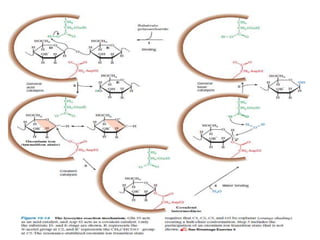
1. Lysozyme attaches to a bacterial cell wall by binding to a 
hexasaccharide unit. In the process, the D-ring is distorted 
toward the half-chair conformation in response to the 
unfavorable contacts that its ¬C6H2OH group would 
otherwise make with the protein. 
2. Glu 35 transfers its proton to the O1 atom linking the D- and E-rings, 
the only polar group in its vicinity, thereby cleaving the 
C1¬O1 bond (general acid catalysis).This step converts the D-ring 
to a planar resonance-stabilized oxonium ion transition 
state, whose formation is facilitated by the strain distorting it to 
the half-chair conformation (catalysis by the preferential 
binding of the transition state).The positively charged oxonium 
ion is stabilized by the presence of the nearby negatively 
charged Asp 52 carboxylate group (electrostatic catalysis).The 
E-ring product is released.
3. The Asp 52 carboxylate group nucleophilically 
attacks the now electron-poor C1 of the D ring to 
form a covalent glycosyl–enzyme intermediate 
(covalent catalysis). 
4. Water replaces the E-ring product in the active site. 
5. Hydrolysis of the covalent bond with the assistance 
of Glu 35 (general base catalysis), which involves 
another oxonium ion transition state, regenerates 
the active site groups.The enzyme then releases the 
D-ring product, completing the catalytic cycle.
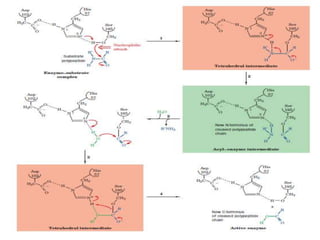
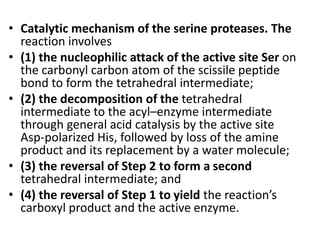
• Catalytic mechanism of the serine proteases. The 
reaction involves 
• (1) the nucleophilic attack of the active site Ser on 
the carbonyl carbon atom of the scissile peptide 
bond to form the tetrahedral intermediate; 
• (2) the decomposition of the tetrahedral 
intermediate to the acyl–enzyme intermediate 
through general acid catalysis by the active site 
Asp-polarized His, followed by loss of the amine 
product and its replacement by a water molecule; 
• (3) the reversal of Step 2 to form a second 
tetrahedral intermediate; and 
• (4) the reversal of Step 1 to yield the reaction’s 
carboxyl product and the active enzyme.
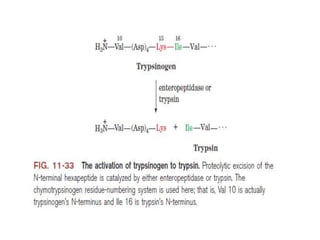
chymotrypsinogen
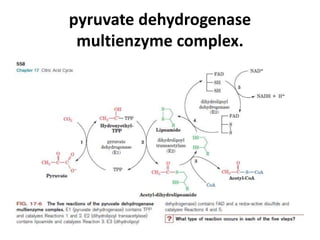
pyruvate dehydrogenase 
multienzyme complex.

Lysozyme Enzymology

  • 1.
  • 2.
  • 4.
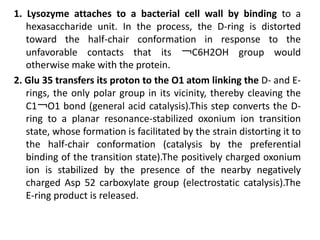
    1. Lysozyme attachesto a bacterial cell wall by binding to a hexasaccharide unit. In the process, the D-ring is distorted toward the half-chair conformation in response to the unfavorable contacts that its ¬C6H2OH group would otherwise make with the protein. 2. Glu 35 transfers its proton to the O1 atom linking the D- and E-rings, the only polar group in its vicinity, thereby cleaving the C1¬O1 bond (general acid catalysis).This step converts the D-ring to a planar resonance-stabilized oxonium ion transition state, whose formation is facilitated by the strain distorting it to the half-chair conformation (catalysis by the preferential binding of the transition state).The positively charged oxonium ion is stabilized by the presence of the nearby negatively charged Asp 52 carboxylate group (electrostatic catalysis).The E-ring product is released.
  • 5.
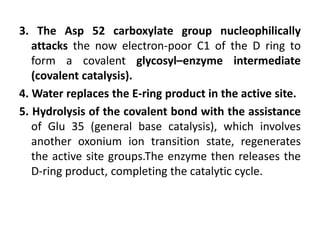
    3. The Asp52 carboxylate group nucleophilically attacks the now electron-poor C1 of the D ring to form a covalent glycosyl–enzyme intermediate (covalent catalysis). 4. Water replaces the E-ring product in the active site. 5. Hydrolysis of the covalent bond with the assistance of Glu 35 (general base catalysis), which involves another oxonium ion transition state, regenerates the active site groups.The enzyme then releases the D-ring product, completing the catalytic cycle.
  • 7.
    • Catalytic mechanismof the serine proteases. The reaction involves • (1) the nucleophilic attack of the active site Ser on the carbonyl carbon atom of the scissile peptide bond to form the tetrahedral intermediate; • (2) the decomposition of the tetrahedral intermediate to the acyl–enzyme intermediate through general acid catalysis by the active site Asp-polarized His, followed by loss of the amine product and its replacement by a water molecule; • (3) the reversal of Step 2 to form a second tetrahedral intermediate; and • (4) the reversal of Step 1 to yield the reaction’s carboxyl product and the active enzyme.
  • 8.
  • 10.