Enzymes
Enzymes
♦ Enzymes are substances that are necessary
for most of the chemical reactions that
occur in living cells.
♦ Chemical reactions that occur in the body
are done in small steps. In some of these
small steps, the enzyme works on the
reaction to help it take place, rearranging
the molecules involved.
Enzymes Are Biological Catalysts
• Enzymes are proteins that carry out most
catalysis in living organisms.
– Unique three-dimensional shape enables an
enzyme to react with specific substrates.
– Because the enzyme itself is not changed or
consumed in the reaction, only a small amount
is needed, and can then be reused.
Enzyme names
♦ Usually end in “-ase” like isomerase
♦ Most enzymes are used within the cell, but
some are used outside of the cell. Example:
Digestive enzymes
Free Energy
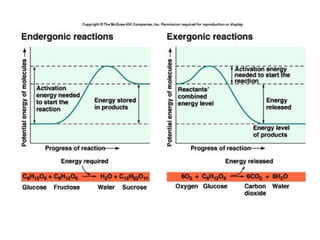
• Free energy refers to the amount of energy
actually available to break and subsequently form
other chemical bonds.
– in a cell - amt of energy contained in a molecules
chemical bonds
• Energy involved in chemical reactions:
• endergonic - any reaction that absorbs free
energy
• exergonic - any reaction that releases free
energy
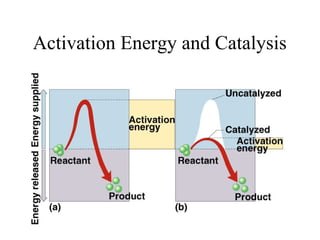
Activation Energy
• Activation energy refers to the extra energy
required to destabilize existing chemical bonds
and initiate a chemical reaction.
• catalyst - substance that lowers the
activation energy
• Enzymes are catalysts.
Activation Energy and Catalysis
How do enzymes work?
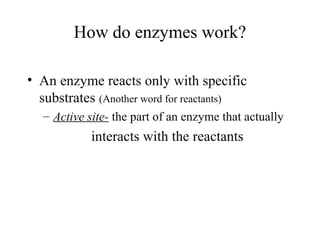
• An enzyme reacts only with specific
substrates (Another word for reactants)
– Active site- the part of an enzyme that actually
interacts with the reactants
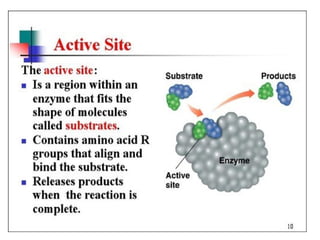
Enzyme Active Site
• Amino acid side chains interact, metal ions,
• Various types of polar, non-polar, ionic interactions
Enzymes
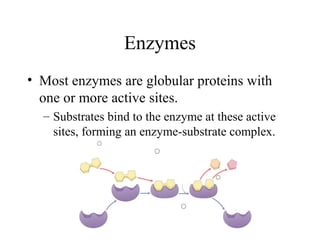
• Most enzymes are globular proteins with
one or more active sites.
– Substrates bind to the enzyme at these active
sites, forming an enzyme-substrate complex.
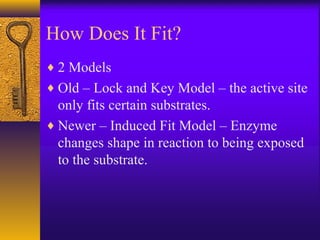
How Does It Fit?
♦ 2 Models
♦ Old – Lock and Key Model – the active site
only fits certain substrates.
♦ Newer – Induced Fit Model – Enzyme
changes shape in reaction to being exposed
to the substrate.
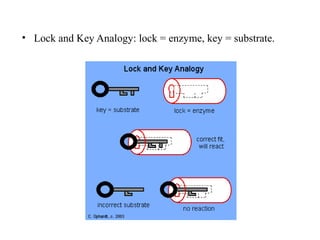
• Lock and Key Analogy: lock = enzyme, key = substrate.
Induced Fit Model
Control of enzyme activity:
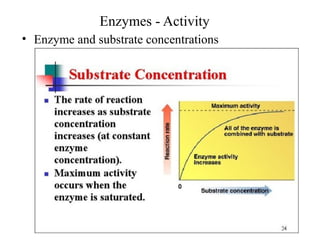
• Concentration of enzyme and substrate molecules
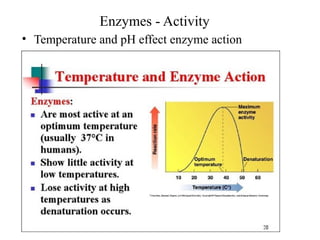
• Temperature
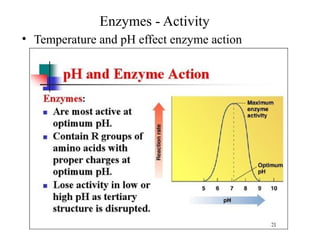
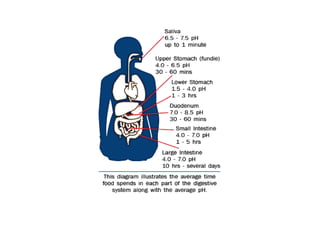
• pH
Enzymes - Activity
• Enzyme and substrate concentrations
Enzymes - Activity
• Temperature and pH effect enzyme action
Enzymes - Activity
• Temperature and pH effect enzyme action
Enzymes for hbs

Enzymes for hbs

  • 1.
  • 2.
    Enzymes ♦ Enzymes aresubstances that are necessary for most of the chemical reactions that occur in living cells. ♦ Chemical reactions that occur in the body are done in small steps. In some of these small steps, the enzyme works on the reaction to help it take place, rearranging the molecules involved.
  • 3.
    Enzymes Are BiologicalCatalysts • Enzymes are proteins that carry out most catalysis in living organisms. – Unique three-dimensional shape enables an enzyme to react with specific substrates. – Because the enzyme itself is not changed or consumed in the reaction, only a small amount is needed, and can then be reused.
  • 4.
    Enzyme names ♦ Usuallyend in “-ase” like isomerase ♦ Most enzymes are used within the cell, but some are used outside of the cell. Example: Digestive enzymes
  • 5.
    Free Energy • Freeenergy refers to the amount of energy actually available to break and subsequently form other chemical bonds. – in a cell - amt of energy contained in a molecules chemical bonds • Energy involved in chemical reactions: • endergonic - any reaction that absorbs free energy • exergonic - any reaction that releases free energy
  • 7.
    Activation Energy • Activationenergy refers to the extra energy required to destabilize existing chemical bonds and initiate a chemical reaction. • catalyst - substance that lowers the activation energy • Enzymes are catalysts.
  • 8.
  • 9.
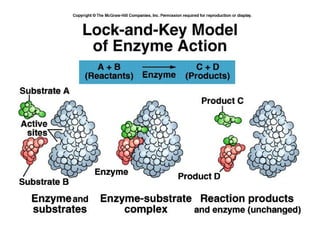
    How do enzymeswork? • An enzyme reacts only with specific substrates (Another word for reactants) – Active site- the part of an enzyme that actually interacts with the reactants
  • 10.
    Enzyme Active Site •Amino acid side chains interact, metal ions, • Various types of polar, non-polar, ionic interactions
  • 11.
    Enzymes • Most enzymesare globular proteins with one or more active sites. – Substrates bind to the enzyme at these active sites, forming an enzyme-substrate complex.
  • 12.
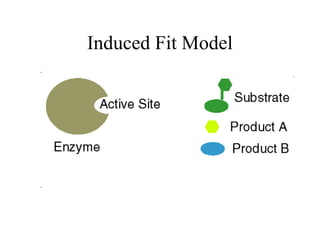
    How Does ItFit? ♦ 2 Models ♦ Old – Lock and Key Model – the active site only fits certain substrates. ♦ Newer – Induced Fit Model – Enzyme changes shape in reaction to being exposed to the substrate.
  • 13.
    • Lock andKey Analogy: lock = enzyme, key = substrate.
  • 15.
  • 16.
    Control of enzymeactivity: • Concentration of enzyme and substrate molecules • Temperature • pH
  • 17.
    Enzymes - Activity •Enzyme and substrate concentrations
  • 18.
    Enzymes - Activity •Temperature and pH effect enzyme action
  • 19.
    Enzymes - Activity •Temperature and pH effect enzyme action

Editor's Notes

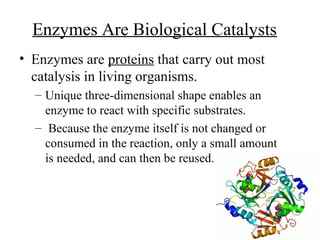
  • #4 Image from Wikipedia: Human glyoxalase I. Two zinc ions that are needed for the enzyme to catalyze its reaction are shown as purple spheres, and an enzyme inhibitor called S-hexylglutathione is shown as a space-filling model, filling the two active sites.
  • #5 Depending on the cell type, there are anywhere between 2000-3000 different types of enzymes a cell is genetically programmed to produce!
  • #16 http://course1.winona.edu/sberg/ANIMTNS/ind-fit.htm Induced Fit Model of Enzyme Action The cycle starts with the active site open and substrate (it could be the disaccharide sucrose) free in solution. The substrate approaches the enzyme and then binds at the active site. Substrate binding causes a change in the shape of the enzyme such that the catalytic parts of the enzyme are brought to bear on the substrate. The chemical reaction occurs and the two products are left in the active site. If sucrose is the substrate, the two products will be glucose and fructose. The two products leave the active site and the enzyme returns to its original active site open configuration. This animation is run in slow motion. An actual enzyme catalyzed reaction occurs so quickly that enzymes can process as many as millions of substrate molecules in one second.