FRACTURE BEHAVIOUR
OF NANOCOMPOSITES
-FATIGUE
SHEETHAL P
2ND M.Sc BPS
CBPST, KOCHI
 Compared to microparticles , nanoparticles
have some unique features. Firstly, higher
specific surface area can promote stress transfer
from matrix to nanoparticles, Secondly; the
required loadings of nanoparticles in polymer
 matrices are usually much lower than those of
micro-fillers (typically 10–40 vol. % for the latter).
Therefore, man y intrinsic merits of neat
polymers, such as low weight, ductility, good
processability, and transparency (e.g . for epoxy)
will be retained after the addition of nanoparticles
.
3
3
Fracture Modes
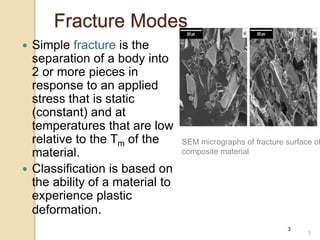
 Simple fracture is the
separation of a body into
2 or more pieces in
response to an applied
stress that is static
(constant) and at
temperatures that are low
relative to the Tm of the
material.
 Classification is based on
the ability of a material to
experience plastic
deformation.
SEM micrographs of fracture surface of
composite material
Types of Fracture
 Brittle Fracture
 Ductile Fracture
 Fatigue Fracture
 Creep Fracture
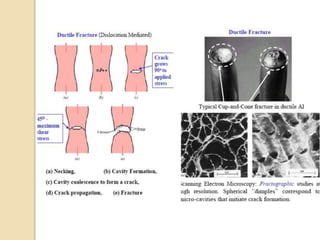
Ductile fracture
Accompanied by significant
plastic deformation
Brittle fracture
Little or no sudden
plastic deformation
Fracture Mechanism
Imposed stress Crack Formation
Propagation
 Ductile failure has extensive plastic
deformation in the vicinity of the advancing
crack. The process proceeds relatively slow
(stable). The crack resists any further
extension unless there is an increase in the
applied stress.
 In brittle failure, cracks may spread very
rapidly, with little deformation. These cracks
are more unstable and crack propagation will
continue without an increase in the applied 5
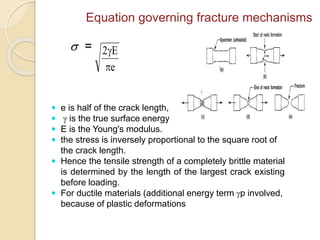
 =
e
E2


Equation governing fracture mechanisms
 e is half of the crack length,
  is the true surface energy
 E is the Young's modulus.
 the stress is inversely proportional to the square root of
the crack length.
 Hence the tensile strength of a completely brittle material
is determined by the length of the largest crack existing
before loading.
 For ductile materials (additional energy term p involved,
because of plastic deformations
8
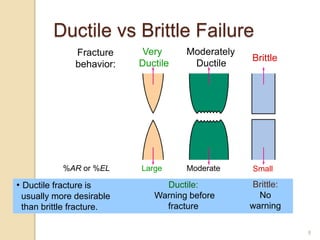
Ductile vs Brittle Failure
Very
Ductile
Moderately
Ductile
Brittle
Fracture
behavior:
Large Moderate%AR or %EL Small
• Ductile fracture is
usually more desirable
than brittle fracture.
Ductile:
Warning before
fracture
Brittle:
No
warning
9
9
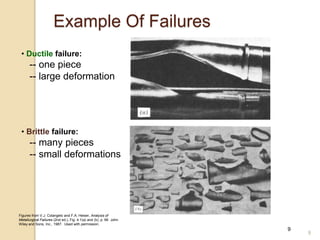
• Ductile failure:
-- one piece
-- large deformation
Figures from V.J. Colangelo and F.A. Heiser, Analysis of
Metallurgical Failures (2nd ed.), Fig. 4.1(a) and (b), p. 66 John
Wiley and Sons, Inc., 1987. Used with permission.
Example Of Failures
• Brittle failure:
-- many pieces
-- small deformations
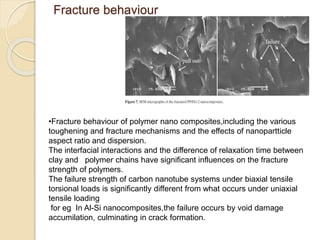
Fracture behaviour
•Fracture behaviour of polymer nano composites,including the various
toughening and fracture mechanisms and the effects of nanopartticle
aspect ratio and dispersion.
The interfacial interactions and the difference of relaxation time between
clay and polymer chains have significant influences on the fracture
strength of polymers.
The failure strength of carbon nanotube systems under biaxial tensile
torsional loads is significantly different from what occurs under uniaxial
tensile loading
for eg In Al-Si nanocomposites,the failure occurs by void damage
accumilation, culminating in crack formation.
Fracture toughness testing
 The fracture toughness of the specimens was
determined by conforming to the procedure
outlined in the standard ASTM D 5045-99.
 The critical stress intensity factor, KICand strain
energy release rate, GIC were determined
according to linear elastic fracture mechanics
principles
 Specimens were loaded under plane-strain
condition in three-point bending until failure
occurred from an initially prepared sharp
precrack.
 Testing was conducted using a MTS 810
universal tester (MTS Systems Corporation,
Eden Prairie, MN, USA) at a crosshead speed of
−1
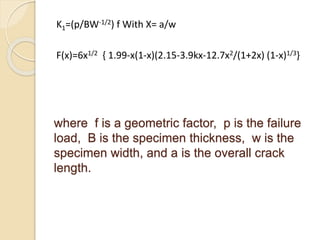
where f is a geometric factor, p is the failure
load, B is the specimen thickness, w is the
specimen width, and a is the overall crack
length.
K1=(p/BW-1/2) f With X= a/w
F(x)=6x1/2 { 1.99-x(1-x)(2.15-3.9kx-12.7x2/(1+2x) (1-x)1/3}
fracture behavior of surface treated
montmorillonite/epoxy nanocomposites.
 mechanical properties of clay-reinforced
nanocomposites are significantly affected by the
dispersion of clay particles in the matrix.
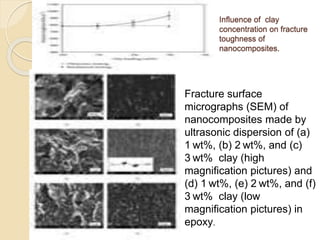
 The effect of surface-treatment of Influence of clay
concentration on fracture toughness of nanocomposites
Montmorillonite (MMT) on the fracture behavior of
MMT/epoxy nanocomposite was investigated. For this
purpose, fracture tests were performed using samples
with three different clay concentration level.
 After fracture tests, SEM analysis was made on the
fracture surfaces to examine the fracture mechanism. It
was found that the MMT treatment using 3-
aminopropyltriethoxysilane enhanced the fracture
toughness increased of the MMT/epoxy nanocomposite.
 This is due to the improved intercalation effect and
interfacial strength between MMT and epoxy matrix.
.
SEM micrograph
of a neat
epoxyfracture
surface
Fracture surface
micrographs (SEM) of
nanocomposites made by
ultrasonic dispersion of (a)
1 wt%, (b) 2 wt%, and (c)
3 wt% clay (high
magnification pictures) and
(d) 1 wt%, (e) 2 wt%, and (f)
3 wt% clay (low
magnification pictures) in
epoxy.
Influence of clay
concentration on fracture
toughness of
nanocomposites.
 Clear evidence of the distorted and perturbed crack
path can be seen in Figures , These tortuous paths
were caused by a crack deflection mechanism when
the path of a propagating crack was impeded by the
uniformly distributed nanoparticles (i.e., both the
intercalated parallel platelets and partially exfoliated
platelets)
 The above observations lead to the inference that
in this particular epoxy system, the occurrence of
crack deflection mechanism only provided
insignificant energy dissipation . Void formation
and cavitation were not observed,
 so there was an excellent interfacial interaction
between the epoxy matrix and clay in an
exfoliated and intercalated structure as had been
predicted.
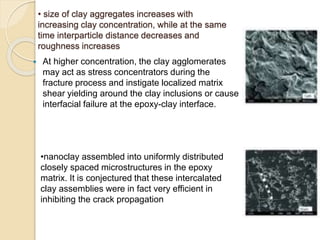
• size of clay aggregates increases with
increasing clay concentration, while at the same
time interparticle distance decreases and
roughness increases
 At higher concentration, the clay agglomerates
may act as stress concentrators during the
fracture process and instigate localized matrix
shear yielding around the clay inclusions or cause
interfacial failure at the epoxy-clay interface.
•nanoclay assembled into uniformly distributed
closely spaced microstructures in the epoxy
matrix. It is conjectured that these intercalated
clay assemblies were in fact very efficient in
inhibiting the crack propagation
Fatigue Failure
 It has been recognized that a material
subjected to a repetitive or fluctuating stress
will fail at a stress much lower than that
required to cause failure on a single application
of load. Failures occurring under conditions of
dynamic loading are called fatigue failures
 . Fatigue failure is characterized by three
stages
 Crack initiation
 Crack propagation
 Final fracture
Fatigue
 Fatigue is one of the primary reasons for
failure in structural materials
Nano particles are believed to improve the
fatigue behaviour without sacrificing
stiffness of polymer composites
 The mechanisms for the enhanced fatigue
resistance may include crack
planning,crack tip deflection,and partice
debonding
 Addition of nano particles results in an
order of magnitude reduction in fatigue
crack propagation rate for systems
 Fatigue crack propagation rate can be
reduced by reducing the diameter and
length and improving their dispersion
 . Fatigue failure is a multi-stage process. It begins with
the initiation of cracks, and with continued cyclic
loading the crack propagates, finally leading to the
rupture of the component or specimen.
 For homogenious materials the fatigue behavior is
often characterized by an early crack that dominates
the damage development and lead to final fracture
 For inhomogeneous materials, such as fiber-or
particulate-reinforced polymers, the fatigue damage at
an early stage is often diffuse in nature, as the crack
can be initiated
The S-N Curve
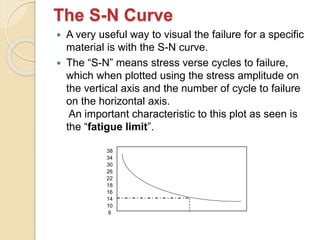
 A very useful way to visual the failure for a specific
material is with the S-N curve.
 The “S-N” means stress verse cycles to failure,
which when plotted using the stress amplitude on
the vertical axis and the number of cycle to failure
on the horizontal axis.
An important characteristic to this plot as seen is
the “fatigue limit”.
6
10
14
16
22
18
26
30
34
38
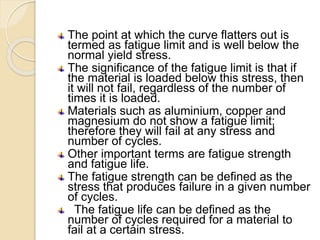
The point at which the curve flatters out is
termed as fatigue limit and is well below the
normal yield stress.
The significance of the fatigue limit is that if
the material is loaded below this stress, then
it will not fail, regardless of the number of
times it is loaded.
Materials such as aluminium, copper and
magnesium do not show a fatigue limit;
therefore they will fail at any stress and
number of cycles.
Other important terms are fatigue strength
and fatigue life.
The fatigue strength can be defined as the
stress that produces failure in a given number
of cycles.
The fatigue life can be defined as the
number of cycles required for a material to
fail at a certain stress.
FATIGUE BEHAVIOUR OF POLYMER
NANOCOMPOSITES
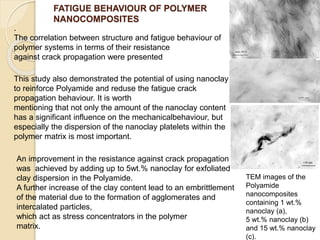
TEM images of the
Polyamide
nanocomposites
containing 1 wt.%
nanoclay (a),
5 wt.% nanoclay (b)
and 15 wt.% nanoclay
(c).
.
The correlation between structure and fatigue behaviour of
polymer systems in terms of their resistance
against crack propagation were presented
An improvement in the resistance against crack propagation
was achieved by adding up to 5wt.% nanoclay for exfoliated
clay dispersion in the Polyamide.
A further increase of the clay content lead to an embrittlement
of the material due to the formation of agglomerates and
intercalated particles,
which act as stress concentrators in the polymer
matrix.
This study also demonstrated the potential of using nanoclay
to reinforce Polyamide and reduse the fatigue crack
propagation behaviour. It is worth
mentioning that not only the amount of the nanoclay content
has a significant influence on the mechanicalbehaviour, but
especially the dispersion of the nanoclay platelets within the
polymer matrix is most important.
SEM OBSERVATIONS OF THE FRACTURE
SURFACES
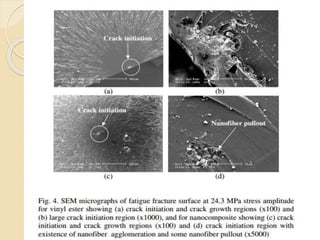
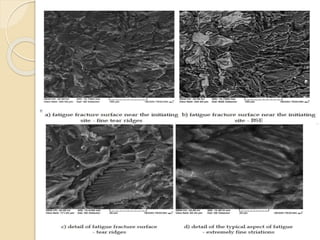
 The fracture surfaces under cyclic stresses
consist of the crack initiation region followed by a
smooth region leading to steps or river-like
pattern.
 The fatigue fracture surfaces also contain a
series of concentric crack growth bands
surrounding the surface source. These bands are
caused by intermittent growth of the crack due to
breakdown of a craze.
 The discontinuous crack growth bands are
followed by a region that show radial tear lines,
secondary fracture features and increasing
surface roughness
 Fracture surfaces of the nanocomposite
specimens were also similar for those
broken at higher stress levels and those
broken at lower stress levels.
 Crack initiated from subsurface on the
fracture surface of nanocomposite (see
Fig. 4(c)).
 For this material, the uniform dispersion
of nanofibers inside the polymer is
important and in some areas
agglomeration of nanofibers exists.
Estimation of Fatigue Life of Epoxy-
alumina Polymer Nanocomposites
 Epoxy alumina polymer nanocomposites were
synthesized by in-situ polymerization technique.
 Dispersion of rod shaped alumina nanoparticles,
having a length less than 50 nm and diameter in
the range of 10 nm, in the epoxy matrix was
achieved using ultrasonication.
 Nanocomposites having 0.5, 1 and 1.5 wt % of
alumina nanoparticles were prepared. Good
dispersion of alumina nanoparticles in epoxy matrix
was observed through transmission electron
micrographs of the nanocomposites
 It was observed that the addition of alumina
nanoparticles provides good improvement in
fatigue life of epoxy.
 An increment of three to four times in the
fatigue life of nanocomposites having 1.5%
alumina particles was observed over that of
neat polymer at low stress levels. Whereas
increment in fatigue life of nanocomposites
decreased at higher stress level .
 Fracture surfaces of specimens in
fatigue were examined with the help of
scanning electron microscope in order
to investigate mechanisms
responsible for the increase in fatigue
life.
 Roughness of fractured surfaces of
nanocomposites were more in
comparison to that of neat epoxy
showing consumption of higher energy
for fatigue failure causing an
increment in the fatigue life of
nanocomposites
Fatigue behavior of Epoxy/ SiO2
NanocompositesReinforced with E- glass Fiber
 Blackman et al studied the fracture and fatigue behavior of nano-
modified epoxy polymers
.
 Further, design engineers would clearly prefer both the initial
toughness and the long-term cyclic-fatigue properties to be
significantly enhanced by the presence of the toughening phase
in the epoxy polymer.
 introduction of nano-silica particles into the epoxy polymer has
increased both the initial toughness, as measured by the fracture
toughness, and also significantly improved the cyclic-fatigue
behaviour of the epoxy polymer
Thermal fatigue and creep fracture
behaviours of a nanocomposite solder
Creep and thermal fatigue behaviours of joints
soldered by a tin base nano composite solder were
characterised at different temperatures
Comparison with Sn60Pb40 solder
The result shows that the nano composite solder has
much better creep resistance and thermal creep
fatigue property than the Sn60Pb40 solder
This is due to the uniformly dispersed nano sized Ag
particles that have provided effective impediment to
dislocation movement and grain boundary sliding,in
addition to the alloying effect
Sn60Pb40 solder joints deform dominantly by
transgranular sliding,while the nano composite solder
joints creep by intergranular mechanism through
grain boundary sliding and voids growth
FRACTURE BEHAVIOUR OF NANOCOMPOSITES -FATIGUE

FRACTURE BEHAVIOUR OF NANOCOMPOSITES -FATIGUE

  • 1.
  • 2.
     Compared tomicroparticles , nanoparticles have some unique features. Firstly, higher specific surface area can promote stress transfer from matrix to nanoparticles, Secondly; the required loadings of nanoparticles in polymer  matrices are usually much lower than those of micro-fillers (typically 10–40 vol. % for the latter). Therefore, man y intrinsic merits of neat polymers, such as low weight, ductility, good processability, and transparency (e.g . for epoxy) will be retained after the addition of nanoparticles .
  • 3.
    3 3 Fracture Modes  Simplefracture is the separation of a body into 2 or more pieces in response to an applied stress that is static (constant) and at temperatures that are low relative to the Tm of the material.  Classification is based on the ability of a material to experience plastic deformation. SEM micrographs of fracture surface of composite material
  • 4.
    Types of Fracture Brittle Fracture  Ductile Fracture  Fatigue Fracture  Creep Fracture Ductile fracture Accompanied by significant plastic deformation Brittle fracture Little or no sudden plastic deformation
  • 5.
    Fracture Mechanism Imposed stressCrack Formation Propagation  Ductile failure has extensive plastic deformation in the vicinity of the advancing crack. The process proceeds relatively slow (stable). The crack resists any further extension unless there is an increase in the applied stress.  In brittle failure, cracks may spread very rapidly, with little deformation. These cracks are more unstable and crack propagation will continue without an increase in the applied 5
  • 6.
     = e E2   Equation governingfracture mechanisms  e is half of the crack length,   is the true surface energy  E is the Young's modulus.  the stress is inversely proportional to the square root of the crack length.  Hence the tensile strength of a completely brittle material is determined by the length of the largest crack existing before loading.  For ductile materials (additional energy term p involved, because of plastic deformations
  • 8.
    8 Ductile vs BrittleFailure Very Ductile Moderately Ductile Brittle Fracture behavior: Large Moderate%AR or %EL Small • Ductile fracture is usually more desirable than brittle fracture. Ductile: Warning before fracture Brittle: No warning
  • 9.
    9 9 • Ductile failure: --one piece -- large deformation Figures from V.J. Colangelo and F.A. Heiser, Analysis of Metallurgical Failures (2nd ed.), Fig. 4.1(a) and (b), p. 66 John Wiley and Sons, Inc., 1987. Used with permission. Example Of Failures • Brittle failure: -- many pieces -- small deformations
  • 10.
    Fracture behaviour •Fracture behaviourof polymer nano composites,including the various toughening and fracture mechanisms and the effects of nanopartticle aspect ratio and dispersion. The interfacial interactions and the difference of relaxation time between clay and polymer chains have significant influences on the fracture strength of polymers. The failure strength of carbon nanotube systems under biaxial tensile torsional loads is significantly different from what occurs under uniaxial tensile loading for eg In Al-Si nanocomposites,the failure occurs by void damage accumilation, culminating in crack formation.
  • 11.
    Fracture toughness testing The fracture toughness of the specimens was determined by conforming to the procedure outlined in the standard ASTM D 5045-99.  The critical stress intensity factor, KICand strain energy release rate, GIC were determined according to linear elastic fracture mechanics principles  Specimens were loaded under plane-strain condition in three-point bending until failure occurred from an initially prepared sharp precrack.  Testing was conducted using a MTS 810 universal tester (MTS Systems Corporation, Eden Prairie, MN, USA) at a crosshead speed of −1
  • 12.
    where f isa geometric factor, p is the failure load, B is the specimen thickness, w is the specimen width, and a is the overall crack length. K1=(p/BW-1/2) f With X= a/w F(x)=6x1/2 { 1.99-x(1-x)(2.15-3.9kx-12.7x2/(1+2x) (1-x)1/3}
  • 13.
    fracture behavior ofsurface treated montmorillonite/epoxy nanocomposites.  mechanical properties of clay-reinforced nanocomposites are significantly affected by the dispersion of clay particles in the matrix.  The effect of surface-treatment of Influence of clay concentration on fracture toughness of nanocomposites Montmorillonite (MMT) on the fracture behavior of MMT/epoxy nanocomposite was investigated. For this purpose, fracture tests were performed using samples with three different clay concentration level.  After fracture tests, SEM analysis was made on the fracture surfaces to examine the fracture mechanism. It was found that the MMT treatment using 3- aminopropyltriethoxysilane enhanced the fracture toughness increased of the MMT/epoxy nanocomposite.  This is due to the improved intercalation effect and interfacial strength between MMT and epoxy matrix. . SEM micrograph of a neat epoxyfracture surface
  • 14.
    Fracture surface micrographs (SEM)of nanocomposites made by ultrasonic dispersion of (a) 1 wt%, (b) 2 wt%, and (c) 3 wt% clay (high magnification pictures) and (d) 1 wt%, (e) 2 wt%, and (f) 3 wt% clay (low magnification pictures) in epoxy. Influence of clay concentration on fracture toughness of nanocomposites.
  • 15.
     Clear evidenceof the distorted and perturbed crack path can be seen in Figures , These tortuous paths were caused by a crack deflection mechanism when the path of a propagating crack was impeded by the uniformly distributed nanoparticles (i.e., both the intercalated parallel platelets and partially exfoliated platelets)  The above observations lead to the inference that in this particular epoxy system, the occurrence of crack deflection mechanism only provided insignificant energy dissipation . Void formation and cavitation were not observed,  so there was an excellent interfacial interaction between the epoxy matrix and clay in an exfoliated and intercalated structure as had been predicted.
  • 16.
    • size ofclay aggregates increases with increasing clay concentration, while at the same time interparticle distance decreases and roughness increases  At higher concentration, the clay agglomerates may act as stress concentrators during the fracture process and instigate localized matrix shear yielding around the clay inclusions or cause interfacial failure at the epoxy-clay interface. •nanoclay assembled into uniformly distributed closely spaced microstructures in the epoxy matrix. It is conjectured that these intercalated clay assemblies were in fact very efficient in inhibiting the crack propagation
  • 17.
    Fatigue Failure  Ithas been recognized that a material subjected to a repetitive or fluctuating stress will fail at a stress much lower than that required to cause failure on a single application of load. Failures occurring under conditions of dynamic loading are called fatigue failures  . Fatigue failure is characterized by three stages  Crack initiation  Crack propagation  Final fracture
  • 18.
    Fatigue  Fatigue isone of the primary reasons for failure in structural materials Nano particles are believed to improve the fatigue behaviour without sacrificing stiffness of polymer composites  The mechanisms for the enhanced fatigue resistance may include crack planning,crack tip deflection,and partice debonding  Addition of nano particles results in an order of magnitude reduction in fatigue crack propagation rate for systems  Fatigue crack propagation rate can be reduced by reducing the diameter and length and improving their dispersion
  • 19.
     . Fatiguefailure is a multi-stage process. It begins with the initiation of cracks, and with continued cyclic loading the crack propagates, finally leading to the rupture of the component or specimen.  For homogenious materials the fatigue behavior is often characterized by an early crack that dominates the damage development and lead to final fracture  For inhomogeneous materials, such as fiber-or particulate-reinforced polymers, the fatigue damage at an early stage is often diffuse in nature, as the crack can be initiated
  • 20.
    The S-N Curve A very useful way to visual the failure for a specific material is with the S-N curve.  The “S-N” means stress verse cycles to failure, which when plotted using the stress amplitude on the vertical axis and the number of cycle to failure on the horizontal axis. An important characteristic to this plot as seen is the “fatigue limit”. 6 10 14 16 22 18 26 30 34 38
  • 21.
    The point atwhich the curve flatters out is termed as fatigue limit and is well below the normal yield stress. The significance of the fatigue limit is that if the material is loaded below this stress, then it will not fail, regardless of the number of times it is loaded. Materials such as aluminium, copper and magnesium do not show a fatigue limit; therefore they will fail at any stress and number of cycles. Other important terms are fatigue strength and fatigue life. The fatigue strength can be defined as the stress that produces failure in a given number of cycles. The fatigue life can be defined as the number of cycles required for a material to fail at a certain stress.
  • 22.
    FATIGUE BEHAVIOUR OFPOLYMER NANOCOMPOSITES TEM images of the Polyamide nanocomposites containing 1 wt.% nanoclay (a), 5 wt.% nanoclay (b) and 15 wt.% nanoclay (c). . The correlation between structure and fatigue behaviour of polymer systems in terms of their resistance against crack propagation were presented An improvement in the resistance against crack propagation was achieved by adding up to 5wt.% nanoclay for exfoliated clay dispersion in the Polyamide. A further increase of the clay content lead to an embrittlement of the material due to the formation of agglomerates and intercalated particles, which act as stress concentrators in the polymer matrix. This study also demonstrated the potential of using nanoclay to reinforce Polyamide and reduse the fatigue crack propagation behaviour. It is worth mentioning that not only the amount of the nanoclay content has a significant influence on the mechanicalbehaviour, but especially the dispersion of the nanoclay platelets within the polymer matrix is most important.
  • 24.
    SEM OBSERVATIONS OFTHE FRACTURE SURFACES  The fracture surfaces under cyclic stresses consist of the crack initiation region followed by a smooth region leading to steps or river-like pattern.  The fatigue fracture surfaces also contain a series of concentric crack growth bands surrounding the surface source. These bands are caused by intermittent growth of the crack due to breakdown of a craze.  The discontinuous crack growth bands are followed by a region that show radial tear lines, secondary fracture features and increasing surface roughness
  • 25.
     Fracture surfacesof the nanocomposite specimens were also similar for those broken at higher stress levels and those broken at lower stress levels.  Crack initiated from subsurface on the fracture surface of nanocomposite (see Fig. 4(c)).  For this material, the uniform dispersion of nanofibers inside the polymer is important and in some areas agglomeration of nanofibers exists.
  • 26.
    Estimation of FatigueLife of Epoxy- alumina Polymer Nanocomposites  Epoxy alumina polymer nanocomposites were synthesized by in-situ polymerization technique.  Dispersion of rod shaped alumina nanoparticles, having a length less than 50 nm and diameter in the range of 10 nm, in the epoxy matrix was achieved using ultrasonication.  Nanocomposites having 0.5, 1 and 1.5 wt % of alumina nanoparticles were prepared. Good dispersion of alumina nanoparticles in epoxy matrix was observed through transmission electron micrographs of the nanocomposites
  • 27.
     It wasobserved that the addition of alumina nanoparticles provides good improvement in fatigue life of epoxy.  An increment of three to four times in the fatigue life of nanocomposites having 1.5% alumina particles was observed over that of neat polymer at low stress levels. Whereas increment in fatigue life of nanocomposites decreased at higher stress level .
  • 28.
     Fracture surfacesof specimens in fatigue were examined with the help of scanning electron microscope in order to investigate mechanisms responsible for the increase in fatigue life.  Roughness of fractured surfaces of nanocomposites were more in comparison to that of neat epoxy showing consumption of higher energy for fatigue failure causing an increment in the fatigue life of nanocomposites
  • 30.
    Fatigue behavior ofEpoxy/ SiO2 NanocompositesReinforced with E- glass Fiber  Blackman et al studied the fracture and fatigue behavior of nano- modified epoxy polymers .  Further, design engineers would clearly prefer both the initial toughness and the long-term cyclic-fatigue properties to be significantly enhanced by the presence of the toughening phase in the epoxy polymer.  introduction of nano-silica particles into the epoxy polymer has increased both the initial toughness, as measured by the fracture toughness, and also significantly improved the cyclic-fatigue behaviour of the epoxy polymer
  • 31.
    Thermal fatigue andcreep fracture behaviours of a nanocomposite solder Creep and thermal fatigue behaviours of joints soldered by a tin base nano composite solder were characterised at different temperatures Comparison with Sn60Pb40 solder The result shows that the nano composite solder has much better creep resistance and thermal creep fatigue property than the Sn60Pb40 solder This is due to the uniformly dispersed nano sized Ag particles that have provided effective impediment to dislocation movement and grain boundary sliding,in addition to the alloying effect Sn60Pb40 solder joints deform dominantly by transgranular sliding,while the nano composite solder joints creep by intergranular mechanism through grain boundary sliding and voids growth