Enzymes
Lecture outlines 
•Catalysis 
•Activation energy & its 
profile 
•Enzyme & substrate 
•How enzymes bind to 
substrates 
•Lock & Key model 
•Induced-fit model 
•Enzyme assay
Lecture outcomes 
• At the end of this lecture, students are 
able to: 
• Define the catalyst 
• Understand how enzymes work as catalysts, 
the concept of activation energy and 
enzymes-substrate binding 
• Explain different theories of the relation 
between enzymes and substrates
Catalysis 
• It is probably the most important function of all 
proteins 
• Most reactions in biological systems would take 
place far too slowly in the absence of catalyst 
• The catalysts that serve this function in 
organisms are called enzymes 
• All other enzymes are globular proteins (with the 
exception of some RNAs (ribozymes) that have 
catalytic activity)
Continue 
• Enzymes can increase the rate of a reaction by 
factor of up to 1020 over uncatalyzed reactions 
• Non-enzymatic catalysts typically enhance the 
rate of the reaction by factors of 102 to 104 
• Catalysts are substances that speed up the rate 
of a chemical reaction 
• Biocatalysts or enzymes are biological catalysts 
that speed up the metabolic reactions that 
occur in the body
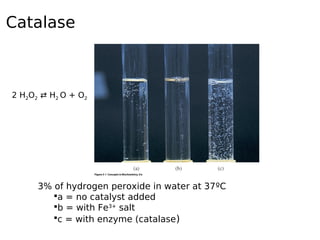
Catalase 
2 H2O2 ⇄ H2 O + O2 
3% of hydrogen peroxide in water at 37ºC 
a = no catalyst added 
b = with Fe3+ salt 
c = with enzyme (catalase)
Hydrogen peroxide 
• Hydrogen peroxide is a waste product of 
metabolism, and if it left in the cell, it would 
initiate the formation of free radical
Activation energy 
• The amount of energy that must be acquired by 
reactant molecules before they can be 
converted to a product 
• It shows the intermediate stages of a reaction, 
those between the initial and final states. 
• It directly affects the rate of reactions. 
• It speeds up a reaction by changing the 
mechanism and thus lowering the activation 
energy
Continue
Continue 
• Plots the energies for an 
exergonic, spontaneous 
reaction, such as the 
complete oxidation of 
glucose. At the maximum of 
the curve connecting the 
reactants and the products 
lies the transition state with 
the necessary amount of 
energy and the correct 
arrangement of atoms to 
produce products.
Continue 
• The activation energy can also be seen as 
the amount of free energy required to 
bring the reactants to the transition state. 
• The change in energy corresponds to the 
change in elevation, and the progress of 
the reaction corresponds to the distance 
traveled
Continue 
• Considerable effort has gone into 
elucidating the intermediate stages in 
reactions of interest chemists and 
biochemists and determining the pathway 
or reaction mechanism that lies between 
the initial and final states. 
• Reaction dynamics, the study of the 
intermediate stages of reaction mechanism, 
is currently a very active field of research
Enzymes and substrates 
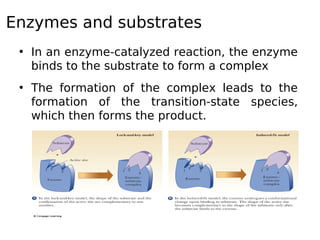
• In an enzyme-catalyzed reaction, the enzyme 
binds to the substrate to form a complex 
• The formation of the complex leads to the 
formation of the transition-state species, 
which then forms the product.
Enzymes-substrate binding 
• In an enzyme-catalyzed reaction 
– Substrate, S (a reactant) 
– Active site: the small portion of the enzyme 
surface where the substrate(s) becomes 
bound by noncovalent forces, e.g., 
hydrogen bonding, electrostatic attractions, 
van der Waals attractions 
E + S ES 
enzyme­substrate 
complex
Lock and Key Model 
• 1890 as envisioned by Emil Fischer 
• The enzyme active site (lock) is able to accept only 
specific type of substrate (key)
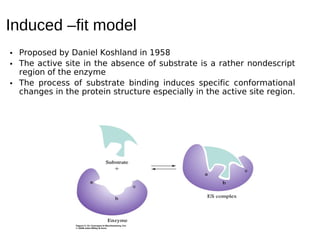
Induced –fit model 
• Proposed by Daniel Koshland in 1958 
• The active site in the absence of substrate is a rather nondescript 
region of the enzyme 
• The process of substrate binding induces specific conformational 
changes in the protein structure especially in the active site region.
Continue 
• The final shape and charge characteristics 
of the active site are not in place until the 
substrate is completely bound.
Enzyme Assay 
• The amount of product formed in a given time 
period. 
• The concentration of enzyme in a test sample 
can be determined by comparing its activity 
to a standard curve.

Enzymes

  • 1.
  • 2.
    Lecture outlines •Catalysis •Activation energy & its profile •Enzyme & substrate •How enzymes bind to substrates •Lock & Key model •Induced-fit model •Enzyme assay
  • 3.
    Lecture outcomes •At the end of this lecture, students are able to: • Define the catalyst • Understand how enzymes work as catalysts, the concept of activation energy and enzymes-substrate binding • Explain different theories of the relation between enzymes and substrates
  • 4.
    Catalysis • Itis probably the most important function of all proteins • Most reactions in biological systems would take place far too slowly in the absence of catalyst • The catalysts that serve this function in organisms are called enzymes • All other enzymes are globular proteins (with the exception of some RNAs (ribozymes) that have catalytic activity)
  • 5.
    Continue • Enzymescan increase the rate of a reaction by factor of up to 1020 over uncatalyzed reactions • Non-enzymatic catalysts typically enhance the rate of the reaction by factors of 102 to 104 • Catalysts are substances that speed up the rate of a chemical reaction • Biocatalysts or enzymes are biological catalysts that speed up the metabolic reactions that occur in the body
  • 6.
    Catalase 2 H2O2⇄ H2 O + O2 3% of hydrogen peroxide in water at 37ºC a = no catalyst added b = with Fe3+ salt c = with enzyme (catalase)
  • 7.
    Hydrogen peroxide •Hydrogen peroxide is a waste product of metabolism, and if it left in the cell, it would initiate the formation of free radical
  • 8.
    Activation energy •The amount of energy that must be acquired by reactant molecules before they can be converted to a product • It shows the intermediate stages of a reaction, those between the initial and final states. • It directly affects the rate of reactions. • It speeds up a reaction by changing the mechanism and thus lowering the activation energy
  • 9.
  • 10.
    Continue • Plotsthe energies for an exergonic, spontaneous reaction, such as the complete oxidation of glucose. At the maximum of the curve connecting the reactants and the products lies the transition state with the necessary amount of energy and the correct arrangement of atoms to produce products.
  • 11.
    Continue • Theactivation energy can also be seen as the amount of free energy required to bring the reactants to the transition state. • The change in energy corresponds to the change in elevation, and the progress of the reaction corresponds to the distance traveled
  • 12.
    Continue • Considerableeffort has gone into elucidating the intermediate stages in reactions of interest chemists and biochemists and determining the pathway or reaction mechanism that lies between the initial and final states. • Reaction dynamics, the study of the intermediate stages of reaction mechanism, is currently a very active field of research
  • 13.
    Enzymes and substrates • In an enzyme-catalyzed reaction, the enzyme binds to the substrate to form a complex • The formation of the complex leads to the formation of the transition-state species, which then forms the product.
  • 14.
    Enzymes-substrate binding •In an enzyme-catalyzed reaction – Substrate, S (a reactant) – Active site: the small portion of the enzyme surface where the substrate(s) becomes bound by noncovalent forces, e.g., hydrogen bonding, electrostatic attractions, van der Waals attractions E + S ES enzyme­substrate complex
  • 15.
    Lock and KeyModel • 1890 as envisioned by Emil Fischer • The enzyme active site (lock) is able to accept only specific type of substrate (key)
  • 16.
    Induced –fit model • Proposed by Daniel Koshland in 1958 • The active site in the absence of substrate is a rather nondescript region of the enzyme • The process of substrate binding induces specific conformational changes in the protein structure especially in the active site region.
  • 17.
    Continue • Thefinal shape and charge characteristics of the active site are not in place until the substrate is completely bound.
  • 18.
    Enzyme Assay •The amount of product formed in a given time period. • The concentration of enzyme in a test sample can be determined by comparing its activity to a standard curve.