

ENZYME INHIBITION
Dipesh Tamrakar
M.Sc. Clinical Biochemistry
1
Enzyme inhibition
 The chemical substances (organic or inorganic) which interfere with
enzyme activity are called as inhibitors (negative modifier)
 the process is called as enzyme inhibition.
 Interaction between an inhibitor and enzyme depends on : protein
structure, ligand binding (H bond, electrostatic interactions,
Hydrophobic interactions and van der waals forces)
 3 broad categories: (based on recovery after removal of inhibitor)
1. Reversible inhibition
2. Irreversible inhibition
3. Allosteric inhibition
2
 Combine non-covalently with the enzyme
 rapid dissociation of EI complex
 Can be readily removed by dialysis
 fully active Enzyme can be recovered after removal of Inhibitor.
 Reversible inhibitions are further classified as:
1. Competitive inhibition
2. Non-competitive inhibition
3. Un-competitive inhibition
Reversible inhibition
3
Competitive inhibitions
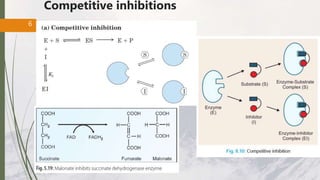
 When the active site or catalytic site of an enzyme is occupied by a
substance other than the substrate of that enzyme, its activity is
inhibited. The type of inhibition of this kind is known as competitive
inhibition.
 This is a type of reversible inhibition. (excess substrate abolishes the
inhibition)
 In such inhibition both the ES and EI (Enzyme-Inhibitor) complexes
are formed during the reaction.
 However, the actual amounts of ES and EI will depend on:
1. Affinity between enzyme and substrate/inhibitor,
2. Actual concentrations (amounts) of substrate and inhibitor present,
and
3. Time of preincubation of enzyme with the substrate or inhibitor.
4
Competitive inhibitions
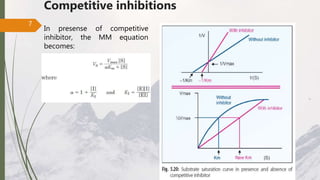
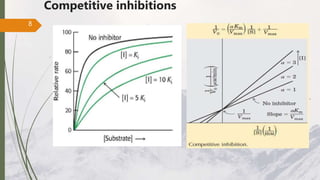
 with the increase in conc. of inhibitor lowers the rate of enzymatic
reaction. Thus, the Km is high, but Vmax is the same in competitive
inhibition.
 However, when the concentration of substrate is increased, the effect
of inhibitor can be reversed forcing it out from EI complex.
 Since effective concentration of enzyme is reduced, the reaction
velocity is decreased.
 In competitive inhibition, the inhibitor will be a structural analog of
the substrate. There will be similarity in three-dimensional structure
between substrate (S) and inhibitor (I). For example, the succinate
dehydrogenase reaction is inhibited by malonate
5
Competitive inhibitions
6
Competitive inhibitions
In presense of competitive
inhibitor, the MM equation
becomes:
7
Competitive inhibitions
8
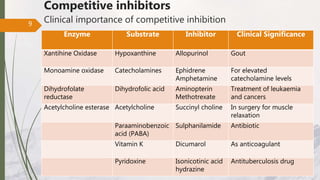
Competitive inhibitors
Clinical importance of competitive inhibition
Enzyme Substrate Inhibitor Clinical Significance
Xantihine Oxidase Hypoxanthine Allopurinol Gout
Monoamine oxidase Catecholamines Ephidrene
Amphetamine
For elevated
catecholamine levels
Dihydrofolate
reductase
Dihydrofolic acid Aminopterin
Methotrexate
Treatment of leukaemia
and cancers
Acetylcholine esterase Acetylcholine Succinyl choline In surgery for muscle
relaxation
Paraaminobenzoic
acid (PABA)
Sulphanilamide Antibiotic
Vitamin K Dicumarol As anticoagulant
Pyridoxine Isonicotinic acid
hydrazine
Antituberculosis drug
9
Competitive inhibitors
Clinical importance of competitive inhibition
Ethanol:
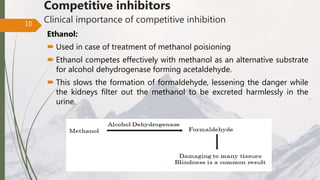
 Used in case of treatment of methanol poisioning
 Ethanol competes effectively with methanol as an alternative substrate
for alcohol dehydrogenase forming acetaldehyde.
 This slows the formation of formaldehyde, lessening the danger while
the kidneys filter out the methanol to be excreted harmlessly in the
urine.
10
Competitive inhibitors
Clinical importance of competitive inhibition
Allopurinol:
 Allopurinol structurally resembles hypoxanthine
 By competitive inhibition, the drug inhibits the enzyme xanthine oxidase thus
reducing uric acid formation by preventing the oxidation of hypoxanthine
 treatment of Gout
Sulfonamides:
 Structural analog of Para-aminobenzoic acid (PABA) which is essential for
synthesis of folic acid by the enzyme action.
 Folic acid is needed for bacterial growth and survival.
 Competitively inhibit folic acid synthesis in bacterial
.
11
Competitive inhibitors
Clinical importance of competitive inhibition
MAO inhibitors:
 The enzyme Monoamine oxidase (MAO) oxidises pressor amines
catecholamines, e.g. epinephrine and norepinephrine.
 Drugs Ephedrine and Amphetamine structurally resemble catecholamines.
Thus, when administered they can competitively inhibit the enzyme “MAO”
and prolong the action of pressor amines.
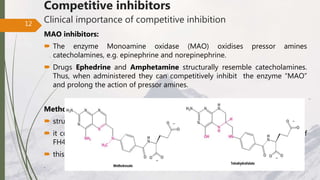
Methotrexate:
 structural analog of folic acid
 it competitively inhibits “folate reductase” enzyme and prevents formation of
FH4, (that is essential of DNA synthesis and cell division)
 this drug is used for cancer therapy
.
12
Competitive inhibitors
Clinical importance of competitive inhibition
Dicoumarol:
 is structurally similar to vitamin K
 can act as an anticoagulant by competitively inhibiting vitamin K.
Succinylcholine:
 It is used as a muscle relaxant.
 Succinylcholine is structurally similar to acetylcholine.
 It competitively fixes on post-synaptic receptors.
 As it is not hydrolysed easily by the enzyme acetylcholinesterase, produces
continued depolarisation with consequent muscle relaxation.
13
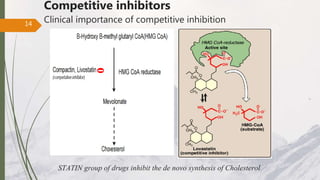
Competitive inhibitors
Clinical importance of competitive inhibition
STATIN group of drugs inhibit the de novo synthesis of Cholesterol
14
Non-Competitive inhibition
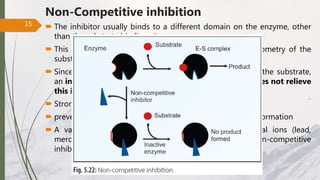
 The inhibitor usually binds to a different domain on the enzyme, other
than the substrate binding site.
 This occurs when the substances not resembling the geometry of the
substrate & do not exhibit mutual competition.
 Since these inhibitors have no structural resemblance to the substrate,
an increase in the substrate concentration generally does not relieve
this inhibition.
 Strong affinity for inhibitors
 prevent catalysis possibly due to distortion in enzyme conformation
 A variety of poisons, such as iodoacetate, heavy metal ions (lead,
mercury) and oxidizing agents act as irreversible non-competitive
inhibitors.
15
Non-Competitive inhibition
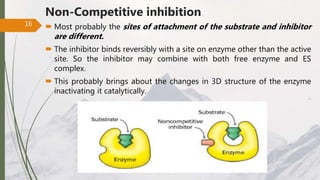
 Most probably the sites of attachment of the substrate and inhibitor
are different.
 The inhibitor binds reversibly with a site on enzyme other than the active
site. So the inhibitor may combine with both free enzyme and ES
complex.
 This probably brings about the changes in 3D structure of the enzyme
inactivating it catalytically.
16
Non-Competitive inhibition
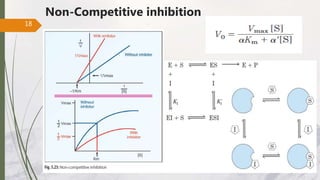
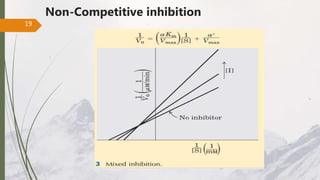
 The velocity (Vmax) is reduced. But Km value is not changed, because the
remaining enzyme molecules have the same affinity for the substrate.
 However, the kinetic properties in case of both are the same.
 If the inhibitor can be removed from its site of binding without affecting the
activity of the enzyme, it is called as Reversible-Non-competitive
Inhibition.
 If the inhibitor can be removed only at the loss of enzymatic activity, it is
known as Irreversible Non-competitive Inhibition.
 The inhibitor combines with the enzymes by forming a covalent bond and
then the reaction becomes irreversible.
17
Non-Competitive inhibition
18
Non-Competitive inhibition
19
Non- Competitive inhibitors
Clinical importance of non-competitive inhibition
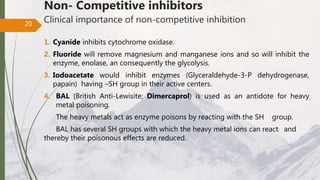
1. Cyanide inhibits cytochrome oxidase.
2. Fluoride will remove magnesium and manganese ions and so will inhibit the
enzyme, enolase, an consequently the glycolysis.
3. Iodoacetate would inhibit enzymes (Glyceraldehyde-3-P dehydrogenase,
papain) having –SH group in their active centers.
4. BAL (British Anti-Lewisite; Dimercaprol) is used as an antidote for heavy
metal poisoning.
The heavy metals act as enzyme poisons by reacting with the SH group.
BAL has several SH groups with which the heavy metal ions can react and
thereby their poisonous effects are reduced.
20
Non- Competitive inhibitors
Clinical importance of non-competitive inhibition
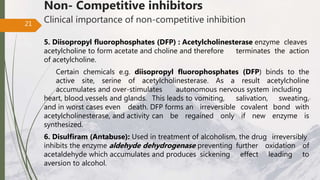
5. Diisopropyl fluorophosphates (DFP) : Acetylcholinesterase enzyme cleaves
acetylcholine to form acetate and choline and therefore terminates the action
of acetylcholine.
Certain chemicals e.g. diisopropyl fluorophosphates (DFP) binds to the
active site, serine of acetylcholinesterase. As a result acetylcholine
accumulates and over-stimulates autonomous nervous system including
heart, blood vessels and glands. This leads to vomiting, salivation, sweating,
and in worst cases even death. DFP forms an irreversible covalent bond with
acetylcholinesterase, and activity can be regained only if new enzyme is
synthesized.
6. Disulfiram (Antabuse): Used in treatment of alcoholism, the drug irreversibly
inhibits the enzyme aldehyde dehydrogenase preventing further oxidation of
acetaldehyde which accumulates and produces sickening effect leading to
aversion to alcohol.
21
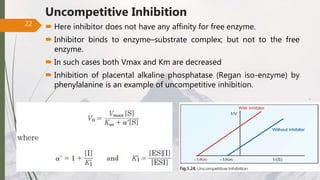
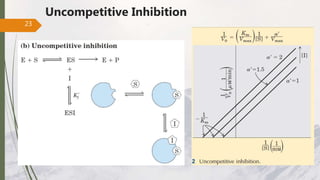
Uncompetitive Inhibition
 Here inhibitor does not have any affinity for free enzyme.
 Inhibitor binds to enzyme–substrate complex; but not to the free
enzyme.
 In such cases both Vmax and Km are decreased
 Inhibition of placental alkaline phosphatase (Regan iso-enzyme) by
phenylalanine is an example of uncompetitive inhibition.
22
Uncompetitive Inhibition
23
Irreversible inhibition
 bind to enzymes very tightly through covalent or non-covalent bonds.
 Combine with the functional groups of the amino acids in the active site,
irreversibly
 Irreversible inhibition occurs when an inhibited enzyme does not regain
activity on dilution of the enzyme-inhibitor complex.
 slow dissociation of EI complex
 Since these covalent changes are relatively stable, an enzyme that has been
“poisoned” by an irreversible inhibitor remains inhibited even after removal of
the remaining inhibitor from the surrounding medium.
 Irreversible inactivation by covalent bonding of inhibitor and enzyme
 Inhibitors are usually toxic substances like OP poisons
 Eg: Iodoacetate; inhibitor of papain and glyceraldehyde 3 phosphate
dehydrogenase.
 Diisopropyl flurorphoshate (DFP) binds with enzymes containing serine at the
active site like serine proteases, acetylcholine esterase
24
Irreversible inhibitors
 Types:
Can be divided as:
1. Group specific reagents/ inhibitors
eg. Diisopropyl phosphofluoridate
iodoacetamide
2. Affinity label molecules (substrate analoge)
eg. tosyl-L- phenylalaninechorlmethyl ketone
3 bromoacetol phosphate
3. Suicide inhibitors
eg. N,N dimethyl propargylamine
25
Irreversible inhibition
1. Group specific reagents/ inhibitors
 Only react with specific side chain of amino acid
 Inhibit an enzyme by covalently modifying a crucial amino acid residue
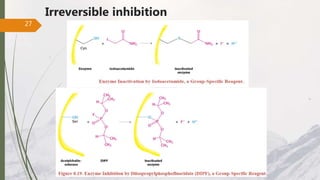
 eg. Iodoacetamide Iodoacetamide:
Inhibit an enzyme by covalently modifying a Cysteine residue
Diisopropyl phosphofluoridate (DIPF)
Inhibit an enzyme by covalently modifying a serine residue
26
Irreversible inhibition
27
Irreversible inhibition
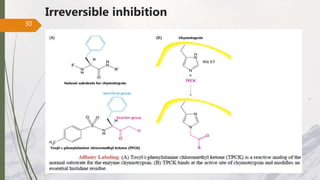
2. Affinity label molecules (substrate analoge)
 are structurally similar to the substrate for the enzyme
 They typically modify the catalytic residue covalently, thereby inhibiting the
enzyme function
 They are thus more specific for the enzyme active site than are group-
specific reagents
eg.
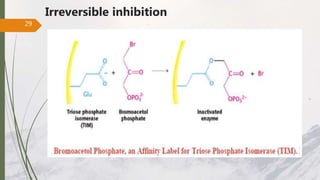
 3 bromoacetol phosphate:
Substrate analog of Dihydroxy acetonephosphate (DHAP)
Tosyl-L- phenylalanine chorlmethyl ketone (TPCK)
substrate analog for chymotrypsin
28
Irreversible inhibition
29
Irreversible inhibition
30
Irreversible inhibition
3. Suicide inhibition
 It is a special type of irreversible inhibition of enzyme activity
 Relatively unreactive until they bind to the active site of a specific enzyme
 A suicide inactivator undergoes the first few chemical steps of the normal
enzymatic reaction,
 but instead of being transformed into the normal product, inactivator is
converted to a very reactive compound that combines irreversibly with the
enzyme
 They hijack the normal enzyme reaction mechanism to inactivate the enzyme
(mechanism based inactivation)
 Significant role in rational drug design
31
Suicide Inhibition
Clinical importance of Suicide Inhibition
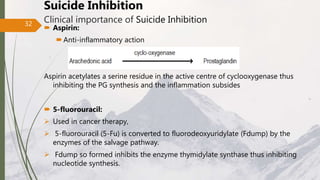
 Aspirin:
Anti-inflammatory action
Aspirin acetylates a serine residue in the active centre of cyclooxygenase thus
inhibiting the PG synthesis and the inflammation subsides
 5-fluorouracil:
 Used in cancer therapy,
 5-fluorouracil (5-Fu) is converted to fluorodeoxyuridylate (Fdump) by the
enzymes of the salvage pathway.
 Fdump so formed inhibits the enzyme thymidylate synthase thus inhibiting
nucleotide synthesis.
32
Suicide Inhibition
Clinical importance of Suicide Inhibition
 Difluoromethylornithine (DFMO)
Ornithine decarboxylase (ODC) catalyzes the conversion of ornithine to
putrescine which is necessary for polyamine synthesis
When the ODC in trypanosoma is inhibited ; multiplication of the parasite is
arrested.
Therefore inhibitors of ODC enzyme such as difluoromethylornithine
(DFMO) has been found to be effective against trypanosomiasis (sleeping
sickness).
DFMO is initially inert, but on binding with the enzyme, forms irreversible
covalent complex with the co-enzyme (pyridoxal phosphate) and the amino
acid residues of the enzyme.
In mammalian cells, the turnover rate of ODC is very high, and so the
inhibition by DFMO is only transient. So DFMO kills the parasites with no
side effects to the patient.
33
Suicide Inhibition
Clinical importance of Suicide Inhibition
 Allopurinol:
The best example of suicide inhibition.
The drug is used in treatment of gout, as it inhibits the enzyme xanthine
oxidase thus decreasing the uric acid formation.
 allopurinol gets oxidised by the enzyme xanthine oxidase itself to form
“alloxanthine” a more potent effective and stronger inhibitor of xanthine
oxidase thus potentiating the action of allopurinol
34
ENZYME INHIBITION
TRANSITION-STATE INHIBITION
 The transition state is unstable state so that direct measurement of the
binding interaction between this species and the enzyme is impossible.
 In some cases, stable molecules can be designed that resemble
transition states- called transition-state analogs.
 They bind to an enzyme more tightly than the substrate binds in the
ES complex
 they fit into the active site than the substrate itself.
 Eg.
Isomerization of L-proline to D-proline by proline racemase
Penicillin
35
ENZYME INHIBITION
TRANSITION-STATE INHIBITION
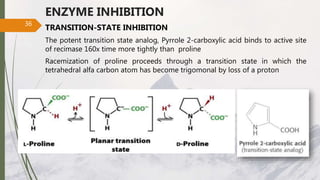
The potent transition state analog, Pyrrole 2-carboxylic acid binds to active site
of recimase 160x time more tightly than proline
Racemization of proline proceeds through a transition state in which the
tetrahedral alfa carbon atom has become trigomonal by loss of a proton
36
ENZYME INHIBITION
TRANSITION-STATE INHIBITION – PENICILLIN
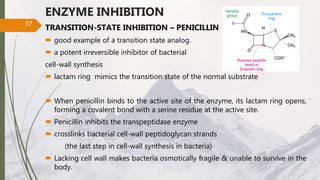
 good example of a transition state analog.
 a potent irreversible inhibitor of bacterial
cell-wall synthesis
 lactam ring mimics the transition state of the normal substrate
 When penicillin binds to the active site of the enzyme, its lactam ring opens,
forming a covalent bond with a serine residue at the active site.
 Penicillin inhibits the transpeptidase enzyme
 crosslinks bacterial cell-wall peptidoglycan strands
(the last step in cell-wall synthesis in bacteria)
 Lacking cell wall makes bacteria osmotically fragile & unable to survive in the
body.
37
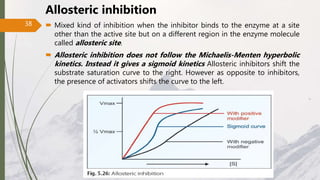
Allosteric inhibition
 Mixed kind of inhibition when the inhibitor binds to the enzyme at a site
other than the active site but on a different region in the enzyme molecule
called allosteric site.
 Allosteric inhibition does not follow the Michaelis-Menten hyperbolic
kinetics. Instead it gives a sigmoid kinetics Allosteric inhibitors shift the
substrate saturation curve to the right. However as opposite to inhibitors,
the presence of activators shifts the curve to the left.
38
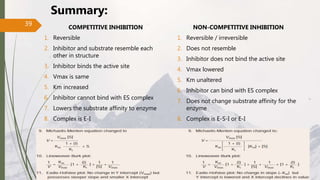
Summary:
COMPETITIVE INHIBITION
1. Reversible
2. Inhibitor and substrate resemble each
other in structure
3. Inhibitor binds the active site
4. Vmax is same
5. Km increased
6. Inhibitor cannot bind with ES complex
7. Lowers the substrate affinity to enzyme
8. Complex is E-I
NON-COMPETITIVE INHIBITION
1. Reversible / irreversible
2. Does not resemble
3. Inhibitor does not bind the active site
4. Vmax lowered
5. Km unaltered
6. Inhibitor can bind with ES complex
7. Does not change substrate affinity for the
enzyme
8. Complex is E-S-I or E-I
39
40

Enzyme inhibition

  • 1.
  • 2.
    Enzyme inhibition  Thechemical substances (organic or inorganic) which interfere with enzyme activity are called as inhibitors (negative modifier)  the process is called as enzyme inhibition.  Interaction between an inhibitor and enzyme depends on : protein structure, ligand binding (H bond, electrostatic interactions, Hydrophobic interactions and van der waals forces)  3 broad categories: (based on recovery after removal of inhibitor) 1. Reversible inhibition 2. Irreversible inhibition 3. Allosteric inhibition 2
  • 3.
     Combine non-covalentlywith the enzyme  rapid dissociation of EI complex  Can be readily removed by dialysis  fully active Enzyme can be recovered after removal of Inhibitor.  Reversible inhibitions are further classified as: 1. Competitive inhibition 2. Non-competitive inhibition 3. Un-competitive inhibition Reversible inhibition 3
  • 4.
    Competitive inhibitions  Whenthe active site or catalytic site of an enzyme is occupied by a substance other than the substrate of that enzyme, its activity is inhibited. The type of inhibition of this kind is known as competitive inhibition.  This is a type of reversible inhibition. (excess substrate abolishes the inhibition)  In such inhibition both the ES and EI (Enzyme-Inhibitor) complexes are formed during the reaction.  However, the actual amounts of ES and EI will depend on: 1. Affinity between enzyme and substrate/inhibitor, 2. Actual concentrations (amounts) of substrate and inhibitor present, and 3. Time of preincubation of enzyme with the substrate or inhibitor. 4
  • 5.
    Competitive inhibitions  withthe increase in conc. of inhibitor lowers the rate of enzymatic reaction. Thus, the Km is high, but Vmax is the same in competitive inhibition.  However, when the concentration of substrate is increased, the effect of inhibitor can be reversed forcing it out from EI complex.  Since effective concentration of enzyme is reduced, the reaction velocity is decreased.  In competitive inhibition, the inhibitor will be a structural analog of the substrate. There will be similarity in three-dimensional structure between substrate (S) and inhibitor (I). For example, the succinate dehydrogenase reaction is inhibited by malonate 5
  • 6.
  • 7.
    Competitive inhibitions In presenseof competitive inhibitor, the MM equation becomes: 7
  • 8.
  • 9.
    Competitive inhibitors Clinical importanceof competitive inhibition Enzyme Substrate Inhibitor Clinical Significance Xantihine Oxidase Hypoxanthine Allopurinol Gout Monoamine oxidase Catecholamines Ephidrene Amphetamine For elevated catecholamine levels Dihydrofolate reductase Dihydrofolic acid Aminopterin Methotrexate Treatment of leukaemia and cancers Acetylcholine esterase Acetylcholine Succinyl choline In surgery for muscle relaxation Paraaminobenzoic acid (PABA) Sulphanilamide Antibiotic Vitamin K Dicumarol As anticoagulant Pyridoxine Isonicotinic acid hydrazine Antituberculosis drug 9
  • 10.
    Competitive inhibitors Clinical importanceof competitive inhibition Ethanol:  Used in case of treatment of methanol poisioning  Ethanol competes effectively with methanol as an alternative substrate for alcohol dehydrogenase forming acetaldehyde.  This slows the formation of formaldehyde, lessening the danger while the kidneys filter out the methanol to be excreted harmlessly in the urine. 10
  • 11.
    Competitive inhibitors Clinical importanceof competitive inhibition Allopurinol:  Allopurinol structurally resembles hypoxanthine  By competitive inhibition, the drug inhibits the enzyme xanthine oxidase thus reducing uric acid formation by preventing the oxidation of hypoxanthine  treatment of Gout Sulfonamides:  Structural analog of Para-aminobenzoic acid (PABA) which is essential for synthesis of folic acid by the enzyme action.  Folic acid is needed for bacterial growth and survival.  Competitively inhibit folic acid synthesis in bacterial . 11
  • 12.
    Competitive inhibitors Clinical importanceof competitive inhibition MAO inhibitors:  The enzyme Monoamine oxidase (MAO) oxidises pressor amines catecholamines, e.g. epinephrine and norepinephrine.  Drugs Ephedrine and Amphetamine structurally resemble catecholamines. Thus, when administered they can competitively inhibit the enzyme “MAO” and prolong the action of pressor amines. Methotrexate:  structural analog of folic acid  it competitively inhibits “folate reductase” enzyme and prevents formation of FH4, (that is essential of DNA synthesis and cell division)  this drug is used for cancer therapy . 12
  • 13.
    Competitive inhibitors Clinical importanceof competitive inhibition Dicoumarol:  is structurally similar to vitamin K  can act as an anticoagulant by competitively inhibiting vitamin K. Succinylcholine:  It is used as a muscle relaxant.  Succinylcholine is structurally similar to acetylcholine.  It competitively fixes on post-synaptic receptors.  As it is not hydrolysed easily by the enzyme acetylcholinesterase, produces continued depolarisation with consequent muscle relaxation. 13
  • 14.
    Competitive inhibitors Clinical importanceof competitive inhibition STATIN group of drugs inhibit the de novo synthesis of Cholesterol 14
  • 15.
    Non-Competitive inhibition  Theinhibitor usually binds to a different domain on the enzyme, other than the substrate binding site.  This occurs when the substances not resembling the geometry of the substrate & do not exhibit mutual competition.  Since these inhibitors have no structural resemblance to the substrate, an increase in the substrate concentration generally does not relieve this inhibition.  Strong affinity for inhibitors  prevent catalysis possibly due to distortion in enzyme conformation  A variety of poisons, such as iodoacetate, heavy metal ions (lead, mercury) and oxidizing agents act as irreversible non-competitive inhibitors. 15
  • 16.
    Non-Competitive inhibition  Mostprobably the sites of attachment of the substrate and inhibitor are different.  The inhibitor binds reversibly with a site on enzyme other than the active site. So the inhibitor may combine with both free enzyme and ES complex.  This probably brings about the changes in 3D structure of the enzyme inactivating it catalytically. 16
  • 17.
    Non-Competitive inhibition  Thevelocity (Vmax) is reduced. But Km value is not changed, because the remaining enzyme molecules have the same affinity for the substrate.  However, the kinetic properties in case of both are the same.  If the inhibitor can be removed from its site of binding without affecting the activity of the enzyme, it is called as Reversible-Non-competitive Inhibition.  If the inhibitor can be removed only at the loss of enzymatic activity, it is known as Irreversible Non-competitive Inhibition.  The inhibitor combines with the enzymes by forming a covalent bond and then the reaction becomes irreversible. 17
  • 18.
  • 19.
  • 20.
    Non- Competitive inhibitors Clinicalimportance of non-competitive inhibition 1. Cyanide inhibits cytochrome oxidase. 2. Fluoride will remove magnesium and manganese ions and so will inhibit the enzyme, enolase, an consequently the glycolysis. 3. Iodoacetate would inhibit enzymes (Glyceraldehyde-3-P dehydrogenase, papain) having –SH group in their active centers. 4. BAL (British Anti-Lewisite; Dimercaprol) is used as an antidote for heavy metal poisoning. The heavy metals act as enzyme poisons by reacting with the SH group. BAL has several SH groups with which the heavy metal ions can react and thereby their poisonous effects are reduced. 20
  • 21.
    Non- Competitive inhibitors Clinicalimportance of non-competitive inhibition 5. Diisopropyl fluorophosphates (DFP) : Acetylcholinesterase enzyme cleaves acetylcholine to form acetate and choline and therefore terminates the action of acetylcholine. Certain chemicals e.g. diisopropyl fluorophosphates (DFP) binds to the active site, serine of acetylcholinesterase. As a result acetylcholine accumulates and over-stimulates autonomous nervous system including heart, blood vessels and glands. This leads to vomiting, salivation, sweating, and in worst cases even death. DFP forms an irreversible covalent bond with acetylcholinesterase, and activity can be regained only if new enzyme is synthesized. 6. Disulfiram (Antabuse): Used in treatment of alcoholism, the drug irreversibly inhibits the enzyme aldehyde dehydrogenase preventing further oxidation of acetaldehyde which accumulates and produces sickening effect leading to aversion to alcohol. 21
  • 22.
    Uncompetitive Inhibition  Hereinhibitor does not have any affinity for free enzyme.  Inhibitor binds to enzyme–substrate complex; but not to the free enzyme.  In such cases both Vmax and Km are decreased  Inhibition of placental alkaline phosphatase (Regan iso-enzyme) by phenylalanine is an example of uncompetitive inhibition. 22
  • 23.
  • 24.
    Irreversible inhibition  bindto enzymes very tightly through covalent or non-covalent bonds.  Combine with the functional groups of the amino acids in the active site, irreversibly  Irreversible inhibition occurs when an inhibited enzyme does not regain activity on dilution of the enzyme-inhibitor complex.  slow dissociation of EI complex  Since these covalent changes are relatively stable, an enzyme that has been “poisoned” by an irreversible inhibitor remains inhibited even after removal of the remaining inhibitor from the surrounding medium.  Irreversible inactivation by covalent bonding of inhibitor and enzyme  Inhibitors are usually toxic substances like OP poisons  Eg: Iodoacetate; inhibitor of papain and glyceraldehyde 3 phosphate dehydrogenase.  Diisopropyl flurorphoshate (DFP) binds with enzymes containing serine at the active site like serine proteases, acetylcholine esterase 24
  • 25.
    Irreversible inhibitors  Types: Canbe divided as: 1. Group specific reagents/ inhibitors eg. Diisopropyl phosphofluoridate iodoacetamide 2. Affinity label molecules (substrate analoge) eg. tosyl-L- phenylalaninechorlmethyl ketone 3 bromoacetol phosphate 3. Suicide inhibitors eg. N,N dimethyl propargylamine 25
  • 26.
    Irreversible inhibition 1. Groupspecific reagents/ inhibitors  Only react with specific side chain of amino acid  Inhibit an enzyme by covalently modifying a crucial amino acid residue  eg. Iodoacetamide Iodoacetamide: Inhibit an enzyme by covalently modifying a Cysteine residue Diisopropyl phosphofluoridate (DIPF) Inhibit an enzyme by covalently modifying a serine residue 26
  • 27.
  • 28.
    Irreversible inhibition 2. Affinitylabel molecules (substrate analoge)  are structurally similar to the substrate for the enzyme  They typically modify the catalytic residue covalently, thereby inhibiting the enzyme function  They are thus more specific for the enzyme active site than are group- specific reagents eg.  3 bromoacetol phosphate: Substrate analog of Dihydroxy acetonephosphate (DHAP) Tosyl-L- phenylalanine chorlmethyl ketone (TPCK) substrate analog for chymotrypsin 28
  • 29.
  • 30.
  • 31.
    Irreversible inhibition 3. Suicideinhibition  It is a special type of irreversible inhibition of enzyme activity  Relatively unreactive until they bind to the active site of a specific enzyme  A suicide inactivator undergoes the first few chemical steps of the normal enzymatic reaction,  but instead of being transformed into the normal product, inactivator is converted to a very reactive compound that combines irreversibly with the enzyme  They hijack the normal enzyme reaction mechanism to inactivate the enzyme (mechanism based inactivation)  Significant role in rational drug design 31
  • 32.
    Suicide Inhibition Clinical importanceof Suicide Inhibition  Aspirin: Anti-inflammatory action Aspirin acetylates a serine residue in the active centre of cyclooxygenase thus inhibiting the PG synthesis and the inflammation subsides  5-fluorouracil:  Used in cancer therapy,  5-fluorouracil (5-Fu) is converted to fluorodeoxyuridylate (Fdump) by the enzymes of the salvage pathway.  Fdump so formed inhibits the enzyme thymidylate synthase thus inhibiting nucleotide synthesis. 32
  • 33.
    Suicide Inhibition Clinical importanceof Suicide Inhibition  Difluoromethylornithine (DFMO) Ornithine decarboxylase (ODC) catalyzes the conversion of ornithine to putrescine which is necessary for polyamine synthesis When the ODC in trypanosoma is inhibited ; multiplication of the parasite is arrested. Therefore inhibitors of ODC enzyme such as difluoromethylornithine (DFMO) has been found to be effective against trypanosomiasis (sleeping sickness). DFMO is initially inert, but on binding with the enzyme, forms irreversible covalent complex with the co-enzyme (pyridoxal phosphate) and the amino acid residues of the enzyme. In mammalian cells, the turnover rate of ODC is very high, and so the inhibition by DFMO is only transient. So DFMO kills the parasites with no side effects to the patient. 33
  • 34.
    Suicide Inhibition Clinical importanceof Suicide Inhibition  Allopurinol: The best example of suicide inhibition. The drug is used in treatment of gout, as it inhibits the enzyme xanthine oxidase thus decreasing the uric acid formation.  allopurinol gets oxidised by the enzyme xanthine oxidase itself to form “alloxanthine” a more potent effective and stronger inhibitor of xanthine oxidase thus potentiating the action of allopurinol 34
  • 35.
    ENZYME INHIBITION TRANSITION-STATE INHIBITION The transition state is unstable state so that direct measurement of the binding interaction between this species and the enzyme is impossible.  In some cases, stable molecules can be designed that resemble transition states- called transition-state analogs.  They bind to an enzyme more tightly than the substrate binds in the ES complex  they fit into the active site than the substrate itself.  Eg. Isomerization of L-proline to D-proline by proline racemase Penicillin 35
  • 36.
    ENZYME INHIBITION TRANSITION-STATE INHIBITION Thepotent transition state analog, Pyrrole 2-carboxylic acid binds to active site of recimase 160x time more tightly than proline Racemization of proline proceeds through a transition state in which the tetrahedral alfa carbon atom has become trigomonal by loss of a proton 36
  • 37.
    ENZYME INHIBITION TRANSITION-STATE INHIBITION– PENICILLIN  good example of a transition state analog.  a potent irreversible inhibitor of bacterial cell-wall synthesis  lactam ring mimics the transition state of the normal substrate  When penicillin binds to the active site of the enzyme, its lactam ring opens, forming a covalent bond with a serine residue at the active site.  Penicillin inhibits the transpeptidase enzyme  crosslinks bacterial cell-wall peptidoglycan strands (the last step in cell-wall synthesis in bacteria)  Lacking cell wall makes bacteria osmotically fragile & unable to survive in the body. 37
  • 38.
    Allosteric inhibition  Mixedkind of inhibition when the inhibitor binds to the enzyme at a site other than the active site but on a different region in the enzyme molecule called allosteric site.  Allosteric inhibition does not follow the Michaelis-Menten hyperbolic kinetics. Instead it gives a sigmoid kinetics Allosteric inhibitors shift the substrate saturation curve to the right. However as opposite to inhibitors, the presence of activators shifts the curve to the left. 38
  • 39.
    Summary: COMPETITIVE INHIBITION 1. Reversible 2.Inhibitor and substrate resemble each other in structure 3. Inhibitor binds the active site 4. Vmax is same 5. Km increased 6. Inhibitor cannot bind with ES complex 7. Lowers the substrate affinity to enzyme 8. Complex is E-I NON-COMPETITIVE INHIBITION 1. Reversible / irreversible 2. Does not resemble 3. Inhibitor does not bind the active site 4. Vmax lowered 5. Km unaltered 6. Inhibitor can bind with ES complex 7. Does not change substrate affinity for the enzyme 8. Complex is E-S-I or E-I 39
  • 40.

Editor's Notes

  • #3 decrease in catalytic activity of that enzyme resulting to either slowing or halting of reaction
  • #5 A competitive inhibitor and substrate exert reciprocal effects on the concentration of the EI and ES complexes. Since binding substrate removes free enzyme available to combine with inhibitor, increasing the [S] decreases the concentration of the EI complex and raises the reaction velocity. The extent to which [S] must be increased to completely overcome the inhibition depends upon the concentration of inhibitor present, its affinity for the enzyme Ki, and the Km of the enzyme for its substrate.
  • #7 Inhibition of the enzyme succinate dehydrogenase by malonate illustrates competitive inhibition by a substrate analog. Succinate dehydrogenase catalyzes the removal of one hydrogen atom from each of the two methylene carbons of succinate . Both succinate and its structural analog malonate (−OOCCH2COO−) can bind to the active site of succinate dehydrogenase, forming an ES or an EI complex, respectively. However, since malonate contains only one methylene carbon, it cannot undergo dehydrogenation.
  • #8 Since the y intercept is equal to 1/Vmax, this pattern indicates that when 1/[S] approaches 0, V is independent of the presence of inhibitor. Note, however, that the intercept on the x axis does vary with inhibitor concentration—and that since −1/Km′(with inhibitor) is smaller than 1/Km, Km′ (the “apparent Km”) becomes larger in the presence of increasing concentrations of inhibitor. Thus, a competitive inhibitor has no effect on Vmax but raises K ′m, the apparent K m for the substrate. For simple competitive inhibition, the intercept on the x axis is given above: Ki values are used to compare different inhibitors of the same enzyme. The lower the value for Ki, the more effective the inhibitor. For example, the statin drugs that act as competitive inhibitors of HMG-CoA reductase (Chapter 26) have Ki values several orders of magnitude lower than the Km for the substrate HMG-CoA.
  • #9 Effect on Vmax : Is reversed by increasing[S]- At sufficient high [S] the rxn velocity reaches the Vmax observed in the absence of inhibitor Effect on Km : Increases the apparent Km for a given substrate- In the presence of a competitive inhibitor, more substrate is required to achieve ½ Vmax The rxn with and without inhibitor shows different x-axis intercepts, indicating that the apparent Km is increasing in the presence of inhibitor because it move to closer to zero from a negative value
  • #11 A medical therapy to treat patients who have ingested methanol, a solvent found in gas-line antifreeze. Alcohol Dehydrogenase- liver enzyme. The therapy for methanol poisoning is slow intravenous infusion of ethanol, at a rate that maintains a controlled concentration in the bloodstream for several hours.
  • #13 Chemically it is 4-amino-N10-methyl folic acid. The drug structurally resembles folic acid.
  • #15 Lovastatin binds to the large domain of HMG-CoA reductase in similar way as the binding of HMG-CoA. It is suggested that the bound NAD+ on HMG-CoA reductase reacts on the terminal carboxylic acid group on the beta hydroxyacid similar to its interaction with the thioester group on HMGCoA. Thus lovastatin in its beta hydroxy acid form is the competitive inhibitor of the enzyme HMG Co A reductase
  • #16 Heavy metal ions can inhibit by binding with cysteinyl sulfhydryl groups ; formation of covalent bonds with carboxyl groups and histidine often resulting in irreversible inhibition.
  • #17 Heavy metal ions can inhibit by binding with cysteinyl sulfhydryl groups ; formation of covalent bonds with carboxyl groups and histidine often resulting in irreversible inhibition.
  • #25 Iodoacetate combines with sulfhydryl -SH groups at active site of enzymes and makes them inactive. DFP – nerve gas developed by the germans druring second world war
  • #27 Group-specific reagents react with specific R groups of amino acids. Two examples of group-specific reagents are diisopropylphosphofluoridate (DIPF; Figure 8.19) and iodoacetamide (Figure 8.20). As we will see in Chapter 9, it is indeed the case that this serine residue is at the active site.
  • #28 Iodoacetamide:bind covalently with the thiol group of cysteine DIPF can inhibit an enzyme by covalently modifying a crucial serine residue DIPF modifies only 1 of the 28 serine residues in the proteolytic enzyme chymotrypsin, implying that this serine residue is especially reactive. DIPF also revealed a reactive serine residue in acetylcholinesterase, an enzyme important in the transmission of nerve impulses . Thus, DIPF and similar compounds that bind and inactivate acetylcholinesterase are potent nerve gases.
  • #30 he compound 3-bromoacetol is an affinity label for the enzyme triose phosphate isomerase (TIM). It mimics the normal substrate, dihydroxyacetone phosphate, by binding at the active site; then it covalently modifies the enzyme such that the enzyme is irreversibly inhibited In glycolysis, DHAP –converted to its isomer by TIM. TIM has glutamte in its A.S- c of bromoacetol reacts with oxygen of glutamate forming covalent bond
  • #31 TPCK binds at the active site; and then reacts irreversibly with a histidine residue at that site, inhibiting the enzyme.
  • #32 Iodoacetate combines with sulfhydryl -SH groups at active site of enzymes and makes them inactive. DFP – nerve gas developed by the germans druring second world war
  • #38 transpeptidase enzyme- cause bacterial cell-wall synthesis