Chemical Kinetics Chapter 13
Chemical Kinetics Thermodynamics – does a reaction take place? Kinetics – how fast does a reaction proceed? Reaction rate  is the change in the concentration of a reactant or a product with time ( M /s).  [A] = change in concentration of A over time period   t  [B] = change in concentration of B over time period   t Because [A] decreases with time,   [A] is negative .   13.1 A  B rate = -  [A]  t rate =   [B]  t
13.1 A  B rate = -  [A]  t rate =   [ B ]  t time
 [Br 2 ]      Absorption 13.1 Br 2   ( aq )  + HCOOH  ( aq )   2Br -   ( aq )  + 2H +   ( aq )  + CO 2   ( g ) time 393 nm light Detector 393 nm Br 2   ( aq )
instantaneous rate  = rate for specific instance in time 13.1 Br 2   ( aq )  + HCOOH  ( aq )   2Br -   ( aq )  + 2H +   ( aq )  + CO 2   ( g ) average rate  = -  [Br 2 ]  t = - [Br 2 ] final  – [Br 2 ] initial t final  -  t initial slope of tangent slope of tangent slope of tangent
rate    [Br 2 ] rate =  k  [Br 2 ] 13.1 =  rate constant = 3.50 x 10 -3  s -1 k  =  rate [Br 2 ]
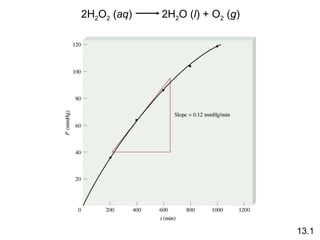
PV  =  nRT 13.1 2H 2 O 2  ( aq )  2H 2 O ( l ) + O 2  ( g ) P  =  RT  = [O 2 ] RT n V [O 2 ] =  P RT 1 rate =   [O 2 ]  t RT 1  P  t = measure   P  over time
13.1 2H 2 O 2  ( aq )  2H 2 O ( l ) + O 2  ( g )
Reaction Rates and Stoichiometry 13.1 Two moles of A disappear for each mole of B that is formed. 2A  B rate =   [B]  t rate = -  [A]  t 1 2 a A +  b B  c C +  d D rate = -  [A]  t 1 a = -  [B]  t 1 b =  [C]  t 1 c =  [D]  t 1 d
13.1 Write the rate expression for the following reaction: CH 4   ( g )  + 2O 2   ( g )   CO 2   ( g )  + 2H 2 O  ( g ) rate = -  [CH 4 ]  t = -  [O 2 ]  t 1 2 =  [H 2 O]  t 1 2 =  [CO 2 ]  t
The Rate Law 13.2 The  rate law  expresses the relationship of the rate of a reaction to the rate constant and the concentrations of the reactants raised to some powers. Rate =  k  [A] x [B] y reaction is  x th order  in A reaction is  y th order  in B reaction is  (x +y)th order overall a A +  b B  c C +  d D
rate =  k  [F 2 ] x [ClO 2 ] y Double [F 2 ] with [ClO 2 ] constant Rate doubles x  = 1 Quadruple [ClO 2 ] with [F 2 ] constant Rate quadruples y  = 1 rate =  k  [F 2 ][ClO 2 ] 13.2 F 2   ( g )  + 2ClO 2   ( g )   2FClO 2   ( g )
rate =  k  [F 2 ][ClO 2 ] Rate Laws Rate laws are  always  determined experimentally. Reaction order is  always  defined in terms of reactant (not product) concentrations. The order of a reactant  is not  related to the stoichiometric coefficient of the reactant in the balanced chemical equation. 13.2 F 2   ( g )  + 2ClO 2   ( g )   2FClO 2   ( g ) 1
rate =  k  [S 2 O 8 2- ] x [I - ] y Double [I - ], rate doubles (experiment 1 & 2) y = 1 Double [S 2 O 8 2- ], rate doubles (experiment 2 & 3) x = 1 = 0.08/ M • s 13.2 rate =  k  [S 2 O 8 2- ][I - ] Determine the rate law and calculate the rate constant for the following reaction from the following data: S 2 O 8 2-   ( aq )  + 3I -   ( aq )   2SO 4 2-   ( aq )  + I 3 -   ( aq ) Experiment [S 2 O 8 2- ] [I - ] Initial Rate ( M /s) 1 0.08 0.034 2.2 x 10 -4 2 0.08 0.017 1.1 x 10 -4 3 0.16 0.017 2.2 x 10 -4 k  =  rate [S 2 O 8 2- ][I - ] = 2.2 x 10 -4  M /s (0.08  M )(0.034  M )
First-Order Reactions 13.3 rate =  k  [A] k  =  = 1/s or s -1 [A] is the concentration of A at any time  t [A] 0  is the concentration of A at time  t =0 A  product rate = -  [A]  t rate [A] M / s M =  [A]  t =  k  [A] - [A] = [A] 0 exp( -kt ) ln[A] = ln[A] 0  -  kt
ln[A] = ln[A] 0  -  kt kt  = ln[A] 0  – ln[A] t  = = 66 s [A] 0  = 0.88  M [A]  = 0.14  M 13.3 The reaction 2A  B is first order in A with a rate constant of 2.8 x 10 -2  s -1  at 80 0 C.  How long will it take for A to decrease from 0.88  M  to 0.14  M  ? ln[A] 0  – ln[A] k ln [A] 0 [A] k = ln 0.88  M 0.14  M 2.8 x 10 -2  s -1 =
First-Order Reactions 13.3 The  half-life ,  t ½ ,  is the time required for the concentration of a reactant to decrease to half of its initial concentration. t ½  =  t   when [A] = [A] 0 /2 = 1200 s = 20 minutes How do you know decomposition is first order? units of  k  (s -1 ) ln [A] 0 [A] 0 /2 k = t ½ ln2 k = 0.693 k = What is the half-life of N 2 O 5  if it decomposes with a rate constant of 5.7 x 10 -4  s -1 ? t ½ ln2 k = 0.693 5.7 x 10 -4  s -1 =
First-order reaction 1 2 3 4 2 4 8 16 13.3 A  product # of  half-lives [A] = [A] 0 / n
Second-Order Reactions 13.3 rate =  k  [A] 2 k  =  = 1/ M • s [A] is the concentration of A at any time  t [A] 0  is the concentration of A at time  t =0 t ½  =  t   when [A] = [A] 0 /2 A  product rate = -  [A]  t rate [A] 2 M / s M 2 =  [A]  t =  k  [A] 2 - 1 [A] = 1 [A] 0 +  kt t ½  = 1 k [A] 0
Zero-Order Reactions 13.3 rate =  k  [A] 0  =  k k  =  =  M /s [A] is the concentration of A at any time  t [A] 0  is the concentration of A at time  t =0 t ½  =  t   when [A] = [A] 0 /2 [A] = [A] 0  -  kt A  product rate = -  [A]  t rate [A] 0  [A]  t =  k - t ½  = [A] 0 2 k
Summary of the Kinetics of Zero-Order, First-Order and Second-Order Reactions 0 1 2 rate =  k rate =  k  [A] rate =  k  [A] 2 ln[A] = ln[A] 0  -  kt [A] = [A] 0  -  kt 13.3 Order Rate Law Concentration-Time Equation Half-Life 1 [A] = 1 [A] 0 +  kt t ½ ln2 k = t ½  = [A] 0 2 k t ½  = 1 k [A] 0
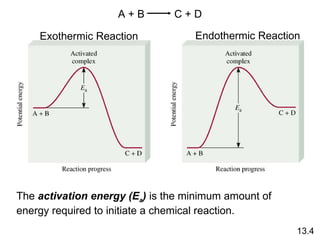
Exothermic Reaction Endothermic Reaction The  activation energy (E a )  is the minimum amount of energy required to initiate a chemical reaction. 13.4 A + B  C + D
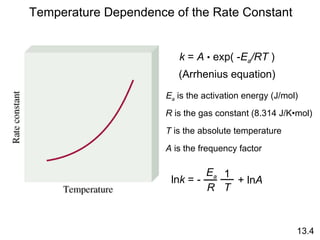
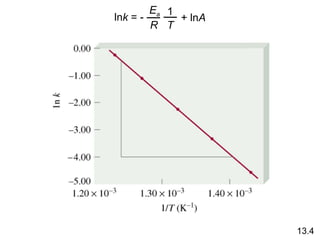
Temperature Dependence of the Rate Constant k  =  A  •   exp( - E a /RT  ) E a   is the activation energy (J/mol) R  is the gas constant (8.314 J/K •mol) T  is the absolute temperature A  is the frequency factor (Arrhenius equation) 13.4 ln k  = - E a R 1 T + ln A
13.4 ln k  = - E a R 1 T + ln A
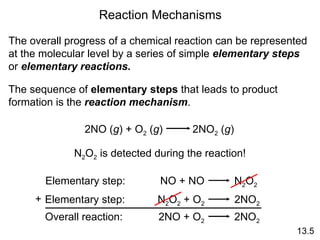
13.5 Reaction Mechanisms The overall progress of a chemical reaction can be represented at the molecular level by a series of simple  elementary steps  or  elementary reactions. The sequence of  elementary steps  that leads to product formation is the  reaction mechanism . N 2 O 2  is detected during the reaction! 2NO ( g ) + O 2  ( g )  2NO 2  ( g ) Elementary step: NO + NO  N 2 O 2 Elementary step: N 2 O 2  + O 2   2NO 2 Overall reaction: 2NO + O 2   2NO 2 +
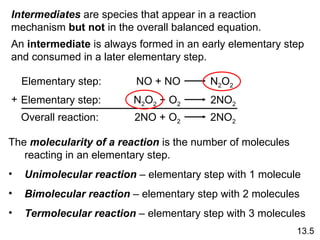
13.5 Intermediates  are species that appear in a reaction mechanism  but not  in the overall balanced equation.  An  intermediate  is always formed in an early elementary step and consumed in a later elementary step. The  molecularity of a reaction  is the number of molecules reacting in an elementary step. Unimolecular reaction  – elementary step with 1 molecule Bimolecular reaction  – elementary step with 2 molecules Termolecular reaction  – elementary step with 3 molecules Elementary step: NO + NO  N 2 O 2 Elementary step: N 2 O 2  + O 2   2NO 2 Overall reaction: 2NO + O 2   2NO 2 +
rate =  k  [A] rate =  k  [A][B] rate =  k  [A] 2 Rate Laws and Elementary Steps 13.5 Writing plausible reaction mechanisms: The sum of the elementary steps  must  give the overall balanced equation for the reaction. The rate-determining step should predict the same rate law that is determined experimentally. Unimolecular reaction A  products Bimolecular reaction A + B  products Bimolecular reaction A + A  products The  rate-determining step  is the  slowest   step in the sequence of steps leading to product formation.
What is the equation for the overall reaction? What is the intermediate? NO 3 What can you say about the relative rates of steps 1 and 2? rate =  k [NO 2 ] 2  is the rate law for step 1 so  step 1 must be slower than step 2 13.5 The experimental rate law for the reaction between NO 2  and CO to produce NO and CO 2  is rate =  k [NO 2 ] 2 .  The reaction is believed to occur via two steps: Step 1: NO 2  + NO 2   NO + NO 3 Step 2: NO 3  + CO  NO 2  + CO 2 NO 2 + CO  NO + CO 2
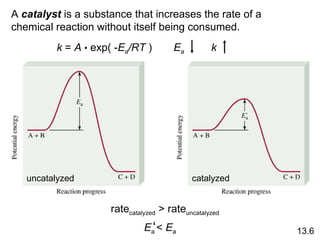
A  catalyst  is a substance that increases the rate of a chemical reaction without itself being consumed. k  =  A  •   exp( - E a /RT  ) rate catalyzed  > rate uncatalyzed 13.6 E a k uncatalyzed catalyzed E a   <  E a ‘
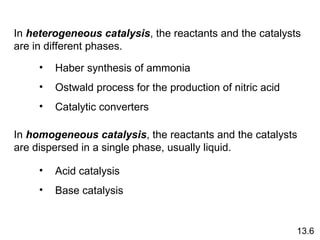
In  heterogeneous catalysis , the reactants and the catalysts are in different phases. In  homogeneous catalysis , the reactants and the catalysts are dispersed in a single phase, usually liquid. Haber synthesis of ammonia Ostwald process for the production of nitric acid Catalytic converters Acid catalysis Base catalysis 13.6
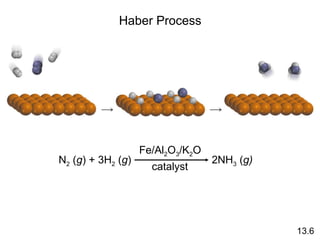
Haber Process 13.6 N 2  ( g ) + 3H 2  ( g )  2NH 3  ( g) Fe/Al 2 O 3 /K 2 O catalyst
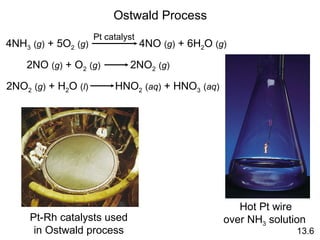
Ostwald Process Pt catalyst 13.6 Hot Pt wire  over NH 3  solution Pt-Rh catalysts used in Ostwald process 4NH 3   ( g )  + 5O 2   ( g )   4NO  ( g )  + 6H 2 O  ( g ) 2NO  ( g )  + O 2   ( g )   2NO 2   ( g ) 2NO 2   ( g )  + H 2 O  ( l )   HNO 2   ( aq )  + HNO 3   ( aq )
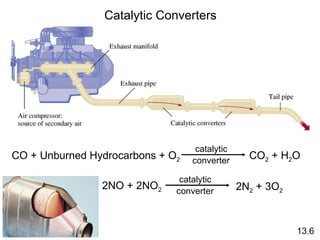
Catalytic Converters 13.6 CO + Unburned Hydrocarbons + O 2 CO 2  + H 2 O catalytic converter 2NO + 2NO 2 2N 2  + 3O 2 catalytic converter
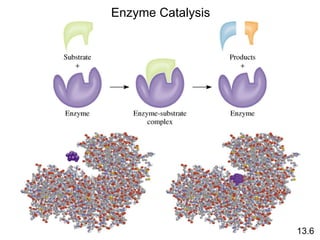
Enzyme Catalysis 13.6
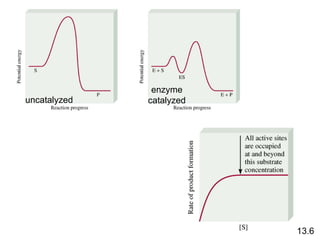
13.6 uncatalyzed enzyme catalyzed

Chemical kinetics online_

  • 1.
  • 2.
    Chemical Kinetics Thermodynamics– does a reaction take place? Kinetics – how fast does a reaction proceed? Reaction rate is the change in the concentration of a reactant or a product with time ( M /s).  [A] = change in concentration of A over time period  t  [B] = change in concentration of B over time period  t Because [A] decreases with time,  [A] is negative . 13.1 A B rate = -  [A]  t rate =  [B]  t
  • 3.
    13.1 A B rate = -  [A]  t rate =  [ B ]  t time
  • 4.
     [Br 2]   Absorption 13.1 Br 2 ( aq ) + HCOOH ( aq ) 2Br - ( aq ) + 2H + ( aq ) + CO 2 ( g ) time 393 nm light Detector 393 nm Br 2 ( aq )
  • 5.
    instantaneous rate = rate for specific instance in time 13.1 Br 2 ( aq ) + HCOOH ( aq ) 2Br - ( aq ) + 2H + ( aq ) + CO 2 ( g ) average rate = -  [Br 2 ]  t = - [Br 2 ] final – [Br 2 ] initial t final - t initial slope of tangent slope of tangent slope of tangent
  • 6.
    rate  [Br 2 ] rate = k [Br 2 ] 13.1 = rate constant = 3.50 x 10 -3 s -1 k = rate [Br 2 ]
  • 7.
    PV = nRT 13.1 2H 2 O 2 ( aq ) 2H 2 O ( l ) + O 2 ( g ) P = RT = [O 2 ] RT n V [O 2 ] = P RT 1 rate =  [O 2 ]  t RT 1  P  t = measure  P over time
  • 8.
    13.1 2H 2O 2 ( aq ) 2H 2 O ( l ) + O 2 ( g )
  • 9.
    Reaction Rates andStoichiometry 13.1 Two moles of A disappear for each mole of B that is formed. 2A B rate =  [B]  t rate = -  [A]  t 1 2 a A + b B c C + d D rate = -  [A]  t 1 a = -  [B]  t 1 b =  [C]  t 1 c =  [D]  t 1 d
  • 10.
    13.1 Write therate expression for the following reaction: CH 4 ( g ) + 2O 2 ( g ) CO 2 ( g ) + 2H 2 O ( g ) rate = -  [CH 4 ]  t = -  [O 2 ]  t 1 2 =  [H 2 O]  t 1 2 =  [CO 2 ]  t
  • 11.
    The Rate Law13.2 The rate law expresses the relationship of the rate of a reaction to the rate constant and the concentrations of the reactants raised to some powers. Rate = k [A] x [B] y reaction is x th order in A reaction is y th order in B reaction is (x +y)th order overall a A + b B c C + d D
  • 12.
    rate = k [F 2 ] x [ClO 2 ] y Double [F 2 ] with [ClO 2 ] constant Rate doubles x = 1 Quadruple [ClO 2 ] with [F 2 ] constant Rate quadruples y = 1 rate = k [F 2 ][ClO 2 ] 13.2 F 2 ( g ) + 2ClO 2 ( g ) 2FClO 2 ( g )
  • 13.
    rate = k [F 2 ][ClO 2 ] Rate Laws Rate laws are always determined experimentally. Reaction order is always defined in terms of reactant (not product) concentrations. The order of a reactant is not related to the stoichiometric coefficient of the reactant in the balanced chemical equation. 13.2 F 2 ( g ) + 2ClO 2 ( g ) 2FClO 2 ( g ) 1
  • 14.
    rate = k [S 2 O 8 2- ] x [I - ] y Double [I - ], rate doubles (experiment 1 & 2) y = 1 Double [S 2 O 8 2- ], rate doubles (experiment 2 & 3) x = 1 = 0.08/ M • s 13.2 rate = k [S 2 O 8 2- ][I - ] Determine the rate law and calculate the rate constant for the following reaction from the following data: S 2 O 8 2- ( aq ) + 3I - ( aq ) 2SO 4 2- ( aq ) + I 3 - ( aq ) Experiment [S 2 O 8 2- ] [I - ] Initial Rate ( M /s) 1 0.08 0.034 2.2 x 10 -4 2 0.08 0.017 1.1 x 10 -4 3 0.16 0.017 2.2 x 10 -4 k = rate [S 2 O 8 2- ][I - ] = 2.2 x 10 -4 M /s (0.08 M )(0.034 M )
  • 15.
    First-Order Reactions 13.3rate = k [A] k = = 1/s or s -1 [A] is the concentration of A at any time t [A] 0 is the concentration of A at time t =0 A product rate = -  [A]  t rate [A] M / s M =  [A]  t = k [A] - [A] = [A] 0 exp( -kt ) ln[A] = ln[A] 0 - kt
  • 16.
    ln[A] = ln[A]0 - kt kt = ln[A] 0 – ln[A] t = = 66 s [A] 0 = 0.88 M [A] = 0.14 M 13.3 The reaction 2A B is first order in A with a rate constant of 2.8 x 10 -2 s -1 at 80 0 C. How long will it take for A to decrease from 0.88 M to 0.14 M ? ln[A] 0 – ln[A] k ln [A] 0 [A] k = ln 0.88 M 0.14 M 2.8 x 10 -2 s -1 =
  • 17.
    First-Order Reactions 13.3The half-life , t ½ , is the time required for the concentration of a reactant to decrease to half of its initial concentration. t ½ = t when [A] = [A] 0 /2 = 1200 s = 20 minutes How do you know decomposition is first order? units of k (s -1 ) ln [A] 0 [A] 0 /2 k = t ½ ln2 k = 0.693 k = What is the half-life of N 2 O 5 if it decomposes with a rate constant of 5.7 x 10 -4 s -1 ? t ½ ln2 k = 0.693 5.7 x 10 -4 s -1 =
  • 18.
    First-order reaction 12 3 4 2 4 8 16 13.3 A product # of half-lives [A] = [A] 0 / n
  • 19.
    Second-Order Reactions 13.3rate = k [A] 2 k = = 1/ M • s [A] is the concentration of A at any time t [A] 0 is the concentration of A at time t =0 t ½ = t when [A] = [A] 0 /2 A product rate = -  [A]  t rate [A] 2 M / s M 2 =  [A]  t = k [A] 2 - 1 [A] = 1 [A] 0 + kt t ½ = 1 k [A] 0
  • 20.
    Zero-Order Reactions 13.3rate = k [A] 0 = k k = = M /s [A] is the concentration of A at any time t [A] 0 is the concentration of A at time t =0 t ½ = t when [A] = [A] 0 /2 [A] = [A] 0 - kt A product rate = -  [A]  t rate [A] 0  [A]  t = k - t ½ = [A] 0 2 k
  • 21.
    Summary of theKinetics of Zero-Order, First-Order and Second-Order Reactions 0 1 2 rate = k rate = k [A] rate = k [A] 2 ln[A] = ln[A] 0 - kt [A] = [A] 0 - kt 13.3 Order Rate Law Concentration-Time Equation Half-Life 1 [A] = 1 [A] 0 + kt t ½ ln2 k = t ½ = [A] 0 2 k t ½ = 1 k [A] 0
  • 22.
    Exothermic Reaction EndothermicReaction The activation energy (E a ) is the minimum amount of energy required to initiate a chemical reaction. 13.4 A + B C + D
  • 23.
    Temperature Dependence ofthe Rate Constant k = A • exp( - E a /RT ) E a is the activation energy (J/mol) R is the gas constant (8.314 J/K •mol) T is the absolute temperature A is the frequency factor (Arrhenius equation) 13.4 ln k = - E a R 1 T + ln A
  • 24.
    13.4 ln k = - E a R 1 T + ln A
  • 25.
    13.5 Reaction MechanismsThe overall progress of a chemical reaction can be represented at the molecular level by a series of simple elementary steps or elementary reactions. The sequence of elementary steps that leads to product formation is the reaction mechanism . N 2 O 2 is detected during the reaction! 2NO ( g ) + O 2 ( g ) 2NO 2 ( g ) Elementary step: NO + NO N 2 O 2 Elementary step: N 2 O 2 + O 2 2NO 2 Overall reaction: 2NO + O 2 2NO 2 +
  • 26.
    13.5 Intermediates are species that appear in a reaction mechanism but not in the overall balanced equation. An intermediate is always formed in an early elementary step and consumed in a later elementary step. The molecularity of a reaction is the number of molecules reacting in an elementary step. Unimolecular reaction – elementary step with 1 molecule Bimolecular reaction – elementary step with 2 molecules Termolecular reaction – elementary step with 3 molecules Elementary step: NO + NO N 2 O 2 Elementary step: N 2 O 2 + O 2 2NO 2 Overall reaction: 2NO + O 2 2NO 2 +
  • 27.
    rate = k [A] rate = k [A][B] rate = k [A] 2 Rate Laws and Elementary Steps 13.5 Writing plausible reaction mechanisms: The sum of the elementary steps must give the overall balanced equation for the reaction. The rate-determining step should predict the same rate law that is determined experimentally. Unimolecular reaction A products Bimolecular reaction A + B products Bimolecular reaction A + A products The rate-determining step is the slowest step in the sequence of steps leading to product formation.
  • 28.
    What is theequation for the overall reaction? What is the intermediate? NO 3 What can you say about the relative rates of steps 1 and 2? rate = k [NO 2 ] 2 is the rate law for step 1 so step 1 must be slower than step 2 13.5 The experimental rate law for the reaction between NO 2 and CO to produce NO and CO 2 is rate = k [NO 2 ] 2 . The reaction is believed to occur via two steps: Step 1: NO 2 + NO 2 NO + NO 3 Step 2: NO 3 + CO NO 2 + CO 2 NO 2 + CO NO + CO 2
  • 29.
    A catalyst is a substance that increases the rate of a chemical reaction without itself being consumed. k = A • exp( - E a /RT ) rate catalyzed > rate uncatalyzed 13.6 E a k uncatalyzed catalyzed E a < E a ‘
  • 30.
    In heterogeneouscatalysis , the reactants and the catalysts are in different phases. In homogeneous catalysis , the reactants and the catalysts are dispersed in a single phase, usually liquid. Haber synthesis of ammonia Ostwald process for the production of nitric acid Catalytic converters Acid catalysis Base catalysis 13.6
  • 31.
    Haber Process 13.6N 2 ( g ) + 3H 2 ( g ) 2NH 3 ( g) Fe/Al 2 O 3 /K 2 O catalyst
  • 32.
    Ostwald Process Ptcatalyst 13.6 Hot Pt wire over NH 3 solution Pt-Rh catalysts used in Ostwald process 4NH 3 ( g ) + 5O 2 ( g ) 4NO ( g ) + 6H 2 O ( g ) 2NO ( g ) + O 2 ( g ) 2NO 2 ( g ) 2NO 2 ( g ) + H 2 O ( l ) HNO 2 ( aq ) + HNO 3 ( aq )
  • 33.
    Catalytic Converters 13.6CO + Unburned Hydrocarbons + O 2 CO 2 + H 2 O catalytic converter 2NO + 2NO 2 2N 2 + 3O 2 catalytic converter
  • 34.
  • 35.