You Rock My World Introduction to Rocks and Landforms Mdm Masayu Mahmud Department of Humanities Innova Junior College, Singapore
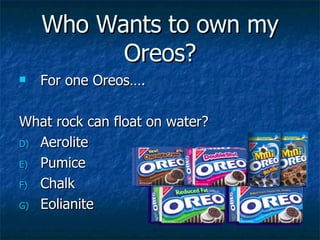
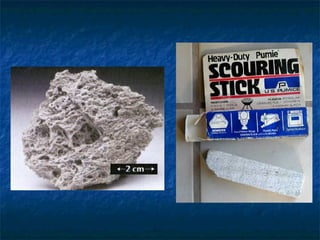
Who Wants to own my Oreos? For one Oreos….  What rock can float on water? Aerolite Pumice Chalk Eolianite
And the Answer Is…… Pumice is a type of lava full of gas bubbles. It can be as light as Styrofoam, or nearly as dense as normal rock.  Aerolite is an old name for meteorites, and Eolianite is any rock type that is made of windblown sediment. Chalk is a lightweight rock, but not  that  light.
 
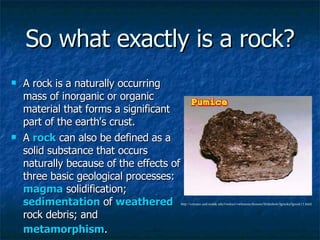
So what exactly is a rock? A rock is a naturally occurring mass of inorganic or organic material that forms a significant part of the earth's crust. A  rock  can also be defined as a solid substance that occurs naturally because of the effects of three basic geological processes:  magma  solidification;  sedimentation  of  weathered  rock debris; and  metamorphism .   http://volcano.und.nodak.edu/vwdocs/vwlessons/lessons/Slideshow/Igrocks/Igrock13.html
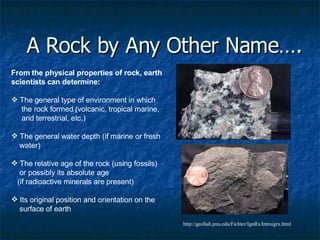
A Rock by Any Other Name…. From the physical properties of rock, earth scientists can determine: The general type of environment in which the rock formed (volcanic, tropical marine, arid terrestrial, etc.)  The general water depth (if marine or fresh water)  The relative age of the rock (using fossils) or possibly its absolute age  (if radioactive minerals are present)  Its original position and orientation on the surface of earth http://geollab.jmu.edu/Fichter/IgnRx/Introigrx.html
Rock Type and Classification 3 types of rocks Igneous rocks  - produced by solidification of molten magma from the mantle.  Sedimentary rocks  - formed by burial, compression, and chemical modification of deposited weathered rock debris or sediments at the earth's surface. Metamorphic rocks  - created when existing rock is chemically or physically modified by intense heat or pressure.
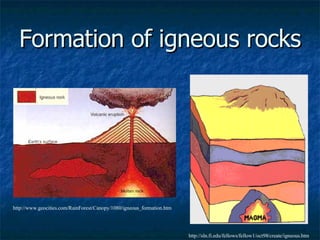
Igneous Rock Rocks formed by crystallization from a melt (magma) Extrusive (volcanic) - produced when magma flows on the earth's surface  Intrusive (plutonic) - produced when magma solidifies at depth beneath the earth Rate of cooling & temperature changes determine the texture & degree of crystallization while the composition of the magma will determine the composition of the igneous rock http://geollab.jmu.edu/Fichter/IgnRx/Introigrx.html
Formation of igneous rocks http://sln.fi.edu/fellows/fellow1/oct98/create/igneous.htm http://www.geocities.com/RainForest/Canopy/1080/igneous_formation.htm
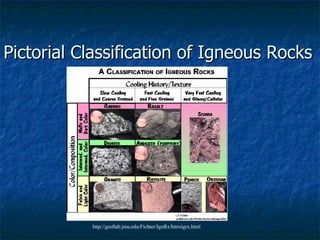
Classification of Igneous Rock Process-oriented. Based on the rate of cooling of the igneous rocks  And their resultant grain size.  Texture - size, shape and arrangement of mineral grains in a rock. Coarse grained - individual mineral grains can be seen which the naked eye. Rock must have cooled slowly to allow large crystals to develop. Fine grained - mineral grains are present but are two small to be seem with the eye. Cooled rapidly before crystals had a chance to grow. Vesicular - rock containing vesicles (gas holes). Always light weight. Example pumice. Glassy - not composed of minerals at all but a true glass. Glasses are  not  crystalline!
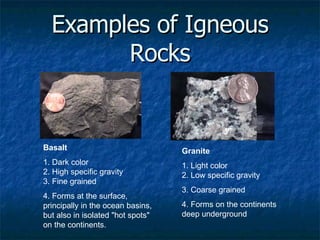
Examples of Igneous Rocks Granite 1. Light color 2. Low specific gravity 3. Coarse grained  4. Forms on the continents deep underground Basalt 1. Dark color 2. High specific gravity 3. Fine grained  4. Forms at the surface, principally in the ocean basins, but also in isolated "hot spots" on the continents.
Pictorial Classification of Igneous Rocks http://geollab.jmu.edu/Fichter/IgnRx/Introigrx.html
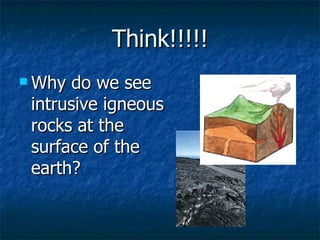
Think!!!!! Why do we see intrusive igneous rocks at the surface of the earth? 
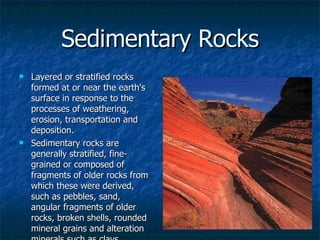
Sedimentary Rocks Layered or stratified rocks formed at or near the earth's surface in response to the processes of weathering, erosion, transportation and deposition. Sedimentary rocks are generally stratified, fine-grained or composed of fragments of older rocks from which these were derived, such as pebbles, sand, angular fragments of older rocks, broken shells, rounded mineral grains and alteration minerals such as clays.
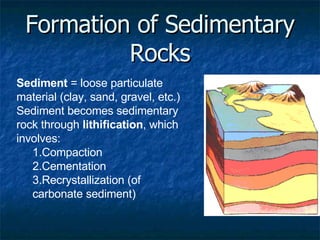
Formation of Sedimentary Rocks Sediment  = loose particulate material (clay, sand, gravel, etc.)  Sediment becomes sedimentary rock through  lithification , which involves:  Compaction  Cementation  Recrystallization (of carbonate sediment)
Types of Sedimentary Rock Mechanically–formed rocks : formed by compression & cementation of sediments deposited over a long periods in the sea e.g: shale, sandstone, conglomerate Organically-formed rocks : formed by compression & cementation of plants & animal remains e.g : coal ( from decayed plants), limestone & chalk (from shells of sea animals) Chemically-formed rocks : formed when water has evaporated from solutions which contain minerals e.g : rock salt
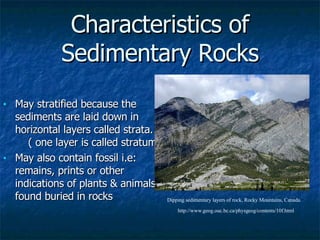
Characteristics of Sedimentary Rocks May stratified because the sediments are laid down in horizontal layers called strata.  ( one layer is called stratum) May also contain fossil i.e: remains, prints or other indications of plants & animals found buried in rocks Dipping sedimentary layers of rock, Rocky Mountains, Canada. http://www.geog.ouc.bc.ca/physgeog/contents/10f.html
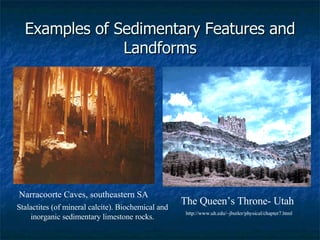
Examples of Sedimentary Features and Landforms The Queen’s Throne- Utah http://www.uh.edu/~jbutler/physical/chapter7.html Narracoorte Caves, southeastern SA Stalactites (of mineral calcite). Biochemical and inorganic sedimentary limestone rocks.
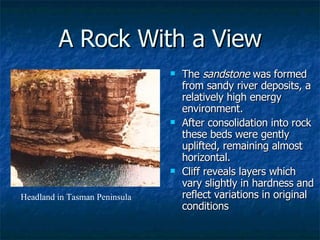
A Rock With a View The  sandstone  was formed from sandy river deposits, a relatively high energy environment.  After consolidation into rock these beds were gently uplifted, remaining almost horizontal.  Cliff reveals layers which vary slightly in hardness and reflect variations in original conditions Headland in Tasman Peninsula
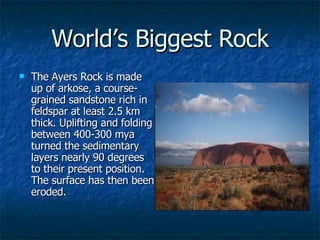
World’s Biggest Rock The Ayers Rock is made up of arkose, a course-grained sandstone rich in feldspar at least 2.5 km thick. Uplifting and folding between 400-300 mya turned the sedimentary layers nearly 90 degrees to their present position. The surface has then been eroded.
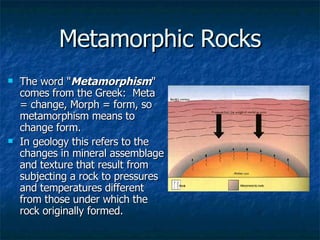
Metamorphic Rocks The word " Metamorphism " comes from the Greek:  Meta = change, Morph = form, so metamorphism means to change form.   In geology this refers to the changes in mineral assemblage and texture that result from subjecting a rock to pressures and temperatures different from those under which the rock originally formed.
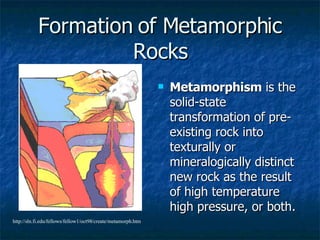
Formation of Metamorphic Rocks Metamorphism  is the solid-state transformation of pre-existing rock into texturally or mineralogically distinct new rock as the result of high temperature high pressure, or both.  http://sln.fi.edu/fellows/fellow1/oct98/create/metamorph.htm
Types of Metamorphism Regional metamorphism : takes place during mountain building when rocks are metamorphosed Contact metamorphism found in the vicinity of igneous intrusions & the high temperatures of magma heats the rock adjacent to these intrusions, causing recrystallization & growth of crystals Pressure metamorphism : rocks are altered under high pressure associated with Earth movements (folding & faulting)
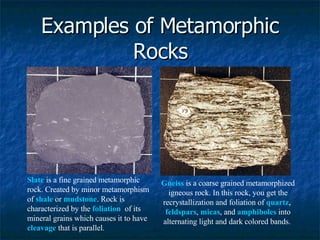
Examples of Metamorphic Rocks Slate  is a fine grained metamorphic rock. Created by minor metamorphism of  shale  or  mudstone . Rock is characterized by the  foliation   of its mineral grains which causes it to have  cleavage  that is parallel.  Gneiss  is a coarse grained metamorphized igneous rock. In this rock, you get the recrystallization and foliation of  quartz ,  feldspars ,  micas , and  amphiboles  into alternating light and dark colored bands.
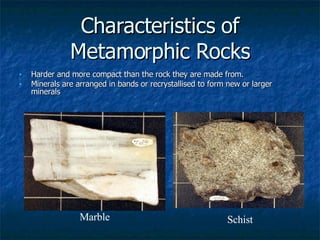
Characteristics of Metamorphic Rocks Harder and more compact than the rock they are made from.  Minerals are arranged in bands or recrystallised to form new or larger minerals Schist Marble
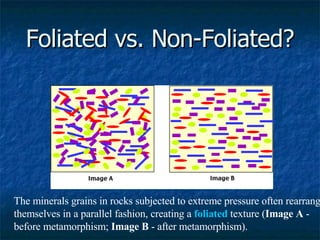
Foliated vs. Non-Foliated? The minerals grains in rocks subjected to extreme pressure often rearrange themselves in a parallel fashion, creating a  foliated  texture ( Image A  - before metamorphism;  Image B  - after metamorphism).
Do Rocks Always  Stay the Same?
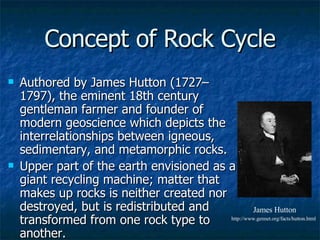
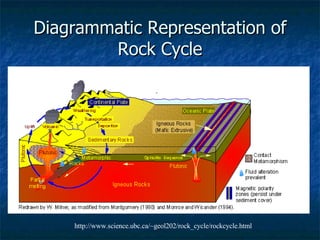
Concept of Rock Cycle Authored by James Hutton (1727–1797), the eminent 18th century gentleman farmer and founder of modern geoscience which depicts the interrelationships between igneous, sedimentary, and metamorphic rocks. Upper part of the earth envisioned as a giant recycling machine; matter that makes up rocks is neither created nor destroyed, but is redistributed and transformed from one rock type to another.  James Hutton http://www.gennet.org/facts/hutton.html
Diagrammatic Representation of Rock Cycle http://www.science.ubc.ca/~geol202/rock_cycle/rockcycle.html
How does it work?? Most surface rocks started out as  igneous  rocks- rocks produced by crystallization from a liquid.  When igneous rocks are exposed at the surface they are subject to  weathering  ( chemical and mechanical processes that reduce rocks to particles ).  Erosion  moves particles into rivers and oceans where they are deposited to become  sedimentary  rocks.  Sedimentary rocks can be buried or pushed to deeper levels in the Earth, where changes in pressure and temperature cause them to become  metamorphic  rocks.  At high temperatures metamorphic rocks may melt to become  magmas .  Magmas rise to the surface, crystallize to become igneous rocks and the processes starts over.
Rock Cycle Song (Sing to the tune of "Row, Row, Row Your Boat")   SEDIMENTARY  rock   Has been formed in layers   Often found near water sources   With fossils from decayers   Then there's  IGNEOUS  rock   Here since Earth was born   Molten Lava, cooled and hardened   That's how it is formed   These two types of rocks   Can also be transformed   With pressure, heat and chemicals   METAMORPHIC  they'll become.
Err..So why am I learning this? Knowledge of rocks fundamental to study of earth sciences Because a rock by any other name is not the same Forms the basis for the study of plate tectonics
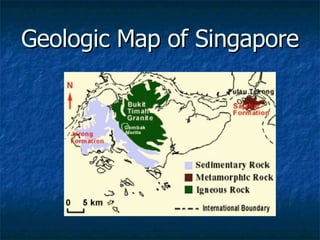
Geologic Map of Singapore
Task Research on the properties of granite, basalt, sandstone, clay and limestone: their chemical composition in relation to their weathering, nature of cementing material, hardness, texture, jointing, bedding planes

Rocks

  • 1.
    You Rock MyWorld Introduction to Rocks and Landforms Mdm Masayu Mahmud Department of Humanities Innova Junior College, Singapore
  • 2.
    Who Wants toown my Oreos? For one Oreos…. What rock can float on water? Aerolite Pumice Chalk Eolianite
  • 3.
    And the AnswerIs…… Pumice is a type of lava full of gas bubbles. It can be as light as Styrofoam, or nearly as dense as normal rock. Aerolite is an old name for meteorites, and Eolianite is any rock type that is made of windblown sediment. Chalk is a lightweight rock, but not that light.
  • 4.
  • 5.
    So what exactlyis a rock? A rock is a naturally occurring mass of inorganic or organic material that forms a significant part of the earth's crust. A rock can also be defined as a solid substance that occurs naturally because of the effects of three basic geological processes: magma solidification; sedimentation of weathered rock debris; and metamorphism . http://volcano.und.nodak.edu/vwdocs/vwlessons/lessons/Slideshow/Igrocks/Igrock13.html
  • 6.
    A Rock byAny Other Name…. From the physical properties of rock, earth scientists can determine: The general type of environment in which the rock formed (volcanic, tropical marine, arid terrestrial, etc.) The general water depth (if marine or fresh water) The relative age of the rock (using fossils) or possibly its absolute age (if radioactive minerals are present) Its original position and orientation on the surface of earth http://geollab.jmu.edu/Fichter/IgnRx/Introigrx.html
  • 7.
    Rock Type andClassification 3 types of rocks Igneous rocks - produced by solidification of molten magma from the mantle. Sedimentary rocks - formed by burial, compression, and chemical modification of deposited weathered rock debris or sediments at the earth's surface. Metamorphic rocks - created when existing rock is chemically or physically modified by intense heat or pressure.
  • 8.
    Igneous Rock Rocksformed by crystallization from a melt (magma) Extrusive (volcanic) - produced when magma flows on the earth's surface Intrusive (plutonic) - produced when magma solidifies at depth beneath the earth Rate of cooling & temperature changes determine the texture & degree of crystallization while the composition of the magma will determine the composition of the igneous rock http://geollab.jmu.edu/Fichter/IgnRx/Introigrx.html
  • 9.
    Formation of igneousrocks http://sln.fi.edu/fellows/fellow1/oct98/create/igneous.htm http://www.geocities.com/RainForest/Canopy/1080/igneous_formation.htm
  • 10.
    Classification of IgneousRock Process-oriented. Based on the rate of cooling of the igneous rocks And their resultant grain size. Texture - size, shape and arrangement of mineral grains in a rock. Coarse grained - individual mineral grains can be seen which the naked eye. Rock must have cooled slowly to allow large crystals to develop. Fine grained - mineral grains are present but are two small to be seem with the eye. Cooled rapidly before crystals had a chance to grow. Vesicular - rock containing vesicles (gas holes). Always light weight. Example pumice. Glassy - not composed of minerals at all but a true glass. Glasses are not crystalline!
  • 11.
    Examples of IgneousRocks Granite 1. Light color 2. Low specific gravity 3. Coarse grained 4. Forms on the continents deep underground Basalt 1. Dark color 2. High specific gravity 3. Fine grained 4. Forms at the surface, principally in the ocean basins, but also in isolated "hot spots" on the continents.
  • 12.
    Pictorial Classification ofIgneous Rocks http://geollab.jmu.edu/Fichter/IgnRx/Introigrx.html
  • 13.
    Think!!!!! Why dowe see intrusive igneous rocks at the surface of the earth? 
  • 14.
    Sedimentary Rocks Layeredor stratified rocks formed at or near the earth's surface in response to the processes of weathering, erosion, transportation and deposition. Sedimentary rocks are generally stratified, fine-grained or composed of fragments of older rocks from which these were derived, such as pebbles, sand, angular fragments of older rocks, broken shells, rounded mineral grains and alteration minerals such as clays.
  • 15.
    Formation of SedimentaryRocks Sediment = loose particulate material (clay, sand, gravel, etc.) Sediment becomes sedimentary rock through lithification , which involves: Compaction Cementation Recrystallization (of carbonate sediment)
  • 16.
    Types of SedimentaryRock Mechanically–formed rocks : formed by compression & cementation of sediments deposited over a long periods in the sea e.g: shale, sandstone, conglomerate Organically-formed rocks : formed by compression & cementation of plants & animal remains e.g : coal ( from decayed plants), limestone & chalk (from shells of sea animals) Chemically-formed rocks : formed when water has evaporated from solutions which contain minerals e.g : rock salt
  • 17.
    Characteristics of SedimentaryRocks May stratified because the sediments are laid down in horizontal layers called strata. ( one layer is called stratum) May also contain fossil i.e: remains, prints or other indications of plants & animals found buried in rocks Dipping sedimentary layers of rock, Rocky Mountains, Canada. http://www.geog.ouc.bc.ca/physgeog/contents/10f.html
  • 18.
    Examples of SedimentaryFeatures and Landforms The Queen’s Throne- Utah http://www.uh.edu/~jbutler/physical/chapter7.html Narracoorte Caves, southeastern SA Stalactites (of mineral calcite). Biochemical and inorganic sedimentary limestone rocks.
  • 19.
    A Rock Witha View The sandstone was formed from sandy river deposits, a relatively high energy environment. After consolidation into rock these beds were gently uplifted, remaining almost horizontal. Cliff reveals layers which vary slightly in hardness and reflect variations in original conditions Headland in Tasman Peninsula
  • 20.
    World’s Biggest RockThe Ayers Rock is made up of arkose, a course-grained sandstone rich in feldspar at least 2.5 km thick. Uplifting and folding between 400-300 mya turned the sedimentary layers nearly 90 degrees to their present position. The surface has then been eroded.
  • 21.
    Metamorphic Rocks Theword " Metamorphism " comes from the Greek:  Meta = change, Morph = form, so metamorphism means to change form.  In geology this refers to the changes in mineral assemblage and texture that result from subjecting a rock to pressures and temperatures different from those under which the rock originally formed.
  • 22.
    Formation of MetamorphicRocks Metamorphism is the solid-state transformation of pre-existing rock into texturally or mineralogically distinct new rock as the result of high temperature high pressure, or both. http://sln.fi.edu/fellows/fellow1/oct98/create/metamorph.htm
  • 23.
    Types of MetamorphismRegional metamorphism : takes place during mountain building when rocks are metamorphosed Contact metamorphism found in the vicinity of igneous intrusions & the high temperatures of magma heats the rock adjacent to these intrusions, causing recrystallization & growth of crystals Pressure metamorphism : rocks are altered under high pressure associated with Earth movements (folding & faulting)
  • 24.
    Examples of MetamorphicRocks Slate is a fine grained metamorphic rock. Created by minor metamorphism of shale or mudstone . Rock is characterized by the foliation of its mineral grains which causes it to have cleavage that is parallel. Gneiss is a coarse grained metamorphized igneous rock. In this rock, you get the recrystallization and foliation of quartz , feldspars , micas , and amphiboles into alternating light and dark colored bands.
  • 25.
    Characteristics of MetamorphicRocks Harder and more compact than the rock they are made from. Minerals are arranged in bands or recrystallised to form new or larger minerals Schist Marble
  • 26.
    Foliated vs. Non-Foliated?The minerals grains in rocks subjected to extreme pressure often rearrange themselves in a parallel fashion, creating a foliated texture ( Image A - before metamorphism; Image B - after metamorphism).
  • 27.
    Do Rocks Always Stay the Same?
  • 28.
    Concept of RockCycle Authored by James Hutton (1727–1797), the eminent 18th century gentleman farmer and founder of modern geoscience which depicts the interrelationships between igneous, sedimentary, and metamorphic rocks. Upper part of the earth envisioned as a giant recycling machine; matter that makes up rocks is neither created nor destroyed, but is redistributed and transformed from one rock type to another. James Hutton http://www.gennet.org/facts/hutton.html
  • 29.
    Diagrammatic Representation ofRock Cycle http://www.science.ubc.ca/~geol202/rock_cycle/rockcycle.html
  • 30.
    How does itwork?? Most surface rocks started out as igneous rocks- rocks produced by crystallization from a liquid. When igneous rocks are exposed at the surface they are subject to weathering ( chemical and mechanical processes that reduce rocks to particles ). Erosion moves particles into rivers and oceans where they are deposited to become sedimentary rocks. Sedimentary rocks can be buried or pushed to deeper levels in the Earth, where changes in pressure and temperature cause them to become metamorphic rocks. At high temperatures metamorphic rocks may melt to become magmas . Magmas rise to the surface, crystallize to become igneous rocks and the processes starts over.
  • 31.
    Rock Cycle Song(Sing to the tune of "Row, Row, Row Your Boat") SEDIMENTARY rock Has been formed in layers Often found near water sources With fossils from decayers Then there's IGNEOUS rock Here since Earth was born Molten Lava, cooled and hardened That's how it is formed These two types of rocks Can also be transformed With pressure, heat and chemicals METAMORPHIC they'll become.
  • 32.
    Err..So why amI learning this? Knowledge of rocks fundamental to study of earth sciences Because a rock by any other name is not the same Forms the basis for the study of plate tectonics
  • 33.
    Geologic Map ofSingapore
  • 34.
    Task Research onthe properties of granite, basalt, sandstone, clay and limestone: their chemical composition in relation to their weathering, nature of cementing material, hardness, texture, jointing, bedding planes