How do organisms interact
with the living and non-
living elements of their
environment?
OBJECTIVES
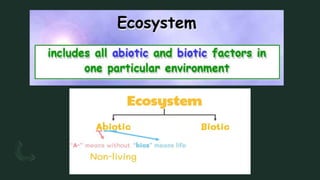
Describe biotic and abiotic
components of an ecosystem
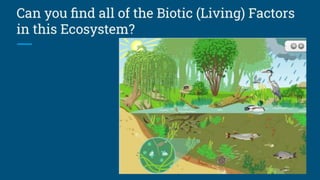
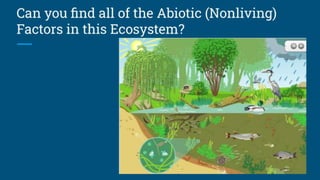
Identifying the biotic and abiotic
factors that work together to create
the given unique ecosystem.
Differentiating the different ecological
relationships in an ecosystem
Describing the type of interaction the
organisms have in their specific
relationship
ECOLOGY
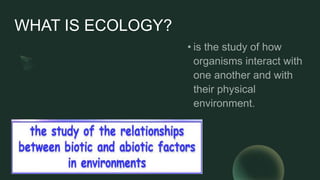
WHAT IS ECOLOGY?
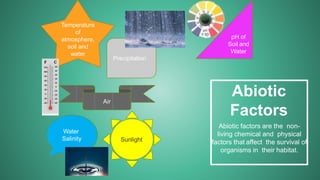
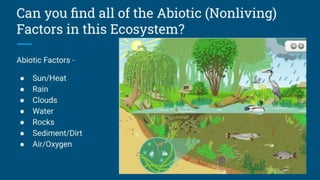
Abiotic
Factors
Abiotic factors are the non-
living chemical and physical
factors that affect the survival of
organisms in their habitat.
Temperature
of
atmosphere,
soil and
water
Air
Water
Salinity
pH of
Soil and
Water
Precipitation
Sunlight
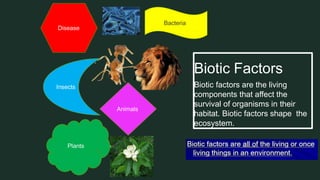
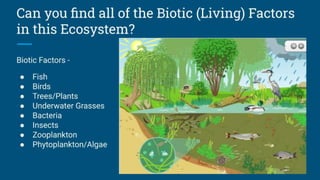
Biotic Factors
Biotic factors are the living
components that affect the
survival of organisms in their
habitat. Biotic factors shape the
ecosystem.
Disease
Plants
Animals
Insects
Bacteria
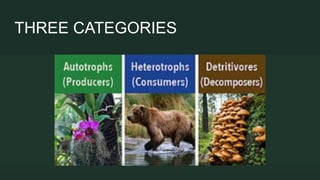
THREE CATEGORIES
Do biotic and abiotic factors affect each
other?
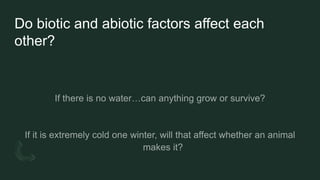
Do biotic and abiotic factors affect each
other?
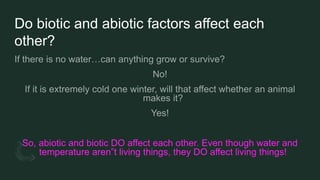
Do biotic and abiotic factors affect each
other?
So, abiotic and biotic DO affect each other. Even though water and
temperature aren”t living things, they DO affect living things!
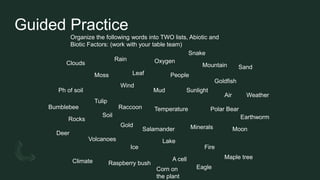
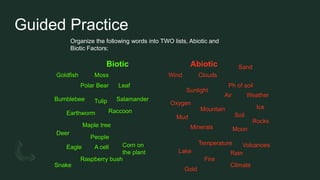
Guided Practice
Organize the following words into TWO lists, Abiotic and
Biotic Factors: (work with your table team)
Clouds
Sunlight
Sand
Ph of soil
Air
Wind
Soil
Rain
Mud
Rocks
Ice
Oxygen
Minerals
Mountain
Temperature
Lake
Volcanoes
Moon
Gold
Fire
Weather
Climate
Tulip
Bumblebee
Moss Leaf
Raccoon Polar Bear
A cell
Deer
Maple tree
Raspberry bush
Goldfish
People
Eagle
Snake
Earthworm
Corn on
the plant
Salamander
Guided Practice
Organize the following words into TWO lists, Abiotic and
Biotic Factors:
Biotic Abiotic
Clouds
Sunlight
Sand
Ph of soil
Air
Wind
Soil
Rain
Mud
Rocks
Ice
Oxygen
Minerals
Mountain
Temperature
Lake
Volcanoes
Moon
Gold
Fire
Weather
Climate
Tulip
Bumblebee
Moss
Leaf
Raccoon
Polar Bear
A cell
Deer
Maple tree
Raspberry bush
Goldfish
People
Eagle
Snake
Earthworm
Corn on
the plant
Salamander
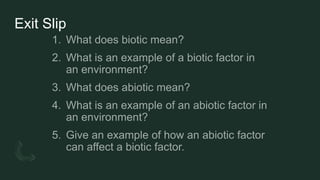
Exit Slip
© 2004 Plano ISD, Plano, TX
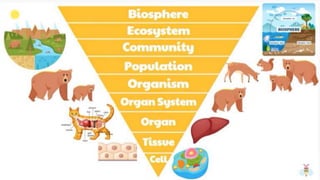
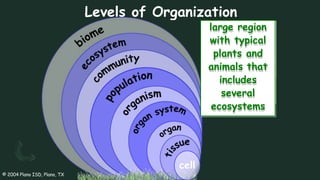
smallest unit
of living
things
group of
similar cells
organized to
work together
group of
different
kinds of
tissues
group of
organs
one individual
living thing
working
together
all organisms
of the same
kind living in
all interacting
populations in
an ecosystem
one area
working
together
all living and
nonliving
things
interacting
within a
certain area
large region
with typical
plants and
animals that
includes
several
ecosystems
cell
© 2004 Plano ISD, Plano, TX
Let’s Sum
up!
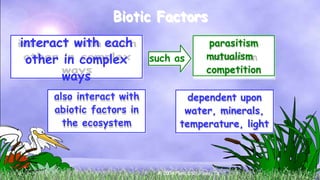
interact with each
other in complex
ways
Biotic Factors
also interact with
abiotic factors in
the ecosystem
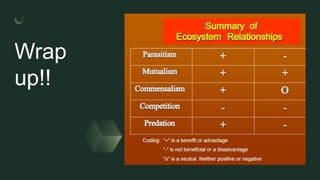
parasitism
mutualism
competition
dependent upon
water, minerals,
temperature, light
such as
© 2004 Plano ISD, Plano, TX
Wrap
up!!
LET’S CHECK
YOUR
UNDERSTANDING
LET’S CHECK
YOUR
UNDERSTANDING
LET’S CHECK
YOUR
UNDERSTANDING
LET’S CHECK
YOUR
UNDERSTANDING
LET’S CHECK
YOUR
UNDERSTANDING
LET’S CHECK
YOUR
UNDERSTANDING
LET’S CHECK
YOUR
UNDERSTANDIN
G
LET’S CHECK
YOUR
UNDERSTANDING
LET’S CHECK
YOUR
UNDERSTANDIN
G

Abiotic and biotic and ecological relationship

Editor's Notes

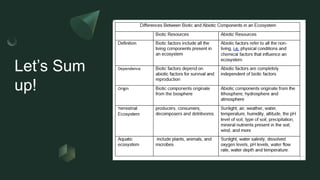
  • #10 The biotic components of an ecosystem are the living things and are capable of reproduction. It may have a direct or indirect influence on other organisms in the environment. The examples of these biotic components are the plants, animals, and microorganisms and their waste materials.
  • #11 Consumers are further categorized as herbivores, carnivores, omnivores and parasites.
  • #22 Biotic components depend on abiotic components for their survival and help in the formation of abiotic factors like soil, nutrients, etc. Below is an example of how the biotic and the abiotic components of an ecosystem interact to create a unique ecosystem
  • #27 Organisms play a functional role within an ecosystem. This functional role that they play in the ecosystem is called niche. A niche includes the physical space in which they live, how they use the resources that are in that space, and how they interact with other organisms in that space.
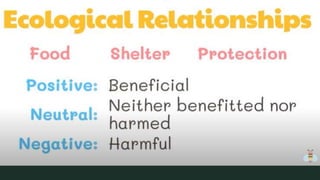
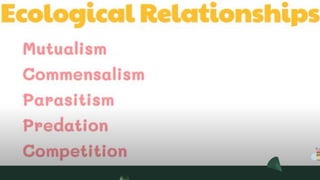
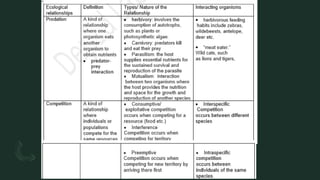
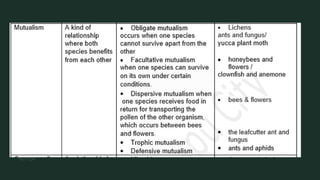
  • #29 The last three subtypes are classically defined as relationships exhibiting symbiosis, but predation and competition can also be considered as forms of symbiosis. Symbiosis refers to a close relationship in which one or both organisms obtain a benefit.