CT 316 Geology & Earthquake Engineering
Lecture# 02& 03
(5th semester Civil)
By: Engr. Hayat Hussain
Lecturer Saidu polytechnic institute saidu sharif Swat
Rock
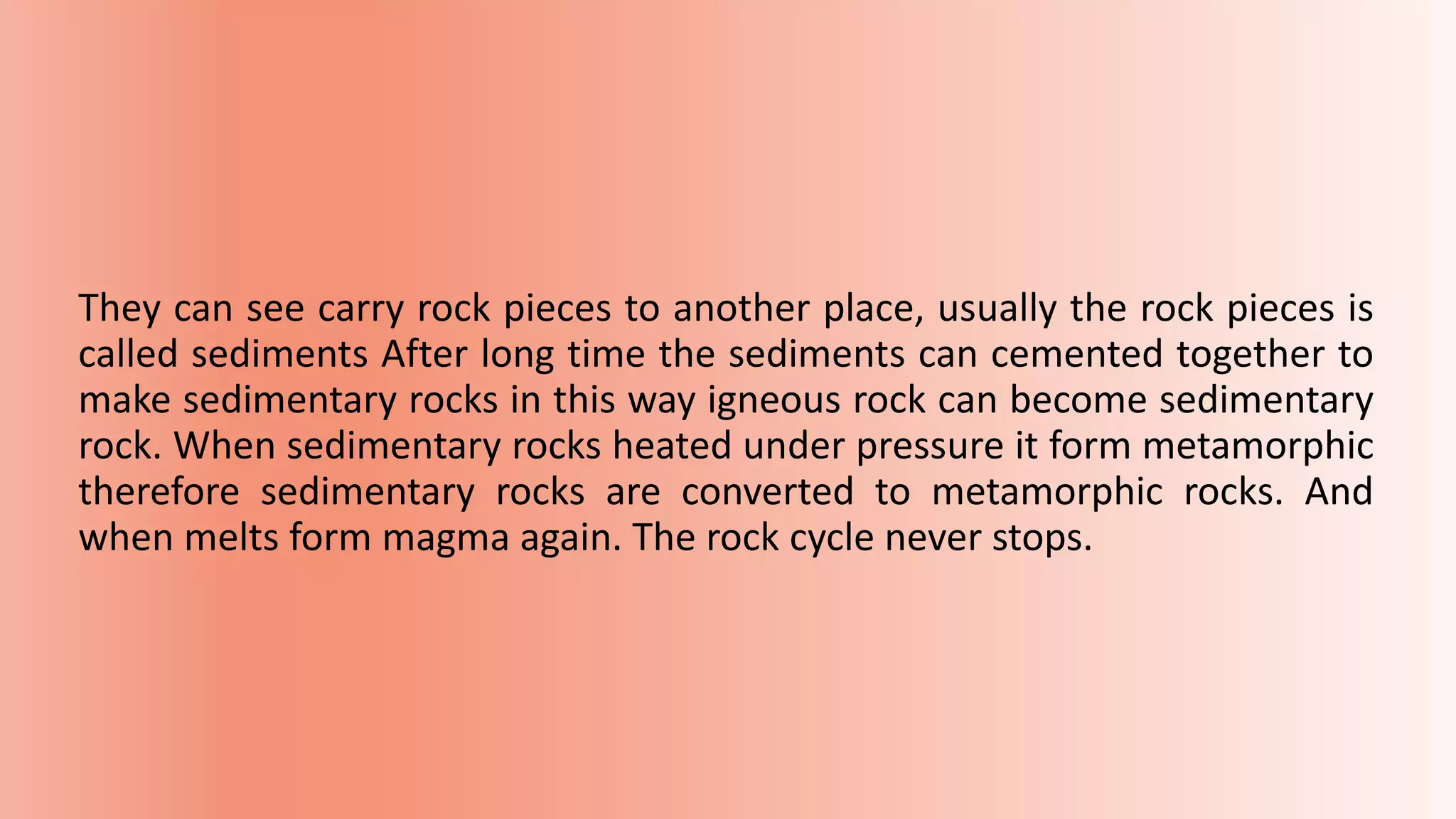
• Geologist: geologist define rock as aggregates or mass composed of
one or more commonly several of minerals. There are few exception
to this rule: not all rocks are composed of minerals for example coal.
• Engineer: engineer define to be a hard, durable material that can not
be excavated without blasting the definition is based on strength and
durability.
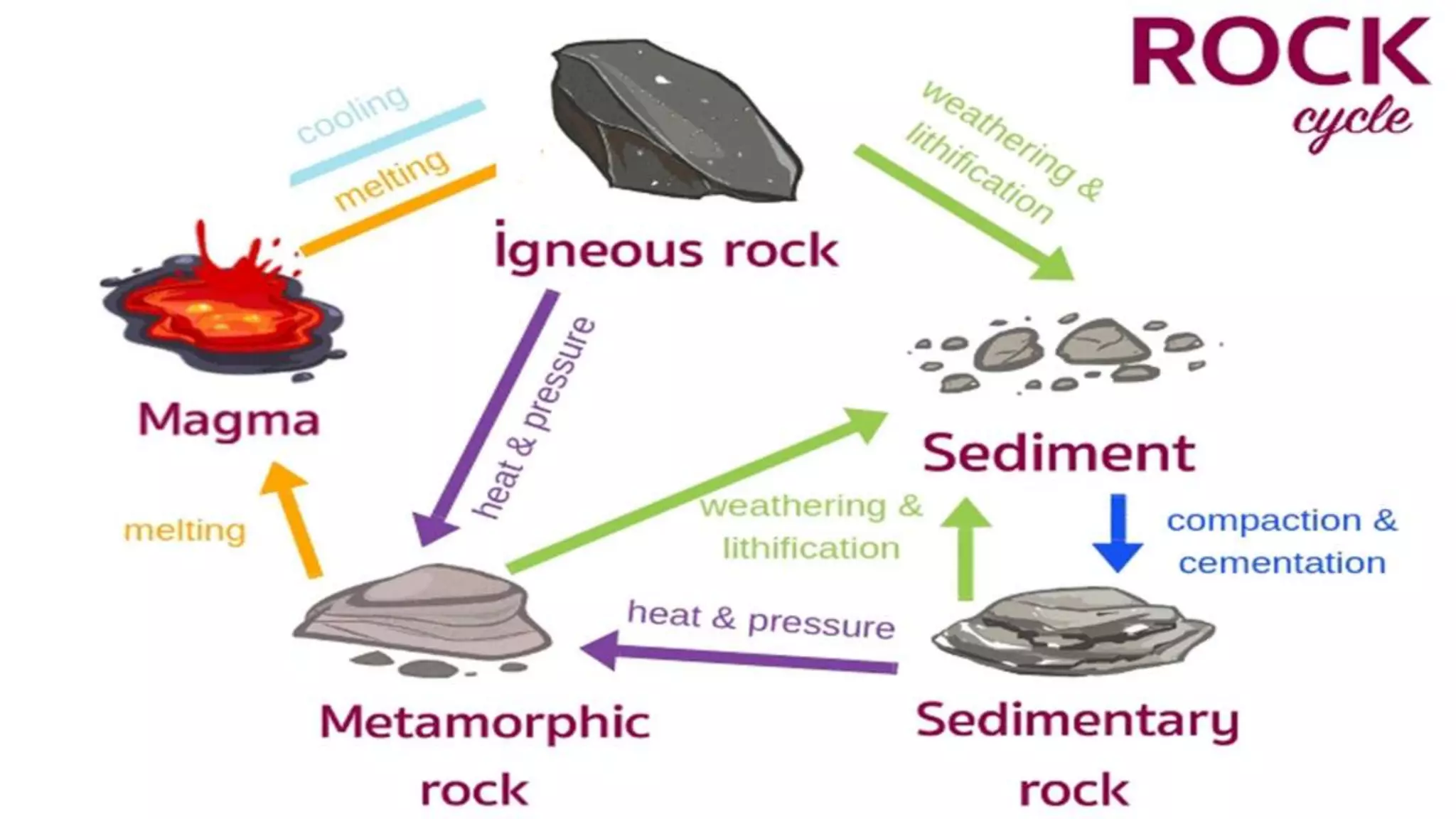
The rock cycle
It is a group of changes igneous rock can change into sedimentary rock
or into metamorphic or into igneous rock. Metamorphic rock can
change into igneous or sedimentary rock.
Explanation:
Igneous rocks form when the magma cools and make crystals. Magma
is hot liquid made of melted minerals. The minerals can form crystal
when they cool. Igneous rocks can form underground, where the
magma cools slowly or igneous rock can form above ground , where
the magma cools quickly. When it pours out on the earth’s surface
magma is called lava. Wind and water can break rock into pieces..
They can see carry rock pieces to another place, usually the rock pieces is
called sediments After long time the sediments can cemented together to
make sedimentary rocks in this way igneous rock can become sedimentary
rock. When sedimentary rocks heated under pressure it form metamorphic
therefore sedimentary rocks are converted to metamorphic rocks. And
when melts form magma again. The rock cycle never stops.
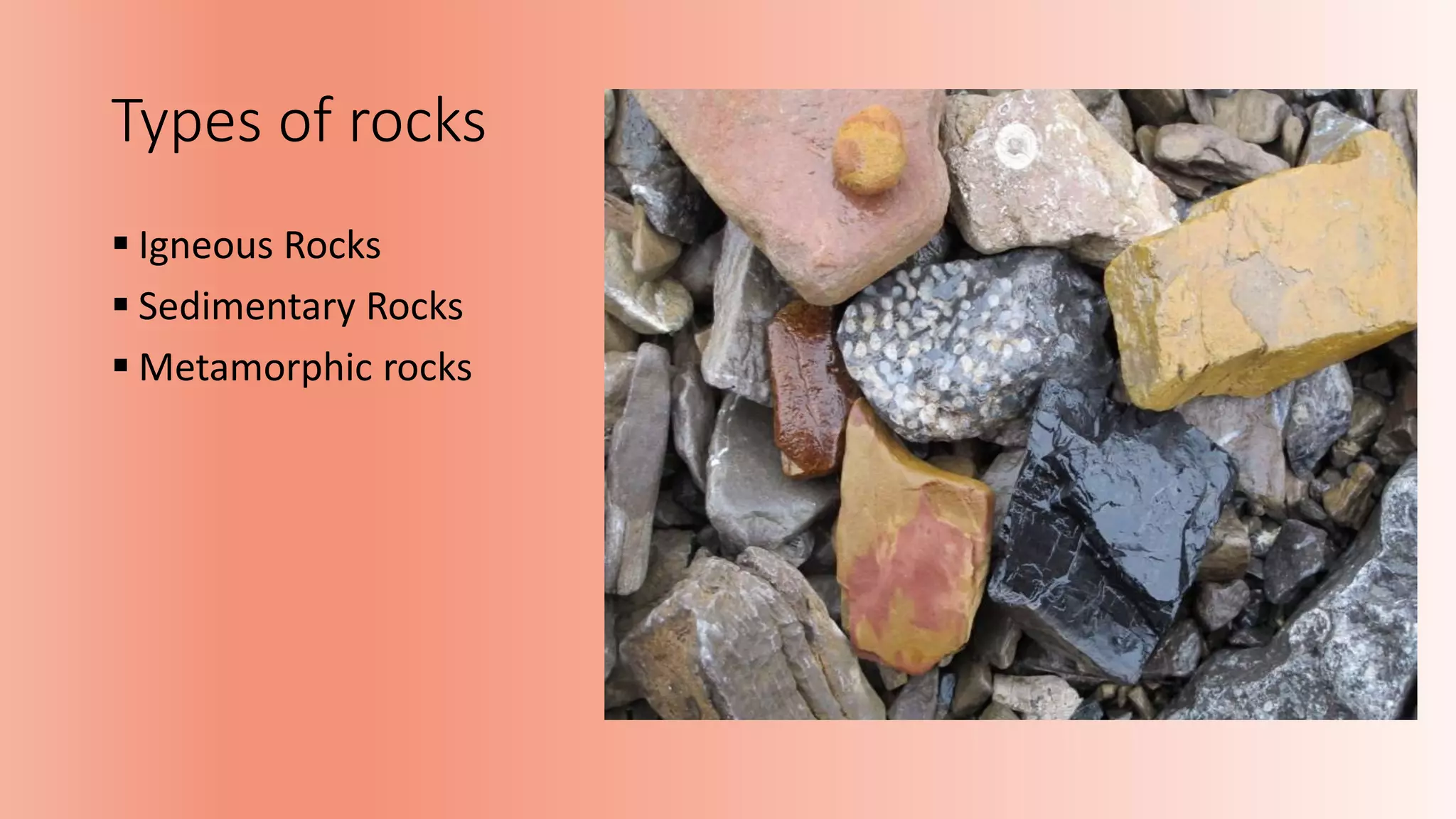
Types of rocks
 Igneous Rocks
 Sedimentary Rocks
 Metamorphic rocks
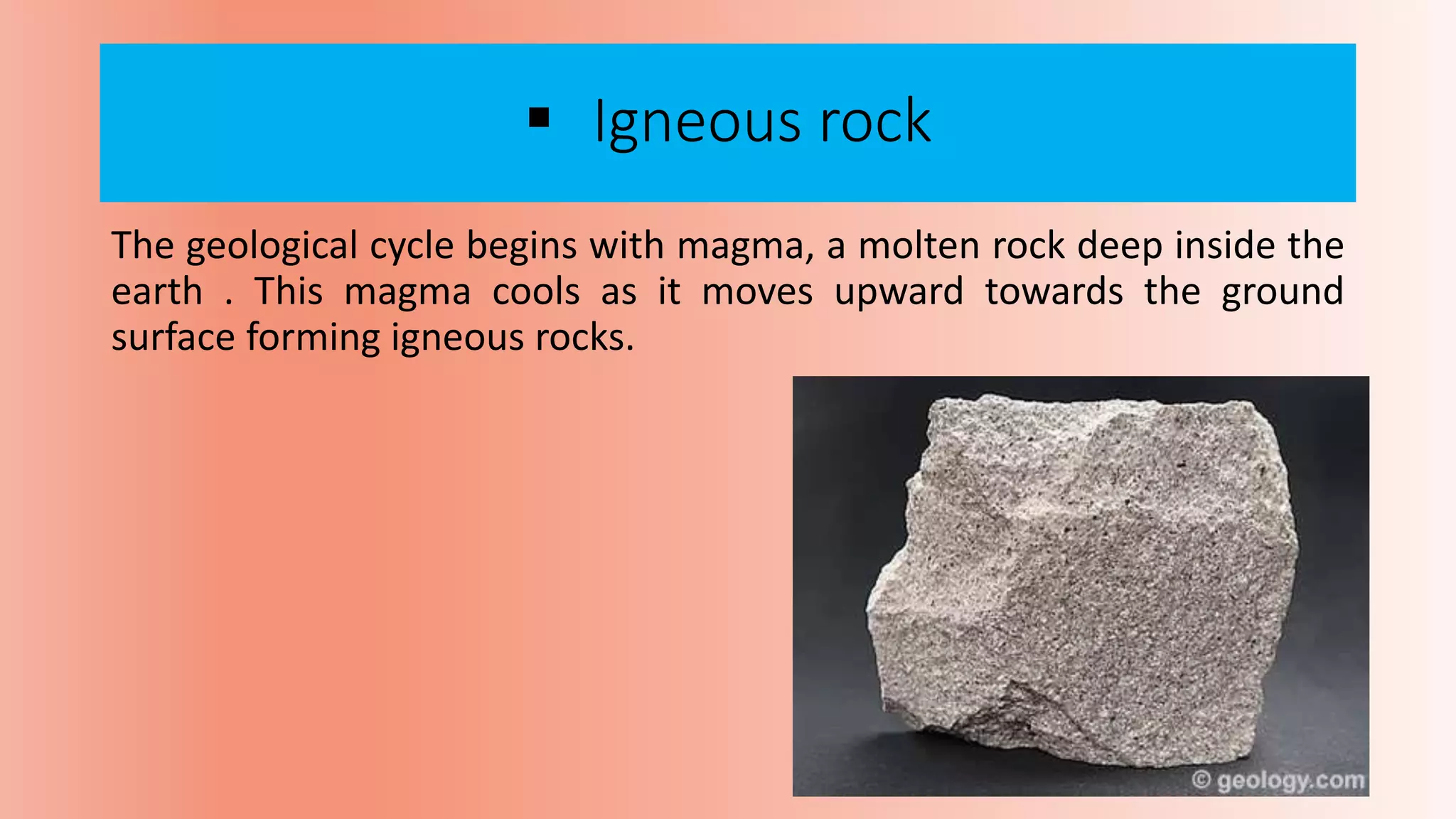
 Igneous rock
The geological cycle begins with magma, a molten rock deep inside the
earth . This magma cools as it moves upward towards the ground
surface forming igneous rocks.
Classification of igneous Rocks
On the basis of texture ( size, shape and arrangement of mineral grain
in rock) and mode of occurrence, igneous rocks is divided broadly into
three types.
Intrusive (plutonic) Rocks
Extrusive ( volcanic) rocks
Hypabyssal Rocks.
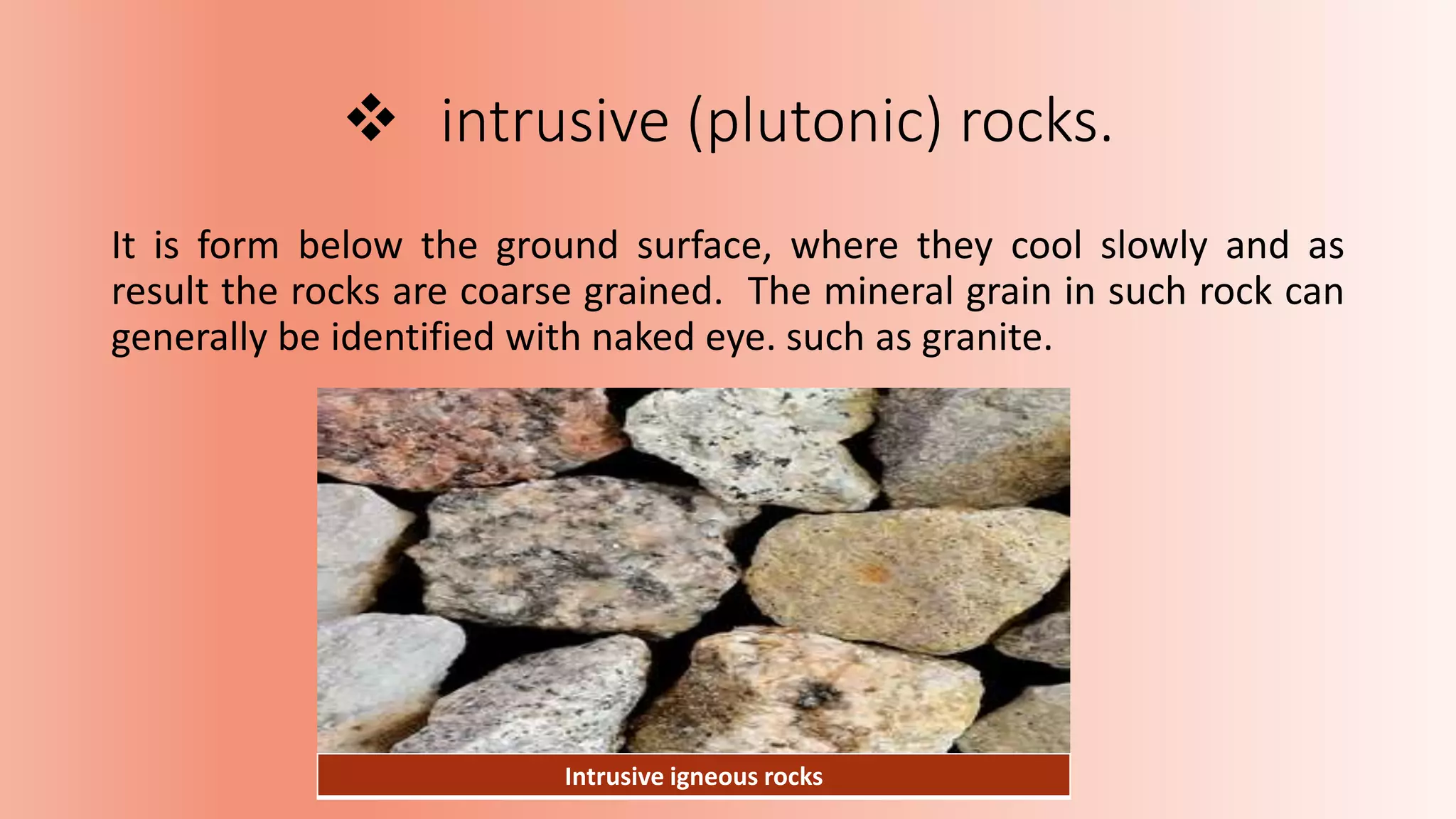
 intrusive (plutonic) rocks.
It is form below the ground surface, where they cool slowly and as
result the rocks are coarse grained. The mineral grain in such rock can
generally be identified with naked eye. such as granite.
Intrusive igneous rocks
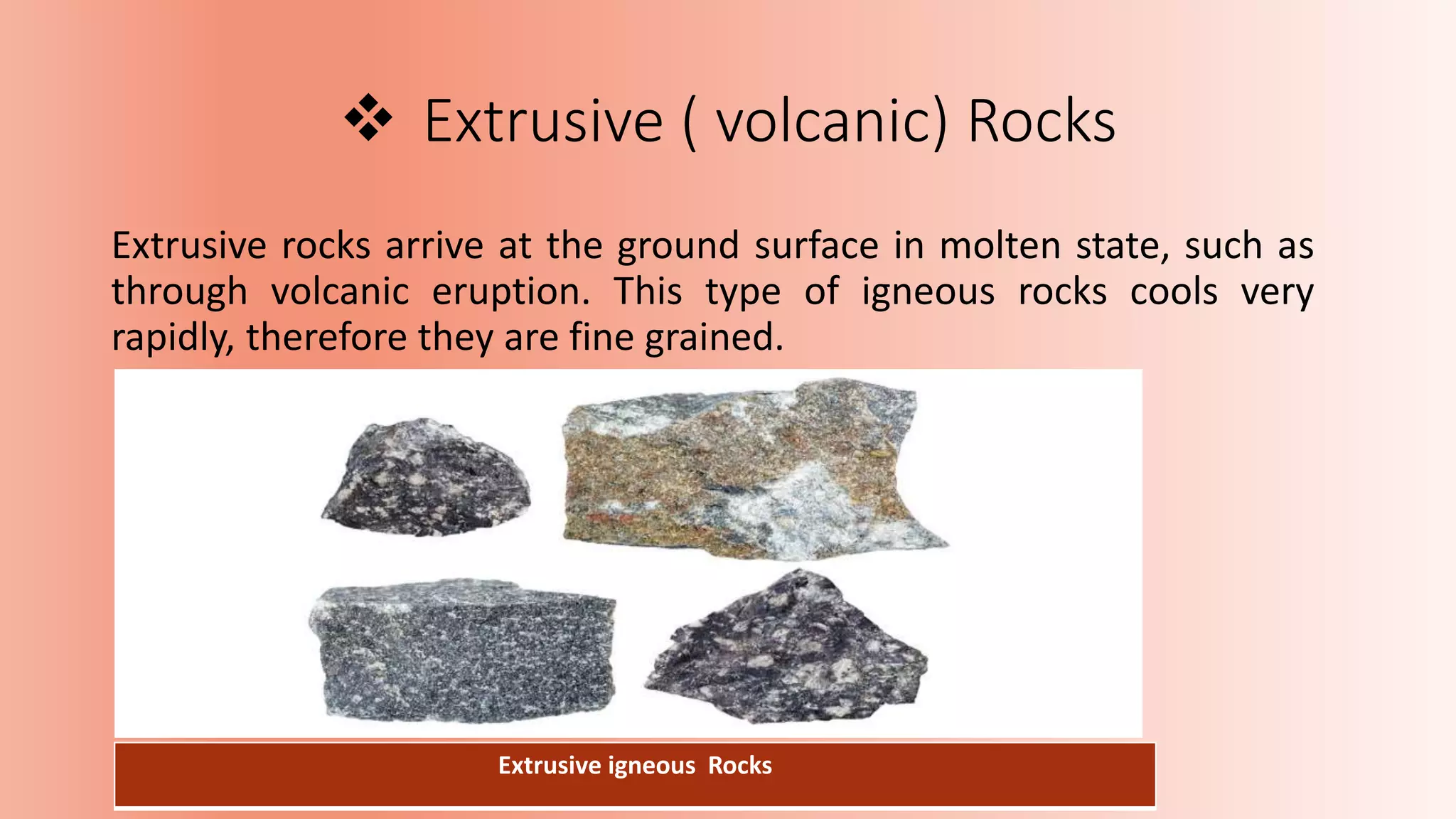
 Extrusive ( volcanic) Rocks
Extrusive rocks arrive at the ground surface in molten state, such as
through volcanic eruption. This type of igneous rocks cools very
rapidly, therefore they are fine grained.
Extrusive igneous Rocks
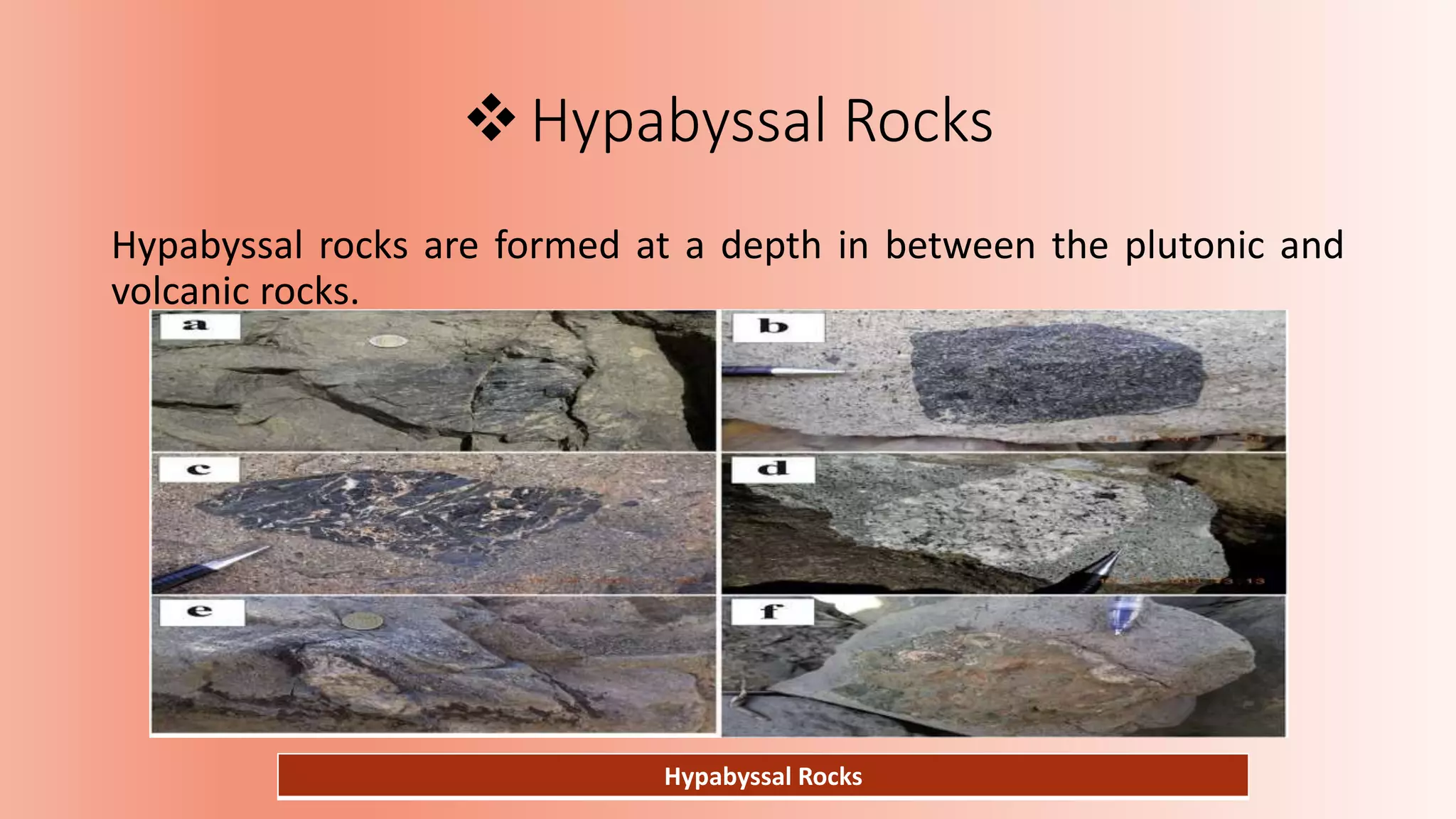
Hypabyssal Rocks
Hypabyssal rocks are formed at a depth in between the plutonic and
volcanic rocks.
Hypabyssal Rocks
Examples of igneous Rocks
 Granite
 Diorite
 Syenite
 Pumic
 Basalt
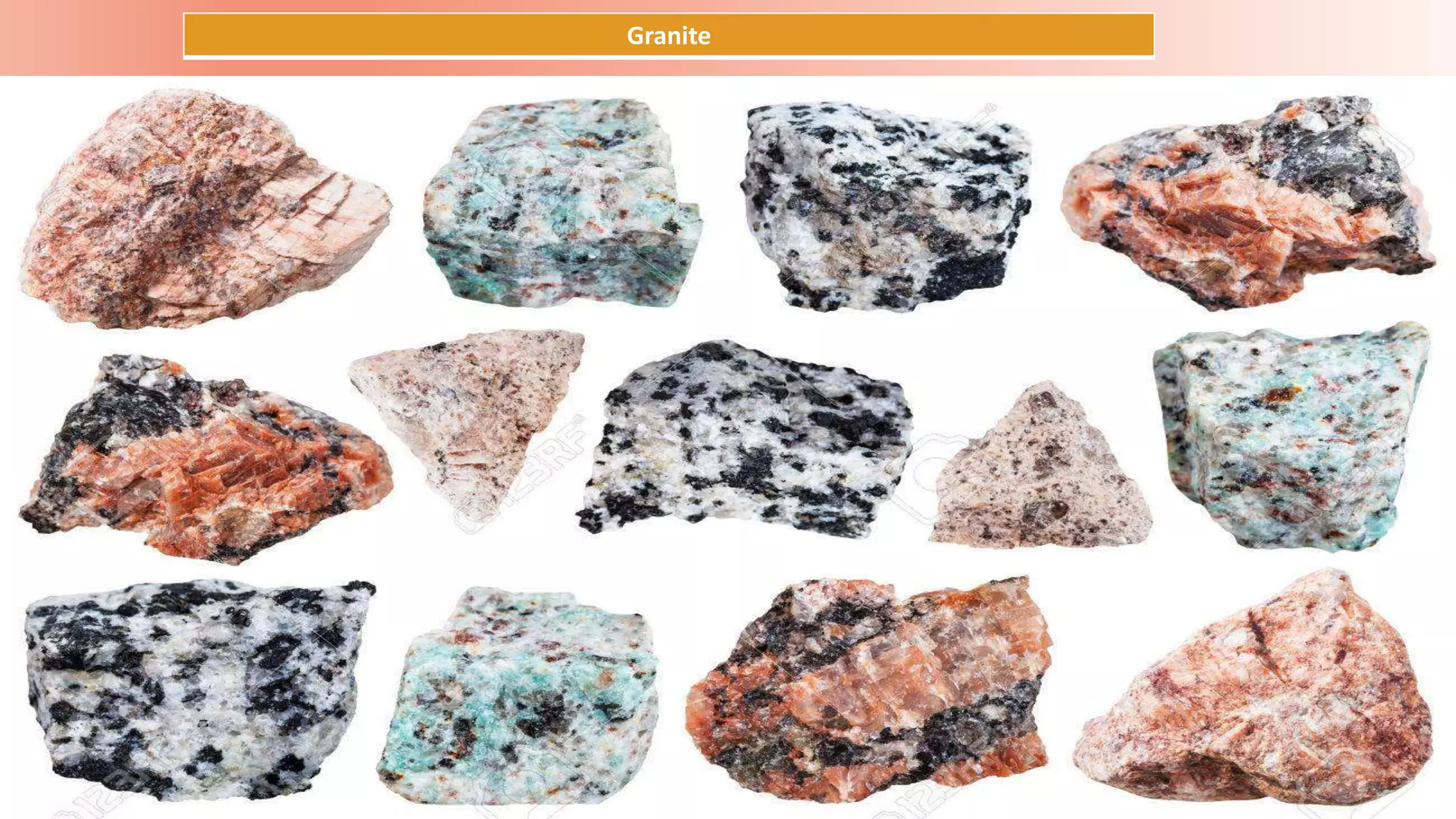
Granite
• It is coarse grained intrusive rock
• It is mostly light in color with white pink
• It is an excellent forest resistance
• Granite is hard and abrasion resistant
• The compressive strength of granite is on average 24500psi
• Specific gravity of granite is 2.6- 2.7
Granite
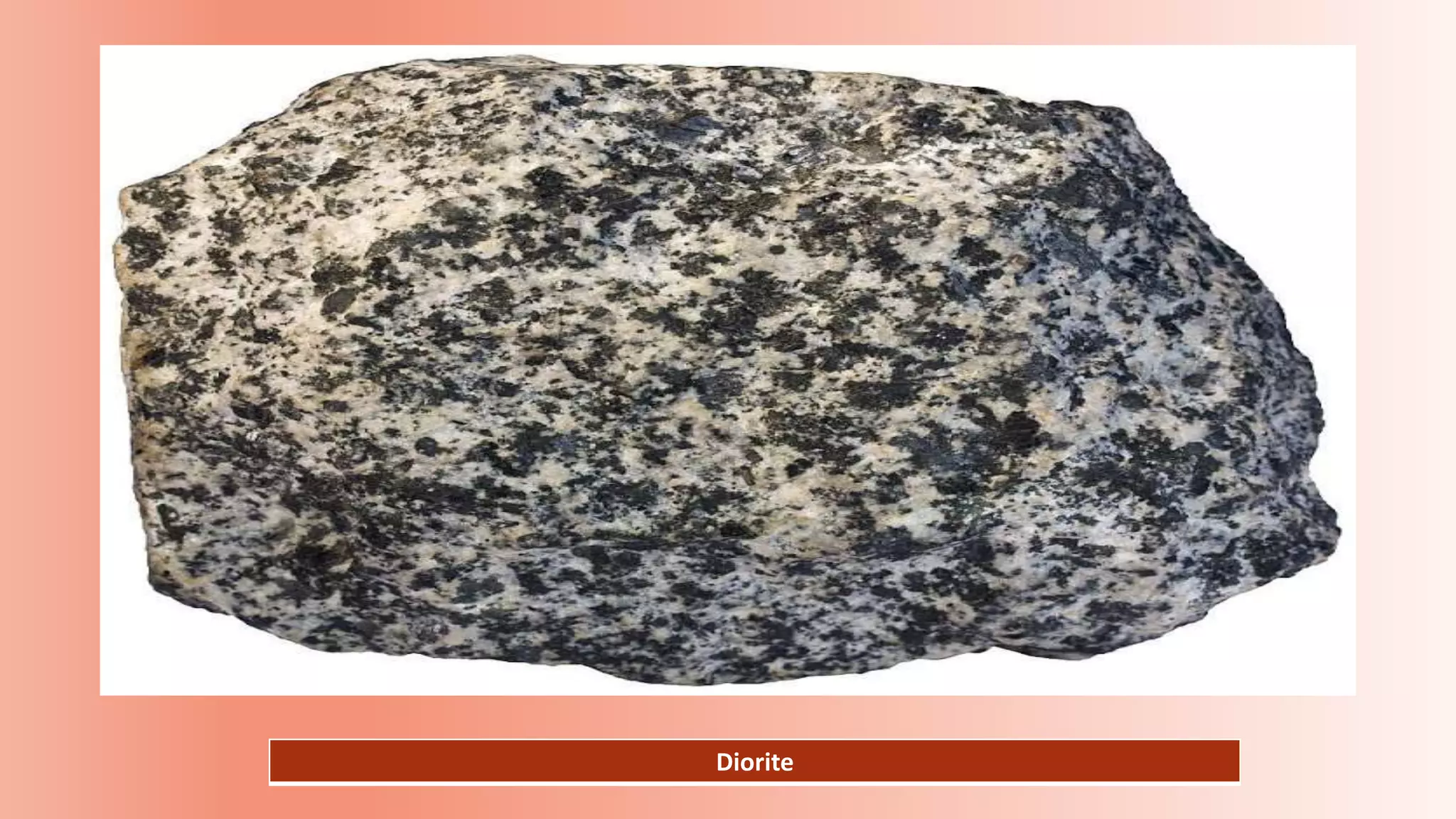
Diorite
• It is coarse grained, an intrusive rock
• It is a relatively rare rock
• It is used for crushed stone decorative and structural purposes
• Diorite is an extremely hard rock
• It to be worked finely and take a high polish and provide a durable
finished work.
• Specific gravity of diorite is 2.7- 2.85
Diorite
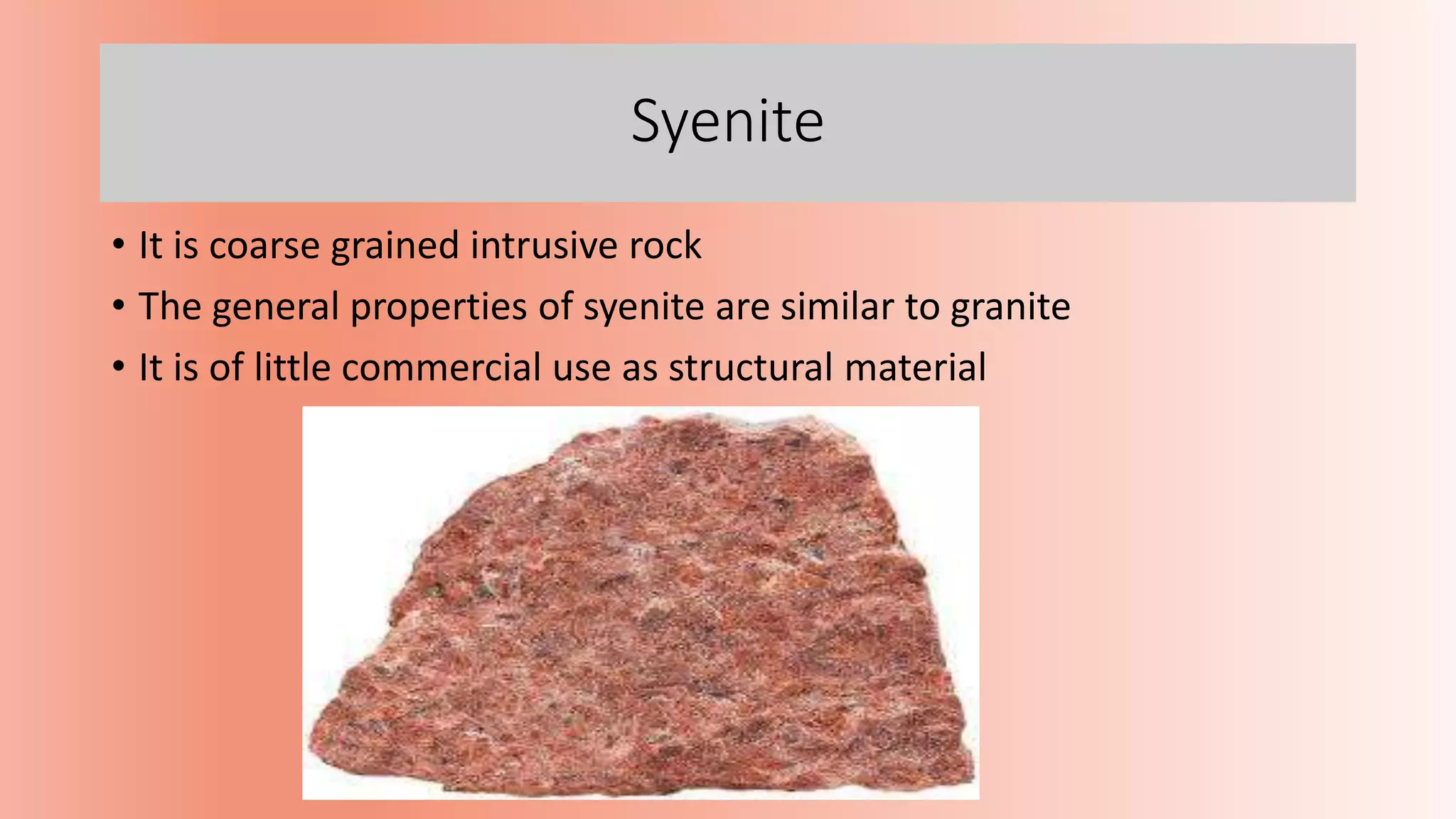
Syenite
• It is coarse grained intrusive rock
• The general properties of syenite are similar to granite
• It is of little commercial use as structural material
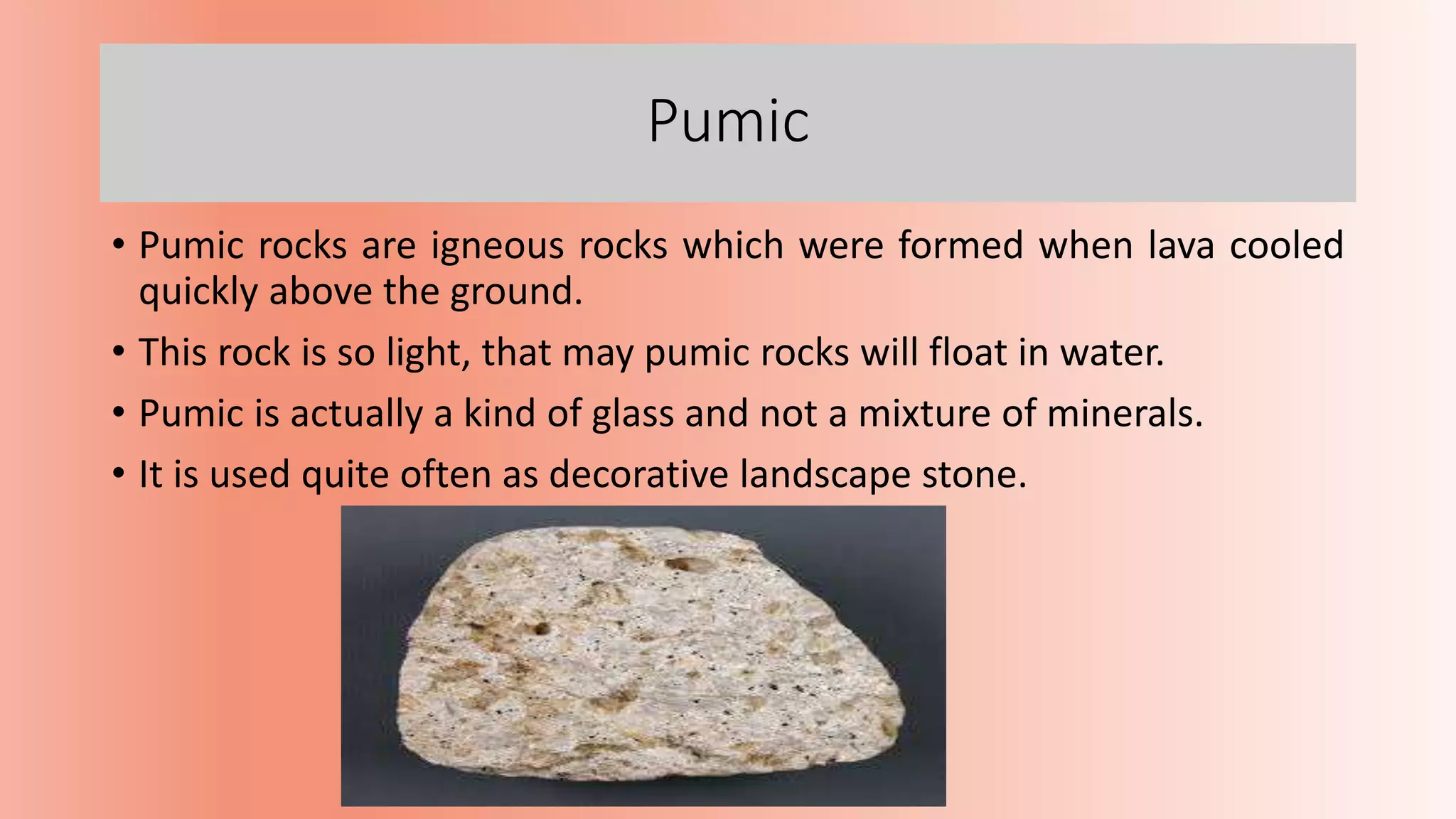
Pumic
• Pumic rocks are igneous rocks which were formed when lava cooled
quickly above the ground.
• This rock is so light, that may pumic rocks will float in water.
• Pumic is actually a kind of glass and not a mixture of minerals.
• It is used quite often as decorative landscape stone.
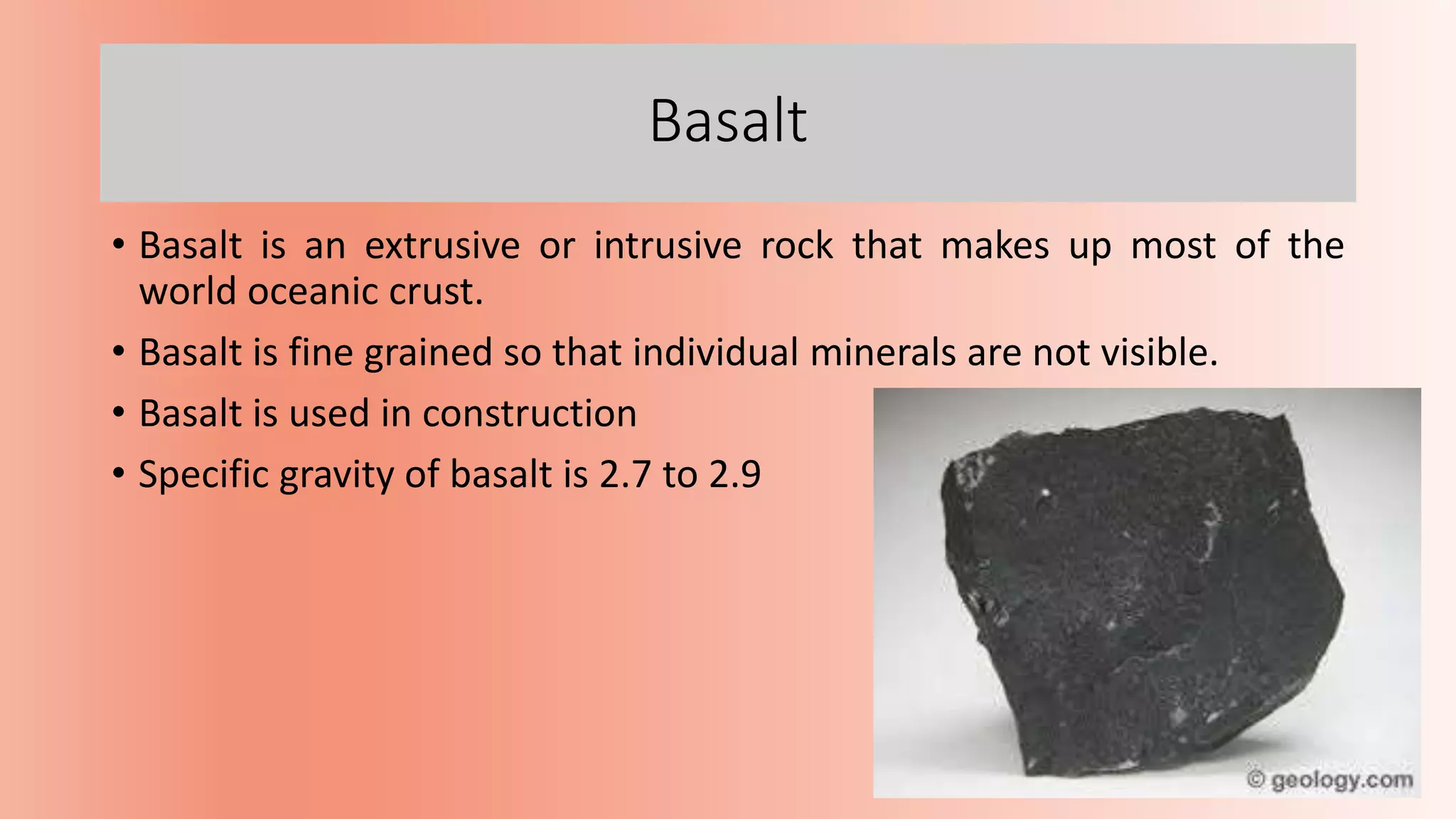
Basalt
• Basalt is an extrusive or intrusive rock that makes up most of the
world oceanic crust.
• Basalt is fine grained so that individual minerals are not visible.
• Basalt is used in construction
• Specific gravity of basalt is 2.7 to 2.9
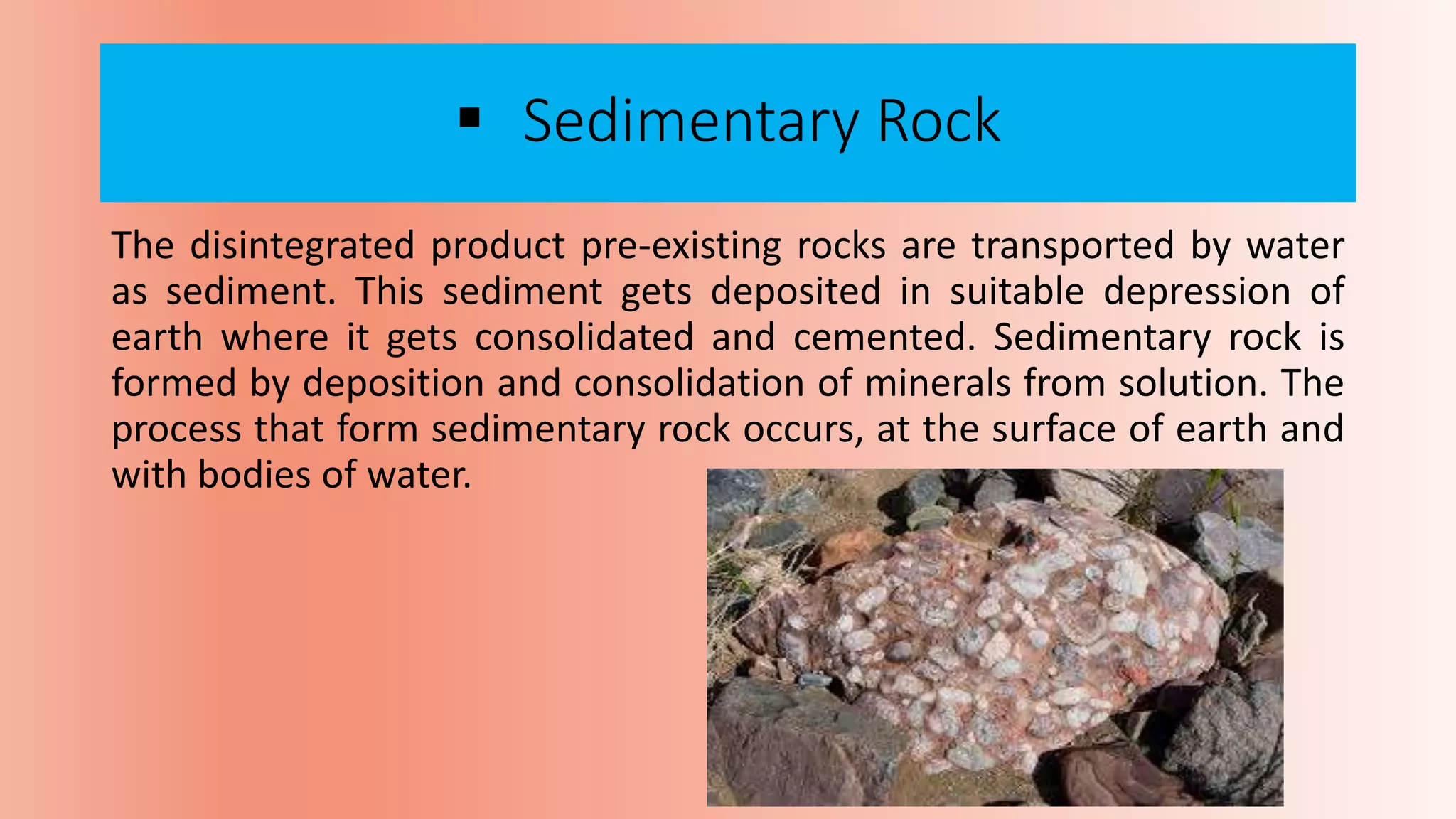
 Sedimentary Rock
The disintegrated product pre-existing rocks are transported by water
as sediment. This sediment gets deposited in suitable depression of
earth where it gets consolidated and cemented. Sedimentary rock is
formed by deposition and consolidation of minerals from solution. The
process that form sedimentary rock occurs, at the surface of earth and
with bodies of water.
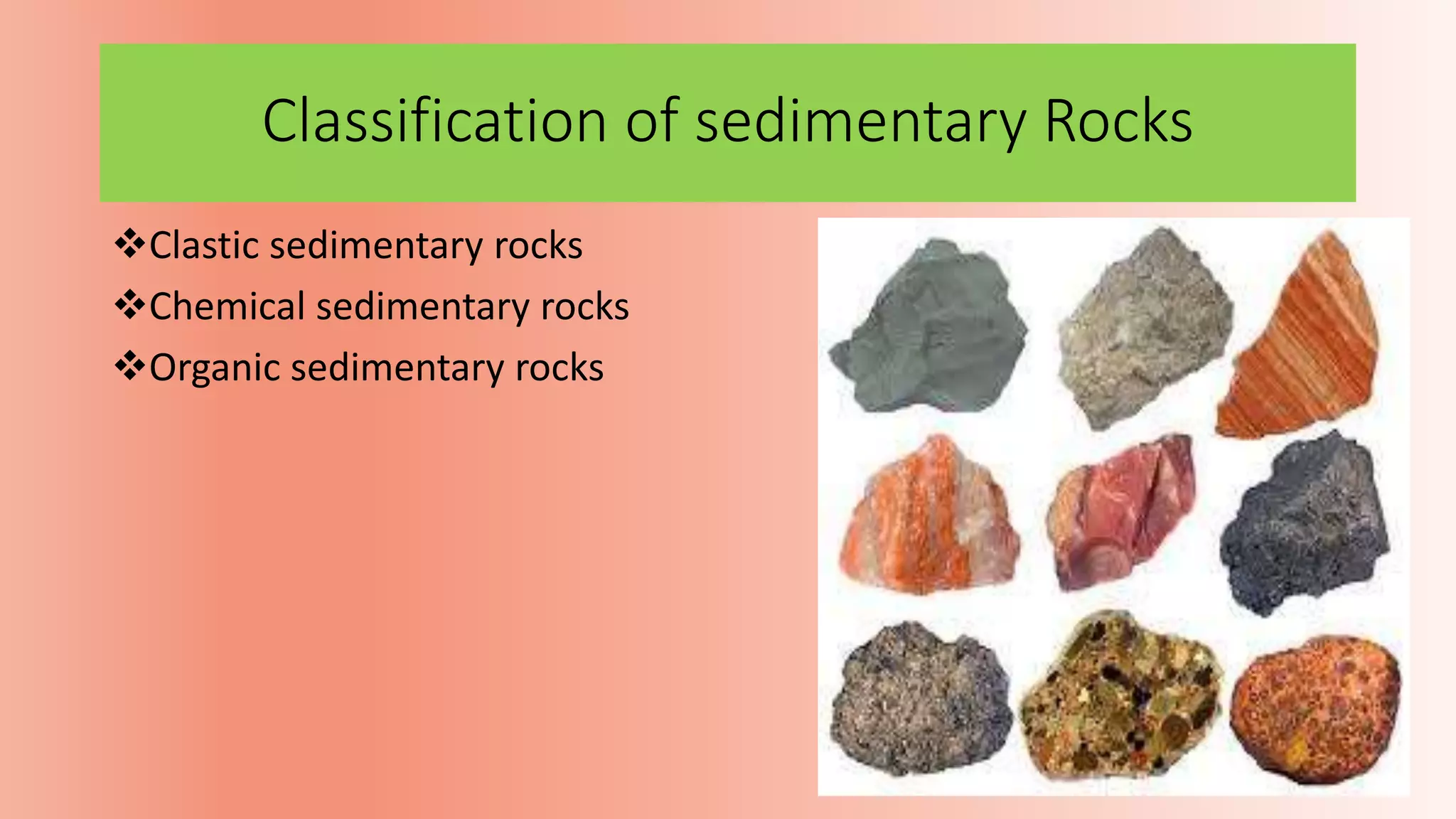
Classification of sedimentary Rocks
Clastic sedimentary rocks
Chemical sedimentary rocks
Organic sedimentary rocks
Clastic sedimentary rocks
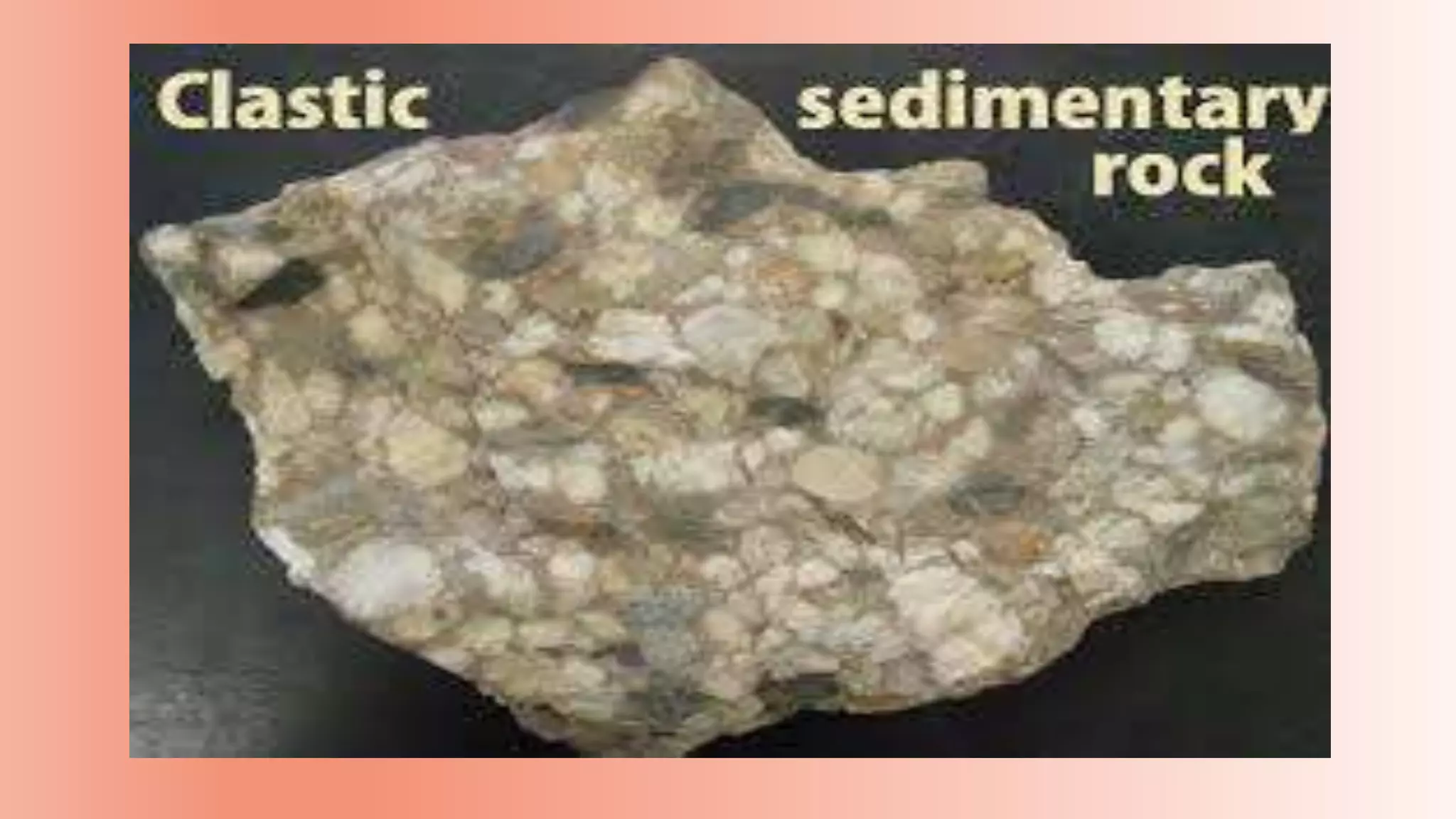
These rocks are formed from lithification of sediments. Most of
sedimentary rocks are clastic. Rocks formed and cemented sediments
grains that are fragments of pre existing rocks, the rock fragments can
either identifiable piece of rock, such as pebbles of granite or shale or
individual mineral grains, such as sand sized quartz and feldspar cystals
lossened from rocks by weathering and erosion. Clay minerals formed
by chemical weathering are also considered fragments of preesting
rocks. During transportation, the grains may have been rounded and
sorted.
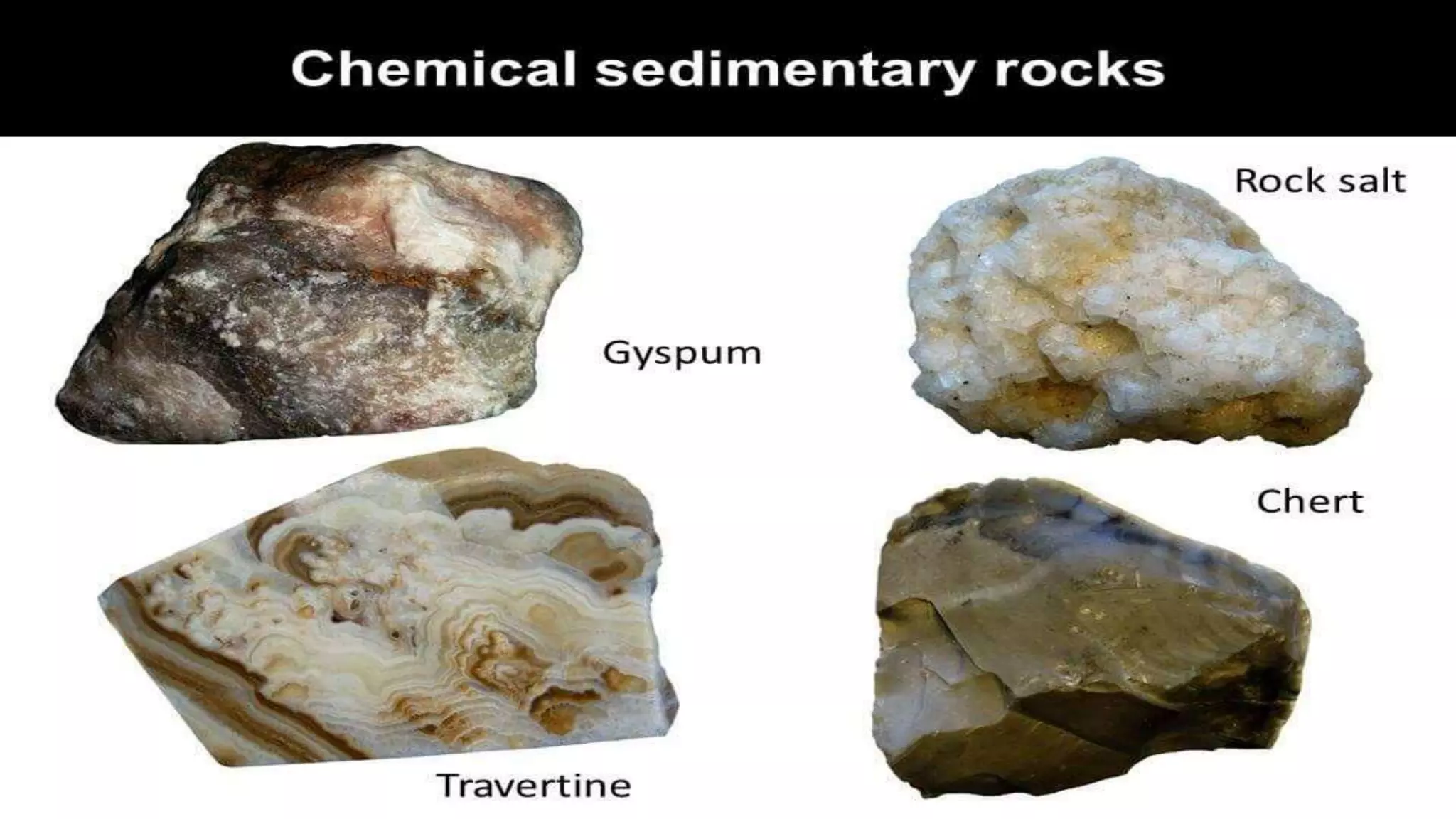
Chemical sedimentary
Chemical sedimentary rocks are deposited by precipitation of mineral
from solution. An example of inorganic precipitation is the formation of
rock salt as seawater evaporates. Chemical precipitation can also
caused by organism. Lime stone, a sedimentary rocks, for instance, can
form by precipitation of calcite with in a coral reef by corals and algae,
such a rock is classified as bio chemical lime stone.
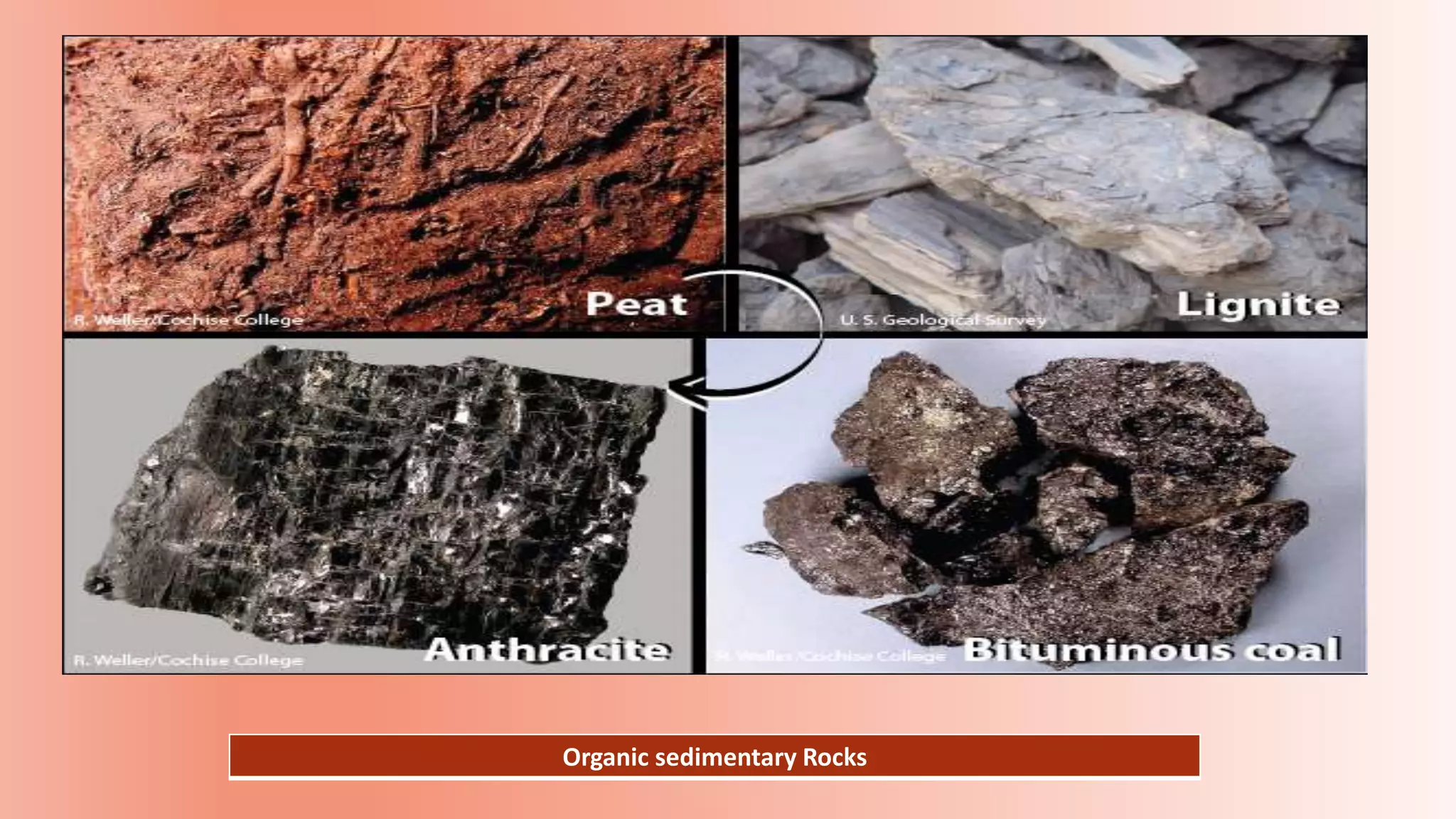
Organic sedimentary rocks
These rocks are formed from the consolidation of remains of plants and
animals. They accumulate from the remains of organism. Coal is
organic rock that from the compression of plant remains such as moss
( small soft plant) leaves, twinges ( the terminal branch) roots, and tree
trunks.
Organic sedimentary Rocks
Examples of sedimentary rocks
• Sedimentary breccia
• Sand stone
• Shale
• Siltstone
• Lime stone
• Dolomite
• Coal
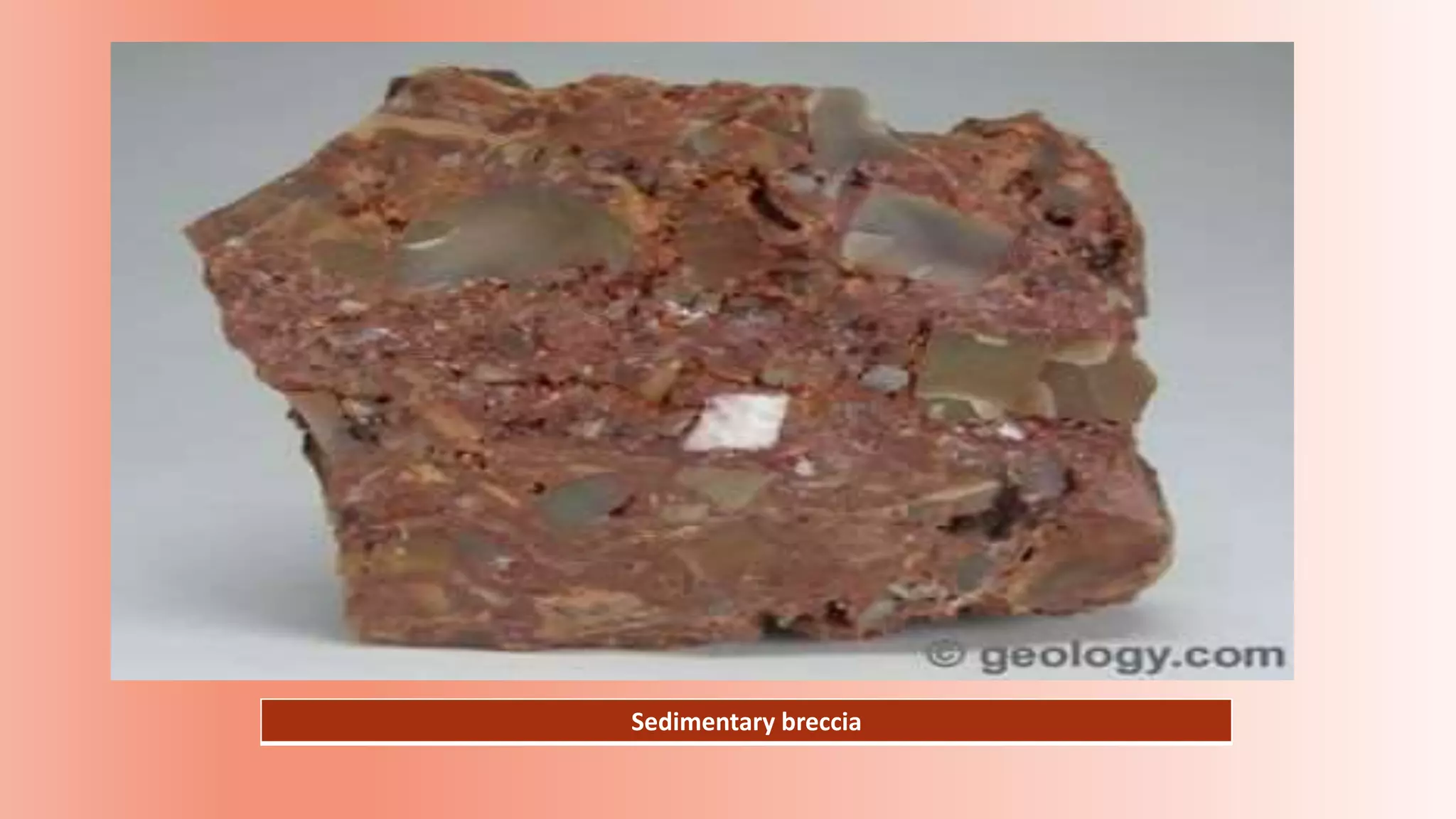
Sedimentary breccia
• Corse grained rock formed by the cementation of coarse, angular
fragments of rubble.
• Because of grains rounded so rapidly during transport, it is unlikely
that the angular fragments with in breccia have moved very far away
from their source.
• Sedimentary breccia might form from fragments that have
accumulated at the base of steep slope of rock that is being
mechanically weathered.
• Landslides deposits also might lithify into sedimentary breccia.
Sedimentary breccia
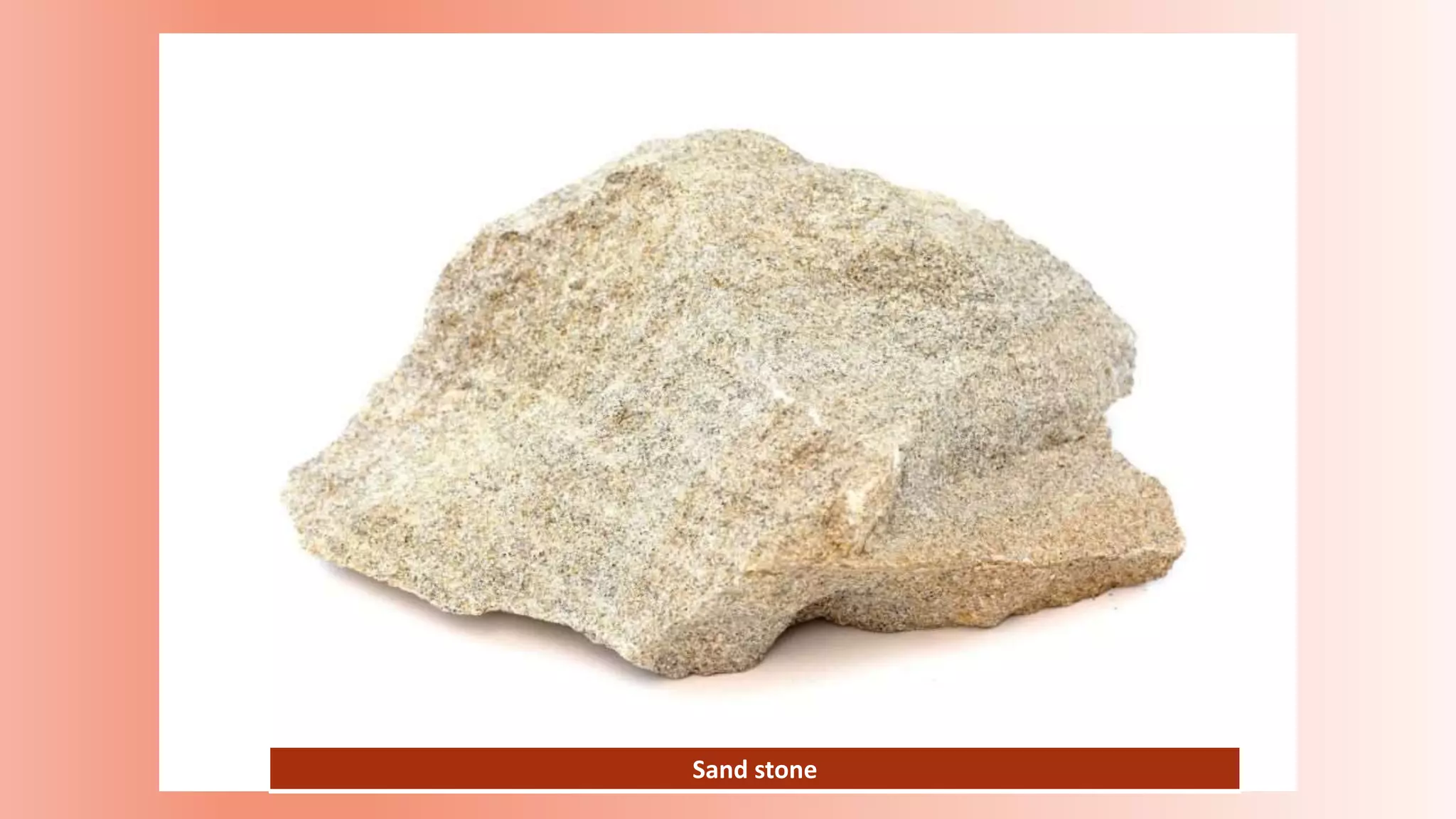
Sand stone
• Sandstone are formed by the cementation of sand grains.
• Any deposit of sand can be lithify to sand stone.
• Like river deposits sand and their channels and wind piles up sand
into dunes. Waves deposit sand on beaches in shallow water. Deep
sea currents spread sand over the sea floor.
• Sand stone show a great deal of variation in mineral composition,
degree of storing and degree of rounding.
Sand stone
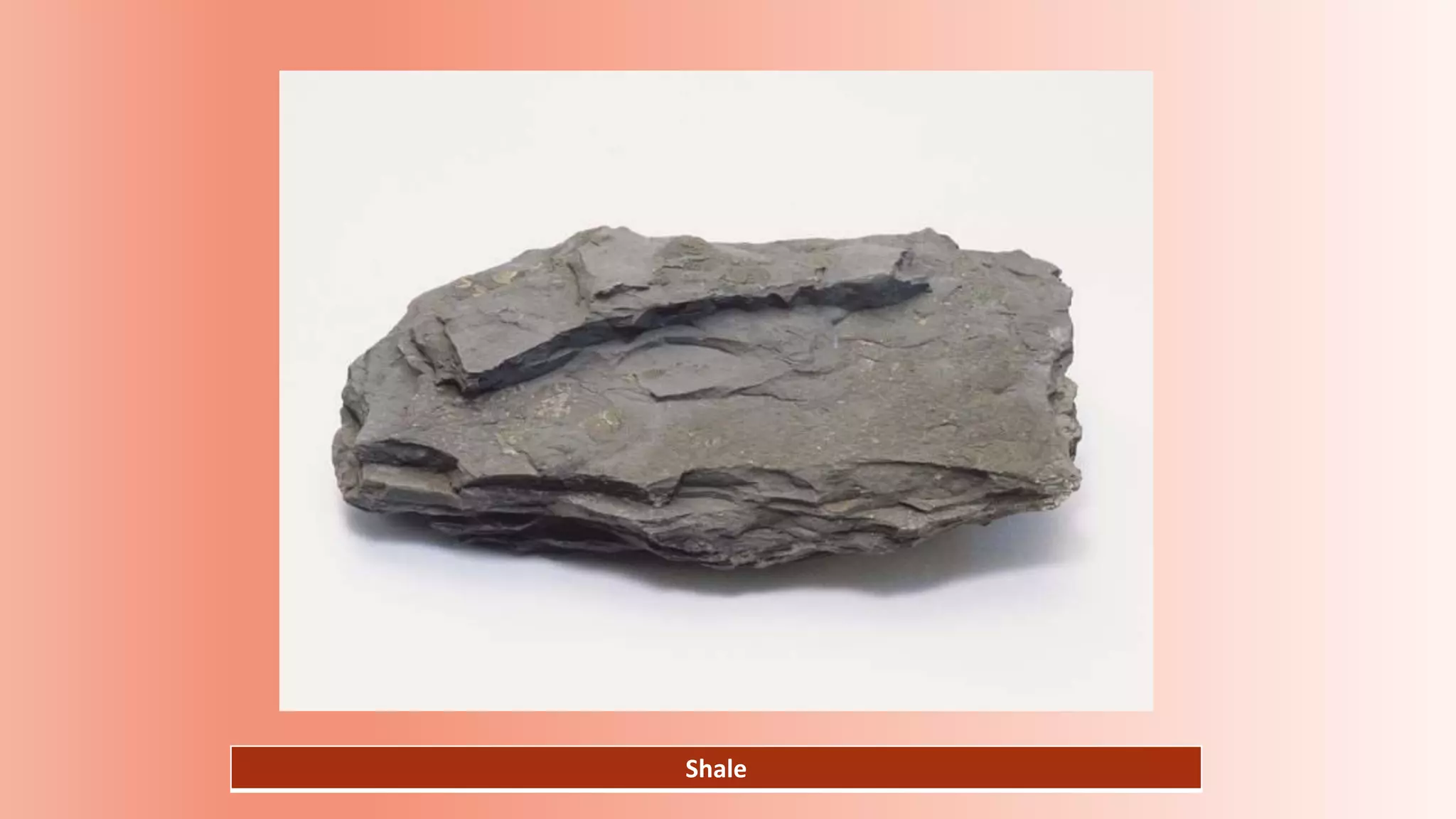
Shale
• Shale is fine grained clastic sedimentary rocks composed of mud that
is mixed of flakes of clay minerals and tiny fragments ( silt sized
particles ) of other minerals especially , quartz and calcite.
• The ratio of clay minerals is variable.
• Shale is characterized by breaks along thin laminae or parallel laying
or bedding less than one centimeter in thickness called fissility (
fissility refres to the property of rocks to splits along planes of
weakness into thin sheet)
Shale
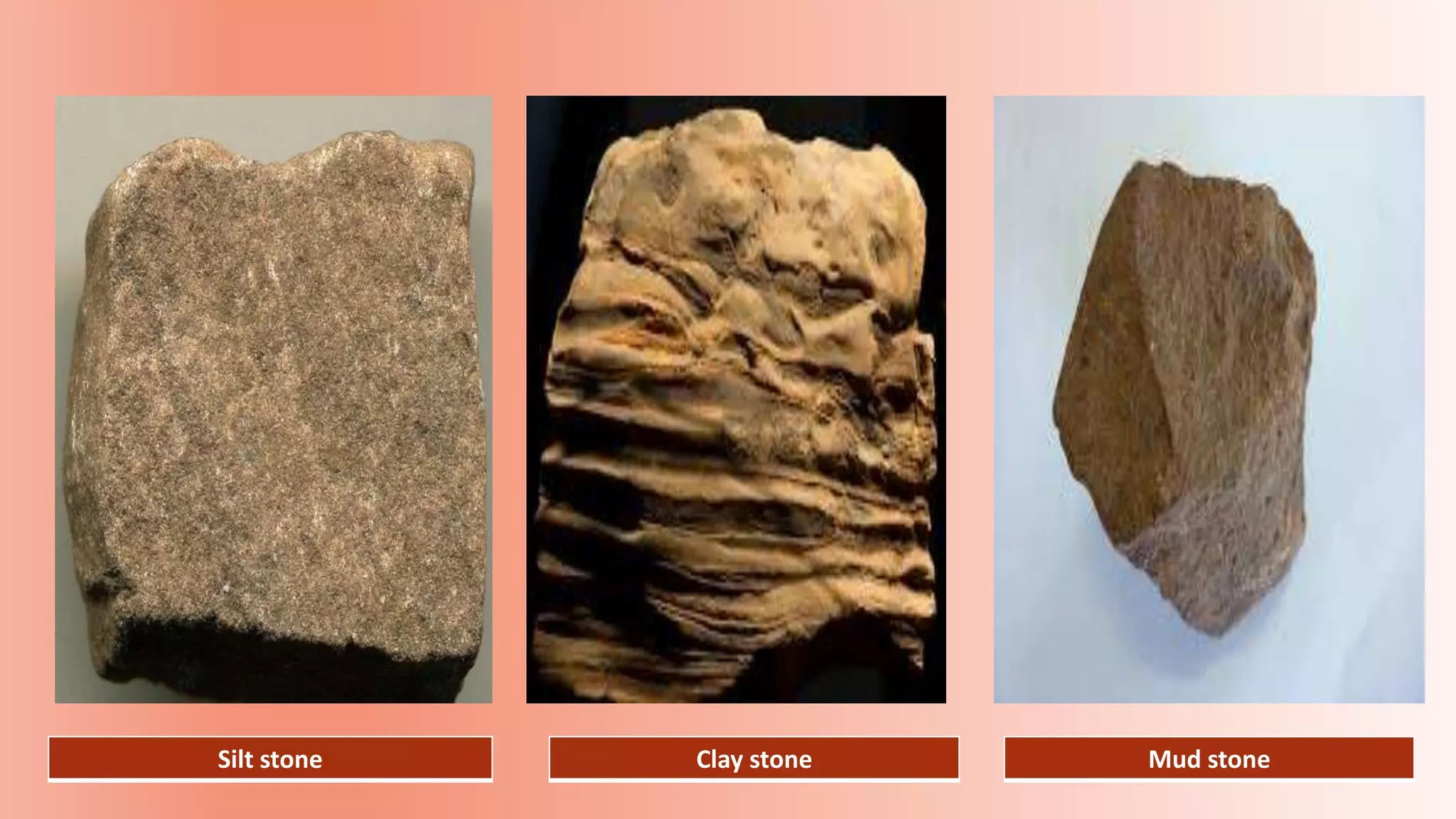
Silt stone, claystone and mud stone
• A rock consisting of mainly silt grain is called slit stone. They lack the
fissility and lamination of shale
• Claystone is rock composed of predominately of clay sized particles
but lacking the fissility of shale
• Mudstone contains both silt and clay having the same grain size and
smooth feel of shale but lacking the shales lamination and fissilit.
mudstone is massive and blocky, while shale is visible layered and
fissile.
Silt stone Clay stone Mud stone
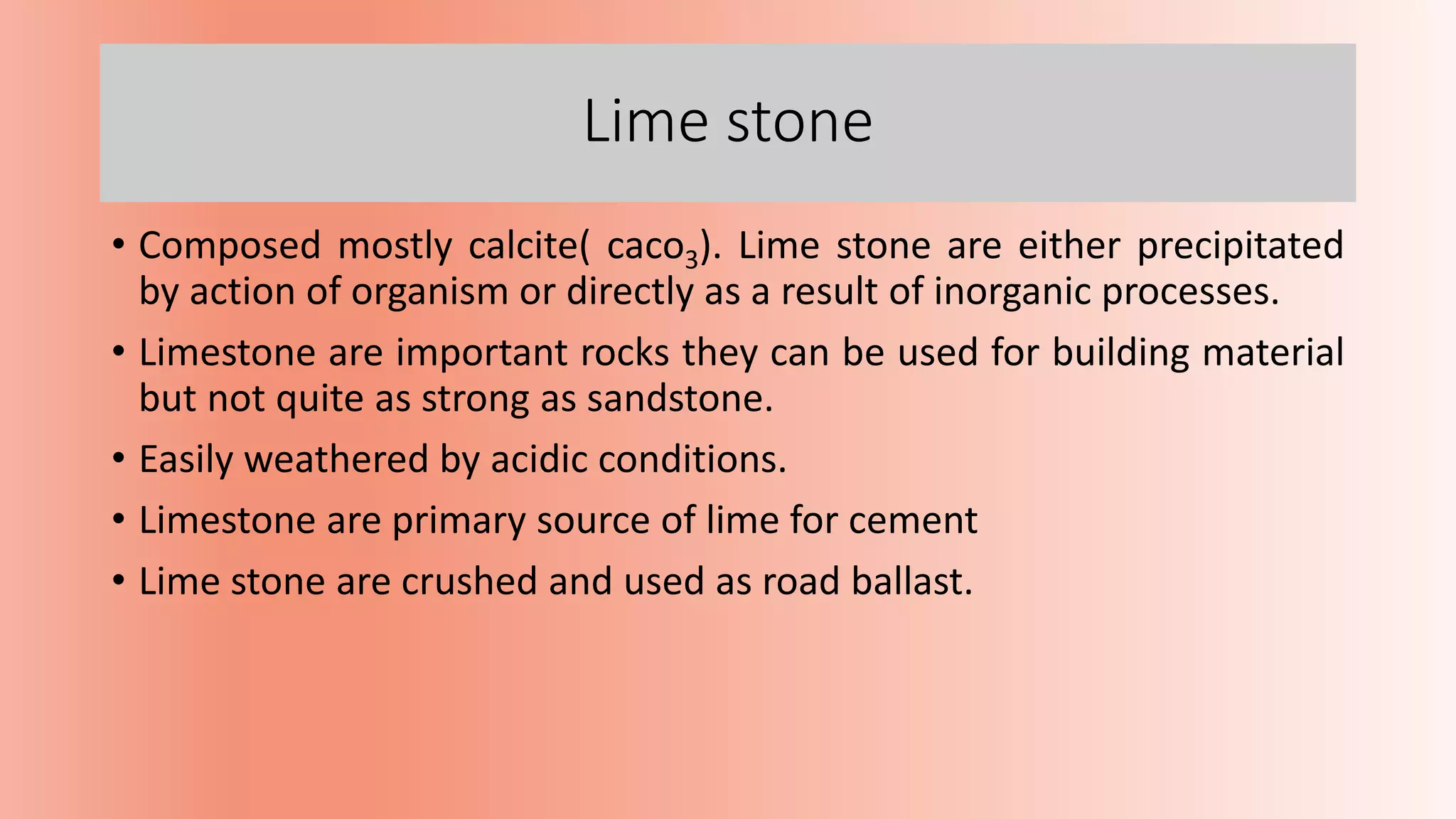
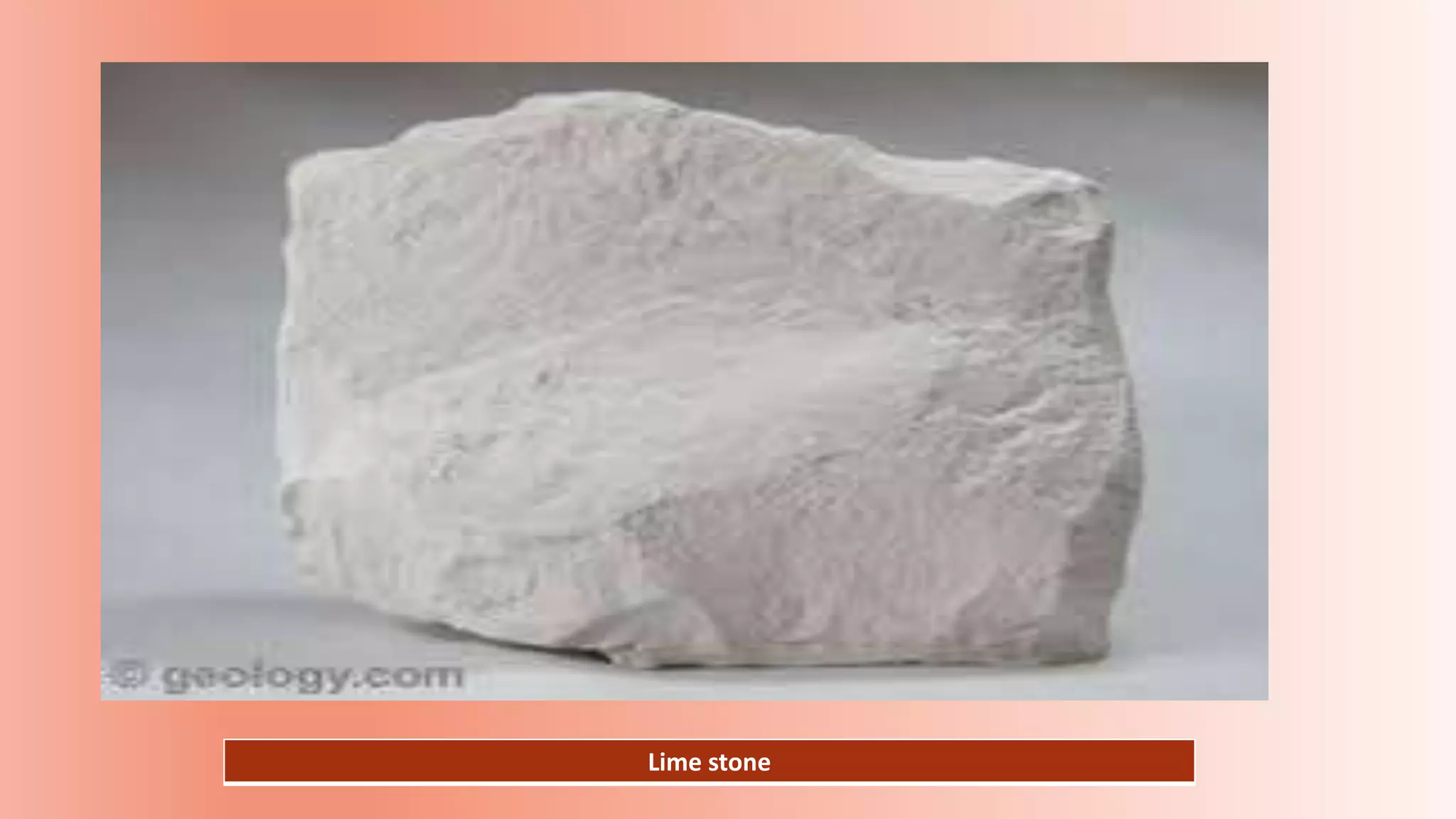
Lime stone
• Composed mostly calcite( caco3). Lime stone are either precipitated
by action of organism or directly as a result of inorganic processes.
• Limestone are important rocks they can be used for building material
but not quite as strong as sandstone.
• Easily weathered by acidic conditions.
• Limestone are primary source of lime for cement
• Lime stone are crushed and used as road ballast.
Lime stone
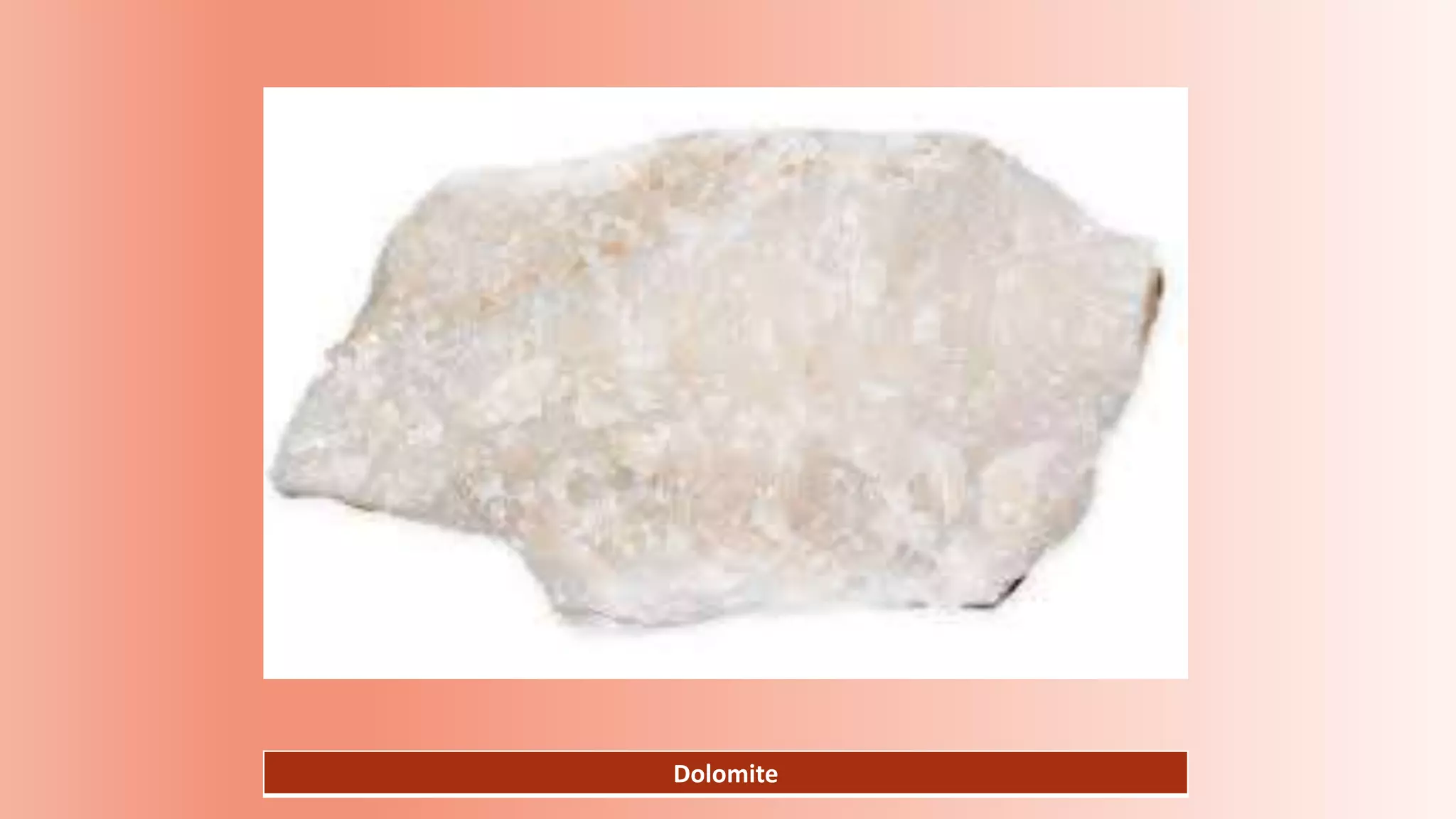
Dolomite
• They are rocks which contain the double carbonate Mgco3.Caco3.
• Dolomite name is used for the mineral as well as for rock.
• Dolomite is usually used as high quality construction aggregates
• It is found in asphalt mixes for roads streets, high strength concrete
mixes high residential bridges
• It is also used to create drainage layers under high volume roads and
is found in uncontaminated construction fill.
Dolomite
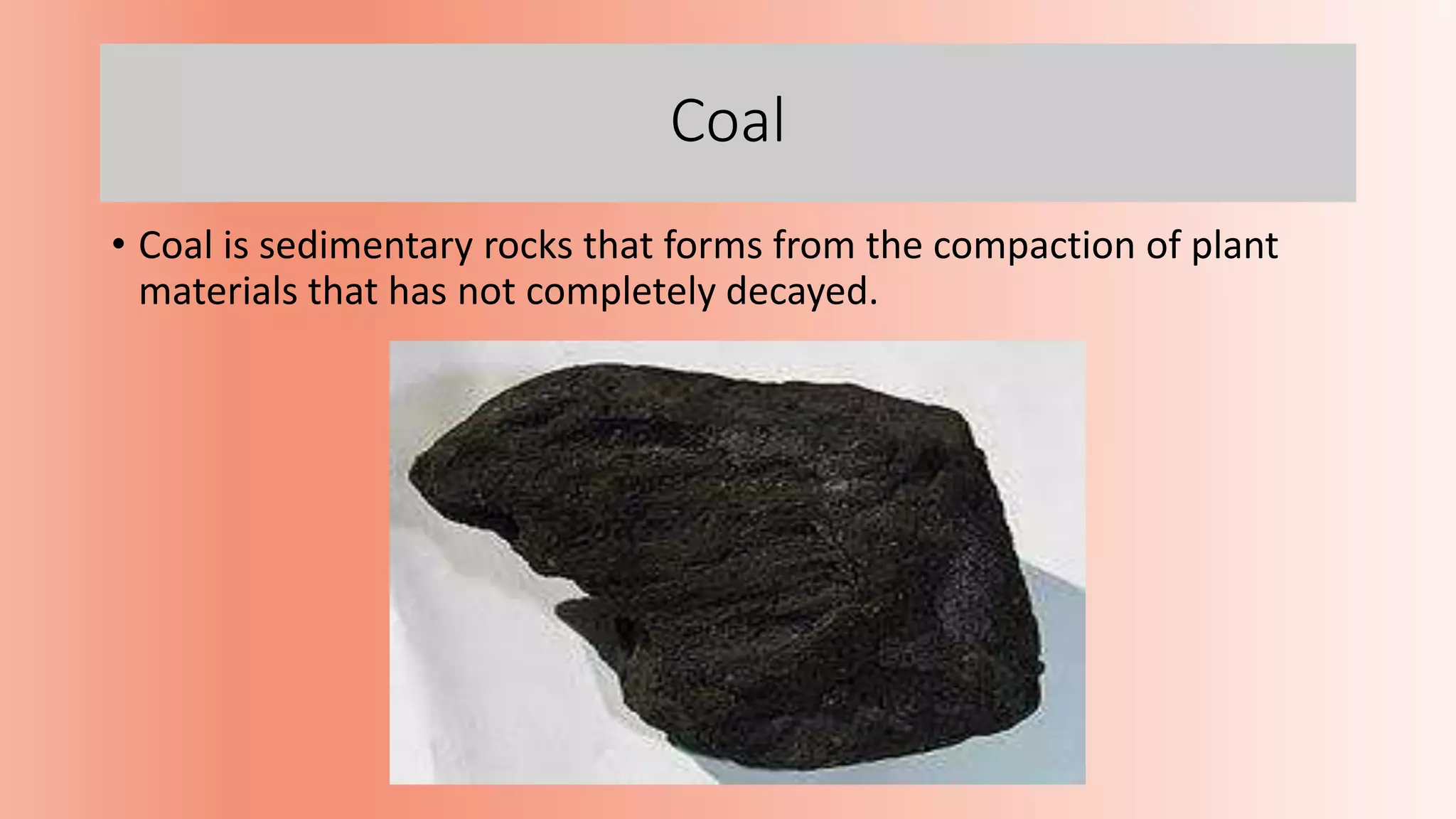
Coal
• Coal is sedimentary rocks that forms from the compaction of plant
materials that has not completely decayed.
 Metamorphic Rocks
Metamorphic rock arise from the transformation of existing rock types
in a process called metamorphism, which means ‘change in forms’
when the pre-existing rock ( sedimentary or igneous rocks) are
subjected to increased temperature, pressure and action of chemically
active fluids, metamorphic rocks are formed. During metamorphism re
crystallization of mineral constituent take place, as a result new
materials and new texture are produced. Metamorphic process
generally improve the engineering behavior of these rocks by
increasing their hardness and strength. Nevertheless, some
metamorphic rocks still can be problematic
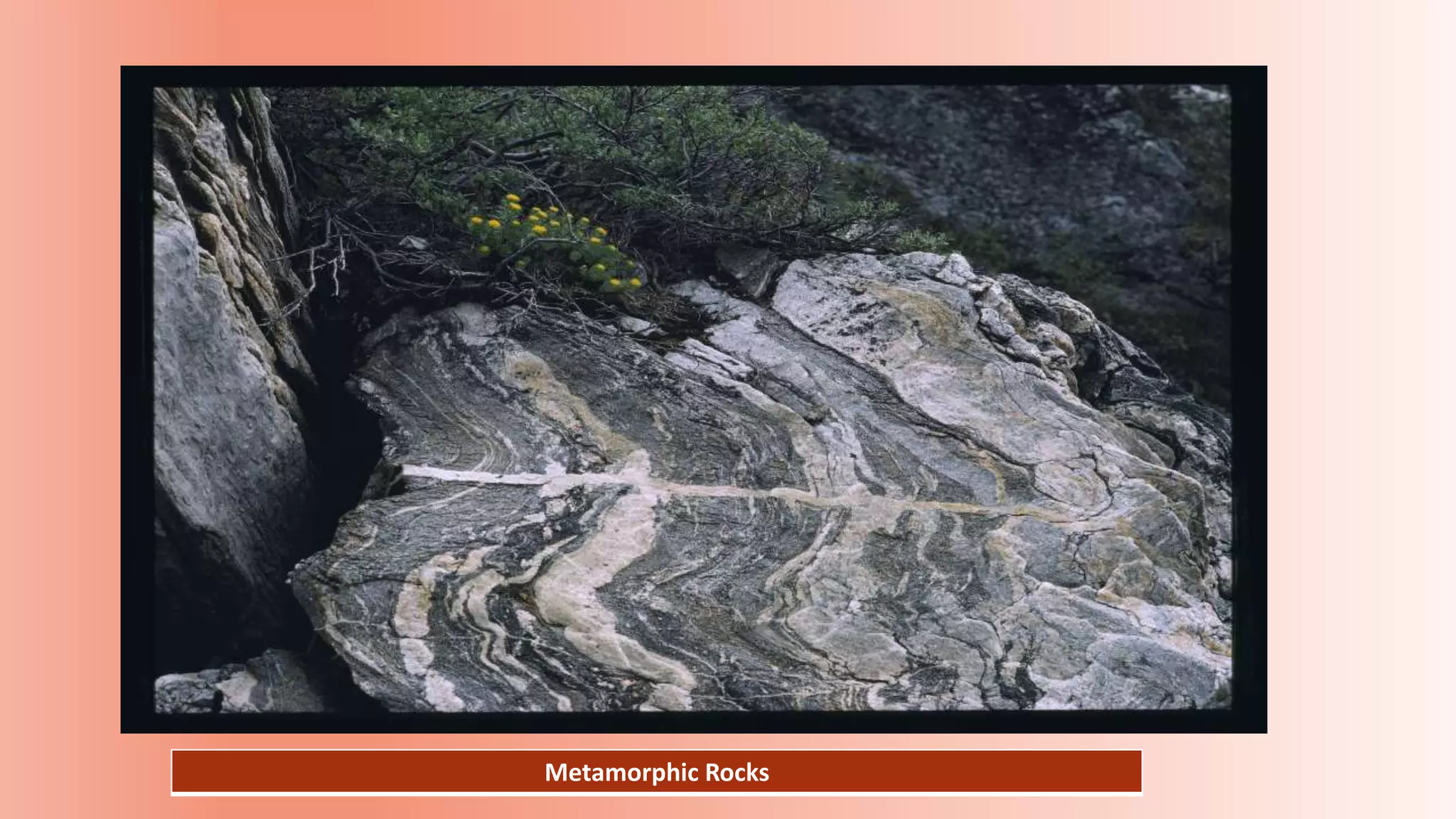
Metamorphic Rocks
Classification of metamorphic rocks
Foliated rocks: it consist of schist , slate, phyllite, gneiss
 Non- foliated metamorphic rocks. It consist of marble, quartz,
amphibolite, hornfels etc.
Examples
• Gneiss
• Schist
• Quartzite
• marble
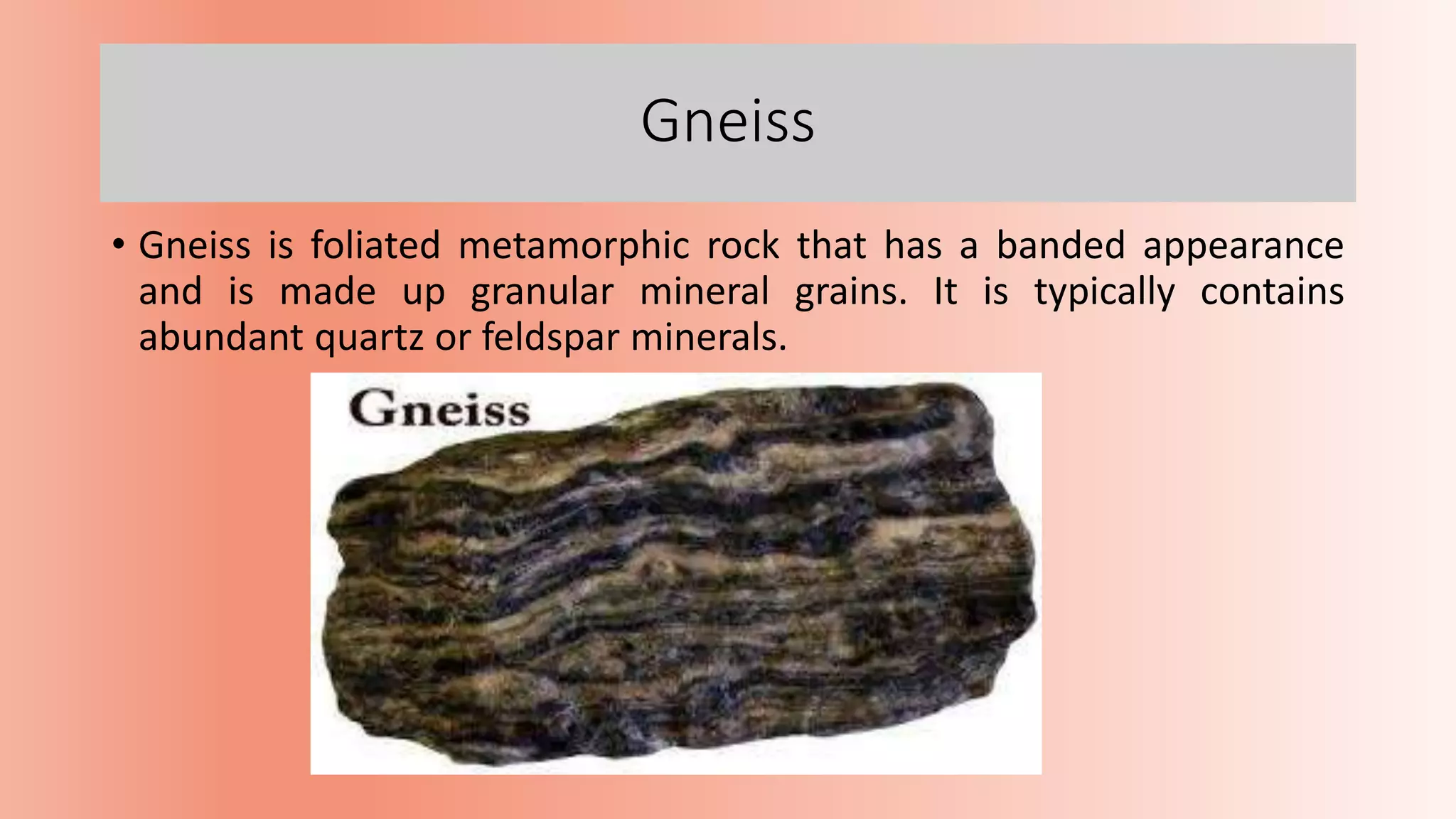
Gneiss
• Gneiss is foliated metamorphic rock that has a banded appearance
and is made up granular mineral grains. It is typically contains
abundant quartz or feldspar minerals.
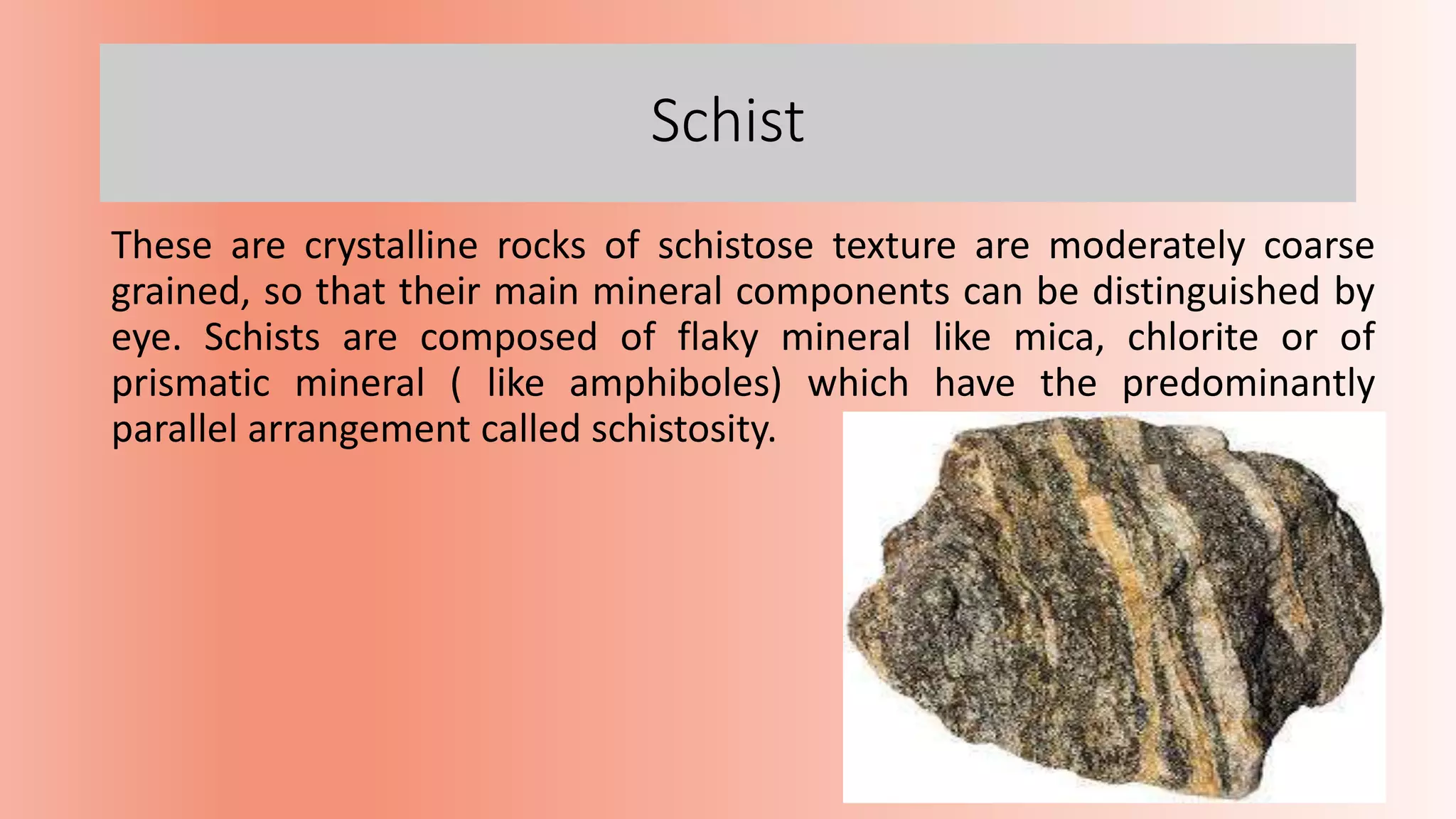
Schist
These are crystalline rocks of schistose texture are moderately coarse
grained, so that their main mineral components can be distinguished by
eye. Schists are composed of flaky mineral like mica, chlorite or of
prismatic mineral ( like amphiboles) which have the predominantly
parallel arrangement called schistosity.
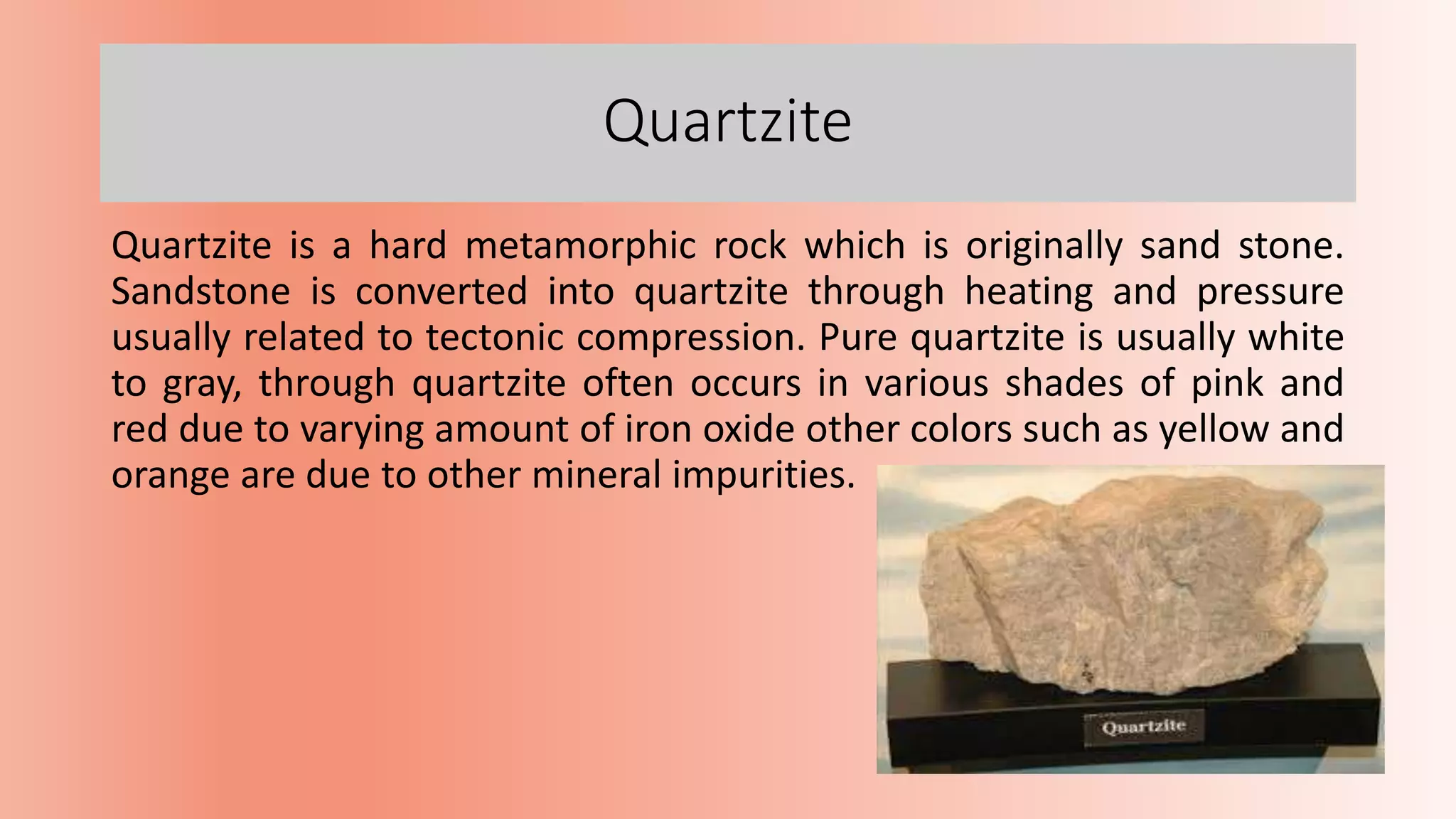
Quartzite
Quartzite is a hard metamorphic rock which is originally sand stone.
Sandstone is converted into quartzite through heating and pressure
usually related to tectonic compression. Pure quartzite is usually white
to gray, through quartzite often occurs in various shades of pink and
red due to varying amount of iron oxide other colors such as yellow and
orange are due to other mineral impurities.
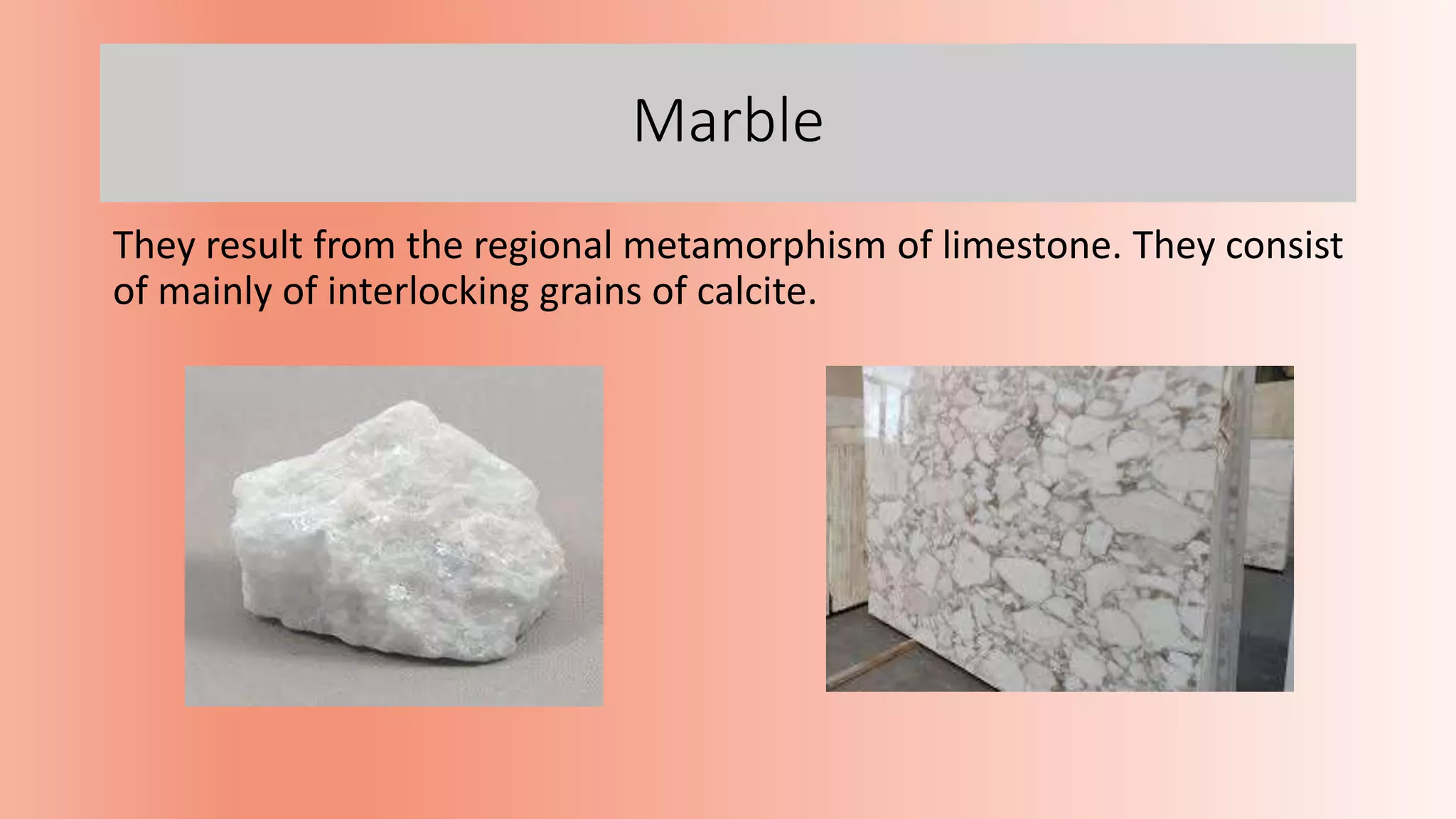
Marble
They result from the regional metamorphism of limestone. They consist
of mainly of interlocking grains of calcite.
Questions and answers
Thanks

Lecture # 02, 03 316 geology and earth quake engineering 5th

  • 1.
    CT 316 Geology& Earthquake Engineering Lecture# 02& 03 (5th semester Civil) By: Engr. Hayat Hussain Lecturer Saidu polytechnic institute saidu sharif Swat
  • 2.
    Rock • Geologist: geologistdefine rock as aggregates or mass composed of one or more commonly several of minerals. There are few exception to this rule: not all rocks are composed of minerals for example coal. • Engineer: engineer define to be a hard, durable material that can not be excavated without blasting the definition is based on strength and durability.
  • 3.
    The rock cycle Itis a group of changes igneous rock can change into sedimentary rock or into metamorphic or into igneous rock. Metamorphic rock can change into igneous or sedimentary rock. Explanation: Igneous rocks form when the magma cools and make crystals. Magma is hot liquid made of melted minerals. The minerals can form crystal when they cool. Igneous rocks can form underground, where the magma cools slowly or igneous rock can form above ground , where the magma cools quickly. When it pours out on the earth’s surface magma is called lava. Wind and water can break rock into pieces..
  • 4.
    They can seecarry rock pieces to another place, usually the rock pieces is called sediments After long time the sediments can cemented together to make sedimentary rocks in this way igneous rock can become sedimentary rock. When sedimentary rocks heated under pressure it form metamorphic therefore sedimentary rocks are converted to metamorphic rocks. And when melts form magma again. The rock cycle never stops.
  • 6.
    Types of rocks Igneous Rocks  Sedimentary Rocks  Metamorphic rocks
  • 7.
     Igneous rock Thegeological cycle begins with magma, a molten rock deep inside the earth . This magma cools as it moves upward towards the ground surface forming igneous rocks.
  • 8.
    Classification of igneousRocks On the basis of texture ( size, shape and arrangement of mineral grain in rock) and mode of occurrence, igneous rocks is divided broadly into three types. Intrusive (plutonic) Rocks Extrusive ( volcanic) rocks Hypabyssal Rocks.
  • 9.
     intrusive (plutonic)rocks. It is form below the ground surface, where they cool slowly and as result the rocks are coarse grained. The mineral grain in such rock can generally be identified with naked eye. such as granite. Intrusive igneous rocks
  • 10.
     Extrusive (volcanic) Rocks Extrusive rocks arrive at the ground surface in molten state, such as through volcanic eruption. This type of igneous rocks cools very rapidly, therefore they are fine grained. Extrusive igneous Rocks
  • 11.
    Hypabyssal Rocks Hypabyssal rocksare formed at a depth in between the plutonic and volcanic rocks. Hypabyssal Rocks
  • 12.
    Examples of igneousRocks  Granite  Diorite  Syenite  Pumic  Basalt
  • 13.
    Granite • It iscoarse grained intrusive rock • It is mostly light in color with white pink • It is an excellent forest resistance • Granite is hard and abrasion resistant • The compressive strength of granite is on average 24500psi • Specific gravity of granite is 2.6- 2.7
  • 14.
  • 15.
    Diorite • It iscoarse grained, an intrusive rock • It is a relatively rare rock • It is used for crushed stone decorative and structural purposes • Diorite is an extremely hard rock • It to be worked finely and take a high polish and provide a durable finished work. • Specific gravity of diorite is 2.7- 2.85
  • 16.
  • 17.
    Syenite • It iscoarse grained intrusive rock • The general properties of syenite are similar to granite • It is of little commercial use as structural material
  • 18.
    Pumic • Pumic rocksare igneous rocks which were formed when lava cooled quickly above the ground. • This rock is so light, that may pumic rocks will float in water. • Pumic is actually a kind of glass and not a mixture of minerals. • It is used quite often as decorative landscape stone.
  • 19.
    Basalt • Basalt isan extrusive or intrusive rock that makes up most of the world oceanic crust. • Basalt is fine grained so that individual minerals are not visible. • Basalt is used in construction • Specific gravity of basalt is 2.7 to 2.9
  • 20.
     Sedimentary Rock Thedisintegrated product pre-existing rocks are transported by water as sediment. This sediment gets deposited in suitable depression of earth where it gets consolidated and cemented. Sedimentary rock is formed by deposition and consolidation of minerals from solution. The process that form sedimentary rock occurs, at the surface of earth and with bodies of water.
  • 21.
    Classification of sedimentaryRocks Clastic sedimentary rocks Chemical sedimentary rocks Organic sedimentary rocks
  • 22.
    Clastic sedimentary rocks Theserocks are formed from lithification of sediments. Most of sedimentary rocks are clastic. Rocks formed and cemented sediments grains that are fragments of pre existing rocks, the rock fragments can either identifiable piece of rock, such as pebbles of granite or shale or individual mineral grains, such as sand sized quartz and feldspar cystals lossened from rocks by weathering and erosion. Clay minerals formed by chemical weathering are also considered fragments of preesting rocks. During transportation, the grains may have been rounded and sorted.
  • 24.
    Chemical sedimentary Chemical sedimentaryrocks are deposited by precipitation of mineral from solution. An example of inorganic precipitation is the formation of rock salt as seawater evaporates. Chemical precipitation can also caused by organism. Lime stone, a sedimentary rocks, for instance, can form by precipitation of calcite with in a coral reef by corals and algae, such a rock is classified as bio chemical lime stone.
  • 26.
    Organic sedimentary rocks Theserocks are formed from the consolidation of remains of plants and animals. They accumulate from the remains of organism. Coal is organic rock that from the compression of plant remains such as moss ( small soft plant) leaves, twinges ( the terminal branch) roots, and tree trunks.
  • 27.
  • 28.
    Examples of sedimentaryrocks • Sedimentary breccia • Sand stone • Shale • Siltstone • Lime stone • Dolomite • Coal
  • 29.
    Sedimentary breccia • Corsegrained rock formed by the cementation of coarse, angular fragments of rubble. • Because of grains rounded so rapidly during transport, it is unlikely that the angular fragments with in breccia have moved very far away from their source. • Sedimentary breccia might form from fragments that have accumulated at the base of steep slope of rock that is being mechanically weathered. • Landslides deposits also might lithify into sedimentary breccia.
  • 30.
  • 31.
    Sand stone • Sandstoneare formed by the cementation of sand grains. • Any deposit of sand can be lithify to sand stone. • Like river deposits sand and their channels and wind piles up sand into dunes. Waves deposit sand on beaches in shallow water. Deep sea currents spread sand over the sea floor. • Sand stone show a great deal of variation in mineral composition, degree of storing and degree of rounding.
  • 32.
  • 33.
    Shale • Shale isfine grained clastic sedimentary rocks composed of mud that is mixed of flakes of clay minerals and tiny fragments ( silt sized particles ) of other minerals especially , quartz and calcite. • The ratio of clay minerals is variable. • Shale is characterized by breaks along thin laminae or parallel laying or bedding less than one centimeter in thickness called fissility ( fissility refres to the property of rocks to splits along planes of weakness into thin sheet)
  • 34.
  • 35.
    Silt stone, claystoneand mud stone • A rock consisting of mainly silt grain is called slit stone. They lack the fissility and lamination of shale • Claystone is rock composed of predominately of clay sized particles but lacking the fissility of shale • Mudstone contains both silt and clay having the same grain size and smooth feel of shale but lacking the shales lamination and fissilit. mudstone is massive and blocky, while shale is visible layered and fissile.
  • 36.
    Silt stone Claystone Mud stone
  • 37.
    Lime stone • Composedmostly calcite( caco3). Lime stone are either precipitated by action of organism or directly as a result of inorganic processes. • Limestone are important rocks they can be used for building material but not quite as strong as sandstone. • Easily weathered by acidic conditions. • Limestone are primary source of lime for cement • Lime stone are crushed and used as road ballast.
  • 38.
  • 39.
    Dolomite • They arerocks which contain the double carbonate Mgco3.Caco3. • Dolomite name is used for the mineral as well as for rock. • Dolomite is usually used as high quality construction aggregates • It is found in asphalt mixes for roads streets, high strength concrete mixes high residential bridges • It is also used to create drainage layers under high volume roads and is found in uncontaminated construction fill.
  • 40.
  • 41.
    Coal • Coal issedimentary rocks that forms from the compaction of plant materials that has not completely decayed.
  • 42.
     Metamorphic Rocks Metamorphicrock arise from the transformation of existing rock types in a process called metamorphism, which means ‘change in forms’ when the pre-existing rock ( sedimentary or igneous rocks) are subjected to increased temperature, pressure and action of chemically active fluids, metamorphic rocks are formed. During metamorphism re crystallization of mineral constituent take place, as a result new materials and new texture are produced. Metamorphic process generally improve the engineering behavior of these rocks by increasing their hardness and strength. Nevertheless, some metamorphic rocks still can be problematic
  • 43.
  • 44.
    Classification of metamorphicrocks Foliated rocks: it consist of schist , slate, phyllite, gneiss  Non- foliated metamorphic rocks. It consist of marble, quartz, amphibolite, hornfels etc.
  • 45.
  • 46.
    Gneiss • Gneiss isfoliated metamorphic rock that has a banded appearance and is made up granular mineral grains. It is typically contains abundant quartz or feldspar minerals.
  • 47.
    Schist These are crystallinerocks of schistose texture are moderately coarse grained, so that their main mineral components can be distinguished by eye. Schists are composed of flaky mineral like mica, chlorite or of prismatic mineral ( like amphiboles) which have the predominantly parallel arrangement called schistosity.
  • 48.
    Quartzite Quartzite is ahard metamorphic rock which is originally sand stone. Sandstone is converted into quartzite through heating and pressure usually related to tectonic compression. Pure quartzite is usually white to gray, through quartzite often occurs in various shades of pink and red due to varying amount of iron oxide other colors such as yellow and orange are due to other mineral impurities.
  • 49.
    Marble They result fromthe regional metamorphism of limestone. They consist of mainly of interlocking grains of calcite.
  • 50.
  • 51.

Editor's Notes

  • #2 By: Engineer Hayat Hussain Lecturer SPI swat.