EARTH MATERIALS
AND PROCESSES
Content
Standard
Learning Competencies
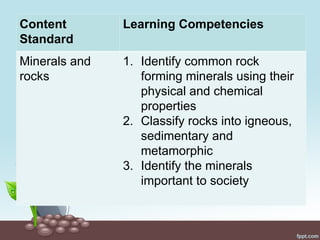
Minerals and
rocks
1. Identify common rock
forming minerals using their
physical and chemical
properties
2. Classify rocks into igneous,
sedimentary and
metamorphic
3. Identify the minerals
important to society
Content
Standard
Learning Competencies
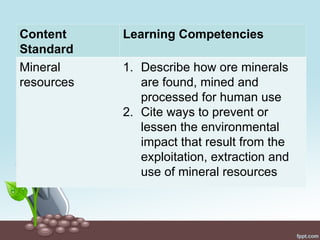
Mineral
resources
1. Describe how ore minerals
are found, mined and
processed for human use
2. Cite ways to prevent or
lessen the environmental
impact that result from the
exploitation, extraction and
use of mineral resources
Minerals and Rocks
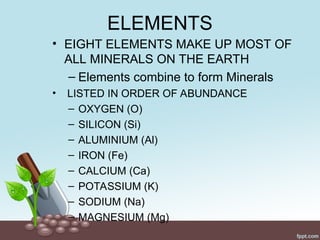
ELEMENTS
• EIGHT ELEMENTS MAKE UP MOST OF
ALL MINERALS ON THE EARTH
– Elements combine to form Minerals
• LISTED IN ORDER OF ABUNDANCE
– OXYGEN (O)
– SILICON (Si)
– ALUMINIUM (Al)
– IRON (Fe)
– CALCIUM (Ca)
– POTASSIUM (K)
– SODIUM (Na)
– MAGNESIUM (Mg)
MINERALS
• BUILDING BLOCKS FOR ROCKS
• DEFINITION:
– naturally occurring, inorganic solids,
consisting of specific chemical elements, and
a definite atomic array
• CRYSTALLINE STRUCTURE – ‘CRYSTAL’
MINERALS
• MINERALS: TWO CATEGORIES
– SILICATES – CONTAIN SILICON &
OXYGEN MOLECULES (SiO)
– NON-SILICATES (NO SiO)
NON-SILICATE MINERALS
• Make up 5% of Earth’s crust
• Native metals: gold, silver, copper
• Carbonates: calcite (used in cement)
• Oxides: hematite (iron ores)
• Sulfides: galena (lead ores)
• Sulfates: gypsum (used in plaster)
SILICATE MINERALS
• Make up 90-95% of the Earth’s
Crust
• Dominant component of most rocks,
include:
–QUARTZ (SiO2)
–FELDSPARS
–MICAS
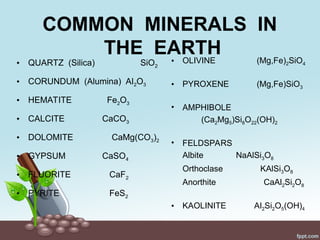
COMMON MINERALS IN
THE EARTH
• QUARTZ (Silica) SiO2
• CORUNDUM (Alumina) Al2O3
• HEMATITE Fe2O3
• CALCITE CaCO3
• DOLOMITE CaMg(CO3)2
• GYPSUM CaSO4
• FLUORITE CaF2
• PYRITE FeS2
• OLIVINE (Mg,Fe)2SiO4
• PYROXENE (Mg,Fe)SiO3
• AMPHIBOLE
(Ca2Mg5)Si8O22(OH)2
• FELDSPARS
Albite NaAlSi3O8
Orthoclase KAlSi3O8
Anorthite CaAl2Si2O8
• KAOLINITE Al2Si2O5(OH)4
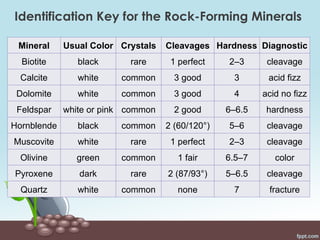
Mineral Usual Color Crystals Cleavages Hardness Diagnostic
Biotite black rare 1 perfect 2–3 cleavage
Calcite white common 3 good 3 acid fizz
Dolomite white common 3 good 4 acid no fizz
Feldspar white or pink common 2 good 6–6.5 hardness
Hornblende black common 2 (60/120°) 5–6 cleavage
Muscovite white rare 1 perfect 2–3 cleavage
Olivine green common 1 fair 6.5–7 color
Pyroxene dark rare 2 (87/93°) 5–6.5 cleavage
Quartz white common none 7 fracture
Identification Key for the Rock-Forming Minerals
PHYSICAL PROPERTIES OF
MINERALS
•Crystal structure and habit: A
mineral may show good crystal
habit or form, or it may be massive,
granular or compact with only
microscopically visible crystals.
•Hardness: the physical hardness of
a mineral is usually measured
according to the Mohs scale. This
scale is relative and goes from 1 to
10. Minerals with a given Mohs
hardness can scratch the surface of
any mineral that has a lower
hardness than itself.
•Lustre indicates the way a
mineral's surface interacts with
light and can range from dull to
glassy (vitreous).
Metallic -high reflectivity like
metal: galena and pyrite
Sub-metallic -slightly less than
metallic reflectivity: magnetite
Non-metallic lusters:
oAdamantine - brilliant, the luster of
diamond also cerussite and anglesite
oVitreous -the luster of a broken glass:
quartz
oPearly - iridescent and pearl-like: talc and
apophyllite
oResinous - the luster of resin: sphalerite
and sulfur
oSilky - a soft light shown by fibrous
materials: gypsum and chrysotile
oDull/earthy -shown by finely crystallized
minerals: the kidney ore variety of hematite
• Colour indicates the appearance of
the mineral in reflected light or
transmitted light for translucent
minerals (i.e. what it looks like to the
naked eye).
Iridescence - the play of colors due
to surface or internal interference.
Labradorite exhibits internal
iridescence whereas hematite and
sphalerite often show the surface
effect.
•Streak refers to the colour of the
powder a mineral leaves after
rubbing it on an unglazed porcelain
streak plate. Note that this is not
always the same colour as the
original mineral.
•Cleavage describes the way a
mineral may split apart along various
planes. In thin sections, cleavage is
visible as thin parallel lines across a
mineral.
•Fracture describes how a mineral
breaks when broken contrary to its
natural cleavage planes.
Chonchoidal fracture is a smooth
curved fracture with concentric
ridges of the type shown by glass.
Hackley is jagged fracture with
sharp edges.
Fibrous
Irregular
• Specific gravity relates the
mineral mass to the mass of an
equal volume of water, namely the
density of the material. While most
minerals, including all the common
rock-forming minerals, have a
specific gravity of 2.5 - 3.5, a few
are noticeably more or less dense,
e.g. several sulfide minerals have
high specific gravity compared to
the common rock-forming
minerals.
•Other properties: fluorescence
(response to ultraviolet light),
magnetism, radioactivity, tenacity
(response to mechanical induced
changes of shape or form),
piezoelectricity and reactivity to
dilute acids.
ROCKS
• AGGREGATIONS OF 2 OR MORE
MINERALS
– Same or different minerals combine
together
• THREE CATEGORIES
– IGNEOUS
– SEDIMENTARY
– METAMORPHIC
IGNEOUS ROCKS
• FORMED FROM COOLED,
SOLIDIFIED MOLTEN MATERIAL, AT
OR BELOW THE SURFACE
• PLUTONIC – INTRUSIVE: COOLED
BELOW SURFACE AT GREAT
DEPTHS
• VOLCANIC – EXTRUSIVE: COOLED
AT OR NEAR THE SURFACE
THROUGH VOLCANIC ERUPTIONS
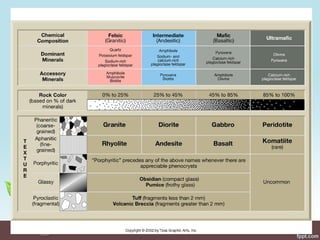
IDENTIFICATION OF IGNEOUS
ROCKS
• IDENTIFICATION PROCESSES:
–TEXTURE:
• Size, shape and manner of growth of
individual crystals
–MINERAL COMPOSITION
• Based on SiO content
Intrusive igneous rocks
Cooled below surface at
great depths
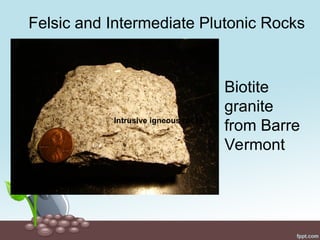
Felsic and Intermediate Plutonic Rocks
Biotite
granite
from Barre
Vermont
Intrusive igneous rocks
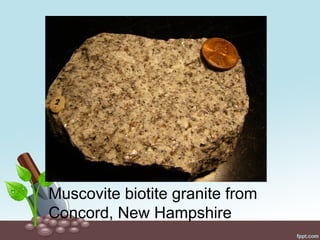
Muscovite biotite granite from
Concord, New Hampshire
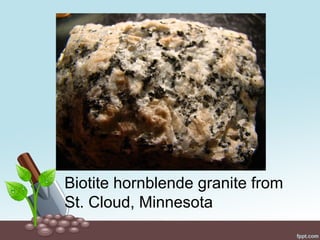
Biotite hornblende granite from
St. Cloud, Minnesota
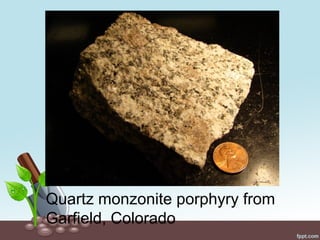
Quartz monzonite porphyry from
Garfield, Colorado
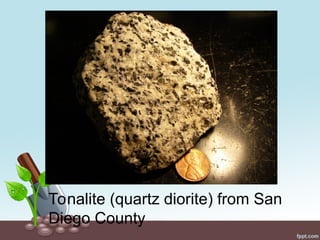
Tonalite (quartz diorite) from San
Diego County
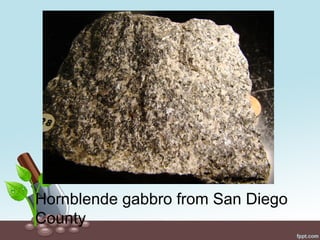
Hornblende gabbro from San Diego
County
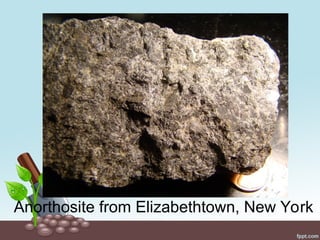
Anorthosite from Elizabethtown, New York
Extrusive igneous rocks
Cooled at or near the
surface through volcanic
eruptions
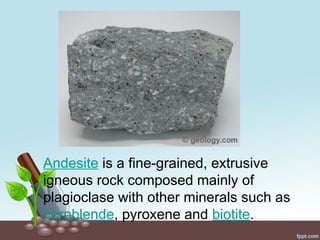
Andesite is a fine-grained, extrusive
igneous rock composed mainly of
plagioclase with other minerals such as
hornblende, pyroxene and biotite.
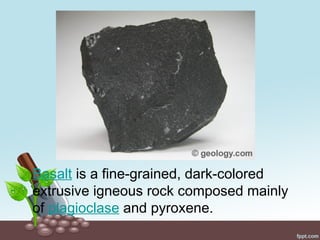
Basalt is a fine-grained, dark-colored
extrusive igneous rock composed mainly
of plagioclase and pyroxene.
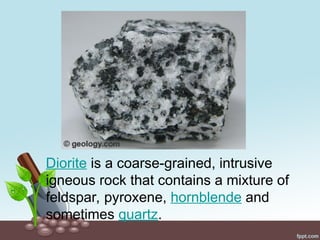
Diorite is a coarse-grained, intrusive
igneous rock that contains a mixture of
feldspar, pyroxene, hornblende and
sometimes quartz.
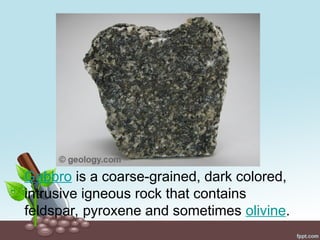
Gabbro is a coarse-grained, dark colored,
intrusive igneous rock that contains
feldspar, pyroxene and sometimes olivine.
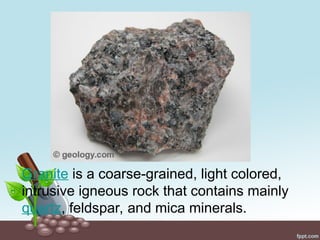
Granite is a coarse-grained, light colored,
intrusive igneous rock that contains mainly
quartz, feldspar, and mica minerals.
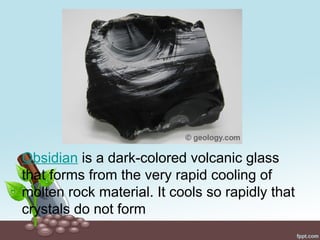
Obsidian is a dark-colored volcanic glass
that forms from the very rapid cooling of
molten rock material. It cools so rapidly that
crystals do not form
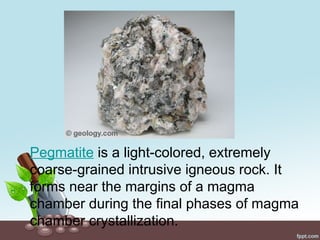
Pegmatite is a light-colored, extremely
coarse-grained intrusive igneous rock. It
forms near the margins of a magma
chamber during the final phases of magma
chamber crystallization.
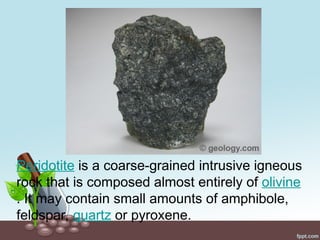
Peridotite is a coarse-grained intrusive igneous
rock that is composed almost entirely of olivine
. It may contain small amounts of amphibole,
feldspar, quartz or pyroxene.
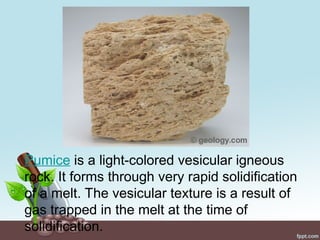
Pumice is a light-colored vesicular igneous
rock. It forms through very rapid solidification
of a melt. The vesicular texture is a result of
gas trapped in the melt at the time of
solidification.
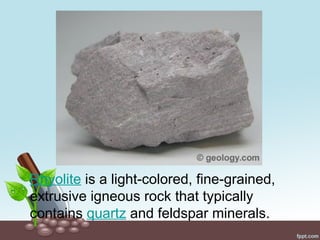
Rhyolite is a light-colored, fine-grained,
extrusive igneous rock that typically
contains quartz and feldspar minerals.
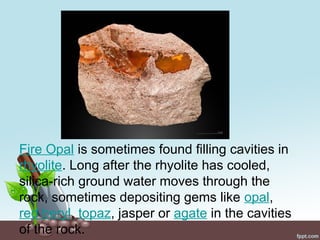
Fire Opal is sometimes found filling cavities in
rhyolite. Long after the rhyolite has cooled,
silica-rich ground water moves through the
rock, sometimes depositing gems like opal,
red beryl, topaz, jasper or agate in the cavities
of the rock.
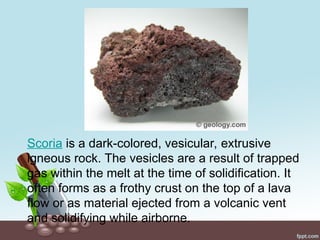
Scoria is a dark-colored, vesicular, extrusive
igneous rock. The vesicles are a result of trapped
gas within the melt at the time of solidification. It
often forms as a frothy crust on the top of a lava
flow or as material ejected from a volcanic vent
and solidifying while airborne.
SEDIMENTARY ROCKS
• Weathering processes break rock
into pieces, sediment, ready for
transportation deposition burial
lithification into new rocks.
CLASSIFYING SEDIMENTARY ROCKS
THREE SOURCES
• Detrital (or clastic) sediment is composed
of transported solid fragments (or detritus)
of pre-existing igneous, sedimentary or
metamorphic rocks
• Chemical sediment forms from previously
dissolved minerals that either precipitated
from solution in water , or were extracted
from water by living organisms
• Organic sedimentary rock consisting mainly
of plant remains
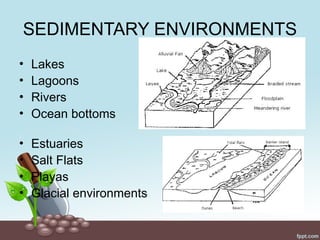
SEDIMENTARY ENVIRONMENTS
• Lakes
• Lagoons
• Rivers
• Ocean bottoms
• Estuaries
• Salt Flats
• Playas
• Glacial environments
SEDIMENTARY PROCESSES
• LITHIFICATION:
• As sediment is buried several kilometers beneath
the surface, heated from below, pressure from
overlying layers and chemically-active water
converts the loose sediment into solid
sedimentary rock
• Compaction - volume of a sediment is reduced
by application of pressure
• Cementation - sediment grains are bound to
each other by materials originally dissolved during
chemical weathering of preexisting rocks
– typical chemicals include silica and calcium
carbonate.
Clastic sedimentary rocks
such as breccia, conglomerate,
sandstone, siltstone, and shale
are formed from mechanical
weathering debris.
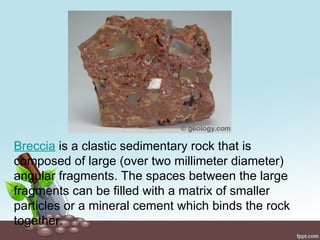
Breccia is a clastic sedimentary rock that is
composed of large (over two millimeter diameter)
angular fragments. The spaces between the large
fragments can be filled with a matrix of smaller
particles or a mineral cement which binds the rock
together.
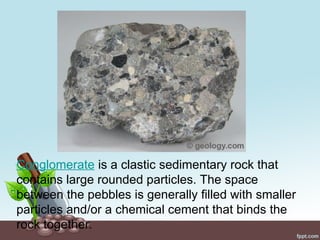
Conglomerate is a clastic sedimentary rock that
contains large rounded particles. The space
between the pebbles is generally filled with smaller
particles and/or a chemical cement that binds the
rock together.
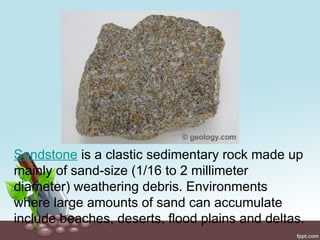
Sandstone is a clastic sedimentary rock made up
mainly of sand-size (1/16 to 2 millimeter
diameter) weathering debris. Environments
where large amounts of sand can accumulate
include beaches, deserts, flood plains and deltas.
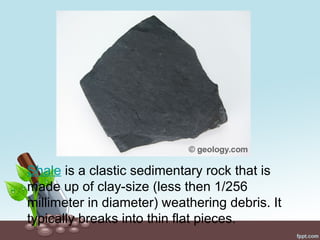
Shale is a clastic sedimentary rock that is
made up of clay-size (less then 1/256
millimeter in diameter) weathering debris. It
typically breaks into thin flat pieces.
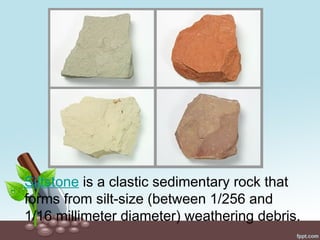
Siltstone is a clastic sedimentary rock that
forms from silt-size (between 1/256 and
1/16 millimeter diameter) weathering debris.
Chemical sedimentary
rocks, such as rock salt,
iron ore, chert, flint, some
dolomites, and some
limestones, form when
dissolved materials precipitate
from solution.
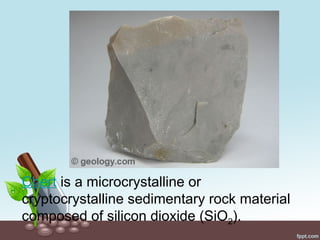
Chert is a microcrystalline or
cryptocrystalline sedimentary rock material
composed of silicon dioxide (SiO2).
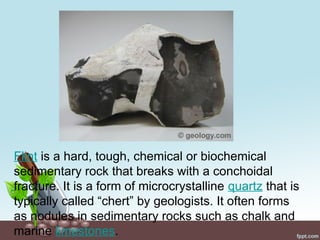
Flint is a hard, tough, chemical or biochemical
sedimentary rock that breaks with a conchoidal
fracture. It is a form of microcrystalline quartz that is
typically called “chert” by geologists. It often forms
as nodules in sedimentary rocks such as chalk and
marine limestones.
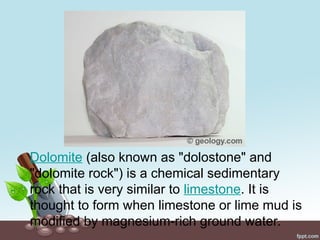
Dolomite (also known as "dolostone" and
"dolomite rock") is a chemical sedimentary
rock that is very similar to limestone. It is
thought to form when limestone or lime mud is
modified by magnesium-rich ground water.
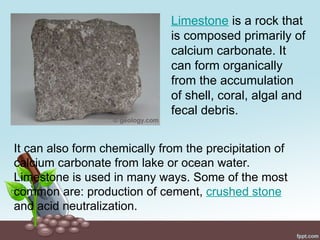
It can also form chemically from the precipitation of
calcium carbonate from lake or ocean water.
Limestone is used in many ways. Some of the most
common are: production of cement, crushed stone
and acid neutralization.
Limestone is a rock that
is composed primarily of
calcium carbonate. It
can form organically
from the accumulation
of shell, coral, algal and
fecal debris.
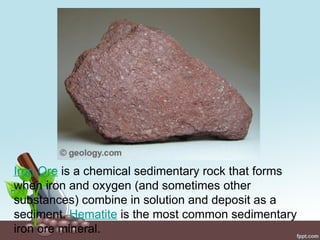
Iron Ore is a chemical sedimentary rock that forms
when iron and oxygen (and sometimes other
substances) combine in solution and deposit as a
sediment. Hematite is the most common sedimentary
iron ore mineral.
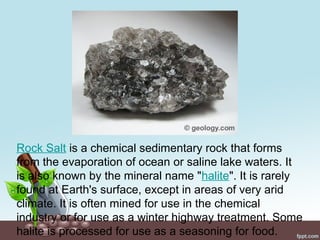
Rock Salt is a chemical sedimentary rock that forms
from the evaporation of ocean or saline lake waters. It
is also known by the mineral name "halite". It is rarely
found at Earth's surface, except in areas of very arid
climate. It is often mined for use in the chemical
industry or for use as a winter highway treatment. Some
halite is processed for use as a seasoning for food.
Organic sedimentary rocks such
as coal, some dolomites, and some
limestones, form from the
accumulation of plant or animal
debris.
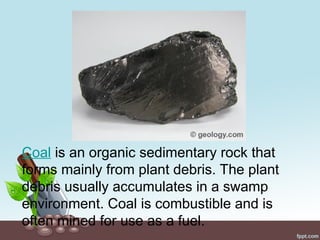
Coal is an organic sedimentary rock that
forms mainly from plant debris. The plant
debris usually accumulates in a swamp
environment. Coal is combustible and is
often mined for use as a fuel.
METAMORPHIC ROCKS
• METAMORPHISM : process by
which conditions within the Earth
alter the mineral content and
structure of any rock, igneous,
sedimentary or metamorphic, without
melting it.
• Metamorphism occurs when heat
and pressure exceed certain levels,
destabilizing the minerals in
rocks...but not enough to cause
melting
There are two basic types of
metamorphic rocks. Foliated
metamorphic rocks such as
gneiss, phyllite, schist, and slate
have a layered or banded
appearance that is produced by
exposure to heat and directed
pressure.
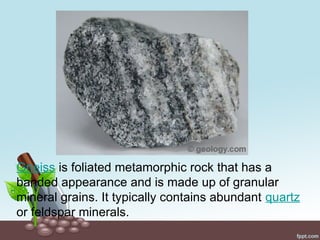
Gneiss is foliated metamorphic rock that has a
banded appearance and is made up of granular
mineral grains. It typically contains abundant quartz
or feldspar minerals.
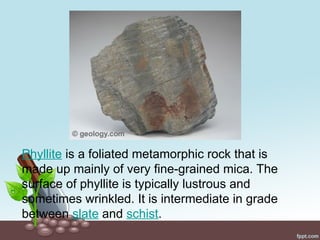
Phyllite is a foliated metamorphic rock that is
made up mainly of very fine-grained mica. The
surface of phyllite is typically lustrous and
sometimes wrinkled. It is intermediate in grade
between slate and schist.
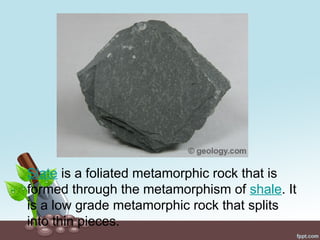
Slate is a foliated metamorphic rock that is
formed through the metamorphism of shale. It
is a low grade metamorphic rock that splits
into thin pieces.
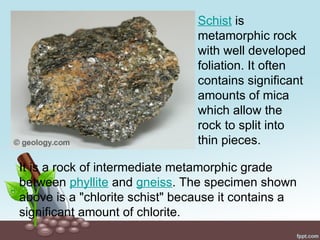
It is a rock of intermediate metamorphic grade
between phyllite and gneiss. The specimen shown
above is a "chlorite schist" because it contains a
significant amount of chlorite.
Schist is
metamorphic rock
with well developed
foliation. It often
contains significant
amounts of mica
which allow the
rock to split into
thin pieces.
Non-foliated metamorphic
rocks such as hornfels, marble,
quartzite, and novaculite do not
have a layered or banded
appearance.
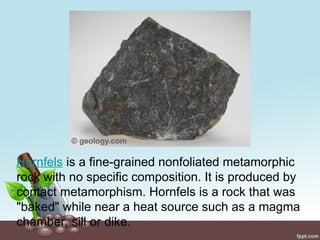
Hornfels is a fine-grained nonfoliated metamorphic
rock with no specific composition. It is produced by
contact metamorphism. Hornfels is a rock that was
"baked" while near a heat source such as a magma
chamber, sill or dike.
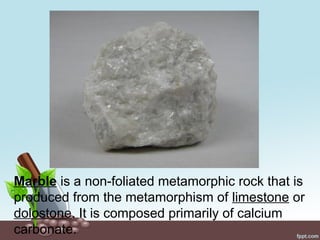
Marble is a non-foliated metamorphic rock that is
produced from the metamorphism of limestone or
dolostone. It is composed primarily of calcium
carbonate.
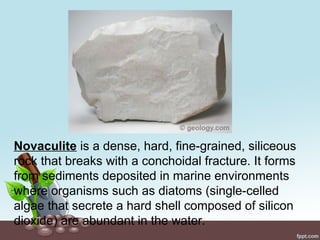
Novaculite is a dense, hard, fine-grained, siliceous
rock that breaks with a conchoidal fracture. It forms
from sediments deposited in marine environments
where organisms such as diatoms (single-celled
algae that secrete a hard shell composed of silicon
dioxide) are abundant in the water.
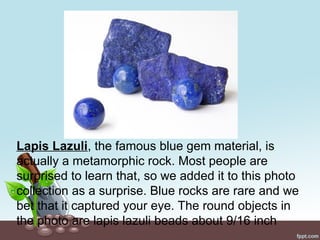
Lapis Lazuli, the famous blue gem material, is
actually a metamorphic rock. Most people are
surprised to learn that, so we added it to this photo
collection as a surprise. Blue rocks are rare and we
bet that it captured your eye. The round objects in
the photo are lapis lazuli beads about 9/16 inch
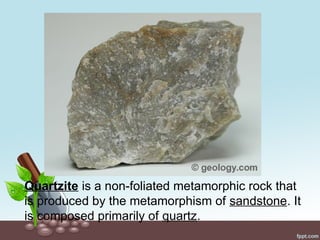
Quartzite is a non-foliated metamorphic rock that
is produced by the metamorphism of sandstone. It
is composed primarily of quartz.
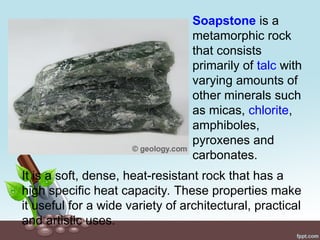
It is a soft, dense, heat-resistant rock that has a
high specific heat capacity. These properties make
it useful for a wide variety of architectural, practical
and artistic uses.
Soapstone is a
metamorphic rock
that consists
primarily of talc with
varying amounts of
other minerals such
as micas, chlorite,
amphiboles,
pyroxenes and
carbonates.
Content
Standard
Learning Competencies
Energy
resources
1. Describe how fossil fuels are
formed
2. Explain how heat from inside the
earth is tapped as a source of
energy (geothermal) for human use
3. Explain how energy (hydroelectric)
is harnessed from flowing water
4. Cite ways to address the different
environmental concerns related to
the use of fossil fuels, geothermal
and hydroelectric energy
Content
Standard
Learning Competencies
Water
resources
1. Recognize how water is
distributed on earth
2. Identify the various water
resources on earth
3. Explain how different activities
affect the quality and availability
of water for human use
4. Suggest ways of conserving and
protecting water resources
Content
Standard
Learning Competencies
Soil
resources
1. Identify human activities such as
farming, construction of
structures and waste disposal
that affect the quality and
quantity of soil
2. Give ways of conserving and
protecting the soil for future
generations
Content
Standard
Learning Competencies
Human
activity and
the
environment
1. Describe how people generate
different types of wastes (solid,
liquid and gaseous) as they make
use of various materials and
resources in everyday life
2. Explain how different types of
waste affect people’s health and
the environment
3. Cite ways of reducing the
production of waste at home, in
school and around the community

The Different Earth Materials and Resources.ppt

  • 1.
  • 2.
    Content Standard Learning Competencies Minerals and rocks 1.Identify common rock forming minerals using their physical and chemical properties 2. Classify rocks into igneous, sedimentary and metamorphic 3. Identify the minerals important to society
  • 3.
    Content Standard Learning Competencies Mineral resources 1. Describehow ore minerals are found, mined and processed for human use 2. Cite ways to prevent or lessen the environmental impact that result from the exploitation, extraction and use of mineral resources
  • 4.
  • 5.
    ELEMENTS • EIGHT ELEMENTSMAKE UP MOST OF ALL MINERALS ON THE EARTH – Elements combine to form Minerals • LISTED IN ORDER OF ABUNDANCE – OXYGEN (O) – SILICON (Si) – ALUMINIUM (Al) – IRON (Fe) – CALCIUM (Ca) – POTASSIUM (K) – SODIUM (Na) – MAGNESIUM (Mg)
  • 6.
    MINERALS • BUILDING BLOCKSFOR ROCKS • DEFINITION: – naturally occurring, inorganic solids, consisting of specific chemical elements, and a definite atomic array • CRYSTALLINE STRUCTURE – ‘CRYSTAL’
  • 7.
    MINERALS • MINERALS: TWOCATEGORIES – SILICATES – CONTAIN SILICON & OXYGEN MOLECULES (SiO) – NON-SILICATES (NO SiO)
  • 8.
    NON-SILICATE MINERALS • Makeup 5% of Earth’s crust • Native metals: gold, silver, copper • Carbonates: calcite (used in cement) • Oxides: hematite (iron ores) • Sulfides: galena (lead ores) • Sulfates: gypsum (used in plaster)
  • 9.
    SILICATE MINERALS • Makeup 90-95% of the Earth’s Crust • Dominant component of most rocks, include: –QUARTZ (SiO2) –FELDSPARS –MICAS
  • 10.
    COMMON MINERALS IN THEEARTH • QUARTZ (Silica) SiO2 • CORUNDUM (Alumina) Al2O3 • HEMATITE Fe2O3 • CALCITE CaCO3 • DOLOMITE CaMg(CO3)2 • GYPSUM CaSO4 • FLUORITE CaF2 • PYRITE FeS2 • OLIVINE (Mg,Fe)2SiO4 • PYROXENE (Mg,Fe)SiO3 • AMPHIBOLE (Ca2Mg5)Si8O22(OH)2 • FELDSPARS Albite NaAlSi3O8 Orthoclase KAlSi3O8 Anorthite CaAl2Si2O8 • KAOLINITE Al2Si2O5(OH)4
  • 11.
    Mineral Usual ColorCrystals Cleavages Hardness Diagnostic Biotite black rare 1 perfect 2–3 cleavage Calcite white common 3 good 3 acid fizz Dolomite white common 3 good 4 acid no fizz Feldspar white or pink common 2 good 6–6.5 hardness Hornblende black common 2 (60/120°) 5–6 cleavage Muscovite white rare 1 perfect 2–3 cleavage Olivine green common 1 fair 6.5–7 color Pyroxene dark rare 2 (87/93°) 5–6.5 cleavage Quartz white common none 7 fracture Identification Key for the Rock-Forming Minerals
  • 12.
    PHYSICAL PROPERTIES OF MINERALS •Crystalstructure and habit: A mineral may show good crystal habit or form, or it may be massive, granular or compact with only microscopically visible crystals.
  • 13.
    •Hardness: the physicalhardness of a mineral is usually measured according to the Mohs scale. This scale is relative and goes from 1 to 10. Minerals with a given Mohs hardness can scratch the surface of any mineral that has a lower hardness than itself.
  • 14.
    •Lustre indicates theway a mineral's surface interacts with light and can range from dull to glassy (vitreous). Metallic -high reflectivity like metal: galena and pyrite Sub-metallic -slightly less than metallic reflectivity: magnetite
  • 15.
    Non-metallic lusters: oAdamantine -brilliant, the luster of diamond also cerussite and anglesite oVitreous -the luster of a broken glass: quartz oPearly - iridescent and pearl-like: talc and apophyllite oResinous - the luster of resin: sphalerite and sulfur oSilky - a soft light shown by fibrous materials: gypsum and chrysotile oDull/earthy -shown by finely crystallized minerals: the kidney ore variety of hematite
  • 16.
    • Colour indicatesthe appearance of the mineral in reflected light or transmitted light for translucent minerals (i.e. what it looks like to the naked eye). Iridescence - the play of colors due to surface or internal interference. Labradorite exhibits internal iridescence whereas hematite and sphalerite often show the surface effect.
  • 17.
    •Streak refers tothe colour of the powder a mineral leaves after rubbing it on an unglazed porcelain streak plate. Note that this is not always the same colour as the original mineral.
  • 18.
    •Cleavage describes theway a mineral may split apart along various planes. In thin sections, cleavage is visible as thin parallel lines across a mineral.
  • 19.
    •Fracture describes howa mineral breaks when broken contrary to its natural cleavage planes. Chonchoidal fracture is a smooth curved fracture with concentric ridges of the type shown by glass. Hackley is jagged fracture with sharp edges. Fibrous Irregular
  • 20.
    • Specific gravityrelates the mineral mass to the mass of an equal volume of water, namely the density of the material. While most minerals, including all the common rock-forming minerals, have a specific gravity of 2.5 - 3.5, a few are noticeably more or less dense, e.g. several sulfide minerals have high specific gravity compared to the common rock-forming minerals.
  • 21.
    •Other properties: fluorescence (responseto ultraviolet light), magnetism, radioactivity, tenacity (response to mechanical induced changes of shape or form), piezoelectricity and reactivity to dilute acids.
  • 22.
    ROCKS • AGGREGATIONS OF2 OR MORE MINERALS – Same or different minerals combine together • THREE CATEGORIES – IGNEOUS – SEDIMENTARY – METAMORPHIC
  • 23.
    IGNEOUS ROCKS • FORMEDFROM COOLED, SOLIDIFIED MOLTEN MATERIAL, AT OR BELOW THE SURFACE • PLUTONIC – INTRUSIVE: COOLED BELOW SURFACE AT GREAT DEPTHS • VOLCANIC – EXTRUSIVE: COOLED AT OR NEAR THE SURFACE THROUGH VOLCANIC ERUPTIONS
  • 24.
    IDENTIFICATION OF IGNEOUS ROCKS •IDENTIFICATION PROCESSES: –TEXTURE: • Size, shape and manner of growth of individual crystals –MINERAL COMPOSITION • Based on SiO content
  • 25.
    Intrusive igneous rocks Cooledbelow surface at great depths
  • 26.
    Felsic and IntermediatePlutonic Rocks Biotite granite from Barre Vermont Intrusive igneous rocks
  • 27.
    Muscovite biotite granitefrom Concord, New Hampshire
  • 28.
    Biotite hornblende granitefrom St. Cloud, Minnesota
  • 29.
    Quartz monzonite porphyryfrom Garfield, Colorado
  • 30.
    Tonalite (quartz diorite)from San Diego County
  • 31.
    Hornblende gabbro fromSan Diego County
  • 32.
  • 33.
    Extrusive igneous rocks Cooledat or near the surface through volcanic eruptions
  • 34.
    Andesite is afine-grained, extrusive igneous rock composed mainly of plagioclase with other minerals such as hornblende, pyroxene and biotite.
  • 35.
    Basalt is afine-grained, dark-colored extrusive igneous rock composed mainly of plagioclase and pyroxene.
  • 36.
    Diorite is acoarse-grained, intrusive igneous rock that contains a mixture of feldspar, pyroxene, hornblende and sometimes quartz.
  • 37.
    Gabbro is acoarse-grained, dark colored, intrusive igneous rock that contains feldspar, pyroxene and sometimes olivine.
  • 38.
    Granite is acoarse-grained, light colored, intrusive igneous rock that contains mainly quartz, feldspar, and mica minerals.
  • 39.
    Obsidian is adark-colored volcanic glass that forms from the very rapid cooling of molten rock material. It cools so rapidly that crystals do not form
  • 40.
    Pegmatite is alight-colored, extremely coarse-grained intrusive igneous rock. It forms near the margins of a magma chamber during the final phases of magma chamber crystallization.
  • 41.
    Peridotite is acoarse-grained intrusive igneous rock that is composed almost entirely of olivine . It may contain small amounts of amphibole, feldspar, quartz or pyroxene.
  • 42.
    Pumice is alight-colored vesicular igneous rock. It forms through very rapid solidification of a melt. The vesicular texture is a result of gas trapped in the melt at the time of solidification.
  • 43.
    Rhyolite is alight-colored, fine-grained, extrusive igneous rock that typically contains quartz and feldspar minerals.
  • 44.
    Fire Opal issometimes found filling cavities in rhyolite. Long after the rhyolite has cooled, silica-rich ground water moves through the rock, sometimes depositing gems like opal, red beryl, topaz, jasper or agate in the cavities of the rock.
  • 45.
    Scoria is adark-colored, vesicular, extrusive igneous rock. The vesicles are a result of trapped gas within the melt at the time of solidification. It often forms as a frothy crust on the top of a lava flow or as material ejected from a volcanic vent and solidifying while airborne.
  • 47.
    SEDIMENTARY ROCKS • Weatheringprocesses break rock into pieces, sediment, ready for transportation deposition burial lithification into new rocks.
  • 48.
    CLASSIFYING SEDIMENTARY ROCKS THREESOURCES • Detrital (or clastic) sediment is composed of transported solid fragments (or detritus) of pre-existing igneous, sedimentary or metamorphic rocks • Chemical sediment forms from previously dissolved minerals that either precipitated from solution in water , or were extracted from water by living organisms • Organic sedimentary rock consisting mainly of plant remains
  • 49.
    SEDIMENTARY ENVIRONMENTS • Lakes •Lagoons • Rivers • Ocean bottoms • Estuaries • Salt Flats • Playas • Glacial environments
  • 50.
    SEDIMENTARY PROCESSES • LITHIFICATION: •As sediment is buried several kilometers beneath the surface, heated from below, pressure from overlying layers and chemically-active water converts the loose sediment into solid sedimentary rock • Compaction - volume of a sediment is reduced by application of pressure • Cementation - sediment grains are bound to each other by materials originally dissolved during chemical weathering of preexisting rocks – typical chemicals include silica and calcium carbonate.
  • 51.
    Clastic sedimentary rocks suchas breccia, conglomerate, sandstone, siltstone, and shale are formed from mechanical weathering debris.
  • 52.
    Breccia is aclastic sedimentary rock that is composed of large (over two millimeter diameter) angular fragments. The spaces between the large fragments can be filled with a matrix of smaller particles or a mineral cement which binds the rock together.
  • 53.
    Conglomerate is aclastic sedimentary rock that contains large rounded particles. The space between the pebbles is generally filled with smaller particles and/or a chemical cement that binds the rock together.
  • 54.
    Sandstone is aclastic sedimentary rock made up mainly of sand-size (1/16 to 2 millimeter diameter) weathering debris. Environments where large amounts of sand can accumulate include beaches, deserts, flood plains and deltas.
  • 55.
    Shale is aclastic sedimentary rock that is made up of clay-size (less then 1/256 millimeter in diameter) weathering debris. It typically breaks into thin flat pieces.
  • 56.
    Siltstone is aclastic sedimentary rock that forms from silt-size (between 1/256 and 1/16 millimeter diameter) weathering debris.
  • 57.
    Chemical sedimentary rocks, suchas rock salt, iron ore, chert, flint, some dolomites, and some limestones, form when dissolved materials precipitate from solution.
  • 58.
    Chert is amicrocrystalline or cryptocrystalline sedimentary rock material composed of silicon dioxide (SiO2).
  • 59.
    Flint is ahard, tough, chemical or biochemical sedimentary rock that breaks with a conchoidal fracture. It is a form of microcrystalline quartz that is typically called “chert” by geologists. It often forms as nodules in sedimentary rocks such as chalk and marine limestones.
  • 60.
    Dolomite (also knownas "dolostone" and "dolomite rock") is a chemical sedimentary rock that is very similar to limestone. It is thought to form when limestone or lime mud is modified by magnesium-rich ground water.
  • 61.
    It can alsoform chemically from the precipitation of calcium carbonate from lake or ocean water. Limestone is used in many ways. Some of the most common are: production of cement, crushed stone and acid neutralization. Limestone is a rock that is composed primarily of calcium carbonate. It can form organically from the accumulation of shell, coral, algal and fecal debris.
  • 62.
    Iron Ore isa chemical sedimentary rock that forms when iron and oxygen (and sometimes other substances) combine in solution and deposit as a sediment. Hematite is the most common sedimentary iron ore mineral.
  • 63.
    Rock Salt isa chemical sedimentary rock that forms from the evaporation of ocean or saline lake waters. It is also known by the mineral name "halite". It is rarely found at Earth's surface, except in areas of very arid climate. It is often mined for use in the chemical industry or for use as a winter highway treatment. Some halite is processed for use as a seasoning for food.
  • 64.
    Organic sedimentary rockssuch as coal, some dolomites, and some limestones, form from the accumulation of plant or animal debris.
  • 65.
    Coal is anorganic sedimentary rock that forms mainly from plant debris. The plant debris usually accumulates in a swamp environment. Coal is combustible and is often mined for use as a fuel.
  • 66.
    METAMORPHIC ROCKS • METAMORPHISM: process by which conditions within the Earth alter the mineral content and structure of any rock, igneous, sedimentary or metamorphic, without melting it. • Metamorphism occurs when heat and pressure exceed certain levels, destabilizing the minerals in rocks...but not enough to cause melting
  • 67.
    There are twobasic types of metamorphic rocks. Foliated metamorphic rocks such as gneiss, phyllite, schist, and slate have a layered or banded appearance that is produced by exposure to heat and directed pressure.
  • 68.
    Gneiss is foliatedmetamorphic rock that has a banded appearance and is made up of granular mineral grains. It typically contains abundant quartz or feldspar minerals.
  • 69.
    Phyllite is afoliated metamorphic rock that is made up mainly of very fine-grained mica. The surface of phyllite is typically lustrous and sometimes wrinkled. It is intermediate in grade between slate and schist.
  • 70.
    Slate is afoliated metamorphic rock that is formed through the metamorphism of shale. It is a low grade metamorphic rock that splits into thin pieces.
  • 71.
    It is arock of intermediate metamorphic grade between phyllite and gneiss. The specimen shown above is a "chlorite schist" because it contains a significant amount of chlorite. Schist is metamorphic rock with well developed foliation. It often contains significant amounts of mica which allow the rock to split into thin pieces.
  • 72.
    Non-foliated metamorphic rocks suchas hornfels, marble, quartzite, and novaculite do not have a layered or banded appearance.
  • 73.
    Hornfels is afine-grained nonfoliated metamorphic rock with no specific composition. It is produced by contact metamorphism. Hornfels is a rock that was "baked" while near a heat source such as a magma chamber, sill or dike.
  • 74.
    Marble is anon-foliated metamorphic rock that is produced from the metamorphism of limestone or dolostone. It is composed primarily of calcium carbonate.
  • 75.
    Novaculite is adense, hard, fine-grained, siliceous rock that breaks with a conchoidal fracture. It forms from sediments deposited in marine environments where organisms such as diatoms (single-celled algae that secrete a hard shell composed of silicon dioxide) are abundant in the water.
  • 76.
    Lapis Lazuli, thefamous blue gem material, is actually a metamorphic rock. Most people are surprised to learn that, so we added it to this photo collection as a surprise. Blue rocks are rare and we bet that it captured your eye. The round objects in the photo are lapis lazuli beads about 9/16 inch
  • 77.
    Quartzite is anon-foliated metamorphic rock that is produced by the metamorphism of sandstone. It is composed primarily of quartz.
  • 78.
    It is asoft, dense, heat-resistant rock that has a high specific heat capacity. These properties make it useful for a wide variety of architectural, practical and artistic uses. Soapstone is a metamorphic rock that consists primarily of talc with varying amounts of other minerals such as micas, chlorite, amphiboles, pyroxenes and carbonates.
  • 79.
    Content Standard Learning Competencies Energy resources 1. Describehow fossil fuels are formed 2. Explain how heat from inside the earth is tapped as a source of energy (geothermal) for human use 3. Explain how energy (hydroelectric) is harnessed from flowing water 4. Cite ways to address the different environmental concerns related to the use of fossil fuels, geothermal and hydroelectric energy
  • 80.
    Content Standard Learning Competencies Water resources 1. Recognizehow water is distributed on earth 2. Identify the various water resources on earth 3. Explain how different activities affect the quality and availability of water for human use 4. Suggest ways of conserving and protecting water resources
  • 81.
    Content Standard Learning Competencies Soil resources 1. Identifyhuman activities such as farming, construction of structures and waste disposal that affect the quality and quantity of soil 2. Give ways of conserving and protecting the soil for future generations
  • 82.
    Content Standard Learning Competencies Human activity and the environment 1.Describe how people generate different types of wastes (solid, liquid and gaseous) as they make use of various materials and resources in everyday life 2. Explain how different types of waste affect people’s health and the environment 3. Cite ways of reducing the production of waste at home, in school and around the community