Chapter 15 Thermodynamics
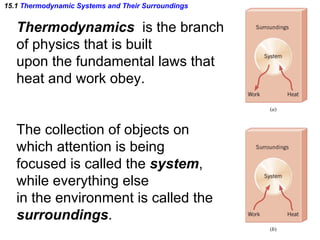
15.1  Thermodynamic Systems and Their Surroundings Thermodynamics  is the branch of physics that is built  upon the fundamental laws that heat and work obey. The collection of objects on which attention is being  focused is called the  system , while everything else in the environment is called the  surroundings .
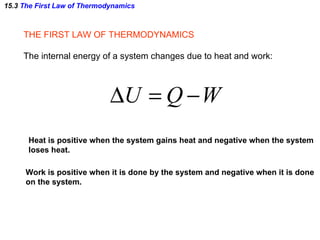
15.3  The First Law of Thermodynamics THE FIRST LAW OF THERMODYNAMICS The internal energy of a system changes due to heat and work: Work is positive when it is done by the system and negative when it is done on the system. Heat is positive when the system gains heat and negative when the system loses heat.
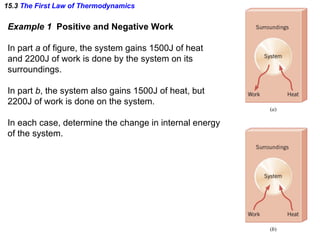
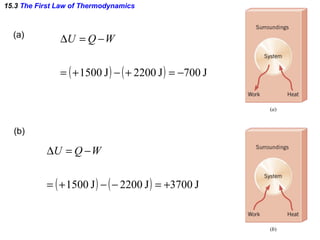
15.3  The First Law of Thermodynamics Example 1  Positive and Negative Work In part  a  of figure, the system gains 1500J of heat and 2200J of work is done by the system on its  surroundings.  In part  b , the system also gains 1500J of heat, but 2200J of work is done on the system. In each case, determine the change in internal energy of the system.
15.3  The First Law of Thermodynamics (a) (b)
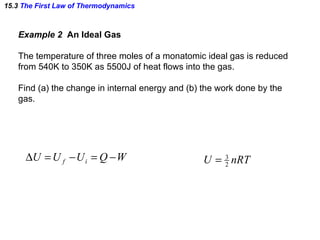
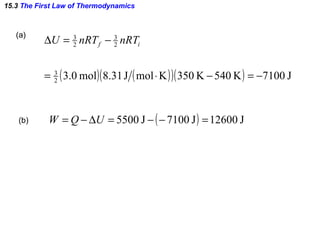
15.3  The First Law of Thermodynamics Example 2  An Ideal Gas The temperature of three moles of a monatomic ideal gas is reduced  from 540K to 350K as 5500J of heat flows into the gas. Find (a) the change in internal energy and (b) the work done by the  gas.
15.3  The First Law of Thermodynamics (a) (b)
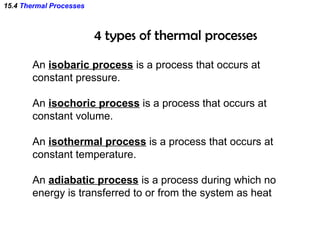
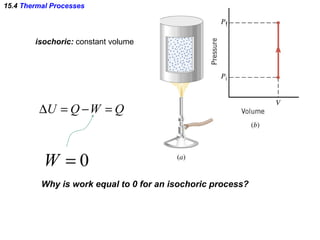
15.4  Thermal Processes 4 types of thermal processes An  isobaric process  is a process that occurs at constant pressure. An  isochoric process  is a process that occurs at constant volume. An  isothermal process  is a process that occurs at constant temperature. An  adiabatic process  is a process during which no energy is transferred to or from the system as heat at.
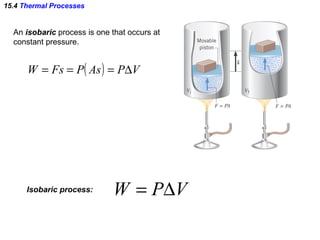
15.4  Thermal Processes An  isobaric  process is one that occurs at constant pressure. Isobaric process:
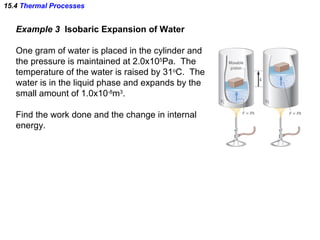
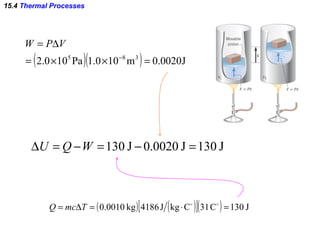
15.4  Thermal Processes Example 3  Isobaric Expansion of Water One gram of water is placed in the cylinder and  the pressure is maintained at 2.0x10 5 Pa.  The temperature of the water is raised by 31 o C.  The water is in the liquid phase and expands by the small amount of 1.0x10 -8 m 3 . Find the work done and the change in internal  energy.
15.4  Thermal Processes
15.4  Thermal Processes isochoric:  constant volume Why is work equal to 0 for an isochoric process?
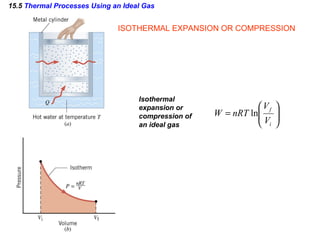
15.5  Thermal Processes Using an Ideal Gas ISOTHERMAL EXPANSION OR COMPRESSION Isothermal expansion or compression of an ideal gas
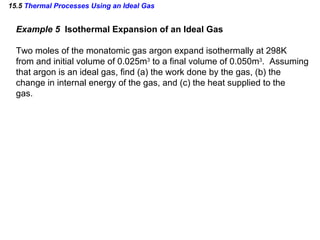
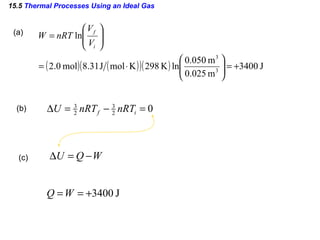
15.5  Thermal Processes Using an Ideal Gas Example 5  Isothermal Expansion of an Ideal Gas Two moles of the monatomic gas argon expand isothermally at 298K from and initial volume of 0.025m 3  to a final volume of 0.050m 3 .  Assuming that argon is an ideal gas, find (a) the work done by the gas, (b) the  change in internal energy of the gas, and (c) the heat supplied to the  gas.
15.5  Thermal Processes Using an Ideal Gas (a)  (b)  (c)
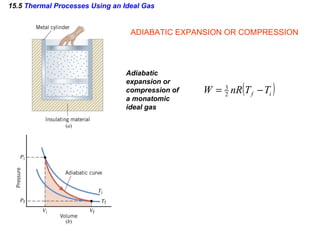
15.5  Thermal Processes Using an Ideal Gas ADIABATIC EXPANSION OR COMPRESSION Adiabatic expansion or compression of a monatomic ideal gas
15.7  The Second Law of Thermodynamics THE SECOND LAW OF THERMODYNAMICS:  THE LAW OF ENTROPY Heat flows spontaneously from a substance at a higher temperature to a substance at a lower temperature and does not flow spontaneously in the reverse direction.
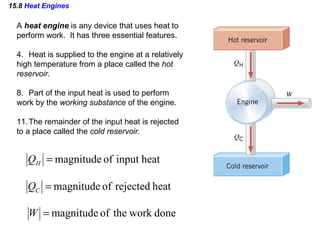
15.8  Heat Engines A  heat engine  is any device that uses heat to  perform work.  It has three essential features. Heat is supplied to the engine at a relatively  high temperature from a place called the  hot  reservoir. Part of the input heat is used to perform  work by the  working substance  of the engine. The remainder of the input heat is rejected  to a place called the  cold reservoir.
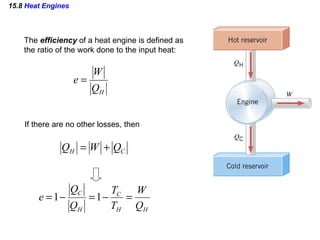
15.8  Heat Engines The  efficiency  of a heat engine is defined as the ratio of the work done to the input heat: If there are no other losses, then
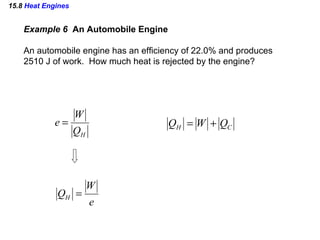
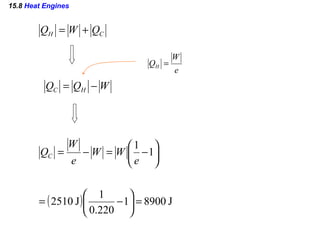
15.8  Heat Engines Example 6  An Automobile Engine An automobile engine has an efficiency of 22.0% and produces  2510 J of work.  How much heat is rejected by the engine?
15.8  Heat Engines
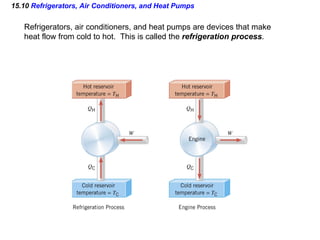
15.10  Refrigerators, Air Conditioners, and Heat Pumps Refrigerators, air conditioners, and heat pumps are devices that make heat flow from cold to hot.  This is called the  refrigeration process .
15.10  Refrigerators, Air Conditioners, and Heat Pumps
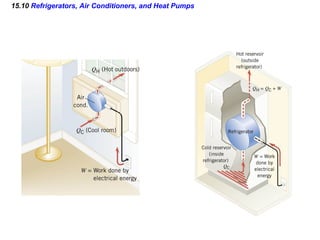
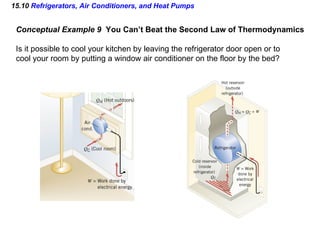
15.10  Refrigerators, Air Conditioners, and Heat Pumps Conceptual Example 9  You Can’t Beat the Second Law of Thermodynamics Is it possible to cool your kitchen by leaving the refrigerator door open or to  cool your room by putting a window air conditioner on the floor by the bed?
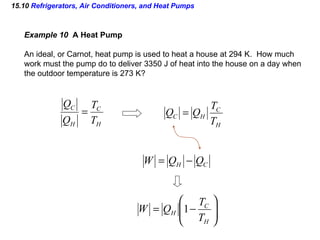
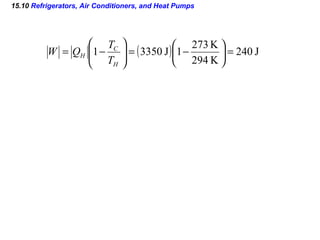
15.10  Refrigerators, Air Conditioners, and Heat Pumps Example 10  A Heat Pump An ideal, or Carnot, heat pump is used to heat a house at 294 K.  How much work must the pump do to deliver 3350 J of heat into the house on a day when the outdoor temperature is 273 K?
15.10  Refrigerators, Air Conditioners, and Heat Pumps
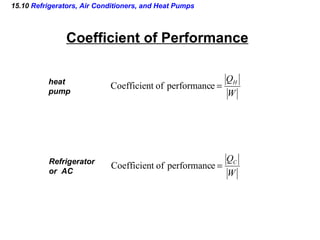
15.10  Refrigerators, Air Conditioners, and Heat Pumps heat  pump Coefficient of Performance Refrigerator  or  AC
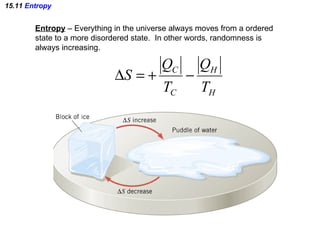
15.11  Entropy Entropy  – Everything in the universe always moves from a ordered state to a more disordered state.  In other words, randomness is always increasing.
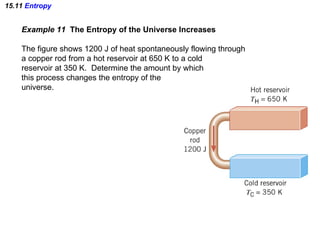
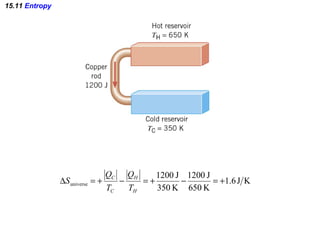
15.11  Entropy Example 11  The Entropy of the Universe Increases The figure shows 1200 J of heat spontaneously flowing through a copper rod from a hot reservoir at 650 K to a cold  reservoir at 350 K.  Determine the amount by which this process changes the entropy of the  universe.
15.11  Entropy
15.12  The Third Law of Thermodynamics THE THIRD LAW OF THERMODYNAMICS It is not possible to lower the temperature of any system to absolute  zero in a finite number of steps.

AP Physics - Chapter 15 Powerpoint

  • 1.
  • 2.
    15.1 ThermodynamicSystems and Their Surroundings Thermodynamics is the branch of physics that is built upon the fundamental laws that heat and work obey. The collection of objects on which attention is being focused is called the system , while everything else in the environment is called the surroundings .
  • 3.
    15.3 TheFirst Law of Thermodynamics THE FIRST LAW OF THERMODYNAMICS The internal energy of a system changes due to heat and work: Work is positive when it is done by the system and negative when it is done on the system. Heat is positive when the system gains heat and negative when the system loses heat.
  • 4.
    15.3 TheFirst Law of Thermodynamics Example 1 Positive and Negative Work In part a of figure, the system gains 1500J of heat and 2200J of work is done by the system on its surroundings. In part b , the system also gains 1500J of heat, but 2200J of work is done on the system. In each case, determine the change in internal energy of the system.
  • 5.
    15.3 TheFirst Law of Thermodynamics (a) (b)
  • 6.
    15.3 TheFirst Law of Thermodynamics Example 2 An Ideal Gas The temperature of three moles of a monatomic ideal gas is reduced from 540K to 350K as 5500J of heat flows into the gas. Find (a) the change in internal energy and (b) the work done by the gas.
  • 7.
    15.3 TheFirst Law of Thermodynamics (a) (b)
  • 8.
    15.4 ThermalProcesses 4 types of thermal processes An isobaric process is a process that occurs at constant pressure. An isochoric process is a process that occurs at constant volume. An isothermal process is a process that occurs at constant temperature. An adiabatic process is a process during which no energy is transferred to or from the system as heat at.
  • 9.
    15.4 ThermalProcesses An isobaric process is one that occurs at constant pressure. Isobaric process:
  • 10.
    15.4 ThermalProcesses Example 3 Isobaric Expansion of Water One gram of water is placed in the cylinder and the pressure is maintained at 2.0x10 5 Pa. The temperature of the water is raised by 31 o C. The water is in the liquid phase and expands by the small amount of 1.0x10 -8 m 3 . Find the work done and the change in internal energy.
  • 11.
    15.4 ThermalProcesses
  • 12.
    15.4 ThermalProcesses isochoric: constant volume Why is work equal to 0 for an isochoric process?
  • 13.
    15.5 ThermalProcesses Using an Ideal Gas ISOTHERMAL EXPANSION OR COMPRESSION Isothermal expansion or compression of an ideal gas
  • 14.
    15.5 ThermalProcesses Using an Ideal Gas Example 5 Isothermal Expansion of an Ideal Gas Two moles of the monatomic gas argon expand isothermally at 298K from and initial volume of 0.025m 3 to a final volume of 0.050m 3 . Assuming that argon is an ideal gas, find (a) the work done by the gas, (b) the change in internal energy of the gas, and (c) the heat supplied to the gas.
  • 15.
    15.5 ThermalProcesses Using an Ideal Gas (a) (b) (c)
  • 16.
    15.5 ThermalProcesses Using an Ideal Gas ADIABATIC EXPANSION OR COMPRESSION Adiabatic expansion or compression of a monatomic ideal gas
  • 17.
    15.7 TheSecond Law of Thermodynamics THE SECOND LAW OF THERMODYNAMICS: THE LAW OF ENTROPY Heat flows spontaneously from a substance at a higher temperature to a substance at a lower temperature and does not flow spontaneously in the reverse direction.
  • 18.
    15.8 HeatEngines A heat engine is any device that uses heat to perform work. It has three essential features. Heat is supplied to the engine at a relatively high temperature from a place called the hot reservoir. Part of the input heat is used to perform work by the working substance of the engine. The remainder of the input heat is rejected to a place called the cold reservoir.
  • 19.
    15.8 HeatEngines The efficiency of a heat engine is defined as the ratio of the work done to the input heat: If there are no other losses, then
  • 20.
    15.8 HeatEngines Example 6 An Automobile Engine An automobile engine has an efficiency of 22.0% and produces 2510 J of work. How much heat is rejected by the engine?
  • 21.
    15.8 HeatEngines
  • 22.
    15.10 Refrigerators,Air Conditioners, and Heat Pumps Refrigerators, air conditioners, and heat pumps are devices that make heat flow from cold to hot. This is called the refrigeration process .
  • 23.
    15.10 Refrigerators,Air Conditioners, and Heat Pumps
  • 24.
    15.10 Refrigerators,Air Conditioners, and Heat Pumps Conceptual Example 9 You Can’t Beat the Second Law of Thermodynamics Is it possible to cool your kitchen by leaving the refrigerator door open or to cool your room by putting a window air conditioner on the floor by the bed?
  • 25.
    15.10 Refrigerators,Air Conditioners, and Heat Pumps Example 10 A Heat Pump An ideal, or Carnot, heat pump is used to heat a house at 294 K. How much work must the pump do to deliver 3350 J of heat into the house on a day when the outdoor temperature is 273 K?
  • 26.
    15.10 Refrigerators,Air Conditioners, and Heat Pumps
  • 27.
    15.10 Refrigerators,Air Conditioners, and Heat Pumps heat pump Coefficient of Performance Refrigerator or AC
  • 28.
    15.11 EntropyEntropy – Everything in the universe always moves from a ordered state to a more disordered state. In other words, randomness is always increasing.
  • 29.
    15.11 EntropyExample 11 The Entropy of the Universe Increases The figure shows 1200 J of heat spontaneously flowing through a copper rod from a hot reservoir at 650 K to a cold reservoir at 350 K. Determine the amount by which this process changes the entropy of the universe.
  • 30.
  • 31.
    15.12 TheThird Law of Thermodynamics THE THIRD LAW OF THERMODYNAMICS It is not possible to lower the temperature of any system to absolute zero in a finite number of steps.