Tom Graves Tetradian Integrated EA March 2011 Enterprise architecture  beyond IT - an Australian view
A habit of ‘thinking architecturally’ often more from necessity than choice Perhaps a bit anarchic at times... again, often more from necessity than choice Five projects that pushed our EA beyond IT: modelling business-information at a telco process-modelling for logistics managing information for aircraft research high-level strategy for a bank design to manage complexity in Army operations An Australian view of EA
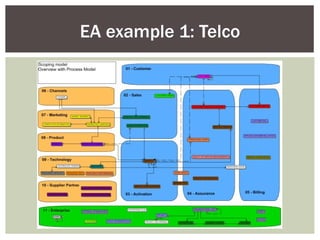
EA example 1: Telco
Data-architecture: made everything seem ‘logical’ single definitions, ‘single source of truth’ all seen from an IT perspective (databases, apps) Business-information: real business use was much ‘messier’ derived-info: counts-of, averages-of, trends-of event-driven, cyclical, sometimes uncertain often blurry business-rules (‘modal-logic’) meaning often dependent on people’s experience Data vs business-information
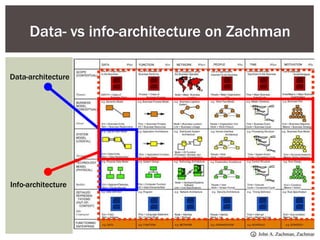
Data- vs info-architecture on Zachman Data-architecture Info-architecture
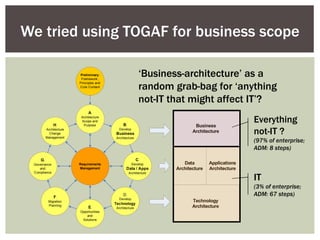
We tried using TOGAF for business scope ‘ Business-architecture’ as a random grab-bag for ‘anything not-IT that might affect IT’? IT (3% of enterprise; ADM: 67 steps) Everything not-IT ? (97% of enterprise;  ADM: 8 steps)
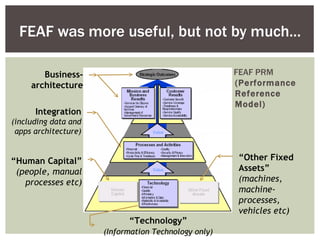
FEAF was more useful, but not by much... “ Technology” (Information Technology only) FEAF PRM  (Performance Reference Model) Integration (including data and apps architecture) “ Other Fixed Assets” (machines, machine-processes, vehicles etc) “ Human Capital” (people, manual processes etc) Business-architecture
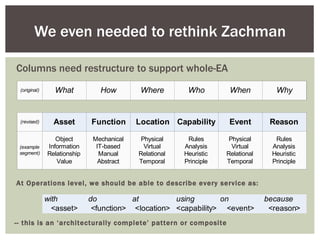
We even needed to rethink Zachman Columns need restructure to support whole-EA At Operations level, we should be able to describe every service as: -- this is an ‘architecturally complete’ pattern or composite
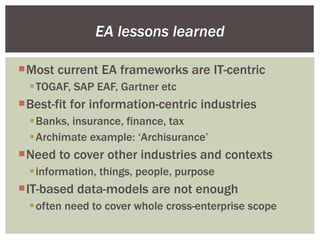
EA lessons learned Most current EA frameworks are IT-centric TOGAF, SAP EAF, Gartner etc Best-fit for information-centric industries Banks, insurance, finance, tax Archimate example: ‘ Archisurance ’ Need to cover other industries and contexts information, things, people, purpose IT-based data-models are not enough often need to cover whole cross-enterprise scope
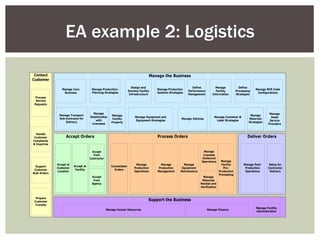
EA example 2: Logistics
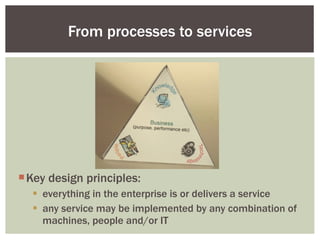
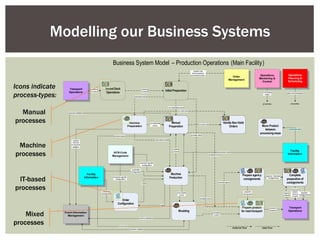
Key design principles: everything in the enterprise is or delivers a service any service may be implemented by any combination of machines, people and/or IT From processes to services
Modelling our Business Systems Icons indicate process-types: Manual processes Machine processes IT-based processes Mixed processes
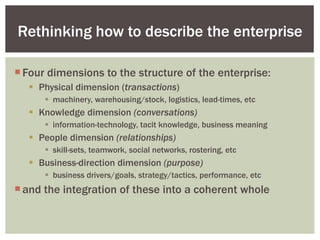
Four dimensions to the structure of the enterprise: Physical dimension ( transactions ) machinery, warehousing/stock, logistics, lead-times, etc Knowledge dimension  (conversations) information-technology, tacit knowledge, business meaning People dimension  (relationships) skill-sets, teamwork, social networks, rostering, etc Business-direction dimension  (purpose) business drivers/goals, strategy/tactics, performance, etc and the integration of these into a coherent whole Rethinking how to describe the enterprise
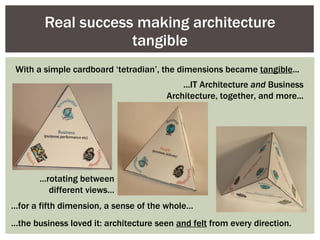
Real success making architecture tangible With a simple cardboard ‘tetradian’, the dimensions became  tangible ... … rotating between different views… … for a fifth dimension, a sense of the whole… ...IT Architecture  and  Business Architecture, together, and more... … the business loved it: architecture seen  and felt  from every direction.
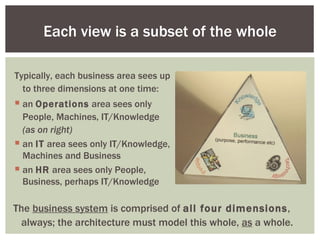
Each view is a subset of the whole Typically, each business area sees up to three dimensions at one time: an  Operations  area sees only People, Machines, IT/Knowledge  (as on right) an  IT  area sees only IT/Knowledge, Machines and Business an  HR  area sees only People, Business, perhaps IT/Knowledge The  business system  is comprised of  all four dimensions , always; the architecture must model this whole,  as  a whole.
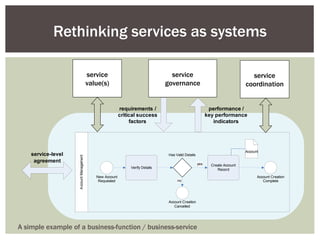
Rethinking services as systems A simple example of a business-function / business-service service governance service value(s) service coordination
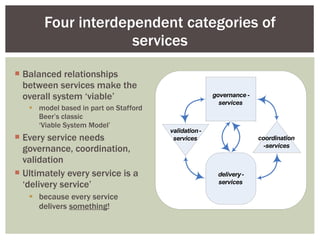
Balanced relationships between services make the overall system ‘viable’ model based in part on Stafford Beer’s classic  ‘Viable System Model’ Every service needs governance, coordination, validation Ultimately every service is a ‘delivery service’ because every service delivers  something ! Four interdependent categories of services
EA lessons learned Breaking away from IT-centric thinking is hard our project eventually took over the architecture unit Underpinned by systematic, inclusive metamodels four dimensions: ‘things’, information, people, purpose whole-enterprise approach to service-oriented architecture Architects work in abstracts, but business-folk don’t we needed to make our examples concrete and tangible Essential to engage the business-folk from the start a real make-or-break for architecture credibility
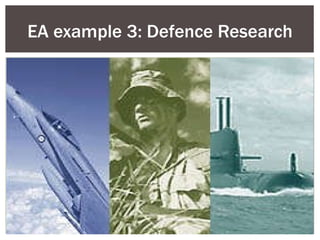
EA example 3: Defence Research
30-year gap between initial-test and new research all senior staff from original project now retired or dead... Original research-reports were almost useless had been heavily ‘laundered’ for political reasons At least two person-years expended on: searching ‘inherited’ filing-cabinets for missing info building catalogue of recovered paper-documents but still no real search-facilities available! Main test-program needed 30yr-old test-data data eventually recovered from fragile tape-reels recorded data-structures could only be guessed... A knowledge-management horror-story...
Standard procedure: test-record life is ‘five to ten years after Task completion’. much too short – see platform / material lifetime Effective lifetime can be  >50 years : compare to: Task lifetime (3 years) software or hardware lifetime (3-5 years) typical government policy lifetime (10-20 years) typical working lifetime (20-40 years) Needed stories to convey knowledge over time A question of lifetime
Knowledge combines three types of information: data - objective, usually quantitative provides information  content metadata - ‘information about information’ identifies information  context connection - subjective, usually qualitative derived from experience describes perceived relationships between data-items indicates information  meaning Objective data are easy to store in databases… … but meaningless without metadata and connections! Managing the long-term knowledge
“ If you’re spending more than one-third of your time on technologies for knowledge management, you’re neglecting the content, organisational culture and motivational approaches that will make a knowledge management system actually useful.” [Tom Davenport] Balancing technology and culture
An intense search for ‘the perfect KM database’: storage  - data, metadata, connections search  and cross-reference access-control  and usage  metrics But knowledge-management depends as much on: leadership  - a commitment to organisational quality change-management  - creating a ‘learning organisation’ culture  - creating a habit of sharing knowledge and exploring its potential for re-use A struggle to get scientists to be serious about culture Too much focus on technology?
Knowledge-sharing was central to the work from data to information to knowledge IT plays a part, but it’s more than just IT culture is the real core, not the IT Managing long-term knowledge requires: technical expertise in long-term data-migration narrative-knowledge to carry stories of meaning These need to become part of the  architecture  of the enterprise EA lessons-learned
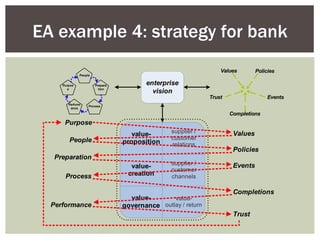
EA example 4: strategy for bank
Slump from most- to least-respected in region loss of internal mutual-respect as well as external Impacts across entire enterprise customer-relations, internal morale, state politics No real concept of ‘big-picture’ strategy arbitrary targets used as substitute for strategy Urgent need to create ‘strategic conversation’ must highlight and clarify systemic issues yet  also  simple, engaging, unthreatening A question of respect
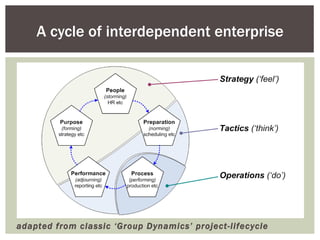
A cycle of interdependent enterprise adapted from classic ‘Group Dynamics’ project-lifecycle
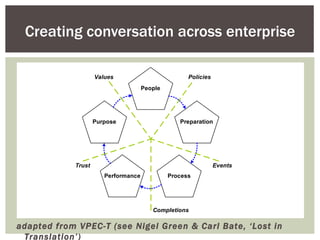
Creating conversation across enterprise adapted from VPEC-T (see Nigel Green & Carl Bate, ‘Lost in Translation’)
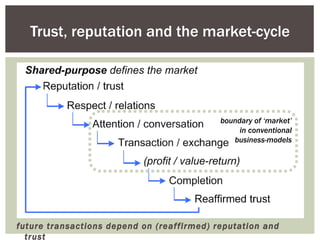
Trust, reputation and the market-cycle future transactions depend on (reaffirmed) reputation and trust boundary of ‘market’ in conventional business-models
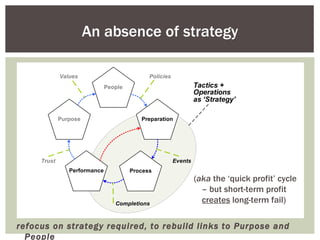
An absence of strategy refocus on strategy required, to rebuild links to Purpose and People ( aka  the ‘quick profit’ cycle – but short-term profit  creates  long-term fail)
Priorities: culture  ->  strategy  ->  tactics  ->  ops “ culture eats strategy for breakfast”  [Peter Drucker] Arbitrary targets often mistaken for strategy “ our strategy is last year plus 10%” gives no indication as to what to  do , or why... IT-centrism hides the real issues IT-detail important but often used as a distraction Culture, respect etc as  architectural  concerns culture as the real core of the enterprise EA lessons-learned
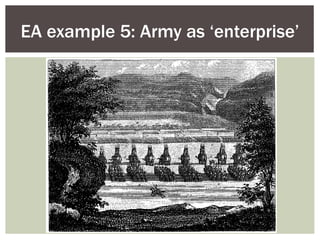
EA example 5: Army as ‘enterprise’
Army is facing new kinds of operational roles adapting architectural ideas from other domains Deliberately experimental approach ‘ brainstorming’ adaptations of ideas from commercial and government architecture Start-point: a ‘business-anarchist’ perspective “ no rules, no rights, values come first, agility is key” ‘ Enterprise’ as a focus for shared commitment bounded by vision, values, principles, stories A back-and-forth on Army architecture
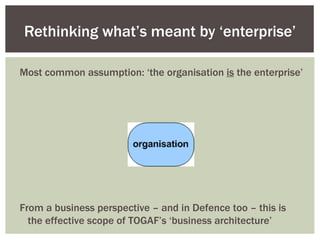
Rethinking what’s meant by ‘enterprise’ From a business perspective – and in Defence too – this is the effective scope of TOGAF’s ‘business architecture’ Most common assumption: ‘the organisation  is  the enterprise’
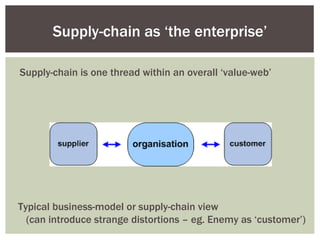
Supply-chain as ‘the enterprise’ Typical business-model or supply-chain view (can introduce strange distortions – eg. Enemy as ‘customer’) Supply-chain is one thread within an overall ‘value-web’
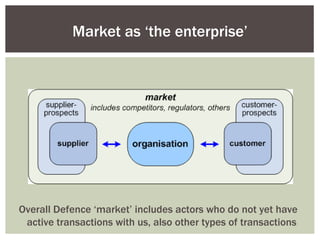
Market as ‘the enterprise’ Overall Defence ‘market’ includes actors who do not yet have active transactions with us, also other types of transactions
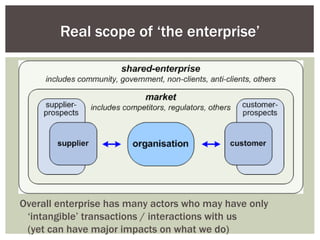
Real scope of ‘the enterprise’ Overall enterprise has many actors who may have only ‘intangible’ transactions / interactions with us (yet can have major impacts on what we do)
Role of military in overall societal enterprise von Clausewitz: “War is not merely a political act, but also a political instrument, a continuation of political relations, a carrying out of the same by other means ” Enemy as ‘anti-client’ in enterprise assumption: “destroy Enemy’s ability to fight” is ‘reduce other’s  desire  to fight’ more effective? Enterprise-model and market-cycle maintain the focus on a shared ‘Why?’ The military enterprise
British Army experience in Northern Ireland every action or inaction by any soldier is ‘political’ US Army experience in Iraq / Afghanistan success is most often from ‘reduce desire to fight’ US Army CAC: ‘FM 5-0 The Operations Process’ role of design-thinking:  FM 5-0 ‘Information Briefing ’ [PPT, 11.0Mb] New emphasis on ‘Commander’s Intent’ outcomes-driven, not process-driven Enterprise vision provides the anchor Design for human complexity
Defence has same issues as in IT-centric ‘EA’: info is important, but there’s more than just IT technology is important, but there’s much more to Defence architecture than just the technology complexity of people-issues is the real core concern – hiding in the ‘easy’ technology-realms doesn’t make those complexities go away! A literal ‘service-oriented architecture’? yet what or whom does each service serve?  –vision as the key anchor for enterprise Beware of over-focus on technology
EA lessons-learned Don’t describe Enemy as a ‘customer’ of the Army! taxonomically correct, but makes no sense to our clients! Market and Enterprise can make practical sense needs some adaptation from business-context Complexity requires new approaches not just about ‘who has the biggest elephant’ any more! role at Ops level of techniques such as design-thinking Architecture concept of ‘vision’ enables new options identify ‘common ground’ – enables shift from ‘Enemy’ status to active assistance in operational goals
A habit of ‘thinking architecturally’ “ things work better when they work together” Perhaps a bit anarchic... rules often arbitrary abstractions from real-world Need to think beyond IT or technology alone maintain awareness of the enterprise as a whole Keep returning to the vision, the ‘Why?’ the ‘Why?’ defines the overall enterprise, provides common-ground for shared-stories A broader role for EA?
Contact: email:  [email_address] web:  http://tetradian.com Twitter:  @tetradian More information: weblog:  http://weblog.tetradian.com slidedecks:  http://www.slideshare.net/tetradian books:  http://tetradianbooks.com Thank you!

Enterprise architecture beyond IT - an Australian view

  • 1.
    Tom Graves TetradianIntegrated EA March 2011 Enterprise architecture beyond IT - an Australian view
  • 2.
    A habit of‘thinking architecturally’ often more from necessity than choice Perhaps a bit anarchic at times... again, often more from necessity than choice Five projects that pushed our EA beyond IT: modelling business-information at a telco process-modelling for logistics managing information for aircraft research high-level strategy for a bank design to manage complexity in Army operations An Australian view of EA
  • 3.
  • 4.
    Data-architecture: made everythingseem ‘logical’ single definitions, ‘single source of truth’ all seen from an IT perspective (databases, apps) Business-information: real business use was much ‘messier’ derived-info: counts-of, averages-of, trends-of event-driven, cyclical, sometimes uncertain often blurry business-rules (‘modal-logic’) meaning often dependent on people’s experience Data vs business-information
  • 5.
    Data- vs info-architectureon Zachman Data-architecture Info-architecture
  • 6.
    We tried usingTOGAF for business scope ‘ Business-architecture’ as a random grab-bag for ‘anything not-IT that might affect IT’? IT (3% of enterprise; ADM: 67 steps) Everything not-IT ? (97% of enterprise; ADM: 8 steps)
  • 7.
    FEAF was moreuseful, but not by much... “ Technology” (Information Technology only) FEAF PRM (Performance Reference Model) Integration (including data and apps architecture) “ Other Fixed Assets” (machines, machine-processes, vehicles etc) “ Human Capital” (people, manual processes etc) Business-architecture
  • 8.
    We even neededto rethink Zachman Columns need restructure to support whole-EA At Operations level, we should be able to describe every service as: -- this is an ‘architecturally complete’ pattern or composite
  • 9.
    EA lessons learnedMost current EA frameworks are IT-centric TOGAF, SAP EAF, Gartner etc Best-fit for information-centric industries Banks, insurance, finance, tax Archimate example: ‘ Archisurance ’ Need to cover other industries and contexts information, things, people, purpose IT-based data-models are not enough often need to cover whole cross-enterprise scope
  • 10.
    EA example 2:Logistics
  • 11.
    Key design principles:everything in the enterprise is or delivers a service any service may be implemented by any combination of machines, people and/or IT From processes to services
  • 12.
    Modelling our BusinessSystems Icons indicate process-types: Manual processes Machine processes IT-based processes Mixed processes
  • 13.
    Four dimensions tothe structure of the enterprise: Physical dimension ( transactions ) machinery, warehousing/stock, logistics, lead-times, etc Knowledge dimension (conversations) information-technology, tacit knowledge, business meaning People dimension (relationships) skill-sets, teamwork, social networks, rostering, etc Business-direction dimension (purpose) business drivers/goals, strategy/tactics, performance, etc and the integration of these into a coherent whole Rethinking how to describe the enterprise
  • 14.
    Real success makingarchitecture tangible With a simple cardboard ‘tetradian’, the dimensions became tangible ... … rotating between different views… … for a fifth dimension, a sense of the whole… ...IT Architecture and Business Architecture, together, and more... … the business loved it: architecture seen and felt from every direction.
  • 15.
    Each view isa subset of the whole Typically, each business area sees up to three dimensions at one time: an Operations area sees only People, Machines, IT/Knowledge (as on right) an IT area sees only IT/Knowledge, Machines and Business an HR area sees only People, Business, perhaps IT/Knowledge The business system is comprised of all four dimensions , always; the architecture must model this whole, as a whole.
  • 16.
    Rethinking services assystems A simple example of a business-function / business-service service governance service value(s) service coordination
  • 17.
    Balanced relationships betweenservices make the overall system ‘viable’ model based in part on Stafford Beer’s classic ‘Viable System Model’ Every service needs governance, coordination, validation Ultimately every service is a ‘delivery service’ because every service delivers something ! Four interdependent categories of services
  • 18.
    EA lessons learnedBreaking away from IT-centric thinking is hard our project eventually took over the architecture unit Underpinned by systematic, inclusive metamodels four dimensions: ‘things’, information, people, purpose whole-enterprise approach to service-oriented architecture Architects work in abstracts, but business-folk don’t we needed to make our examples concrete and tangible Essential to engage the business-folk from the start a real make-or-break for architecture credibility
  • 19.
    EA example 3:Defence Research
  • 20.
    30-year gap betweeninitial-test and new research all senior staff from original project now retired or dead... Original research-reports were almost useless had been heavily ‘laundered’ for political reasons At least two person-years expended on: searching ‘inherited’ filing-cabinets for missing info building catalogue of recovered paper-documents but still no real search-facilities available! Main test-program needed 30yr-old test-data data eventually recovered from fragile tape-reels recorded data-structures could only be guessed... A knowledge-management horror-story...
  • 21.
    Standard procedure: test-recordlife is ‘five to ten years after Task completion’. much too short – see platform / material lifetime Effective lifetime can be >50 years : compare to: Task lifetime (3 years) software or hardware lifetime (3-5 years) typical government policy lifetime (10-20 years) typical working lifetime (20-40 years) Needed stories to convey knowledge over time A question of lifetime
  • 22.
    Knowledge combines threetypes of information: data - objective, usually quantitative provides information content metadata - ‘information about information’ identifies information context connection - subjective, usually qualitative derived from experience describes perceived relationships between data-items indicates information meaning Objective data are easy to store in databases… … but meaningless without metadata and connections! Managing the long-term knowledge
  • 23.
    “ If you’respending more than one-third of your time on technologies for knowledge management, you’re neglecting the content, organisational culture and motivational approaches that will make a knowledge management system actually useful.” [Tom Davenport] Balancing technology and culture
  • 24.
    An intense searchfor ‘the perfect KM database’: storage - data, metadata, connections search and cross-reference access-control and usage metrics But knowledge-management depends as much on: leadership - a commitment to organisational quality change-management - creating a ‘learning organisation’ culture - creating a habit of sharing knowledge and exploring its potential for re-use A struggle to get scientists to be serious about culture Too much focus on technology?
  • 25.
    Knowledge-sharing was centralto the work from data to information to knowledge IT plays a part, but it’s more than just IT culture is the real core, not the IT Managing long-term knowledge requires: technical expertise in long-term data-migration narrative-knowledge to carry stories of meaning These need to become part of the architecture of the enterprise EA lessons-learned
  • 26.
    EA example 4:strategy for bank
  • 27.
    Slump from most-to least-respected in region loss of internal mutual-respect as well as external Impacts across entire enterprise customer-relations, internal morale, state politics No real concept of ‘big-picture’ strategy arbitrary targets used as substitute for strategy Urgent need to create ‘strategic conversation’ must highlight and clarify systemic issues yet also simple, engaging, unthreatening A question of respect
  • 28.
    A cycle ofinterdependent enterprise adapted from classic ‘Group Dynamics’ project-lifecycle
  • 29.
    Creating conversation acrossenterprise adapted from VPEC-T (see Nigel Green & Carl Bate, ‘Lost in Translation’)
  • 30.
    Trust, reputation andthe market-cycle future transactions depend on (reaffirmed) reputation and trust boundary of ‘market’ in conventional business-models
  • 31.
    An absence ofstrategy refocus on strategy required, to rebuild links to Purpose and People ( aka the ‘quick profit’ cycle – but short-term profit creates long-term fail)
  • 32.
    Priorities: culture -> strategy -> tactics -> ops “ culture eats strategy for breakfast” [Peter Drucker] Arbitrary targets often mistaken for strategy “ our strategy is last year plus 10%” gives no indication as to what to do , or why... IT-centrism hides the real issues IT-detail important but often used as a distraction Culture, respect etc as architectural concerns culture as the real core of the enterprise EA lessons-learned
  • 33.
    EA example 5:Army as ‘enterprise’
  • 34.
    Army is facingnew kinds of operational roles adapting architectural ideas from other domains Deliberately experimental approach ‘ brainstorming’ adaptations of ideas from commercial and government architecture Start-point: a ‘business-anarchist’ perspective “ no rules, no rights, values come first, agility is key” ‘ Enterprise’ as a focus for shared commitment bounded by vision, values, principles, stories A back-and-forth on Army architecture
  • 35.
    Rethinking what’s meantby ‘enterprise’ From a business perspective – and in Defence too – this is the effective scope of TOGAF’s ‘business architecture’ Most common assumption: ‘the organisation is the enterprise’
  • 36.
    Supply-chain as ‘theenterprise’ Typical business-model or supply-chain view (can introduce strange distortions – eg. Enemy as ‘customer’) Supply-chain is one thread within an overall ‘value-web’
  • 37.
    Market as ‘theenterprise’ Overall Defence ‘market’ includes actors who do not yet have active transactions with us, also other types of transactions
  • 38.
    Real scope of‘the enterprise’ Overall enterprise has many actors who may have only ‘intangible’ transactions / interactions with us (yet can have major impacts on what we do)
  • 39.
    Role of militaryin overall societal enterprise von Clausewitz: “War is not merely a political act, but also a political instrument, a continuation of political relations, a carrying out of the same by other means ” Enemy as ‘anti-client’ in enterprise assumption: “destroy Enemy’s ability to fight” is ‘reduce other’s desire to fight’ more effective? Enterprise-model and market-cycle maintain the focus on a shared ‘Why?’ The military enterprise
  • 40.
    British Army experiencein Northern Ireland every action or inaction by any soldier is ‘political’ US Army experience in Iraq / Afghanistan success is most often from ‘reduce desire to fight’ US Army CAC: ‘FM 5-0 The Operations Process’ role of design-thinking: FM 5-0 ‘Information Briefing ’ [PPT, 11.0Mb] New emphasis on ‘Commander’s Intent’ outcomes-driven, not process-driven Enterprise vision provides the anchor Design for human complexity
  • 41.
    Defence has sameissues as in IT-centric ‘EA’: info is important, but there’s more than just IT technology is important, but there’s much more to Defence architecture than just the technology complexity of people-issues is the real core concern – hiding in the ‘easy’ technology-realms doesn’t make those complexities go away! A literal ‘service-oriented architecture’? yet what or whom does each service serve? –vision as the key anchor for enterprise Beware of over-focus on technology
  • 42.
    EA lessons-learned Don’tdescribe Enemy as a ‘customer’ of the Army! taxonomically correct, but makes no sense to our clients! Market and Enterprise can make practical sense needs some adaptation from business-context Complexity requires new approaches not just about ‘who has the biggest elephant’ any more! role at Ops level of techniques such as design-thinking Architecture concept of ‘vision’ enables new options identify ‘common ground’ – enables shift from ‘Enemy’ status to active assistance in operational goals
  • 43.
    A habit of‘thinking architecturally’ “ things work better when they work together” Perhaps a bit anarchic... rules often arbitrary abstractions from real-world Need to think beyond IT or technology alone maintain awareness of the enterprise as a whole Keep returning to the vision, the ‘Why?’ the ‘Why?’ defines the overall enterprise, provides common-ground for shared-stories A broader role for EA?
  • 44.
    Contact: email: [email_address] web: http://tetradian.com Twitter: @tetradian More information: weblog: http://weblog.tetradian.com slidedecks: http://www.slideshare.net/tetradian books: http://tetradianbooks.com Thank you!