Bangkok  >  PACIS ‘05  > July 2005 E-Business Models and Disruptive Behaviors > Business Design disruptive services on the Internet: Skype vs. Telco Zurich/Bangkok - alex@businessmodeldesign.com - http://www.businessmodeldesign.com Business Design BusinessModelDesign.Com Introduction WHY CONCENTRATE ON BUSINESS MODELS motivations research in b-models models selected STUDYING SKYPE’S DISRUPTIVE POTENTIAL skype comparison DELPHI STUDY Rafii experiment outcome Conclusion Table of content University of Lausanne Ecole des Hautes Etudes Commerciales (HEC) BusinessModelDesign.Com Alexander Osterwalder, University of Lausanne  Yves Pigneur, University of Lausanne
About Me University of Lausanne Switzerland www.hec.unil.ch BusinessModelDesign.com Switzerland/Thailand www.businessmodeldesign.com The Constellation for AIDS Competence Belgium/Thailand www.aidscompetence.com
Agenda WHY CONCENTRATE ON BUSINESS MODELS Motivations What is a business model Research evolution in business models Selected Models > Business Model Ontology & e3-value STUDYING SKYPE’S DISRUPTIVE POTENTIAL > COMPARING BUSINESS MODELS (INSURGENT VS. INCUMBENT) Intro Skype Business Model Ontology (9 business model building blocks) & e3-value Conclusions DELPHI STUDY > DISRUPTION PHASES An experiment to evaluate Skype’s disruptive potential
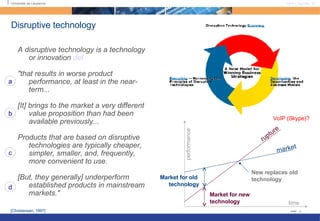
A disruptive technology is a technology or innovation  def "that results in worse product performance, at least in the near-term... [It] brings to the market a very different value proposition than had been available previously... Products that are based on disruptive technologies are typically cheaper, simpler, smaller, and, frequently, more convenient to use.  [But, they generally] underperform established products in mainstream markets."  Disruptive technology time performance market rupture New replaces old technology  Market for old  technology Market for new  technology [Christensen, 1997]  a b c d VoIP (Skype)?
Technology roadmap (and landscape) [Zurcher and Kostoff, 1997] [Rinne, 2004[ Market Product Technology time 2 What is the Business Model? How have technology & products been incorporated into different companies’ disruptive business models  in order to reach markets and make a profit?
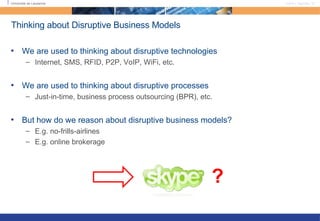
Thinking about Disruptive Business Models We are used to thinking about disruptive technologies Internet, SMS, RFID, P2P, VoIP, WiFi, etc.  We are used to thinking about disruptive processes Just-in-time, business process outsourcing (BPR), etc.  But how do we reason about disruptive business models? E.g. no-frills-airlines E.g. online brokerage ?
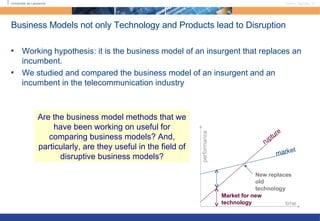
Business Models not only Technology and Products lead to Disruption Working hypothesis: it is the business model of an insurgent that replaces an incumbent. We studied and compared the business model of an insurgent and an incumbent in the telecommunication industry Are the business model methods that we have been working on useful for comparing business models? And, particularly, are they useful in the field of disruptive business models? time performance market rupture New replaces old technology  Market for new  technology
Goals of this Tutorial Theoretical/conceptual goal: mapping, understanding and comparing business models  and particularly their disruptive potential bring conceptual business model research to another level Practical goal as an executive/consultant: be able to map, understand and compare your business model to the one of your competitor by using the concepts outlined in this tutorial Practical goals: be able to design a new, or extend and re-design your existing business model to achieve a competitive edge (in e-business). Map > understand > analyze & compare > reconfirm or reposition
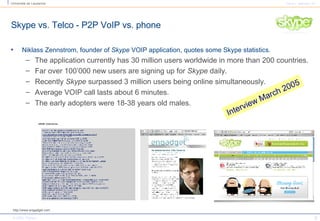
Niklass Zennstrom, founder of  Skype  VOIP application, quotes some Skype statistics.  The application currently has 30 million users worldwide in more than 200 countries.  Far over 100’000 new users are signing up for  Skype  daily.  Recently  Skype  surpassed 3 million users being online simultaneously.  Average VOIP call lasts about 6 minutes.  The early adopters were 18-38 years old males. Skype vs. Telco - P2P VoIP vs. phone http://www.engadget.com Interview March 2005
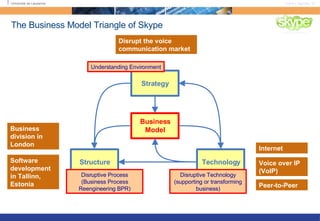
The Business Model Triangle of Skype Strategy Structure Technology Business Model Internet Voice over IP (VoIP) Peer-to-Peer Disrupt the voice communication market Software development in Tallinn, Estonia Business division in London Disruptive Process (Business Process Reengineering BPR) Disruptive Technology (supporting or transforming business) Understanding Environment
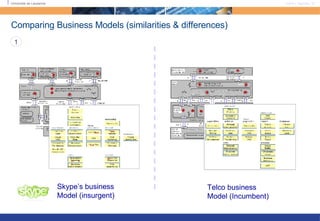
Comparing Business Models (similarities & differences) Skype’s business Model (insurgent) Telco business Model (Incumbent) 1
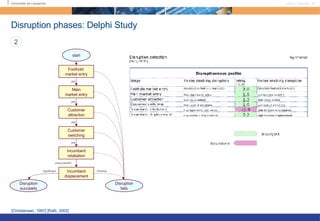
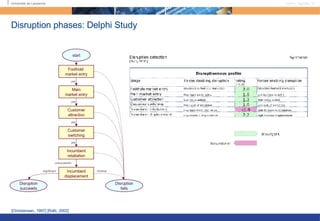
Disruption phases: Delphi Study [Christensen, 1997] [Rafii, 2002] 2 Foothold  market entry Main market entry Customer attraction Customer switching Incumbent retaliation Incumbent displacement yes yes yes yes unsuccessful significant start Disruption succeeds Disruption fails minimal
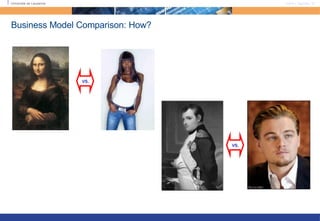
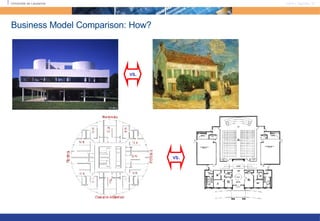
Business Model Comparison: How? vs. vs.
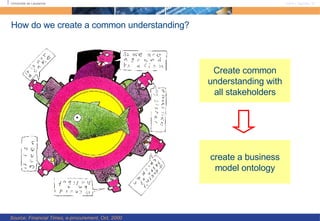
How do we create a common understanding? Courtesy slide: Hans Akkermans Create common understanding with all stakeholders Source: Financial Times, e-procurement, Oct. 2000 create a business model ontology
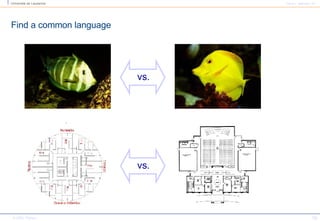
Find a common language vs. vs.
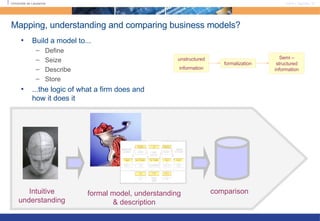
Mapping, understanding and comparing business models? Build a model to... Define Seize Describe Store ...the logic of what a firm does and how it does it unstructured information Semi –structured information formalization formal model, understanding & description Intuitive understanding comparison
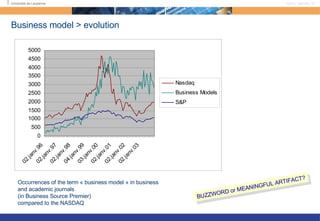
Business model > evolution  Occurrences of the term « business model » in business and academic journals (in Business Source Premier) compared to the NASDAQ BUZZWORD or MEANINGFUL ARTIFACT?
Business model: buzzword or meaningful artifact? A buzzword with no precise definition? […] Executives, reporters and analysts  who use the term don't have a clear idea of what it means. They use it to describe everything from how a company earns revenue to how it structures its organization or … An artifact aggregating … the value a company offers to one or several segments of customers, and the architecture of the firm and its network of partners  for creating, marketing and delivering this value and relationship capital, in order to generate profitable and sustainable revenue streams. [Linder, 2000]
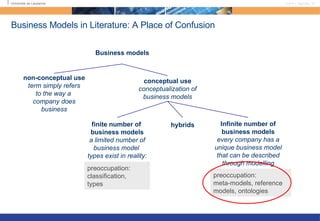
Business Models in Literature: A Place of Confusion non-conceptual use term simply refers to the way a  company does business conceptual use conceptualization of business models finite number of  business models a limited number of business model  types exist in reality: Infinite number of business models every company has a unique business model that can be described through modelling Business models preoccupation: classification, types preoccupation: meta-models, reference models, ontologies hybrids
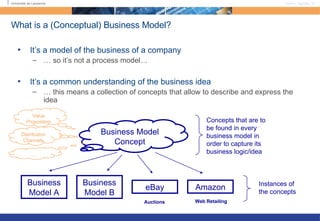
What is a (Conceptual) Business Model? It’s a model of the business of a company …  so it’s not a process model… It’s a common understanding of the business idea …  this means a collection of concepts that allow to describe and express the idea Business Model Concept Business Model A Business Model B eBay Amazon Concepts that are to  be found in every  business model in  order to capture its business logic/idea Instances of the concepts Value Proposition Distribution Channels … Auctions Web Retailing
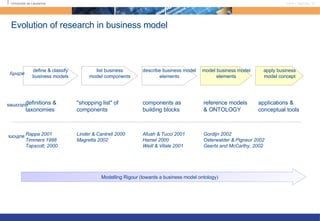
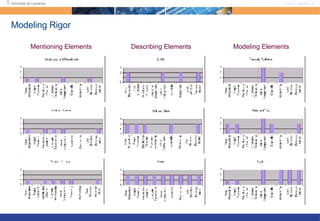
Evolution of research in business model define & classify business models list business model components describe business model elements model business model elements apply business model concept Rappa 2001 Timmers 1998 Tapscott, 2000 Linder & Cantrell 2000 Magretta 2002 Afuah & Tucci 2001 Hamel 2000 Weill & Vitale 2001 Gordijn 2002 Osterwalder & Pigneur 2002 Geerts and McCarthy, 2002 definitions & taxonomies "shopping list" of components components as building blocks reference models & ONTOLOGY applications & conceptual tools activity outcomes authors Modelling Rigour (towards a business model ontology)
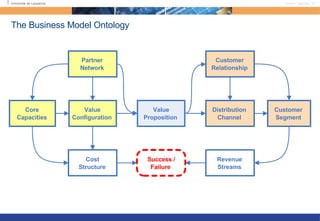
The Business Model Ontology Value Proposition Partner Network Core Capacities Value Configuration Customer Relationship Distribution Channel Customer  Segment Cost Structure Revenue Streams Success / Failure
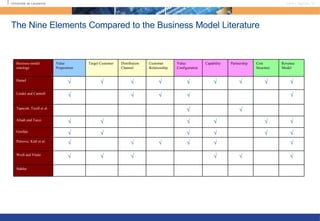
The Nine Elements Compared to the Business Model Literature Revenue Model Cost Structure Partnership Capability Value Configuration Customer Relationship Distribution Channel Target Customer Value Proposition Business model ontology Stähler √ √ √ √ √ √ Weill and Vitale √ √ √ √ √ √ Petrovic, Kittl et al. √ √ √ √ √ √ Gordijn √ √ √ √ √ √ Afuah and Tucci √ √ Tapscott, Ticoll et al. √ √ √ √ √ Linder and Cantrell √ √ √ √ √ √ √ √ √ Hamel
Modeling Rigor Mentioning Elements Describing Elements Modeling Elements
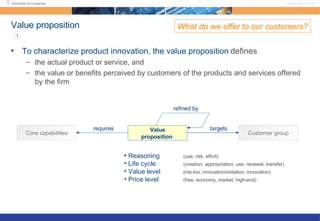
Value proposition To characterize product innovation, the value proposition   defines the actual product or service, and  the value or benefits perceived by customers of the products and services offered by the firm What do we offer to our customers? Reasoning (use, risk, effort) Life cycle  (creation, appropriation, use, renewal, transfer) Value level  (me-too, innovation/imitation, innovation) Price level  (free, economy, market, high-end) Value proposition   Customer group Core capabilities requires targets 1 refined by
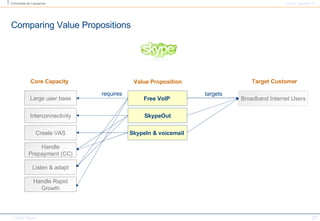
Comparing Value Propositions Free VoIP   Broadband Internet Users targets SkypeOut SkypeIn & voicemail   Value Proposition Target Customer Core Capacity Large user base requires Interconnectivity Create VAS Handle Prepayment (CC) Listen & adapt Handle Rapid Growth
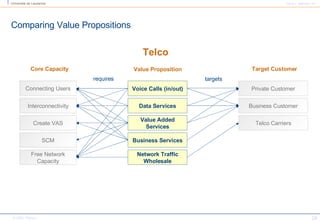
Comparing Value Propositions Voice Calls (in/out) Private Customer Connecting Users Data Services Value Added Services Interconnectivity Create VAS Business Customer Telco Carriers Network Traffic Wholesale Business Services Free Network Capacity SCM requires targets Value Proposition Target Customer Core Capacity Telco
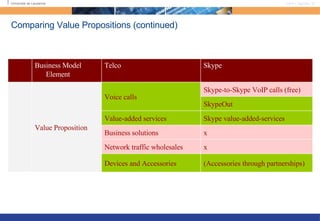
Comparing Value Propositions (continued) (Accessories through partnerships) Devices and Accessories x Network traffic wholesales x Business solutions Skype value-added-services Value-added services SkypeOut Skype-to-Skype VoIP calls (free) Voice calls Value Proposition Skype Telco Business Model Element
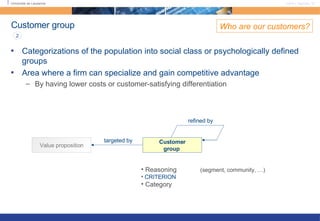
Customer group Categorizations of the population into social class or psychologically defined groups Area where a firm can specialize and gain competitive advantage By having lower costs or customer-satisfying differentiation Who are our customers? Customer group   Value proposition Reasoning (segment, community, …) CRITERION Category targeted by 2 refined by
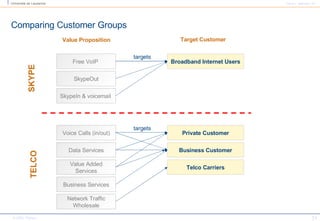
Comparing Customer Groups Free VoIP  Broadband Internet Users targets SkypeOut SkypeIn & voicemail  Voice Calls (in/out) Private Customer targets Data Services Value Added Services Business Customer Telco Carriers Network Traffic Wholesale Business Services Value Proposition Target Customer SKYPE TELCO
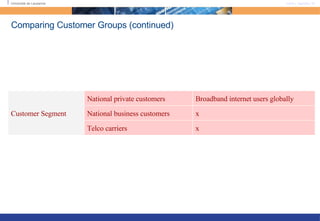
Comparing Customer Groups (continued) x Telco carriers x National business customers Broadband internet users globally National private customers Customer Segment
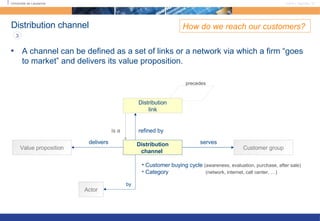
Distribution channel A channel can be defined as a set of links or a network via which a firm “goes to market” and delivers its value proposition. How do we reach our customers?  Distribution link Distribution channel   Customer group Value proposition by delivers serves Actor refined by is a Customer buying cycle   (awareness, evaluation, purchase, after sale)  Category   (network, internet, call center, …) 3 precedes
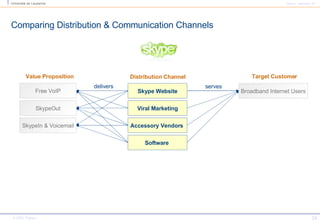
Comparing Distribution & Communication Channels Skype Website Broadband Internet Users Free VoIP delivers serves Viral Marketing Accessory Vendors   SkypeOut SkypeIn & Voicemail Distribution Channel Target Customer Value Proposition Software
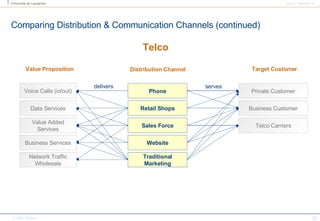
Comparing Distribution & Communication Channels (continued) Phone Private Customer Voice Calls (in/out) delivers serves Retail Shops Sales Force Data Services Value Added Services Business Customer Telco Carriers Traditional Marketing Website Network Traffic Wholesale Business Services Distribution Channel Target Customer Value Proposition Telco
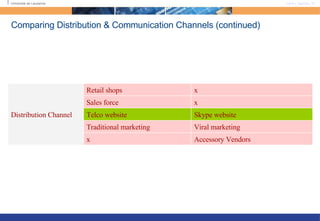
Comparing Distribution & Communication Channels (continued) Accessory Vendors x Viral marketing Traditional marketing Skype website Telco website x Sales force x Retail shops Distribution Channel
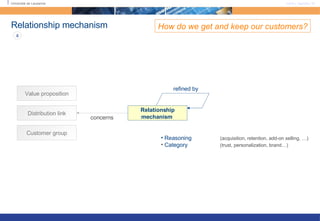
Relationship mechanism How do we get and keep our customers? Relationship mechanism   Reasoning (acquisition, retention, add-on selling, …) Category   (trust, personalization, brand…) Customer group Value proposition concerns Distribution link 4 refined by
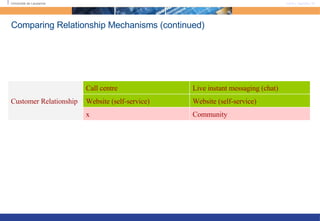
Comparing Relationship Mechanisms (continued) Community x Website (self-service) Website (self-service) Live instant messaging (chat) Call centre Customer Relationship
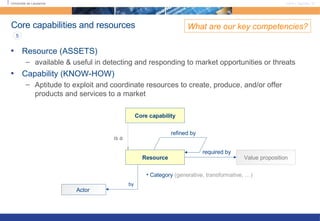
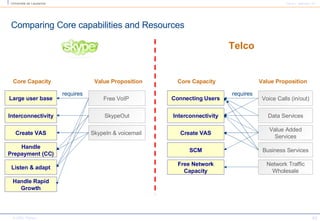
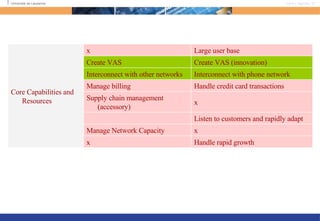
Core capabilities and resources Resource (ASSETS) available & useful in detecting and responding to market opportunities or threats Capability (KNOW-HOW) Aptitude to exploit and coordinate resources to create, produce, and/or offer products and services to a market  What are our key competencies? 5 Resource Value proposition Actor  by Category  (generative, transformative, …) required by Core capability is a refined by
Comparing  Core capabilities and Resources Free VoIP  Large user base requires SkypeOut SkypeIn & voicemail  Interconnectivity Create VAS Voice Calls (in/out) Connecting Users requires Data Services Value Added Services Interconnectivity Create VAS Network Traffic Wholesale Business Services Free Network Capacity SCM Value Proposition Core Capacity Value Proposition Core Capacity Handle Prepayment (CC) Listen & adapt Handle Rapid Growth Telco
x Manage Network Capacity Handle rapid growth x Listen to customers and rapidly adapt x Supply chain management (accessory) Handle credit card transactions Manage billing Interconnect with phone network Interconnect with other networks Create VAS (innovation) Create VAS Large user base x Core Capabilities and Resources
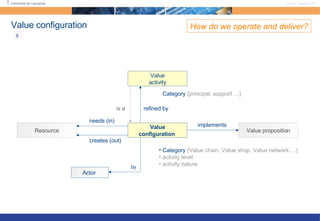
Value configuration How do we operate and deliver? 6 Value activity Value configuration   Actor  by Category  {Value chain, Value shop, Value network …} activity level activity nature  needs (in) implements Resource Value proposition refined by is a Category  {principal, support …}  creates (out)
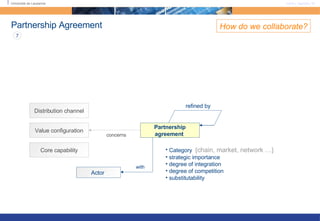
Partnership Agreement How do we collaborate? Partnership agreement   Actor  with Category   {chain, market, network …} strategic importance degree of integration degree of competition substitutability  concerns Core capability Distribution channel Value configuration 7 refined by
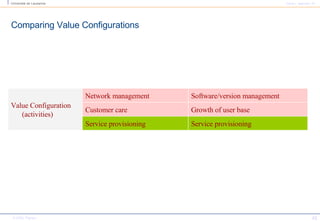
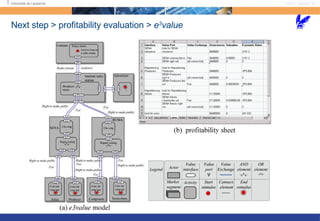
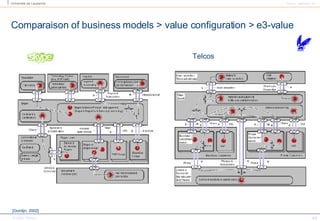
Comparaison of business models > value configuration > e3-value Telcos [Gordijn, 2002]
Comparing  Value Configurations Service provisioning Service provisioning Growth of user base Customer care Software/version management Network management Value Configuration (activities)
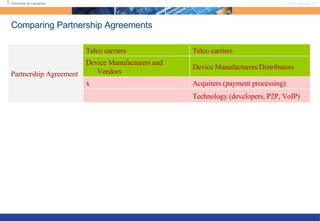
Comparing Partnership Agreements Technology (developers, P2P, VoIP) Acquirers (payment processing) x Device Manufacturers/Distributors Device Manufacturers and Vendors Telco carriers Telco carriers Partnership Agreement
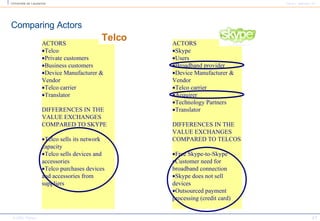
Comparing Actors ACTORS Skype Users Broadband provider Device Manufacturer & Vendor Telco carrier Acquirer Technology Partners Translator DIFFERENCES IN THE VALUE EXCHANGES COMPARED TO TELCOS Free Skype-to-Skype Customer need for broadband connection Skype does not sell devices Outsourced payment processing (credit card) ACTORS Telco Private customers Business customers Device Manufacturer & Vendor Telco carrier Translator DIFFERENCES IN THE VALUE EXCHANGES COMPARED TO SKYPE Telco sells its network capacity Telco sells devices and accessories Telco purchases devices and accessories from suppliers Telco
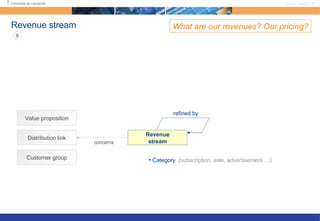
Revenue stream What are our revenues? Our pricing? Revenue stream Category {subscription, sale, advertisement …}  concerns Customer group Value proposition Distribution link 8 refined by
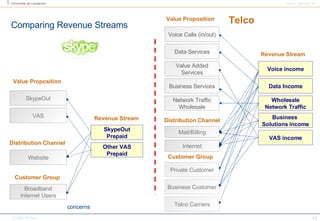
Comparing Revenue Streams SkypeOut Prepaid Other VAS Prepaid Voice income SkypeOut concerns Wholesale Network Traffic Business  Solutions income VAS Website VAS income Broadband Internet Users Revenue Stream Value Proposition Revenue Stream Telco Distribution Channel Customer Group Mail/Billing Value Proposition Distribution Channel Customer Group Voice Calls (in/out) Data Services Value Added Services Network Traffic Wholesale Business Services Data Income Private Customer Business Customer Telco Carriers Internet
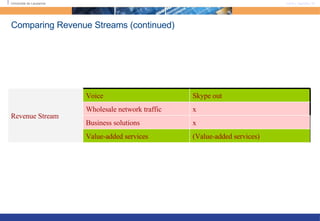
Comparing Revenue Streams (continued) (Value-added services) Value-added services x Business solutions x Wholesale network traffic Skype out Voice Revenue Stream
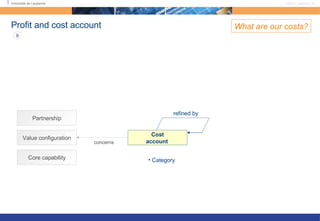
Profit and cost account What are our costs? Cost account   Category   concerns Core capability Partnership Value configuration 9 refined by
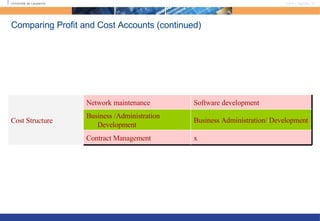
Comparing Profit and Cost Accounts (continued) Business Administration/ Development Business /Administration Development x Contract Management Software development Network maintenance Cost Structure
Disruption phases: Delphi Study [Christensen, 1997] [Rafii, 2002] Foothold  market entry Main market entry Customer attraction Customer switching Incumbent retaliation Incumbent displacement yes yes yes yes unsuccessful significant start Disruption succeeds Disruption fails minimal
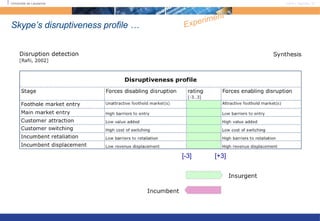
Skype’s disruptiveness profile … Experiment [-3] [+3]
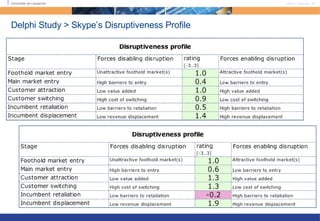
Delphi Study > Skype’s Disruptiveness Profile
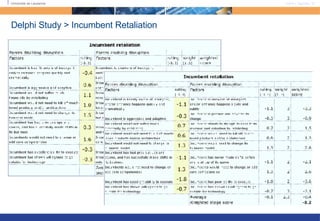
Delphi Study > Incumbent Retaliation
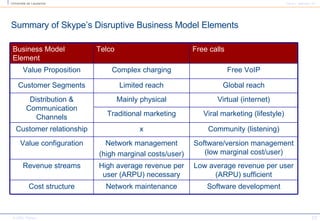
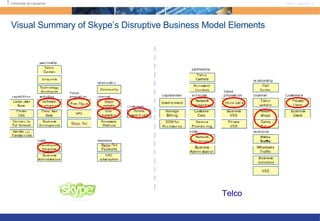
Summary of Skype’s Disruptive Business Model Elements Software development Network maintenance Cost structure Low average revenue per user (ARPU) sufficient High average revenue per user (ARPU) necessary Revenue streams Software/version management (low marginal cost/user) Network management (high marginal costs/user) Value configuration Community (listening) x Customer relationship Viral marketing (lifestyle) Traditional marketing Virtual (internet) Mainly physical Distribution & Communication Channels Global reach Limited reach Customer Segments Free VoIP Complex charging Value Proposition Free calls Telco Business Model Element
Visual Summary of Skype’s Disruptive Business Model Elements Telco
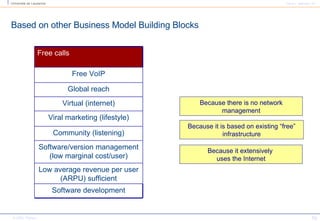
Based on other Business Model Building Blocks Because there is no network management Because it is based on existing “free” infrastructure Because it extensively  uses the Internet Software development Low average revenue per user (ARPU) sufficient Software/version management (low marginal cost/user) Community (listening) Viral marketing (lifestyle) Virtual (internet) Global reach Free VoIP Free calls
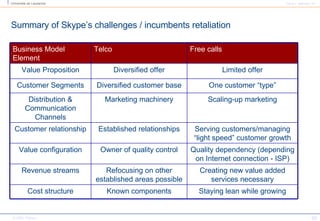
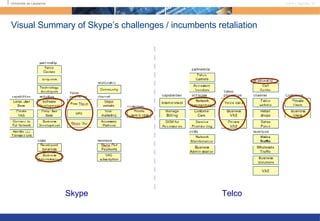
Summary of Skype’s challenges / incumbents retaliation Staying lean while growing Known components Cost structure Creating new value added services necessary Refocusing on other established areas possible Revenue streams Quality dependency (depending on Internet connection - ISP) Owner of quality control Value configuration Serving customers/managing “light speed” customer growth Established relationships Customer relationship Scaling-up marketing Marketing machinery Distribution & Communication Channels One customer “type” Diversified customer base Customer Segments Limited offer Diversified offer Value Proposition Free calls Telco Business Model Element
Visual Summary of Skype’s challenges / incumbents retaliation Skype Telco
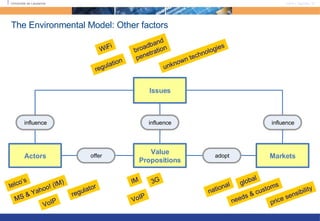
The Environmental Model: Other factors Value Propositions Actors Markets Issues influence influence influence adopt offer IM 3G VoIP MS & Yahoo! (IM) telco’s regulator VoIP national needs & customs global price sensibility WiFi broadband penetration regulation unknown technologies
Next step > profitability evaluation >  e 3 value
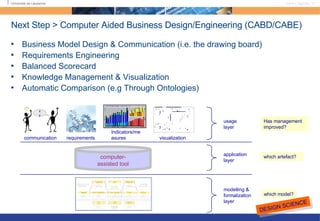
Next Step > Computer Aided Business Design/Engineering (CABD/CABE)  Business Model Design & Communication (i.e. the drawing board) Requirements Engineering Balanced Scorecard Knowledge Management & Visualization Automatic Comparison (e.g Through Ontologies) DESIGN SCIENCE modelling & formalization layer which model? computer- assisted tool application layer which artefact? visualization Indicators/measures requirements communication xy usage layer Has management improved?
Further Research
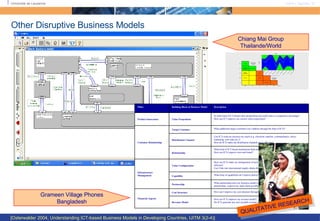
Other Disruptive Business Models [Osterwalder 2004, Understanding ICT-based Business Models in Developing Countries, IJITM 3(2-4)] QUALITATIVE RESEARCH Grameen Village Phones Bangladesh Chiang Mai Group Thailande/World How can ICTs improve my revenue model? Do ICTs generate any new possible revenue streams? Revenue Model How can I improve my cost structure through ICTs? Cost Structure Financial Aspects What partnerships does my business model require and how do ICTs influence these partnerships, respectively make them possible or more efficient? Partnership What kind of capabilities do I need to deliver my (ICT-based) value proposition?  Capability How can ICTs make my arrangement of activities and resources for value creation more efficient? Can I link into international supply chains through ICTs?  Value Configuration Infrastructure Management What kind of ICT-based mechanisms help me establish a relationship with my customers? How can ICTs improve trust and brand? Relationship Can ICTs help me increase my reach (e.g. electronic markets, cybermediaries, direct marketing, web sales etc.)? How do ICTs make my distribution channels more efficient? Distribution Channel What additional target customers can I address through the help of ICTs? Target Customer  Customer Relationship In what kind of ICT-based value propositions do/could I have a competitive advantage? How can ICT improve my current value proposition? Value Proposition Product Innovation Description Building Block of Business Model Pillar
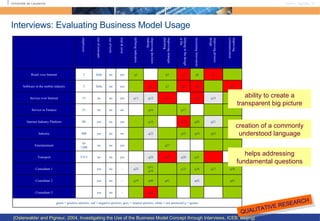
Interviews: Evaluating Business Model Usage ability to create a transparent big picture creation of a commonly understood language helps addressing fundamental questions [Osterwalder and Pigneur, 2004, Investigating the Use of the Business Model Concept through Interviews, ICEB, Beijing] QUALITATIVE RESEARCH green = positive answers, red = negative answers, grey = neutral answers, white = not answered q = quotes q44 - no yes Consultant 3 q43 q42 q41 q40 q39 - no yes Consultant 2 q38 q37 q36 q35 q33, q34 q32 - no yes Consultant 1 q31 q30 q29 q28 yes no no 3'315 Transport q27 yes no no 10-1200 Entertainment q26 q25 q24 q23 q22 no no yes 400 Industry q21 q20 q19 q18 yes no yes 80 Internet Industry Platform q17 q16 no no no 31 Service in Finance q15 q14 q13 q12 q11 yes no no 15 Service over Internet q10 q9 q8 q7 q6 yes no little 5 Software in the mobile industry q5 q4 q3 q2 q1 yes no little 3 Retail over Internet improving communication improving process design increasing innovation helping in the design of ISs improving strategic planning improving decision making defining indicators trial & error use of tools use of concepts employees
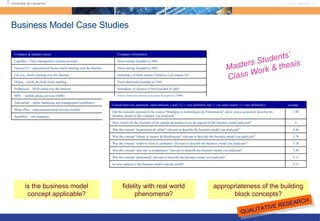
Business Model Case Studies fidelity with real world phenomena? is the business model concept applicable? appropriateness of the building block concepts? Masters Students’  Class Work & thesis QUALITATIVE RESEARCH Swiss company ZenithVie – life insurance Belgian venture established in 1999 Phone-Plus – telecommunication services reseller Swiss consultancy Adrenalink – sports marketing and management consultancy Swiss Telecom service provider founded in 1998 MNC – mobile phone services (SMS) Subsidiary of Aleance (USA) founded in 2001 NetMovies – DVD rental over the Internet Swiss bookstore founded in 1984 Ellipse – bricks & clicks book retailing Subsidiary of book retailer Librairies La Fontaine SA LeLivre –book retailing over the Internet Swiss startup founded in 2003 Factory121 – personalized Swiss watch retailing over the Internet Swiss startup founded in 2002 Logifleet – Fleet management systems provider Company information Company & industry sector 4.33 In your opinion is the business model concept useful? 4.11 Was the concept "partenariat" relevant to describe the business model you analyzed? 3.89 Was the concept "activités et compétence" relevant  to describe the business model you analyzed? 3.78 Was the concept "relation-client et confiance"  relevant to describe the business model you analyzed? 3.78 Was the concept "clients et canaux de distributions"  relevant to describe the business model you analyzed? 4.44 Was the concept "proposition de valeur" relevant to describe the business model you analyzed? 4 How closely do the elements of the sample document cover the aspects of the business model analyzed? 3.89 Did the concepts exposed in the course "Stratégies et technologies de l'information" allow you to accurately describe the business model of the company you analyzed? average Closed interview questions  rated between 1 and 5 (1 = very definitely not, 3 = to some extent, 5 = very definitely)
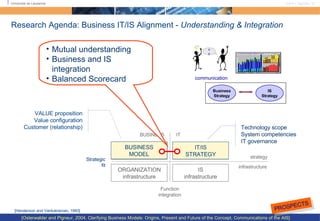
Research Agenda: Business IT/IS Alignment -  Understanding & Integration BUSINESS strategy IT strategy IT/IS STRATEGY BUSINESS MODEL Function integration Strategic fit BUSINESS IT strategy infrastructure [Henderson and Venkatraman, 1993] ORGANIZATION infrastructure IS infrastructure VALUE proposition Value configuration Customer (relationship) Mutual understanding Business and IS integration Balanced Scorecard Technology scope System competencies IT governance [Osterwalder and Pigneur, 2004, Clarifying Business Models: Origins, Present and Future of the Concept, Communications of the AIS] PROSPECTS communication xy Business Strategy IS Strategy
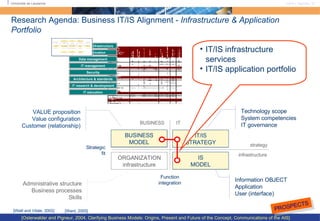
Research Agenda: Business IT/IS Alignment -  Infrastructure & Application Portfolio Function integration Strategic fit BUSINESS IT strategy infrastructure Technology scope System competencies IT governance Administrative structure Business processes Skills [Weill and Vitale, 2002] VALUE proposition Value configuration Customer (relationship) Information OBJECT Application User (interface) ORGANIZATION infrastructure IS infrastructure BUSINESS strategy IT strategy IS MODEL IT/IS STRATEGY BUSINESS MODEL IT/IS infrastructure services  IT/IS application portfolio [Ward, 2000] [Osterwalder and Pigneur, 2004, Clarifying Business Models: Origins, Present and Future of the Concept, Communications of the AIS] PROSPECTS Application infrastructure Communication Data management IT management Security Architecture & standards IT research & development IT education
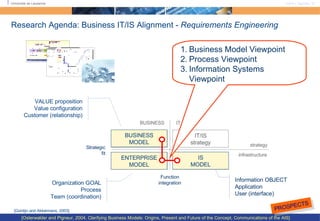
Research Agenda: Business IT/IS Alignment -  Requirements Engineering Function integration Strategic fit BUSINESS IT strategy infrastructure [Gordijn and Akkermans, 2003] VALUE proposition Value configuration Customer (relationship) Information OBJECT Application User (interface) ORGANIZATION infrastructure IS infrastructure BUSINESS strategy IT/IS strategy IS MODEL BUSINESS MODEL Business Model Viewpoint Process Viewpoint Information Systems Viewpoint ENTERPRISE MODEL Organization GOAL Process Team (coordination) [Osterwalder and Pigneur, 2004, Clarifying Business Models: Origins, Present and Future of the Concept, Communications of the AIS] PROSPECTS
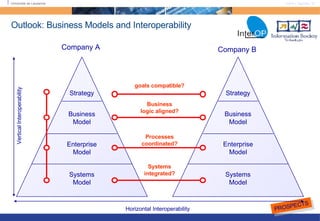
Outlook: Business Models and Interoperability PROSPECTS Vertical Interoperability Horizontal Interoperability Company A Company B Strategy Business Model Enterprise Model Systems Model Strategy Business Model Enterprise Model Systems Model goals compatible? Business logic aligned? Processes coordinated? Systems integrated?
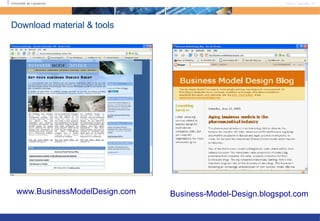
Download material & tools www.BusinessModelDesign.com Business-Model-Design.blogspot.com
Questions? [email_address] http://www.BusinessModelDesign.com What do I want to know from Alex? Can he help me?